Google, Naver multiprocess image web crawler (Selenium)
Python
1,694
71 commits
updated Aug 30, 2026
Google, Naver multiprocess image crawler (High Quality & Speed & Customizable)
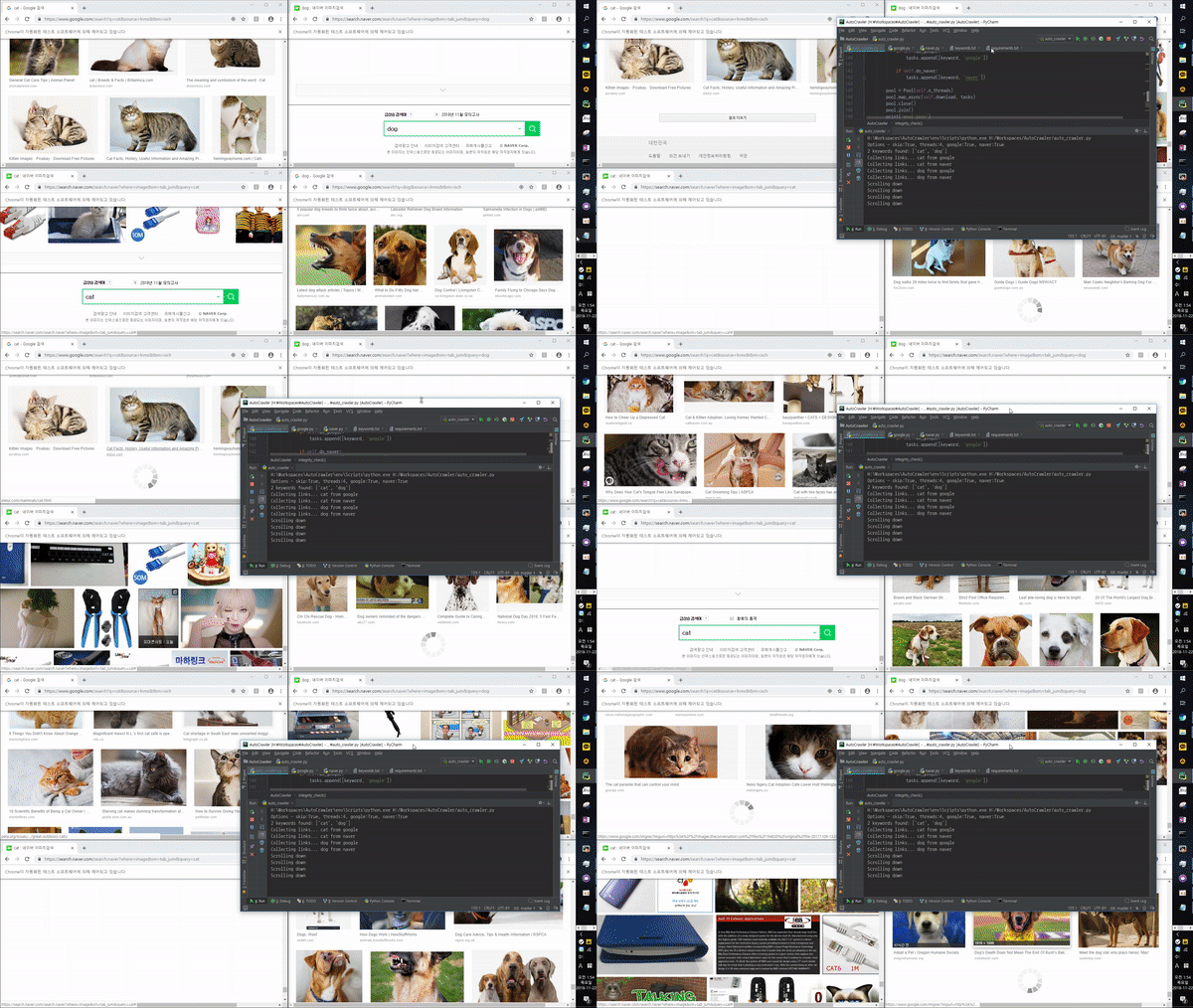
Install Chrome
pip install -e . (installs the autocrawler package and its dependencies)
Write search keywords in keywords.txt
Run autocrawler (or python -m autocrawler, or python main.py for backwards compatibility)
Files will be downloaded to the 'download' directory.
usage:
autocrawler [--skip] [--threads 4] [--google] [--naver] [--full] [--face] [--no_gui auto] [--limit 0]
--skip / --no-skip     Skip a keyword if its download directory already exists. (default: --skip)
                       This is needed when re-downloading.

--threads 4            Number of worker processes to download with.

--google / --no-google Download from google.com. (default: --google)

--naver / --no-naver   Download from naver.com. (default: --naver)

--full / --no-full     Download full resolution image instead of thumbnails (slow). (default: --no-full)

--face / --no-face     Face search mode. (default: --no-face)

--no_gui auto|true|false   No GUI mode. (headless mode) Acceleration for full_resolution mode, but unstable on thumbnail mode.
                           Default: "auto" - false if --full is not set, true if --full is set.
                           (can be used for docker linux system)

--limit 0              Maximum count of images to download per site. (0: infinite)
--proxy-list ''        The comma separated proxy list like: "socks://127.0.0.1:1080,http://127.0.0.1:1081".
                       Every task randomly chooses one from the list.
--download-path        Download folder path. (default: download)
--keywords-file        Path to the search keywords file. (default: keywords.txt)
Note: as of v2.0, the boolean flags (
--skip,--naver,--full,--face) use--flag/--no-flagpairs instead of--flag true/--flag false.--no_guiis unchanged.
You can download full resolution image of JPG, GIF, PNG files by specifying --full true
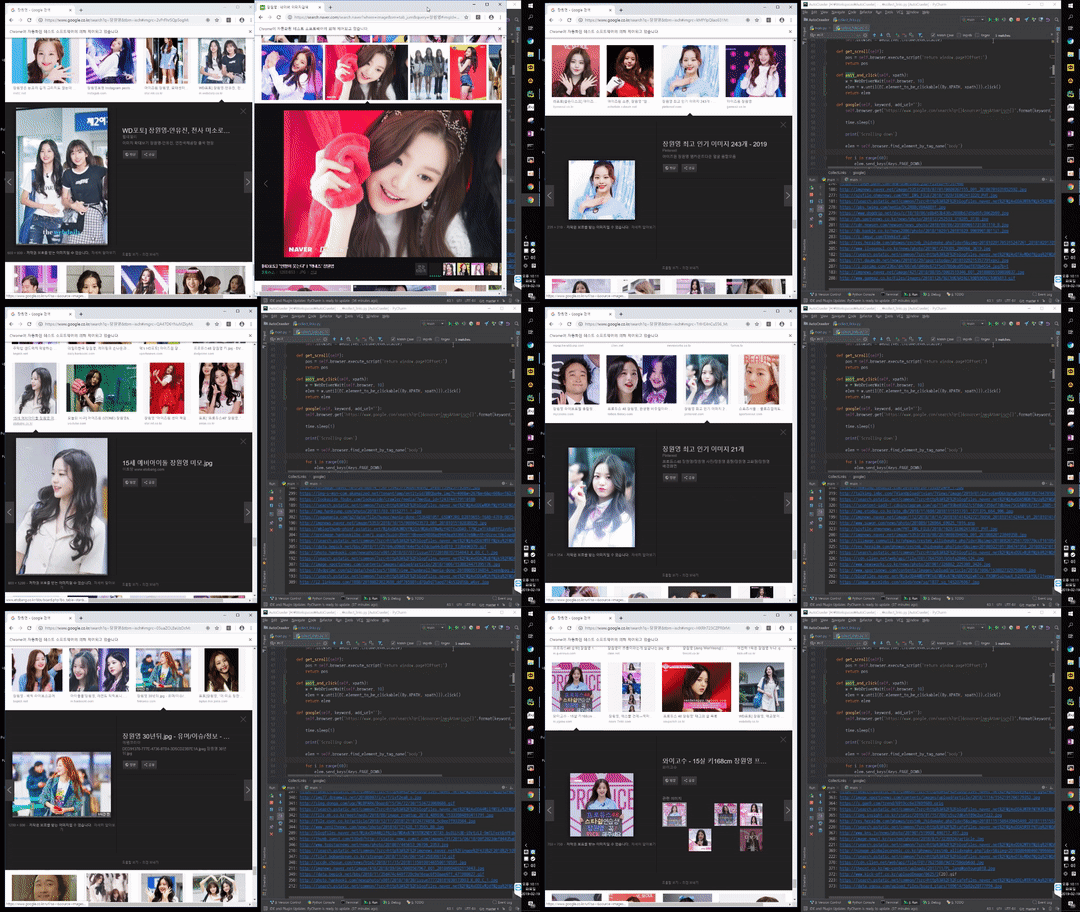
Detects data imbalance based on number of files.
When crawling ends, the message show you what directory has under 50% of average files.
I recommend you to remove those directories and re-download.
sudo apt-get install xvfb <- This is virtual display

sudo apt-get install screen <- This will allow you to close SSH terminal while running.

screen -S s1

Xvfb :99 -ac & DISPLAY=:99 autocrawler
You can make your own crawler by changing the collectors under src/autocrawler/collectors/
(google.py, naver.py, and the shared helpers in base.py).
As Google/Naver's sites consistently change, you may need to fix the XPath selectors in
src/autocrawler/collectors/google.py or src/autocrawler/collectors/naver.py.
src/autocrawler/collectors/google.py / naver.py
As of 2026-08, all four collectors (collect_google, collect_naver, collect_google_full,
collect_naver_full) were re-verified end-to-end against the live DOM and several selector and
timing bugs were fixed. See the NOTE comment at the top of each function in
src/autocrawler/collectors/google.py / naver.py for what changed and why.
If chromedriver hangs indefinitely (even when run standalone, outside this project) or the
process ends up stuck and unkillable, macOS Gatekeeper may be rejecting it — chromedriver
binaries (from webdriver-manager or Homebrew) are typically ad-hoc signed with no Team
Identifier, and recent macOS versions increasingly reject unnotarized binaries outright. Check
with:
spctl -a -vv "$(which chromedriver)"
If it prints rejected: on macOS 15+, spctl --add (the classic per-file exception) no longer
works (This operation is no longer supported) — the only remaining override is
sudo spctl --global-disable, which reveals an "allow apps downloaded from anywhere" toggle in
System Settings → Privacy & Security, plus an "Open Anyway" confirmation the next time the
binary runs. In practice, just running chromedriver once directly in an interactive Terminal
(not through a script) got it trusted without needing that toggle at all, so try that first.
If a chromedriver you've already gotten trusted (e.g. via Homebrew, on PATH) still gets rejected
inside this project, note that build_driver() prefers a chromedriver already on PATH over
downloading a separate copy via webdriver-manager — but each distinct binary/path needs its
own Gatekeeper trust, so a copy webdriver-manager downloaded under ~/.wdm/ is a different file
and needs to be approved separately from one on PATH.
Google's bot-detection is IP-reputation based, not just per-browser: hitting it with a burst of automated requests (including just testing/debugging) can get your IP flagged for a while, during which a fresh browser process may be asked to solve a CAPTCHA again even with valid cookies.
This works the same regardless of --threads - no need to drop to --threads 1 for this part,
since it all happens before any worker processes start:
autocrawler opens one visible Chrome window against Google in the
main process (this warm-up only targets Google — Naver hasn't been observed to CAPTCHA-block
this crawler), using a persistent profile at ./chrome-profile.CAPTCHA detected at https://www.google.com/sorry/index?...
Solve the CAPTCHA in the open Chrome window, then press Enter here to continue...
./chrome-profile. Each crawl task then gets its own
temporary copy of that profile (Chrome won't let two processes share one profile directory),
so the warmed-up cookies carry over to every task — including when running with multiple
--threads — without them colliding on the same profile.61 followers · starred May 2023
171 followers · starred Dec 2018
115 followers · starred Oct 2019
30 followers · starred Nov 2022
Google, Naver multiprocess image web crawler (Selenium)
Python
1,694
71 commits
updated Aug 30, 2026
Google, Naver multiprocess image crawler (High Quality & Speed & Customizable)
Install Chrome
pip install -e . (installs the autocrawler package and its dependencies)
Write search keywords in keywords.txt
Run autocrawler (or python -m autocrawler, or python main.py for backwards compatibility)
Files will be downloaded to the 'download' directory.
usage:
autocrawler [--skip] [--threads 4] [--google] [--naver] [--full] [--face] [--no_gui auto] [--limit 0]
--skip / --no-skip     Skip a keyword if its download directory already exists. (default: --skip)
                       This is needed when re-downloading.

--threads 4            Number of worker processes to download with.

--google / --no-google Download from google.com. (default: --google)

--naver / --no-naver   Download from naver.com. (default: --naver)

--full / --no-full     Download full resolution image instead of thumbnails (slow). (default: --no-full)

--face / --no-face     Face search mode. (default: --no-face)

--no_gui auto|true|false   No GUI mode. (headless mode) Acceleration for full_resolution mode, but unstable on thumbnail mode.
                           Default: "auto" - false if --full is not set, true if --full is set.
                           (can be used for docker linux system)

--limit 0              Maximum count of images to download per site. (0: infinite)
--proxy-list ''        The comma separated proxy list like: "socks://127.0.0.1:1080,http://127.0.0.1:1081".
                       Every task randomly chooses one from the list.
--download-path        Download folder path. (default: download)
--keywords-file        Path to the search keywords file. (default: keywords.txt)
Note: as of v2.0, the boolean flags (
--skip,--naver,--full,--face) use--flag/--no-flagpairs instead of--flag true/--flag false.--no_guiis unchanged.
You can download full resolution image of JPG, GIF, PNG files by specifying --full true
Detects data imbalance based on number of files.
When crawling ends, the message show you what directory has under 50% of average files.
I recommend you to remove those directories and re-download.
sudo apt-get install xvfb <- This is virtual display

sudo apt-get install screen <- This will allow you to close SSH terminal while running.

screen -S s1

Xvfb :99 -ac & DISPLAY=:99 autocrawler
You can make your own crawler by changing the collectors under src/autocrawler/collectors/
(google.py, naver.py, and the shared helpers in base.py).
As Google/Naver's sites consistently change, you may need to fix the XPath selectors in
src/autocrawler/collectors/google.py or src/autocrawler/collectors/naver.py.
src/autocrawler/collectors/google.py / naver.py
As of 2026-08, all four collectors (collect_google, collect_naver, collect_google_full,
collect_naver_full) were re-verified end-to-end against the live DOM and several selector and
timing bugs were fixed. See the NOTE comment at the top of each function in
src/autocrawler/collectors/google.py / naver.py for what changed and why.
If chromedriver hangs indefinitely (even when run standalone, outside this project) or the
process ends up stuck and unkillable, macOS Gatekeeper may be rejecting it — chromedriver
binaries (from webdriver-manager or Homebrew) are typically ad-hoc signed with no Team
Identifier, and recent macOS versions increasingly reject unnotarized binaries outright. Check
with:
spctl -a -vv "$(which chromedriver)"
If it prints rejected: on macOS 15+, spctl --add (the classic per-file exception) no longer
works (This operation is no longer supported) — the only remaining override is
sudo spctl --global-disable, which reveals an "allow apps downloaded from anywhere" toggle in
System Settings → Privacy & Security, plus an "Open Anyway" confirmation the next time the
binary runs. In practice, just running chromedriver once directly in an interactive Terminal
(not through a script) got it trusted without needing that toggle at all, so try that first.
If a chromedriver you've already gotten trusted (e.g. via Homebrew, on PATH) still gets rejected
inside this project, note that build_driver() prefers a chromedriver already on PATH over
downloading a separate copy via webdriver-manager — but each distinct binary/path needs its
own Gatekeeper trust, so a copy webdriver-manager downloaded under ~/.wdm/ is a different file
and needs to be approved separately from one on PATH.
Google's bot-detection is IP-reputation based, not just per-browser: hitting it with a burst of automated requests (including just testing/debugging) can get your IP flagged for a while, during which a fresh browser process may be asked to solve a CAPTCHA again even with valid cookies.
This works the same regardless of --threads - no need to drop to --threads 1 for this part,
since it all happens before any worker processes start:
autocrawler opens one visible Chrome window against Google in the
main process (this warm-up only targets Google — Naver hasn't been observed to CAPTCHA-block
this crawler), using a persistent profile at ./chrome-profile.CAPTCHA detected at https://www.google.com/sorry/index?...
Solve the CAPTCHA in the open Chrome window, then press Enter here to continue...
./chrome-profile. Each crawl task then gets its own
temporary copy of that profile (Chrome won't let two processes share one profile directory),
so the warmed-up cookies carry over to every task — including when running with multiple
--threads — without them colliding on the same profile.61 followers · starred May 2023
171 followers · starred Dec 2018
115 followers · starred Oct 2019
30 followers · starred Nov 2022



