
[EMNLP 2026] Official implementation for paper "Demystifying Reinforcement Learning for Long-Horizon Tool-Using Agents: A Comprehensive Recipe"
See the codeREADME
Agent-STAR




This repository is the official implementation of our paper: Demystifying Reinforcement Learning for Long-Horizon Tool-Using Agents: A Comprehensive Recipe.
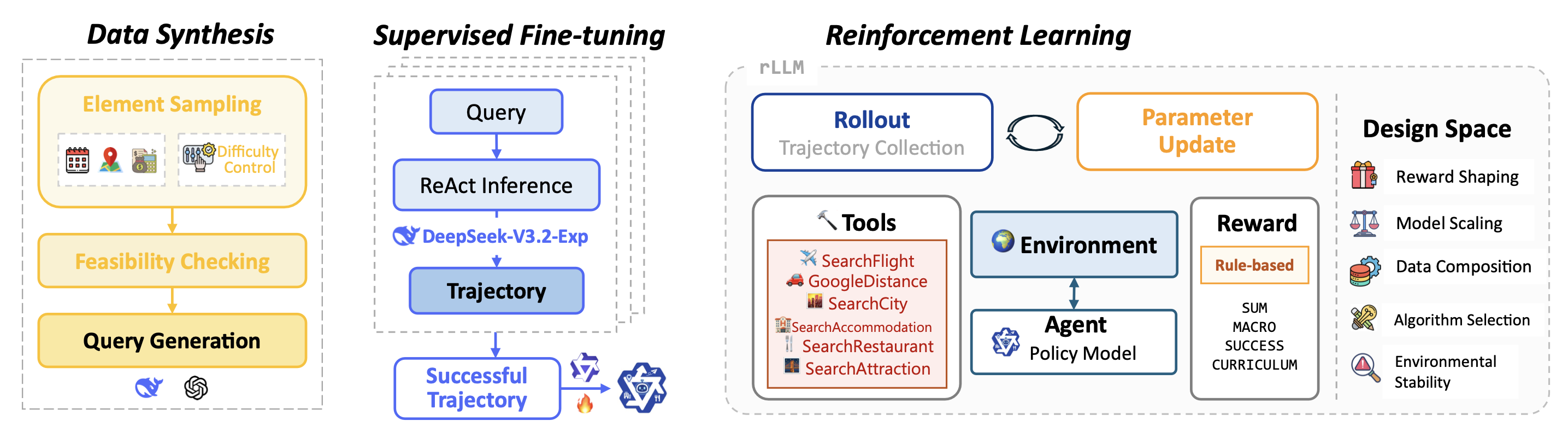
We use TravelPlanner as a long-horizon tool-use testbed, where agents must iteratively call tools to satisfy multifaceted constraints, i.e., commonsense and hard constraints. We implement STAR [Data Synthesis → SFT → RL], a unified post-training pipeline that systematically studies the agentic RL design space across five axes: reward shaping, model scaling, data composition, algorithm selection, and environmental stability.
Please consider citing or giving a 🌟 if Agent-STAR is helpful to your work!
@misc{wu2026agentstar,
      title={Demystifying Reinforcement Learning for Long-Horizon Tool-Using Agents: A Comprehensive Recipe},
      author={Xixi Wu and Qianguo Sun and Ruiyang Zhang and Chao Song and Junlong Wu and Yiyan Qi and Hong Cheng},
      year={2026},
      eprint={2603.21972},
      archivePrefix={arXiv},
      primaryClass={cs.LG},
      url={https://arxiv.org/abs/2603.21972},
}
🎙️ News
🎉 [2026-08-22] Our paper is accepted by EMNLP 2026!
🏋️ [2026-08-22] We release the full RL training framework and scripts under RL/, covering TravelPlanner RL training and out-of-domain inference on BrowseComp-Plus and Knowledge-Intensive QA.
📑 [2026-03-24] Our paper is released on arXiv!
🌱 [2026-03-23] We release the data synthesis and inference framework of our STAR-pipeline, along with three STAR-SFT models and three STAR-RL models.
👀 Stay tuned for continuous updates, new STAR checkpoints will be added over time!
🏋️ RL code is live — start here
📘 RL Guide (English) • 📗 RL 使用文档 (中文)
Environment setup · reward configuration · training scripts for 1.5B / 3B / 7B · checkpoint export · OOD inference
📖 Table of Contents
📚 Dataset
We open-source our data synthesis codes and 17K+ synthetic queries.
Synthetic datasets are available at https://huggingface.co/datasets/xxwu/Agent-STAR-TravelDataset.
| Data | Description |
|---|---|
| TravelPlanner_Val180.jsonl | Official TravelPlanner validation set of 180 instances |
| TravelTotal_17K.jsonl | All 17K+ synthetic queries after element sampling, feasibility checking, and back-translation |
| Travel_Mixed_1K_RL.jsonl | Default 1K RL training set with mixed difficulty |
| Travel_{Difficulty}_1K.jsonl | Difficulty-specific 1K sets, i.e., Easy / Medium / Hard for controlled experiments |
To generate your own training samples, follow the three-step pipeline:
-
Step 0 - Prepare the travel database
- Download: https://huggingface.co/datasets/xxwu/Agent-STAR-TravelDatabase
- Put all CSV files under
database/.
-
Step 1 - Element sampling
cd DataSynthesis python3 step1_generate_dict.py --generate_dict --easy_num 1000 --medium_num 1000 --hard_num 1000 -
Step 2 - Feasibility checking
Merge the sampled files into a single file, e.g.,
combine_3k.jsonl, then:python3 step2_dict_feasibility.py --path output/combine_3k.jsonlOutput files:
*_feasible.jsonland*_failed.jsonl. -
Step 3 - Query generation
Use LLM back-translation to turn feasible JSON elements into natural language TravelPlanner queries
Fill API keys in
step3_generate_query.pyfirst:python3 step3_generate_query.py --input_file output/combine_3k_feasible.jsonl --output_file output/combine_3k_final.jsonl
🔧 Environment
For inference, the required packages are:
vllm==0.11.0
transformers==4.57.3
torch==2.8.0
Before running the inference, you have to download the travel database, and put all the CSV files under the database folder.
If you use commercial LLMs like Gemini3-Pro, Seed-1.8 / Seed-2.0, Kimi-K2.5, DeepSeek-V3.2, Qwen3-397B-A17B, etc, fill up the corresponding API keys in Inference/config.json.
🤗 Model
We release both the STAR-SFT and STAR-RL tuned models across 1.5B / 3B / 7B scales for reproducing and further research.
Backbones: Qwen2.5-Instruct.
SFT: fine-tune from the Qwen2.5-Instruct base using 1K successful trajectories, which are generated by DeepSeek-V3.2-Exp-Thinking on synthetic queries. The corresponding SFT scripts are provided under SFTScripts/. The scripts are based on LLaMAFactory==0.9.4.dev0.
RL: we follow the paper’s scale-aware recipe, as smaller models benefit from curriculum-style rewards and exploration-heavy algorithms, while 7B can leverage GRPO with the dense SUM reward for stronger performance and faster convergence.
| Model | Path |
|---|---|
| Agent-STAR-SFT-1.5B | https://huggingface.co/xxwu/Agent-STAR-SFT-1.5B |
| Agent-STAR-SFT-3B | https://huggingface.co/xxwu/Agent-STAR-SFT-3B |
| Agent-STAR-SFT-7B | https://huggingface.co/xxwu/Agent-STAR-SFT-7B |
| Agent-STAR-RL-1.5B | https://huggingface.co/xxwu/Agent-STAR-RL-1.5B |
| Agent-STAR-RL-3B | https://huggingface.co/xxwu/Agent-STAR-RL-3B |
| Agent-STAR-RL-7B | https://huggingface.co/xxwu/Agent-STAR-RL-7B |
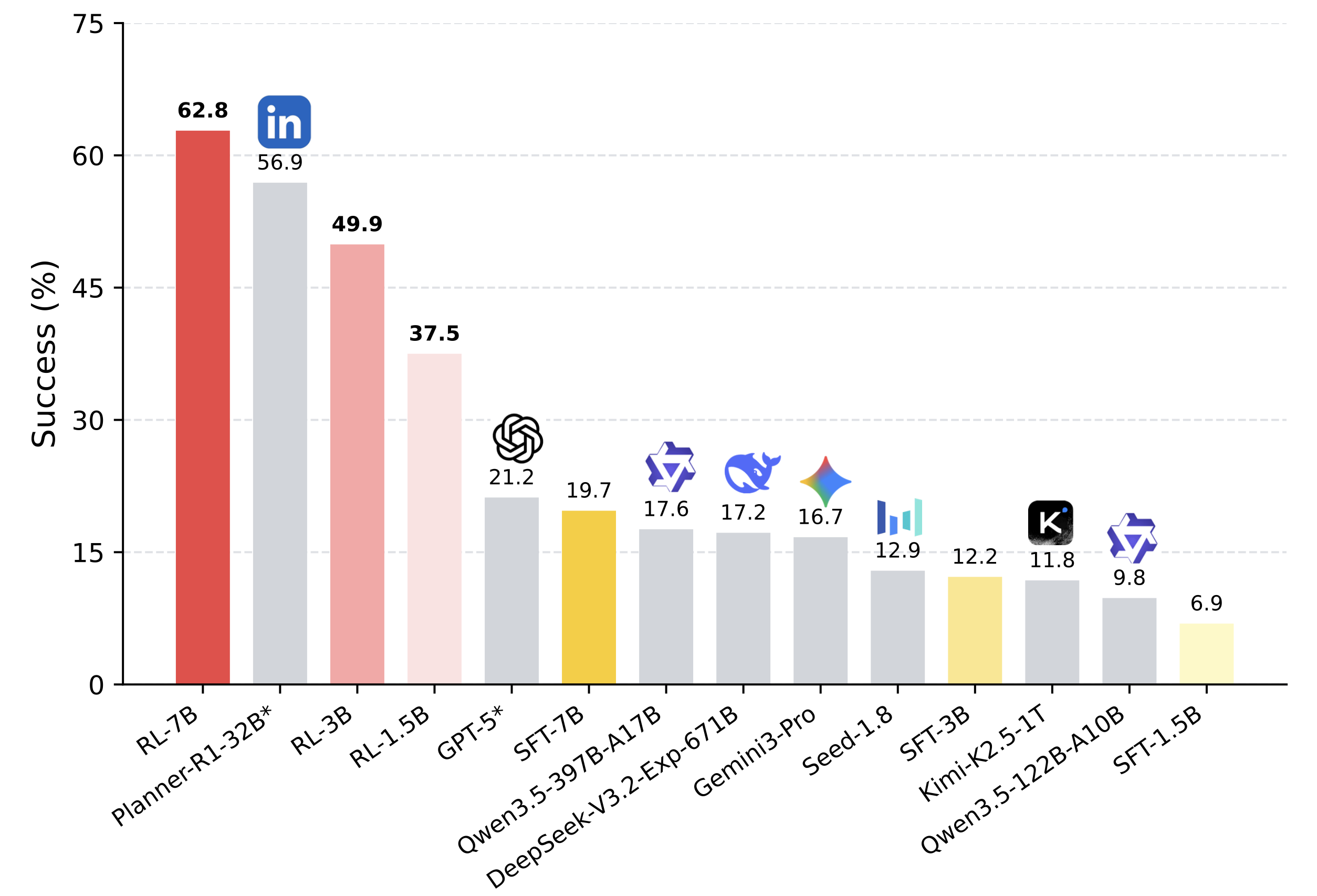
The figure summarizes TravelPlanner test-set success across training variants and model scales.
🚀 Run Inference
The inference code lives under Inference/. The pipeline is:
ReAct inference → Post-processing [NL → structured JSON] → Evaluation.
Quick scripts
We provide ready-to-use scripts under Inference/scripts/:
infer_sotamodel.sh: run inference with strong commercial LLMsinfer_testset.sh: deploy a local model using vLLM and run inference on the TravelPlanner test set
Step-by-step
-
Step 0: Prepare the environment
- Put the TravelPlanner travel CSVs under
database/. - If you use commercial LLMs, fill
Inference/config.jsonincluding API endpoints and keys.
- Put the TravelPlanner travel CSVs under
-
Step 1: Run ReAct inference
From the repo root, you can run:
cd Inference
python3 -u main.py \
  --model YOUR_MODEL_PATH_OR_NAME \
  --save_suffix YOUR_SUFFIX \
  --max_workers 20 \
  --split validation  # or test
  --max_context 32768 \
  --max_turns 60
If you want to run inference on your own synthesized dataset, add:
--use_custom_query --input_file YOUR_FILE.jsonl. -
Step 2: Post-processing to format plans into the evaluation JSON
Set the DashScope API key used by
Inference/utils.py:export DASHSCOPE_API_KEY="YOUR_DASHSCOPE_API_KEY" python3 -u post_process.py \ --path PREDICTIONS.jsonl \ --split validation # or test --format_model deepseek-v3.2-exppost_process.pyconverts the model’s natural-language itinerary into the strict JSON format used by the evaluators.⚠️ IMPORTANT & 🚨 REWARD-HACKING PREVENTION
- For test set,
post_process.pyrunsutils.py::format_planning_for_official_testto normalizetransportation, i.e.,driving/...→Self-driving, so TravelPlanner’s checker matches correctly. - For local evaluation like validation set, we use
Inference/eval_commonsense.py::detect_transportation_typefor stricter transport matching.
- For test set,
-
Step 3: Evaluation
-
Validation set:
python3 -u eval.py --path YOUR_FORMATTED.jsonl --save_score -
Test set:
Use the official TravelPlanner leaderboard
-
🏋️ RL Training
The RL code lives under RL/, built on rLLM with a lightly patched verl==0.5.0 vendored in RL/verl/.
📘 Full documentation: RL Guide (English) · RL 使用文档 (中文)
The guides cover the local sandbox database, reward/API configuration, the complete variable cheat sheet, training dynamics, checkpoint export, and OOD inference.
Quick start
-
Step 1: Set up the environment
conda create -n rllm_0511 python=3.10 && conda activate rllm_0511 cd RL bash scripts/install_verl.sh pip install -e . pip install swanlabRL/rllm_env.txtrecords a known-good, fully reproducible environment. -
Step 2: Verify tools and reward
TravelPlanner tools read from the local sandbox at
rllm/tools/travel_tools/database/. Smoke-test before training:export DEEPSEEK_API_KEY="YOUR_DEEPSEEK_API_KEY" # used by the reward formatter python3 -m rllm.rewards.travel_reward python3 -m rllm.tools.travel_tools.search_restaurant -
Step 3: Launch training
Pick a script, fill in the model / data / logging variables at the top, then run it. Starting from a STAR-SFT checkpoint is recommended.
bash examples/travel/3b_scripts/train_qwen2_5_sft_3b_curriculum.shScripts follow the paper's scale-aware recipe — the staged Curriculum reward for smaller models, the dense Sum reward with GRPO at 7B:
Scale Script Reward Algorithm 1.5B examples/travel/1_5b_scripts/train_qwen2_5_sft_1_5b_curriculum.shCurriculum GRPO 3B examples/travel/3b_scripts/train_qwen2_5_sft_3b_curriculum.shCurriculum GRPO 3B examples/travel/3b_scripts/train_qwen2_5_sft_3b_macro.shMacro GRPO 3B examples/travel/3b_scripts/train_qwen2_5_sft_3b_macro_arpo.shMacro ARPO 3B examples/travel/3b_scripts/train_qwen2_5_sft_3b_macro_dapo.shMacro DAPO 7B examples/travel/7b_scripts/train_qwen2_5_sft_7b_sum.shSum GRPO Reward designs are switched via
REWARD_TYPE:SUM,MACRO,SUCCESS, andPLANNER_R1for the Curriculum reward, which additionally requiresTOTAL_STEPS. -
Step 4: Export the checkpoint
cd helper
python3 convert_safetensor.py --local_dir /PATH/TO/SAVE_FOLDER/global_step_140/actor
Out-of-domain inference
To check whether the tool-use ability transfers beyond TravelPlanner, we evaluate on two retrieval-heavy suites. Both need at least 2 GPUs and their own corpus/index download — see the RL Guide for details.
| Task | Location | Benchmarks |
|---|---|---|
| Deep research | RL/examples/deepresearch/ | BrowseComp-Plus |
| Knowledge-intensive QA | RL/examples/searchqa/ | nq, triviaqa, popqa, hotpotqa, 2wikimultihopqa, musique, bamboogle |
📮 Contact
If you have any questions about usage, reproducibility, or would like to discuss, please feel free to open an issue on GitHub or contact the authors via email at xxwu@se.cuhk.edu.hk
🙏 Acknowledgements
We sincerely thank the authors of TravelPlanner for creating a realistic and challenging benchmark, and for providing open-source resources and ongoing support for consistent evaluation. We also appreciate the open-sourced rLLM framework that supports our RL training. The first author, X. Wu, would also like to thank her previous colleagues from DeepResearch Team@Tongyi Lab for helpful hands-on experiences in agentic RL and valuable insights.
Contributors

12 commits
Similar repos


Languages
Python
73.1%
Jupyter Notebook
20.0%
Shell
6.9%
[EMNLP 2026] Official implementation for paper "Demystifying Reinforcement Learning for Long-Horizon Tool-Using Agents: A Comprehensive Recipe"
See the codeREADME
Agent-STAR
This repository is the official implementation of our paper: Demystifying Reinforcement Learning for Long-Horizon Tool-Using Agents: A Comprehensive Recipe.
We use TravelPlanner as a long-horizon tool-use testbed, where agents must iteratively call tools to satisfy multifaceted constraints, i.e., commonsense and hard constraints. We implement STAR [Data Synthesis → SFT → RL], a unified post-training pipeline that systematically studies the agentic RL design space across five axes: reward shaping, model scaling, data composition, algorithm selection, and environmental stability.
Please consider citing or giving a 🌟 if Agent-STAR is helpful to your work!
@misc{wu2026agentstar,
      title={Demystifying Reinforcement Learning for Long-Horizon Tool-Using Agents: A Comprehensive Recipe},
      author={Xixi Wu and Qianguo Sun and Ruiyang Zhang and Chao Song and Junlong Wu and Yiyan Qi and Hong Cheng},
      year={2026},
      eprint={2603.21972},
      archivePrefix={arXiv},
      primaryClass={cs.LG},
      url={https://arxiv.org/abs/2603.21972},
}
🎙️ News
🎉 [2026-08-22] Our paper is accepted by EMNLP 2026!
🏋️ [2026-08-22] We release the full RL training framework and scripts under RL/, covering TravelPlanner RL training and out-of-domain inference on BrowseComp-Plus and Knowledge-Intensive QA.
📑 [2026-03-24] Our paper is released on arXiv!
🌱 [2026-03-23] We release the data synthesis and inference framework of our STAR-pipeline, along with three STAR-SFT models and three STAR-RL models.
👀 Stay tuned for continuous updates, new STAR checkpoints will be added over time!
🏋️ RL code is live — start here
📘 RL Guide (English) • 📗 RL 使用文档 (中文)
Environment setup · reward configuration · training scripts for 1.5B / 3B / 7B · checkpoint export · OOD inference
📖 Table of Contents
📚 Dataset
We open-source our data synthesis codes and 17K+ synthetic queries.
Synthetic datasets are available at https://huggingface.co/datasets/xxwu/Agent-STAR-TravelDataset.
| Data | Description |
|---|---|
| TravelPlanner_Val180.jsonl | Official TravelPlanner validation set of 180 instances |
| TravelTotal_17K.jsonl | All 17K+ synthetic queries after element sampling, feasibility checking, and back-translation |
| Travel_Mixed_1K_RL.jsonl | Default 1K RL training set with mixed difficulty |
| Travel_{Difficulty}_1K.jsonl | Difficulty-specific 1K sets, i.e., Easy / Medium / Hard for controlled experiments |
To generate your own training samples, follow the three-step pipeline:
-
Step 0 - Prepare the travel database
- Download: https://huggingface.co/datasets/xxwu/Agent-STAR-TravelDatabase
- Put all CSV files under
database/.
-
Step 1 - Element sampling
cd DataSynthesis python3 step1_generate_dict.py --generate_dict --easy_num 1000 --medium_num 1000 --hard_num 1000 -
Step 2 - Feasibility checking
Merge the sampled files into a single file, e.g.,
combine_3k.jsonl, then:python3 step2_dict_feasibility.py --path output/combine_3k.jsonlOutput files:
*_feasible.jsonland*_failed.jsonl. -
Step 3 - Query generation
Use LLM back-translation to turn feasible JSON elements into natural language TravelPlanner queries
Fill API keys in
step3_generate_query.pyfirst:python3 step3_generate_query.py --input_file output/combine_3k_feasible.jsonl --output_file output/combine_3k_final.jsonl
🔧 Environment
For inference, the required packages are:
vllm==0.11.0
transformers==4.57.3
torch==2.8.0
Before running the inference, you have to download the travel database, and put all the CSV files under the database folder.
If you use commercial LLMs like Gemini3-Pro, Seed-1.8 / Seed-2.0, Kimi-K2.5, DeepSeek-V3.2, Qwen3-397B-A17B, etc, fill up the corresponding API keys in Inference/config.json.
🤗 Model
We release both the STAR-SFT and STAR-RL tuned models across 1.5B / 3B / 7B scales for reproducing and further research.
Backbones: Qwen2.5-Instruct.
SFT: fine-tune from the Qwen2.5-Instruct base using 1K successful trajectories, which are generated by DeepSeek-V3.2-Exp-Thinking on synthetic queries. The corresponding SFT scripts are provided under SFTScripts/. The scripts are based on LLaMAFactory==0.9.4.dev0.
RL: we follow the paper’s scale-aware recipe, as smaller models benefit from curriculum-style rewards and exploration-heavy algorithms, while 7B can leverage GRPO with the dense SUM reward for stronger performance and faster convergence.
| Model | Path |
|---|---|
| Agent-STAR-SFT-1.5B | https://huggingface.co/xxwu/Agent-STAR-SFT-1.5B |
| Agent-STAR-SFT-3B | https://huggingface.co/xxwu/Agent-STAR-SFT-3B |
| Agent-STAR-SFT-7B | https://huggingface.co/xxwu/Agent-STAR-SFT-7B |
| Agent-STAR-RL-1.5B | https://huggingface.co/xxwu/Agent-STAR-RL-1.5B |
| Agent-STAR-RL-3B | https://huggingface.co/xxwu/Agent-STAR-RL-3B |
| Agent-STAR-RL-7B | https://huggingface.co/xxwu/Agent-STAR-RL-7B |
The figure summarizes TravelPlanner test-set success across training variants and model scales.
🚀 Run Inference
The inference code lives under Inference/. The pipeline is:
ReAct inference → Post-processing [NL → structured JSON] → Evaluation.
Quick scripts
We provide ready-to-use scripts under Inference/scripts/:
infer_sotamodel.sh: run inference with strong commercial LLMsinfer_testset.sh: deploy a local model using vLLM and run inference on the TravelPlanner test set
Step-by-step
-
Step 0: Prepare the environment
- Put the TravelPlanner travel CSVs under
database/. - If you use commercial LLMs, fill
Inference/config.jsonincluding API endpoints and keys.
- Put the TravelPlanner travel CSVs under
-
Step 1: Run ReAct inference
From the repo root, you can run:
cd Inference
python3 -u main.py \
  --model YOUR_MODEL_PATH_OR_NAME \
  --save_suffix YOUR_SUFFIX \
  --max_workers 20 \
  --split validation  # or test
  --max_context 32768 \
  --max_turns 60
If you want to run inference on your own synthesized dataset, add:
--use_custom_query --input_file YOUR_FILE.jsonl. -
Step 2: Post-processing to format plans into the evaluation JSON
Set the DashScope API key used by
Inference/utils.py:export DASHSCOPE_API_KEY="YOUR_DASHSCOPE_API_KEY" python3 -u post_process.py \ --path PREDICTIONS.jsonl \ --split validation # or test --format_model deepseek-v3.2-exppost_process.pyconverts the model’s natural-language itinerary into the strict JSON format used by the evaluators.⚠️ IMPORTANT & 🚨 REWARD-HACKING PREVENTION
- For test set,
post_process.pyrunsutils.py::format_planning_for_official_testto normalizetransportation, i.e.,driving/...→Self-driving, so TravelPlanner’s checker matches correctly. - For local evaluation like validation set, we use
Inference/eval_commonsense.py::detect_transportation_typefor stricter transport matching.
- For test set,
-
Step 3: Evaluation
-
Validation set:
python3 -u eval.py --path YOUR_FORMATTED.jsonl --save_score -
Test set:
Use the official TravelPlanner leaderboard
-
🏋️ RL Training
The RL code lives under RL/, built on rLLM with a lightly patched verl==0.5.0 vendored in RL/verl/.
📘 Full documentation: RL Guide (English) · RL 使用文档 (中文)
The guides cover the local sandbox database, reward/API configuration, the complete variable cheat sheet, training dynamics, checkpoint export, and OOD inference.
Quick start
-
Step 1: Set up the environment
conda create -n rllm_0511 python=3.10 && conda activate rllm_0511 cd RL bash scripts/install_verl.sh pip install -e . pip install swanlabRL/rllm_env.txtrecords a known-good, fully reproducible environment. -
Step 2: Verify tools and reward
TravelPlanner tools read from the local sandbox at
rllm/tools/travel_tools/database/. Smoke-test before training:export DEEPSEEK_API_KEY="YOUR_DEEPSEEK_API_KEY" # used by the reward formatter python3 -m rllm.rewards.travel_reward python3 -m rllm.tools.travel_tools.search_restaurant -
Step 3: Launch training
Pick a script, fill in the model / data / logging variables at the top, then run it. Starting from a STAR-SFT checkpoint is recommended.
bash examples/travel/3b_scripts/train_qwen2_5_sft_3b_curriculum.shScripts follow the paper's scale-aware recipe — the staged Curriculum reward for smaller models, the dense Sum reward with GRPO at 7B:
Scale Script Reward Algorithm 1.5B examples/travel/1_5b_scripts/train_qwen2_5_sft_1_5b_curriculum.shCurriculum GRPO 3B examples/travel/3b_scripts/train_qwen2_5_sft_3b_curriculum.shCurriculum GRPO 3B examples/travel/3b_scripts/train_qwen2_5_sft_3b_macro.shMacro GRPO 3B examples/travel/3b_scripts/train_qwen2_5_sft_3b_macro_arpo.shMacro ARPO 3B examples/travel/3b_scripts/train_qwen2_5_sft_3b_macro_dapo.shMacro DAPO 7B examples/travel/7b_scripts/train_qwen2_5_sft_7b_sum.shSum GRPO Reward designs are switched via
REWARD_TYPE:SUM,MACRO,SUCCESS, andPLANNER_R1for the Curriculum reward, which additionally requiresTOTAL_STEPS. -
Step 4: Export the checkpoint
cd helper
python3 convert_safetensor.py --local_dir /PATH/TO/SAVE_FOLDER/global_step_140/actor
Out-of-domain inference
To check whether the tool-use ability transfers beyond TravelPlanner, we evaluate on two retrieval-heavy suites. Both need at least 2 GPUs and their own corpus/index download — see the RL Guide for details.
| Task | Location | Benchmarks |
|---|---|---|
| Deep research | RL/examples/deepresearch/ | BrowseComp-Plus |
| Knowledge-intensive QA | RL/examples/searchqa/ | nq, triviaqa, popqa, hotpotqa, 2wikimultihopqa, musique, bamboogle |
📮 Contact
If you have any questions about usage, reproducibility, or would like to discuss, please feel free to open an issue on GitHub or contact the authors via email at xxwu@se.cuhk.edu.hk
🙏 Acknowledgements
We sincerely thank the authors of TravelPlanner for creating a realistic and challenging benchmark, and for providing open-source resources and ongoing support for consistent evaluation. We also appreciate the open-sourced rLLM framework that supports our RL training. The first author, X. Wu, would also like to thank her previous colleagues from DeepResearch Team@Tongyi Lab for helpful hands-on experiences in agentic RL and valuable insights.
Similar repos
Contributors
12 commits
Languages
Python
73.1%
Jupyter Notebook
20.0%
Shell
6.9%