
Curated MiniMax H3 Max video prompts, creator examples, shot breakdowns and workflows. Maintained by h3max.io.
See the codeREADME
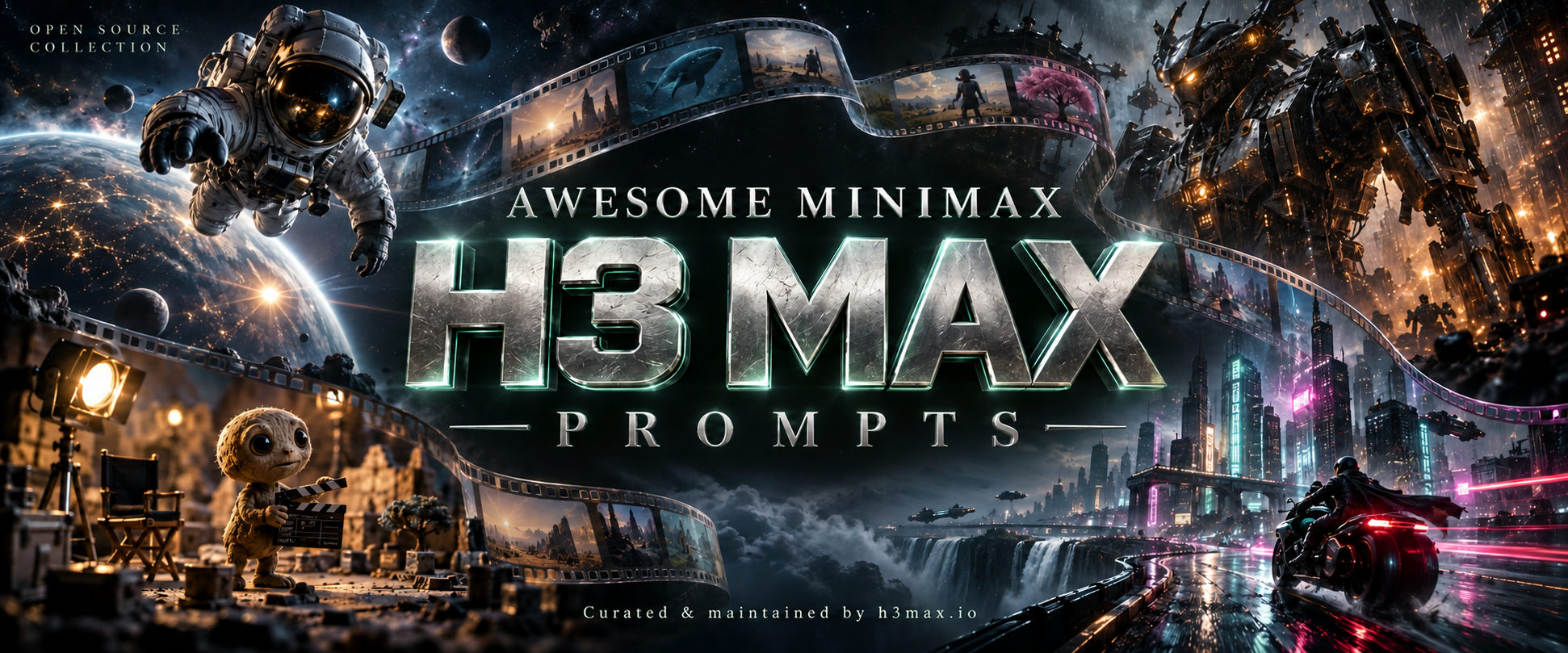
Awesome MiniMax H3 Max Prompts




Learn MiniMax H3 Max through real public examples: watch a shot, read the breakdown, then copy a prompt to make your own version. Explore action, performance, animation, short stories, reference workflows and interactive applications.
30 cases · 15 source accounts · 7 creative categories · English & Chinese guides · a preview and attribution for every case
Created and maintained by the h3max.io project. Contributions, source corrections and documented reproductions are welcome.
Previews are creator examples, not generations reproduced by this repository. Copyable text is labeled as an adaptation, visual reconstruction or editorial workflow. When an original prompt is available, we link to the author’s wording. A video cannot reveal its unique original prompt.
Start here
- Pick a shot below. Click its cover or Watch video to inspect the creator’s example.
- Expand the prompt and prepare the listed references. Suggested settings are editorial starting points.
- Try it on h3max.io or a provider supporting the relevant endpoint. Homepage links do not prefill prompts; endpoint availability varies by provider.
- Change one variable per iteration: action, camera, lighting or sound. Keep your inputs, settings and results for comparison.
Prompting guide · Research & sources · Model boundaries · Contributing · Machine-readable cases
The collection
Organized by creative task, not a popularity leaderboard. Engagement is a dated snapshot from September 13, 2026; unknown values remain unknown.
Camera & action
- A dancer bends the timeline
- A day entirely through one character’s eyes
- Henshin: a transformation with a causal trigger
- Parkour with visible takeoffs and landings
- Rain-soaked rooftop choreography
- Rust, sparks and a robot boxer
Characters & performance
- A chaotic haircut, an unimpressed customer
- A clay patient wakes in the wrong chair
- A lighthouse keeper’s quiet confession
- An astronaut otter closes its visor
- Exhaustion in a rain-lit taxi
- Office cat versus the meeting notification
Animation & character design
Short stories & visual comedy
- A courtroom becomes a cooking-show punchline
- A strip of film becomes another world
- A suspect lineup that changes on a cut
- The power station reaches creative overload
- The zombies only want to create
Documentary & cinematic atmosphere
References & continuity
- Blockout plus reference images in ComfyUI
- Coffee, a portrait, a doorway: a connected sequence
- Keep a Blender camera, replace the materials
- Separate face, costume and location references
Production & interactive workflows
- A branching adventure at the clock tower
- An animated classroom that answers one question
- One still, several controlled viewpoints · related endpoint
- Three short clips become a product teaser
- Turn a product benefit into three hook concepts
A dancer bends the timeline

▶ Watch video · @ivanfioravanti · Author’s original prompt
Adapted from a published prompt · text-to-video · Not independently generated
Tie each effect to a specific musical event, then remove effects that do not explain movement.
Copy prompt · inputs · breakdown & notes
Inputs: Optional full-body dancer reference.
Suggested starting point (not original settings): 15s · 768P · 16:9.
A single adult dancer performs inside a black-and-white chamber crossed by luminous red
timeline rails. Make a 15-second industrial-pop video at a requested 160 BPM. Each kick
drum pulls the rails inward; each snare leaves a brief translucent echo of her previous
pose. These echoes are traces, not additional people. Begin with three sharp angle
changes, then follow one continuous wide-angle move as the chamber folds around her
during the musical drop. She steps beyond the last rail and settles into a clear final
pose. Keep face, outfit and anatomy stable. Metallic percussion, distorted bass, no
intelligible lyrics or unrelated flashes.
Reproduction note: Three source outputs share one prompt and count as one case. Exact beat synchronization is a target, not verified here.
Model attribution evidence · JSON · Standalone case
Source checked: 2026-09-13. Source upload length: 15.104s (may include comparisons, editing or end cards).
56 likes · 30 bookmarks · 2 reposts · 7,805 views (dated snapshot)
A day entirely through one character’s eyes

▶ Watch video · @magnific · Author’s original prompt
Adapted from a published prompt · text-to-video · Not independently generated
Define what the camera is allowed to see; reflections reveal identity without leaving POV.
Copy prompt · inputs · breakdown & notes
Inputs: Optional consistent character and interior references.
Suggested starting point (not original settings): 15s · 768P · 16:9.
Create a 15-second stylized 3D first-person sequence. We see only the character’s hands,
surroundings and reflections: a blue cap and red hoodie identify him in mirrors. 0–3s:
hands rub sleepy eyes in a warm bedroom. 3–6s: a bathroom reflection adjusts the cap.
6–9s: hands lift a small travel bag. 9–13s: both hands hold a plain steering wheel while
rain and neon move beyond the windshield. 13–15s: a brief rearview-mirror glance, then
eyes return to the road. Keep the viewpoint at eye height with mild wide-angle
distortion. Use room tone, cloth movement, wipers and engine hum. No phone use while
driving.
Reproduction note: H3 Max is on the right of the comparison. This editorial version removes the source’s phone-handling beat.
Model attribution evidence · JSON · Standalone case
Source checked: 2026-09-13. Source upload length: 13.625s (may include comparisons, editing or end cards).
106 likes · 55 bookmarks · 8 reposts · 11,264 views (dated snapshot)
Henshin: a transformation with a causal trigger

▶ Watch video · @Tomw852 · Author’s original prompt
Adapted from a published prompt · image-to-video · Not independently generated
Give the transformation a trigger and an assembly order; reserve time for the finished design.
Copy prompt · inputs · breakdown & notes
Inputs: Opening character image with visible transformation belt.
Suggested starting point (not original settings): 15s · 768P · 16:9.
Animate the supplied fantasy character into an armored insect-inspired hero over 15
seconds. Begin in a cold, dim room with a low-angle waist-up view. The character
steadies their breathing and presses the central device on a transformation belt. A
brief light pulse crosses the eyes, then a ring of energy pushes dust away. Dark armor
plates assemble progressively from shoulders to chest, followed by a helmet with red
compound-eye lenses. Slowly orbit toward a frontal hero portrait and hold the completed
silhouette. Preserve body scale and belt placement. Sound: a quiet transformation call,
mechanical locking clicks and a rising bass tone. No blood or dismemberment.
Reproduction note: Rewrites the author’s darker body-transformation prompt into a non-gory armor assembly.
Model attribution evidence · JSON · Standalone case
Source checked: 2026-09-13. Source upload length: 15.139s (may include comparisons, editing or end cards).
3 likes · 1 bookmarks · 0 reposts · 485 views (dated snapshot)
Parkour with visible takeoffs and landings

▶ Watch video · @renoiseai · Author’s original prompt
Adapted from a published prompt · reference-to-video · Not independently generated
A takeoff–flight–landing chain makes physical continuity inspectable.
Copy prompt · inputs · breakdown & notes
Inputs: Reference image of the performer; optional course layout.
Suggested starting point (not original settings): 15s · 768P · 16:9.
Follow one adult freerunner through a sunlit concrete sports arena for 15 seconds. Use
the reference woman throughout: two contrasting braids, dark sleeveless top, olive cargo
trousers and heavy boots. Start with a low trailing view of her sprint. She plants on a
short wall, reaches a rail, then swings from a horizontal bar to the next platform. Show
the load before each jump and the knee bend after each landing. End with a steady wide
view as she catches her breath. Keep one continuous chase-camera path at human height.
Add footfalls, metal vibration, wind and a restrained electronic rhythm. No levitation
or hidden cuts.
Reproduction note: This is a labeled two-model comparison, not an independent benchmark. The adapted route is simpler than the source.
Model attribution evidence · JSON · Standalone case
Source checked: 2026-09-13. Source upload length: 14.7s (may include comparisons, editing or end cards).
29 likes · 5 bookmarks · 2 reposts · 2,157 views (dated snapshot)
Rain-soaked rooftop choreography

▶ Watch video · @enhance_ai · Author’s original prompt
Adapted from a published prompt · text-to-video · Not independently generated
Write approach, contact and recovery instead of asking for generic epic combat.
Copy prompt · inputs · breakdown & notes
Inputs: Character references recommended; two distinct silhouettes.
Suggested starting point (not original settings): 6s · 768P · 16:9.
Make a six-second live-action rooftop fight in heavy diagonal rain. Lock two adult
performers: an agile woman in wet black leather and a larger man in dark tactical
clothing. Begin behind her shoulder as she advances with two compact punches; he blocks
and counters. She ducks, plants one boot in a puddle, and pivots into a controlled back
kick. Arc the camera toward a low side view, keeping both bodies and the contact point
visible. Finish with both recovering balanced stances. Cyan city reflections, hard rain
backlight, natural motion blur. Sound: rain, boots, breath and muffled impacts. No gore,
floating limbs or teleportation.
Reproduction note: Comparison video: H3 Max is the lower panel; Seedance 2.5 is above.
Model attribution evidence · JSON · Standalone case
Source checked: 2026-09-13. Source upload length: 14.784s (may include comparisons, editing or end cards).
67 likes · 36 bookmarks · 6 reposts · 12,941 views (dated snapshot)
Rust, sparks and a robot boxer

▶ Watch video · @magnific · Author’s original prompt
Adapted from a published prompt · text-to-video · Not independently generated
Assign one readable action to each shot; use a sudden stop as the final beat.
Copy prompt · inputs · breakdown & notes
Inputs: Optional opening frame of the robot and locker room.
Suggested starting point (not original settings): 15s · 768P · 16:9.
Direct a 15-second robot training scene in a derelict locker room. Keep the same
battered brass robot and worn boxing gloves in every shot. 0–3s: it springs from a
wooden crate beneath one bare bulb. 3–6s: close on a rapid fist combination, servos
recoiling between strikes. 6–10s: a low side angle follows a kick into an empty metal
locker; dust and loose chains react to the impact. 10–13s: the swinging lamp sweeps
light across its armor. 13–15s: settle on its glowing eyes and raised guard. Cut cleanly
between angles. Sound: joints, glove impacts, rattling steel, then silence. No music.
Reproduction note: Adaptation condenses the published five-shot brief. The preview is the creator’s result.
Model attribution evidence · JSON · Standalone case
Source checked: 2026-09-13. Source upload length: 15.083s (may include comparisons, editing or end cards).
20 likes · 7 bookmarks · 2 reposts · 3,362 views (dated snapshot)
A chaotic haircut, an unimpressed customer

▶ Watch video · @magnific · Author’s original prompt
Adapted from a published prompt · image-to-video · Not independently generated
Let the environment react while the character remains deadpan.
Copy prompt · inputs · breakdown & notes
Inputs: Opening barbershop image; retain its mirror and chair positions.
Suggested starting point (not original settings): 6s · 768P · 16:9.
Continue the supplied stylized barbershop frame for six seconds. The barber’s hands turn
the chair toward the large mirror; the customer keeps a sleepy, unimpressed expression.
With a crisp cut, the striped cape lifts away in a theatrical flourish, carrying a few
loose hair clippings. The customer hops down, takes a wrapped candy from the counter and
walks out with quiet confidence. End on the empty chair rotating slightly as a bottle
wobbles and settles. Warm practical bulbs, checkered floor and the same character
proportions throughout. Sound: chair squeak, cape swish, wrapper rustle and footsteps.
Keep the humor in the contrast between movement and expression.
Reproduction note: A six-second adaptation of the author’s short clip recipe, not a 15-second claim.
Model attribution evidence · JSON · Standalone case
Source checked: 2026-09-13. Source upload length: 15.083s (may include comparisons, editing or end cards).
2 likes · 2 bookmarks · 0 reposts · 771 views (dated snapshot)
A clay patient wakes in the wrong chair

▶ Watch video · @magnific · Author’s original prompt
Adapted from a published prompt · text-to-video · Not independently generated
Build the joke as sleep → recognition → reaction → embarrassment.
Copy prompt · inputs · breakdown & notes
Inputs: Optional clay character and dental-chair opening image.
Suggested starting point (not original settings): 6s · 768P · 16:9.
A handmade clay patient dozes in a teal dental chair, cheeks slightly puffed by a cotton
roll. In a six-second comic beat, a faint snore breaks off; the eyes open, scan the
room, then widen in recognition. The patient jolts upright, ejecting the cotton onto a
metal tray with a tiny clatter. The overhead lamp wobbles once. Finish on an embarrassed
smile and a small shoulder shrug. Keep visible clay fingerprints, modest stop-motion
stepping and one consistent face. Use a medium close-up with a brief camera bump at the
jolt. Sound: snore, gasp, tray ping and lamp rattle. No procedure or injury.
Reproduction note: The reply asks for 5–6 seconds despite the parent thread’s 15-second headline.
Model attribution evidence · JSON · Standalone case
Source checked: 2026-09-13. Source upload length: 14.333s (may include comparisons, editing or end cards).
2 likes · 1 bookmarks · 0 reposts · 505 views (dated snapshot)
A lighthouse keeper’s quiet confession

Reconstructed from video · text-to-video · Not independently generated
One short line leaves room for breath, listening and facial motion.
Copy prompt · inputs · breakdown & notes
Inputs: No required source input; optional portrait reference.
Suggested starting point (not original settings): 10s · 768P · 16:9.
Film a ten-second documentary-style interview with an elderly lighthouse keeper beside a
window. Weather charts, a brass instrument and worn books sit softly out of focus behind
her. Hold a respectful eye-level close-up; preserve wrinkles, gray hair and the texture
of her knitted sweater. She considers the interviewer off camera, gives a small smile
and says, "The sea changes. My morning routine does not." Leave a breath before and
after the sentence. Diffused coastal daylight, restrained handheld drift and natural
skin. Sound: an intimate unhurried voice, distant wind and quiet room tone. No captions,
beauty filter or dramatic music.
Reproduction note: Prompt and dialogue are reconstructed; the source claims a single 10-second pass.
Model attribution evidence · JSON · Standalone case
Source checked: 2026-09-13. Source upload length: 10.133s (may include comparisons, editing or end cards).
27 likes · 1 bookmarks · 2 reposts · 3,818 views (dated snapshot)
An astronaut otter closes its visor

Reconstructed from video · text-to-video · Not independently generated
A single prop interaction exposes contact, identity and transparency in one shot.
Copy prompt · inputs · breakdown & notes
Inputs: No mandatory source image; optional otter and spacesuit references.
Suggested starting point (not original settings): 7s · 768P · 16:9.
Create a seven-second close shot of a realistic otter wearing a practical astronaut suit
inside a compact spacecraft. Begin with its face clearly visible above the open visor.
Two gloved paws lift carefully to the helmet rim and lower the transparent shield until
it clicks shut. Preserve the otter’s whiskers, dark eyes and wet nose behind the glass;
reflections should not replace its face. It pauses and gives one small reassuring
gesture toward the camera. Hold an intimate wide-angle view with restrained cockpit
lighting. Sound: suit fabric, latch click, ventilation and a soft breath. No extra paws,
sudden cuts or subtitles.
Reproduction note: The source is a screen recording of generation, including waiting time; its upload length is not the generated clip length.
Model attribution evidence · JSON · Standalone case
Source checked: 2026-09-13. Source upload length: 17.229s (may include comparisons, editing or end cards).
907 likes · 433 bookmarks · 60 reposts · 89,628 views (dated snapshot)
Exhaustion in a rain-lit taxi

▶ Watch video · @magnific · Author’s original prompt
Adapted from a published prompt · image-to-video · Not independently generated
Small performance needs a stable camera and very few competing actions.
Copy prompt · inputs · breakdown & notes
Inputs: First frame of the character seated beside a rainy window.
Suggested starting point (not original settings): 15s · 768P · 16:9.
Hold a 15-second close portrait of the same stylized young adult in the back seat of a
moving taxi. His messy dark hair, denim jacket and heavy eyelids stay consistent. Rain
trails down the window beside him; amber street lamps alternate with cool blue
reflections. Use an almost imperceptible push toward his face. He blinks, releases a
long breath, and rests his temple against the glass. Let the expression move from tense
fatigue to quiet resignation without exaggerated crying. Keep the cabin geometry stable
and the passing lights outside. Sound: tires on wet asphalt, soft ventilation and one
breath. No speech or scene change.
Reproduction note: Source wording is in the author’s reply. Our wording and sound direction are editorial.
Model attribution evidence · JSON · Standalone case
Source checked: 2026-09-13. Source upload length: 15.083s (may include comparisons, editing or end cards).
53 likes · 34 bookmarks · 1 reposts · 6,561 views (dated snapshot)
Office cat versus the meeting notification

▶ Watch video · @magnific · Author’s original prompt
Adapted from a published prompt · text-to-video · Not independently generated
Specify short text, its physical location and a reading pause.
Copy prompt · inputs · breakdown & notes
Inputs: Optional office-cat reference image.
Suggested starting point (not original settings): 15s · 768P · 16:9.
Make a 15-second animated office comedy with one grumpy long-haired cat. Open on a
monitor showing only the short notification "MEETING NOW". Cut to narrowed eyes and
flattening ears. In a wider view the cat pushes the monitor off the desk, then calmly
lifts a mug marked "BREAK". Hold the mug still long enough to read it. End on a
satisfied look directly into camera. Warm late-afternoon light, detailed fur and the
same desk layout between cuts. Use a notification ping, the monitor landing, a small sip
and an abrupt quiet ending. No additional readable text or background characters.
Reproduction note: Preview lettering differs from this adaptation. H3 Max attribution is corroborated by the thread and visible overlay.
Model attribution evidence · JSON · Standalone case
Source checked: 2026-09-13. Source upload length: 15.083s (may include comparisons, editing or end cards).
19 likes · 11 bookmarks · 1 reposts · 3,606 views (dated snapshot)
A reference sheet becomes a studio performance

Reconstructed from video · image-to-video · Not independently generated
A few meaningful poses test identity better than a rapid random montage.
Copy prompt · inputs · breakdown & notes
Inputs: A character sheet plus a clean chosen opening view.
Suggested starting point (not original settings): 15s · 768P · 16:9.
Use the reference character to create a 15-second studio showcase. Keep the same face,
short blond hair, pointed ears and layered beige-and-white outfit. Open with an
eye-level portrait against a neutral seamless backdrop. The character turns slightly,
adjusts a sleeve and shifts weight into a seated pose. Cut to a side profile and then a
full-body standing view. Keep the visible studio lights and background consistent; use
soft key light and a gentle rim rather than changing locations. Maintain believable limb
lengths and clothing folds. Sound: subtle cloth movement and light shoe contact. No
speech, redesign, title cards or unrelated people.
Reproduction note: The post says prompt in replies, but the relevant reply was not retrieved; this is a visual reconstruction.
Model attribution evidence · JSON · Standalone case
Source checked: 2026-09-13. Source upload length: 15.104s (may include comparisons, editing or end cards).
1 likes · 1 bookmarks · 0 reposts · 254 views (dated snapshot)
An elf character PV with graphic wipes

▶ Watch video · @Tomw852 · Author’s original prompt
Adapted from a published prompt · image-to-video · Not independently generated
Use recurring costume details and one palette to unite rapid cuts.
Copy prompt · inputs · breakdown & notes
Inputs: Character reference matching the intended appearance.
Suggested starting point (not original settings): 15s · 768P · 16:9.
Create a 15-second character introduction from the supplied elf illustration. Preserve
amber eyes, freckles, blond braids, pointed ears, beige knitwear and a lavender tie.
Start on an eye close-up; pull back to a relaxed half-body pose. Cut to three details:
ear, braid and fabric. Let a passing lock of hair motivate a graphic wipe into a
full-body hero pose. Use ivory, pale gold and lavender panels throughout. Add the short
editable title "AMANE" only in the final composition and hold it steady. Finish with a
calm direct gaze. Sound: gentle paper transitions, fabric movement and a warm
instrumental pop cue. No identity changes.
Reproduction note: The author reports 15s / 768p / I2VA. Our shorter English title replaces the original Japanese typography.
Model attribution evidence · JSON · Standalone case
Source checked: 2026-09-13. Source upload length: 15s (may include comparisons, editing or end cards).
7 likes · 3 bookmarks · 1 reposts · 1,140 views (dated snapshot)
A courtroom becomes a cooking-show punchline

▶ Watch video · @magnific · Author’s original prompt
Adapted from a published prompt · text-to-video · Not independently generated
Enumerate the props and their arrival order; leave a readable final tableau.
Copy prompt · inputs · breakdown & notes
Inputs: Optional courtroom and two-character references.
Suggested starting point (not original settings): 15s · 768P · 16:9.
Stage a 15-second sunlit courtroom comedy in three shots. A judge drops a stack of
picture sheets and asks an artist, "All of these last night?" The artist answers, "I was
exploring." In a medium two-shot the judge replies, "Then make me a champion." The
artist taps a small remote. Cut wider: a berry cake rolls beside the bench, a gold whisk
arrives in the judge’s hand, then a tall chef hat drops into place. Show each object
separately before revealing the complete tableau. End with a proud gavel tap. Sound:
paper, dialogue, wheels, a bright metal ring and a brief celebratory sting.
Reproduction note: Dialogue and prop timing are rewritten. The source upload includes branding after the creative clip.
Model attribution evidence · JSON · Standalone case
Source checked: 2026-09-13. Source upload length: 17s (may include comparisons, editing or end cards).
1 likes · 1 bookmarks · 0 reposts · 1,383 views (dated snapshot)
A strip of film becomes another world

Reconstructed from video · text-to-video · Not independently generated
A shared rectangular frame links macro detail, an imagined world and a cinema screen.
Copy prompt · inputs · breakdown & notes
Inputs: Optional filmmaker portrait and retro rocket concept references.
Suggested starting point (not original settings): 15s · 768P · 16:9.
Make a 15-second monochrome cinema fantasy with selective red accents. Begin close on a
filmmaker inspecting a physical strip of film against a light. Move toward one
illuminated frame until its image fills the screen. Cut into a silver retro rocket
coasting above a cratered moon. Pull back to reveal that lunar scene projected in a
small theater, with seats silhouetted in the foreground. Keep the film perforations,
projector beam and screen edges tangible. Sound: film transport chatter becoming a low
spacecraft hum, then returning to the projector. End on the moving projection, not a
logo. No captions or random scene changes.
Reproduction note: Reconstructed from the root post’s actual clip, not the four different reply examples.
Model attribution evidence · JSON · Standalone case
Source checked: 2026-09-13. Source upload length: 15s (may include comparisons, editing or end cards).
61 likes · 38 bookmarks · 7 reposts · 6,427 views (dated snapshot)
A suspect lineup that changes on a cut

▶ Watch video · @magnific · Author’s original prompt
Adapted from a published prompt · text-to-video · Not independently generated
Use an editorial cut for replacement, not a difficult multi-character morph.
Copy prompt · inputs · breakdown & notes
Inputs: Optional lineup layout reference with five spaced floor marks.
Suggested starting point (not original settings): 15s · 768P · 16:9.
A 15-second dry detective comedy in an evenly lit identification room. The detective and
witness look through observation glass. Show exactly five suspects, each fully visible
on a separate floor mark: an orc, a lanky alien, a cheerful zombie, a clown and a
bird-headed gentleman. The witness says, "Try another group." A button clicks. Make a
hard cut to the identical framing with five entirely new figures: a bronze robot, blue
furry giant, porcelain doll, swamp witch and upright mantis. Everyone points toward an
unseen door. Finish on the detective’s puzzled look. Keep silhouettes distinct; no
morphing between groups. Fluorescent hum, button click and quiet dialogue.
Reproduction note: A shortened adaptation; exact character counting still needs checking in each generated result.
Model attribution evidence · JSON · Standalone case
Source checked: 2026-09-13. Source upload length: 17s (may include comparisons, editing or end cards).
1 likes · 1 bookmarks · 0 reposts · 323 views (dated snapshot)
The power station reaches creative overload

▶ Watch video · @magnific · Author’s original prompt
Adapted from a published prompt · text-to-video · Not independently generated
Use color and sound to show unstable → intervention → stable.
Copy prompt · inputs · breakdown & notes
Inputs: Optional control-hall reference with a visible coil and lever.
Suggested starting point (not original settings): 15s · 768P · 16:9.
Direct a 15-second retro-industrial comedy inside a blue control hall. In the opening
wide shot a large copper coil pulses red and an analog gauge climbs. Cut to the chief
asking a technician, "Can we handle it?" She answers, "Open the reserve." The chief
pulls one brass lever. Return wide as three technicians turn separate wheels; the coil
shifts from erratic red to steady cyan and the gauge settles. End on a relieved nod,
with the same cables and workstations visible. Sound: low turbine vibration, one alarm,
clear dialogue, lever clunk and a resolving electrical hum. No explosion, extra rooms or
floating interfaces.
Reproduction note: This simplified adaptation changes dialogue and technician count. No native-duration claim is inferred from the branded upload.
Model attribution evidence · JSON · Standalone case
Source checked: 2026-09-13. Source upload length: 17s (may include comparisons, editing or end cards).
1 likes · 3 bookmarks · 0 reposts · 412 views (dated snapshot)
The zombies only want to create

▶ Watch video · @magnific · Author’s original prompt
Adapted from a published prompt · image-to-video · Not independently generated
Reverse the meaning of an opening action without replacing the setting.
Copy prompt · inputs · breakdown & notes
Inputs: Start image of the man, crowd and arcade.
Suggested starting point (not original settings): 15s · 768P · 16:9.
Create a 15-second non-gory horror comedy anchored to the supplied nighttime arcade
image. A frightened man runs toward camera, then ducks beside a kiosk. The crowd of
friendly zombies streams past him toward bright arcade doors. Cut to one late arrival
offering a colored wristband and saying, "Come on. Your turn." Inside, show three
screens with distinct stable pictures: a ringed planet, a blue garden and a tiny lunar
vehicle. The man chooses a terminal and relaxes as the crowd welcomes him. Hold his
completed picture before ending. Sound: running footsteps, arcade hum, one clear spoken
line and cheerful murmurs. No attacks or rapidly flickering screens.
Reproduction note: Reduces the source’s many screen subjects and spoken exchanges to a smaller reproducible brief.
Model attribution evidence · JSON · Standalone case
Source checked: 2026-09-13. Source upload length: 17s (may include comparisons, editing or end cards).
3 likes · 1 bookmarks · 0 reposts · 521 views (dated snapshot)
A quiet astronaut drift from a still

Reconstructed from video · image-to-video · Not independently generated
Separate subject drift from camera drift to create depth without excessive action.
Copy prompt · inputs · breakdown & notes
Inputs: One astronaut still; use an image you have rights to.
Suggested starting point (not original settings): 5s · 768P · 16:9.
Animate a supplied astronaut portrait into a five-second zero-gravity shot. A single
suited figure drifts diagonally through a sparse star field, one gloved hand moving
slightly toward the lens. Keep the visor opaque, helmet shape fixed and all suit
fittings attached. Add a slow camera glide in the opposite direction to reveal gentle
parallax; do not rotate the entire background as one flat layer. A distant sun produces
one restrained rim highlight. The body continues its existing momentum without swimming
gestures. Sound: muffled breathing and a quiet suit ventilation tone, with no external
explosions. Finish while the drift is still in progress.
Reproduction note: Reconstructs the space segment within the creator’s I2V montage; the other shots are different examples.
Model attribution evidence · JSON · Standalone case
Source checked: 2026-09-13. Source upload length: 50.6s (may include comparisons, editing or end cards).
41 likes · 10 bookmarks · 4 reposts · 3,553 views (dated snapshot)
An octopus moves through a living reef

Reconstructed from video · text-to-video · Not independently generated
Contact points and sediment make motion feel connected to the environment.
Copy prompt · inputs · breakdown & notes
Inputs: No mandatory reference; optional reef or animal image.
Suggested starting point (not original settings): 10s · 768P · 16:9.
Shoot a ten-second underwater wildlife sequence beside a shallow coral reef. Track a
single brown octopus from a low, close angle as its arms find separate contact points on
the rock. It briefly explores a crevice, then glides into open blue water, stirring a
small cloud of sediment. Preserve its anatomy, suction-cup detail and natural color
variation. Sunlight ripples over coral; distant fish remain small and unobtrusive. Use
gentle buoyant camera motion, never a sudden terrestrial-style zoom. Sound: subdued
underwater ambience and one calm original narration line, "Every opening offers another
route." Keep music minimal and the animal clearly visible.
Reproduction note: The post’s 12 seconds describes generation time, not an established native clip duration. Narration is newly written.
Model attribution evidence · JSON · Standalone case
Source checked: 2026-09-13. Source upload length: 12.233s (may include comparisons, editing or end cards).
57 likes · 18 bookmarks · 2 reposts · 3,965 views (dated snapshot)
Blockout plus reference images in ComfyUI

Editorial workflow · reference-to-video · Not independently generated
Separate structural guidance from appearance guidance, then inspect before upscaling.
Copy prompt · inputs · breakdown & notes
Inputs: Blockout video, look references and ComfyUI H3 Max Partner Nodes.
Suggested starting point (not original settings): 10s · 768P · 16:9.
Treat the supplied blockout video as a strict guide to camera movement and object
placement. Produce a ten-second finished cinematic shot while preserving the route, lens
direction and the relative scale of every large object. Use the still references only
for surface finish, color, lighting and character appearance. Add contact shadows,
grounded reflections and motion blur consistent with the camera; keep silhouettes stable
across the whole move. Do not redesign the scene to make it more dramatic. Sound:
ambience appropriate to the depicted location, with no unsolicited dialogue. Compare the
result with the blockout before running any separate upscale stage.
Reproduction note: Source demonstrates a pipeline with optional 2K upscaling; this is not evidence of native H3 Max 2K output.
Model attribution evidence · JSON · Standalone case
Source checked: 2026-09-13. Source upload length: 12s (may include comparisons, editing or end cards).
804 likes · 819 bookmarks · 85 reposts · 42,035 views (dated snapshot)
Coffee, a portrait, a doorway: a connected sequence

Editorial workflow · first-last-frame · Not independently generated
Solve the boundary images first; continuity is a workflow, not merely the word seamless.
Copy prompt · inputs · breakdown & notes
Inputs: A planned sequence of matching first/last frames and a video editor.
Suggested starting point (not original settings): 15s · 768P · 16:9.
For one transition, use the supplied first and last frames as composition anchors. Begin
directly above a cup of coffee on a wooden table. Move gently toward the circular
reflection, then let the dark surface fill the view before revealing the same woman
seated beside a cafe window in the final frame. Keep a muted autumn palette and natural
photographic texture. The camera motion must progress in one direction without a sudden
reversal. Sound: cafe room tone and a soft cup contact fading into street ambience. Hold
the target composition briefly. Render later transitions as separate clips using matched
boundary frames, then assemble them in an editor.
Reproduction note: Author used four 15-second clips, Premiere Morph Cut, grading and Topaz. The final 1080p/60fps is post-processed.
Model attribution evidence · JSON · Standalone case
Source checked: 2026-09-13. Source upload length: 58.9s (may include comparisons, editing or end cards).
96 likes · 56 bookmarks · 1 reposts · 10,276 views (dated snapshot)
Keep a Blender camera, replace the materials

Editorial workflow · reference-to-video · Not independently generated
Lock motion and geometry explicitly before asking for realism.
Copy prompt · inputs · breakdown & notes
Inputs: Your Blender camera preview; optional material/look reference images.
Suggested starting point (not original settings): 10s · 768P · 16:9.
Use the supplied 3D preview as the motion and geometry reference for a ten-second
architectural shot. Preserve the camera path, timing, building outlines, street width
and central round tower. Replace flat preview materials with weathered stone, plaster,
glass and individually readable roof tiles. Add natural daytime sky light, soft contact
shadows and restrained atmospheric depth. Keep every facade attached to its original
structure as perspective changes; do not invent streets or bend the tower. Avoid adding
foreground crowds that obscure the comparison. Sound: distant city ambience and light
wind. Return one continuous shot with no added cuts or typography.
Reproduction note: The creator’s 30-second result and speed comparison are workflow claims, not single-request limits or our benchmark.
Model attribution evidence · JSON · Standalone case
Source checked: 2026-09-13. Source upload length: 30s (may include comparisons, editing or end cards).
711 likes · 633 bookmarks · 43 reposts · 57,263 views (dated snapshot)
Separate face, costume and location references

Editorial workflow · reference-to-video · Not independently generated
Give each reference one responsibility instead of combining conflicting information.
Copy prompt · inputs · breakdown & notes
Inputs: Separate facial-expression, costume/equipment and location references.
Suggested starting point (not original settings): 10s · 768P · 16:9.
Using the supplied face, spacesuit and location references, create a ten-second
cinematic shot of the same young astronaut discovering a spacecraft corridor. Preserve
the face from the portrait; take only clothing and equipment from the suit sheet; take
architecture and lighting from the corridor image. Start close on his expression of
wonder inside the clear helmet, then ease back as he reaches toward a window. Let
instrument light travel across the visor while his identity and suit proportions remain
unchanged. End on his reflection beside the distant planet. Sound: ventilation, a small
glove contact and a quiet breath. No new costume, labels or extra people.
Reproduction note: Source is a multi-shot workflow. Our prompt covers one shot; prepare sheets with an image tool first.
Model attribution evidence · JSON · Standalone case
Source checked: 2026-09-13. Source upload length: 30.166s (may include comparisons, editing or end cards).
404 likes · 440 bookmarks · 24 reposts · 28,547 views (dated snapshot)
A branching adventure at the clock tower

Editorial workflow · image-to-video · Not independently generated
Persist choices outside the video model and render one consequence at a time.
Copy prompt · inputs · breakdown & notes
Inputs: Previous shot’s frame, a compact state summary and one player decision.
Suggested starting point (not original settings): 5s · 768P · 16:9.
For the next five-second scene of a stylized fantasy adventure, use the supplied
previous frame as the visual anchor. Keep the same golden sky, distant clock tower, path
and the small knight’s helmet and red plume. The player has chosen "approach the gate".
Track behind the knight as he moves a few paces and the tower grows in frame; a small
light appears beside the entrance. End before crossing the threshold so the application
can offer the next choice. Sound: footsteps, breeze and a distant clock mechanism. Do
not display buttons or invent another player decision. Keep state and choice handling in
the application; this prompt generates only the resulting shot.
Reproduction note: The source demonstrates an interactive application. Its internal orchestration and exact model route are not published here.
Model attribution evidence · JSON · Standalone case
Source checked: 2026-09-13. Source upload length: 52.918s (may include comparisons, editing or end cards).
3,249 likes · 1,817 bookmarks · 220 reposts · 508,391 views (dated snapshot)
An animated classroom that answers one question

▶ Watch video · @internetphysics
Editorial workflow · image-to-video · Not independently generated
Keep educational claims in a reviewed script; ask the video model to visualize one causal chain.
Copy prompt · inputs · breakdown & notes
Inputs: An original teaching-character reference and a checked one-concept script.
Suggested starting point (not original settings): 10s · 768P · 16:9.
Animate the supplied original classroom mascot beside a simple blackboard for ten
seconds. Teach one idea: a turbine turns a generator to produce electricity. The mascot
points to a large wheel; it rotates a connected shaft, then a nearby lamp lights. Keep
the causal sequence visible in three clear stages. Use a fixed medium-wide camera and
consistent character proportions. Speak one concise original explanation in a friendly
voice, leaving time for the final lamp reaction. Sound: quiet classroom ambience and
gentle mechanical motion. No equations or crowded captions. Generate the next
explanation as a separate shot after the application checks its factual content.
Reproduction note: Replaces the source’s recognizable meme teacher with your own mascot. Queuing and follow-up questions require application logic.
Model attribution evidence · JSON · Standalone case
Source checked: 2026-09-13. Source upload length: 146.398s (may include comparisons, editing or end cards).
645 likes · 480 bookmarks · 61 reposts · 131,942 views (dated snapshot)
One still, several controlled viewpoints

Editorial workflow · camera-controls · Not independently generated
Numeric camera controls and a descriptive prompt serve different roles.
Copy prompt · inputs · breakdown & notes
Inputs: One scene image and the dedicated H3 Max multi-angle/camera-controls endpoint.
Suggested starting point (not original settings): 5s · 768P · 16:9; check the dedicated endpoint schema.
Use the supplied room image as the only scene. Move the viewpoint gently around the main
object while preserving furniture positions, wall geometry, surface materials and the
existing lighting direction. Reveal a small amount of the previously hidden side without
introducing new objects or changing the room’s proportions. Keep motion smooth and the
object’s scale stable. End on a clear three-quarter view. Use this as the descriptive
brief alongside the endpoint’s dedicated camera controls; set the desired horizontal and
vertical angles in the interface rather than relying on prose to encode them. Sound, if
supported: quiet room ambience without speech.
Reproduction note: Related capability, not the ordinary text-to-video route. Inspect the live schema; no parameter names are guessed here.
Model attribution evidence · JSON · Standalone case
Source checked: 2026-09-13. Source upload length: 24.009s (may include comparisons, editing or end cards).
526 likes · 393 bookmarks · 69 reposts · 91,390 views (dated snapshot)
Three short clips become a product teaser

▶ Watch video · @Marcos12345rico
Editorial workflow · text-to-video · Not independently generated
Use generation for atmosphere and movement; finish exact product messaging in the edit.
Copy prompt · inputs · breakdown & notes
Inputs: Product brief, approved branding assets and an editor for three clips.
Suggested starting point (not original settings): 5s · 768P · 16:9.
Create one five-second visual for a three-part software teaser. Show translucent editing
tracks receding into a dark studio space, with a single orange playhead advancing across
them. As it moves, three small video panels light up in sequence; each panel remains a
stable rectangle. Use a slow lateral camera glide, crisp glass edges and restrained
white highlights. Sound: three soft clicks followed by a short rising tone. No readable
interface labels, logos or claims. Generate opening, feature and closing shots
separately using the same palette and camera direction; add approved copy and the real
product logo in the final edit.
Reproduction note: Creator explicitly stitched three videos. This is an editorial workflow, not the original production prompt.
Model attribution evidence · JSON · Standalone case
Source checked: 2026-09-13. Source upload length: 9.541s (may include comparisons, editing or end cards).
125 likes · 119 bookmarks · 5 reposts · 11,794 views (dated snapshot)
Turn a product benefit into three hook concepts

Editorial workflow · text-to-video · Not independently generated
A short hook needs one visual before/after rather than a full feature tour.
Copy prompt · inputs · breakdown & notes
Inputs: A product URL or brief reduced to one factual benefit; create each alternative separately.
Suggested starting point (not original settings): 5s · 768P · 16:9.
Create a five-second visual hook for a tool that organizes scattered ideas. On a dark
desk, loose blank paper cards flutter in a messy cloud. One small warm light switches
on; the cards settle into three neat vertical stacks, each casting a clean shadow. Push
the camera slowly toward the center stack and hold the organized result for the final
second. Keep the transformation physical and easy to understand. Sound: paper movement
resolving into three soft taps. No claims, readable text or logo. For two alternate
hooks, change only the metaphor, keeping duration, palette and the single-benefit
structure identical.
Reproduction note: New editorial example inspired by the demonstrated hook-generator workflow; it is not a recovered source prompt.
Model attribution evidence · JSON · Standalone case
Source checked: 2026-09-13. Source upload length: 6.8s (may include comparisons, editing or end cards).
320 likes · 471 bookmarks · 31 reposts · 39,316 views (dated snapshot)
What the prompt labels mean
- Adapted from a published prompt: the author’s wording was retrieved and linked. Our condensed version may change dialogue, shot count or action complexity.
- Reconstructed from video: an editorial shot brief inferred from visible sampled frames and post context, never presented as the author’s exact words.
- Editorial workflow: a recipe for references, previz, assembly or an interactive application. State handling, asset preparation, editing and upscaling need their own tools.
No case has been independently regenerated by this repository. Audio has not been independently reviewed. Sampled frames support composition analysis, not claims about full temporal consistency, lip sync or physical correctness. Undisclosed seeds, expansion settings and original inputs remain unknown.
About the model name
H3 Max is fal’s post-trained variant of MiniMax H3. Base H3, H3 Max, H3 Max Turbo, Director and camera-control endpoints are distinct. Check the exact provider schema for current capabilities. See the official announcement and our model notes.
Maintenance & contributions
Maintained by the h3max.io project as a community resource, independently of MiniMax and fal. Open a PR with a useful attributed example, or contribute a documented reproduction. After changing the data, run npm run build and npm run check. See CONTRIBUTING.md.
Credits & license
Thanks to the creators who share their work and methods. The visual-first structure is inspired by awesome-gpt-image-2-5-prompts. Its cases, prompts and branding were not reused.
Original repository code, documentation and editorial prompts are MIT licensed. Linked or embedded third-party videos, covers, brands and author text retain their respective rights; inclusion does not relicense them under MIT. See content policy & corrections.
Contributors

5 commits
See what people are saying
Hacker News (1)
Similar repos






Languages
JavaScript
100.0%
Curated MiniMax H3 Max video prompts, creator examples, shot breakdowns and workflows. Maintained by h3max.io.
See the codeREADME
Awesome MiniMax H3 Max Prompts
Learn MiniMax H3 Max through real public examples: watch a shot, read the breakdown, then copy a prompt to make your own version. Explore action, performance, animation, short stories, reference workflows and interactive applications.
30 cases · 15 source accounts · 7 creative categories · English & Chinese guides · a preview and attribution for every case
Created and maintained by the h3max.io project. Contributions, source corrections and documented reproductions are welcome.
Previews are creator examples, not generations reproduced by this repository. Copyable text is labeled as an adaptation, visual reconstruction or editorial workflow. When an original prompt is available, we link to the author’s wording. A video cannot reveal its unique original prompt.
Start here
- Pick a shot below. Click its cover or Watch video to inspect the creator’s example.
- Expand the prompt and prepare the listed references. Suggested settings are editorial starting points.
- Try it on h3max.io or a provider supporting the relevant endpoint. Homepage links do not prefill prompts; endpoint availability varies by provider.
- Change one variable per iteration: action, camera, lighting or sound. Keep your inputs, settings and results for comparison.
Prompting guide · Research & sources · Model boundaries · Contributing · Machine-readable cases
The collection
Organized by creative task, not a popularity leaderboard. Engagement is a dated snapshot from September 13, 2026; unknown values remain unknown.
Camera & action
- A dancer bends the timeline
- A day entirely through one character’s eyes
- Henshin: a transformation with a causal trigger
- Parkour with visible takeoffs and landings
- Rain-soaked rooftop choreography
- Rust, sparks and a robot boxer
Characters & performance
- A chaotic haircut, an unimpressed customer
- A clay patient wakes in the wrong chair
- A lighthouse keeper’s quiet confession
- An astronaut otter closes its visor
- Exhaustion in a rain-lit taxi
- Office cat versus the meeting notification
Animation & character design
Short stories & visual comedy
- A courtroom becomes a cooking-show punchline
- A strip of film becomes another world
- A suspect lineup that changes on a cut
- The power station reaches creative overload
- The zombies only want to create
Documentary & cinematic atmosphere
References & continuity
- Blockout plus reference images in ComfyUI
- Coffee, a portrait, a doorway: a connected sequence
- Keep a Blender camera, replace the materials
- Separate face, costume and location references
Production & interactive workflows
- A branching adventure at the clock tower
- An animated classroom that answers one question
- One still, several controlled viewpoints · related endpoint
- Three short clips become a product teaser
- Turn a product benefit into three hook concepts
A dancer bends the timeline
▶ Watch video · @ivanfioravanti · Author’s original prompt
Adapted from a published prompt · text-to-video · Not independently generated
Tie each effect to a specific musical event, then remove effects that do not explain movement.
Copy prompt · inputs · breakdown & notes
Inputs: Optional full-body dancer reference.
Suggested starting point (not original settings): 15s · 768P · 16:9.
A single adult dancer performs inside a black-and-white chamber crossed by luminous red
timeline rails. Make a 15-second industrial-pop video at a requested 160 BPM. Each kick
drum pulls the rails inward; each snare leaves a brief translucent echo of her previous
pose. These echoes are traces, not additional people. Begin with three sharp angle
changes, then follow one continuous wide-angle move as the chamber folds around her
during the musical drop. She steps beyond the last rail and settles into a clear final
pose. Keep face, outfit and anatomy stable. Metallic percussion, distorted bass, no
intelligible lyrics or unrelated flashes.
Reproduction note: Three source outputs share one prompt and count as one case. Exact beat synchronization is a target, not verified here.
Model attribution evidence · JSON · Standalone case
Source checked: 2026-09-13. Source upload length: 15.104s (may include comparisons, editing or end cards).
56 likes · 30 bookmarks · 2 reposts · 7,805 views (dated snapshot)
A day entirely through one character’s eyes
▶ Watch video · @magnific · Author’s original prompt
Adapted from a published prompt · text-to-video · Not independently generated
Define what the camera is allowed to see; reflections reveal identity without leaving POV.
Copy prompt · inputs · breakdown & notes
Inputs: Optional consistent character and interior references.
Suggested starting point (not original settings): 15s · 768P · 16:9.
Create a 15-second stylized 3D first-person sequence. We see only the character’s hands,
surroundings and reflections: a blue cap and red hoodie identify him in mirrors. 0–3s:
hands rub sleepy eyes in a warm bedroom. 3–6s: a bathroom reflection adjusts the cap.
6–9s: hands lift a small travel bag. 9–13s: both hands hold a plain steering wheel while
rain and neon move beyond the windshield. 13–15s: a brief rearview-mirror glance, then
eyes return to the road. Keep the viewpoint at eye height with mild wide-angle
distortion. Use room tone, cloth movement, wipers and engine hum. No phone use while
driving.
Reproduction note: H3 Max is on the right of the comparison. This editorial version removes the source’s phone-handling beat.
Model attribution evidence · JSON · Standalone case
Source checked: 2026-09-13. Source upload length: 13.625s (may include comparisons, editing or end cards).
106 likes · 55 bookmarks · 8 reposts · 11,264 views (dated snapshot)
Henshin: a transformation with a causal trigger
▶ Watch video · @Tomw852 · Author’s original prompt
Adapted from a published prompt · image-to-video · Not independently generated
Give the transformation a trigger and an assembly order; reserve time for the finished design.
Copy prompt · inputs · breakdown & notes
Inputs: Opening character image with visible transformation belt.
Suggested starting point (not original settings): 15s · 768P · 16:9.
Animate the supplied fantasy character into an armored insect-inspired hero over 15
seconds. Begin in a cold, dim room with a low-angle waist-up view. The character
steadies their breathing and presses the central device on a transformation belt. A
brief light pulse crosses the eyes, then a ring of energy pushes dust away. Dark armor
plates assemble progressively from shoulders to chest, followed by a helmet with red
compound-eye lenses. Slowly orbit toward a frontal hero portrait and hold the completed
silhouette. Preserve body scale and belt placement. Sound: a quiet transformation call,
mechanical locking clicks and a rising bass tone. No blood or dismemberment.
Reproduction note: Rewrites the author’s darker body-transformation prompt into a non-gory armor assembly.
Model attribution evidence · JSON · Standalone case
Source checked: 2026-09-13. Source upload length: 15.139s (may include comparisons, editing or end cards).
3 likes · 1 bookmarks · 0 reposts · 485 views (dated snapshot)
Parkour with visible takeoffs and landings
▶ Watch video · @renoiseai · Author’s original prompt
Adapted from a published prompt · reference-to-video · Not independently generated
A takeoff–flight–landing chain makes physical continuity inspectable.
Copy prompt · inputs · breakdown & notes
Inputs: Reference image of the performer; optional course layout.
Suggested starting point (not original settings): 15s · 768P · 16:9.
Follow one adult freerunner through a sunlit concrete sports arena for 15 seconds. Use
the reference woman throughout: two contrasting braids, dark sleeveless top, olive cargo
trousers and heavy boots. Start with a low trailing view of her sprint. She plants on a
short wall, reaches a rail, then swings from a horizontal bar to the next platform. Show
the load before each jump and the knee bend after each landing. End with a steady wide
view as she catches her breath. Keep one continuous chase-camera path at human height.
Add footfalls, metal vibration, wind and a restrained electronic rhythm. No levitation
or hidden cuts.
Reproduction note: This is a labeled two-model comparison, not an independent benchmark. The adapted route is simpler than the source.
Model attribution evidence · JSON · Standalone case
Source checked: 2026-09-13. Source upload length: 14.7s (may include comparisons, editing or end cards).
29 likes · 5 bookmarks · 2 reposts · 2,157 views (dated snapshot)
Rain-soaked rooftop choreography
▶ Watch video · @enhance_ai · Author’s original prompt
Adapted from a published prompt · text-to-video · Not independently generated
Write approach, contact and recovery instead of asking for generic epic combat.
Copy prompt · inputs · breakdown & notes
Inputs: Character references recommended; two distinct silhouettes.
Suggested starting point (not original settings): 6s · 768P · 16:9.
Make a six-second live-action rooftop fight in heavy diagonal rain. Lock two adult
performers: an agile woman in wet black leather and a larger man in dark tactical
clothing. Begin behind her shoulder as she advances with two compact punches; he blocks
and counters. She ducks, plants one boot in a puddle, and pivots into a controlled back
kick. Arc the camera toward a low side view, keeping both bodies and the contact point
visible. Finish with both recovering balanced stances. Cyan city reflections, hard rain
backlight, natural motion blur. Sound: rain, boots, breath and muffled impacts. No gore,
floating limbs or teleportation.
Reproduction note: Comparison video: H3 Max is the lower panel; Seedance 2.5 is above.
Model attribution evidence · JSON · Standalone case
Source checked: 2026-09-13. Source upload length: 14.784s (may include comparisons, editing or end cards).
67 likes · 36 bookmarks · 6 reposts · 12,941 views (dated snapshot)
Rust, sparks and a robot boxer
▶ Watch video · @magnific · Author’s original prompt
Adapted from a published prompt · text-to-video · Not independently generated
Assign one readable action to each shot; use a sudden stop as the final beat.
Copy prompt · inputs · breakdown & notes
Inputs: Optional opening frame of the robot and locker room.
Suggested starting point (not original settings): 15s · 768P · 16:9.
Direct a 15-second robot training scene in a derelict locker room. Keep the same
battered brass robot and worn boxing gloves in every shot. 0–3s: it springs from a
wooden crate beneath one bare bulb. 3–6s: close on a rapid fist combination, servos
recoiling between strikes. 6–10s: a low side angle follows a kick into an empty metal
locker; dust and loose chains react to the impact. 10–13s: the swinging lamp sweeps
light across its armor. 13–15s: settle on its glowing eyes and raised guard. Cut cleanly
between angles. Sound: joints, glove impacts, rattling steel, then silence. No music.
Reproduction note: Adaptation condenses the published five-shot brief. The preview is the creator’s result.
Model attribution evidence · JSON · Standalone case
Source checked: 2026-09-13. Source upload length: 15.083s (may include comparisons, editing or end cards).
20 likes · 7 bookmarks · 2 reposts · 3,362 views (dated snapshot)
A chaotic haircut, an unimpressed customer
▶ Watch video · @magnific · Author’s original prompt
Adapted from a published prompt · image-to-video · Not independently generated
Let the environment react while the character remains deadpan.
Copy prompt · inputs · breakdown & notes
Inputs: Opening barbershop image; retain its mirror and chair positions.
Suggested starting point (not original settings): 6s · 768P · 16:9.
Continue the supplied stylized barbershop frame for six seconds. The barber’s hands turn
the chair toward the large mirror; the customer keeps a sleepy, unimpressed expression.
With a crisp cut, the striped cape lifts away in a theatrical flourish, carrying a few
loose hair clippings. The customer hops down, takes a wrapped candy from the counter and
walks out with quiet confidence. End on the empty chair rotating slightly as a bottle
wobbles and settles. Warm practical bulbs, checkered floor and the same character
proportions throughout. Sound: chair squeak, cape swish, wrapper rustle and footsteps.
Keep the humor in the contrast between movement and expression.
Reproduction note: A six-second adaptation of the author’s short clip recipe, not a 15-second claim.
Model attribution evidence · JSON · Standalone case
Source checked: 2026-09-13. Source upload length: 15.083s (may include comparisons, editing or end cards).
2 likes · 2 bookmarks · 0 reposts · 771 views (dated snapshot)
A clay patient wakes in the wrong chair
▶ Watch video · @magnific · Author’s original prompt
Adapted from a published prompt · text-to-video · Not independently generated
Build the joke as sleep → recognition → reaction → embarrassment.
Copy prompt · inputs · breakdown & notes
Inputs: Optional clay character and dental-chair opening image.
Suggested starting point (not original settings): 6s · 768P · 16:9.
A handmade clay patient dozes in a teal dental chair, cheeks slightly puffed by a cotton
roll. In a six-second comic beat, a faint snore breaks off; the eyes open, scan the
room, then widen in recognition. The patient jolts upright, ejecting the cotton onto a
metal tray with a tiny clatter. The overhead lamp wobbles once. Finish on an embarrassed
smile and a small shoulder shrug. Keep visible clay fingerprints, modest stop-motion
stepping and one consistent face. Use a medium close-up with a brief camera bump at the
jolt. Sound: snore, gasp, tray ping and lamp rattle. No procedure or injury.
Reproduction note: The reply asks for 5–6 seconds despite the parent thread’s 15-second headline.
Model attribution evidence · JSON · Standalone case
Source checked: 2026-09-13. Source upload length: 14.333s (may include comparisons, editing or end cards).
2 likes · 1 bookmarks · 0 reposts · 505 views (dated snapshot)
A lighthouse keeper’s quiet confession
Reconstructed from video · text-to-video · Not independently generated
One short line leaves room for breath, listening and facial motion.
Copy prompt · inputs · breakdown & notes
Inputs: No required source input; optional portrait reference.
Suggested starting point (not original settings): 10s · 768P · 16:9.
Film a ten-second documentary-style interview with an elderly lighthouse keeper beside a
window. Weather charts, a brass instrument and worn books sit softly out of focus behind
her. Hold a respectful eye-level close-up; preserve wrinkles, gray hair and the texture
of her knitted sweater. She considers the interviewer off camera, gives a small smile
and says, "The sea changes. My morning routine does not." Leave a breath before and
after the sentence. Diffused coastal daylight, restrained handheld drift and natural
skin. Sound: an intimate unhurried voice, distant wind and quiet room tone. No captions,
beauty filter or dramatic music.
Reproduction note: Prompt and dialogue are reconstructed; the source claims a single 10-second pass.
Model attribution evidence · JSON · Standalone case
Source checked: 2026-09-13. Source upload length: 10.133s (may include comparisons, editing or end cards).
27 likes · 1 bookmarks · 2 reposts · 3,818 views (dated snapshot)
An astronaut otter closes its visor
Reconstructed from video · text-to-video · Not independently generated
A single prop interaction exposes contact, identity and transparency in one shot.
Copy prompt · inputs · breakdown & notes
Inputs: No mandatory source image; optional otter and spacesuit references.
Suggested starting point (not original settings): 7s · 768P · 16:9.
Create a seven-second close shot of a realistic otter wearing a practical astronaut suit
inside a compact spacecraft. Begin with its face clearly visible above the open visor.
Two gloved paws lift carefully to the helmet rim and lower the transparent shield until
it clicks shut. Preserve the otter’s whiskers, dark eyes and wet nose behind the glass;
reflections should not replace its face. It pauses and gives one small reassuring
gesture toward the camera. Hold an intimate wide-angle view with restrained cockpit
lighting. Sound: suit fabric, latch click, ventilation and a soft breath. No extra paws,
sudden cuts or subtitles.
Reproduction note: The source is a screen recording of generation, including waiting time; its upload length is not the generated clip length.
Model attribution evidence · JSON · Standalone case
Source checked: 2026-09-13. Source upload length: 17.229s (may include comparisons, editing or end cards).
907 likes · 433 bookmarks · 60 reposts · 89,628 views (dated snapshot)
Exhaustion in a rain-lit taxi
▶ Watch video · @magnific · Author’s original prompt
Adapted from a published prompt · image-to-video · Not independently generated
Small performance needs a stable camera and very few competing actions.
Copy prompt · inputs · breakdown & notes
Inputs: First frame of the character seated beside a rainy window.
Suggested starting point (not original settings): 15s · 768P · 16:9.
Hold a 15-second close portrait of the same stylized young adult in the back seat of a
moving taxi. His messy dark hair, denim jacket and heavy eyelids stay consistent. Rain
trails down the window beside him; amber street lamps alternate with cool blue
reflections. Use an almost imperceptible push toward his face. He blinks, releases a
long breath, and rests his temple against the glass. Let the expression move from tense
fatigue to quiet resignation without exaggerated crying. Keep the cabin geometry stable
and the passing lights outside. Sound: tires on wet asphalt, soft ventilation and one
breath. No speech or scene change.
Reproduction note: Source wording is in the author’s reply. Our wording and sound direction are editorial.
Model attribution evidence · JSON · Standalone case
Source checked: 2026-09-13. Source upload length: 15.083s (may include comparisons, editing or end cards).
53 likes · 34 bookmarks · 1 reposts · 6,561 views (dated snapshot)
Office cat versus the meeting notification
▶ Watch video · @magnific · Author’s original prompt
Adapted from a published prompt · text-to-video · Not independently generated
Specify short text, its physical location and a reading pause.
Copy prompt · inputs · breakdown & notes
Inputs: Optional office-cat reference image.
Suggested starting point (not original settings): 15s · 768P · 16:9.
Make a 15-second animated office comedy with one grumpy long-haired cat. Open on a
monitor showing only the short notification "MEETING NOW". Cut to narrowed eyes and
flattening ears. In a wider view the cat pushes the monitor off the desk, then calmly
lifts a mug marked "BREAK". Hold the mug still long enough to read it. End on a
satisfied look directly into camera. Warm late-afternoon light, detailed fur and the
same desk layout between cuts. Use a notification ping, the monitor landing, a small sip
and an abrupt quiet ending. No additional readable text or background characters.
Reproduction note: Preview lettering differs from this adaptation. H3 Max attribution is corroborated by the thread and visible overlay.
Model attribution evidence · JSON · Standalone case
Source checked: 2026-09-13. Source upload length: 15.083s (may include comparisons, editing or end cards).
19 likes · 11 bookmarks · 1 reposts · 3,606 views (dated snapshot)
A reference sheet becomes a studio performance
Reconstructed from video · image-to-video · Not independently generated
A few meaningful poses test identity better than a rapid random montage.
Copy prompt · inputs · breakdown & notes
Inputs: A character sheet plus a clean chosen opening view.
Suggested starting point (not original settings): 15s · 768P · 16:9.
Use the reference character to create a 15-second studio showcase. Keep the same face,
short blond hair, pointed ears and layered beige-and-white outfit. Open with an
eye-level portrait against a neutral seamless backdrop. The character turns slightly,
adjusts a sleeve and shifts weight into a seated pose. Cut to a side profile and then a
full-body standing view. Keep the visible studio lights and background consistent; use
soft key light and a gentle rim rather than changing locations. Maintain believable limb
lengths and clothing folds. Sound: subtle cloth movement and light shoe contact. No
speech, redesign, title cards or unrelated people.
Reproduction note: The post says prompt in replies, but the relevant reply was not retrieved; this is a visual reconstruction.
Model attribution evidence · JSON · Standalone case
Source checked: 2026-09-13. Source upload length: 15.104s (may include comparisons, editing or end cards).
1 likes · 1 bookmarks · 0 reposts · 254 views (dated snapshot)
An elf character PV with graphic wipes
▶ Watch video · @Tomw852 · Author’s original prompt
Adapted from a published prompt · image-to-video · Not independently generated
Use recurring costume details and one palette to unite rapid cuts.
Copy prompt · inputs · breakdown & notes
Inputs: Character reference matching the intended appearance.
Suggested starting point (not original settings): 15s · 768P · 16:9.
Create a 15-second character introduction from the supplied elf illustration. Preserve
amber eyes, freckles, blond braids, pointed ears, beige knitwear and a lavender tie.
Start on an eye close-up; pull back to a relaxed half-body pose. Cut to three details:
ear, braid and fabric. Let a passing lock of hair motivate a graphic wipe into a
full-body hero pose. Use ivory, pale gold and lavender panels throughout. Add the short
editable title "AMANE" only in the final composition and hold it steady. Finish with a
calm direct gaze. Sound: gentle paper transitions, fabric movement and a warm
instrumental pop cue. No identity changes.
Reproduction note: The author reports 15s / 768p / I2VA. Our shorter English title replaces the original Japanese typography.
Model attribution evidence · JSON · Standalone case
Source checked: 2026-09-13. Source upload length: 15s (may include comparisons, editing or end cards).
7 likes · 3 bookmarks · 1 reposts · 1,140 views (dated snapshot)
A courtroom becomes a cooking-show punchline
▶ Watch video · @magnific · Author’s original prompt
Adapted from a published prompt · text-to-video · Not independently generated
Enumerate the props and their arrival order; leave a readable final tableau.
Copy prompt · inputs · breakdown & notes
Inputs: Optional courtroom and two-character references.
Suggested starting point (not original settings): 15s · 768P · 16:9.
Stage a 15-second sunlit courtroom comedy in three shots. A judge drops a stack of
picture sheets and asks an artist, "All of these last night?" The artist answers, "I was
exploring." In a medium two-shot the judge replies, "Then make me a champion." The
artist taps a small remote. Cut wider: a berry cake rolls beside the bench, a gold whisk
arrives in the judge’s hand, then a tall chef hat drops into place. Show each object
separately before revealing the complete tableau. End with a proud gavel tap. Sound:
paper, dialogue, wheels, a bright metal ring and a brief celebratory sting.
Reproduction note: Dialogue and prop timing are rewritten. The source upload includes branding after the creative clip.
Model attribution evidence · JSON · Standalone case
Source checked: 2026-09-13. Source upload length: 17s (may include comparisons, editing or end cards).
1 likes · 1 bookmarks · 0 reposts · 1,383 views (dated snapshot)
A strip of film becomes another world
Reconstructed from video · text-to-video · Not independently generated
A shared rectangular frame links macro detail, an imagined world and a cinema screen.
Copy prompt · inputs · breakdown & notes
Inputs: Optional filmmaker portrait and retro rocket concept references.
Suggested starting point (not original settings): 15s · 768P · 16:9.
Make a 15-second monochrome cinema fantasy with selective red accents. Begin close on a
filmmaker inspecting a physical strip of film against a light. Move toward one
illuminated frame until its image fills the screen. Cut into a silver retro rocket
coasting above a cratered moon. Pull back to reveal that lunar scene projected in a
small theater, with seats silhouetted in the foreground. Keep the film perforations,
projector beam and screen edges tangible. Sound: film transport chatter becoming a low
spacecraft hum, then returning to the projector. End on the moving projection, not a
logo. No captions or random scene changes.
Reproduction note: Reconstructed from the root post’s actual clip, not the four different reply examples.
Model attribution evidence · JSON · Standalone case
Source checked: 2026-09-13. Source upload length: 15s (may include comparisons, editing or end cards).
61 likes · 38 bookmarks · 7 reposts · 6,427 views (dated snapshot)
A suspect lineup that changes on a cut
▶ Watch video · @magnific · Author’s original prompt
Adapted from a published prompt · text-to-video · Not independently generated
Use an editorial cut for replacement, not a difficult multi-character morph.
Copy prompt · inputs · breakdown & notes
Inputs: Optional lineup layout reference with five spaced floor marks.
Suggested starting point (not original settings): 15s · 768P · 16:9.
A 15-second dry detective comedy in an evenly lit identification room. The detective and
witness look through observation glass. Show exactly five suspects, each fully visible
on a separate floor mark: an orc, a lanky alien, a cheerful zombie, a clown and a
bird-headed gentleman. The witness says, "Try another group." A button clicks. Make a
hard cut to the identical framing with five entirely new figures: a bronze robot, blue
furry giant, porcelain doll, swamp witch and upright mantis. Everyone points toward an
unseen door. Finish on the detective’s puzzled look. Keep silhouettes distinct; no
morphing between groups. Fluorescent hum, button click and quiet dialogue.
Reproduction note: A shortened adaptation; exact character counting still needs checking in each generated result.
Model attribution evidence · JSON · Standalone case
Source checked: 2026-09-13. Source upload length: 17s (may include comparisons, editing or end cards).
1 likes · 1 bookmarks · 0 reposts · 323 views (dated snapshot)
The power station reaches creative overload
▶ Watch video · @magnific · Author’s original prompt
Adapted from a published prompt · text-to-video · Not independently generated
Use color and sound to show unstable → intervention → stable.
Copy prompt · inputs · breakdown & notes
Inputs: Optional control-hall reference with a visible coil and lever.
Suggested starting point (not original settings): 15s · 768P · 16:9.
Direct a 15-second retro-industrial comedy inside a blue control hall. In the opening
wide shot a large copper coil pulses red and an analog gauge climbs. Cut to the chief
asking a technician, "Can we handle it?" She answers, "Open the reserve." The chief
pulls one brass lever. Return wide as three technicians turn separate wheels; the coil
shifts from erratic red to steady cyan and the gauge settles. End on a relieved nod,
with the same cables and workstations visible. Sound: low turbine vibration, one alarm,
clear dialogue, lever clunk and a resolving electrical hum. No explosion, extra rooms or
floating interfaces.
Reproduction note: This simplified adaptation changes dialogue and technician count. No native-duration claim is inferred from the branded upload.
Model attribution evidence · JSON · Standalone case
Source checked: 2026-09-13. Source upload length: 17s (may include comparisons, editing or end cards).
1 likes · 3 bookmarks · 0 reposts · 412 views (dated snapshot)
The zombies only want to create
▶ Watch video · @magnific · Author’s original prompt
Adapted from a published prompt · image-to-video · Not independently generated
Reverse the meaning of an opening action without replacing the setting.
Copy prompt · inputs · breakdown & notes
Inputs: Start image of the man, crowd and arcade.
Suggested starting point (not original settings): 15s · 768P · 16:9.
Create a 15-second non-gory horror comedy anchored to the supplied nighttime arcade
image. A frightened man runs toward camera, then ducks beside a kiosk. The crowd of
friendly zombies streams past him toward bright arcade doors. Cut to one late arrival
offering a colored wristband and saying, "Come on. Your turn." Inside, show three
screens with distinct stable pictures: a ringed planet, a blue garden and a tiny lunar
vehicle. The man chooses a terminal and relaxes as the crowd welcomes him. Hold his
completed picture before ending. Sound: running footsteps, arcade hum, one clear spoken
line and cheerful murmurs. No attacks or rapidly flickering screens.
Reproduction note: Reduces the source’s many screen subjects and spoken exchanges to a smaller reproducible brief.
Model attribution evidence · JSON · Standalone case
Source checked: 2026-09-13. Source upload length: 17s (may include comparisons, editing or end cards).
3 likes · 1 bookmarks · 0 reposts · 521 views (dated snapshot)
A quiet astronaut drift from a still
Reconstructed from video · image-to-video · Not independently generated
Separate subject drift from camera drift to create depth without excessive action.
Copy prompt · inputs · breakdown & notes
Inputs: One astronaut still; use an image you have rights to.
Suggested starting point (not original settings): 5s · 768P · 16:9.
Animate a supplied astronaut portrait into a five-second zero-gravity shot. A single
suited figure drifts diagonally through a sparse star field, one gloved hand moving
slightly toward the lens. Keep the visor opaque, helmet shape fixed and all suit
fittings attached. Add a slow camera glide in the opposite direction to reveal gentle
parallax; do not rotate the entire background as one flat layer. A distant sun produces
one restrained rim highlight. The body continues its existing momentum without swimming
gestures. Sound: muffled breathing and a quiet suit ventilation tone, with no external
explosions. Finish while the drift is still in progress.
Reproduction note: Reconstructs the space segment within the creator’s I2V montage; the other shots are different examples.
Model attribution evidence · JSON · Standalone case
Source checked: 2026-09-13. Source upload length: 50.6s (may include comparisons, editing or end cards).
41 likes · 10 bookmarks · 4 reposts · 3,553 views (dated snapshot)
An octopus moves through a living reef
Reconstructed from video · text-to-video · Not independently generated
Contact points and sediment make motion feel connected to the environment.
Copy prompt · inputs · breakdown & notes
Inputs: No mandatory reference; optional reef or animal image.
Suggested starting point (not original settings): 10s · 768P · 16:9.
Shoot a ten-second underwater wildlife sequence beside a shallow coral reef. Track a
single brown octopus from a low, close angle as its arms find separate contact points on
the rock. It briefly explores a crevice, then glides into open blue water, stirring a
small cloud of sediment. Preserve its anatomy, suction-cup detail and natural color
variation. Sunlight ripples over coral; distant fish remain small and unobtrusive. Use
gentle buoyant camera motion, never a sudden terrestrial-style zoom. Sound: subdued
underwater ambience and one calm original narration line, "Every opening offers another
route." Keep music minimal and the animal clearly visible.
Reproduction note: The post’s 12 seconds describes generation time, not an established native clip duration. Narration is newly written.
Model attribution evidence · JSON · Standalone case
Source checked: 2026-09-13. Source upload length: 12.233s (may include comparisons, editing or end cards).
57 likes · 18 bookmarks · 2 reposts · 3,965 views (dated snapshot)
Blockout plus reference images in ComfyUI
Editorial workflow · reference-to-video · Not independently generated
Separate structural guidance from appearance guidance, then inspect before upscaling.
Copy prompt · inputs · breakdown & notes
Inputs: Blockout video, look references and ComfyUI H3 Max Partner Nodes.
Suggested starting point (not original settings): 10s · 768P · 16:9.
Treat the supplied blockout video as a strict guide to camera movement and object
placement. Produce a ten-second finished cinematic shot while preserving the route, lens
direction and the relative scale of every large object. Use the still references only
for surface finish, color, lighting and character appearance. Add contact shadows,
grounded reflections and motion blur consistent with the camera; keep silhouettes stable
across the whole move. Do not redesign the scene to make it more dramatic. Sound:
ambience appropriate to the depicted location, with no unsolicited dialogue. Compare the
result with the blockout before running any separate upscale stage.
Reproduction note: Source demonstrates a pipeline with optional 2K upscaling; this is not evidence of native H3 Max 2K output.
Model attribution evidence · JSON · Standalone case
Source checked: 2026-09-13. Source upload length: 12s (may include comparisons, editing or end cards).
804 likes · 819 bookmarks · 85 reposts · 42,035 views (dated snapshot)
Coffee, a portrait, a doorway: a connected sequence
Editorial workflow · first-last-frame · Not independently generated
Solve the boundary images first; continuity is a workflow, not merely the word seamless.
Copy prompt · inputs · breakdown & notes
Inputs: A planned sequence of matching first/last frames and a video editor.
Suggested starting point (not original settings): 15s · 768P · 16:9.
For one transition, use the supplied first and last frames as composition anchors. Begin
directly above a cup of coffee on a wooden table. Move gently toward the circular
reflection, then let the dark surface fill the view before revealing the same woman
seated beside a cafe window in the final frame. Keep a muted autumn palette and natural
photographic texture. The camera motion must progress in one direction without a sudden
reversal. Sound: cafe room tone and a soft cup contact fading into street ambience. Hold
the target composition briefly. Render later transitions as separate clips using matched
boundary frames, then assemble them in an editor.
Reproduction note: Author used four 15-second clips, Premiere Morph Cut, grading and Topaz. The final 1080p/60fps is post-processed.
Model attribution evidence · JSON · Standalone case
Source checked: 2026-09-13. Source upload length: 58.9s (may include comparisons, editing or end cards).
96 likes · 56 bookmarks · 1 reposts · 10,276 views (dated snapshot)
Keep a Blender camera, replace the materials
Editorial workflow · reference-to-video · Not independently generated
Lock motion and geometry explicitly before asking for realism.
Copy prompt · inputs · breakdown & notes
Inputs: Your Blender camera preview; optional material/look reference images.
Suggested starting point (not original settings): 10s · 768P · 16:9.
Use the supplied 3D preview as the motion and geometry reference for a ten-second
architectural shot. Preserve the camera path, timing, building outlines, street width
and central round tower. Replace flat preview materials with weathered stone, plaster,
glass and individually readable roof tiles. Add natural daytime sky light, soft contact
shadows and restrained atmospheric depth. Keep every facade attached to its original
structure as perspective changes; do not invent streets or bend the tower. Avoid adding
foreground crowds that obscure the comparison. Sound: distant city ambience and light
wind. Return one continuous shot with no added cuts or typography.
Reproduction note: The creator’s 30-second result and speed comparison are workflow claims, not single-request limits or our benchmark.
Model attribution evidence · JSON · Standalone case
Source checked: 2026-09-13. Source upload length: 30s (may include comparisons, editing or end cards).
711 likes · 633 bookmarks · 43 reposts · 57,263 views (dated snapshot)
Separate face, costume and location references
Editorial workflow · reference-to-video · Not independently generated
Give each reference one responsibility instead of combining conflicting information.
Copy prompt · inputs · breakdown & notes
Inputs: Separate facial-expression, costume/equipment and location references.
Suggested starting point (not original settings): 10s · 768P · 16:9.
Using the supplied face, spacesuit and location references, create a ten-second
cinematic shot of the same young astronaut discovering a spacecraft corridor. Preserve
the face from the portrait; take only clothing and equipment from the suit sheet; take
architecture and lighting from the corridor image. Start close on his expression of
wonder inside the clear helmet, then ease back as he reaches toward a window. Let
instrument light travel across the visor while his identity and suit proportions remain
unchanged. End on his reflection beside the distant planet. Sound: ventilation, a small
glove contact and a quiet breath. No new costume, labels or extra people.
Reproduction note: Source is a multi-shot workflow. Our prompt covers one shot; prepare sheets with an image tool first.
Model attribution evidence · JSON · Standalone case
Source checked: 2026-09-13. Source upload length: 30.166s (may include comparisons, editing or end cards).
404 likes · 440 bookmarks · 24 reposts · 28,547 views (dated snapshot)
A branching adventure at the clock tower
Editorial workflow · image-to-video · Not independently generated
Persist choices outside the video model and render one consequence at a time.
Copy prompt · inputs · breakdown & notes
Inputs: Previous shot’s frame, a compact state summary and one player decision.
Suggested starting point (not original settings): 5s · 768P · 16:9.
For the next five-second scene of a stylized fantasy adventure, use the supplied
previous frame as the visual anchor. Keep the same golden sky, distant clock tower, path
and the small knight’s helmet and red plume. The player has chosen "approach the gate".
Track behind the knight as he moves a few paces and the tower grows in frame; a small
light appears beside the entrance. End before crossing the threshold so the application
can offer the next choice. Sound: footsteps, breeze and a distant clock mechanism. Do
not display buttons or invent another player decision. Keep state and choice handling in
the application; this prompt generates only the resulting shot.
Reproduction note: The source demonstrates an interactive application. Its internal orchestration and exact model route are not published here.
Model attribution evidence · JSON · Standalone case
Source checked: 2026-09-13. Source upload length: 52.918s (may include comparisons, editing or end cards).
3,249 likes · 1,817 bookmarks · 220 reposts · 508,391 views (dated snapshot)
An animated classroom that answers one question
▶ Watch video · @internetphysics
Editorial workflow · image-to-video · Not independently generated
Keep educational claims in a reviewed script; ask the video model to visualize one causal chain.
Copy prompt · inputs · breakdown & notes
Inputs: An original teaching-character reference and a checked one-concept script.
Suggested starting point (not original settings): 10s · 768P · 16:9.
Animate the supplied original classroom mascot beside a simple blackboard for ten
seconds. Teach one idea: a turbine turns a generator to produce electricity. The mascot
points to a large wheel; it rotates a connected shaft, then a nearby lamp lights. Keep
the causal sequence visible in three clear stages. Use a fixed medium-wide camera and
consistent character proportions. Speak one concise original explanation in a friendly
voice, leaving time for the final lamp reaction. Sound: quiet classroom ambience and
gentle mechanical motion. No equations or crowded captions. Generate the next
explanation as a separate shot after the application checks its factual content.
Reproduction note: Replaces the source’s recognizable meme teacher with your own mascot. Queuing and follow-up questions require application logic.
Model attribution evidence · JSON · Standalone case
Source checked: 2026-09-13. Source upload length: 146.398s (may include comparisons, editing or end cards).
645 likes · 480 bookmarks · 61 reposts · 131,942 views (dated snapshot)
One still, several controlled viewpoints
Editorial workflow · camera-controls · Not independently generated
Numeric camera controls and a descriptive prompt serve different roles.
Copy prompt · inputs · breakdown & notes
Inputs: One scene image and the dedicated H3 Max multi-angle/camera-controls endpoint.
Suggested starting point (not original settings): 5s · 768P · 16:9; check the dedicated endpoint schema.
Use the supplied room image as the only scene. Move the viewpoint gently around the main
object while preserving furniture positions, wall geometry, surface materials and the
existing lighting direction. Reveal a small amount of the previously hidden side without
introducing new objects or changing the room’s proportions. Keep motion smooth and the
object’s scale stable. End on a clear three-quarter view. Use this as the descriptive
brief alongside the endpoint’s dedicated camera controls; set the desired horizontal and
vertical angles in the interface rather than relying on prose to encode them. Sound, if
supported: quiet room ambience without speech.
Reproduction note: Related capability, not the ordinary text-to-video route. Inspect the live schema; no parameter names are guessed here.
Model attribution evidence · JSON · Standalone case
Source checked: 2026-09-13. Source upload length: 24.009s (may include comparisons, editing or end cards).
526 likes · 393 bookmarks · 69 reposts · 91,390 views (dated snapshot)
Three short clips become a product teaser
▶ Watch video · @Marcos12345rico
Editorial workflow · text-to-video · Not independently generated
Use generation for atmosphere and movement; finish exact product messaging in the edit.
Copy prompt · inputs · breakdown & notes
Inputs: Product brief, approved branding assets and an editor for three clips.
Suggested starting point (not original settings): 5s · 768P · 16:9.
Create one five-second visual for a three-part software teaser. Show translucent editing
tracks receding into a dark studio space, with a single orange playhead advancing across
them. As it moves, three small video panels light up in sequence; each panel remains a
stable rectangle. Use a slow lateral camera glide, crisp glass edges and restrained
white highlights. Sound: three soft clicks followed by a short rising tone. No readable
interface labels, logos or claims. Generate opening, feature and closing shots
separately using the same palette and camera direction; add approved copy and the real
product logo in the final edit.
Reproduction note: Creator explicitly stitched three videos. This is an editorial workflow, not the original production prompt.
Model attribution evidence · JSON · Standalone case
Source checked: 2026-09-13. Source upload length: 9.541s (may include comparisons, editing or end cards).
125 likes · 119 bookmarks · 5 reposts · 11,794 views (dated snapshot)
Turn a product benefit into three hook concepts
Editorial workflow · text-to-video · Not independently generated
A short hook needs one visual before/after rather than a full feature tour.
Copy prompt · inputs · breakdown & notes
Inputs: A product URL or brief reduced to one factual benefit; create each alternative separately.
Suggested starting point (not original settings): 5s · 768P · 16:9.
Create a five-second visual hook for a tool that organizes scattered ideas. On a dark
desk, loose blank paper cards flutter in a messy cloud. One small warm light switches
on; the cards settle into three neat vertical stacks, each casting a clean shadow. Push
the camera slowly toward the center stack and hold the organized result for the final
second. Keep the transformation physical and easy to understand. Sound: paper movement
resolving into three soft taps. No claims, readable text or logo. For two alternate
hooks, change only the metaphor, keeping duration, palette and the single-benefit
structure identical.
Reproduction note: New editorial example inspired by the demonstrated hook-generator workflow; it is not a recovered source prompt.
Model attribution evidence · JSON · Standalone case
Source checked: 2026-09-13. Source upload length: 6.8s (may include comparisons, editing or end cards).
320 likes · 471 bookmarks · 31 reposts · 39,316 views (dated snapshot)
What the prompt labels mean
- Adapted from a published prompt: the author’s wording was retrieved and linked. Our condensed version may change dialogue, shot count or action complexity.
- Reconstructed from video: an editorial shot brief inferred from visible sampled frames and post context, never presented as the author’s exact words.
- Editorial workflow: a recipe for references, previz, assembly or an interactive application. State handling, asset preparation, editing and upscaling need their own tools.
No case has been independently regenerated by this repository. Audio has not been independently reviewed. Sampled frames support composition analysis, not claims about full temporal consistency, lip sync or physical correctness. Undisclosed seeds, expansion settings and original inputs remain unknown.
About the model name
H3 Max is fal’s post-trained variant of MiniMax H3. Base H3, H3 Max, H3 Max Turbo, Director and camera-control endpoints are distinct. Check the exact provider schema for current capabilities. See the official announcement and our model notes.
Maintenance & contributions
Maintained by the h3max.io project as a community resource, independently of MiniMax and fal. Open a PR with a useful attributed example, or contribute a documented reproduction. After changing the data, run npm run build and npm run check. See CONTRIBUTING.md.
Credits & license
Thanks to the creators who share their work and methods. The visual-first structure is inspired by awesome-gpt-image-2-5-prompts. Its cases, prompts and branding were not reused.
Original repository code, documentation and editorial prompts are MIT licensed. Linked or embedded third-party videos, covers, brands and author text retain their respective rights; inclusion does not relicense them under MIT. See content policy & corrections.
See what people are saying
Hacker News (1)
Similar repos
Contributors
5 commits
Languages
JavaScript
100.0%