Virto Commerce B2B Innovation Platform
See the code








Virto Commerce is an open-source platform for building extensible ecommerce applications. This includes complex digital commerce solutions for B2B, B2C, or B2B2C businesses, marketplaces, and derived SaaS commerce platforms.
Virto Commerce architecture is based on such principles as Microservices, API-first, Cloud-native, Headless, and Advanced Extensibility.
The main principle is to help the development teams focus on the implementation of business features without worrying about CLEAN ARCHITECTURE.
The following chart illustrates the high-level architecture and main areas of the Virto Commerce solutions:
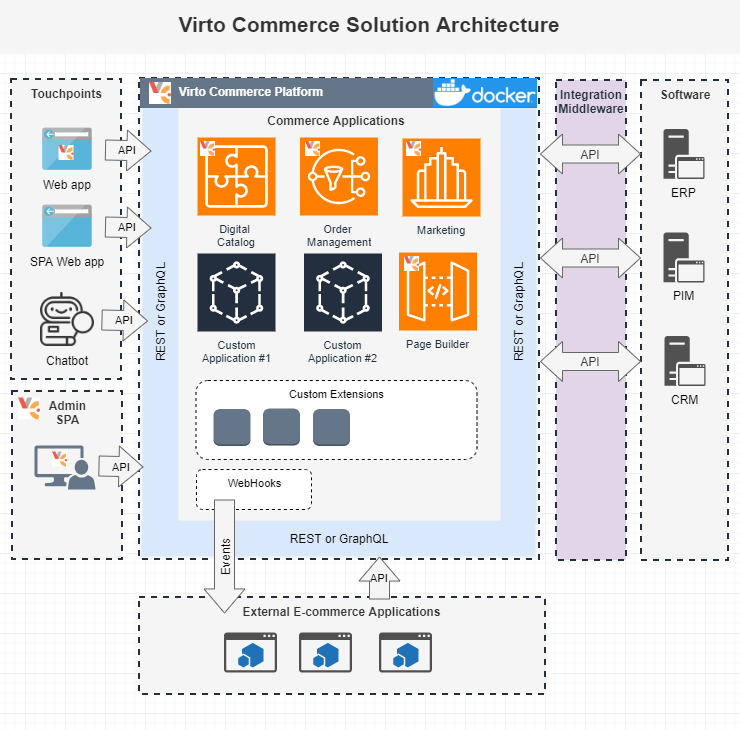
Virto Commerce Platform: Launches the ecommerce applications in the public, hybrid, and private cloud environments.
Commerce Applications: API-based, modular and extensible logical set of one or more headless microservices (modules) with a focus on the implementation of the business feature, such as Digital Catalog, Order Management, Content Management, Marketing, etc.
Custom Extensions: Virto Commerce Module that enables extending API model, persistent model, business logic, and admin UI within the commerce applications.
External Commerce Applications: Third-party ecommerce applications and services.
Touchpoints: Sell your products on the website, through a mobile application, chatbot or any third-party services: marketplace, dropshipping, or any other option you create. Virto Commerce Storefront Kit allows you to manage various brands and stores in the same environment and with the same features.
Admin SPA: Virto Commerce has an extensible and intuitive admin user interface, which allows you to manage data within your commerce applications across all channels.
Integration middleware: Asynchronous integration middleware for declarative integration with non-real-time and legacy services.
These Virto Commerce docs will help you learn and use the Virto Commerce platform, from your local solution to optimizing complex enterprise builds:
In our work, we make every effort to always use advanced technologies. We picked the techs below as a result of our extensive experience in working with Microsoft products:
[!TIP] AI helps at every step: Ask Virto OZ for documentation-grounded answers, Install Claude Code with Context7 for instant code changes, Add llms.txt to your prompts for zero-install documentation grounding
👨💻 Ai Quick Start
Use start-local to bring up the full stack (platform, frontend, database, Redis, Elasticsearch, Kibana) on your machine with one PowerShell command.
$installSCript = Invoke-WebRequest -Uri "https://raw.githubusercontent.com/VirtoCommerce/start-local/dev/VirtoLocal_create_local_files.ps1" -UseBasicParsing; Set-Content -Path ".\VirtoLocal_create_local_files.ps1" -Value $installSCript.Content; .\VirtoLocal_create_local_files.ps1
Or
Virto Commerce is designed to be extended. Start with Configure your custom solution
The Extensibility Framework lets you add entities, override services, extend APIs, and add admin UI — all without forking.
Working on the platform code itself? 📖 Run the platform from source in Visual Studio covers the prerequisites, where to keep your own connection strings and settings (user secrets and environment variables, never the shared appsettings*.json), and how to start the platform with F5 or dotnet run.
Virto Commerce ships as modules — independently versioned, independently deployable units. Modules combine into bundles you can pick from based on how you want to balance stability and speed.
| Release Strategy | What it is | Use it for |
|---|---|---|
| Stable | Quarterly release; passed full regression, E2E, and load testing | Production, new solution development (default in vc-build) |
| Hotfix | Bug fixes for the two most recent stable releases | Maintenance updates between stable cuts |
| Edge | Latest features as they land — minimal risk, maximum freshness | Early access to new capabilities, prototyping |
Every monthly release, rendered as an interactive Virto Commerce slide deck. Product, engineering, and business stakeholders review what shipped, mark features for their own backlog, then export a ready-to-paste Markdown table for Jira, Linear, or GitHub Issues.
We welcome contributions — code, docs, bug reports, and feature ideas. The fastest path:
Copyright (c) Virto Solutions LTD. All rights reserved.
Licensed under the Virto Commerce Open Software License (the "License"); you may not use this file except in compliance with the License. You may obtain a copy of the License at http://virtocommerce.com/open-source-license
Unless required by applicable law or agreed to in written form, the software distributed under the License is provided on an "AS IS" BASIS, WITHOUT WARRANTIES OR CONDITIONS OF ANY KIND, either express or implied.
37 followers · starred Mar 2017
130 followers · starred Jul 2019
12 followers · starred Jul 2015
Virto Commerce B2B Innovation Platform
See the code
Virto Commerce is an open-source platform for building extensible ecommerce applications. This includes complex digital commerce solutions for B2B, B2C, or B2B2C businesses, marketplaces, and derived SaaS commerce platforms.
Virto Commerce architecture is based on such principles as Microservices, API-first, Cloud-native, Headless, and Advanced Extensibility.
The main principle is to help the development teams focus on the implementation of business features without worrying about CLEAN ARCHITECTURE.
The following chart illustrates the high-level architecture and main areas of the Virto Commerce solutions:
Virto Commerce Platform: Launches the ecommerce applications in the public, hybrid, and private cloud environments.
Commerce Applications: API-based, modular and extensible logical set of one or more headless microservices (modules) with a focus on the implementation of the business feature, such as Digital Catalog, Order Management, Content Management, Marketing, etc.
Custom Extensions: Virto Commerce Module that enables extending API model, persistent model, business logic, and admin UI within the commerce applications.
External Commerce Applications: Third-party ecommerce applications and services.
Touchpoints: Sell your products on the website, through a mobile application, chatbot or any third-party services: marketplace, dropshipping, or any other option you create. Virto Commerce Storefront Kit allows you to manage various brands and stores in the same environment and with the same features.
Admin SPA: Virto Commerce has an extensible and intuitive admin user interface, which allows you to manage data within your commerce applications across all channels.
Integration middleware: Asynchronous integration middleware for declarative integration with non-real-time and legacy services.
These Virto Commerce docs will help you learn and use the Virto Commerce platform, from your local solution to optimizing complex enterprise builds:
In our work, we make every effort to always use advanced technologies. We picked the techs below as a result of our extensive experience in working with Microsoft products:
[!TIP] AI helps at every step: Ask Virto OZ for documentation-grounded answers, Install Claude Code with Context7 for instant code changes, Add llms.txt to your prompts for zero-install documentation grounding
👨💻 Ai Quick Start
Use start-local to bring up the full stack (platform, frontend, database, Redis, Elasticsearch, Kibana) on your machine with one PowerShell command.
$installSCript = Invoke-WebRequest -Uri "https://raw.githubusercontent.com/VirtoCommerce/start-local/dev/VirtoLocal_create_local_files.ps1" -UseBasicParsing; Set-Content -Path ".\VirtoLocal_create_local_files.ps1" -Value $installSCript.Content; .\VirtoLocal_create_local_files.ps1
Or
Virto Commerce is designed to be extended. Start with Configure your custom solution
The Extensibility Framework lets you add entities, override services, extend APIs, and add admin UI — all without forking.
Working on the platform code itself? 📖 Run the platform from source in Visual Studio covers the prerequisites, where to keep your own connection strings and settings (user secrets and environment variables, never the shared appsettings*.json), and how to start the platform with F5 or dotnet run.
Virto Commerce ships as modules — independently versioned, independently deployable units. Modules combine into bundles you can pick from based on how you want to balance stability and speed.
| Release Strategy | What it is | Use it for |
|---|---|---|
| Stable | Quarterly release; passed full regression, E2E, and load testing | Production, new solution development (default in vc-build) |
| Hotfix | Bug fixes for the two most recent stable releases | Maintenance updates between stable cuts |
| Edge | Latest features as they land — minimal risk, maximum freshness | Early access to new capabilities, prototyping |
Every monthly release, rendered as an interactive Virto Commerce slide deck. Product, engineering, and business stakeholders review what shipped, mark features for their own backlog, then export a ready-to-paste Markdown table for Jira, Linear, or GitHub Issues.
We welcome contributions — code, docs, bug reports, and feature ideas. The fastest path:
Copyright (c) Virto Solutions LTD. All rights reserved.
Licensed under the Virto Commerce Open Software License (the "License"); you may not use this file except in compliance with the License. You may obtain a copy of the License at http://virtocommerce.com/open-source-license
Unless required by applicable law or agreed to in written form, the software distributed under the License is provided on an "AS IS" BASIS, WITHOUT WARRANTIES OR CONDITIONS OF ANY KIND, either express or implied.
37 followers · starred Mar 2017
130 followers · starred Jul 2019
12 followers · starred Jul 2015





