Analysis of the listening test that measures the phoneme intelligibility of anonymized speech with the DALT (Diagnostic Alliteration Test, Recommendation ITU-T P.807), and its prediction by an ensemble of 12 ASR models.
Python
0
1 commits
updated Oct 6, 2026

Analysis of the listening test that measures the phoneme intelligibility of anonymized speech with the DALT (Diagnostic Alliteration Test, Recommendation ITU-T P.807), and its prediction by an ensemble of 12 ASR models.
The listening test itself (anonymized audio, item lists) is prepared in the DALT-ANON repository. This repository:
take_the_test.py, which estimates the human intelligibility of a new
anonymization system from the ASR ensemble, without a listening test.data/
human_ratings.db human answers of the listening test (SQLite)
ASR_ratings.db ASR answers, one table per model and carrier configuration
audio/ not versioned, see below
samples/
clean/English/test-data/ clean recordings
clean/English/test_design.csv metadata of the clean recordings
<condition>/ anonymized versions (B2_mcadams, B3_sttts, B4_nac, B5_asr_bn)
your_anonymizer/ the audio of your system, for take_the_test.py
level_normalized_26dbfs_w_concat_carrier_phrase_2/
versions with a 5-word carrier sentence, see concat_metadata.csv
TTS_Qwen/ TTS versions, with the carrier "please select the word <word>"
The audio files are not included in this repository. Download the content of
data/audio/samples from the DALT-ANON-STUDY repository (DALT-ANON-STUDY/data/audio/samples).
A script to download the content is provided in data/audio/README.md.
Conditions. The 2006 items rated by humans are spread over 6 conditions: clean,
B2_mcadams, B3_sttts, B4_nac, B5_asr_bn (VoicePrivacy Challenge baselines) and
TTS_Qwen. Each item is a DALT trial: a recorded word (the present word) and the other word
of its pair (the absent word), which differ by one consonant, initial or final (test_type),
along one phonetic feature (Voicing, Nasality, Sustention, Sibilation, Graveness,
Compactness).
Human intelligibility. Each answer is scored +1 if right and −1 if wrong, and averaged
per item: (right − wrong) / total, in [−1, 1]. Only the sessions that passed both the golden
and the trap questions are kept (get_human_ratings in src/utils.py).
ASR intelligibility. For each item, every model chooses one of the two words of the
pair. Let p be the probability of the chosen word; since the choice is restricted to the
two words, p(present) + p(absent) = 1 for each model. The answers of the 12 models are
pooled and scored with one of 3 methods, where ± is + if the model
chose the present word and − otherwise:
| Metric | Definition |
|---|---|
HARD_VOTING | Σ(±1) / count: same scale as the human intelligibility |
SOFT_VOTING | Σ(±p) / Σp: answers weighted by the confidence of the model |
LOG_LIKELIHOOD_RATIO | Σ log p(present) − Σ log p(absent) per item, averaged over the items |
The sums run over the 12 models (and over both carrier configurations when they are pooled). Summing the log-probabilities of the models multiplies their likelihoods, i.e. treats the models as independent judges of the same item.
| Model | Backend in src/models/ |
|---|---|
CohereLabs/cohere-transcribe-03-2026 | cohere.py |
facebook/wav2vec2-lv-60-espeak-cv-ft | wav2vec2_espeak.py |
facebook/wav2vec2-xlsr-53-espeak-cv-ft | wav2vec2_espeak.py |
openai/whisper-large-v3 | whisper.py |
openai/whisper-large-v3-turbo | whisper.py |
distil-whisper/distil-large-v3.5 | whisper.py |
nvidia/canary-qwen-2.5b | canary_qwen.py |
Qwen/Qwen3-ASR-1.7B-hf | qwen_transformers.py |
Qwen/Qwen3-ASR-0.6B-hf | qwen_transformers.py |
ibm-granite/granite-4.0-1b-speech | granite_ibm.py |
ibm-granite/granite-speech-4.1-2b | granite_ibm.py |
ibm-granite/granite-speech-4.1-2b-plus | granite_ibm.py |
Every backend implements load_model(model_name) and
generate_tokens_from_audio(audio_path, …, word_a, word_b, carrier_phrase), which constrains
the generation to the two words of the pair (optionally preceded by the carrier phrase) and
returns the chosen word with its probability. The models are downloaded from the Hugging Face
Hub on first use.
All scripts are run from the repository root, and --help lists their options.
src/take_the_test.pyAnonymize the clean recordings of data/audio/samples/clean/English/test-data (the files
without carrier phrase) with your system, keeping the file names.
Put the anonymized files in data/audio/samples/your_anonymizer (or any folder name
you like, e.g. data/audio/samples/my_system).
Run:
uv run src/take_the_test.py --audio-folder data/audio/samples/your_anonymizer --name your_anonymizer
The script maps the files to their DALT trial with test_design.csv (1152 trials: 12
recordings are used in two word pairs), runs the 12 ASR models, scores them with
HARD_VOTING, then maps the ASR score to an estimated human intelligibility with the linear
regressions fitted on the 6 conditions rated by humans:
| Aggregation | Fitted on | Regression line |
|---|---|---|
| a. all samples | 6 conditions | y = 0.733863 x + 0.254060 |
| b. per test type | 12 (condition, test type) pairs | y = 0.756790 x + 0.236537 |
| c. per feature | 36 (condition, feature) pairs | y = 0.788272 x + 0.212755 |
The estimates are printed and saved to data/take_the_test/<name>_estimates.csv, on the
same scale as the human intelligibility ((right − wrong) / total). The ASR answers are stored
in data/take_the_test/<name>.db, one table per model: an interrupted run resumes with the
models not evaluated yet, --skip-asr only recomputes the estimates and --overwrite reruns
all the models. Running the 12 models on 1152 trials can take a while; a GPU is strongly
recommended.
src/run_eval.pyRuns one or several models on the 2006 items of the listening test and writes the answers to
data/ASR_ratings.db (one table per model and carrier configuration, e.g.
results_openai_whisper_large_v3_without_carrier_phrase). The item lists are read from
data/samples/*.csv (generated by DALT-ANON).
uv run src/run_eval.py --models openai/whisper-large-v3 Qwen/Qwen3-ASR-0.6B-hf --carrier-phrase
The answers are written by batches of 500, so a crash only loses the last batch. An existing
table is never appended to: the script stops before starting, unless --overwrite is given.
src/plot_ASR_and_human_intelligibility_correlation.pyFits the linear regression of the human on the ASR intelligibility, prints R, R², the
regression line, the RMSE before (identity line) and after the regression, and checks the
residuals (Breusch-Pagan test for heteroscedasticity, Shapiro-Wilk test and QQ plot for
normality). --merge sets the columns defining one item, i.e. the aggregation level.
uv run src/plot_ASR_and_human_intelligibility_correlation.py --metric HARD_VOTING --merge condition feature
The regression lines used by take_the_test.py are obtained with --metric HARD_VOTING --carrier-phrase without and --merge condition, condition test_type or
condition feature.
src/compare_ASR_correlations_steiger_williams.pySteiger-Williams test (Williams' t) of the difference between two dependent correlations with the human intelligibility, computed on the same items:
# Two metrics on the same carrier phrase configuration
uv run src/compare_ASR_correlations_steiger_williams.py metrics --metrics HARD_VOTING SOFT_VOTING

# Two carrier phrase configurations with the same metric
uv run src/compare_ASR_correlations_steiger_williams.py carrier-phrase --metric LOG_LIKELIHOOD_RATIO --carrier-phrases without both
src/compute_split_half_human.pySplit-half reliability: the ratings of each item are randomly split into two halves of 4, the item means of both halves are correlated, and the correlation is corrected with the Spearman-Brown formula. The split is repeated to give the mean reliability and its 95 % interval.
uv run src/compute_split_half_human.py --n-iterations 100
src/
  take_the_test.py                                 estimate the intelligibility of a new system
  run_eval.py                                      run the ASR models on the DALT items
  plot_ASR_and_human_intelligibility_correlation.py
  compare_ASR_correlations_steiger_williams.py
  compute_split_half_human.py
  utils.py                                         loading of the human and ASR ratings
  correlation/                                     shared code of the correlation scripts
    config.py                                        default settings (models, metric, items)
    data.py                                          loading, aggregation and merging of the ratings
    stats.py                                         regression, residual diagnostics, Steiger-Williams test
    plots.py                                         correlation and QQ plots
    cli.py                                           shared command line options
  models/                                          one backend per ASR model family
img/                                               figures, see Results
  human/                                           human listening test
  asr_vs_human/                                    ASR vs human correlation
  calibration/                                     calibration of the ASR models
  unused/                                          duplicates and older versions, not shown
The project uses uv and Python ≥ 3.13 (3.13 pinned in
.python-version).
uv sync
The scripts use paths relative to the repository root and must be run from it. A GPU is recommended to run the ASR models.
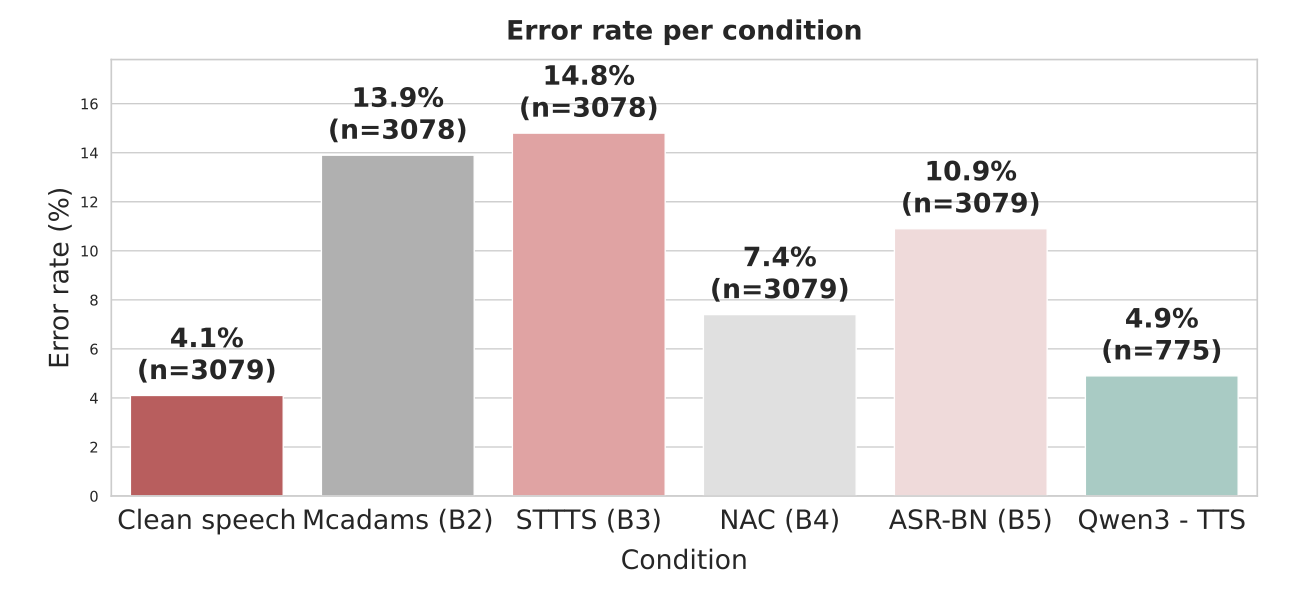
Error rate per condition. Clean speech gives 4.1 % of errors and the TTS condition 4.9 %. Among the anonymization systems, NAC (B4) preserves intelligibility best (7.4 %), followed by ASR-BN (B5, 10.9 %), McAdams (B2, 13.9 %) and STTTS (B3, 14.8 %). The TTS condition has 4 times fewer trials, since it uses a single voice.
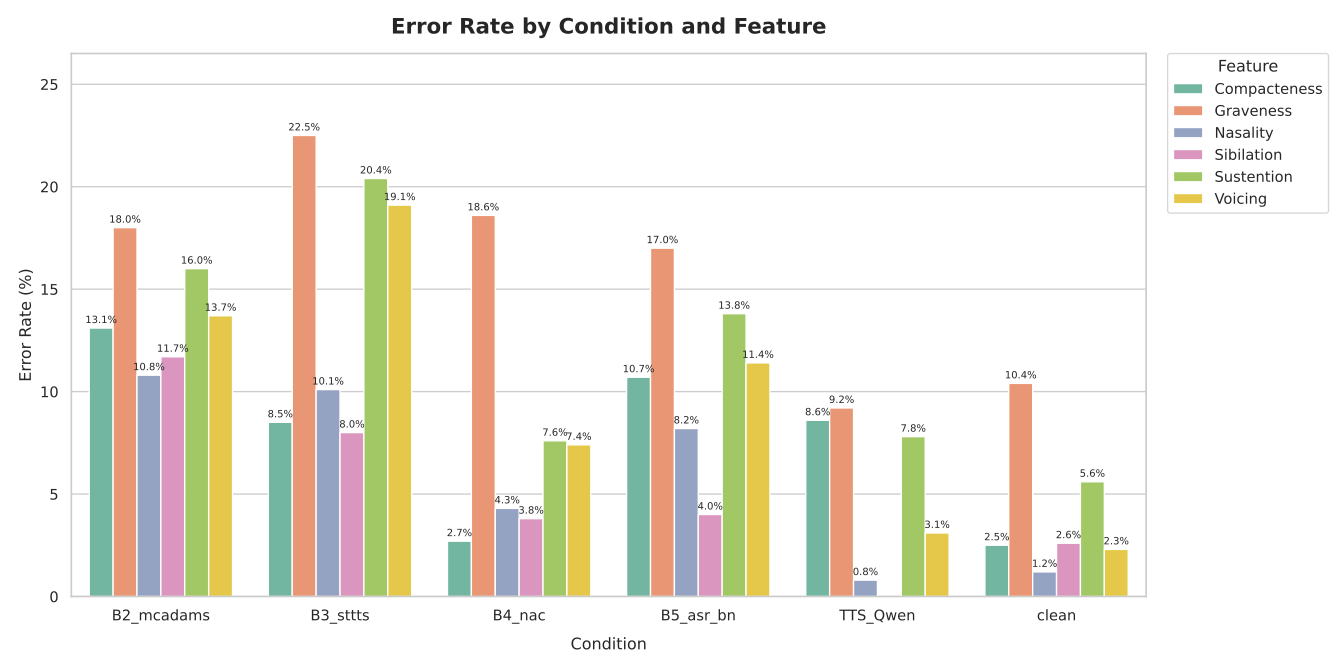
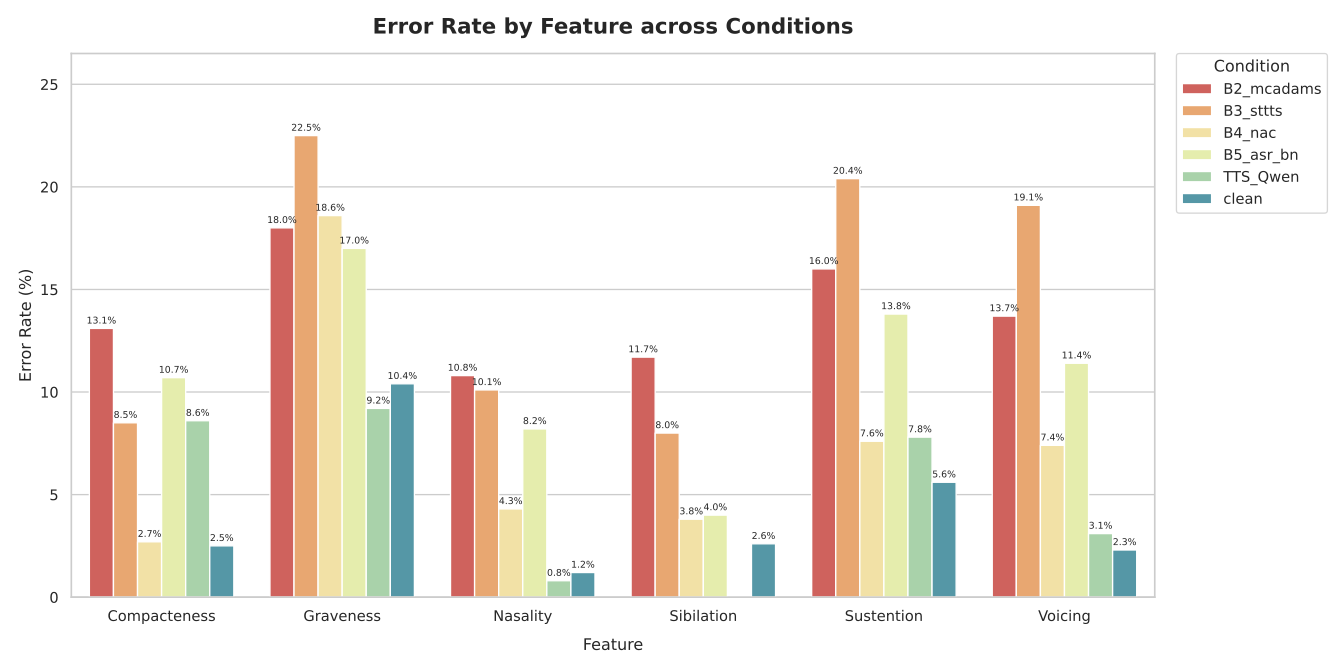
Per phonetic feature. The same data split by feature, grouped by condition and then by feature. Graveness is the hardest feature in every condition (from 9.2 % for TTS Qwen to 22.5 % for B3), while nasality and sibilation are the most robust.
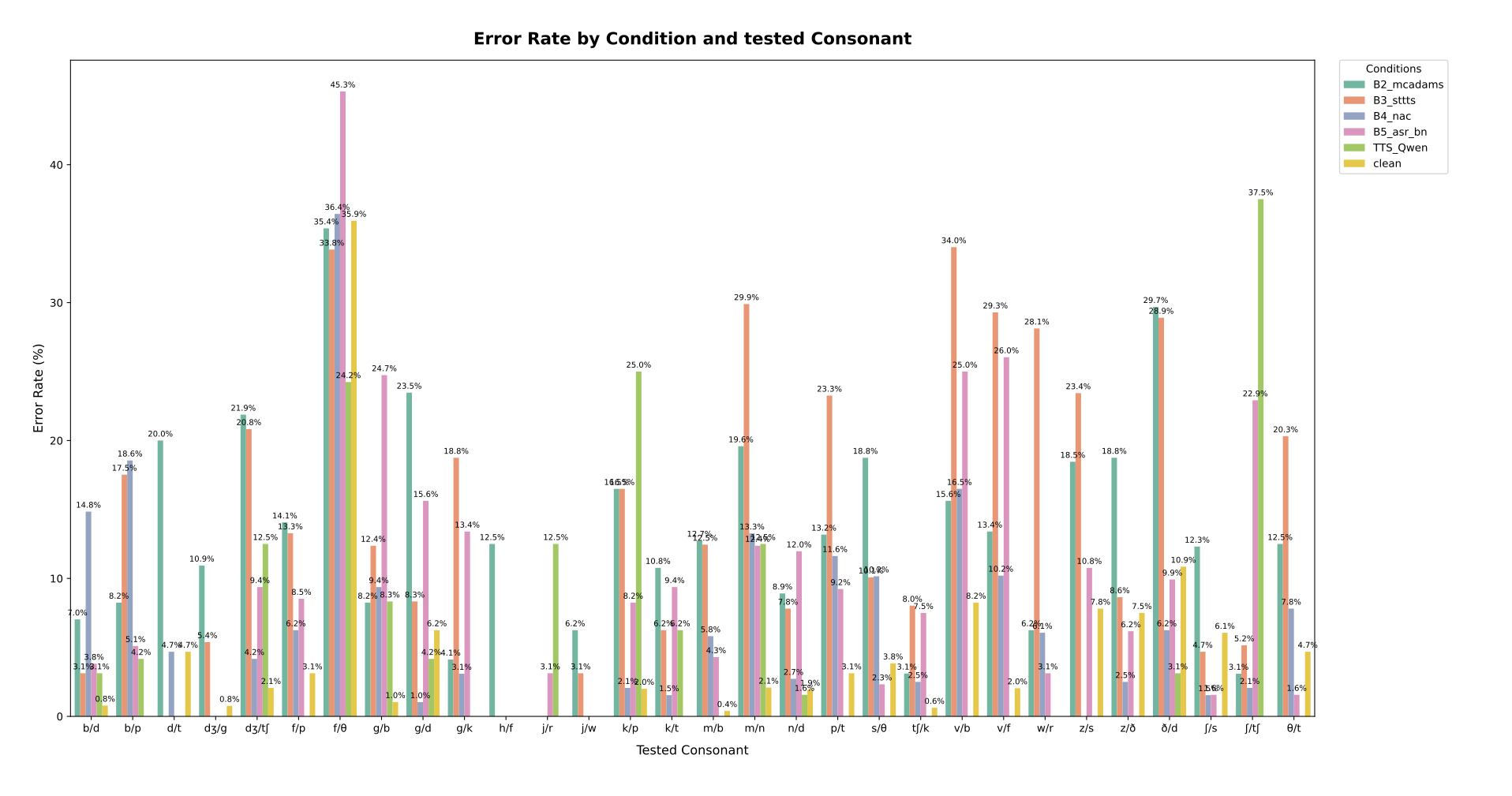
Per tested consonant pair. The errors concentrate on a few contrasts, such as f/θ in every condition.
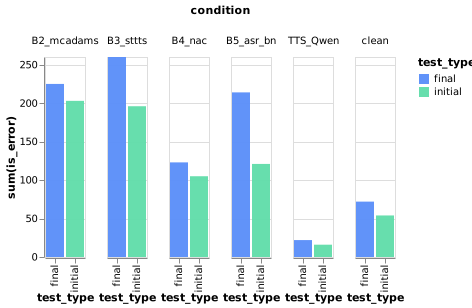
Per test type. Number of errors on the initial and on the final consonant: the final consonant gives more errors in every condition.
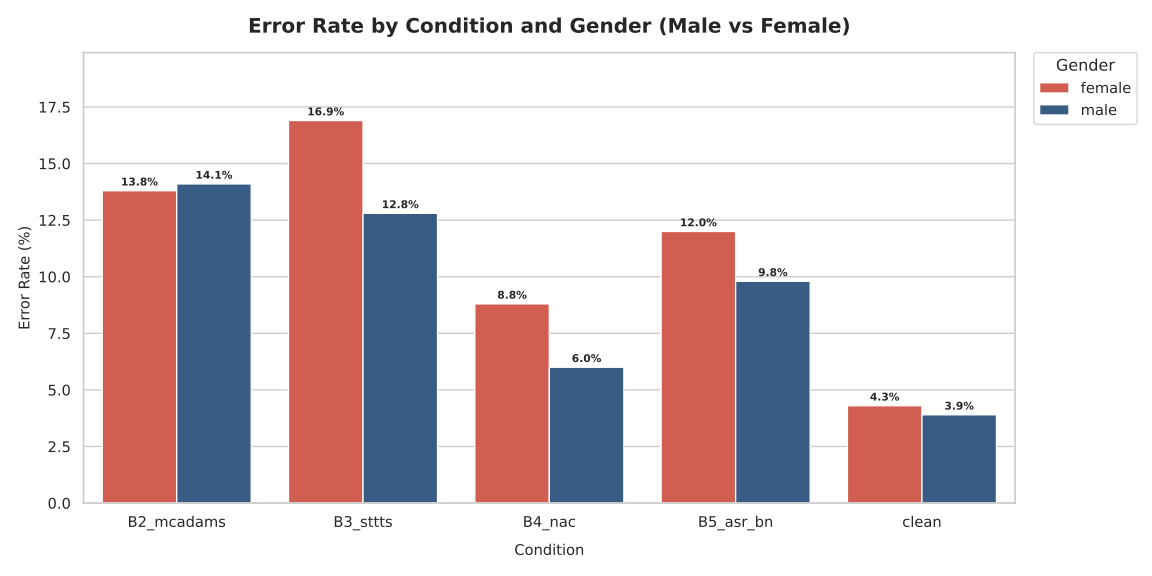
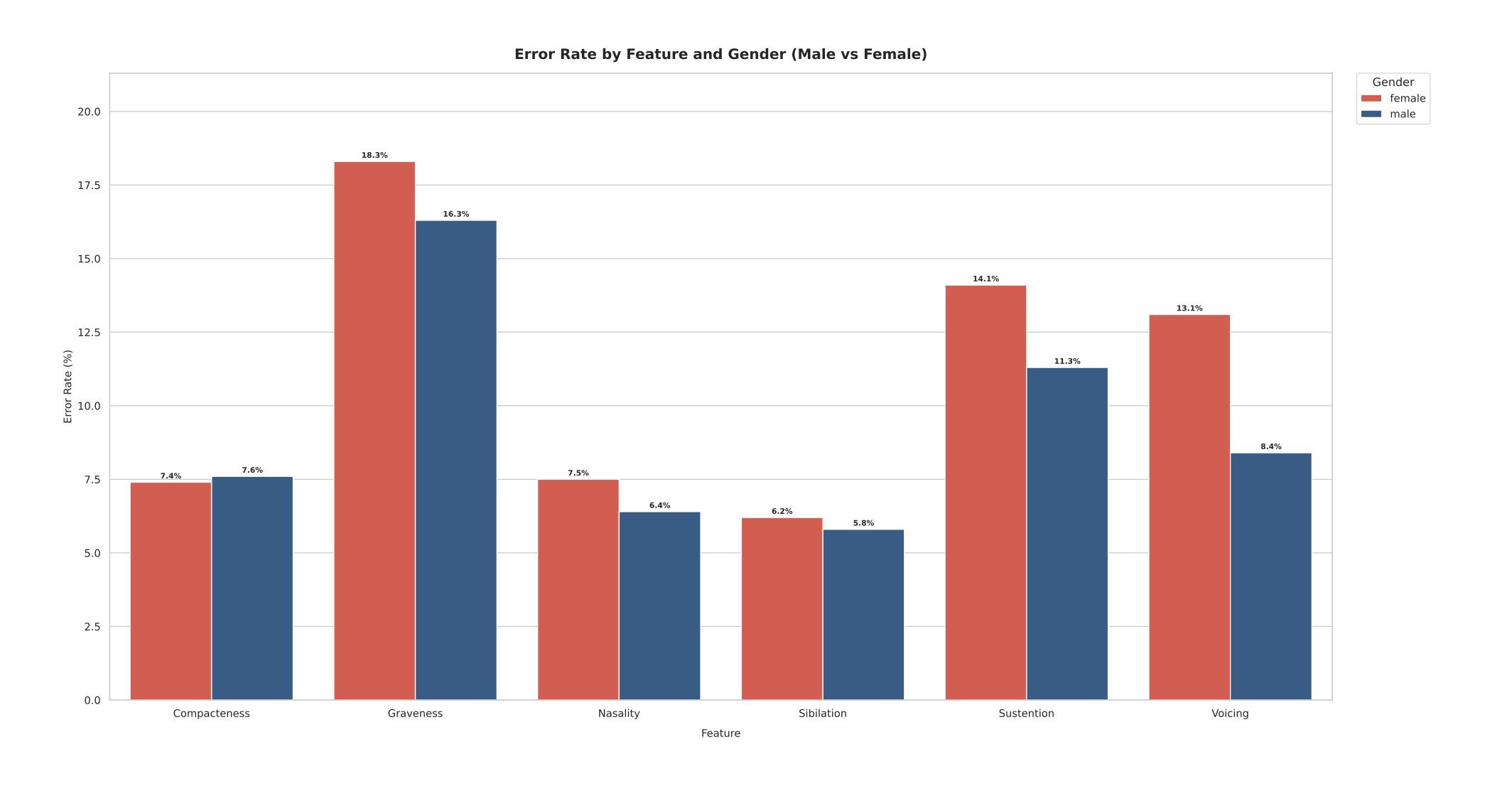
Per talker gender. The female talkers give more errors than the male talkers in most conditions, especially B3 and B4; per feature, the gap is largest for voicing and sustention.
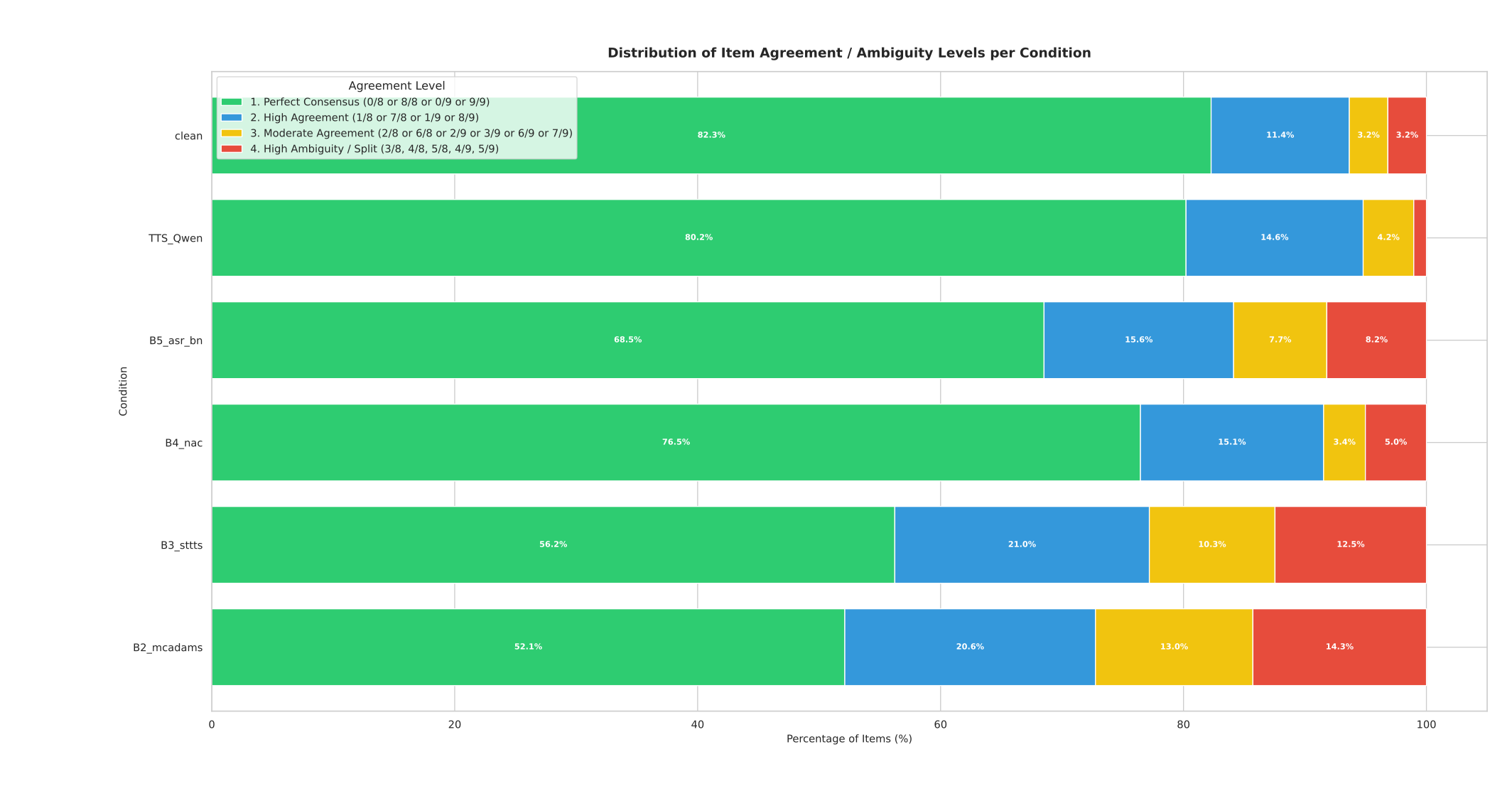
Listener agreement. Share of items per agreement level among the 8 or 9 listeners of each item. All listeners agree on 82.3 % of the clean items but only on 52.1 % of the B2 items, where 14.3 % of the items are highly ambiguous.
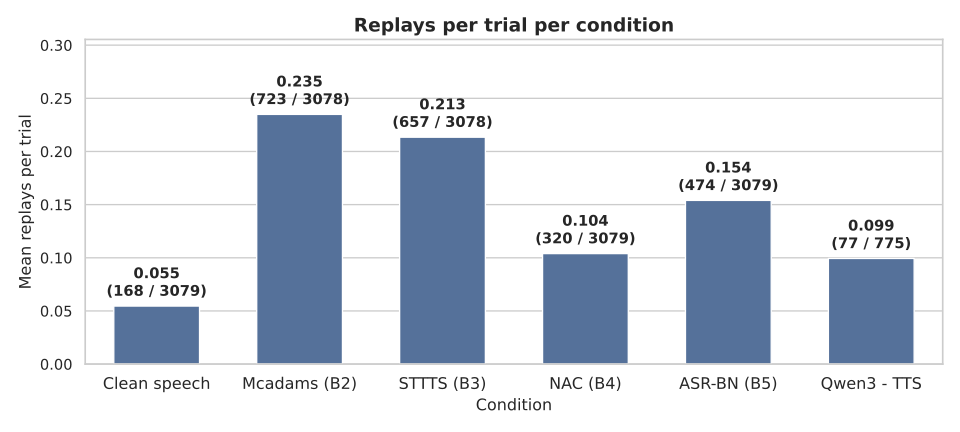
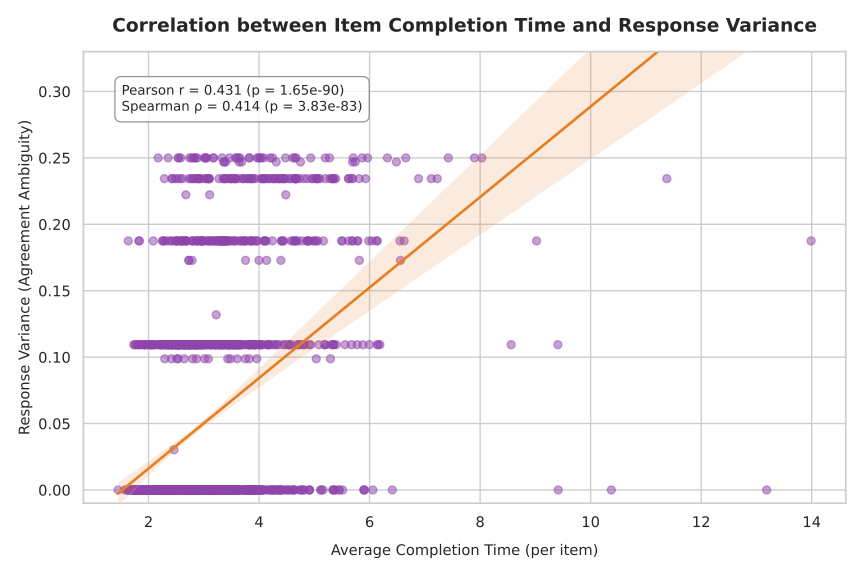
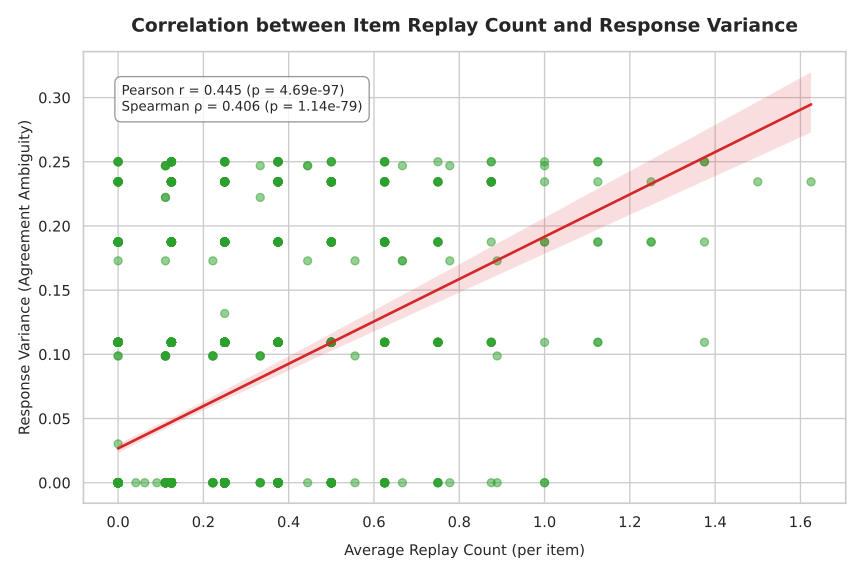
Listening behavior. Mean number of replays per trial: the listeners replay the B2 and B3 audio about 4 times more often than clean speech (0.235 and 0.213 vs 0.055 replays per trial), roughly following the error rates (only B2 and B3 swap places). The answer variance of an item also correlates with its average completion time (Pearson r = 0.43) and replay count (r = 0.45): ambiguous items take longer and are replayed more.
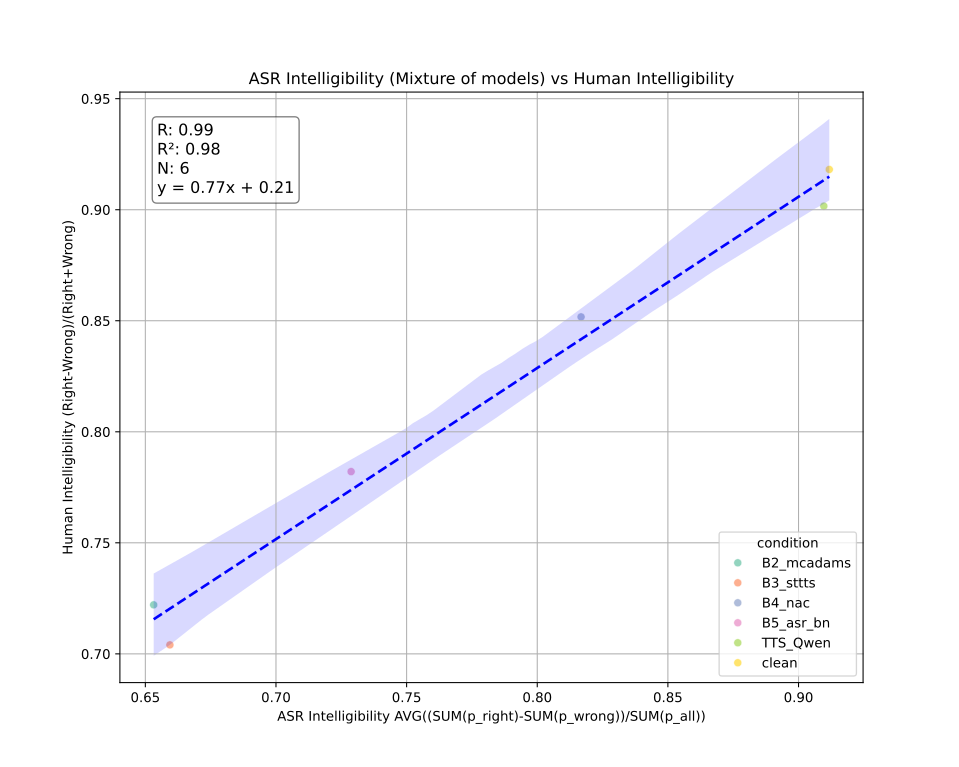
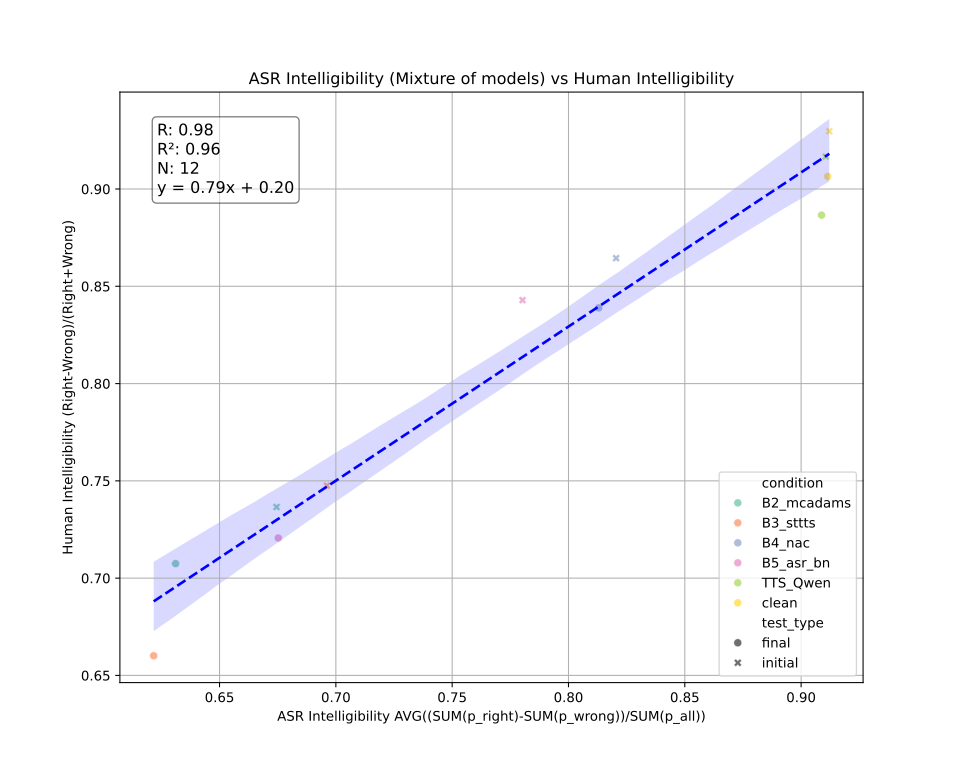
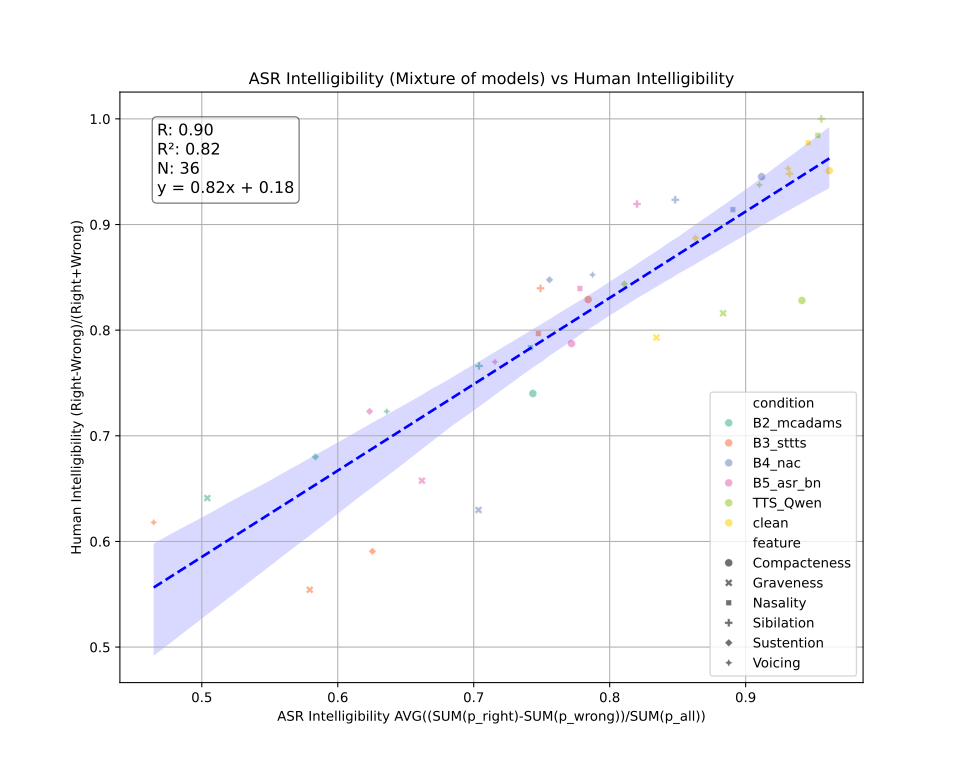
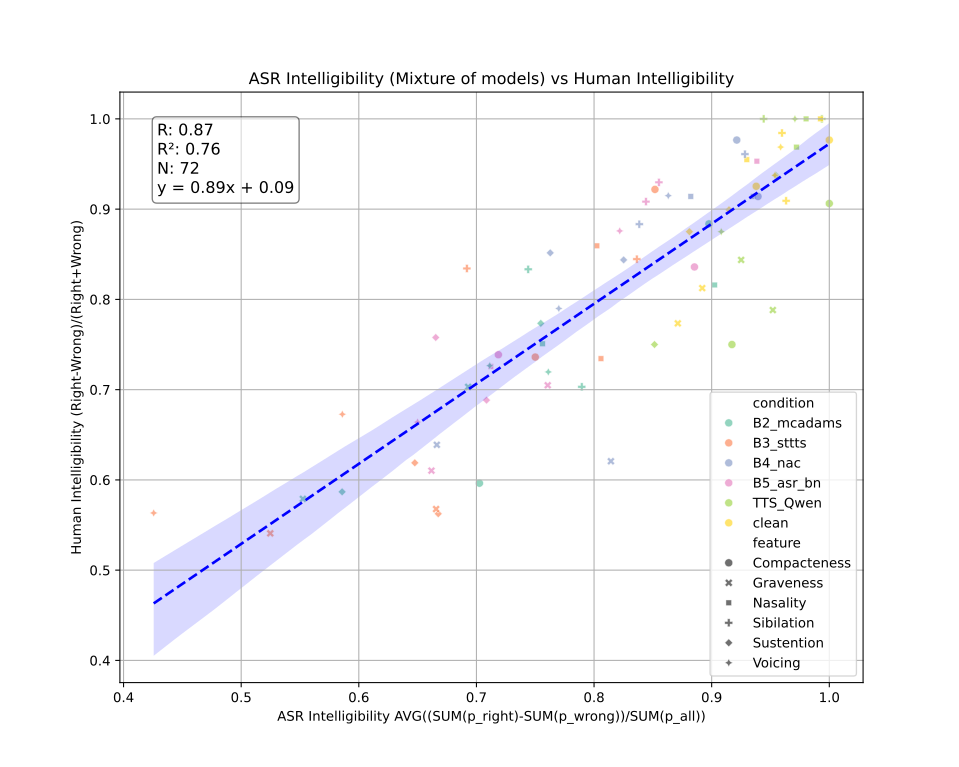
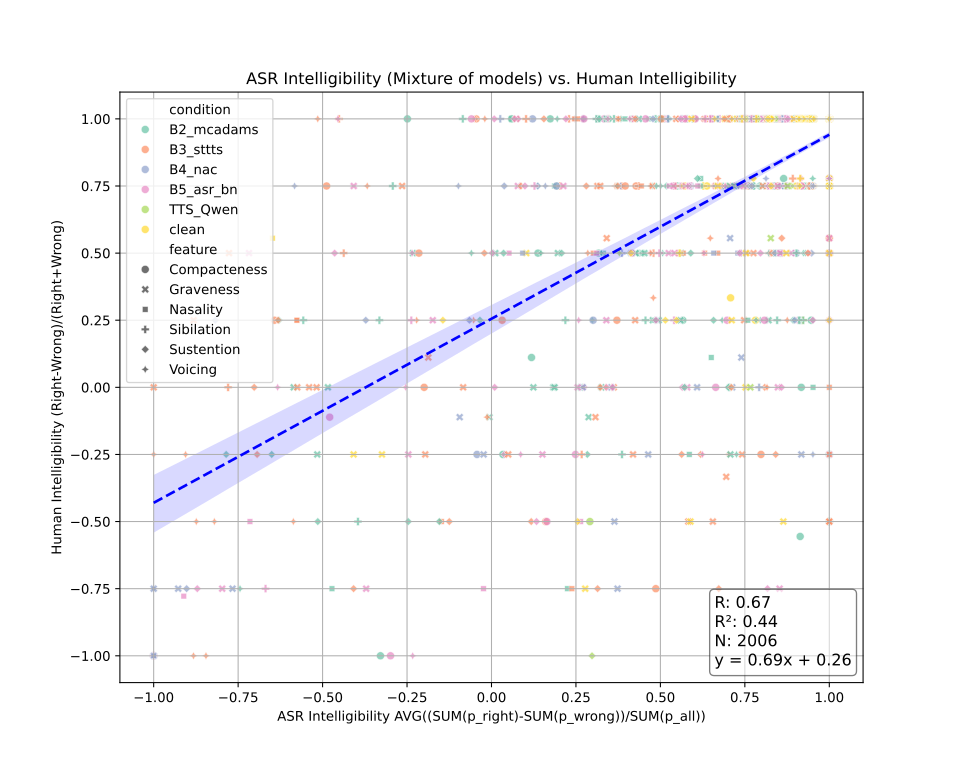
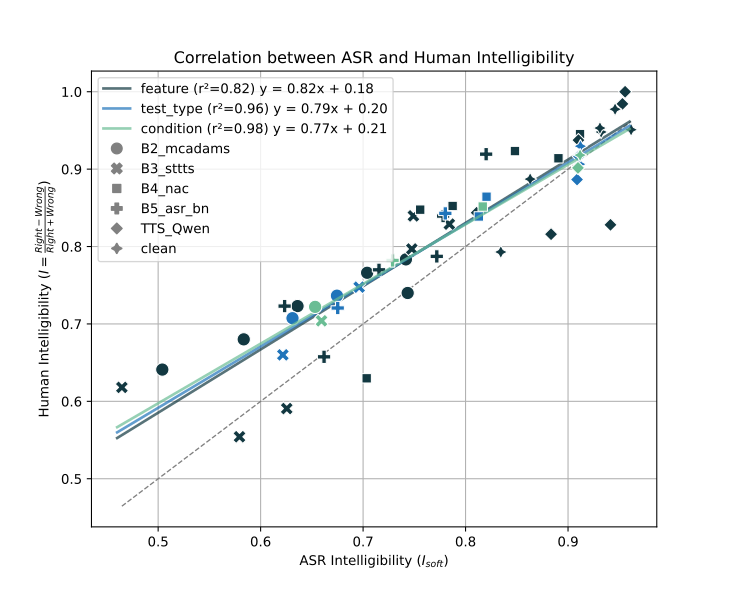
Linear regression of the human intelligibility on the ASR intelligibility (SOFT_VOTING,
12 models pooled), from the coarsest to the finest aggregation level
(plot script).
take_the_test.py uses the same approach with HARD_VOTING.
| Items | N | Carrier phrase | R | R² |
|---|---|---|---|---|
| condition | 6 | without | 0.99 | 0.98 |
| condition × test type | 12 | without | 0.98 | 0.96 |
| condition × feature | 36 | without | 0.90 | 0.82 |
| condition × test type × feature | 72 | with and without pooled | 0.87 | 0.76 |
| item | 2006 | with and without pooled | 0.67 | 0.44 |
The ASR ensemble ranks the conditions almost perfectly, and the correlation decreases as the items get finer and noisier. The points lie above the identity line (grey dashed line of the last figure): the ASR ensemble slightly underestimates the human intelligibility, which the linear mapping corrects.
The three aggregation levels used by take_the_test.py on the same figure:
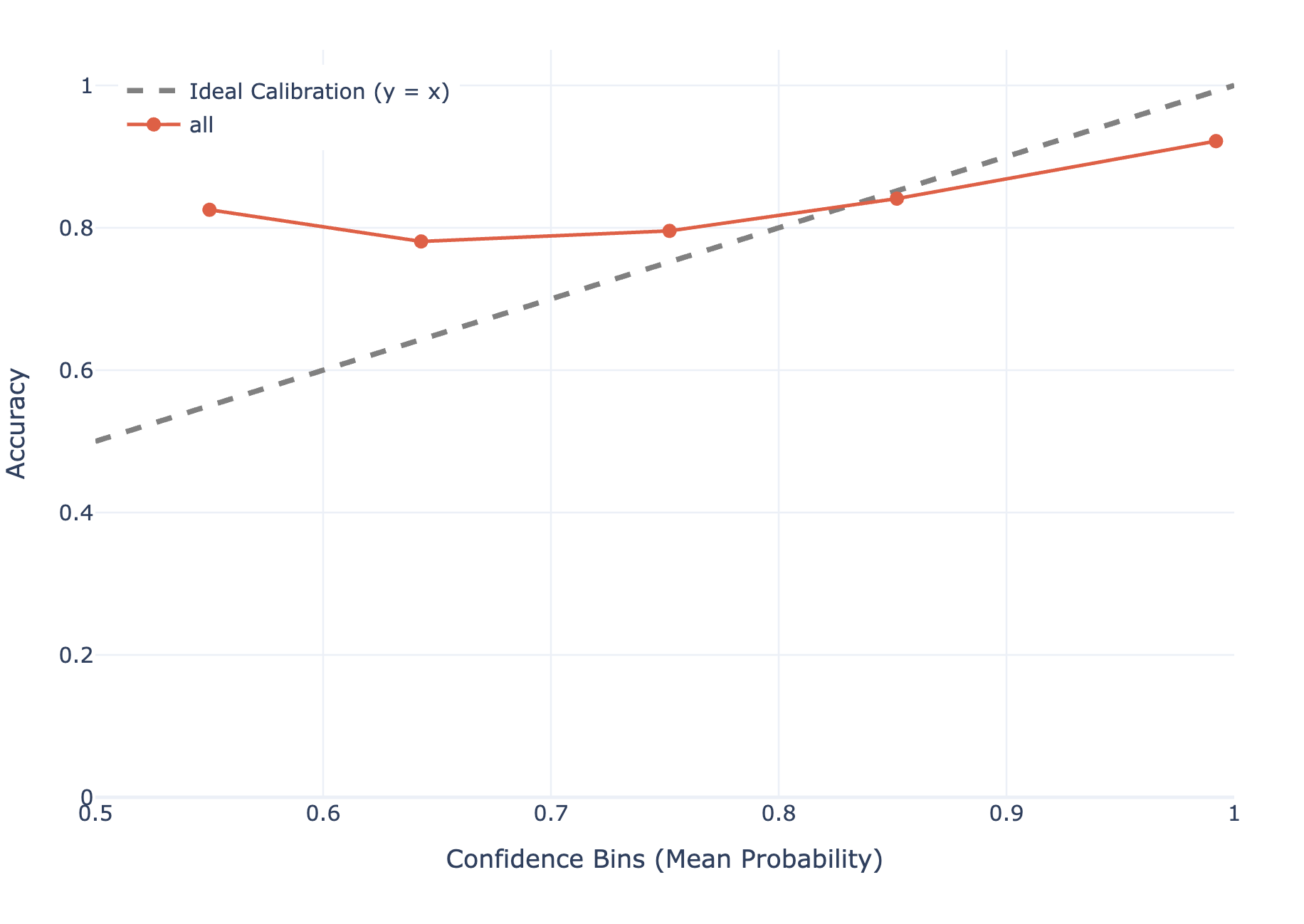
Reliability diagrams (ECE): accuracy of the ASR answers per confidence bin, the ideal calibration being the diagonal. Pooled over the 12 models, without carrier phrase, the models are underconfident at low confidence and slightly overconfident at the highest confidence. With the carrier phrase, the calibration is less regular. Per model, the wav2vec2 models are underconfident, while the Granite Speech 4.1 models are the least calibrated, especially with the carrier phrase.
| Without carrier phrase | With carrier phrase | |
|---|---|---|
| Pooled | 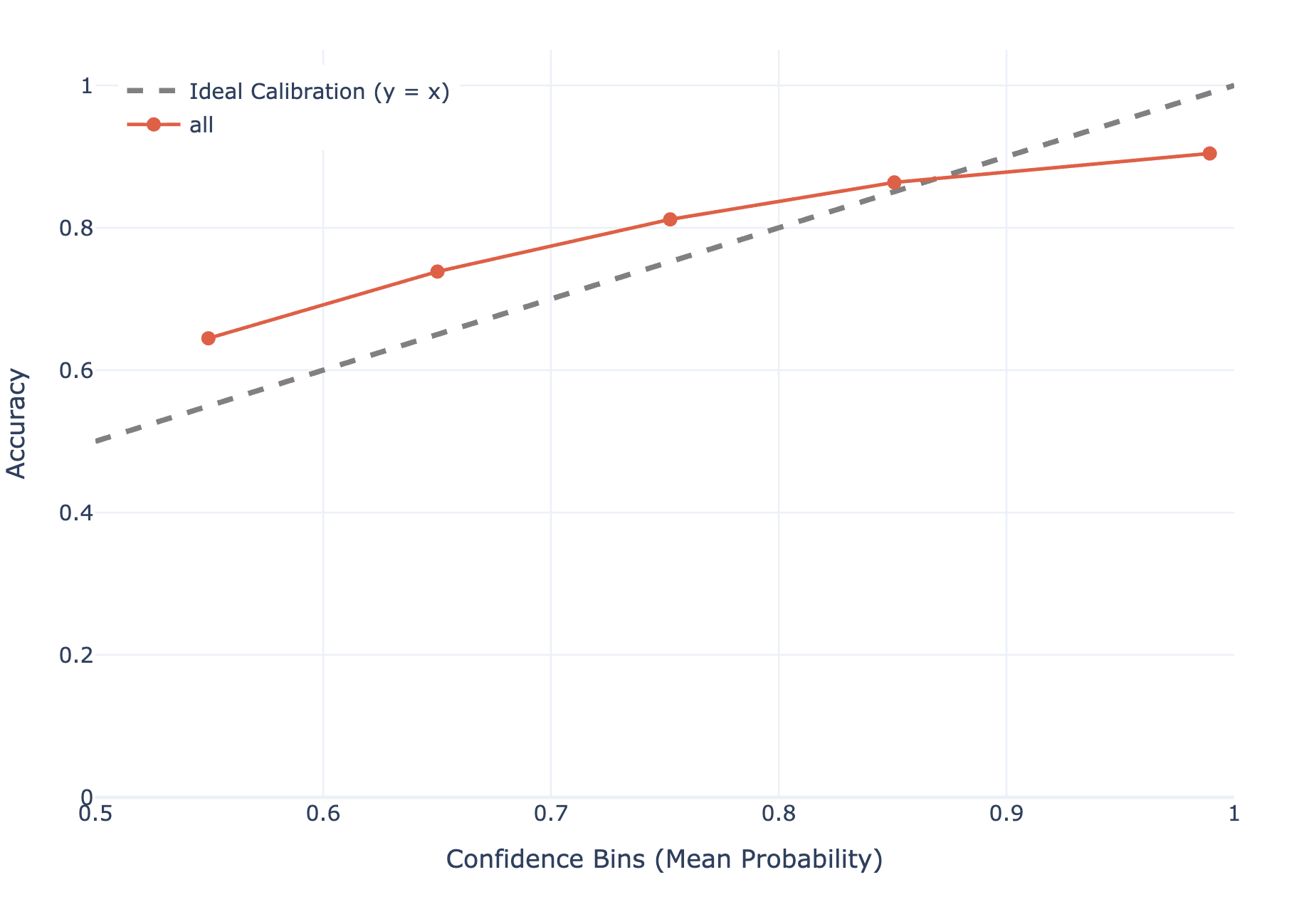 | 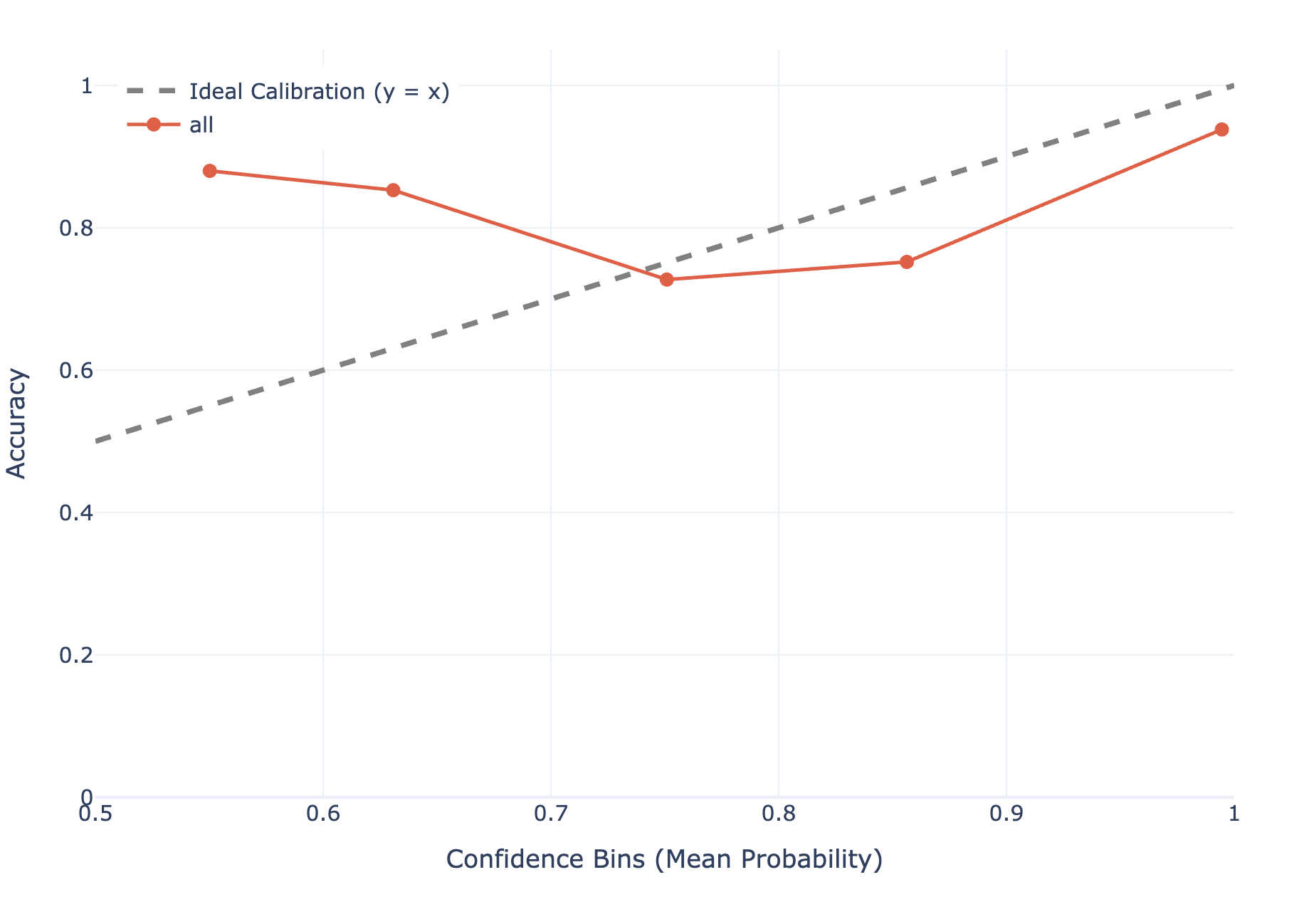 |
| Per model | 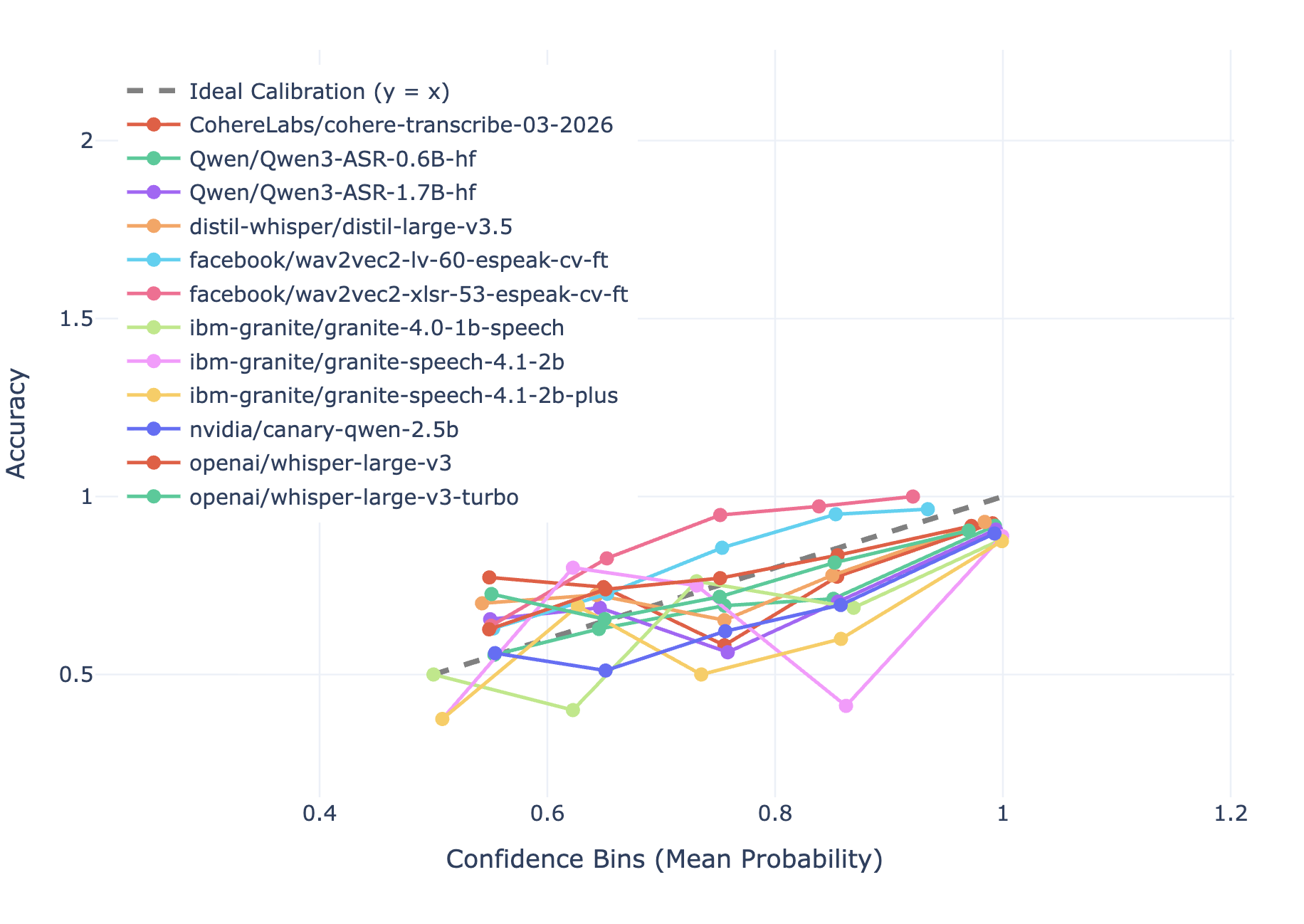 | 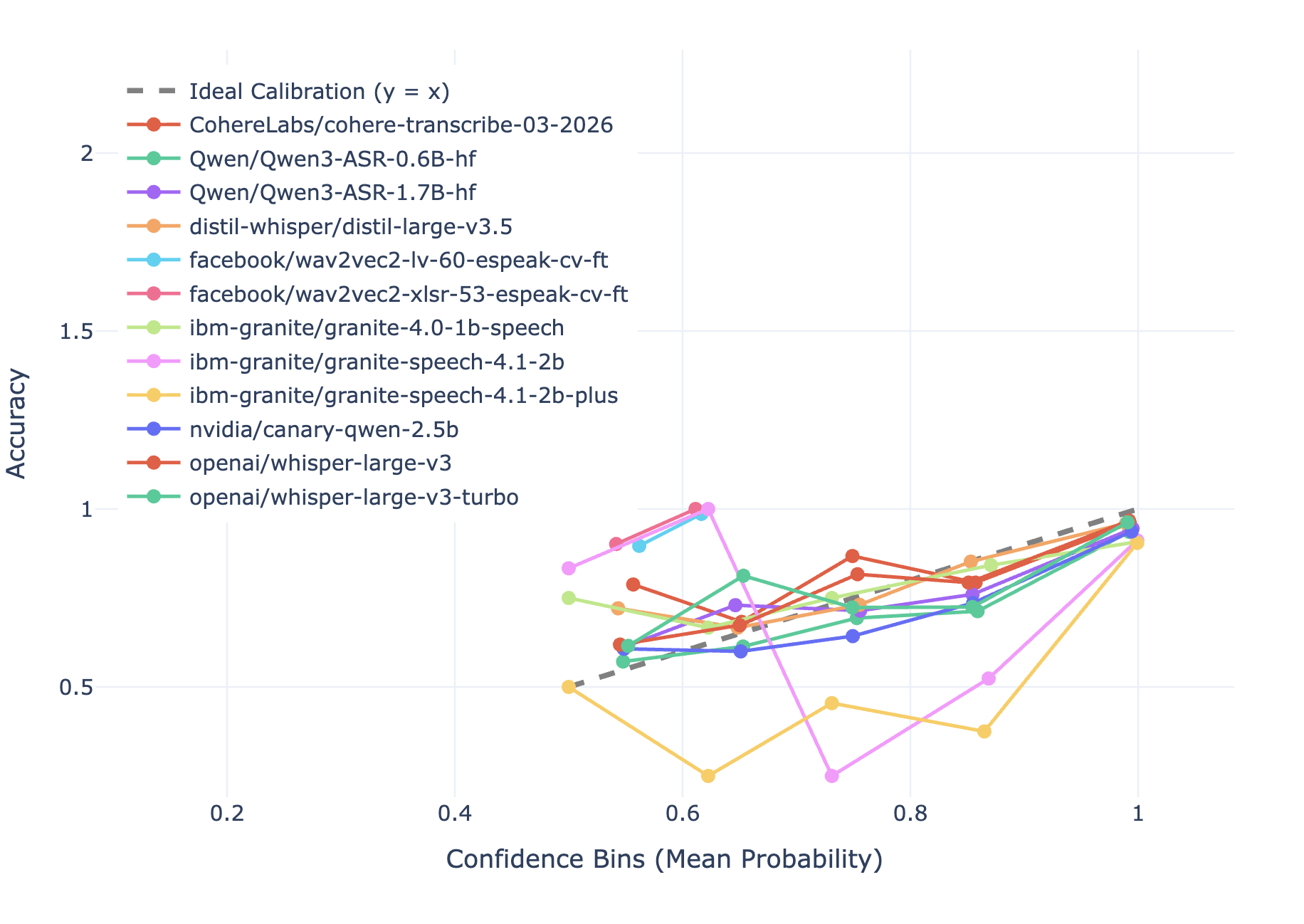 |
Both carrier phrase configurations pooled:
The source code is released under the MIT license. The audio files are not covered by the MIT license: they keep the licenses of their sources, described in data/audio/README.md.
If you use this repository, please cite:
V. Ménestrel, S. Möller, S. Ouni and D. Kolossa, "ASR ensembling for phoneme intelligibility evaluation of speech anonymizers", arXiv preprint arXiv:2609.28577, 2026.
@article{menestrel2026asr,
  title   = {{ASR} ensembling for phoneme intelligibility evaluation of speech anonymizers},
  author  = {M{\'e}nestrel, Victor and M{\"o}ller, Sebastian and Ouni, Slim and Kolossa, Dorothea},
  journal = {arXiv preprint arXiv:2609.28577},
  year    = {2026}
}
Analysis of the listening test that measures the phoneme intelligibility of anonymized speech with the DALT (Diagnostic Alliteration Test, Recommendation ITU-T P.807), and its prediction by an ensemble of 12 ASR models.
Python
0
1 commits
updated Oct 6, 2026
Analysis of the listening test that measures the phoneme intelligibility of anonymized speech with the DALT (Diagnostic Alliteration Test, Recommendation ITU-T P.807), and its prediction by an ensemble of 12 ASR models.
The listening test itself (anonymized audio, item lists) is prepared in the DALT-ANON repository. This repository:
take_the_test.py, which estimates the human intelligibility of a new
anonymization system from the ASR ensemble, without a listening test.data/
human_ratings.db human answers of the listening test (SQLite)
ASR_ratings.db ASR answers, one table per model and carrier configuration
audio/ not versioned, see below
samples/
clean/English/test-data/ clean recordings
clean/English/test_design.csv metadata of the clean recordings
<condition>/ anonymized versions (B2_mcadams, B3_sttts, B4_nac, B5_asr_bn)
your_anonymizer/ the audio of your system, for take_the_test.py
level_normalized_26dbfs_w_concat_carrier_phrase_2/
versions with a 5-word carrier sentence, see concat_metadata.csv
TTS_Qwen/ TTS versions, with the carrier "please select the word <word>"
The audio files are not included in this repository. Download the content of
data/audio/samples from the DALT-ANON-STUDY repository (DALT-ANON-STUDY/data/audio/samples).
A script to download the content is provided in data/audio/README.md.
Conditions. The 2006 items rated by humans are spread over 6 conditions: clean,
B2_mcadams, B3_sttts, B4_nac, B5_asr_bn (VoicePrivacy Challenge baselines) and
TTS_Qwen. Each item is a DALT trial: a recorded word (the present word) and the other word
of its pair (the absent word), which differ by one consonant, initial or final (test_type),
along one phonetic feature (Voicing, Nasality, Sustention, Sibilation, Graveness,
Compactness).
Human intelligibility. Each answer is scored +1 if right and −1 if wrong, and averaged
per item: (right − wrong) / total, in [−1, 1]. Only the sessions that passed both the golden
and the trap questions are kept (get_human_ratings in src/utils.py).
ASR intelligibility. For each item, every model chooses one of the two words of the
pair. Let p be the probability of the chosen word; since the choice is restricted to the
two words, p(present) + p(absent) = 1 for each model. The answers of the 12 models are
pooled and scored with one of 3 methods, where ± is + if the model
chose the present word and − otherwise:
| Metric | Definition |
|---|---|
HARD_VOTING | Σ(±1) / count: same scale as the human intelligibility |
SOFT_VOTING | Σ(±p) / Σp: answers weighted by the confidence of the model |
LOG_LIKELIHOOD_RATIO | Σ log p(present) − Σ log p(absent) per item, averaged over the items |
The sums run over the 12 models (and over both carrier configurations when they are pooled). Summing the log-probabilities of the models multiplies their likelihoods, i.e. treats the models as independent judges of the same item.
| Model | Backend in src/models/ |
|---|---|
CohereLabs/cohere-transcribe-03-2026 | cohere.py |
facebook/wav2vec2-lv-60-espeak-cv-ft | wav2vec2_espeak.py |
facebook/wav2vec2-xlsr-53-espeak-cv-ft | wav2vec2_espeak.py |
openai/whisper-large-v3 | whisper.py |
openai/whisper-large-v3-turbo | whisper.py |
distil-whisper/distil-large-v3.5 | whisper.py |
nvidia/canary-qwen-2.5b | canary_qwen.py |
Qwen/Qwen3-ASR-1.7B-hf | qwen_transformers.py |
Qwen/Qwen3-ASR-0.6B-hf | qwen_transformers.py |
ibm-granite/granite-4.0-1b-speech | granite_ibm.py |
ibm-granite/granite-speech-4.1-2b | granite_ibm.py |
ibm-granite/granite-speech-4.1-2b-plus | granite_ibm.py |
Every backend implements load_model(model_name) and
generate_tokens_from_audio(audio_path, …, word_a, word_b, carrier_phrase), which constrains
the generation to the two words of the pair (optionally preceded by the carrier phrase) and
returns the chosen word with its probability. The models are downloaded from the Hugging Face
Hub on first use.
All scripts are run from the repository root, and --help lists their options.
src/take_the_test.pyAnonymize the clean recordings of data/audio/samples/clean/English/test-data (the files
without carrier phrase) with your system, keeping the file names.
Put the anonymized files in data/audio/samples/your_anonymizer (or any folder name
you like, e.g. data/audio/samples/my_system).
Run:
uv run src/take_the_test.py --audio-folder data/audio/samples/your_anonymizer --name your_anonymizer
The script maps the files to their DALT trial with test_design.csv (1152 trials: 12
recordings are used in two word pairs), runs the 12 ASR models, scores them with
HARD_VOTING, then maps the ASR score to an estimated human intelligibility with the linear
regressions fitted on the 6 conditions rated by humans:
| Aggregation | Fitted on | Regression line |
|---|---|---|
| a. all samples | 6 conditions | y = 0.733863 x + 0.254060 |
| b. per test type | 12 (condition, test type) pairs | y = 0.756790 x + 0.236537 |
| c. per feature | 36 (condition, feature) pairs | y = 0.788272 x + 0.212755 |
The estimates are printed and saved to data/take_the_test/<name>_estimates.csv, on the
same scale as the human intelligibility ((right − wrong) / total). The ASR answers are stored
in data/take_the_test/<name>.db, one table per model: an interrupted run resumes with the
models not evaluated yet, --skip-asr only recomputes the estimates and --overwrite reruns
all the models. Running the 12 models on 1152 trials can take a while; a GPU is strongly
recommended.
src/run_eval.pyRuns one or several models on the 2006 items of the listening test and writes the answers to
data/ASR_ratings.db (one table per model and carrier configuration, e.g.
results_openai_whisper_large_v3_without_carrier_phrase). The item lists are read from
data/samples/*.csv (generated by DALT-ANON).
uv run src/run_eval.py --models openai/whisper-large-v3 Qwen/Qwen3-ASR-0.6B-hf --carrier-phrase
The answers are written by batches of 500, so a crash only loses the last batch. An existing
table is never appended to: the script stops before starting, unless --overwrite is given.
src/plot_ASR_and_human_intelligibility_correlation.pyFits the linear regression of the human on the ASR intelligibility, prints R, R², the
regression line, the RMSE before (identity line) and after the regression, and checks the
residuals (Breusch-Pagan test for heteroscedasticity, Shapiro-Wilk test and QQ plot for
normality). --merge sets the columns defining one item, i.e. the aggregation level.
uv run src/plot_ASR_and_human_intelligibility_correlation.py --metric HARD_VOTING --merge condition feature
The regression lines used by take_the_test.py are obtained with --metric HARD_VOTING --carrier-phrase without and --merge condition, condition test_type or
condition feature.
src/compare_ASR_correlations_steiger_williams.pySteiger-Williams test (Williams' t) of the difference between two dependent correlations with the human intelligibility, computed on the same items:
# Two metrics on the same carrier phrase configuration
uv run src/compare_ASR_correlations_steiger_williams.py metrics --metrics HARD_VOTING SOFT_VOTING

# Two carrier phrase configurations with the same metric
uv run src/compare_ASR_correlations_steiger_williams.py carrier-phrase --metric LOG_LIKELIHOOD_RATIO --carrier-phrases without both
src/compute_split_half_human.pySplit-half reliability: the ratings of each item are randomly split into two halves of 4, the item means of both halves are correlated, and the correlation is corrected with the Spearman-Brown formula. The split is repeated to give the mean reliability and its 95 % interval.
uv run src/compute_split_half_human.py --n-iterations 100
src/
  take_the_test.py                                 estimate the intelligibility of a new system
  run_eval.py                                      run the ASR models on the DALT items
  plot_ASR_and_human_intelligibility_correlation.py
  compare_ASR_correlations_steiger_williams.py
  compute_split_half_human.py
  utils.py                                         loading of the human and ASR ratings
  correlation/                                     shared code of the correlation scripts
    config.py                                        default settings (models, metric, items)
    data.py                                          loading, aggregation and merging of the ratings
    stats.py                                         regression, residual diagnostics, Steiger-Williams test
    plots.py                                         correlation and QQ plots
    cli.py                                           shared command line options
  models/                                          one backend per ASR model family
img/                                               figures, see Results
  human/                                           human listening test
  asr_vs_human/                                    ASR vs human correlation
  calibration/                                     calibration of the ASR models
  unused/                                          duplicates and older versions, not shown
The project uses uv and Python ≥ 3.13 (3.13 pinned in
.python-version).
uv sync
The scripts use paths relative to the repository root and must be run from it. A GPU is recommended to run the ASR models.
Error rate per condition. Clean speech gives 4.1 % of errors and the TTS condition 4.9 %. Among the anonymization systems, NAC (B4) preserves intelligibility best (7.4 %), followed by ASR-BN (B5, 10.9 %), McAdams (B2, 13.9 %) and STTTS (B3, 14.8 %). The TTS condition has 4 times fewer trials, since it uses a single voice.
Per phonetic feature. The same data split by feature, grouped by condition and then by feature. Graveness is the hardest feature in every condition (from 9.2 % for TTS Qwen to 22.5 % for B3), while nasality and sibilation are the most robust.
Per tested consonant pair. The errors concentrate on a few contrasts, such as f/θ in every condition.
Per test type. Number of errors on the initial and on the final consonant: the final consonant gives more errors in every condition.
Per talker gender. The female talkers give more errors than the male talkers in most conditions, especially B3 and B4; per feature, the gap is largest for voicing and sustention.
Listener agreement. Share of items per agreement level among the 8 or 9 listeners of each item. All listeners agree on 82.3 % of the clean items but only on 52.1 % of the B2 items, where 14.3 % of the items are highly ambiguous.
Listening behavior. Mean number of replays per trial: the listeners replay the B2 and B3 audio about 4 times more often than clean speech (0.235 and 0.213 vs 0.055 replays per trial), roughly following the error rates (only B2 and B3 swap places). The answer variance of an item also correlates with its average completion time (Pearson r = 0.43) and replay count (r = 0.45): ambiguous items take longer and are replayed more.
Linear regression of the human intelligibility on the ASR intelligibility (SOFT_VOTING,
12 models pooled), from the coarsest to the finest aggregation level
(plot script).
take_the_test.py uses the same approach with HARD_VOTING.
| Items | N | Carrier phrase | R | R² |
|---|---|---|---|---|
| condition | 6 | without | 0.99 | 0.98 |
| condition × test type | 12 | without | 0.98 | 0.96 |
| condition × feature | 36 | without | 0.90 | 0.82 |
| condition × test type × feature | 72 | with and without pooled | 0.87 | 0.76 |
| item | 2006 | with and without pooled | 0.67 | 0.44 |
The ASR ensemble ranks the conditions almost perfectly, and the correlation decreases as the items get finer and noisier. The points lie above the identity line (grey dashed line of the last figure): the ASR ensemble slightly underestimates the human intelligibility, which the linear mapping corrects.
The three aggregation levels used by take_the_test.py on the same figure:
Reliability diagrams (ECE): accuracy of the ASR answers per confidence bin, the ideal calibration being the diagonal. Pooled over the 12 models, without carrier phrase, the models are underconfident at low confidence and slightly overconfident at the highest confidence. With the carrier phrase, the calibration is less regular. Per model, the wav2vec2 models are underconfident, while the Granite Speech 4.1 models are the least calibrated, especially with the carrier phrase.
| Without carrier phrase | With carrier phrase | |
|---|---|---|
| Pooled | | |
| Per model | | |
Both carrier phrase configurations pooled:
The source code is released under the MIT license. The audio files are not covered by the MIT license: they keep the licenses of their sources, described in data/audio/README.md.
If you use this repository, please cite:
V. Ménestrel, S. Möller, S. Ouni and D. Kolossa, "ASR ensembling for phoneme intelligibility evaluation of speech anonymizers", arXiv preprint arXiv:2609.28577, 2026.
@article{menestrel2026asr,
  title   = {{ASR} ensembling for phoneme intelligibility evaluation of speech anonymizers},
  author  = {M{\'e}nestrel, Victor and M{\"o}ller, Sebastian and Ouni, Slim and Kolossa, Dorothea},
  journal = {arXiv preprint arXiv:2609.28577},
  year    = {2026}
}



