
C++23 header-only library for computational geometry and physics on arbitrary Riemannian manifolds — spheres, hyperbolic space, and custom surfaces as first-class concepts, not hardcoded types
C++
2
50 commits
updated Sep 22, 2026
See what people are saying (1)
README
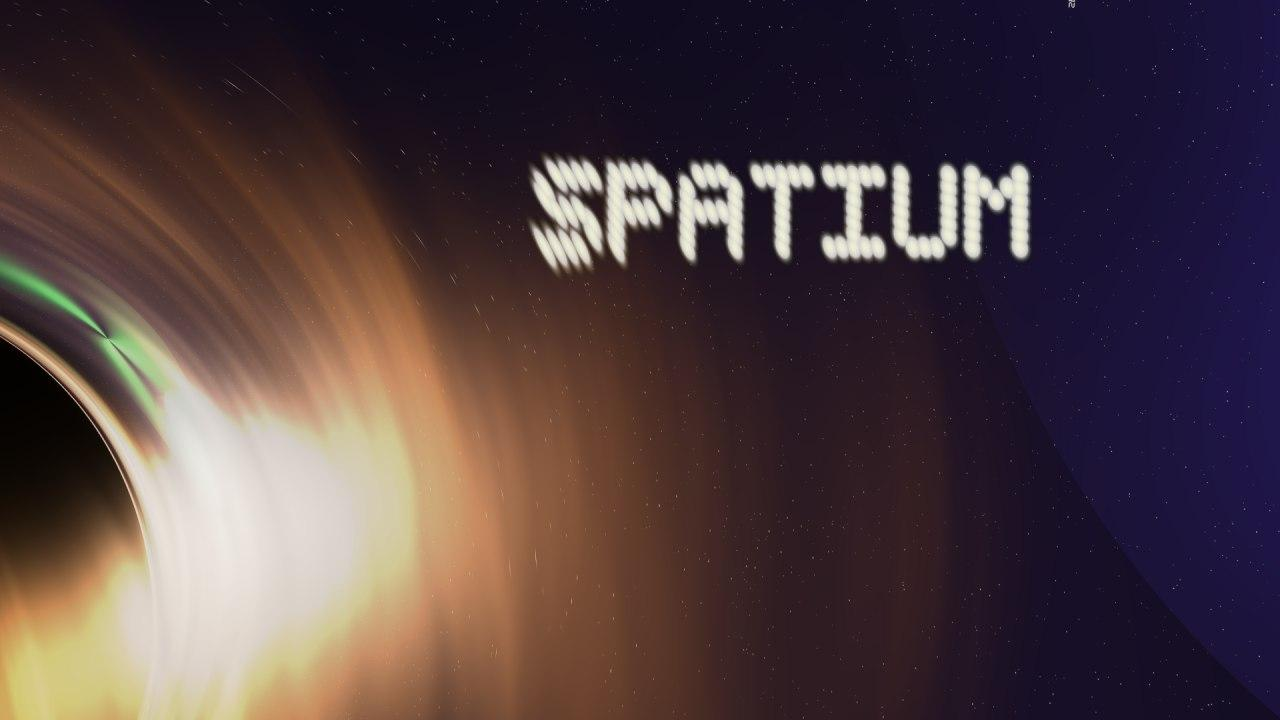
Spatium
Any mathematical space, one library.
Geometry libraries hardcode their space: CGAL's kernels, Eigen's linear algebra, GLM's vectors all assume flat Euclidean R^N wired into every type. Need geodesics on a sphere, distances in hyperbolic space, mesh operations on some other manifold? That's a different, specialized library each time — or a parallel hand-written stack duplicating the one you already have.
Spatium doesn't hardcode a space. It has a concept hierarchy — Set → TopologicalSpace → MetricSpace → NormedSpace → InnerProductSpace → Manifold → RiemannianManifold → Surface — and any type satisfying a concept's requirements gets the whole library for free:
struct FlatTorus { /* distance(), exp_map(), log_map(), project()... */ };
static_assert(spatium::RiemannianManifold<FlatTorus>);
// Mesh<FlatTorus>, subdivision, geodesics, morphisms — all work automatically.
One exception to "all work automatically", stated here rather than left to
be discovered: spatial acceleration is still flat. spatial/'s BVH
bounds with axis-aligned boxes, so ray casting and nearest-neighbour
queries are accelerated in Euclidean space and unaccelerated off it. The
operations still give correct answers on any space; they just walk
everything. A ball tree over geodesic balls is the fix and is an open item
in the roadmap, not an oversight.
C++23, in large part header-only — three deliberate exceptions exist where real complexity made that the wrong tradeoff, not an oversight: the Vulkan viewer needs genuine C linkage, the periodic-table data backs a single compiled translation unit, and the physics/mechanics research track plus optional CUDA/ipc-toolkit integrations sit outside the header-only spine on purpose. See Architecture for the honest breakdown, not a marketing gloss.
Gallery
- Kerr black hole — full 4-coordinate geodesic integration, GPU-rendered (CUDA) at 1920x1080 (video)
- A donut, declaratively — built entirely from
torus()/offset()/scatter(), see the getting-started guide (build-up video)
The donut is also where the scene DSL's argument is easiest to check. A scene is described as spaces rather than as meshes, and the description stays a small inspectable graph: 34 nodes describing 2,021,984 objects. Geometry that would be 64,654,768 vertices if every object carried its own copy is stored as 39,272 — about 1646x — and the frame renders in under a gigabyte. That is not a trick in the renderer; it is what having described the scene as spaces buys.
More in gallery/.
Features
Spaces. The concept hierarchy — Set, TopologicalSpace, MetricSpace,
NormedSpace, InnerProductSpace, Manifold, RiemannianManifold, Surface — and
the spaces that satisfy it: Euclidean<N>, Sphere<N>, Hyperbolic<N>,
ParametricSurface, ImplicitSurface, product spaces. chart_of() is the ADL
extension point that lets a space declared outside this library into the
scene DSL.
Lie groups and matrix manifolds. SO(3) via Rodrigues, SE(3) for rigid-body motions, and SPD(n) — the manifold of symmetric positive-definite matrices — under two metrics, log-Euclidean and affine-invariant. All templated on the scalar type.
Geometry. Line, Ray, Segment, Hyperplane, Triangle, Polygon, Circle,
Disk, Box, Simplex, Quadric. Intersection (Möller–Trumbore, slab method,
analytical ray–quadric and ray–torus), distance between every shape pair,
polygon booleans, clipping, and a | pipe syntax for composing them.
Mesh and geodesics. Mesh<Surface> for any surface, subdivision with
surface projection, LOD chains, geodesic distance by Dijkstra or the heat
method (Crane 2013), geodesic Voronoi, parallel transport, and discrete
exterior calculus — cotangent Laplacian, mass matrix, face gradients,
divergence.
Spatial acceleration. BVH with SAH construction, ray casting, nearest queries, box queries, over triangles or over analytic primitives directly.
Numerics. Dual<T> forward-mode autodiff that satisfies Scalar and so
substitutes into ordinary code; polynomial solvers through the quartic;
native SVD and symmetric eigendecomposition; N×N linear solve; ODE
integrators; Complex<T>; calculus over plain callables — gradient,
integrate, minimize. Arbitrary precision through Boost.Multiprecision
(Real50, Real100, any digit count), optional.
Riemannian optimization. Index-raise an ambient covector through the
space's own metric, project to the tangent space, retract by exp_map — so
gradient descent works on any RiemannianManifold that is also a Surface.
Physics. Compile-time SI units, point masses and rigid bodies, symplectic and Lie-group and variational integrators, geometric continuum mechanics, the IPC contact barrier with continuous collision detection against any Surface, XPBD, wave PDEs for strings and membranes, and metric-agnostic geodesic integration with exact Christoffel symbols — Schwarzschild and Kerr, with the accretion-disk redshift for both.
Declarative scene DSL (io::build). torus()/offset()/scatter()/
compose() build a flat, inspectable Trace rather than a tree of opaque
closures, analytic until the last mile: offset surfaces and area-weighted
placement are real function composition, and no mesh exists until something
asks for triangles. Tutorial in docs/getting-started-dsl.md,
runnable in examples/donut_demo.cpp.
Rendering and I/O. A CPU ray tracer — pinhole camera, row-parallel work stealing, jittered supersampling, PNG output, physical blackbody colour — plus a Vulkan viewer with ImGui. Hand-rolled readers and writers with no external dependency: JSON, WAV, OBJ, STL, SVG.
RSC. A trained dispatcher that picks which implementation to use for a problem — Newton or bisection, double or fifty digits, analytic or tessellated — with ground truth generated by running the candidates rather than hand-labelled. Seven domains; see the roadmap for what is and is not connected.
Verification. verify_metric, verify_inner_product, verify_exp_log
and a symplecticity check, so a space you define yourself can be tested
against the axioms it claims.
N-dimensional and zero-cost. Templated on dimension and scalar type, concepts checked at compile time, no virtual dispatch anywhere.
Quick Start
#include <spatium/spatium.hpp>
#include <print>

using namespace spatium;
using namespace spatium::geometry;

int main() {
    // Geometry — clean factory syntax
    auto t = tri(Vec3{0, 0, 0}, Vec3{1, 0, 0}, Vec3{0, 1, 0});
    std::println("area = {:.4f}, normal = {}", t.area(), t.normal());

    // Intersection via pipe
    auto r = *ray(Vec3{0.25, 0.25, 5}, Vec3{0, 0, -1});
    if (auto hit = r | t)
        std::println("hit at {}", *hit);

    // Morphism pipeline
    auto scale = morph<E3, E3>([](const Vec3& p) { return p * 2.0; });
    auto proj  = morph<E3, E2>([](const Vec3& p) -> Vec2 { return {p[0], p[1]}; });
    auto result = pt<E3>(Vec3{1, 2, 3}) | scale | proj;
    std::println("{}", result);  // P(2, 4)

    // Sphere geodesics
    S2 sphere;
    auto north = pt<S2>(Vec3{0, 0, 1});
    auto east  = pt<S2>(Vec3{1, 0, 0});
    auto tangent = north.log(east, sphere);
    auto midpoint = north.exp(tangent, 0.5, sphere);
    std::println("geodesic midpoint: {}", midpoint);

    // Mesh subdivision
    auto mesh = mesh::icosahedron(sphere);
    auto refined = mesh::subdivide(mesh, sphere, 3);
    std::println("{}", refined);  // Mesh{V=642 F=1280 E≈1920}
}
Build
Requires C++23 (GCC 15+ or Clang 19+), CMake 3.28+, Catch2 v3 for tests.
# With Nix (recommended)
nix develop
cmake --preset default
cmake --build --preset default
ctest --preset default

# Without Nix
cmake -B build -G Ninja -DCMAKE_BUILD_TYPE=Debug
ninja -C build
CMakePresets.json has presets beyond default for common configurations — release (Eigen, for RSC training-heavy work), modules (the C++23 modules build path), noeigen, vulkan-dev, cuda, and two benchmark-harness presets. cmake --list-presets shows all of them.
CMake options
| Option | Default | Notes |
|---|---|---|
SPATIUM_BUILD_TESTS | ON* | Catch2 v3 unit tests (ctest --preset default) |
SPATIUM_BUILD_EXAMPLES | ON* | All examples/* binaries |
SPATIUM_BUILD_BENCHMARKS | OFF | Google Benchmark suite (benchmarks/) |
SPATIUM_BUILD_VIEWER | ON* | Vulkan + GLFW + shaderc viewer. Emits a WARNING and skips the target if any of those packages are missing. |
SPATIUM_EIGEN | OFF | Required by the heat-method geodesic solver and the cotangent-Laplacian DEC operators. |
SPATIUM_NATIVE_ARCH | OFF | Adds -march=native. Resulting binaries are not portable across CPUs — use only for local performance work. |
SPATIUM_USE_MODULES | OFF | C++23 named-modules build. Currently behind the header tree (see the option's own comment in CMakeLists.txt) — not a compiler-bug wait, real catch-up work. |
SPATIUM_IPC_TOOLKIT | OFF | Implicit contact physics via ipc-toolkit (Newton + log-barrier + CCD). FetchContent-based, pulls its own dependency tree. |
SPATIUM_CUDA | OFF | CUDA GPU kernels (gpu/) for GR ray tracing. Requires nvcc; not part of a default build. |
SPATIUM_BUILD_RSC_TOOLS | ON* | RSC training tools (rsc/tools/train_base, ...). |
IMGUI_DIR (env or -D) | unset | Source path of Dear ImGui; enables the in-viewer panel when set. |
* Defaults to ON only when Spatium is the top-level CMake project (built
standalone, as above). Pulled in via add_subdirectory() or FetchContent
from another project, these four default to OFF instead, so a downstream
consumer gets just Spatium::sdk without forcing a Vulkan/Catch2/example
build it never asked for -- see "Using in Your Project" below.
Using in Your Project
CMake FetchContent
include(FetchContent)
FetchContent_Declare(spatium
    GIT_REPOSITORY https://github.com/Vaniell0/spatium.git
    GIT_TAG v1.0.0
)
FetchContent_MakeAvailable(spatium)

target_link_libraries(your_target PRIVATE Spatium::sdk)
This pulls in only the header-only Spatium::sdk interface target -- the
Vulkan viewer, examples, tests, and RSC tools all default OFF when Spatium
isn't the top-level CMake project, so nothing beyond Spatium::sdk and its
one required dependency (Boost headers, for Real50/Real100) gets built.
See examples/external-consumer/ for a
complete, independently-buildable project using exactly this snippet.
After Install
find_package(Spatium REQUIRED)
target_link_libraries(your_target PRIVATE Spatium::sdk)
Defining Your Own Space
Any struct with the right methods satisfies the concepts automatically:
struct FlatTorus {
    using ScalarType = double;
    using PointType = Vec<double, 2>;
    using TangentVector = Vec<double, 2>;
    static constexpr std::size_t dimension = 2;
    static constexpr bool is_complete = true;

    bool contains(const PointType& p) const { /* ... */ }
    ScalarType distance(const PointType& a, const PointType& b) const { /* ... */ }
    PointType exp_map(const PointType& p, const TangentVector& v, ScalarType t) const { /* ... */ }
    TangentVector log_map(const PointType& p, const PointType& q) const { /* ... */ }
    ScalarType metric_at(const PointType& p, const TangentVector& u, const TangentVector& v) const { /* ... */ }
    PointType project(const PointType& p) const { /* ... */ }
    TangentVector normal(const PointType& p) const { /* ... */ }
};

static_assert(spatium::RiemannianManifold<FlatTorus>);
static_assert(spatium::Surface<FlatTorus>);
// Mesh<FlatTorus>, subdivision, morphisms — all work automatically.
Arbitrary Precision
#include <spatium/core/precision.hpp>

using namespace spatium;

// 50-digit precision
Euclidean<3, Real50> space;
Vec<Real50, 3> a{Real50{0}, Real50{0}, Real50{0}};
Vec<Real50, 3> b{Real50{3}, Real50{4}, Real50{0}};
auto d = space.distance(a, b);  // 5.000...000 (50 digits)
Documentation
- Architecture — concept hierarchy, design decisions, the real dependency graph
- Conventions — namespace/subdivision/error-handling rules, and the known violations being fixed
- API Reference — all types, methods, concepts
- Quick Start Guide — getting started
- Getting Started: The Declarative Scene DSL — zero-barrier-to-entry, build a donut in three declarative steps
- Extending Spatium — defining custom spaces and primitives
- Roadmap — what's done, what's planned, project history
- Concept-Driven Physics — how
physics/mechanics/fits the concept hierarchy
Project Structure
include/spatium/
    core/                concepts, error, verify, precision
    algebra/             Vec, Matrix, Quaternion, Complex, Dual (autodiff), calculus,
                         ODE solvers, linear solve, polynomial solvers, Eigen interop
    algebra/groups/      SO3, SE3
    spaces/              Euclidean, Sphere, Hyperbolic, ParametricSurface, ImplicitSurface
    geometry/            primitives, intersection, distance, boolean ops, ray_surface (Quadric)
    mesh/                Mesh, subdivision, LOD, topology, geodesic, voronoi, DEC
    spatial/             BVH (SAH build, ray_cast, nearest, query_box)
    discrete/            FiniteSet, GeometricSet
    render/              supersample_pixel(), camera, write_image, parallel_for_rows
    io/                  Table, SVG, OBJ, STL
    physics/             periodic-table element data (the one compiled TU)
    physics/atomic/      atom/orbital models, Bohr model, SVG rendering
    physics/mechanics/   integrators, symplectic/Lie-group/variational structure, contact
    physics/relativity/  Schwarzschild/Kerr geodesic integration, accretion disks
    viewer/              Vulkan app (multi-mesh, point clouds, ImGui)
    point.hpp, morphism.hpp, spatium.hpp
rsc/                     RSC — trained dispatcher on top of Spatium (7 domains, see docs/ROADMAP.md)
tests/, examples/, benchmarks/
Demos
nix run .#primitives                    # unified primitives + BVH raycast, interactive Vulkan
nix run .#tumbling                      # Dzhanibekov-effect rigid-body tumble (LGVI), frame sequence
More demos exist in examples/ — analytical ray tracing, a Schwarzschild/Kerr GR raytracer, an Ellis wormhole flythrough, and others; cmake --list-presets and nix flake show list every buildable target.
License
Apache License 2.0 — see LICENSE. Contributing guide: CONTRIBUTING.md.
Project history: docs/ROADMAP.md.
Contributors

50 commits
Similar repos


Languages
C++
95.7%
CMake
1.9%
Cuda
1.1%
C++23 header-only library for computational geometry and physics on arbitrary Riemannian manifolds — spheres, hyperbolic space, and custom surfaces as first-class concepts, not hardcoded types
C++
2
50 commits
updated Sep 22, 2026
See what people are saying (1)
README
Spatium
Any mathematical space, one library.
Geometry libraries hardcode their space: CGAL's kernels, Eigen's linear algebra, GLM's vectors all assume flat Euclidean R^N wired into every type. Need geodesics on a sphere, distances in hyperbolic space, mesh operations on some other manifold? That's a different, specialized library each time — or a parallel hand-written stack duplicating the one you already have.
Spatium doesn't hardcode a space. It has a concept hierarchy — Set → TopologicalSpace → MetricSpace → NormedSpace → InnerProductSpace → Manifold → RiemannianManifold → Surface — and any type satisfying a concept's requirements gets the whole library for free:
struct FlatTorus { /* distance(), exp_map(), log_map(), project()... */ };
static_assert(spatium::RiemannianManifold<FlatTorus>);
// Mesh<FlatTorus>, subdivision, geodesics, morphisms — all work automatically.
One exception to "all work automatically", stated here rather than left to
be discovered: spatial acceleration is still flat. spatial/'s BVH
bounds with axis-aligned boxes, so ray casting and nearest-neighbour
queries are accelerated in Euclidean space and unaccelerated off it. The
operations still give correct answers on any space; they just walk
everything. A ball tree over geodesic balls is the fix and is an open item
in the roadmap, not an oversight.
C++23, in large part header-only — three deliberate exceptions exist where real complexity made that the wrong tradeoff, not an oversight: the Vulkan viewer needs genuine C linkage, the periodic-table data backs a single compiled translation unit, and the physics/mechanics research track plus optional CUDA/ipc-toolkit integrations sit outside the header-only spine on purpose. See Architecture for the honest breakdown, not a marketing gloss.
Gallery
- Kerr black hole — full 4-coordinate geodesic integration, GPU-rendered (CUDA) at 1920x1080 (video)
- A donut, declaratively — built entirely from
torus()/offset()/scatter(), see the getting-started guide (build-up video)
The donut is also where the scene DSL's argument is easiest to check. A scene is described as spaces rather than as meshes, and the description stays a small inspectable graph: 34 nodes describing 2,021,984 objects. Geometry that would be 64,654,768 vertices if every object carried its own copy is stored as 39,272 — about 1646x — and the frame renders in under a gigabyte. That is not a trick in the renderer; it is what having described the scene as spaces buys.
More in gallery/.
Features
Spaces. The concept hierarchy — Set, TopologicalSpace, MetricSpace,
NormedSpace, InnerProductSpace, Manifold, RiemannianManifold, Surface — and
the spaces that satisfy it: Euclidean<N>, Sphere<N>, Hyperbolic<N>,
ParametricSurface, ImplicitSurface, product spaces. chart_of() is the ADL
extension point that lets a space declared outside this library into the
scene DSL.
Lie groups and matrix manifolds. SO(3) via Rodrigues, SE(3) for rigid-body motions, and SPD(n) — the manifold of symmetric positive-definite matrices — under two metrics, log-Euclidean and affine-invariant. All templated on the scalar type.
Geometry. Line, Ray, Segment, Hyperplane, Triangle, Polygon, Circle,
Disk, Box, Simplex, Quadric. Intersection (Möller–Trumbore, slab method,
analytical ray–quadric and ray–torus), distance between every shape pair,
polygon booleans, clipping, and a | pipe syntax for composing them.
Mesh and geodesics. Mesh<Surface> for any surface, subdivision with
surface projection, LOD chains, geodesic distance by Dijkstra or the heat
method (Crane 2013), geodesic Voronoi, parallel transport, and discrete
exterior calculus — cotangent Laplacian, mass matrix, face gradients,
divergence.
Spatial acceleration. BVH with SAH construction, ray casting, nearest queries, box queries, over triangles or over analytic primitives directly.
Numerics. Dual<T> forward-mode autodiff that satisfies Scalar and so
substitutes into ordinary code; polynomial solvers through the quartic;
native SVD and symmetric eigendecomposition; N×N linear solve; ODE
integrators; Complex<T>; calculus over plain callables — gradient,
integrate, minimize. Arbitrary precision through Boost.Multiprecision
(Real50, Real100, any digit count), optional.
Riemannian optimization. Index-raise an ambient covector through the
space's own metric, project to the tangent space, retract by exp_map — so
gradient descent works on any RiemannianManifold that is also a Surface.
Physics. Compile-time SI units, point masses and rigid bodies, symplectic and Lie-group and variational integrators, geometric continuum mechanics, the IPC contact barrier with continuous collision detection against any Surface, XPBD, wave PDEs for strings and membranes, and metric-agnostic geodesic integration with exact Christoffel symbols — Schwarzschild and Kerr, with the accretion-disk redshift for both.
Declarative scene DSL (io::build). torus()/offset()/scatter()/
compose() build a flat, inspectable Trace rather than a tree of opaque
closures, analytic until the last mile: offset surfaces and area-weighted
placement are real function composition, and no mesh exists until something
asks for triangles. Tutorial in docs/getting-started-dsl.md,
runnable in examples/donut_demo.cpp.
Rendering and I/O. A CPU ray tracer — pinhole camera, row-parallel work stealing, jittered supersampling, PNG output, physical blackbody colour — plus a Vulkan viewer with ImGui. Hand-rolled readers and writers with no external dependency: JSON, WAV, OBJ, STL, SVG.
RSC. A trained dispatcher that picks which implementation to use for a problem — Newton or bisection, double or fifty digits, analytic or tessellated — with ground truth generated by running the candidates rather than hand-labelled. Seven domains; see the roadmap for what is and is not connected.
Verification. verify_metric, verify_inner_product, verify_exp_log
and a symplecticity check, so a space you define yourself can be tested
against the axioms it claims.
N-dimensional and zero-cost. Templated on dimension and scalar type, concepts checked at compile time, no virtual dispatch anywhere.
Quick Start
#include <spatium/spatium.hpp>
#include <print>

using namespace spatium;
using namespace spatium::geometry;

int main() {
    // Geometry — clean factory syntax
    auto t = tri(Vec3{0, 0, 0}, Vec3{1, 0, 0}, Vec3{0, 1, 0});
    std::println("area = {:.4f}, normal = {}", t.area(), t.normal());

    // Intersection via pipe
    auto r = *ray(Vec3{0.25, 0.25, 5}, Vec3{0, 0, -1});
    if (auto hit = r | t)
        std::println("hit at {}", *hit);

    // Morphism pipeline
    auto scale = morph<E3, E3>([](const Vec3& p) { return p * 2.0; });
    auto proj  = morph<E3, E2>([](const Vec3& p) -> Vec2 { return {p[0], p[1]}; });
    auto result = pt<E3>(Vec3{1, 2, 3}) | scale | proj;
    std::println("{}", result);  // P(2, 4)

    // Sphere geodesics
    S2 sphere;
    auto north = pt<S2>(Vec3{0, 0, 1});
    auto east  = pt<S2>(Vec3{1, 0, 0});
    auto tangent = north.log(east, sphere);
    auto midpoint = north.exp(tangent, 0.5, sphere);
    std::println("geodesic midpoint: {}", midpoint);

    // Mesh subdivision
    auto mesh = mesh::icosahedron(sphere);
    auto refined = mesh::subdivide(mesh, sphere, 3);
    std::println("{}", refined);  // Mesh{V=642 F=1280 E≈1920}
}
Build
Requires C++23 (GCC 15+ or Clang 19+), CMake 3.28+, Catch2 v3 for tests.
# With Nix (recommended)
nix develop
cmake --preset default
cmake --build --preset default
ctest --preset default

# Without Nix
cmake -B build -G Ninja -DCMAKE_BUILD_TYPE=Debug
ninja -C build
CMakePresets.json has presets beyond default for common configurations — release (Eigen, for RSC training-heavy work), modules (the C++23 modules build path), noeigen, vulkan-dev, cuda, and two benchmark-harness presets. cmake --list-presets shows all of them.
CMake options
| Option | Default | Notes |
|---|---|---|
SPATIUM_BUILD_TESTS | ON* | Catch2 v3 unit tests (ctest --preset default) |
SPATIUM_BUILD_EXAMPLES | ON* | All examples/* binaries |
SPATIUM_BUILD_BENCHMARKS | OFF | Google Benchmark suite (benchmarks/) |
SPATIUM_BUILD_VIEWER | ON* | Vulkan + GLFW + shaderc viewer. Emits a WARNING and skips the target if any of those packages are missing. |
SPATIUM_EIGEN | OFF | Required by the heat-method geodesic solver and the cotangent-Laplacian DEC operators. |
SPATIUM_NATIVE_ARCH | OFF | Adds -march=native. Resulting binaries are not portable across CPUs — use only for local performance work. |
SPATIUM_USE_MODULES | OFF | C++23 named-modules build. Currently behind the header tree (see the option's own comment in CMakeLists.txt) — not a compiler-bug wait, real catch-up work. |
SPATIUM_IPC_TOOLKIT | OFF | Implicit contact physics via ipc-toolkit (Newton + log-barrier + CCD). FetchContent-based, pulls its own dependency tree. |
SPATIUM_CUDA | OFF | CUDA GPU kernels (gpu/) for GR ray tracing. Requires nvcc; not part of a default build. |
SPATIUM_BUILD_RSC_TOOLS | ON* | RSC training tools (rsc/tools/train_base, ...). |
IMGUI_DIR (env or -D) | unset | Source path of Dear ImGui; enables the in-viewer panel when set. |
* Defaults to ON only when Spatium is the top-level CMake project (built
standalone, as above). Pulled in via add_subdirectory() or FetchContent
from another project, these four default to OFF instead, so a downstream
consumer gets just Spatium::sdk without forcing a Vulkan/Catch2/example
build it never asked for -- see "Using in Your Project" below.
Using in Your Project
CMake FetchContent
include(FetchContent)
FetchContent_Declare(spatium
    GIT_REPOSITORY https://github.com/Vaniell0/spatium.git
    GIT_TAG v1.0.0
)
FetchContent_MakeAvailable(spatium)

target_link_libraries(your_target PRIVATE Spatium::sdk)
This pulls in only the header-only Spatium::sdk interface target -- the
Vulkan viewer, examples, tests, and RSC tools all default OFF when Spatium
isn't the top-level CMake project, so nothing beyond Spatium::sdk and its
one required dependency (Boost headers, for Real50/Real100) gets built.
See examples/external-consumer/ for a
complete, independently-buildable project using exactly this snippet.
After Install
find_package(Spatium REQUIRED)
target_link_libraries(your_target PRIVATE Spatium::sdk)
Defining Your Own Space
Any struct with the right methods satisfies the concepts automatically:
struct FlatTorus {
    using ScalarType = double;
    using PointType = Vec<double, 2>;
    using TangentVector = Vec<double, 2>;
    static constexpr std::size_t dimension = 2;
    static constexpr bool is_complete = true;

    bool contains(const PointType& p) const { /* ... */ }
    ScalarType distance(const PointType& a, const PointType& b) const { /* ... */ }
    PointType exp_map(const PointType& p, const TangentVector& v, ScalarType t) const { /* ... */ }
    TangentVector log_map(const PointType& p, const PointType& q) const { /* ... */ }
    ScalarType metric_at(const PointType& p, const TangentVector& u, const TangentVector& v) const { /* ... */ }
    PointType project(const PointType& p) const { /* ... */ }
    TangentVector normal(const PointType& p) const { /* ... */ }
};

static_assert(spatium::RiemannianManifold<FlatTorus>);
static_assert(spatium::Surface<FlatTorus>);
// Mesh<FlatTorus>, subdivision, morphisms — all work automatically.
Arbitrary Precision
#include <spatium/core/precision.hpp>

using namespace spatium;

// 50-digit precision
Euclidean<3, Real50> space;
Vec<Real50, 3> a{Real50{0}, Real50{0}, Real50{0}};
Vec<Real50, 3> b{Real50{3}, Real50{4}, Real50{0}};
auto d = space.distance(a, b);  // 5.000...000 (50 digits)
Documentation
- Architecture — concept hierarchy, design decisions, the real dependency graph
- Conventions — namespace/subdivision/error-handling rules, and the known violations being fixed
- API Reference — all types, methods, concepts
- Quick Start Guide — getting started
- Getting Started: The Declarative Scene DSL — zero-barrier-to-entry, build a donut in three declarative steps
- Extending Spatium — defining custom spaces and primitives
- Roadmap — what's done, what's planned, project history
- Concept-Driven Physics — how
physics/mechanics/fits the concept hierarchy
Project Structure
include/spatium/
    core/                concepts, error, verify, precision
    algebra/             Vec, Matrix, Quaternion, Complex, Dual (autodiff), calculus,
                         ODE solvers, linear solve, polynomial solvers, Eigen interop
    algebra/groups/      SO3, SE3
    spaces/              Euclidean, Sphere, Hyperbolic, ParametricSurface, ImplicitSurface
    geometry/            primitives, intersection, distance, boolean ops, ray_surface (Quadric)
    mesh/                Mesh, subdivision, LOD, topology, geodesic, voronoi, DEC
    spatial/             BVH (SAH build, ray_cast, nearest, query_box)
    discrete/            FiniteSet, GeometricSet
    render/              supersample_pixel(), camera, write_image, parallel_for_rows
    io/                  Table, SVG, OBJ, STL
    physics/             periodic-table element data (the one compiled TU)
    physics/atomic/      atom/orbital models, Bohr model, SVG rendering
    physics/mechanics/   integrators, symplectic/Lie-group/variational structure, contact
    physics/relativity/  Schwarzschild/Kerr geodesic integration, accretion disks
    viewer/              Vulkan app (multi-mesh, point clouds, ImGui)
    point.hpp, morphism.hpp, spatium.hpp
rsc/                     RSC — trained dispatcher on top of Spatium (7 domains, see docs/ROADMAP.md)
tests/, examples/, benchmarks/
Demos
nix run .#primitives                    # unified primitives + BVH raycast, interactive Vulkan
nix run .#tumbling                      # Dzhanibekov-effect rigid-body tumble (LGVI), frame sequence
More demos exist in examples/ — analytical ray tracing, a Schwarzschild/Kerr GR raytracer, an Ellis wormhole flythrough, and others; cmake --list-presets and nix flake show list every buildable target.
License
Apache License 2.0 — see LICENSE. Contributing guide: CONTRIBUTING.md.
Project history: docs/ROADMAP.md.
Similar repos
Contributors
50 commits
Languages
C++
95.7%
CMake
1.9%
Cuda
1.1%