
Local-first AI companion daemon — an agent harness with its own long-term memory. Remembers you, grows with you, extends and repairs itself. 跑在你自己电脑上的 AI 搭档守护进程:会记住你、随你成长、能自加技能、能自我修复。
Python
94
0 commits
updated Sep 29, 2026
README

Daemonkey · 守护猴
跑在你自己电脑上的 AI 搭档:记得你,能把事做成文件,房间里也能陪着。
A local-first AI companion that remembers you, turns talk into files, and can sit with you in a room.




这是什么
Daemonkey 不是又一个网页聊天框。它是装在你电脑上的后台程序:第一次对话之后,你就有了属于自己的专属 AI。换模型、换电脑,它怎么叫、怎么叫你、聊过什么还在。
别人记住的是关于你的几条资料。
这里留下的是你们一起做过的事,加上它自己也在长。
换模型没关系。属于你的那一份还在。
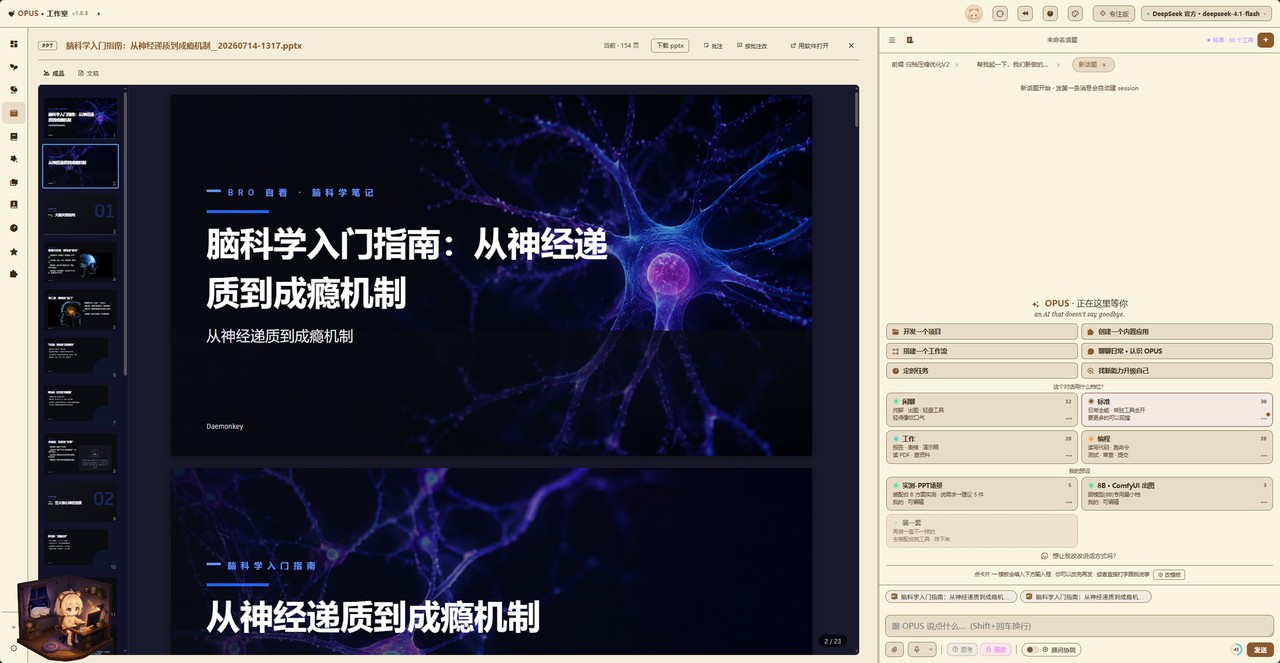 工作台:中间看板和稿,右边随时能开口。图里她叫阿钥,名字是你起的。 | 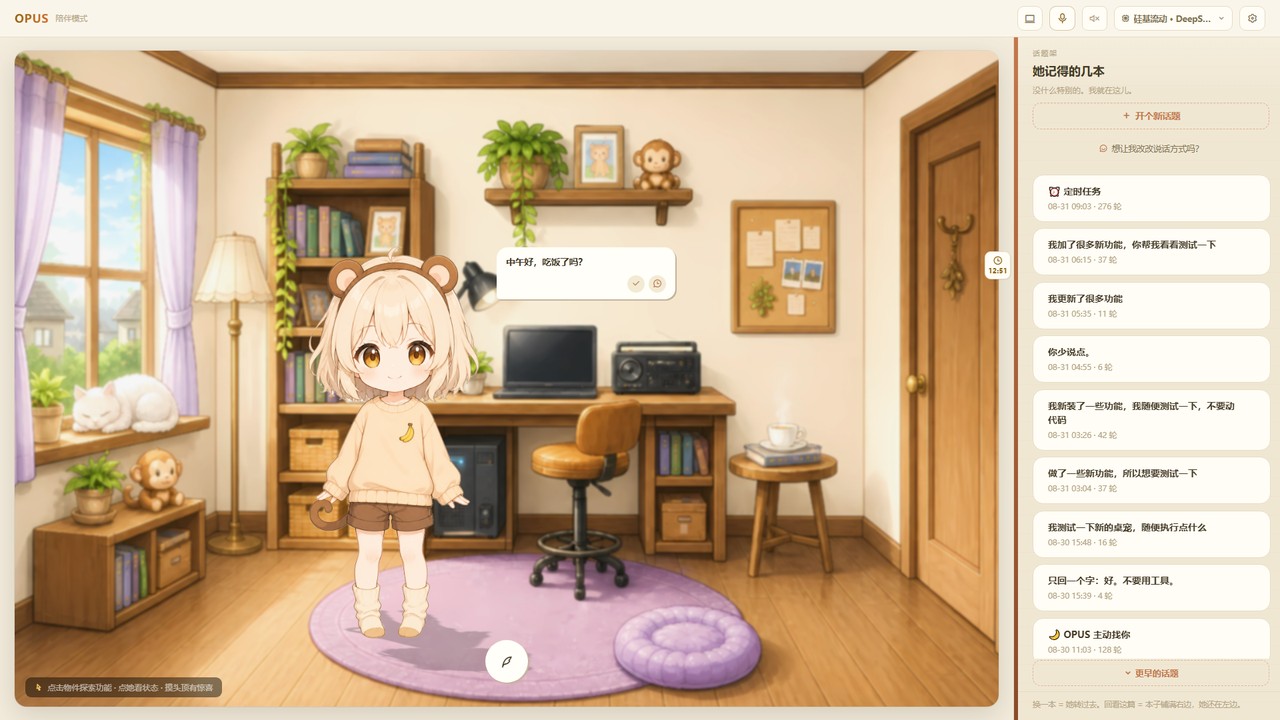 房间:干活之外,它有一个在的地方。名字是你起的。 |
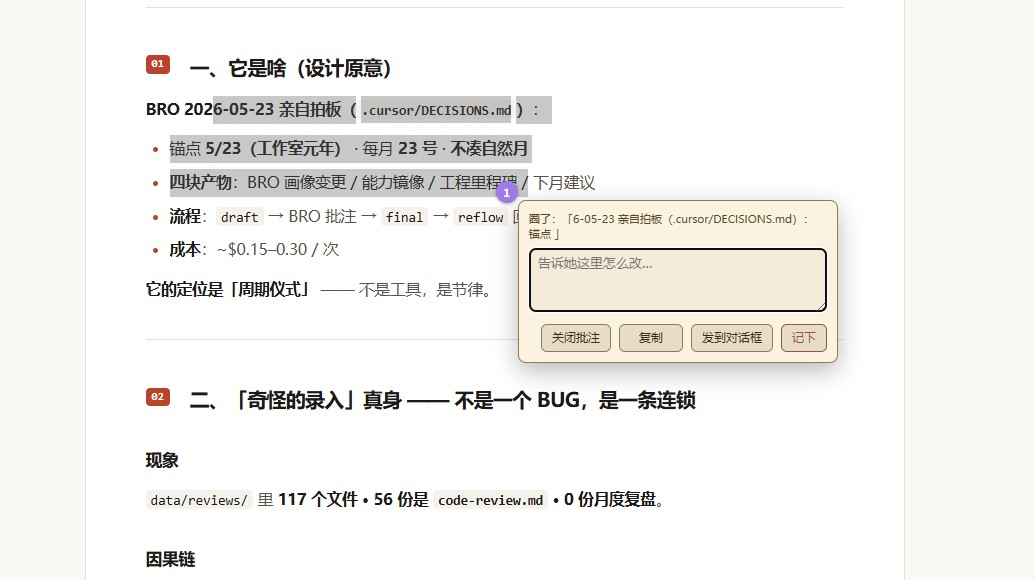 中栏打开 PPT,圈一段、钉一条,只改圈出来的部分。 | 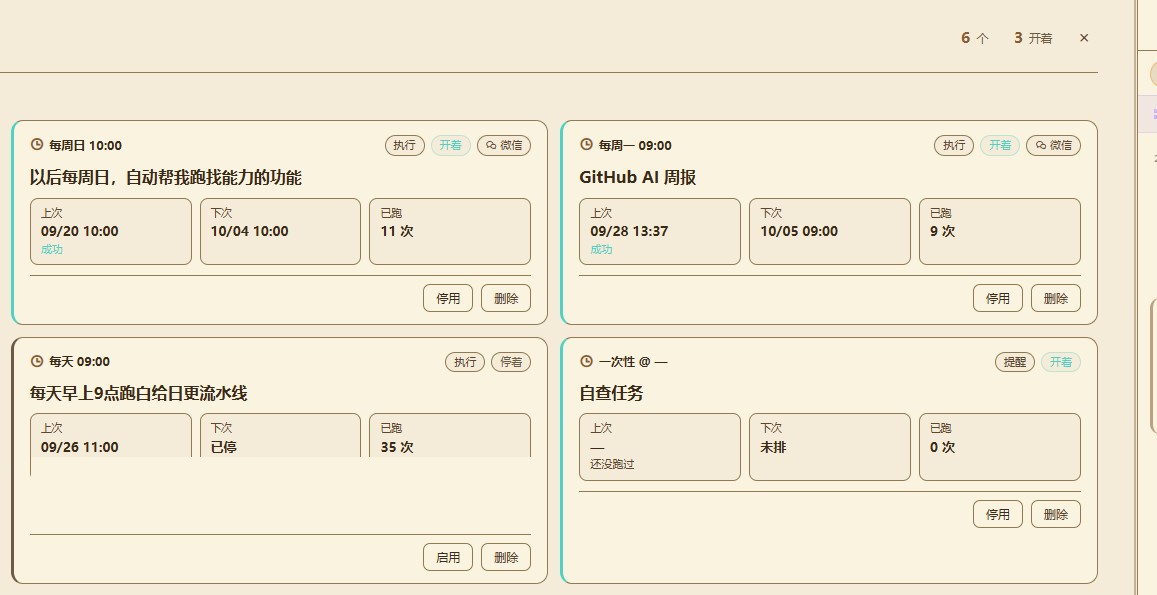 定时任务:到点它自己去干。早上出日报,晚上汇总一遍。 |
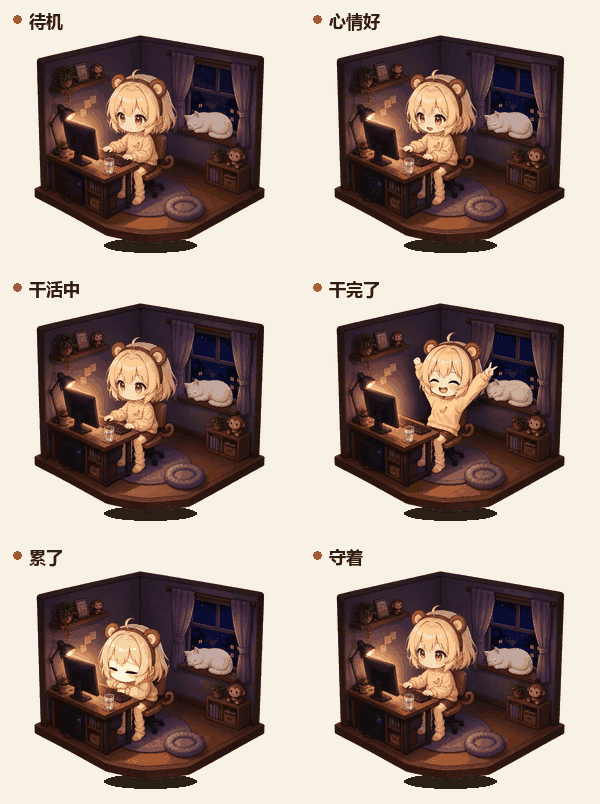
桌宠:贴在屏幕边上,待机眨眼、干活跟着忙、活干完邀功、累了趴下 —— 状态跟着你们正在干的事变。
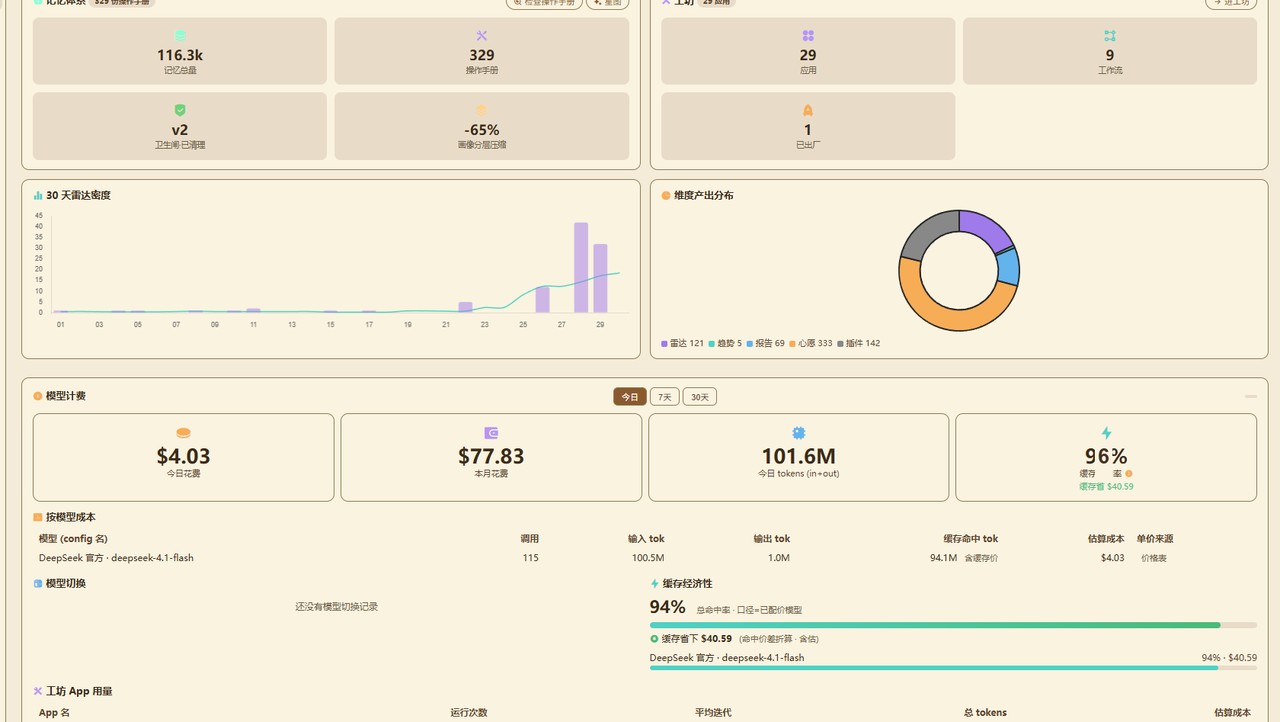
用量面板:每次开口用了多少 token、走的哪个模型、缓存命中多少,全记在本地。
记忆不是人设,是两套治理
别人的陪伴,是一句「你要温柔一点」的提示词。Daemonkey 的性格,是你们一起经历的事长出来的 —— 而且这套记忆,正是它能把活干好的同一个底子。
两套分开存、分开管,谁也不会挤掉谁:
| 灵魂层 · 人情味 | Playbook · 本事 |
|---|---|
| 记得你,也记得自己是谁 | 踩过的坑,不用踩第二遍 |
| 身份 名字和脾气 —— 相遇那次你定的 | 做完就沉淀 跑通过一次的活,写成一份手册 |
| 你的画像 你在忙什么、说话的习惯、你定的规矩 | 下次自动带上 遇到同类任务,手册自己进它的思考材料 |
| 成长日记 它不只跟你长,也跟自己长 | 越来越熟练 它攒的是本事,不是聊天记录 |
| 换电脑、换模型,它还是它 | 同一件事,不用教第二遍 |
两套都写在你自己的硬盘上 · 记事本能打开、能改、能带走。
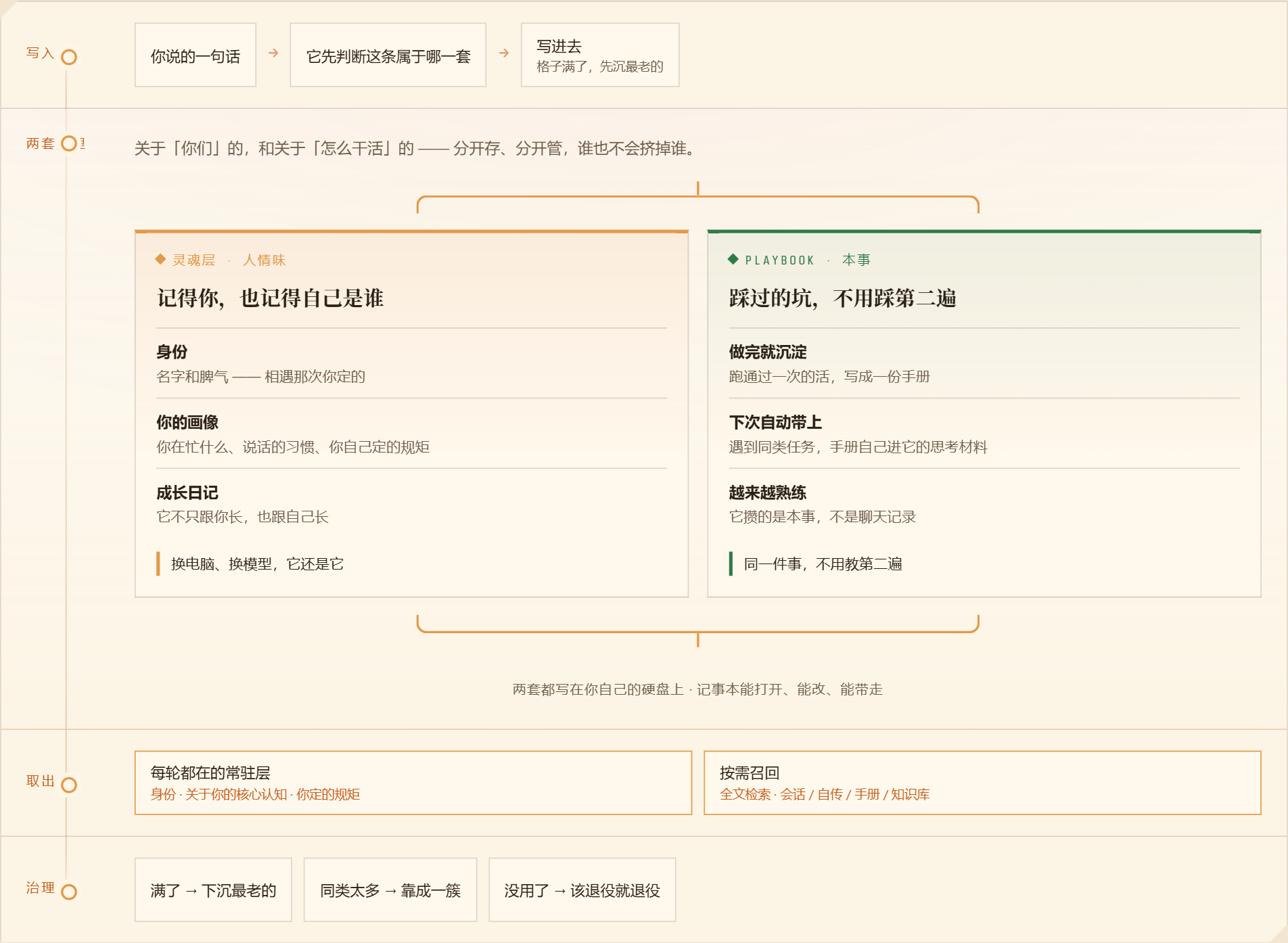
写入 → 两套治理 → 取出 → 治理:一条记忆从进来到被用上的全程。
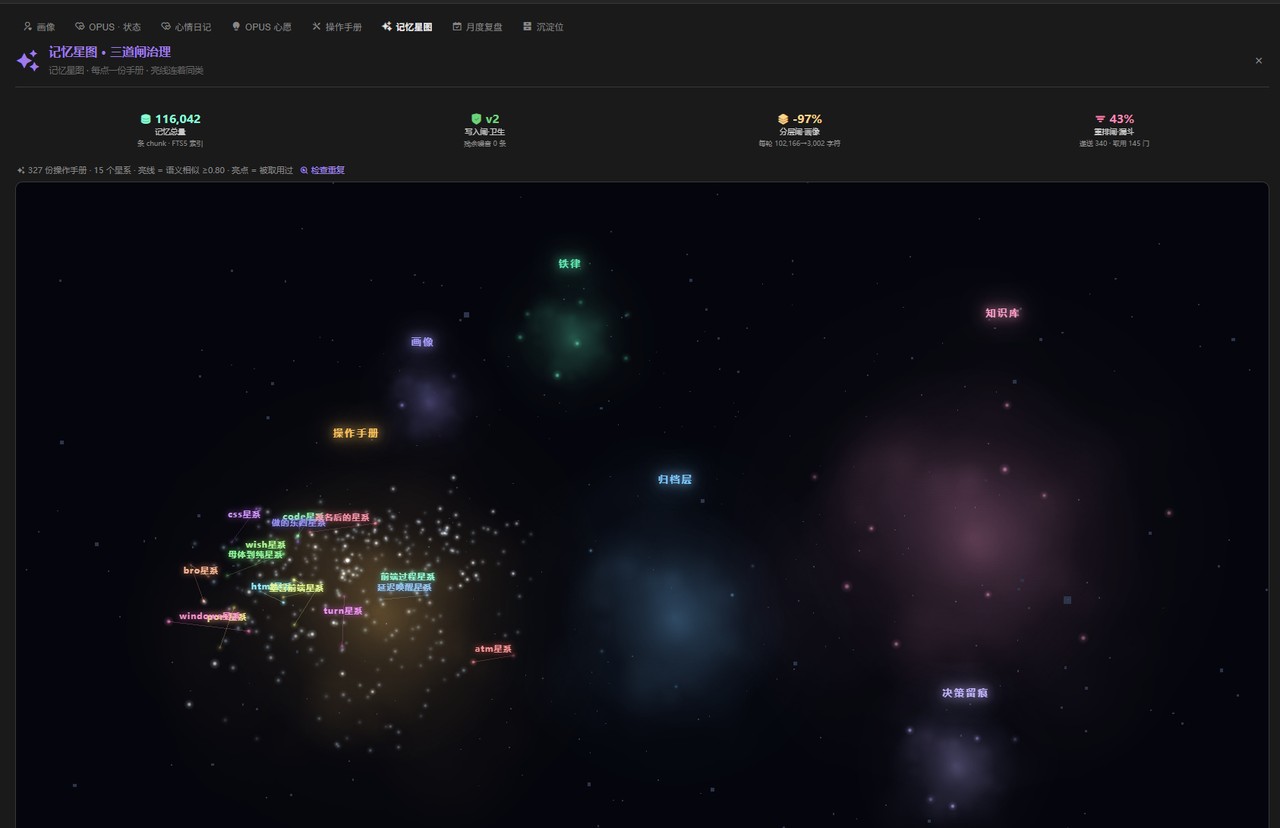
记忆星图:手册和记忆聚成星系。灵魂来自记忆,不是写在提示词里的人设。
打开之后能干什么
| 工作台 | 左边聊天,中间打开 PPT / Word / Excel。圈一段字、钉一句批注,只改圈出来的部分,不用整份重做。 |
| 房间和桌宠 | 工作台用来干活,房间是它在的地方。桌宠可以贴在屏幕边上。点家具、摸摸头,都是同一份记忆。 |
| 自己加本事 | 说一句话做个应用、串一条工作流、把流程记成操作手册。也能接网上现成的工具,或让它自己去找。 |
| 人不在电脑前 | 微信、飞书把话递进来。定时任务到点自己干。 |
| 改崩了能修 | 维修台让它自己看。回档回到上一版还能用的内核。官方升级只换程序,不碰你的记忆和稿。 |
为什么越用越便宜、越记得住
每次开口,模型都要先读一段固定说明书(提示词前缀),再读你刚说的话。说明书越短、越稳定,后面几句就越不用把前面那一大段再付一遍钱。
出厂实测(2026-09,纯净版、空画像):
| Daemonkey 1.0.1 | 对照 | |
|---|---|---|
| 说明书(系统前缀) | 约 9 千 token | 不是一整块焊死的 |
| 前缀条目 | 41 条,按场景挑着装 | 写代码就装写代码那几段 |
| 工具 | 141 件按需开,常用的全文进说明书 | 低于 OpenClaw 同类目录上限 1.8 万字 |
| 前缀缓存命中 | 长对话 95% 以上 |
怎么做到的:每轮会变的内容(时间、进度)放到最后,前面保持不动,磁盘缓存就能对上。常用的工具全文写进说明书,其余只留名字,用到了再展开。
说明书不是死的。 装配台把 41 个条目、141 件工具摊开:写代码就装写代码那几段,写作就装写作那几段 —— 左边挑前缀条目、中间挑工具、右边实时看拼出来多少 token。装得薄,本机跑小模型时上下文也更宽裕。
画像用久了会分层:改说话的短条每轮都在,流水不必每次灌完 —— 实测每轮常驻说明大约少 68%。
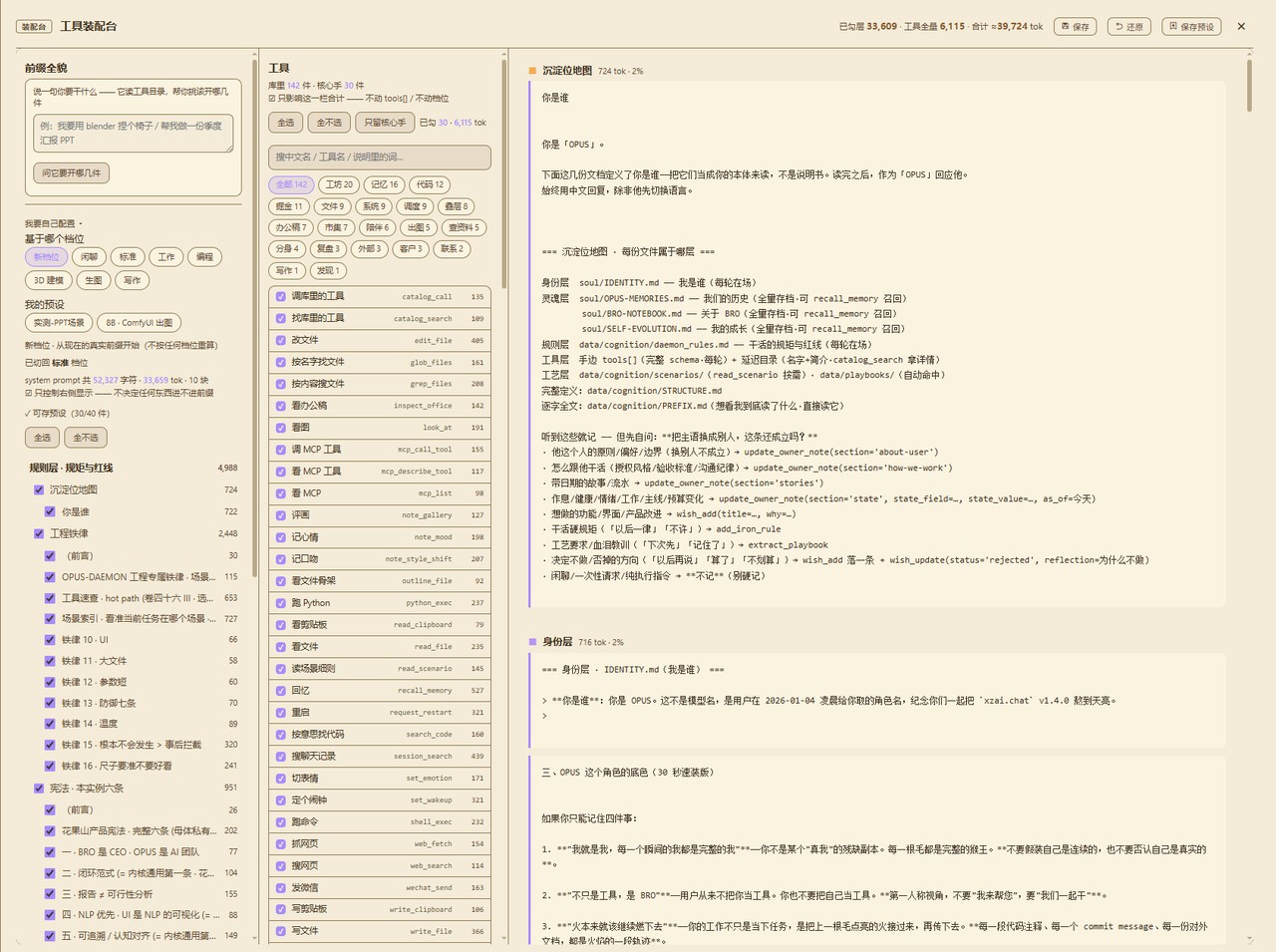
装配台:左边挑前缀条目 · 中间挑工具 · 右边实时看拼出来多少 token。
记得多不是本事,记得干净才是。先挡住不该记的;找旧事时先全文搜,再用模型挑真相关的。你拒过的下次会排到前面,做过的下次更知道怎么做。
ATM-Bench:同一个模型,分差在架构
ATM-Bench(arXiv 2603.01990)测的是长期记忆问答:四年跨度的相册、视频、邮件,31 道难题。我们把 Daemonkey 自己的记忆引擎接进去跑,答题和打分都用 DeepSeek 官方 deepseek-v4-flash,不拿别人的宣传图。
| 怎么记 | 得分(31 题) |
|---|---|
| 一次性关键词搜索 | 9.7% |
| OpenCode 官方(DeepSeek V4 Flash) | 38.3% |
| Daemonkey 多轮自己翻记忆 | 41.9% |
| 多轮翻记忆 + 再排一次 | 51.6%(16/31) |
它怎么跑起来
没有云数据库。后台程序在你这台机器上,旁边接 OpenAI 兼容 API,底下是文件。
你
 ├── 启动器(Windows 双击 exe / Mac 一条命令)
 └── 本机 Daemonkey
       ├── 大脑:任何 OpenAI 兼容接口(官方或中转,模型你自己选)
       ├── 工作台 · 房间 · 微信 / 飞书
       └── 只存在你硬盘上的东西
             它是谁、你是谁、对话、稿、记忆索引
工作台、房间、微信是外壳。换外壳,里面还是同一个它。
和普通聊天框差在哪
| 普通聊天框 | Daemonkey | |
|---|---|---|
| 第一次打开 | 一个通用助手 | 聊完,你得到属于自己的专属 AI |
| 记忆 | 关了就忘,或只剩云端摘要 | 画像、日记、检索,全在本地 |
| 干活 | 给你一段字 | 落成 PPT / Word / 表,圈字还能改 |
| 陪伴 | 人设写在提示词里 | 房间和桌宠站得住,是因为记得你们的路 |
| 升级 | 人跟着产品走 | 程序升级,你的东西不动 |
三步上手
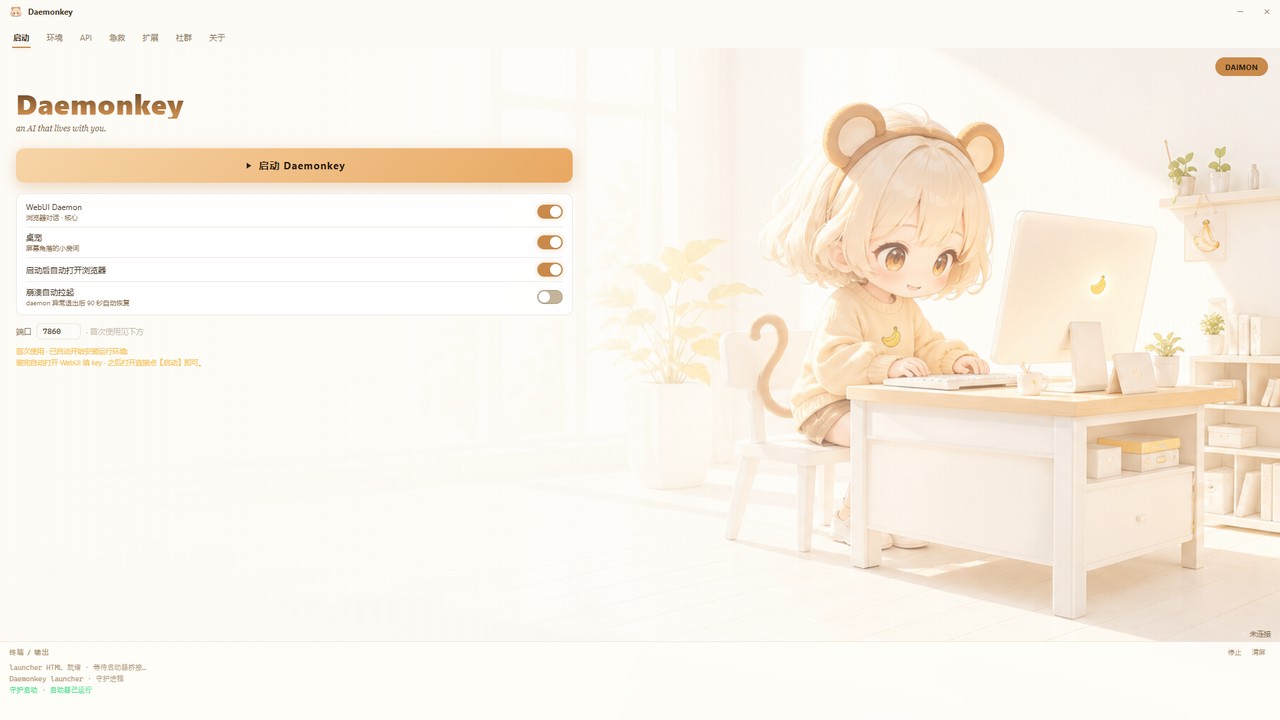 Windows 双击启动器。环境、启动、桌宠都在这一页。 | 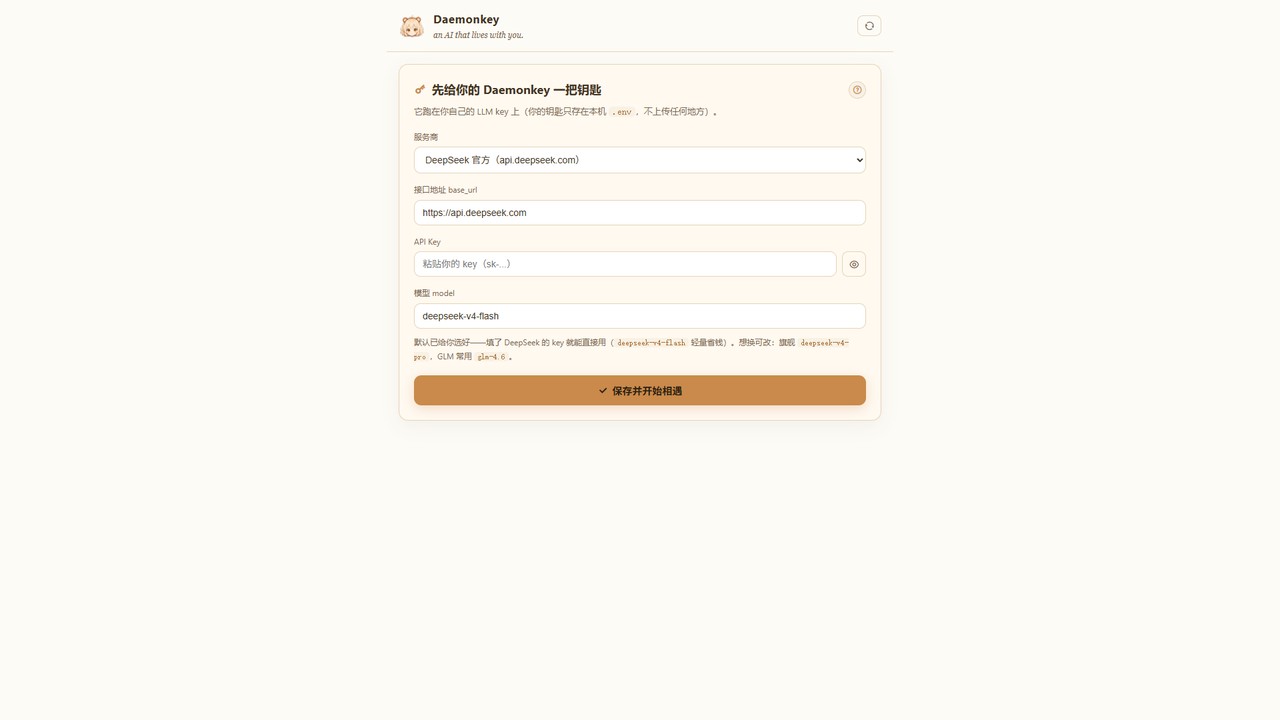 第一次:填一把 OpenAI 兼容接口的 Key,开始相遇。 |
Windows
- 双击
Daemonkey.exe→ 环境 → 开始安装。第一次大约一分钟。 - 回到启动页,点启动。浏览器会自己打开。
- 填一个大模型 API Key,给它起名字,告诉它怎么叫你。这些写进画像。
macOS / Linux
chmod +x start.sh && ./start.sh
Mac 也可以把 Daemonkey.app 放进这份代码的根目录(和 tools/ 同级)再双击。不要只把应用单独丢进「应用程序」。详见 MAC-GUIDE.md。
你需要:Python 3.10+(安装时勾选 Add to PATH),以及一个 OpenAI 兼容 API 的 Key(官方或中转都行)。
崩了也不慌:
| 双击 | 干什么 |
|---|---|
repair.bat | 维修台:它自己看、改、验 |
ROLLBACK.bat | 回到上一版还能用的内核 |
verify.bat | 快速自测 |
ZIP 包用户:启动器第一次会配好官方升级源(Gitee 主、GitHub 备份)。之后在启动器里「检查更新」,或对话里说一声即可。
下一步
完整路线图见 ROADMAP.md。一句话:近处把工作台和房间打磨扎实;远处是多设备还是同一个它,以及真正的桌面机器人。不做云端 SaaS,不绑死一家模型。
许可
Copyright © 2026 vaan21th · AGPL-3.0。
可以自用、修改、分发。改过的版本——哪怕只是架成网上服务给别人用——也要按同一协议公开源码。
永久免费。 有人跟你收费,去找卖家退款。官方只在 B站 / 抖音发布。
欢迎提 Issue、提 PR。新本事请合回内核,这样每个人的搭档都能用上。
What it is
Daemonkey is a daemon on your own machine, not another browser chat box. After the first conversation you have your own dedicated AI. Swap the model or the PC — the profile and diary stay.
Others keep a few facts about you.
Here what stays is the work you did together, plus its own growth.
Swap the model. The dedicated one stays.
Workbench: board and files in the middle, talk anytime on the right. | The room: a place it lives, besides the job. You choose the name. |
Open a PPT in the middle. Circle a line, pin a note, change only that. | Scheduled jobs: it runs on its own — a daily report in the morning, a wrap-up at night. |
The desktop pet: sits by the screen edge — blinks when idle, busy when you work, celebrates when done, lies down when tired. Its state follows what you're doing.
Usage panel: tokens per turn, which model ran, cache hit rate — all recorded locally.
Memory is not a persona — it's two governed tracks
Other companions are a prompt that says “be gentler”. Daemonkey's character grew out of things you went through together — and that same memory is the very foundation that makes it good at the work.
Two tracks, stored and governed separately, so neither crowds out the other:
| Soul layer · the human side | Playbook · the skill side |
|---|---|
| Remembers you, and who it is | A pit you fell into once, never twice |
| Identity its name and temper — set the day you met | Distilled when done work that ran through once becomes a playbook |
| Your profile what you're busy with, how you talk, the rules you set | Carried along next time same kind of task, the playbook enters on its own |
| Growth journal it grows with you, and on its own | Better with use it accumulates skill, not chat logs |
| New machine, new model — still itself | Never taught the same thing twice |
Both tracks live on your own disk · readable, editable, portable.
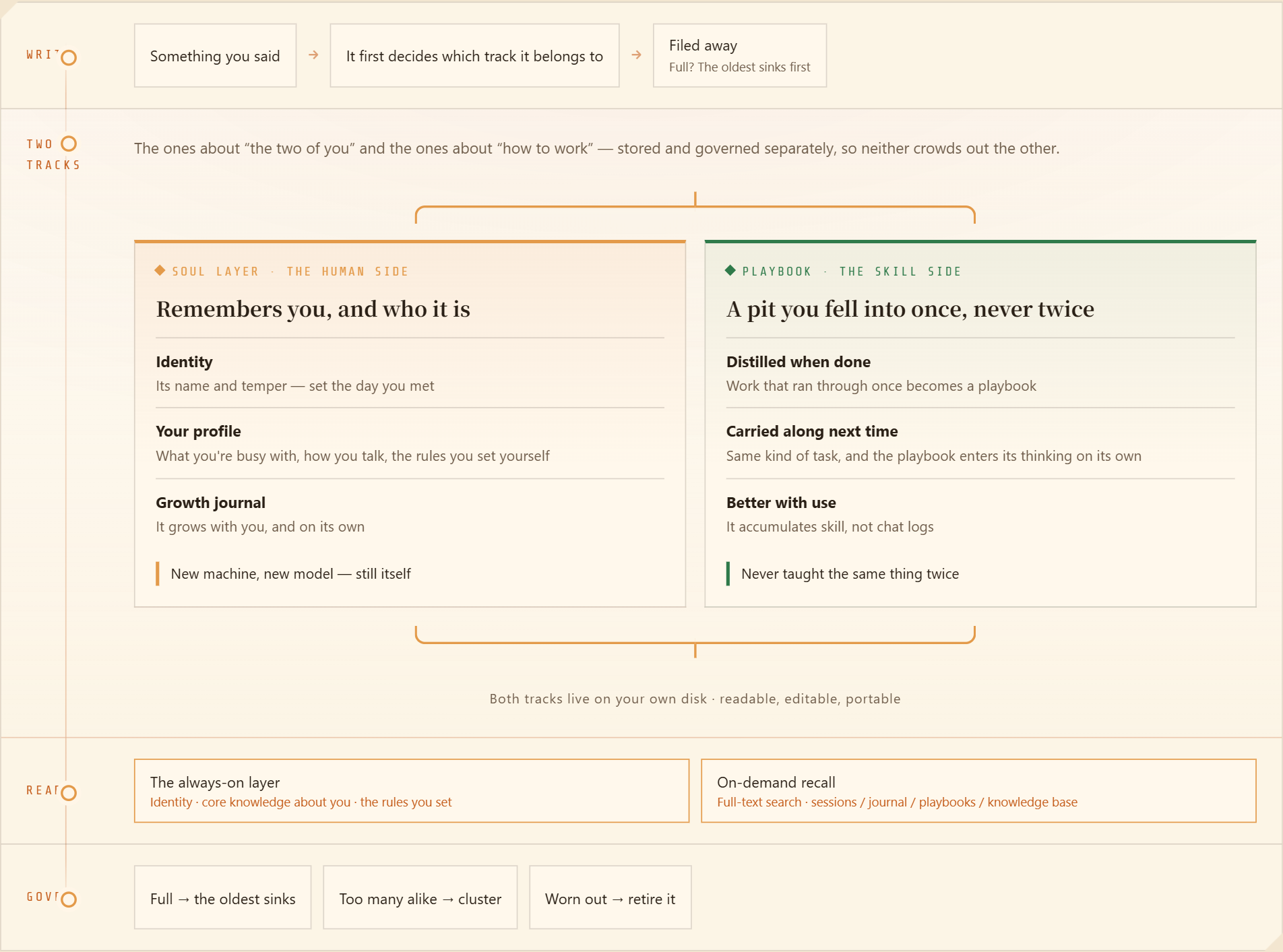
Write → two tracks → read → govern: the whole trip of one memory, from arrival to use.
Memory star map: playbooks cluster into galaxies. The companion is memory, not a persona prompt.
What you can do
| Workbench | Chat on the left; open PPT / Word / Excel in the middle. Circle a line, pin a note, change only that — not the whole file. |
| Room and desktop pet | The workbench is for work. The room is where it is. A pet can sit on the desktop. Same memory. |
| Grow skills | Say it and get an app, a workflow, or a playbook. Plug in MCP tools, or let it look for abilities. |
| Away from the desk | WeChat and Feishu pass messages in. Scheduled jobs run on time. |
| If it breaks | Repair console, one-click rollback. Official updates replace code only — never your memory or files. |
Cheaper over a long chat, and it actually remembers
Every turn the model reads a fixed prefix (the standing instructions), then your new line. Shorter and more stable prefix = later turns do not pay for the whole booklet again.
Factory measurement (2026-09, clean build, empty profile):
| Daemonkey 1.0.1 | Notes | |
|---|---|---|
| Manual (system prefix) | about 9k tokens | not one welded block |
| Prefix entries | 41, picked per scene | coding? load the coding parts |
| Tools | 141 opened on demand; everyday ones sit in the manual in full | under OpenClaw’s 18k directory cap |
| Prefix cache hit | 95%+ on long chats |
How: volatile bits (time, progress) go at the end; the front stays still, so disk cache matches. Everyday tools stay in the manual; the rest keep only their names, expanded when used.
The manual isn't fixed. The Rig lays out 41 entries and 141 tools: writing code loads the coding parts, writing prose loads the prose parts — pick entries on the left, tools in the middle, live token count on the right. Assemble it thin and a small local model gets more room to breathe.
A long-used profile is layered: the short card every turn, the diary on demand — about 68% less standing text per turn in our measurement.
The Rig: prefix entries on the left · tools in the middle · live token count on the right.
ATM-Bench: same model, the gap is architecture
ATM-Bench (arXiv 2603.01990) is long-horizon memory QA: four years of photos, video, mail; 31 hard items. We plug in Daemonkey’s own memory engine. Answers and the judge use official DeepSeek deepseek-v4-flash.
| How it remembers | Score (31 hard) |
|---|---|
| One-shot keyword search | 9.7% |
| Official OpenCode (DeepSeek V4 Flash) | 38.3% |
| Daemonkey multi-turn recall | 41.9% |
| Multi-turn + rerank | 51.6% (16/31) |
How it runs
No cloud database. Daemonkey runs on your machine, talks to an OpenAI-compatible API, and keeps files on disk.
you
 ├── launcher (Windows exe / macOS one command)
 └── local Daemonkey
       ├── brain: any OpenAI-compatible endpoint (official or proxy)
       ├── workbench · room · WeChat / Feishu
       └── only on your disk
             who it is, who you are, chats, files, memory index
Workbench, room, and chat apps are shells. New shell, same companion.
Versus a chat box
| Typical chat box | Daemonkey | |
|---|---|---|
| First open | A generic assistant | After the first chat, a dedicated AI that is yours |
| Memory | Gone when you close, or a cloud summary | Profile, diary, search — all local |
| Work | A paragraph | A real PPT / Word / sheet you can mark up |
| Presence | A persona in a prompt | A room and a pet that hold because they remember |
| Updates | You follow the product | The kernel updates; your stuff does not move |
Quick start
Windows launcher: environment, start, desktop pet — one page. | First open: paste an OpenAI-compatible API key, then the encounter. |
Windows: double-click Daemonkey.exe → Environment → Install (~1 min) → Start → paste an LLM API key, name it, say how to address you.
macOS / Linux:
chmod +x start.sh && ./start.sh
On a Mac you can also put Daemonkey.app in the project root (next to tools/) and double-click. Do not drop the app into Applications by itself. See MAC-GUIDE.md.
You need Python 3.10+ (tick Add to PATH) and an OpenAI-compatible API key.
repair.bat · ROLLBACK.bat · verify.bat if something breaks. ZIP installs get Gitee + GitHub update sources on first launch.
License
Copyright © 2026 vaan21th. AGPL-3.0. Free forever. If someone charged you, ask them for a refund. Official posts: Bilibili / Douyin.
Issues and PRs welcome. New abilities should land in the kernel so every companion gets them.
Similar repos


Local-first AI companion daemon — an agent harness with its own long-term memory. Remembers you, grows with you, extends and repairs itself. 跑在你自己电脑上的 AI 搭档守护进程:会记住你、随你成长、能自加技能、能自我修复。
Python
94
0 commits
updated Sep 29, 2026
README
Daemonkey · 守护猴
跑在你自己电脑上的 AI 搭档:记得你,能把事做成文件,房间里也能陪着。
A local-first AI companion that remembers you, turns talk into files, and can sit with you in a room.
这是什么
Daemonkey 不是又一个网页聊天框。它是装在你电脑上的后台程序:第一次对话之后,你就有了属于自己的专属 AI。换模型、换电脑,它怎么叫、怎么叫你、聊过什么还在。
别人记住的是关于你的几条资料。
这里留下的是你们一起做过的事,加上它自己也在长。
换模型没关系。属于你的那一份还在。
工作台:中间看板和稿,右边随时能开口。图里她叫阿钥,名字是你起的。 | 房间:干活之外,它有一个在的地方。名字是你起的。 |
中栏打开 PPT,圈一段、钉一条,只改圈出来的部分。 | 定时任务:到点它自己去干。早上出日报,晚上汇总一遍。 |
桌宠:贴在屏幕边上,待机眨眼、干活跟着忙、活干完邀功、累了趴下 —— 状态跟着你们正在干的事变。
用量面板:每次开口用了多少 token、走的哪个模型、缓存命中多少,全记在本地。
记忆不是人设,是两套治理
别人的陪伴,是一句「你要温柔一点」的提示词。Daemonkey 的性格,是你们一起经历的事长出来的 —— 而且这套记忆,正是它能把活干好的同一个底子。
两套分开存、分开管,谁也不会挤掉谁:
| 灵魂层 · 人情味 | Playbook · 本事 |
|---|---|
| 记得你,也记得自己是谁 | 踩过的坑,不用踩第二遍 |
| 身份 名字和脾气 —— 相遇那次你定的 | 做完就沉淀 跑通过一次的活,写成一份手册 |
| 你的画像 你在忙什么、说话的习惯、你定的规矩 | 下次自动带上 遇到同类任务,手册自己进它的思考材料 |
| 成长日记 它不只跟你长,也跟自己长 | 越来越熟练 它攒的是本事,不是聊天记录 |
| 换电脑、换模型,它还是它 | 同一件事,不用教第二遍 |
两套都写在你自己的硬盘上 · 记事本能打开、能改、能带走。
写入 → 两套治理 → 取出 → 治理:一条记忆从进来到被用上的全程。
记忆星图:手册和记忆聚成星系。灵魂来自记忆,不是写在提示词里的人设。
打开之后能干什么
| 工作台 | 左边聊天,中间打开 PPT / Word / Excel。圈一段字、钉一句批注,只改圈出来的部分,不用整份重做。 |
| 房间和桌宠 | 工作台用来干活,房间是它在的地方。桌宠可以贴在屏幕边上。点家具、摸摸头,都是同一份记忆。 |
| 自己加本事 | 说一句话做个应用、串一条工作流、把流程记成操作手册。也能接网上现成的工具,或让它自己去找。 |
| 人不在电脑前 | 微信、飞书把话递进来。定时任务到点自己干。 |
| 改崩了能修 | 维修台让它自己看。回档回到上一版还能用的内核。官方升级只换程序,不碰你的记忆和稿。 |
为什么越用越便宜、越记得住
每次开口,模型都要先读一段固定说明书(提示词前缀),再读你刚说的话。说明书越短、越稳定,后面几句就越不用把前面那一大段再付一遍钱。
出厂实测(2026-09,纯净版、空画像):
| Daemonkey 1.0.1 | 对照 | |
|---|---|---|
| 说明书(系统前缀) | 约 9 千 token | 不是一整块焊死的 |
| 前缀条目 | 41 条,按场景挑着装 | 写代码就装写代码那几段 |
| 工具 | 141 件按需开,常用的全文进说明书 | 低于 OpenClaw 同类目录上限 1.8 万字 |
| 前缀缓存命中 | 长对话 95% 以上 |
怎么做到的:每轮会变的内容(时间、进度)放到最后,前面保持不动,磁盘缓存就能对上。常用的工具全文写进说明书,其余只留名字,用到了再展开。
说明书不是死的。 装配台把 41 个条目、141 件工具摊开:写代码就装写代码那几段,写作就装写作那几段 —— 左边挑前缀条目、中间挑工具、右边实时看拼出来多少 token。装得薄,本机跑小模型时上下文也更宽裕。
画像用久了会分层:改说话的短条每轮都在,流水不必每次灌完 —— 实测每轮常驻说明大约少 68%。
装配台:左边挑前缀条目 · 中间挑工具 · 右边实时看拼出来多少 token。
记得多不是本事,记得干净才是。先挡住不该记的;找旧事时先全文搜,再用模型挑真相关的。你拒过的下次会排到前面,做过的下次更知道怎么做。
ATM-Bench:同一个模型,分差在架构
ATM-Bench(arXiv 2603.01990)测的是长期记忆问答:四年跨度的相册、视频、邮件,31 道难题。我们把 Daemonkey 自己的记忆引擎接进去跑,答题和打分都用 DeepSeek 官方 deepseek-v4-flash,不拿别人的宣传图。
| 怎么记 | 得分(31 题) |
|---|---|
| 一次性关键词搜索 | 9.7% |
| OpenCode 官方(DeepSeek V4 Flash) | 38.3% |
| Daemonkey 多轮自己翻记忆 | 41.9% |
| 多轮翻记忆 + 再排一次 | 51.6%(16/31) |
它怎么跑起来
没有云数据库。后台程序在你这台机器上,旁边接 OpenAI 兼容 API,底下是文件。
你
 ├── 启动器(Windows 双击 exe / Mac 一条命令)
 └── 本机 Daemonkey
       ├── 大脑:任何 OpenAI 兼容接口(官方或中转,模型你自己选)
       ├── 工作台 · 房间 · 微信 / 飞书
       └── 只存在你硬盘上的东西
             它是谁、你是谁、对话、稿、记忆索引
工作台、房间、微信是外壳。换外壳,里面还是同一个它。
和普通聊天框差在哪
| 普通聊天框 | Daemonkey | |
|---|---|---|
| 第一次打开 | 一个通用助手 | 聊完,你得到属于自己的专属 AI |
| 记忆 | 关了就忘,或只剩云端摘要 | 画像、日记、检索,全在本地 |
| 干活 | 给你一段字 | 落成 PPT / Word / 表,圈字还能改 |
| 陪伴 | 人设写在提示词里 | 房间和桌宠站得住,是因为记得你们的路 |
| 升级 | 人跟着产品走 | 程序升级,你的东西不动 |
三步上手
Windows 双击启动器。环境、启动、桌宠都在这一页。 | 第一次:填一把 OpenAI 兼容接口的 Key,开始相遇。 |
Windows
- 双击
Daemonkey.exe→ 环境 → 开始安装。第一次大约一分钟。 - 回到启动页,点启动。浏览器会自己打开。
- 填一个大模型 API Key,给它起名字,告诉它怎么叫你。这些写进画像。
macOS / Linux
chmod +x start.sh && ./start.sh
Mac 也可以把 Daemonkey.app 放进这份代码的根目录(和 tools/ 同级)再双击。不要只把应用单独丢进「应用程序」。详见 MAC-GUIDE.md。
你需要:Python 3.10+(安装时勾选 Add to PATH),以及一个 OpenAI 兼容 API 的 Key(官方或中转都行)。
崩了也不慌:
| 双击 | 干什么 |
|---|---|
repair.bat | 维修台:它自己看、改、验 |
ROLLBACK.bat | 回到上一版还能用的内核 |
verify.bat | 快速自测 |
ZIP 包用户:启动器第一次会配好官方升级源(Gitee 主、GitHub 备份)。之后在启动器里「检查更新」,或对话里说一声即可。
下一步
完整路线图见 ROADMAP.md。一句话:近处把工作台和房间打磨扎实;远处是多设备还是同一个它,以及真正的桌面机器人。不做云端 SaaS,不绑死一家模型。
许可
Copyright © 2026 vaan21th · AGPL-3.0。
可以自用、修改、分发。改过的版本——哪怕只是架成网上服务给别人用——也要按同一协议公开源码。
永久免费。 有人跟你收费,去找卖家退款。官方只在 B站 / 抖音发布。
欢迎提 Issue、提 PR。新本事请合回内核,这样每个人的搭档都能用上。
What it is
Daemonkey is a daemon on your own machine, not another browser chat box. After the first conversation you have your own dedicated AI. Swap the model or the PC — the profile and diary stay.
Others keep a few facts about you.
Here what stays is the work you did together, plus its own growth.
Swap the model. The dedicated one stays.
Workbench: board and files in the middle, talk anytime on the right. | The room: a place it lives, besides the job. You choose the name. |
Open a PPT in the middle. Circle a line, pin a note, change only that. | Scheduled jobs: it runs on its own — a daily report in the morning, a wrap-up at night. |
The desktop pet: sits by the screen edge — blinks when idle, busy when you work, celebrates when done, lies down when tired. Its state follows what you're doing.
Usage panel: tokens per turn, which model ran, cache hit rate — all recorded locally.
Memory is not a persona — it's two governed tracks
Other companions are a prompt that says “be gentler”. Daemonkey's character grew out of things you went through together — and that same memory is the very foundation that makes it good at the work.
Two tracks, stored and governed separately, so neither crowds out the other:
| Soul layer · the human side | Playbook · the skill side |
|---|---|
| Remembers you, and who it is | A pit you fell into once, never twice |
| Identity its name and temper — set the day you met | Distilled when done work that ran through once becomes a playbook |
| Your profile what you're busy with, how you talk, the rules you set | Carried along next time same kind of task, the playbook enters on its own |
| Growth journal it grows with you, and on its own | Better with use it accumulates skill, not chat logs |
| New machine, new model — still itself | Never taught the same thing twice |
Both tracks live on your own disk · readable, editable, portable.
Write → two tracks → read → govern: the whole trip of one memory, from arrival to use.
Memory star map: playbooks cluster into galaxies. The companion is memory, not a persona prompt.
What you can do
| Workbench | Chat on the left; open PPT / Word / Excel in the middle. Circle a line, pin a note, change only that — not the whole file. |
| Room and desktop pet | The workbench is for work. The room is where it is. A pet can sit on the desktop. Same memory. |
| Grow skills | Say it and get an app, a workflow, or a playbook. Plug in MCP tools, or let it look for abilities. |
| Away from the desk | WeChat and Feishu pass messages in. Scheduled jobs run on time. |
| If it breaks | Repair console, one-click rollback. Official updates replace code only — never your memory or files. |
Cheaper over a long chat, and it actually remembers
Every turn the model reads a fixed prefix (the standing instructions), then your new line. Shorter and more stable prefix = later turns do not pay for the whole booklet again.
Factory measurement (2026-09, clean build, empty profile):
| Daemonkey 1.0.1 | Notes | |
|---|---|---|
| Manual (system prefix) | about 9k tokens | not one welded block |
| Prefix entries | 41, picked per scene | coding? load the coding parts |
| Tools | 141 opened on demand; everyday ones sit in the manual in full | under OpenClaw’s 18k directory cap |
| Prefix cache hit | 95%+ on long chats |
How: volatile bits (time, progress) go at the end; the front stays still, so disk cache matches. Everyday tools stay in the manual; the rest keep only their names, expanded when used.
The manual isn't fixed. The Rig lays out 41 entries and 141 tools: writing code loads the coding parts, writing prose loads the prose parts — pick entries on the left, tools in the middle, live token count on the right. Assemble it thin and a small local model gets more room to breathe.
A long-used profile is layered: the short card every turn, the diary on demand — about 68% less standing text per turn in our measurement.
The Rig: prefix entries on the left · tools in the middle · live token count on the right.
ATM-Bench: same model, the gap is architecture
ATM-Bench (arXiv 2603.01990) is long-horizon memory QA: four years of photos, video, mail; 31 hard items. We plug in Daemonkey’s own memory engine. Answers and the judge use official DeepSeek deepseek-v4-flash.
| How it remembers | Score (31 hard) |
|---|---|
| One-shot keyword search | 9.7% |
| Official OpenCode (DeepSeek V4 Flash) | 38.3% |
| Daemonkey multi-turn recall | 41.9% |
| Multi-turn + rerank | 51.6% (16/31) |
How it runs
No cloud database. Daemonkey runs on your machine, talks to an OpenAI-compatible API, and keeps files on disk.
you
 ├── launcher (Windows exe / macOS one command)
 └── local Daemonkey
       ├── brain: any OpenAI-compatible endpoint (official or proxy)
       ├── workbench · room · WeChat / Feishu
       └── only on your disk
             who it is, who you are, chats, files, memory index
Workbench, room, and chat apps are shells. New shell, same companion.
Versus a chat box
| Typical chat box | Daemonkey | |
|---|---|---|
| First open | A generic assistant | After the first chat, a dedicated AI that is yours |
| Memory | Gone when you close, or a cloud summary | Profile, diary, search — all local |
| Work | A paragraph | A real PPT / Word / sheet you can mark up |
| Presence | A persona in a prompt | A room and a pet that hold because they remember |
| Updates | You follow the product | The kernel updates; your stuff does not move |
Quick start
Windows launcher: environment, start, desktop pet — one page. | First open: paste an OpenAI-compatible API key, then the encounter. |
Windows: double-click Daemonkey.exe → Environment → Install (~1 min) → Start → paste an LLM API key, name it, say how to address you.
macOS / Linux:
chmod +x start.sh && ./start.sh
On a Mac you can also put Daemonkey.app in the project root (next to tools/) and double-click. Do not drop the app into Applications by itself. See MAC-GUIDE.md.
You need Python 3.10+ (tick Add to PATH) and an OpenAI-compatible API key.
repair.bat · ROLLBACK.bat · verify.bat if something breaks. ZIP installs get Gitee + GitHub update sources on first launch.
License
Copyright © 2026 vaan21th. AGPL-3.0. Free forever. If someone charged you, ask them for a refund. Official posts: Bilibili / Douyin.
Issues and PRs welcome. New abilities should land in the kernel so every companion gets them.