
Auto-clipper that turns long videos (podcasts, talks, essays, comedy) into short standalone clips for Shorts, Reels and TikTok. Code lists every possible cut; an AI judge picks where each clip starts and ends. Benchmarked on 38 hand-labelled videos.
Python
1
115 commits
updated Sep 27, 2026
See what people are saying
README
jevcut
Turn a long video into short clips that stand on their own — for Shorts, Reels, TikTok, or just a highlights reel. One command in, ranked mp4s out.
uv run jevcut run talk.mp4 --model lemonfox
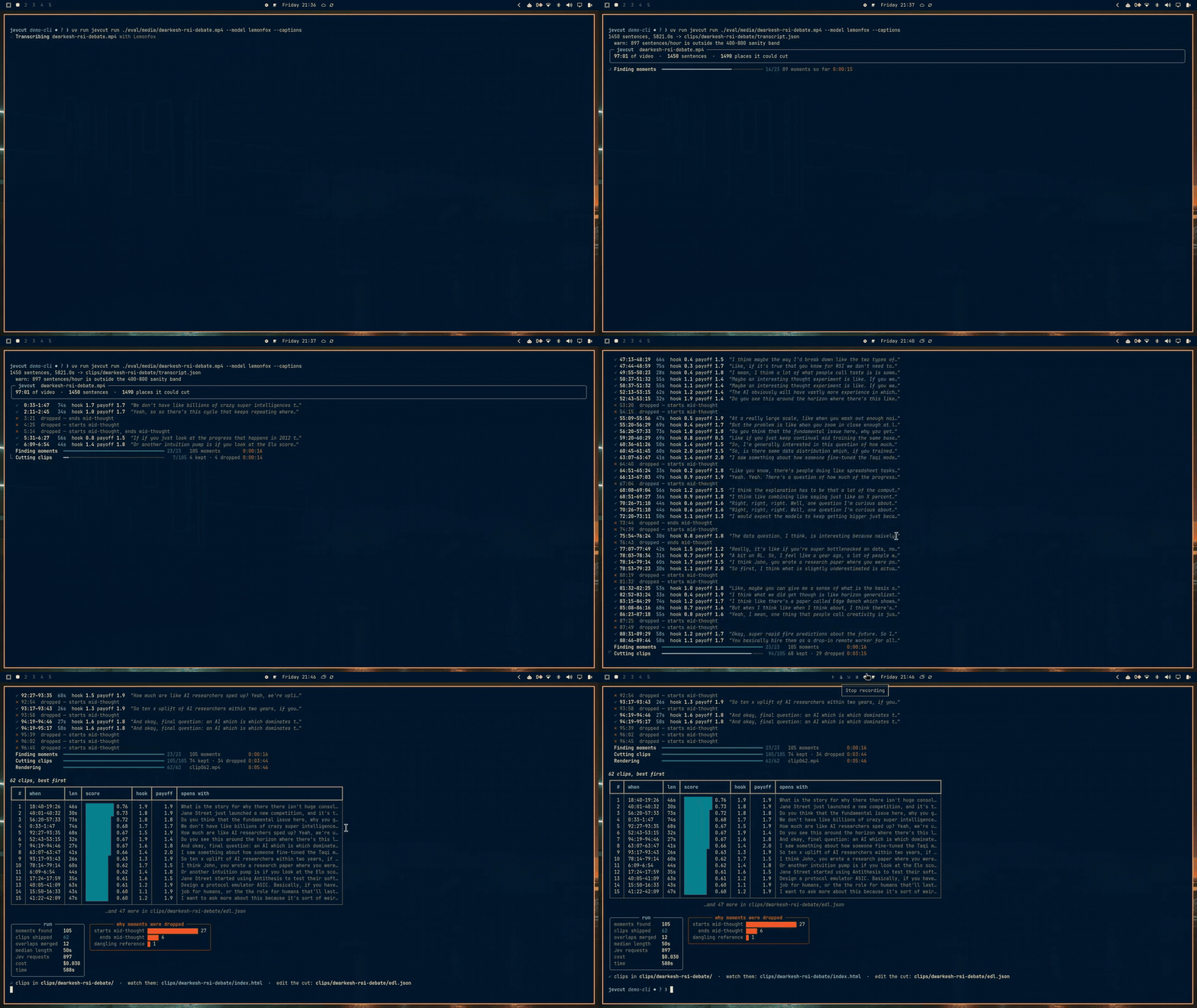
jevcut transcribes the video, finds the moments worth clipping, decides exactly where each one starts and stops, drops anything that doesn't stand alone or turns out to be an ad, and writes ranked mp4s plus a page to watch them on, best first.
What makes it different: code lists every place a clip could start or end — sentence ends, pauses, speaker changes — and never lets a model name a timestamp. Jev (TypeSafe's System One model) only ever judges the clip that one candidate edge would make, or picks among candidates code has already enumerated. See What jevcut does differently.
Measured, not asserted. On 38 hand-labelled videos across 13 genres, jevcut beats five simpler approaches — scoring every sentence, fixed windows, padding the top sentence, and two that keep jevcut's own choice of moment but set the edges in code — on recall, on how often both edges land where a human would cut, and on precision. Full numbers in BENCHMARKS.md; why each result came out the way it did is in RESEARCH.md. It costs about 3¢ of Jev per hour of video (What it costs); transcription is extra.
Scope: v1 clips verbal content — podcasts, interviews, talks, panels, comedy, streams where people talk. The judge is Jev over transcript text, so a moment carrying no words (a crash, a scream, a stunt) is invisible to it by construction. That is a deliberate v1 boundary, not an oversight: see issue 021.
See ROADMAP.md and issues/ for what's built and what's next.
The bet
Every auto-clipper on the market fails the same way: the clip is roughly in the right place but starts mid-thought, opens on a pronoun with no referent, or ends before the punchline lands. That is not a "find the interesting part" problem. It is a boundary problem, and boundaries are where existing Jev-based tools are weakest too:
| Tool | Boundary method | Weakness |
|---|---|---|
| jevmeter | highest rolling average over a 10–15s stretch | finds energy, not a self-contained thought |
| jev-skip | 30s caption windows snapped to sentence ends | window granularity is coarser than a cut |
| youtube-sponsor-detection | scan → anchor → trace back to lead-in | right idea — jevcut steals this and generalizes it |
What jevcut does differently
-
Code lists the edges; Jev judges the clips they make. Code enumerates every plausible cut (sentence end, speech pause ≥350ms, speaker change) and never lets a model name a timestamp. This took two tries. First Jev was to pick a cut from a
Choice— a tuned constant offset kept matching it. Then code placed and repaired the clip by rule — on eight labeled videos that dropped 57% of moments for a ragged edge. Now code offers every real opening and ending as a candidate and Jev judges the clip each would make: recall on the pilot set went 0.23 → 0.41. Edges are still the weak point (few land inside a labeler's acceptable range), and the numbers are in RESEARCH.md, with the early experiments ineval/experiments/for anyone who wants to disagree.Jev is spent where arithmetic cannot compete even in principle: whether a moment is worth clipping, whether the clip stands alone, whether the payoff lands inside the cut. No offset or snapping rule answers those — there is nothing for it to compute on.
-
A cascade, not dense scoring. A cheap windowed pass finds candidate anchors; only around those does jevcut judge candidate clips. The plan was ~20× fewer requests than scoring every sentence; measured, it spends about as many (~520 per hour of video), because every clip's candidate endings are judged. The requests went into boundaries instead of into scoring every sentence. See What it costs.
-
An explicit standalone gate — now the main event. Dedicated Nouls for the failure modes that actually kill clips: starts mid-thought, dangling pronoun, payoff never lands. Every candidate edge is judged; a clip no candidate can make pass is dropped — never shipped. Under-clip on purpose. No open-source clipper we read has any output check at all — autoclip asks its model for self-containment as a scoring criterion and never verifies the clip it cut. See docs/PRIOR-ART.md.
-
Live with a lookback ring buffer. Live detection is always late, so the start is never "now". On trigger, one retro
Choiceover the buffered cut points recovers the real start. See docs/ARCHITECTURE.md. -
Measured, not asserted. Every claim above is an issue with a metric attached. docs/EVAL.md defines the harness and the baselines we must beat before any of this is worth believing.
What it costs
Measured on the pilot eval set (8 videos, 4.6 hours of media, 2026-09-24), per hour of video:
| Jev requests | cost | |
|---|---|---|
Transcription, Lemonfox (--model lemonfox) | – | ~$0.17 |
| Scan: finding the moments worth clipping | ~85 | |
| Boundary search: opening, endings, ad check | ~430 | |
| Jev total | ~520 | ~$0.03 |
Jev bills about $0.05 per 1,000 requests here (as reported per call, ~1,100 input tokens each), so the model calls are the cheap part: transcribing costs five times more. Local Whisper makes transcription free and finds fewer moments (BENCHMARKS.md).
Requests, not dollars, are the budget that matters. Jev allows 1,200 requests a minute, so at ~520 per hour of video one account backfills about two hours of video a minute. Three things keep the count down:
- The scan reads windows, not sentences. About five minutes of transcript per request, picking up to six moments from each.
- Openings are one question. Every candidate start point is marked in the transcript and a single Choice picks one, instead of judging each separately.
- Endings stop early. A clip ends at the earliest point where its thought is
finished, so jevcut judges candidate endings in time order, two at a time, and stops
at the first that works: once one does, no later ending can change the pick. Same
clips, 25% fewer requests on the pilot set.
--all-endingsturns this off, for eval runs that want every ending judged and on record.
The first plan estimated ~32 requests per hour, one judgment per clip. Judging every candidate edge instead is what raised recall from 0.23 to 0.54, and it costs about what dense per-sentence scoring was estimated at (~600 per hour). docs/COST-MODEL.md has the plan and the measurement side by side.
Layout
docs/       design: concepts, architecture, question specs, cost model, eval plan, prior art
issues/     the work, one file per task, numbered and dependency-ordered
src/        the pipeline: transcript, cut points, scan, boundaries, gate, ranking, render
tests/      unit tests; no API key, model or media needed
scripts/    check_docs.py — do the docs still describe the code?
eval/       a synthetic fixture and the research experiments; no labeled set yet (011)
Running it
uv sync --extra dev          # add --extra asr for Whisper (brings the CUDA runtime, so an
                             # NVIDIA GPU is used), --extra shots for scene detection
uv run pytest                # no API key needed
uv run ruff check .          # lint; the known findings are listed below
uv run python scripts/check_docs.py   # do the docs still describe the code?

# a real video, end to end -> ranked mp4s, an editable edl.json and index.html (a page
# to watch them on, best first, with the scores that ranked them), all in clips/talk/.
# At a terminal it shows live progress, every moment kept or dropped and why, a ranked
# table and a run summary; piped, or with --plain, it prints one line per event
# a second run on the same video reuses its transcript, so ASR runs once (a transcript
# made from a different video is never reused); Jev answers are cached
uv run jevcut run talk.mp4 --language en
# optional, on run or clip: --vertical centre-crops to 9:16 at 1080x1920 (no face
# tracking yet), --captions burns in word-level captions from the transcript
uv run jevcut run talk.mp4 --language en --vertical --captions
# the best-measured transcript is hosted: --model lemonfox (LEMONFOX_API_KEY in
# .env.local; $0.50 per 3 hours of audio). It punctuates where Whisper small does not and
# labels speakers, which raised recall on every label set (BENCHMARKS.md, lemonfox-asr)
uv run jevcut run talk.mp4 --language en --model lemonfox

# the same in two steps
uv run jevcut transcribe talk.mp4 --model small --language en --out t.json
uv run jevcut clip t.json --media talk.mp4 --out clips/talk/

# without ASR, from the synthetic fixture
uv run jevcut transcribe x --from-json eval/fixtures/interview.words.json --out t.json

# score every labeled video's run against its labels (eval/labels-v2, issue 011); no API
# calls. What a label means -- the shortest cut that works, opening on its hook -- is
# eval/RUBRIC.md. Score a change against the second labeler too: eval eval/labels-v2-b
uv run jevcut eval --note "what changed"
# how much two independent labelers agree -- the noise floor any boundary error sits on
uv run jevcut agree eval/labels-v2 eval/labels-v2-b
# every measured version, re-scored against every label set -> BENCHMARKS.md. After a
# change is kept: jevcut bench --snapshot NAME --what "..." --commit SHA --gate-requests N
uv run jevcut bench
# the same as a web page of bar charts (template: eval/benchmarks/page.template.html)
uv run python scripts/bench_page.py benchmarks.html

# the stages one at a time
uv run jevcut cuts t.json --out c.json
uv run jevcut region t.json L009   # the transcript around one anchor, with cut points marked
uv run jevcut scan t.json          # Pass C — costs real requests
uv run jevcut smoke                # one live Noul, traced
eval/fixtures/interview.words.json is a synthetic word list, so from there on no ASR
model is needed, and cuts and region need no API key either.
Lint. The tree is formatted and ruff check reports three findings, all left on
purpose: one long line in cli.py that is a Noul criterion string — splitting it risks
losing a space in prompt text that has to read exactly as written — and an l loop
variable with its single-element slice in test_render.py, where next(...) would only
trade an IndexError for a StopIteration in a test that fails either way.
The formatting run is listed in .git-blame-ignore-revs. Turn it on with
git config blame.ignoreRevsFile .git-blame-ignore-revs so blame skips it.
Reaching Jev. Two backends, same code above them. openrouter (the default) posts to
/api/alpha/decisions with typesafe/jev-1.13 and needs OPENROUTER_API_KEY;
typesafe uses the first-party SDK and TYPESAFE_API_KEY. Copy .env.example to
.env.local — it is gitignored, and a variable already set in your shell always wins.
Review
docs/REVIEW-LOG.md records what a review of M0 found, with the reproduction for each defect. Worth reading before trusting any of this.
Reading order
docs/CONCEPTS.md → docs/ARCHITECTURE.md → docs/QUESTIONS.md → ROADMAP.md → pick an issue.
Start with CONCEPTS: it defines the sentence IDs, cut points and regions that every other document uses without explaining.
License
MIT.
Contributors

115 commits
Similar repos


Languages
Python
93.6%
HTML
6.2%
Auto-clipper that turns long videos (podcasts, talks, essays, comedy) into short standalone clips for Shorts, Reels and TikTok. Code lists every possible cut; an AI judge picks where each clip starts and ends. Benchmarked on 38 hand-labelled videos.
Python
1
115 commits
updated Sep 27, 2026
See what people are saying
README
jevcut
Turn a long video into short clips that stand on their own — for Shorts, Reels, TikTok, or just a highlights reel. One command in, ranked mp4s out.
uv run jevcut run talk.mp4 --model lemonfox
jevcut transcribes the video, finds the moments worth clipping, decides exactly where each one starts and stops, drops anything that doesn't stand alone or turns out to be an ad, and writes ranked mp4s plus a page to watch them on, best first.
What makes it different: code lists every place a clip could start or end — sentence ends, pauses, speaker changes — and never lets a model name a timestamp. Jev (TypeSafe's System One model) only ever judges the clip that one candidate edge would make, or picks among candidates code has already enumerated. See What jevcut does differently.
Measured, not asserted. On 38 hand-labelled videos across 13 genres, jevcut beats five simpler approaches — scoring every sentence, fixed windows, padding the top sentence, and two that keep jevcut's own choice of moment but set the edges in code — on recall, on how often both edges land where a human would cut, and on precision. Full numbers in BENCHMARKS.md; why each result came out the way it did is in RESEARCH.md. It costs about 3¢ of Jev per hour of video (What it costs); transcription is extra.
Scope: v1 clips verbal content — podcasts, interviews, talks, panels, comedy, streams where people talk. The judge is Jev over transcript text, so a moment carrying no words (a crash, a scream, a stunt) is invisible to it by construction. That is a deliberate v1 boundary, not an oversight: see issue 021.
See ROADMAP.md and issues/ for what's built and what's next.
The bet
Every auto-clipper on the market fails the same way: the clip is roughly in the right place but starts mid-thought, opens on a pronoun with no referent, or ends before the punchline lands. That is not a "find the interesting part" problem. It is a boundary problem, and boundaries are where existing Jev-based tools are weakest too:
| Tool | Boundary method | Weakness |
|---|---|---|
| jevmeter | highest rolling average over a 10–15s stretch | finds energy, not a self-contained thought |
| jev-skip | 30s caption windows snapped to sentence ends | window granularity is coarser than a cut |
| youtube-sponsor-detection | scan → anchor → trace back to lead-in | right idea — jevcut steals this and generalizes it |
What jevcut does differently
-
Code lists the edges; Jev judges the clips they make. Code enumerates every plausible cut (sentence end, speech pause ≥350ms, speaker change) and never lets a model name a timestamp. This took two tries. First Jev was to pick a cut from a
Choice— a tuned constant offset kept matching it. Then code placed and repaired the clip by rule — on eight labeled videos that dropped 57% of moments for a ragged edge. Now code offers every real opening and ending as a candidate and Jev judges the clip each would make: recall on the pilot set went 0.23 → 0.41. Edges are still the weak point (few land inside a labeler's acceptable range), and the numbers are in RESEARCH.md, with the early experiments ineval/experiments/for anyone who wants to disagree.Jev is spent where arithmetic cannot compete even in principle: whether a moment is worth clipping, whether the clip stands alone, whether the payoff lands inside the cut. No offset or snapping rule answers those — there is nothing for it to compute on.
-
A cascade, not dense scoring. A cheap windowed pass finds candidate anchors; only around those does jevcut judge candidate clips. The plan was ~20× fewer requests than scoring every sentence; measured, it spends about as many (~520 per hour of video), because every clip's candidate endings are judged. The requests went into boundaries instead of into scoring every sentence. See What it costs.
-
An explicit standalone gate — now the main event. Dedicated Nouls for the failure modes that actually kill clips: starts mid-thought, dangling pronoun, payoff never lands. Every candidate edge is judged; a clip no candidate can make pass is dropped — never shipped. Under-clip on purpose. No open-source clipper we read has any output check at all — autoclip asks its model for self-containment as a scoring criterion and never verifies the clip it cut. See docs/PRIOR-ART.md.
-
Live with a lookback ring buffer. Live detection is always late, so the start is never "now". On trigger, one retro
Choiceover the buffered cut points recovers the real start. See docs/ARCHITECTURE.md. -
Measured, not asserted. Every claim above is an issue with a metric attached. docs/EVAL.md defines the harness and the baselines we must beat before any of this is worth believing.
What it costs
Measured on the pilot eval set (8 videos, 4.6 hours of media, 2026-09-24), per hour of video:
| Jev requests | cost | |
|---|---|---|
Transcription, Lemonfox (--model lemonfox) | – | ~$0.17 |
| Scan: finding the moments worth clipping | ~85 | |
| Boundary search: opening, endings, ad check | ~430 | |
| Jev total | ~520 | ~$0.03 |
Jev bills about $0.05 per 1,000 requests here (as reported per call, ~1,100 input tokens each), so the model calls are the cheap part: transcribing costs five times more. Local Whisper makes transcription free and finds fewer moments (BENCHMARKS.md).
Requests, not dollars, are the budget that matters. Jev allows 1,200 requests a minute, so at ~520 per hour of video one account backfills about two hours of video a minute. Three things keep the count down:
- The scan reads windows, not sentences. About five minutes of transcript per request, picking up to six moments from each.
- Openings are one question. Every candidate start point is marked in the transcript and a single Choice picks one, instead of judging each separately.
- Endings stop early. A clip ends at the earliest point where its thought is
finished, so jevcut judges candidate endings in time order, two at a time, and stops
at the first that works: once one does, no later ending can change the pick. Same
clips, 25% fewer requests on the pilot set.
--all-endingsturns this off, for eval runs that want every ending judged and on record.
The first plan estimated ~32 requests per hour, one judgment per clip. Judging every candidate edge instead is what raised recall from 0.23 to 0.54, and it costs about what dense per-sentence scoring was estimated at (~600 per hour). docs/COST-MODEL.md has the plan and the measurement side by side.
Layout
docs/       design: concepts, architecture, question specs, cost model, eval plan, prior art
issues/     the work, one file per task, numbered and dependency-ordered
src/        the pipeline: transcript, cut points, scan, boundaries, gate, ranking, render
tests/      unit tests; no API key, model or media needed
scripts/    check_docs.py — do the docs still describe the code?
eval/       a synthetic fixture and the research experiments; no labeled set yet (011)
Running it
uv sync --extra dev          # add --extra asr for Whisper (brings the CUDA runtime, so an
                             # NVIDIA GPU is used), --extra shots for scene detection
uv run pytest                # no API key needed
uv run ruff check .          # lint; the known findings are listed below
uv run python scripts/check_docs.py   # do the docs still describe the code?

# a real video, end to end -> ranked mp4s, an editable edl.json and index.html (a page
# to watch them on, best first, with the scores that ranked them), all in clips/talk/.
# At a terminal it shows live progress, every moment kept or dropped and why, a ranked
# table and a run summary; piped, or with --plain, it prints one line per event
# a second run on the same video reuses its transcript, so ASR runs once (a transcript
# made from a different video is never reused); Jev answers are cached
uv run jevcut run talk.mp4 --language en
# optional, on run or clip: --vertical centre-crops to 9:16 at 1080x1920 (no face
# tracking yet), --captions burns in word-level captions from the transcript
uv run jevcut run talk.mp4 --language en --vertical --captions
# the best-measured transcript is hosted: --model lemonfox (LEMONFOX_API_KEY in
# .env.local; $0.50 per 3 hours of audio). It punctuates where Whisper small does not and
# labels speakers, which raised recall on every label set (BENCHMARKS.md, lemonfox-asr)
uv run jevcut run talk.mp4 --language en --model lemonfox

# the same in two steps
uv run jevcut transcribe talk.mp4 --model small --language en --out t.json
uv run jevcut clip t.json --media talk.mp4 --out clips/talk/

# without ASR, from the synthetic fixture
uv run jevcut transcribe x --from-json eval/fixtures/interview.words.json --out t.json

# score every labeled video's run against its labels (eval/labels-v2, issue 011); no API
# calls. What a label means -- the shortest cut that works, opening on its hook -- is
# eval/RUBRIC.md. Score a change against the second labeler too: eval eval/labels-v2-b
uv run jevcut eval --note "what changed"
# how much two independent labelers agree -- the noise floor any boundary error sits on
uv run jevcut agree eval/labels-v2 eval/labels-v2-b
# every measured version, re-scored against every label set -> BENCHMARKS.md. After a
# change is kept: jevcut bench --snapshot NAME --what "..." --commit SHA --gate-requests N
uv run jevcut bench
# the same as a web page of bar charts (template: eval/benchmarks/page.template.html)
uv run python scripts/bench_page.py benchmarks.html

# the stages one at a time
uv run jevcut cuts t.json --out c.json
uv run jevcut region t.json L009   # the transcript around one anchor, with cut points marked
uv run jevcut scan t.json          # Pass C — costs real requests
uv run jevcut smoke                # one live Noul, traced
eval/fixtures/interview.words.json is a synthetic word list, so from there on no ASR
model is needed, and cuts and region need no API key either.
Lint. The tree is formatted and ruff check reports three findings, all left on
purpose: one long line in cli.py that is a Noul criterion string — splitting it risks
losing a space in prompt text that has to read exactly as written — and an l loop
variable with its single-element slice in test_render.py, where next(...) would only
trade an IndexError for a StopIteration in a test that fails either way.
The formatting run is listed in .git-blame-ignore-revs. Turn it on with
git config blame.ignoreRevsFile .git-blame-ignore-revs so blame skips it.
Reaching Jev. Two backends, same code above them. openrouter (the default) posts to
/api/alpha/decisions with typesafe/jev-1.13 and needs OPENROUTER_API_KEY;
typesafe uses the first-party SDK and TYPESAFE_API_KEY. Copy .env.example to
.env.local — it is gitignored, and a variable already set in your shell always wins.
Review
docs/REVIEW-LOG.md records what a review of M0 found, with the reproduction for each defect. Worth reading before trusting any of this.
Reading order
docs/CONCEPTS.md → docs/ARCHITECTURE.md → docs/QUESTIONS.md → ROADMAP.md → pick an issue.
Start with CONCEPTS: it defines the sentence IDs, cut points and regions that every other document uses without explaining.
License
MIT.
Similar repos
Contributors
115 commits
Languages
Python
93.6%
HTML
6.2%