ArchRivet: a second opinion for your system design. Experimental local MCP reviews for messaging retries, durability and queue overload, with evidence and workload calculations.
Python
2
13 commits
updated Oct 16, 2026
Review backend decisions, spot missing details, and plan workload before you build.



ArchRivet is a local MCP plugin for reviewing backend architectures with your AI assistant. Your assistant drafts and explains the design; ArchRivet returns focused findings, supporting references, workload estimates, and questions that still need answers.
Useful for messaging services, notification systems, transactional backends, and system-design exercises. Supply structured requirements and design facts using the example and input guide.
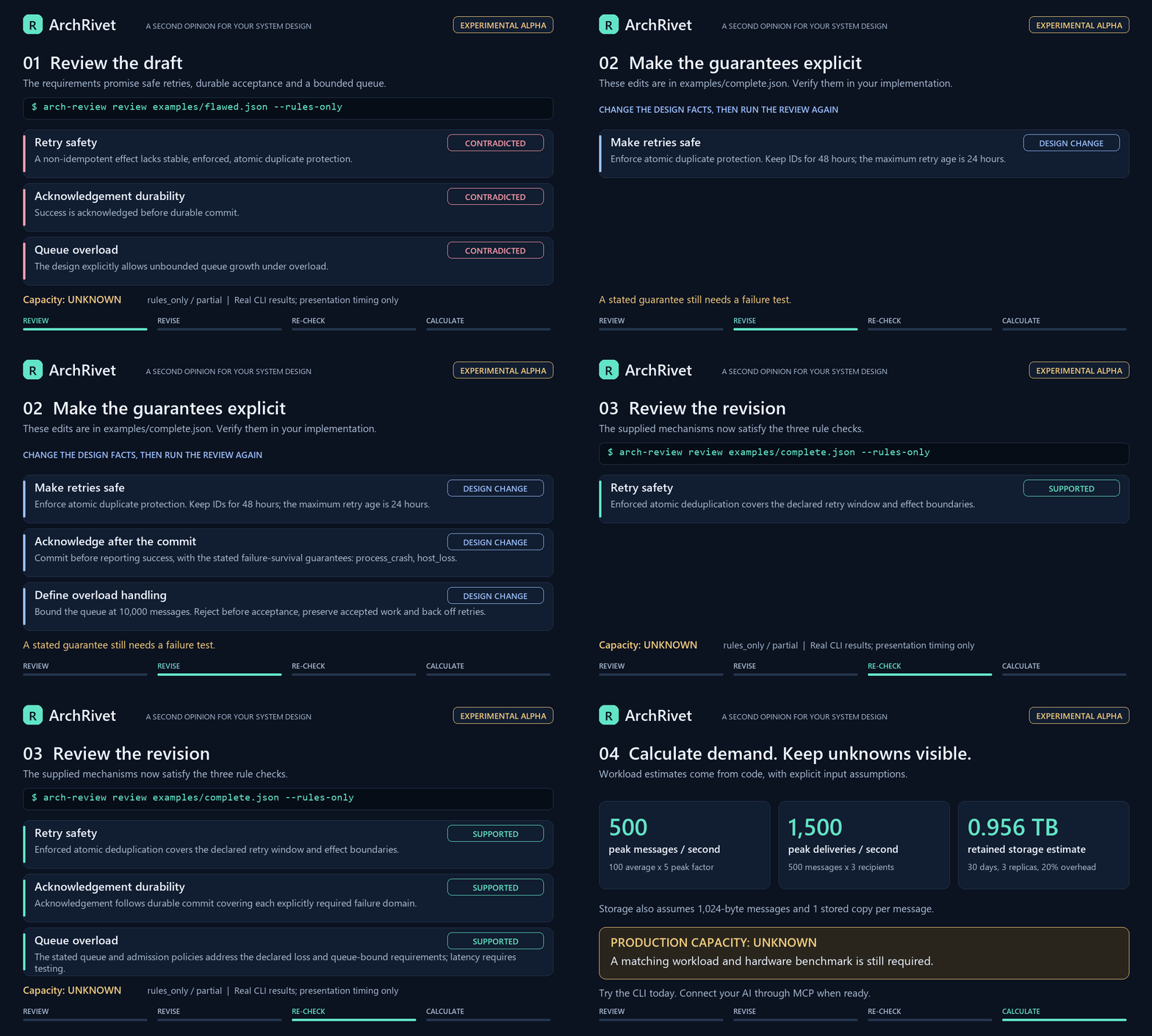
Demo of the three-check rules-based workflow; no model inference. Text walkthrough · Static preview
What if the design is incomplete? Run the clarification example to see an unresolved retry check, the missing facts, and how answers change the verdict.
You need Git and Python 3.11 or 3.12. Start with the included example; installation downloads Python dependencies. The package is available on GitHub Releases, not PyPI.
git clone https://github.com/Ujjansh05/archrivet.git
cd archrivet
python -m venv .venv
.\.venv\Scripts\python.exe -m pip install -e .
.\.venv\Scripts\python.exe -m arch_review review examples\flawed.json --rules-only
python3 -m venv .venv
source .venv/bin/activate
python -m pip install -e .
arch-review review examples/flawed.json --rules-only
The review returns JSON with findings, evidence, workload estimates, and missing information. Compare it with the revised example, or follow the eight-check quick start.
Follow the MCP setup guide to start the local service and generate your host configuration. Windows users must start the service in an independent terminal before connecting. Stop an existing service before changing its configuration.
Once connected, ask your assistant:
Review this backend design with ArchRivet using only supplied facts. Show findings and missing information, ask focused follow-up questions, and keep unanswered facts unknown. After I answer, rerun the review and explain what changed, including remaining gaps and verification steps.
An MCP-compatible host is required. Integration has been tested with Codex; other hosts need verification. Local reviews run offline after setup; your AI host follows its own provider and data-handling settings.
The complete experimental model includes merged weights, tokenizer, configuration, and calibration. No separate base-model or adapter download is needed.
The archive is approximately 964 MB; allow additional space for extraction and dependencies. Rules remain the default, and model inference is optional.
Experimental alpha. Reviews cover eight defined decisions and depend on supplied facts. Workload estimates describe demand; production capacity requires relevant benchmarks and tests. Model confidence is separate from production failure risk.
The published model scored 25/36 on synthetic development cases and 4/12 on separate regression cases. These small evaluations do not establish general architecture accuracy. Results and limitations
Open an issue with a small example, what you expected, and what happened. Installation problems and incorrect findings are especially useful. See CONTRIBUTING.md to contribute. ALSO pls do 🌟 if you find interesting
Original code uses the MIT License. Model weights and reference materials retain their respective licenses and attribution; see third-party notices.
ArchRivet: a second opinion for your system design. Experimental local MCP reviews for messaging retries, durability and queue overload, with evidence and workload calculations.
Python
2
13 commits
updated Oct 16, 2026
Review backend decisions, spot missing details, and plan workload before you build.
ArchRivet is a local MCP plugin for reviewing backend architectures with your AI assistant. Your assistant drafts and explains the design; ArchRivet returns focused findings, supporting references, workload estimates, and questions that still need answers.
Useful for messaging services, notification systems, transactional backends, and system-design exercises. Supply structured requirements and design facts using the example and input guide.
Demo of the three-check rules-based workflow; no model inference. Text walkthrough · Static preview
What if the design is incomplete? Run the clarification example to see an unresolved retry check, the missing facts, and how answers change the verdict.
You need Git and Python 3.11 or 3.12. Start with the included example; installation downloads Python dependencies. The package is available on GitHub Releases, not PyPI.
git clone https://github.com/Ujjansh05/archrivet.git
cd archrivet
python -m venv .venv
.\.venv\Scripts\python.exe -m pip install -e .
.\.venv\Scripts\python.exe -m arch_review review examples\flawed.json --rules-only
python3 -m venv .venv
source .venv/bin/activate
python -m pip install -e .
arch-review review examples/flawed.json --rules-only
The review returns JSON with findings, evidence, workload estimates, and missing information. Compare it with the revised example, or follow the eight-check quick start.
Follow the MCP setup guide to start the local service and generate your host configuration. Windows users must start the service in an independent terminal before connecting. Stop an existing service before changing its configuration.
Once connected, ask your assistant:
Review this backend design with ArchRivet using only supplied facts. Show findings and missing information, ask focused follow-up questions, and keep unanswered facts unknown. After I answer, rerun the review and explain what changed, including remaining gaps and verification steps.
An MCP-compatible host is required. Integration has been tested with Codex; other hosts need verification. Local reviews run offline after setup; your AI host follows its own provider and data-handling settings.
The complete experimental model includes merged weights, tokenizer, configuration, and calibration. No separate base-model or adapter download is needed.
The archive is approximately 964 MB; allow additional space for extraction and dependencies. Rules remain the default, and model inference is optional.
Experimental alpha. Reviews cover eight defined decisions and depend on supplied facts. Workload estimates describe demand; production capacity requires relevant benchmarks and tests. Model confidence is separate from production failure risk.
The published model scored 25/36 on synthetic development cases and 4/12 on separate regression cases. These small evaluations do not establish general architecture accuracy. Results and limitations
Open an issue with a small example, what you expected, and what happened. Installation problems and incorrect findings are especially useful. See CONTRIBUTING.md to contribute. ALSO pls do 🌟 if you find interesting
Original code uses the MIT License. Model weights and reference materials retain their respective licenses and attribution; see third-party notices.





