Alexandria: A Multi-Domain Dialectal Arabic Machine Translation Dataset for Culturally Inclusive and Linguistically Diverse LLMs
See the codeAlexandria covers 13 Arab countries, 11 domains, and 107K community-driven samples.
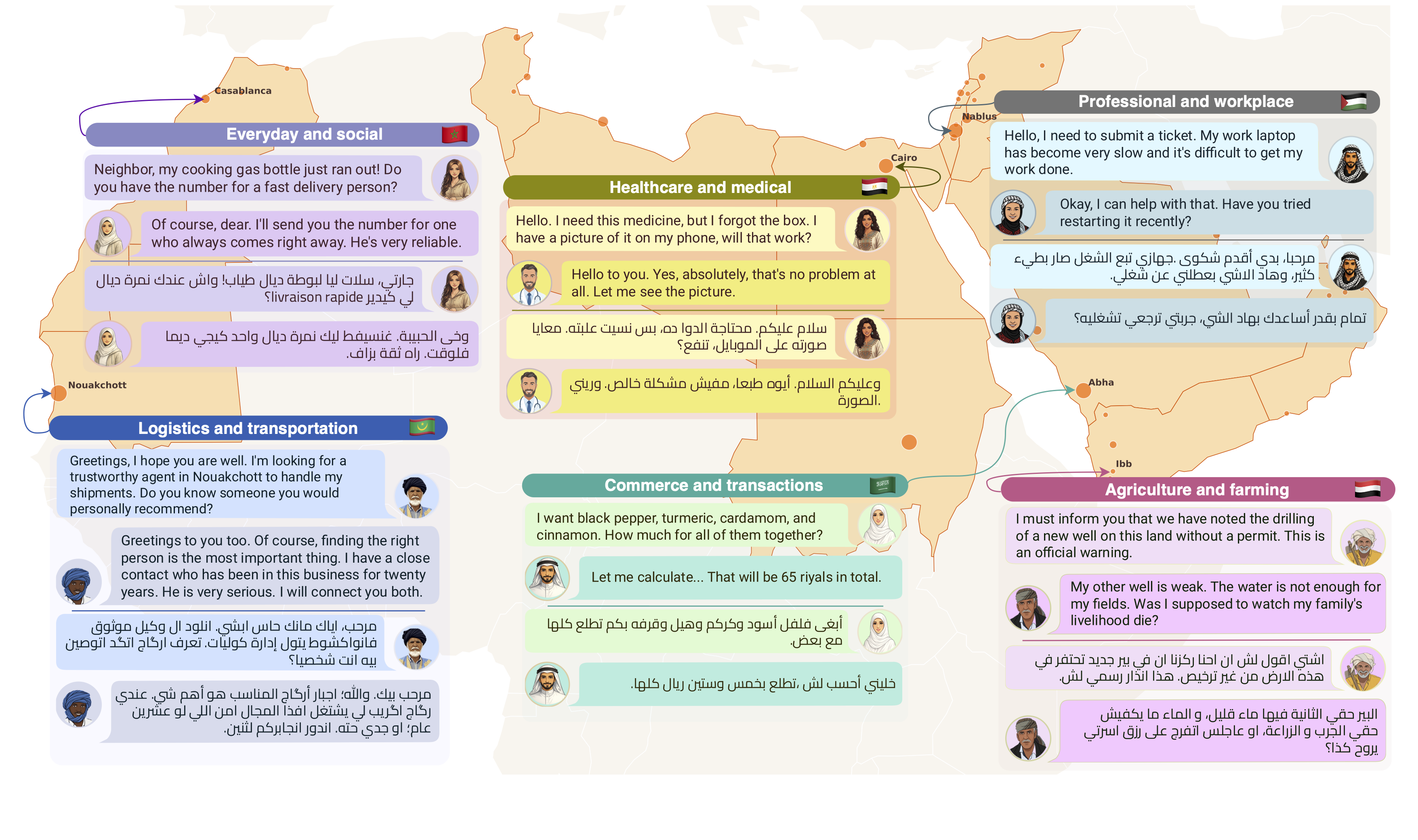








This repository accompanies the Alexandria paper and collects the project assets used to build and evaluate a benchmark for Dialectal Arabic Machine Translation, Arabic dialect translation, English-to-dialect Arabic translation, dialect-to-English translation, and multi-turn conversational MT. Alexandria is organized into four splits: Train, Dev, Public Test, and Private Test. This repository focuses on the materials behind the dataset creation pipeline: prompt templates for English source conversation generation, participant guidelines for translation and revision, and the evaluation area for benchmarking Arabic MT systems and LLMs on the Alexandria public test set.
Alexandria is introduced in the paper Alexandria: A Multi-Domain Dialectal Arabic Machine Translation Dataset for Culturally Inclusive and Linguistically Diverse LLMs. The project targets a persistent gap in Arabic NLP: strong support for Modern Standard Arabic but much weaker coverage of dialectal Arabic, especially in realistic, culturally grounded conversational settings.
This repository organizes the Alexandria resources used across the creation workflow and the public-test evaluation setup for dialectal Arabic MT, city-level Arabic dialect translation, culturally grounded machine translation, code-switching-aware translation, gender-aware translation, and Arabic LLM evaluation.
Keywords: dialectal Arabic machine translation, Arabic dialect translation, conversational machine translation, multi-turn MT, city-level dialect benchmarking, English-dialect parallel data, culturally grounded Arabic NLP, code-switching, persona-aware translation, gender-conditioned translation, Arabic LLM evaluation.
Alexandria contains 107,631 total turns across 13 Arab country contexts and 11 domains. The dataset is city-level, multi-turn, English <-> Dialect Arabic, averages 13.23 words per turn, and has 0.826 Distinct-2 lexical diversity.
Alexandria is organized into four standard benchmark splits:
TrainDevPublic TestPrivate TestThe Public Test split is intended for open benchmarking and reproducible reporting, while the Private Test split supports held-out evaluation.
You can access Alexandria directly from Hugging Face using the datasets library. The example below loads a specific country subset and reads the first English and dialectal turns from the training split.
from datasets import load_dataset

# Load a specific country subset (e.g., 'MA' for Morocco, 'EG' for Egypt) with a specific split
train_data = load_dataset("UBC-NLP/alexandria", name="MA", split="train")
test_data = load_dataset("UBC-NLP/alexandria", name="MA", split="test")

# View the first parallel turn of the first conversation from the train set
first_conv = train_data[0]
eng_turn = first_conv['english_conversation'][0]
dialect_turn = first_conv['dialectal_conversation'][0]

print(f"English: {eng_turn['text']}")
print(f"Dialect: {dialect_turn['text']}")
The 13 dialect settings covered in Alexandria are Jordanian Arabic, Lebanese Arabic, Palestinian Arabic, Syrian Arabic, Saudi Arabic, Omani Arabic, Yemeni Arabic, Egyptian Arabic, Sudanese Arabic, Libyan Arabic, Moroccan Arabic, Mauritanian Arabic, and Tunisian Arabic.
Regional grouping in the table below:
Levant: JO (Jordanian Arabic), LB (Lebanese Arabic), PS (Palestinian Arabic), SY (Syrian Arabic)Gulf: SA (Saudi Arabic), OM (Omani Arabic), YE (Yemeni Arabic)Nile: EG (Egyptian Arabic), SD (Sudanese Arabic)Maghreb: LY (Libyan Arabic), MA (Moroccan Arabic), MR (Mauritanian Arabic), TN (Tunisian Arabic)| Domain | JO | LB | PS | SY | SA | OM | YE | EG | SD | LY | MA | MR | TN | Total |
|---|---|---|---|---|---|---|---|---|---|---|---|---|---|---|
| Agriculture/Farming | 825 | 1140 | 1770 | 931 | 1162 | 915 | 529 | 583 | 163 | 231 | 570 | 970 | 481 | 10270 |
| Commerce/Transactions | 750 | 1004 | 1595 | 749 | 1020 | 650 | 579 | 506 | 201 | 160 | 445 | 757 | 401 | 8817 |
| Construction/Real Estate | 859 | 995 | 1761 | 861 | 1161 | 974 | 696 | 660 | 225 | 271 | 574 | 673 | 485 | 10195 |
| Education/Academia | 816 | 1191 | 1513 | 831 | 1017 | 1079 | 563 | 549 | 170 | 220 | 601 | 863 | 551 | 9964 |
| Energy/Resources | 786 | 1048 | 1715 | 928 | 1177 | 937 | 587 | 625 | 189 | 243 | 447 | 719 | 470 | 9871 |
| Everyday/Social | 967 | 1215 | 1697 | 787 | 1020 | 888 | 642 | 604 | 175 | 210 | 595 | 824 | 550 | 10174 |
| Healthcare/Medical | 727 | 1240 | 1728 | 781 | 1043 | 895 | 548 | 487 | 164 | 253 | 556 | 948 | 522 | 9892 |
| Legal/Financial | 693 | 1006 | 1566 | 757 | 857 | 753 | 496 | 539 | 177 | 174 | 481 | 642 | 412 | 8553 |
| Logistics/Transport | 842 | 1020 | 1512 | 950 | 1234 | 842 | 629 | 646 | 189 | 187 | 593 | 877 | 515 | 10036 |
| Professional/Workplace | 845 | 1220 | 1810 | 959 | 1112 | 866 | 549 | 645 | 178 | 253 | 480 | 709 | 526 | 10152 |
| Tourism/Hospitality | 720 | 1161 | 1596 | 884 | 1004 | 815 | 608 | 608 | 190 | 216 | 567 | 878 | 460 | 9707 |
| Total | 8830 | 12240 | 18263 | 9418 | 11807 | 9614 | 6426 | 6452 | 2021 | 2418 | 5909 | 8860 | 5373 | 107631 |
Alexandria is designed to extend prior Arabic dialect MT resources with broader domain coverage, multi-turn conversational structure, local context, code-switching support, gender-direction annotations, and persona roles.
| Dataset | # Sentence Pairs / Turns | # Dialects | Granularity | Src Type | Direction | # Domains | Avg. words | Distinct-2 | LC | CS | GD | PR |
|---|---|---|---|---|---|---|---|---|---|---|---|---|
| PADIC (Meftouh et al., 2015) | 38K | 6 | Country | Sentence | Eng <-> Dialect | 1 | 6.77 | 0.782 | No | No | No | No |
| MADAR (Bouamor et al., 2018) | 100K | 13 | City | Sentence | Eng <-> Dialect | 1 | 5.73 | 0.768 | No | No | No | No |
| FLORES+ (Team et al., 2022) | 16K | 9 | Country | Sentence | Eng <-> Dialect | 3 | 18.39 | 0.898 | No | No | No | No |
| Alexandria (ours) | 107K | 13 | City | Multi-turn | Eng <-> Dialect | 11 | 13.23 | 0.826 | Yes | Yes | Yes | Yes |
LC = Local Context, CS = Code-Switching, GD = gender-direction annotations, PR = persona roles.
.
├── evaluation_code/
├── guidelines/
│   ├── Alexandria_MT_Revision_Phase_Guidelines.pdf
│   └── Alexandria_MT_Translation_Phase_Guidelines.pdf
├── images/
│   └── alexandria_overview.webp
└── prompts/
    ├── coversations_generation_prompt.txt
    ├── *_prompt.txt
    └── topics_examples/
prompts/The prompts/ directory covers the prompts used per domain to generate the English source conversations that were later translated into local dialects and languages. It includes:
agriculture_farming, commerce_transactions, construction_real_estate, education_academia, energy_resources, everyday_social, healthcare_medical, legal_financial, logistics_transportation, professional_workplace, and tourism_hospitalityprompts/topics_examples/ for the same set of domainscoversations_generation_prompt.txtguidelines/The guidelines/ directory contains the documents given to participants during the human data creation stages:
Alexandria_MT_Translation_Phase_Guidelines.pdf for the translation phaseAlexandria_MT_Revision_Phase_Guidelines.pdf for the revision phaseevaluation_code/The evaluation_code/ directory covers the evaluation code for running Alexandria benchmarking on your own models, with the public evaluation setup centered on the Public Test split.
Alexandria spans 11 practical domains designed to reflect everyday and specialized communication across Arab communities:
If you use this repository or the Alexandria dataset in your research, please cite the paper:
@inproceedings{el-mekki-etal-2026-alexandria,
    title = "Alexandria: A Multi-Domain Dialectal {A}rabic Machine Translation Dataset for Culturally Inclusive and Linguistically Diverse {LLM}s",
    author = "EL Mekki, Abdellah  and
      Magdy, Samar M.  and
      Atou, Houdaifa  and
      AbuHweidi, Ruwa  and
      Qawasmeh, Baraah  and
      Nacar, Omer  and
      Al-hibiri, Thikra  and
      Saadie, Razan  and
      Alsayadi, Hamzah A.  and
      Hammouda, Nadia Ghezaiel  and
      Alkhazimi, Alshima Mohammed  and
      Hamod, Aya  and
      Al-Ghafri, Al-Yas Yaqoob  and
      El-Sayed, Wesam  and
      al Sharji, Asila Ismail  and
      Ballout, Mohamad  and
      Belfathi, Anas  and
      Ghaddar, Karim  and
      Sibaee, Serry  and
      Aoun, Alaa  and
      Aseri, Aeej Mohammed  and
      Abureesh, Lina  and
      Bashiti, Ahlam  and
      Yousef, Majdal  and
      Hafiz, Abdulaziz  and
      Mohamed, Yehdih  and
      Hamedtou, Emira  and
      Emehah, Brakehe  and
      Alhamouri, Rahaf  and
      Nafea, Youssef  and
      El Aatar, Aya  and
      Al-Dhabyani, Walid  and
      Hamed, Emhemed S.  and
      Shatnawi, Sara  and
      Alwajih, Fakhraddin  and
      Elkhidir, Khalid  and
      Alasmari, Ashwag  and
      Gerrio, Abdurrahman  and
      Alshahri, Omar Said  and
      Elmadany, AbdelRahim A.  and
      Berrada, Ismail  and
      Al-kathiri, Amir Azad Adli  and
      Zaraket, Fadi  and
      Jarrar, Mustafa  and
      EL Hadj, Yahya Mohamed  and
      Alhuzali, Hassan  and
      Abdul-Mageed, Muhammad",
    editor = "Liakata, Maria  and
      Moreira, Viviane P.  and
      Zhang, Jiajun  and
      Jurgens, David",
    booktitle = "Proceedings of the 64th Annual Meeting of the {A}ssociation for {C}omputational {L}inguistics (Volume 1: Long Papers)",
    month = jul,
    year = "2026",
    address = "San Diego, California, United States",
    publisher = "Association for Computational Linguistics",
    url = "https://aclanthology.org/2026.acl-long.1503/",
    pages = "32567--32592",
    ISBN = "979-8-89176-390-6"
}
For questions, corrections, or feedback, please open an issue in this repository.
Alexandria: A Multi-Domain Dialectal Arabic Machine Translation Dataset for Culturally Inclusive and Linguistically Diverse LLMs
See the codeAlexandria covers 13 Arab countries, 11 domains, and 107K community-driven samples.
This repository accompanies the Alexandria paper and collects the project assets used to build and evaluate a benchmark for Dialectal Arabic Machine Translation, Arabic dialect translation, English-to-dialect Arabic translation, dialect-to-English translation, and multi-turn conversational MT. Alexandria is organized into four splits: Train, Dev, Public Test, and Private Test. This repository focuses on the materials behind the dataset creation pipeline: prompt templates for English source conversation generation, participant guidelines for translation and revision, and the evaluation area for benchmarking Arabic MT systems and LLMs on the Alexandria public test set.
Alexandria is introduced in the paper Alexandria: A Multi-Domain Dialectal Arabic Machine Translation Dataset for Culturally Inclusive and Linguistically Diverse LLMs. The project targets a persistent gap in Arabic NLP: strong support for Modern Standard Arabic but much weaker coverage of dialectal Arabic, especially in realistic, culturally grounded conversational settings.
This repository organizes the Alexandria resources used across the creation workflow and the public-test evaluation setup for dialectal Arabic MT, city-level Arabic dialect translation, culturally grounded machine translation, code-switching-aware translation, gender-aware translation, and Arabic LLM evaluation.
Keywords: dialectal Arabic machine translation, Arabic dialect translation, conversational machine translation, multi-turn MT, city-level dialect benchmarking, English-dialect parallel data, culturally grounded Arabic NLP, code-switching, persona-aware translation, gender-conditioned translation, Arabic LLM evaluation.
Alexandria contains 107,631 total turns across 13 Arab country contexts and 11 domains. The dataset is city-level, multi-turn, English <-> Dialect Arabic, averages 13.23 words per turn, and has 0.826 Distinct-2 lexical diversity.
Alexandria is organized into four standard benchmark splits:
TrainDevPublic TestPrivate TestThe Public Test split is intended for open benchmarking and reproducible reporting, while the Private Test split supports held-out evaluation.
You can access Alexandria directly from Hugging Face using the datasets library. The example below loads a specific country subset and reads the first English and dialectal turns from the training split.
from datasets import load_dataset

# Load a specific country subset (e.g., 'MA' for Morocco, 'EG' for Egypt) with a specific split
train_data = load_dataset("UBC-NLP/alexandria", name="MA", split="train")
test_data = load_dataset("UBC-NLP/alexandria", name="MA", split="test")

# View the first parallel turn of the first conversation from the train set
first_conv = train_data[0]
eng_turn = first_conv['english_conversation'][0]
dialect_turn = first_conv['dialectal_conversation'][0]

print(f"English: {eng_turn['text']}")
print(f"Dialect: {dialect_turn['text']}")
The 13 dialect settings covered in Alexandria are Jordanian Arabic, Lebanese Arabic, Palestinian Arabic, Syrian Arabic, Saudi Arabic, Omani Arabic, Yemeni Arabic, Egyptian Arabic, Sudanese Arabic, Libyan Arabic, Moroccan Arabic, Mauritanian Arabic, and Tunisian Arabic.
Regional grouping in the table below:
Levant: JO (Jordanian Arabic), LB (Lebanese Arabic), PS (Palestinian Arabic), SY (Syrian Arabic)Gulf: SA (Saudi Arabic), OM (Omani Arabic), YE (Yemeni Arabic)Nile: EG (Egyptian Arabic), SD (Sudanese Arabic)Maghreb: LY (Libyan Arabic), MA (Moroccan Arabic), MR (Mauritanian Arabic), TN (Tunisian Arabic)| Domain | JO | LB | PS | SY | SA | OM | YE | EG | SD | LY | MA | MR | TN | Total |
|---|---|---|---|---|---|---|---|---|---|---|---|---|---|---|
| Agriculture/Farming | 825 | 1140 | 1770 | 931 | 1162 | 915 | 529 | 583 | 163 | 231 | 570 | 970 | 481 | 10270 |
| Commerce/Transactions | 750 | 1004 | 1595 | 749 | 1020 | 650 | 579 | 506 | 201 | 160 | 445 | 757 | 401 | 8817 |
| Construction/Real Estate | 859 | 995 | 1761 | 861 | 1161 | 974 | 696 | 660 | 225 | 271 | 574 | 673 | 485 | 10195 |
| Education/Academia | 816 | 1191 | 1513 | 831 | 1017 | 1079 | 563 | 549 | 170 | 220 | 601 | 863 | 551 | 9964 |
| Energy/Resources | 786 | 1048 | 1715 | 928 | 1177 | 937 | 587 | 625 | 189 | 243 | 447 | 719 | 470 | 9871 |
| Everyday/Social | 967 | 1215 | 1697 | 787 | 1020 | 888 | 642 | 604 | 175 | 210 | 595 | 824 | 550 | 10174 |
| Healthcare/Medical | 727 | 1240 | 1728 | 781 | 1043 | 895 | 548 | 487 | 164 | 253 | 556 | 948 | 522 | 9892 |
| Legal/Financial | 693 | 1006 | 1566 | 757 | 857 | 753 | 496 | 539 | 177 | 174 | 481 | 642 | 412 | 8553 |
| Logistics/Transport | 842 | 1020 | 1512 | 950 | 1234 | 842 | 629 | 646 | 189 | 187 | 593 | 877 | 515 | 10036 |
| Professional/Workplace | 845 | 1220 | 1810 | 959 | 1112 | 866 | 549 | 645 | 178 | 253 | 480 | 709 | 526 | 10152 |
| Tourism/Hospitality | 720 | 1161 | 1596 | 884 | 1004 | 815 | 608 | 608 | 190 | 216 | 567 | 878 | 460 | 9707 |
| Total | 8830 | 12240 | 18263 | 9418 | 11807 | 9614 | 6426 | 6452 | 2021 | 2418 | 5909 | 8860 | 5373 | 107631 |
Alexandria is designed to extend prior Arabic dialect MT resources with broader domain coverage, multi-turn conversational structure, local context, code-switching support, gender-direction annotations, and persona roles.
| Dataset | # Sentence Pairs / Turns | # Dialects | Granularity | Src Type | Direction | # Domains | Avg. words | Distinct-2 | LC | CS | GD | PR |
|---|---|---|---|---|---|---|---|---|---|---|---|---|
| PADIC (Meftouh et al., 2015) | 38K | 6 | Country | Sentence | Eng <-> Dialect | 1 | 6.77 | 0.782 | No | No | No | No |
| MADAR (Bouamor et al., 2018) | 100K | 13 | City | Sentence | Eng <-> Dialect | 1 | 5.73 | 0.768 | No | No | No | No |
| FLORES+ (Team et al., 2022) | 16K | 9 | Country | Sentence | Eng <-> Dialect | 3 | 18.39 | 0.898 | No | No | No | No |
| Alexandria (ours) | 107K | 13 | City | Multi-turn | Eng <-> Dialect | 11 | 13.23 | 0.826 | Yes | Yes | Yes | Yes |
LC = Local Context, CS = Code-Switching, GD = gender-direction annotations, PR = persona roles.
.
├── evaluation_code/
├── guidelines/
│   ├── Alexandria_MT_Revision_Phase_Guidelines.pdf
│   └── Alexandria_MT_Translation_Phase_Guidelines.pdf
├── images/
│   └── alexandria_overview.webp
└── prompts/
    ├── coversations_generation_prompt.txt
    ├── *_prompt.txt
    └── topics_examples/
prompts/The prompts/ directory covers the prompts used per domain to generate the English source conversations that were later translated into local dialects and languages. It includes:
agriculture_farming, commerce_transactions, construction_real_estate, education_academia, energy_resources, everyday_social, healthcare_medical, legal_financial, logistics_transportation, professional_workplace, and tourism_hospitalityprompts/topics_examples/ for the same set of domainscoversations_generation_prompt.txtguidelines/The guidelines/ directory contains the documents given to participants during the human data creation stages:
Alexandria_MT_Translation_Phase_Guidelines.pdf for the translation phaseAlexandria_MT_Revision_Phase_Guidelines.pdf for the revision phaseevaluation_code/The evaluation_code/ directory covers the evaluation code for running Alexandria benchmarking on your own models, with the public evaluation setup centered on the Public Test split.
Alexandria spans 11 practical domains designed to reflect everyday and specialized communication across Arab communities:
If you use this repository or the Alexandria dataset in your research, please cite the paper:
@inproceedings{el-mekki-etal-2026-alexandria,
    title = "Alexandria: A Multi-Domain Dialectal {A}rabic Machine Translation Dataset for Culturally Inclusive and Linguistically Diverse {LLM}s",
    author = "EL Mekki, Abdellah  and
      Magdy, Samar M.  and
      Atou, Houdaifa  and
      AbuHweidi, Ruwa  and
      Qawasmeh, Baraah  and
      Nacar, Omer  and
      Al-hibiri, Thikra  and
      Saadie, Razan  and
      Alsayadi, Hamzah A.  and
      Hammouda, Nadia Ghezaiel  and
      Alkhazimi, Alshima Mohammed  and
      Hamod, Aya  and
      Al-Ghafri, Al-Yas Yaqoob  and
      El-Sayed, Wesam  and
      al Sharji, Asila Ismail  and
      Ballout, Mohamad  and
      Belfathi, Anas  and
      Ghaddar, Karim  and
      Sibaee, Serry  and
      Aoun, Alaa  and
      Aseri, Aeej Mohammed  and
      Abureesh, Lina  and
      Bashiti, Ahlam  and
      Yousef, Majdal  and
      Hafiz, Abdulaziz  and
      Mohamed, Yehdih  and
      Hamedtou, Emira  and
      Emehah, Brakehe  and
      Alhamouri, Rahaf  and
      Nafea, Youssef  and
      El Aatar, Aya  and
      Al-Dhabyani, Walid  and
      Hamed, Emhemed S.  and
      Shatnawi, Sara  and
      Alwajih, Fakhraddin  and
      Elkhidir, Khalid  and
      Alasmari, Ashwag  and
      Gerrio, Abdurrahman  and
      Alshahri, Omar Said  and
      Elmadany, AbdelRahim A.  and
      Berrada, Ismail  and
      Al-kathiri, Amir Azad Adli  and
      Zaraket, Fadi  and
      Jarrar, Mustafa  and
      EL Hadj, Yahya Mohamed  and
      Alhuzali, Hassan  and
      Abdul-Mageed, Muhammad",
    editor = "Liakata, Maria  and
      Moreira, Viviane P.  and
      Zhang, Jiajun  and
      Jurgens, David",
    booktitle = "Proceedings of the 64th Annual Meeting of the {A}ssociation for {C}omputational {L}inguistics (Volume 1: Long Papers)",
    month = jul,
    year = "2026",
    address = "San Diego, California, United States",
    publisher = "Association for Computational Linguistics",
    url = "https://aclanthology.org/2026.acl-long.1503/",
    pages = "32567--32592",
    ISBN = "979-8-89176-390-6"
}
For questions, corrections, or feedback, please open an issue in this repository.