This repository provides three stages for patient timeline modeling with Qwen3:
All project demo data are synthetic. The files in 0_pre_train/data/ contain fictional patient timelines, and 1_fine_tuning/mock_data_10.jsonl contains artificial classification examples. They are intended for checking data formats and exercising the workflow. Results on these tiny examples do not measure clinical or out-of-distribution performance. The bundled LLaMA-Factory directory also contains upstream examples unrelated to this project.
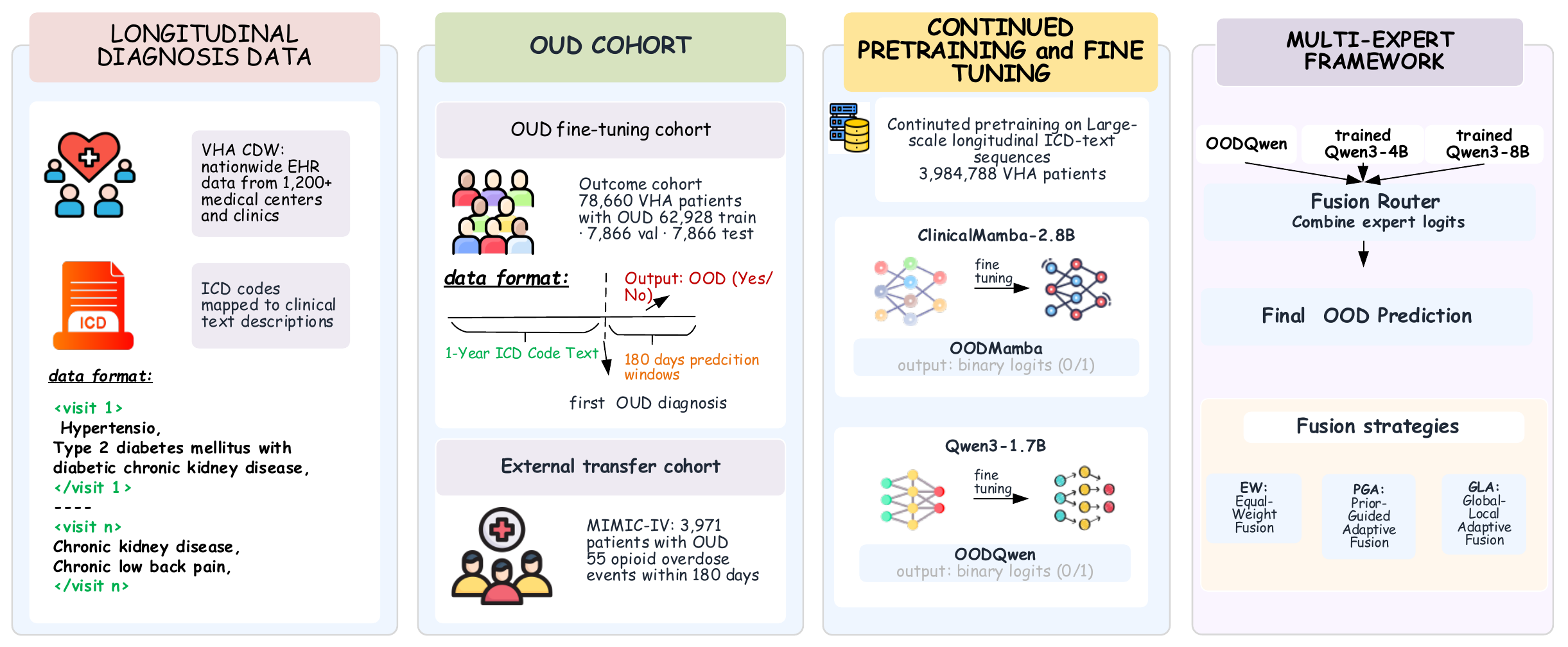
Figure: study framework. Click the image to open the original PDF. The preview is cropped to the four framework panels for readability.
The framework uses longitudinal diagnosis histories to predict opioid overdose (OOD) among patients with opioid use disorder (OUD). Here, OOD in the figure means opioid overdose; external transfer evaluates generalization to another cohort.
These cohort sizes describe the supplied study figure; the underlying study datasets and trained models are not included. This repository provides a synthetic-data Qwen3 implementation of the pretraining, classification, and logit-fusion workflow. It does not include a ClinicalMamba implementation or pretrained 4B/8B expert checkpoints.
| Framework component | Repository implementation |
|---|---|
| ICD-text continued pretraining | 0_pre_train/ — LLaMA-Factory LoRA pretraining |
| Binary outcome fine-tuning | 1_fine_tuning/ — Qwen3 sequence classification |
| Expert logit export | 2_logits_moe/save_logits.py |
| EW fusion | 2_logits_moe/1_average_moe.py |
| PGA fusion | 2_logits_moe/2_weighted_moe.py |
| GLA fusion | 2_logits_moe/3_global_local_moe.py |
0_pre_train/
  data/                             # Synthetic pretraining data and dataset registry
  prepare_patient_pretrain.py       # Generate demo data or convert your own records
  qwen3_lora_pretrain_demo.yaml      # Two-step LoRA pretraining configuration
  run_qwen3.sh                      # Data preparation and pretraining launcher
  sinmple.sh                        # Minimal pretraining launcher
  LLaMA-Factory/                    # Bundled upstream training framework
1_fine_tuning/
  model.py                          # Qwen3 sequence classifier with LoRA
  train.py                          # Binary classification training
  mock_data_10.jsonl                # Ten synthetic labeled records
  eval.py                           # Additional evaluation entry point
  analysis/                         # Supplementary analysis scripts
2_logits_moe/
  save_logits.py                    # Export one expert's aligned logits
  1_average_moe.py                  # Uniform averaging
  2_weighted_moe.py                 # Prior and entropy-adaptive weighting
  3_global_local_moe.py             # Validation quality and local entropy weighting
The bundled LLaMA-Factory source has been modified for this English-only distribution. Localized documents use their English counterparts, Chinese prompt text and comments have been translated, and interface entries containing Chinese characters fall back to English. Mixed-language demo datasets retain complete non-Chinese records; standalone Chinese demo datasets use the corresponding English examples. Existing filenames and locale keys are retained for compatibility. These changes also affect localized prompt behavior and demo dataset sizes. Upstream Git history and packaged binary dependencies are outside this text cleanup.
Use Python 3.11 or newer, as required by the bundled LLaMA-Factory package. Training and logit export require CUDA; the model code loads weights in BF16, so use a GPU that supports BF16 and has sufficient memory. Fusion of saved logits runs on CPU.
Run the following from the repository root in a fresh environment with a CUDA-compatible PyTorch installation:
python -m venv .venv
source .venv/bin/activate
python -m pip install -e ./0_pre_train/LLaMA-Factory
python -m pip install scikit-learn tqdm
The bundled package declares its dependencies in 0_pre_train/LLaMA-Factory/pyproject.toml. Model downloads require access to the model repository; alternatively supply a local model directory. The offline installation scripts and wheel folders are environment-specific: some wheels target Python 3.10, and the bundled Transformers 4.52.4 wheel is below the framework's declared minimum of 4.55.0. Do not treat those archives as a complete installation for this environment.
From the repository root:
python 0_pre_train/prepare_patient_pretrain.py
This writes six training records, two development records, raw demo files, and dataset_info.json under 0_pre_train/data/. The training format is one JSON object per line:
{"text": "P0001 <visit> Time: 0 months I10 | Essential hypertension."}
To convert your own data into a separate directory:
python 0_pre_train/prepare_patient_pretrain.py \
  --train-file /path/to/train.jsonl \
  --dev-file /path/to/dev.jsonl \
  --output-dir /path/to/pretrain_data
Both input paths must be supplied together. JSON, JSONL, and plain text are supported. Object records can use text, patienrID (the original example spelling), patientID, patient_id, timeline, visit, or content. The selected field must contain the timeline text. Generation overwrites the corresponding output files.
cd 0_pre_train
PYTHON_BIN="$(command -v python)" GPU_IDS=0 DISABLE_VERSION_CHECK=0 \
  bash run_qwen3.sh
cd ..
The launcher defaults to Qwen/Qwen3-1.7B and writes to 0_pre_train/outputs/qwen3_1_7b_patient_lora_demo. The YAML performs only two optimizer steps, with sequence length 256, LoRA rank 8, and BF16. It enables output-directory overwriting. Use a new output directory for each experiment.
Environment variables supported by the launcher include MODEL_NAME_OR_PATH, GPU_IDS, TRAIN_FILE, DEV_FILE, OUTPUT_DIR, and PYTHON_BIN. GPU_IDS=0,1 selects two GPUs. --prepare-only converts data without loading a model; --check-only additionally checks runtime imports. Set PYTHON_BIN to use the active environment without the launcher's default qwen3 conda activation.
For a converted dataset in another directory, invoke the CLI directly:
cd 0_pre_train
CUDA_VISIBLE_DEVICES=0 llamafactory-cli train qwen3_lora_pretrain_demo.yaml \
  dataset_dir=/path/to/pretrain_data \
  output_dir=outputs/my_pretrain_run
cd ..
For a substantive training run, adjust max_steps, sequence length, batch size, and other training settings in the YAML. The saved output is a causal-language-model LoRA adapter, not a standalone merged model.
The classification JSONL schema differs from the pretraining schema:
{"icd": "I10 E11.9 E78.5", "label": "0"}
{"icd": "I21.3 I25.1 R07.9", "label": "1"}
Use string labels "0" and "1"; the current loader treats only the string "1" as positive. Include both classes in the training data because the sampler uses inverse class frequencies.
cd 1_fine_tuning
CUDA_VISIBLE_DEVICES=0 python train.py
cd ..
The default base model is Qwen/Qwen3-1.7B, configured by MODEL_ID in model.py. The script uses a maximum length of 2000, batch size 16, learning rate 2e-5, up to 20 epochs, and LoRA rank 16 on q_proj and v_proj.
The demo uses the same ten records for training and validation. Before a real experiment, edit the two get_data(...) calls in train.py to point to independent training and validation JSONL files. Batch size, epochs, learning rate, and checkpoint directory are also configured in that script; it does not expose training CLI flags. Reduce batch size if GPU memory is insufficient.
An improved validation F1 above 0.10 triggers saving to 1_fine_tuning/checkpoints/. A checkpoint is therefore not guaranteed on every run. The directory contains the classification adapter and its saved classification head; the base model is still needed for inference. Use a separate checkpoint directory for each expert.
By default, classification starts from the original Qwen model. To use stage 1, first merge its causal-LM adapter into the same base model used for pretraining. For example, create 0_pre_train/export_pretrain.yaml:
model_name_or_path: Qwen/Qwen3-1.7B
adapter_name_or_path: outputs/qwen3_1_7b_patient_lora_demo
finetuning_type: lora
template: qwen3
export_dir: outputs/qwen3_patient_merged
export_size: 5
export_device: cpu
export_legacy_format: false
Then export from 0_pre_train/:
cd 0_pre_train
llamafactory-cli export export_pretrain.yaml
cd ..
Set MODEL_ID in 1_fine_tuning/model.py to the absolute path of that merged model before running train.py. The sequence classifier initializes a classification head and trains a new classification LoRA adapter. Do not pass the pretraining adapter directly to the classification adapter loader.
These scripts combine the outputs of exactly three separately trained classification experts. This is output-level fusion; there is no jointly trained sparse MoE layer. Supply three classification checkpoints and their matching base models. The repository does not include trained checkpoints.
Run from the repository root. This single-expert example uses the synthetic classification data:
CUDA_VISIBLE_DEVICES=0 python 2_logits_moe/save_logits.py \
  --llm-path Qwen/Qwen3-1.7B \
  --checkpoint 1_fine_tuning/checkpoints \
  --data-file 1_fine_tuning/mock_data_10.jsonl \
  --output logits/expert1_test.pt \
  --batch-size 1
For a full experiment, export each of the three experts on the same validation file and the same independent test file. For example, if all three experts share the original Qwen base:
for expert in 1 2 3; do
  for split in validation test; do
    CUDA_VISIBLE_DEVICES=0 python 2_logits_moe/save_logits.py \
      --llm-path Qwen/Qwen3-1.7B \
      --checkpoint "/path/to/expert${expert}/checkpoints" \
      --data-file "/path/to/${split}.jsonl" \
      --output "logits/expert${expert}_${split}.pt"
  done
done
Replace the placeholder paths. If the experts use different base or merged models, run exports separately with each expert's matching --llm-path. This option also selects the tokenizer.
Each .pt file contains logits, labels, sample indices, a data fingerprint, and model metadata. Within each split, all experts must see identical records in identical order; the loader checks alignment. Keep expert ordering consistent between validation and test arguments. Select weights using validation data and report final results on held-out test data.
python 2_logits_moe/1_average_moe.py \
  --test-logits logits/expert1_test.pt logits/expert2_test.pt logits/expert3_test.pt
python 2_logits_moe/2_weighted_moe.py \
  --validation-logits logits/expert1_validation.pt logits/expert2_validation.pt logits/expert3_validation.pt \
  --test-logits logits/expert1_test.pt logits/expert2_test.pt logits/expert3_test.pt \
  --prior-weights 0.30 0.50 0.20 \
  --lambda-candidates 0.0 0.01 0.02 0.05 0.10 0.20 0.30 \
  --entropy-beta 1.0
Weights interpolate between the supplied prior and per-sample inverse-entropy weights. The interpolation parameter is selected by validation AUPRC. Prior weights must be nonnegative and sum to one; lambda candidates must lie in [0, 1] and include zero.
python 2_logits_moe/3_global_local_moe.py \
  --validation-logits logits/expert1_validation.pt logits/expert2_validation.pt logits/expert3_validation.pt \
  --test-logits logits/expert1_test.pt logits/expert2_test.pt logits/expert3_test.pt \
  --alpha 1.0 --beta 1.0
Each expert's validation AUPRC supplies a global quality score. Per-sample prediction entropy supplies local uncertainty. Routing weights are softmax(alpha * quality - beta * entropy). The script also reports an entropy-only baseline. Both parameters must be nonnegative.
The MoE scripts print evaluation metrics to standard output. They do not create or train a new model checkpoint.
This repository provides three stages for patient timeline modeling with Qwen3:
All project demo data are synthetic. The files in 0_pre_train/data/ contain fictional patient timelines, and 1_fine_tuning/mock_data_10.jsonl contains artificial classification examples. They are intended for checking data formats and exercising the workflow. Results on these tiny examples do not measure clinical or out-of-distribution performance. The bundled LLaMA-Factory directory also contains upstream examples unrelated to this project.
Figure: study framework. Click the image to open the original PDF. The preview is cropped to the four framework panels for readability.
The framework uses longitudinal diagnosis histories to predict opioid overdose (OOD) among patients with opioid use disorder (OUD). Here, OOD in the figure means opioid overdose; external transfer evaluates generalization to another cohort.
These cohort sizes describe the supplied study figure; the underlying study datasets and trained models are not included. This repository provides a synthetic-data Qwen3 implementation of the pretraining, classification, and logit-fusion workflow. It does not include a ClinicalMamba implementation or pretrained 4B/8B expert checkpoints.
| Framework component | Repository implementation |
|---|---|
| ICD-text continued pretraining | 0_pre_train/ — LLaMA-Factory LoRA pretraining |
| Binary outcome fine-tuning | 1_fine_tuning/ — Qwen3 sequence classification |
| Expert logit export | 2_logits_moe/save_logits.py |
| EW fusion | 2_logits_moe/1_average_moe.py |
| PGA fusion | 2_logits_moe/2_weighted_moe.py |
| GLA fusion | 2_logits_moe/3_global_local_moe.py |
0_pre_train/
  data/                             # Synthetic pretraining data and dataset registry
  prepare_patient_pretrain.py       # Generate demo data or convert your own records
  qwen3_lora_pretrain_demo.yaml      # Two-step LoRA pretraining configuration
  run_qwen3.sh                      # Data preparation and pretraining launcher
  sinmple.sh                        # Minimal pretraining launcher
  LLaMA-Factory/                    # Bundled upstream training framework
1_fine_tuning/
  model.py                          # Qwen3 sequence classifier with LoRA
  train.py                          # Binary classification training
  mock_data_10.jsonl                # Ten synthetic labeled records
  eval.py                           # Additional evaluation entry point
  analysis/                         # Supplementary analysis scripts
2_logits_moe/
  save_logits.py                    # Export one expert's aligned logits
  1_average_moe.py                  # Uniform averaging
  2_weighted_moe.py                 # Prior and entropy-adaptive weighting
  3_global_local_moe.py             # Validation quality and local entropy weighting
The bundled LLaMA-Factory source has been modified for this English-only distribution. Localized documents use their English counterparts, Chinese prompt text and comments have been translated, and interface entries containing Chinese characters fall back to English. Mixed-language demo datasets retain complete non-Chinese records; standalone Chinese demo datasets use the corresponding English examples. Existing filenames and locale keys are retained for compatibility. These changes also affect localized prompt behavior and demo dataset sizes. Upstream Git history and packaged binary dependencies are outside this text cleanup.
Use Python 3.11 or newer, as required by the bundled LLaMA-Factory package. Training and logit export require CUDA; the model code loads weights in BF16, so use a GPU that supports BF16 and has sufficient memory. Fusion of saved logits runs on CPU.
Run the following from the repository root in a fresh environment with a CUDA-compatible PyTorch installation:
python -m venv .venv
source .venv/bin/activate
python -m pip install -e ./0_pre_train/LLaMA-Factory
python -m pip install scikit-learn tqdm
The bundled package declares its dependencies in 0_pre_train/LLaMA-Factory/pyproject.toml. Model downloads require access to the model repository; alternatively supply a local model directory. The offline installation scripts and wheel folders are environment-specific: some wheels target Python 3.10, and the bundled Transformers 4.52.4 wheel is below the framework's declared minimum of 4.55.0. Do not treat those archives as a complete installation for this environment.
From the repository root:
python 0_pre_train/prepare_patient_pretrain.py
This writes six training records, two development records, raw demo files, and dataset_info.json under 0_pre_train/data/. The training format is one JSON object per line:
{"text": "P0001 <visit> Time: 0 months I10 | Essential hypertension."}
To convert your own data into a separate directory:
python 0_pre_train/prepare_patient_pretrain.py \
  --train-file /path/to/train.jsonl \
  --dev-file /path/to/dev.jsonl \
  --output-dir /path/to/pretrain_data
Both input paths must be supplied together. JSON, JSONL, and plain text are supported. Object records can use text, patienrID (the original example spelling), patientID, patient_id, timeline, visit, or content. The selected field must contain the timeline text. Generation overwrites the corresponding output files.
cd 0_pre_train
PYTHON_BIN="$(command -v python)" GPU_IDS=0 DISABLE_VERSION_CHECK=0 \
  bash run_qwen3.sh
cd ..
The launcher defaults to Qwen/Qwen3-1.7B and writes to 0_pre_train/outputs/qwen3_1_7b_patient_lora_demo. The YAML performs only two optimizer steps, with sequence length 256, LoRA rank 8, and BF16. It enables output-directory overwriting. Use a new output directory for each experiment.
Environment variables supported by the launcher include MODEL_NAME_OR_PATH, GPU_IDS, TRAIN_FILE, DEV_FILE, OUTPUT_DIR, and PYTHON_BIN. GPU_IDS=0,1 selects two GPUs. --prepare-only converts data without loading a model; --check-only additionally checks runtime imports. Set PYTHON_BIN to use the active environment without the launcher's default qwen3 conda activation.
For a converted dataset in another directory, invoke the CLI directly:
cd 0_pre_train
CUDA_VISIBLE_DEVICES=0 llamafactory-cli train qwen3_lora_pretrain_demo.yaml \
  dataset_dir=/path/to/pretrain_data \
  output_dir=outputs/my_pretrain_run
cd ..
For a substantive training run, adjust max_steps, sequence length, batch size, and other training settings in the YAML. The saved output is a causal-language-model LoRA adapter, not a standalone merged model.
The classification JSONL schema differs from the pretraining schema:
{"icd": "I10 E11.9 E78.5", "label": "0"}
{"icd": "I21.3 I25.1 R07.9", "label": "1"}
Use string labels "0" and "1"; the current loader treats only the string "1" as positive. Include both classes in the training data because the sampler uses inverse class frequencies.
cd 1_fine_tuning
CUDA_VISIBLE_DEVICES=0 python train.py
cd ..
The default base model is Qwen/Qwen3-1.7B, configured by MODEL_ID in model.py. The script uses a maximum length of 2000, batch size 16, learning rate 2e-5, up to 20 epochs, and LoRA rank 16 on q_proj and v_proj.
The demo uses the same ten records for training and validation. Before a real experiment, edit the two get_data(...) calls in train.py to point to independent training and validation JSONL files. Batch size, epochs, learning rate, and checkpoint directory are also configured in that script; it does not expose training CLI flags. Reduce batch size if GPU memory is insufficient.
An improved validation F1 above 0.10 triggers saving to 1_fine_tuning/checkpoints/. A checkpoint is therefore not guaranteed on every run. The directory contains the classification adapter and its saved classification head; the base model is still needed for inference. Use a separate checkpoint directory for each expert.
By default, classification starts from the original Qwen model. To use stage 1, first merge its causal-LM adapter into the same base model used for pretraining. For example, create 0_pre_train/export_pretrain.yaml:
model_name_or_path: Qwen/Qwen3-1.7B
adapter_name_or_path: outputs/qwen3_1_7b_patient_lora_demo
finetuning_type: lora
template: qwen3
export_dir: outputs/qwen3_patient_merged
export_size: 5
export_device: cpu
export_legacy_format: false
Then export from 0_pre_train/:
cd 0_pre_train
llamafactory-cli export export_pretrain.yaml
cd ..
Set MODEL_ID in 1_fine_tuning/model.py to the absolute path of that merged model before running train.py. The sequence classifier initializes a classification head and trains a new classification LoRA adapter. Do not pass the pretraining adapter directly to the classification adapter loader.
These scripts combine the outputs of exactly three separately trained classification experts. This is output-level fusion; there is no jointly trained sparse MoE layer. Supply three classification checkpoints and their matching base models. The repository does not include trained checkpoints.
Run from the repository root. This single-expert example uses the synthetic classification data:
CUDA_VISIBLE_DEVICES=0 python 2_logits_moe/save_logits.py \
  --llm-path Qwen/Qwen3-1.7B \
  --checkpoint 1_fine_tuning/checkpoints \
  --data-file 1_fine_tuning/mock_data_10.jsonl \
  --output logits/expert1_test.pt \
  --batch-size 1
For a full experiment, export each of the three experts on the same validation file and the same independent test file. For example, if all three experts share the original Qwen base:
for expert in 1 2 3; do
  for split in validation test; do
    CUDA_VISIBLE_DEVICES=0 python 2_logits_moe/save_logits.py \
      --llm-path Qwen/Qwen3-1.7B \
      --checkpoint "/path/to/expert${expert}/checkpoints" \
      --data-file "/path/to/${split}.jsonl" \
      --output "logits/expert${expert}_${split}.pt"
  done
done
Replace the placeholder paths. If the experts use different base or merged models, run exports separately with each expert's matching --llm-path. This option also selects the tokenizer.
Each .pt file contains logits, labels, sample indices, a data fingerprint, and model metadata. Within each split, all experts must see identical records in identical order; the loader checks alignment. Keep expert ordering consistent between validation and test arguments. Select weights using validation data and report final results on held-out test data.
python 2_logits_moe/1_average_moe.py \
  --test-logits logits/expert1_test.pt logits/expert2_test.pt logits/expert3_test.pt
python 2_logits_moe/2_weighted_moe.py \
  --validation-logits logits/expert1_validation.pt logits/expert2_validation.pt logits/expert3_validation.pt \
  --test-logits logits/expert1_test.pt logits/expert2_test.pt logits/expert3_test.pt \
  --prior-weights 0.30 0.50 0.20 \
  --lambda-candidates 0.0 0.01 0.02 0.05 0.10 0.20 0.30 \
  --entropy-beta 1.0
Weights interpolate between the supplied prior and per-sample inverse-entropy weights. The interpolation parameter is selected by validation AUPRC. Prior weights must be nonnegative and sum to one; lambda candidates must lie in [0, 1] and include zero.
python 2_logits_moe/3_global_local_moe.py \
  --validation-logits logits/expert1_validation.pt logits/expert2_validation.pt logits/expert3_validation.pt \
  --test-logits logits/expert1_test.pt logits/expert2_test.pt logits/expert3_test.pt \
  --alpha 1.0 --beta 1.0
Each expert's validation AUPRC supplies a global quality score. Per-sample prediction entropy supplies local uncertainty. Routing weights are softmax(alpha * quality - beta * entropy). The script also reports an entropy-only baseline. Both parameters must be nonnegative.
The MoE scripts print evaluation metrics to standard output. They do not create or train a new model checkpoint.



