
SEED-Voken: A Series of Powerful Visual Tokenizers
Python
1,022
31 commits
updated Nov 25, 2025
README
🚀 SEED-Voken: A Series of Powerful Visual Tokenizers
The project aims to provide advanced visual tokenizers for autoregressive visual generation and currently supports the following methods:
Open-MAGVIT2: An Open-source Project Toward Democratizing Auto-Regressive Visual Generation
Zhuoyan Luo*, Fengyuan Shi*, Yixiao Ge, Yujiu Yang, Limin Wang, Ying Shan
ARC Lab Tencent PCG, Tsinghua University, Nanjing University
📚Open-MAGVIT2.md@article{luo2024open, title={Open-MAGVIT2: An Open-Source Project Toward Democratizing Auto-regressive Visual Generation}, author={Luo, Zhuoyan and Shi, Fengyuan and Ge, Yixiao and Yang, Yujiu and Wang, Limin and Shan, Ying}, journal={arXiv preprint arXiv:2409.04410}, year={2024} }
IBQ: Scalable Image Tokenization with Index Backpropagation Quantization
Fengyuan Shi*, Zhuoyan Luo*, Yixiao Ge, Yujiu Yang, Ying Shan, Limin Wang
Nanjing University, Tsinghua University, ARC Lab Tencent PCG
📚IBQ.md@InProceedings{Shi_2025_ICCV, author={Shi, Fengyuan and Luo, Zhuoyan and Ge, Yixiao and Yang, Yujiu and Shan, Ying and Wang, Limin}, title={Scalable Image Tokenization with Index Backpropagation Quantization}, booktitle={Proceedings of the IEEE/CVF International Conference on Computer Vision (ICCV)}, month={October}, year={2025}, pages={16037-16046} }
📰 News
- [2025.06.26]:fire::fire::fire: IBQ is accepted by ICCV 2025.
- [2025.02.14] The pretrained version of IBQ visual tokenizers, which achieves SOTA performance with high code dimension is released.
- [2025.02.09] We release Open-MAGVIT2 Video tokenizers, which achieves SOTA performance compared to OmniTokenizer, LARP and SweetTokenizer.
- [2025.01.21] Open-MAGVIT2 tokenizers (codebook size of 16384 and 262144) for text-conditional image generation are now released! They are pretrained with large-scale image-text datasets, achieving SOTA performance compared to LlamaGen, Show-o, and Cosmos.
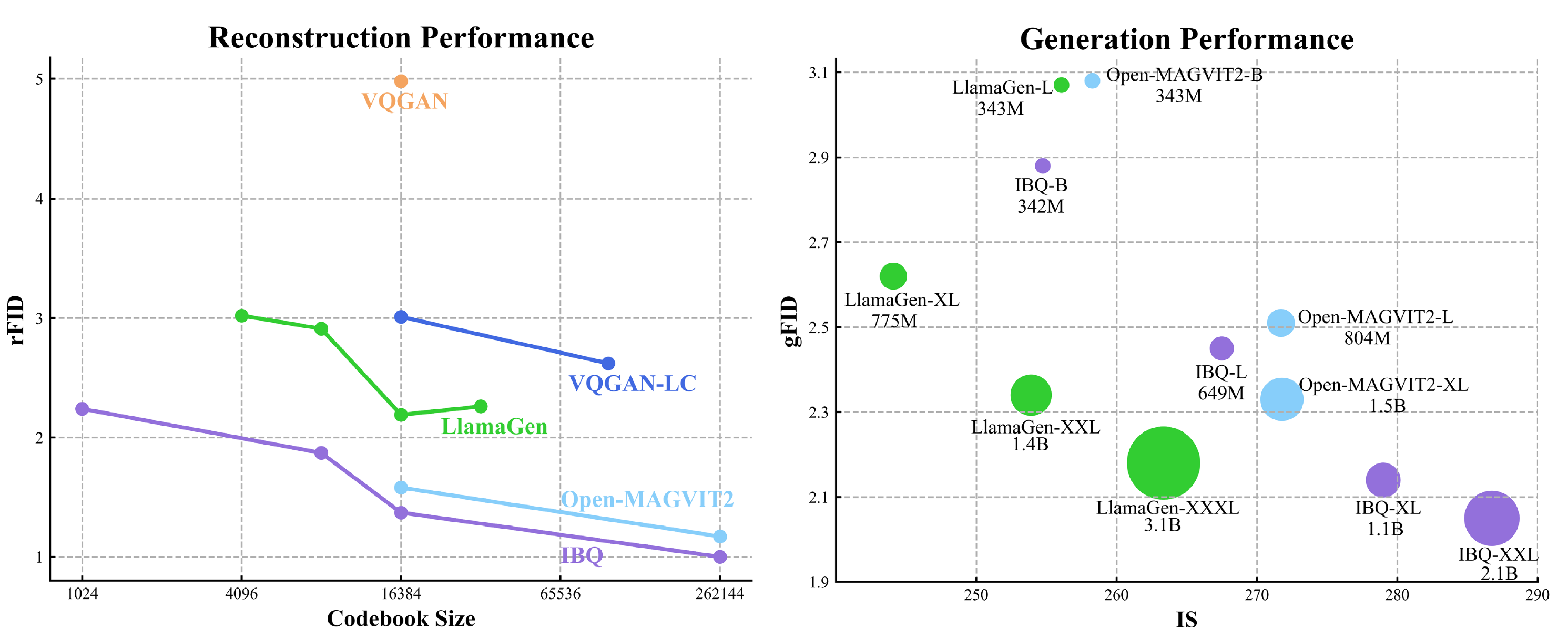
- [2024.11.26] We are excited to release IBQ, a series of scalable visual tokenizers, which achieve a large-scale codebook (2^18) with high dimension (256) and high utilization.
- [2024.09.09] We release an improved version of Open-MAGVIT2 tokenizer and a family of auto-regressive models ranging from 300M to 1.5B.
- [2024.06.17] We release the training code of the Open-MAGVIT2 tokenizer and checkpoints for different resolutions, achieving state-of-the-art performance (
0.39 rFIDfor 8x downsampling) compared to VQGAN, MaskGIT, and recent TiTok, LlamaGen, and OmniTokenizer.
📖 Implementations
Our codebase supports both NPU and GPU for training and inference. All experiments were conducted using the Ascend 910B for training, and we validated our models on the V100. The observed performance between the two platforms is nearly identical.
🛠️ Installation
GPU
- Env: We have tested on
Python 3.8.8andCUDA 11.8(other versions may also be fine). - Dependencies:
pip install -r requirements.txt
NPU
Image Version
- Env:
Python 3.9.16andCANN 8.0.T13 - Main Dependencies:
torch=2.1.0+cpu+torch-npu=2.1.0.post3-20240523+Lightning
Video Version
- Env
Python 3.9.16andCANN 8.0.T62 - Main Dependencies:
torch=2.1.0+cpu+torch-npu=2.1.0.post10.dev20241128+Lightning
Other Dependencies: see in requirements.txt
Datasets
- Image Dataset
We use Imagenet2012 as our Image dataset.
imagenet
└── train/
    ├── n01440764
        ├── n01440764_10026.JPEG
        ├── n01440764_10027.JPEG
        ├── ...
    ├── n01443537
    ├── ...
└── val/
    ├── ...
- Video Dataset
We use UCF-101 as our Video Dataset
UCF101
└── train/
    ├── class_0
        ├── video_1.mp4
        ├── video_2.mp4
        ├── ...
    ├── class_1
    ├── class_2
└── val/
    ├── ...
The preparation of UCF-101 can be referred to VideoGPT
- Text2Image Datasets
We recommend the data are organized in the following tar format.
data
└── LAION_COCO/
    ├── webdataset
        ├── 1.tar
        ├── 2.tar
        ├── 3.tar
        ├── ...
└── CC12M/
    ├── webdataset
        ├── 1.tar
        ├── 2.tar
        ├── 3.tar
        ├── ...
Before pretraining, the sample.json and filter_keys.json of each datasets should be prepared. Please refer to src/Open_MAGVIT2/data/prepare_pretrain.py
⚡ Training & Evaluation
The training and evaluation scripts are in Open-MAGVIT2.md and IBQ.md.
❤️ Acknowledgement
We thank Lijun Yu for his encouraging discussions. We refer a lot from VQGAN and MAGVIT. We also refer to LlamaGen, VAR, RQVAE and VideoGPT, OmniTokenizer. We also thank Bowen Zheng for pointing out that the IBQ is mathematically equivalent to the deterministic hard-gumbel without temperature implementation available in the lucidrains/vector-quantize-pytorch library. Thanks for their wonderful work.
Contributors


Similar repos


Languages
Python
97.0%
Shell
3.0%
SEED-Voken: A Series of Powerful Visual Tokenizers
Python
1,022
31 commits
updated Nov 25, 2025
README
🚀 SEED-Voken: A Series of Powerful Visual Tokenizers
The project aims to provide advanced visual tokenizers for autoregressive visual generation and currently supports the following methods:
Open-MAGVIT2: An Open-source Project Toward Democratizing Auto-Regressive Visual Generation
Zhuoyan Luo*, Fengyuan Shi*, Yixiao Ge, Yujiu Yang, Limin Wang, Ying Shan
ARC Lab Tencent PCG, Tsinghua University, Nanjing University
📚Open-MAGVIT2.md@article{luo2024open, title={Open-MAGVIT2: An Open-Source Project Toward Democratizing Auto-regressive Visual Generation}, author={Luo, Zhuoyan and Shi, Fengyuan and Ge, Yixiao and Yang, Yujiu and Wang, Limin and Shan, Ying}, journal={arXiv preprint arXiv:2409.04410}, year={2024} }
IBQ: Scalable Image Tokenization with Index Backpropagation Quantization
Fengyuan Shi*, Zhuoyan Luo*, Yixiao Ge, Yujiu Yang, Ying Shan, Limin Wang
Nanjing University, Tsinghua University, ARC Lab Tencent PCG
📚IBQ.md@InProceedings{Shi_2025_ICCV, author={Shi, Fengyuan and Luo, Zhuoyan and Ge, Yixiao and Yang, Yujiu and Shan, Ying and Wang, Limin}, title={Scalable Image Tokenization with Index Backpropagation Quantization}, booktitle={Proceedings of the IEEE/CVF International Conference on Computer Vision (ICCV)}, month={October}, year={2025}, pages={16037-16046} }
📰 News
- [2025.06.26]:fire::fire::fire: IBQ is accepted by ICCV 2025.
- [2025.02.14] The pretrained version of IBQ visual tokenizers, which achieves SOTA performance with high code dimension is released.
- [2025.02.09] We release Open-MAGVIT2 Video tokenizers, which achieves SOTA performance compared to OmniTokenizer, LARP and SweetTokenizer.
- [2025.01.21] Open-MAGVIT2 tokenizers (codebook size of 16384 and 262144) for text-conditional image generation are now released! They are pretrained with large-scale image-text datasets, achieving SOTA performance compared to LlamaGen, Show-o, and Cosmos.
- [2024.11.26] We are excited to release IBQ, a series of scalable visual tokenizers, which achieve a large-scale codebook (2^18) with high dimension (256) and high utilization.
- [2024.09.09] We release an improved version of Open-MAGVIT2 tokenizer and a family of auto-regressive models ranging from 300M to 1.5B.
- [2024.06.17] We release the training code of the Open-MAGVIT2 tokenizer and checkpoints for different resolutions, achieving state-of-the-art performance (
0.39 rFIDfor 8x downsampling) compared to VQGAN, MaskGIT, and recent TiTok, LlamaGen, and OmniTokenizer.
📖 Implementations
Our codebase supports both NPU and GPU for training and inference. All experiments were conducted using the Ascend 910B for training, and we validated our models on the V100. The observed performance between the two platforms is nearly identical.
🛠️ Installation
GPU
- Env: We have tested on
Python 3.8.8andCUDA 11.8(other versions may also be fine). - Dependencies:
pip install -r requirements.txt
NPU
Image Version
- Env:
Python 3.9.16andCANN 8.0.T13 - Main Dependencies:
torch=2.1.0+cpu+torch-npu=2.1.0.post3-20240523+Lightning
Video Version
- Env
Python 3.9.16andCANN 8.0.T62 - Main Dependencies:
torch=2.1.0+cpu+torch-npu=2.1.0.post10.dev20241128+Lightning
Other Dependencies: see in requirements.txt
Datasets
- Image Dataset
We use Imagenet2012 as our Image dataset.
imagenet
└── train/
    ├── n01440764
        ├── n01440764_10026.JPEG
        ├── n01440764_10027.JPEG
        ├── ...
    ├── n01443537
    ├── ...
└── val/
    ├── ...
- Video Dataset
We use UCF-101 as our Video Dataset
UCF101
└── train/
    ├── class_0
        ├── video_1.mp4
        ├── video_2.mp4
        ├── ...
    ├── class_1
    ├── class_2
└── val/
    ├── ...
The preparation of UCF-101 can be referred to VideoGPT
- Text2Image Datasets
We recommend the data are organized in the following tar format.
data
└── LAION_COCO/
    ├── webdataset
        ├── 1.tar
        ├── 2.tar
        ├── 3.tar
        ├── ...
└── CC12M/
    ├── webdataset
        ├── 1.tar
        ├── 2.tar
        ├── 3.tar
        ├── ...
Before pretraining, the sample.json and filter_keys.json of each datasets should be prepared. Please refer to src/Open_MAGVIT2/data/prepare_pretrain.py
⚡ Training & Evaluation
The training and evaluation scripts are in Open-MAGVIT2.md and IBQ.md.
❤️ Acknowledgement
We thank Lijun Yu for his encouraging discussions. We refer a lot from VQGAN and MAGVIT. We also refer to LlamaGen, VAR, RQVAE and VideoGPT, OmniTokenizer. We also thank Bowen Zheng for pointing out that the IBQ is mathematically equivalent to the deterministic hard-gumbel without temperature implementation available in the lucidrains/vector-quantize-pytorch library. Thanks for their wonderful work.
Similar repos
Contributors
Languages
Python
97.0%
Shell
3.0%