
README

Can VLMs Spot Fine-Grained Visual Differences in Web Interfaces?
WeChat AI



DiffSpot is a benchmark for fine-grained visual change detection in real-world web interfaces. Each example is a pair of near-identical screenshots that differ by a single programmatic CSS-level mutation; a VLM must describe what changed. Ground truth is recorded directly from the mutation that produced the pair.
✨ Highlights
- A clean probe for fine-grained perception. VLMs ace high-level image–text alignment but stumble on localized UI changes — DiffSpot isolates exactly that ability on real web interfaces.
- Difficulty is property-dependent. Neither pixel magnitude nor CLIP distance predicts recall — the bottleneck is nameability, not visual salience.
- Controllable by construction. A fully code-driven pipeline (mutate one CSS property → re-render → record) yields exact ground truth on a tunable difficulty gradient, with a grounding gate that discards no-effect and reflow-contaminated pairs.
👀 Example Pairs
Each pair differs by a single CSS-level mutation. The model is given both screenshots and must name the change.
| Before | After |
|---|---|
 |  |
| The caption under the "PDF Viewer" heading is slightly larger. | |
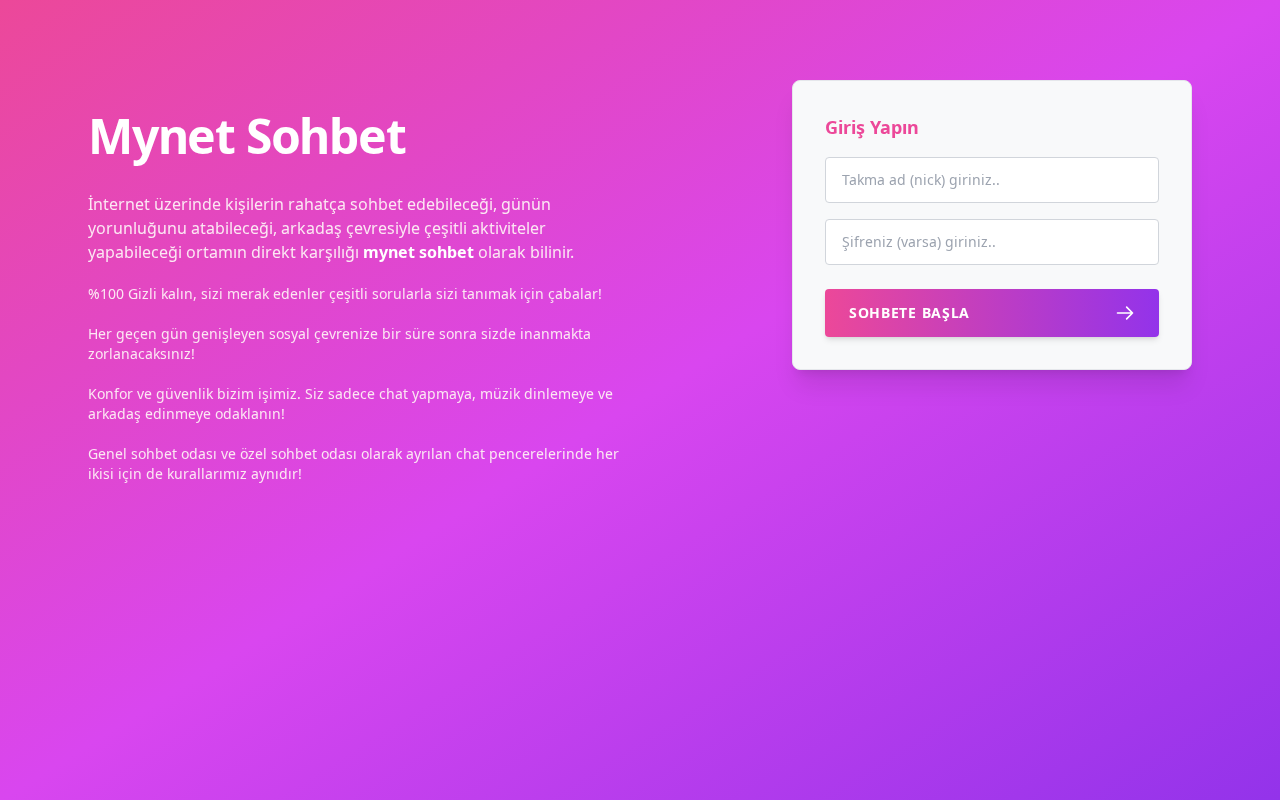 | 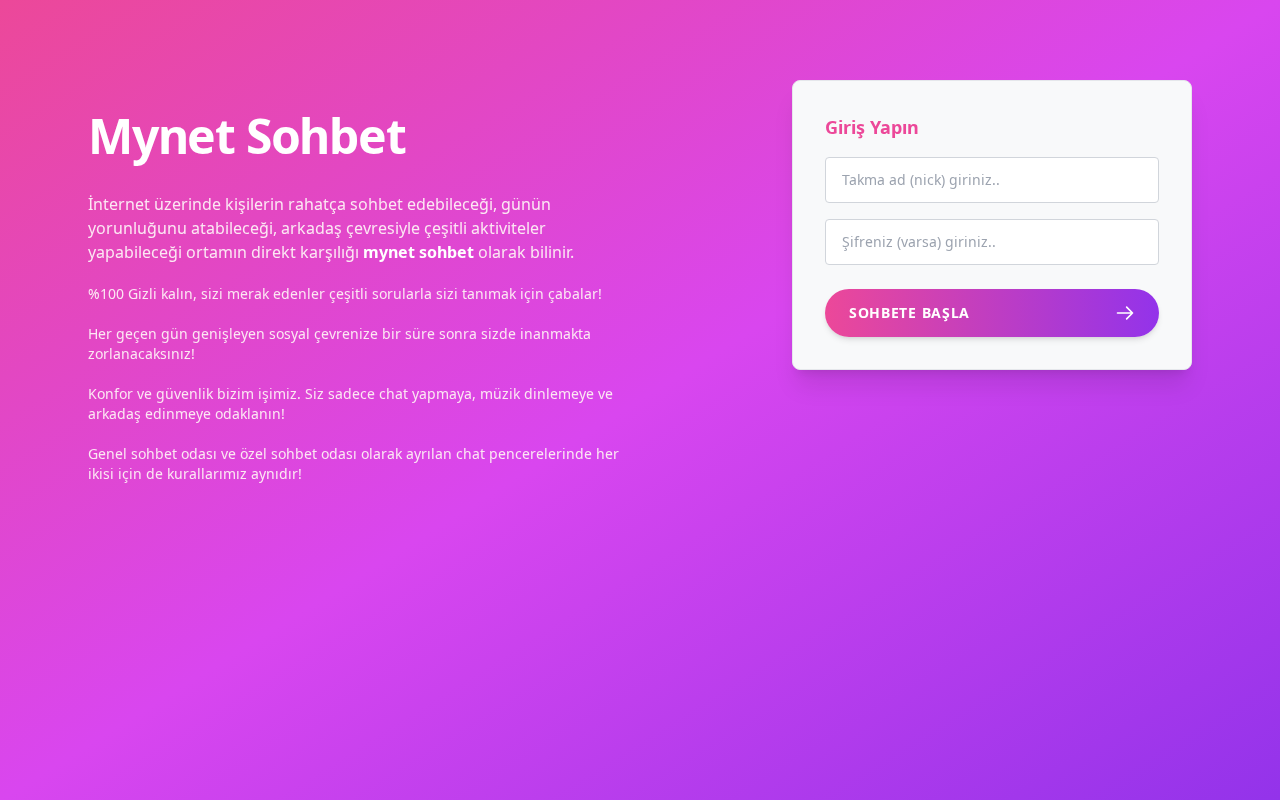 |
| The "SOHBETE BAŞLA" button has more rounded corners. | |
 |  |
| The card with the heading "Interesting Facts About Steamboat Springs" is much more transparent. | |
 |  |
| The banner background showing the "Find your ideal partner" tagline now uses a different gradient. | |
 |  |
| The subtitle "your loan installment!" in the financing section is slightly bolder. | |
🏆 Leaderboard
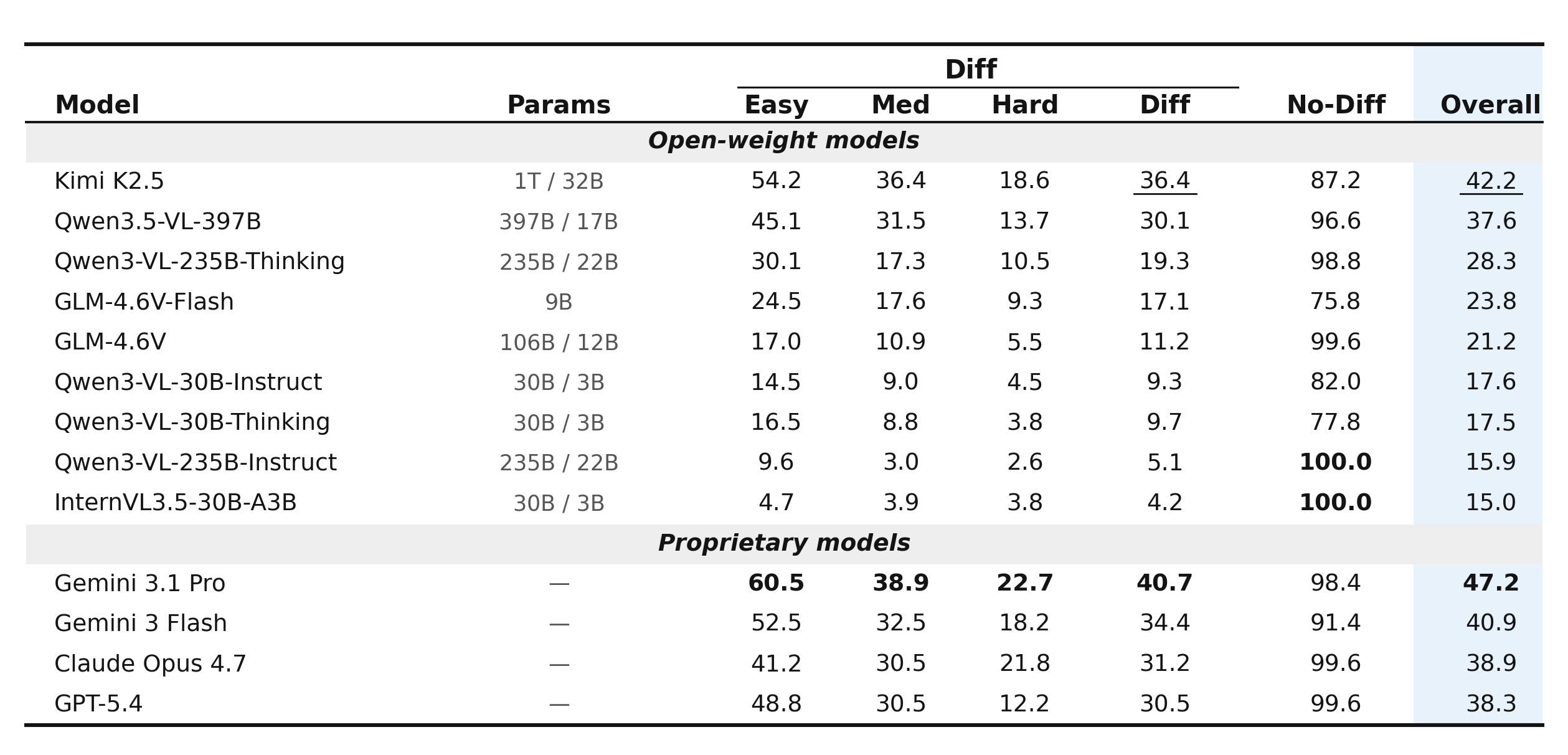
Easy / Med / Hard / Diff are Recall on the has-diff pairs (1,300 per tier; 3,900 total); No-Diff is specificity on the 500 control pairs; Overall is per-case accuracy (TP + TN) / 4,400 — the official score. Judge: gpt-oss-120b, reasoning_effort=high (cross-judge Kendall τ = 1.000 across gpt-oss-120b / Kimi-K2.5 / Qwen3.5-VL-397B). Bold = column max; underline = best open-weight. Trivial always-no-diff baseline: 11.4% Overall.
[!TIP] Gemini 3.1 Pro leads at 47.2%, 5.0 pp ahead of the best open-weight model (Kimi K2.5, 42.2%). Seven of thirteen models fall below 30%. Difficulty is strongly property-dependent — across CSS operators, neither pixel magnitude nor CLIP distance reliably predicts recall.
Submit your model: see docs/submission.md.
🚀 Quick Start
git clone https://github.com/Tencent/DiffSpot.git
cd DiffSpot
pip install -e ".[api]"

export OPENAI_API_KEY=...   # for both the baseline run and the judge

# 1. Run a baseline VLM (loads the HF dataset, writes predictions JSONL)
#    Replace gpt-5.4 with your own model — see "Evaluate your own model" below.
python baselines/api/run_openai.py \
    --model gpt-5.4 \
    --output results/gpt-5.4/predictions.jsonl

# 2. Score predictions with the official LLM judge (gpt-oss-120b)
python scripts/evaluate.py \
    --predictions results/gpt-5.4/predictions.jsonl \
    --judge-model gpt-oss-120b \
    --output results/gpt-5.4/scores.json

# 3. Print the official metrics table
python scripts/show_results.py results/gpt-5.4/scores.json
[!TIP] To target an OpenAI-compatible endpoint (vLLM, sglang, an internal gateway) for the judge, set
OPENAI_BASE_URL. Anthropic / Google baselines useANTHROPIC_API_KEY/GOOGLE_API_KEY.
📦 Dataset
from datasets import load_dataset

ds = load_dataset("tencent/DiffSpot", split="test")   # 4,400 pairs
ex = ds[0]
ex["image_before"], ex["image_after"]   # PIL.Image — before / after, in this order
ex["task_type"]                          # "visual_diff" | "no_diff"
ex["difficulty"]                         # easy | medium | hard | no_diff
ex["ground_truth_diff"]                  # natural-language GT (display only)
ex["mutation_dicts_json"]                # JSON-encoded structured GT (scoring source)
Other per-pair fields: mutation_types, domain, pixel_diff / target_diff / outside_diff, target_bbox_{x,y,w,h}. Offline / local parquet: diffspot.data.load(dataset_path="path/to/test-*.parquet").
🧪 Evaluate your own model
The contract is simple: produce a predictions JSONL using the prompts in
diffspot/prompts/ verbatim, then score it. Copy a runner in
baselines/ (api/ or local/) as a template and swap in your model client.
[!IMPORTANT] Two things silently wreck scores if you roll your own runner:
- Image order — feed
image_beforefirst,image_aftersecond (the prompt is anchored to "Image 1 = before, Image 2 = after").max_tokens≥ 16384 attemperature 0. A thinking model on a small budget spends it on hidden reasoning and returns emptycontent→ parse failures, not errors.
Predictions JSONL — one record per pair:
{"id": "...", "split": "easy|medium|hard|no_diff", "model": "...", "prompt_version": "v1.0", "prediction": "<model's free-form diff list>"}
Runners resume automatically (re-running continues from where they stopped). Validate before submitting:
python scripts/prepare_submission.py --predictions results/<model>/predictions.jsonl --output submissions/<model>.zip
Scoring uses the official judge gpt-oss-120b (reasoning_effort=high), two ways:
- Self-evaluate — the judge is open-weight; host it (vLLM / sglang) or point
OPENAI_BASE_URLat any OpenAI-compatible endpoint serving it, then runscripts/evaluate.py(Quick Start step 2). - Don't want to host a 120B judge? Submit only your predictions and we score them — see
docs/submission.md.
Metric definitions (Overall / Diff / No-Diff, and why No-Diff specificity matters): docs/evaluation.md.
⚙️ Environment Variables
| Variable | Used by |
|---|---|
OPENAI_API_KEY | OpenAI baseline and the judge |
OPENAI_BASE_URL | route the OpenAI client to a vLLM / sglang / gateway endpoint (judge or self-hosted models) |
ANTHROPIC_API_KEY | Anthropic baseline |
GOOGLE_API_KEY (or GEMINI_API_KEY) | Google baseline |
Requires Python ≥ 3.10. pip install -e ".[api]" pulls the API clients; self-hosted models in baselines/local/ expect an OpenAI-compatible endpoint (--endpoint).
🗂️ Repository Layout
DiffSpot/
├── diffspot/              # Core package (data loader, judge, metrics)
│   └── prompts/           # VLM and judge prompt templates (versioned)
├── baselines/             # Reference baseline runners
│   ├── api/               # API-hosted models (OpenAI / Anthropic / Google)
│   └── local/             # Self-hosted models via sglang / vllm
├── scripts/               # End-to-end CLIs (eval, metrics, submission prep)
├── docs/                  # Data card, evaluation protocol, submission guide
├── examples/              # Sample predictions + walkthrough
├── results/               # Per-model raw predictions + scores (reproducibility)
├── leaderboard/           # Machine-readable leaderboard + auto-update tooling
└── space/                 # HuggingFace Space demo source
📚 Citation
@misc{zhang2026diffspotvlmsspotfinegrained,
      title={DiffSpot: Can VLMs Spot Fine-Grained Visual Differences in Web Interfaces?},
      author={Linhao Zhang and Aiwei Liu and Yuan Liu and Xiao Zhou},
      year={2026},
      eprint={2605.29615},
      archivePrefix={arXiv},
      primaryClass={cs.CV},
      url={https://arxiv.org/abs/2605.29615},
}
📄 License
DiffSpot-Bench (code and dataset) is released under the MIT License — see LICENSE. Copyright (C) 2026 Tencent. All rights reserved.
Contributors

44 commits
Similar repos



Languages
Python
100.0%
README
Can VLMs Spot Fine-Grained Visual Differences in Web Interfaces?
WeChat AI
DiffSpot is a benchmark for fine-grained visual change detection in real-world web interfaces. Each example is a pair of near-identical screenshots that differ by a single programmatic CSS-level mutation; a VLM must describe what changed. Ground truth is recorded directly from the mutation that produced the pair.
✨ Highlights
- A clean probe for fine-grained perception. VLMs ace high-level image–text alignment but stumble on localized UI changes — DiffSpot isolates exactly that ability on real web interfaces.
- Difficulty is property-dependent. Neither pixel magnitude nor CLIP distance predicts recall — the bottleneck is nameability, not visual salience.
- Controllable by construction. A fully code-driven pipeline (mutate one CSS property → re-render → record) yields exact ground truth on a tunable difficulty gradient, with a grounding gate that discards no-effect and reflow-contaminated pairs.
👀 Example Pairs
Each pair differs by a single CSS-level mutation. The model is given both screenshots and must name the change.
| Before | After |
|---|---|
| |
| The caption under the "PDF Viewer" heading is slightly larger. | |
| |
| The "SOHBETE BAŞLA" button has more rounded corners. | |
| |
| The card with the heading "Interesting Facts About Steamboat Springs" is much more transparent. | |
| |
| The banner background showing the "Find your ideal partner" tagline now uses a different gradient. | |
| |
| The subtitle "your loan installment!" in the financing section is slightly bolder. | |
🏆 Leaderboard
Easy / Med / Hard / Diff are Recall on the has-diff pairs (1,300 per tier; 3,900 total); No-Diff is specificity on the 500 control pairs; Overall is per-case accuracy (TP + TN) / 4,400 — the official score. Judge: gpt-oss-120b, reasoning_effort=high (cross-judge Kendall τ = 1.000 across gpt-oss-120b / Kimi-K2.5 / Qwen3.5-VL-397B). Bold = column max; underline = best open-weight. Trivial always-no-diff baseline: 11.4% Overall.
[!TIP] Gemini 3.1 Pro leads at 47.2%, 5.0 pp ahead of the best open-weight model (Kimi K2.5, 42.2%). Seven of thirteen models fall below 30%. Difficulty is strongly property-dependent — across CSS operators, neither pixel magnitude nor CLIP distance reliably predicts recall.
Submit your model: see docs/submission.md.
🚀 Quick Start
git clone https://github.com/Tencent/DiffSpot.git
cd DiffSpot
pip install -e ".[api]"

export OPENAI_API_KEY=...   # for both the baseline run and the judge

# 1. Run a baseline VLM (loads the HF dataset, writes predictions JSONL)
#    Replace gpt-5.4 with your own model — see "Evaluate your own model" below.
python baselines/api/run_openai.py \
    --model gpt-5.4 \
    --output results/gpt-5.4/predictions.jsonl

# 2. Score predictions with the official LLM judge (gpt-oss-120b)
python scripts/evaluate.py \
    --predictions results/gpt-5.4/predictions.jsonl \
    --judge-model gpt-oss-120b \
    --output results/gpt-5.4/scores.json

# 3. Print the official metrics table
python scripts/show_results.py results/gpt-5.4/scores.json
[!TIP] To target an OpenAI-compatible endpoint (vLLM, sglang, an internal gateway) for the judge, set
OPENAI_BASE_URL. Anthropic / Google baselines useANTHROPIC_API_KEY/GOOGLE_API_KEY.
📦 Dataset
from datasets import load_dataset

ds = load_dataset("tencent/DiffSpot", split="test")   # 4,400 pairs
ex = ds[0]
ex["image_before"], ex["image_after"]   # PIL.Image — before / after, in this order
ex["task_type"]                          # "visual_diff" | "no_diff"
ex["difficulty"]                         # easy | medium | hard | no_diff
ex["ground_truth_diff"]                  # natural-language GT (display only)
ex["mutation_dicts_json"]                # JSON-encoded structured GT (scoring source)
Other per-pair fields: mutation_types, domain, pixel_diff / target_diff / outside_diff, target_bbox_{x,y,w,h}. Offline / local parquet: diffspot.data.load(dataset_path="path/to/test-*.parquet").
🧪 Evaluate your own model
The contract is simple: produce a predictions JSONL using the prompts in
diffspot/prompts/ verbatim, then score it. Copy a runner in
baselines/ (api/ or local/) as a template and swap in your model client.
[!IMPORTANT] Two things silently wreck scores if you roll your own runner:
- Image order — feed
image_beforefirst,image_aftersecond (the prompt is anchored to "Image 1 = before, Image 2 = after").max_tokens≥ 16384 attemperature 0. A thinking model on a small budget spends it on hidden reasoning and returns emptycontent→ parse failures, not errors.
Predictions JSONL — one record per pair:
{"id": "...", "split": "easy|medium|hard|no_diff", "model": "...", "prompt_version": "v1.0", "prediction": "<model's free-form diff list>"}
Runners resume automatically (re-running continues from where they stopped). Validate before submitting:
python scripts/prepare_submission.py --predictions results/<model>/predictions.jsonl --output submissions/<model>.zip
Scoring uses the official judge gpt-oss-120b (reasoning_effort=high), two ways:
- Self-evaluate — the judge is open-weight; host it (vLLM / sglang) or point
OPENAI_BASE_URLat any OpenAI-compatible endpoint serving it, then runscripts/evaluate.py(Quick Start step 2). - Don't want to host a 120B judge? Submit only your predictions and we score them — see
docs/submission.md.
Metric definitions (Overall / Diff / No-Diff, and why No-Diff specificity matters): docs/evaluation.md.
⚙️ Environment Variables
| Variable | Used by |
|---|---|
OPENAI_API_KEY | OpenAI baseline and the judge |
OPENAI_BASE_URL | route the OpenAI client to a vLLM / sglang / gateway endpoint (judge or self-hosted models) |
ANTHROPIC_API_KEY | Anthropic baseline |
GOOGLE_API_KEY (or GEMINI_API_KEY) | Google baseline |
Requires Python ≥ 3.10. pip install -e ".[api]" pulls the API clients; self-hosted models in baselines/local/ expect an OpenAI-compatible endpoint (--endpoint).
🗂️ Repository Layout
DiffSpot/
├── diffspot/              # Core package (data loader, judge, metrics)
│   └── prompts/           # VLM and judge prompt templates (versioned)
├── baselines/             # Reference baseline runners
│   ├── api/               # API-hosted models (OpenAI / Anthropic / Google)
│   └── local/             # Self-hosted models via sglang / vllm
├── scripts/               # End-to-end CLIs (eval, metrics, submission prep)
├── docs/                  # Data card, evaluation protocol, submission guide
├── examples/              # Sample predictions + walkthrough
├── results/               # Per-model raw predictions + scores (reproducibility)
├── leaderboard/           # Machine-readable leaderboard + auto-update tooling
└── space/                 # HuggingFace Space demo source
📚 Citation
@misc{zhang2026diffspotvlmsspotfinegrained,
      title={DiffSpot: Can VLMs Spot Fine-Grained Visual Differences in Web Interfaces?},
      author={Linhao Zhang and Aiwei Liu and Yuan Liu and Xiao Zhou},
      year={2026},
      eprint={2605.29615},
      archivePrefix={arXiv},
      primaryClass={cs.CV},
      url={https://arxiv.org/abs/2605.29615},
}
📄 License
DiffSpot-Bench (code and dataset) is released under the MIT License — see LICENSE. Copyright (C) 2026 Tencent. All rights reserved.
Similar repos
Contributors
44 commits
Languages
Python
100.0%