Trace reads the internet so you don’t have to.
See the codeTrace reads the internet so you don't have to. 100+ tech sources, 10 stories, 5 minutes. Free for everyone, open source.
Trace reads tech and AI news from over a hundred sources every morning, groups the stories everyone is covering into one card, ranks them, and summarises each one with every source attached. Read it in the feed, in a daily email you shape yourself, on your phone, in every new Chrome tab, or through your AI assistant.
Live: yourtrace.online · Daily archive: yourtrace.online/brief · Build your brief: yourtrace.online/brief/customize
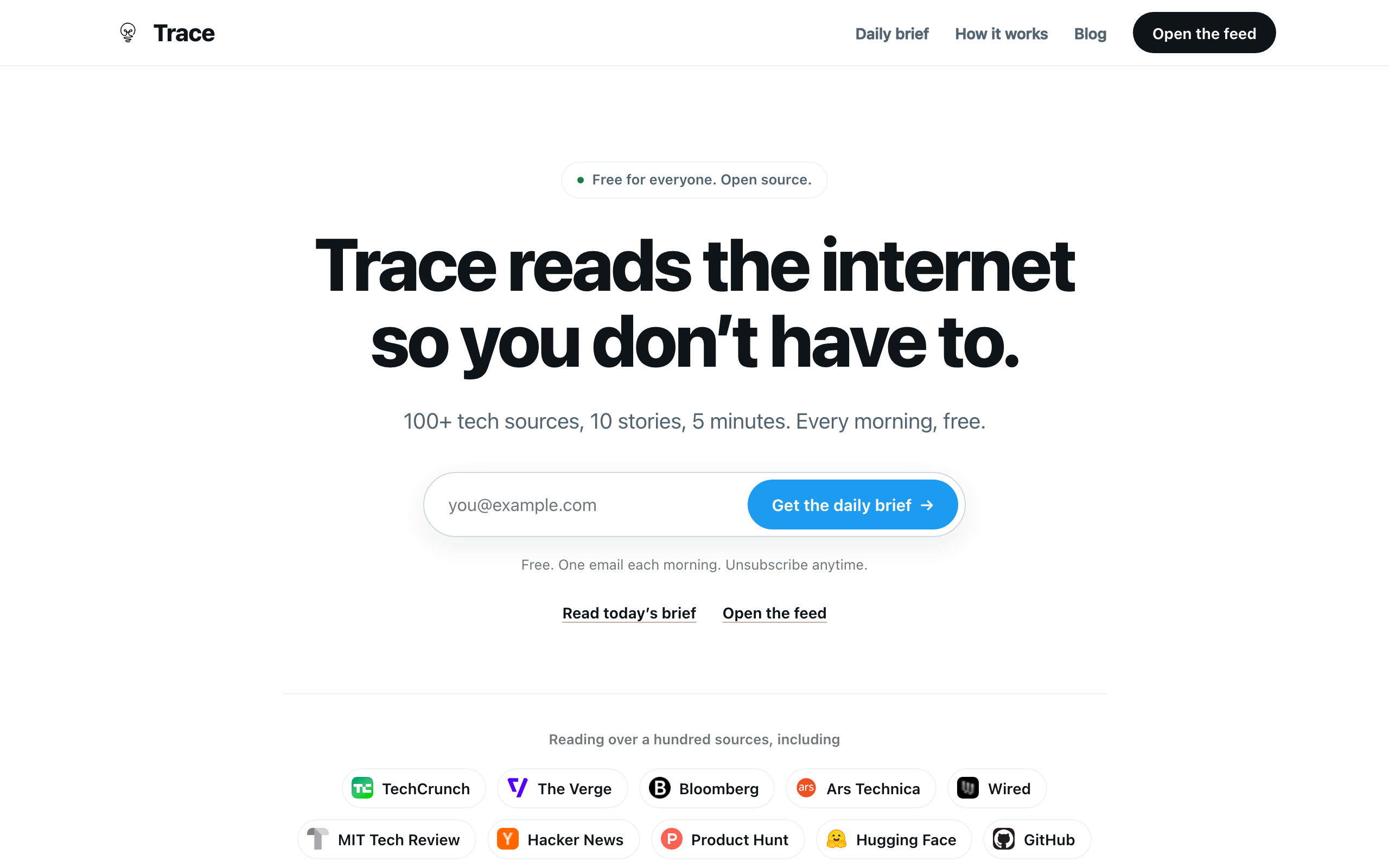
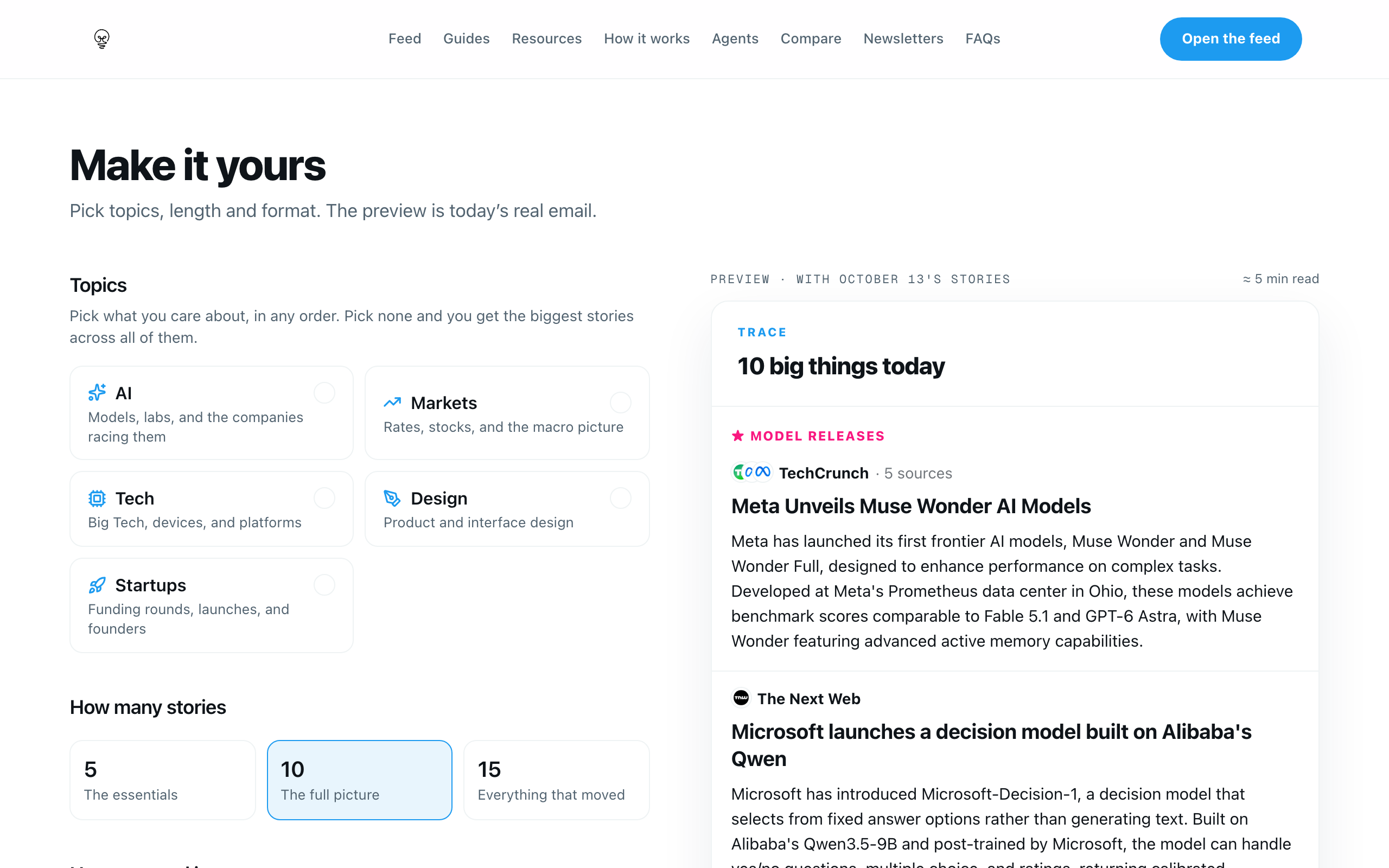
| The feed | One card per story, every source attached, ranked by how much it matters. Topic lanes (AI, Markets, Tech, Startups, Design), Top articles, bookmarks, an archive. |
| The daily brief | A morning email. Ten stories by default; each reader picks topics, 5/10/15 stories, and summaries, headlines only, or images. The preview in the builder is the real selection. |
| Public archive | Every edition at /brief/YYYY-MM-DD, with share buttons and its own share image. |
| Mobile app | Android app on Google Play; the Expo source lives in trace/ in the main repo. |
| New tab | Chrome extension in trace-extension/: the latest stories on every new tab. |
| Agents | Claude, Cursor and other MCP clients can read the feed (/agents). |
 sources (RSS/Atom, HN, Reddit, Product Hunt, X, ...)      every ~20 min / ~3 h
        |
        v
 backend/v3  pipeline ── fetch → filter → group same-event coverage → rank
        |                └─ summarise each article once (cached), pick the brief
        v
 LocalDB (SQLite, Firestore-compatible API)  ◄── frontend/ (Next.js) ── readers
        |                                             trace/ (mobile), trace-extension/
        v
 daily email: own Postfix MTA + DKIM, or Brevo
backend/v3/flows/send_audience_newsletter.py picks each
reader's stories. frontend/lib/newsletter-select.ts is a line-for-line
TypeScript port used by the live preview; a parity test keeps them identical.| Path | What |
|---|---|
frontend/ | Next.js web app: landing, feed, /brief, builder, account, API routes |
backend/v3/ | The pipeline: sources (v3/config), builders, ranking, summaries, scheduler, newsletter |
backend/v1/, backend/v2/ | Shared modules the pipeline still uses (storage, email sending, templates, push notifications) |
backend/localdb/ | Self-hosted SQLite document store with a Firestore-compatible client and HTTP server |
backend/vps/ | systemd units, Caddy example and backup script for a single-server deployment |
trace/ | Mobile app (Expo / React Native); not yet in the public mirror |
trace-extension/ | Chrome new-tab extension (Manifest V3) |
docker/, docker-compose.yml | Self-hosting stack: LocalDB + pipeline + web app |
docs/ | Screenshots and deployment notes |
Prerequisites: Docker with Compose v2, an OpenAI API key, and a free Firebase project (used for sign-in only).
git clone <this repo> trace && cd trace
cp .env.example .env
# set at least:
#   OPENAI_API_KEY
#   LOCALDB_API_TOKEN            openssl rand -hex 32
#   TRACE_SESSION_SECRET         openssl rand -hex 32
#   FIREBASE_SERVICE_ACCOUNT_KEY single-line service-account JSON (Firebase Auth)
#   NEXT_PUBLIC_FIREBASE_*       your Firebase web app config
#   TRACE_APP_URL                public URL; email links are built from it
docker compose up --build
Web app on http://localhost:3000. The pipeline container builds the feed every
20 minutes (pulse every 3 hours) and publishes today's /brief edition without
emailing anyone. The feed is empty until the first run finishes (a few minutes).
The pipeline runs from backend/; LocalDB and the web app from the repo root.
# 1. LocalDB
export LOCALDB_API_TOKEN=... LOCALDB_ALLOWED_COLLECTIONS=...   # see .env.example
python3 -m backend.localdb.server --db data/localdb/documents.sqlite3 --port 8502

# 2. Pipeline
python3 -m venv .venv && .venv/bin/pip install -r backend/requirements.txt
cd backend
export TRACE_DB=local TRACE_LOCALDB_PATH=../data/localdb/documents.sqlite3
../.venv/bin/python -m v3.scheduler --jobs trending assemble --audience all --force-pools
../.venv/bin/python -m v3.flows.send_audience_newsletter --publish-only   # today's /brief
cd ..

# 3. Web app
cd frontend && npm install
FIRESTORE_BACKEND=local LOCALDB_URL=http://127.0.0.1:8502 LOCALDB_API_TOKEN=... npm run dev   # :5001
python -m v3.scheduler --help (from backend/) lists every job: trending,
pulse, for_you, assemble, newsletter, ...
cd trace && npm install && npm run start (Expo), where the
app source is included. Point it at your web app's API in its config.chrome://extensions, enable Developer mode, Load
unpacked → trace-extension/. See trace-extension/README.md.cd backend
python -m v3.flows.send_audience_newsletter --dry-run # who would get what
python -m v3.scheduler --jobs newsletter # build + send
EMAIL_TRANSPORT=smtp sends through a local MTA (Postfix on 127.0.0.1:25),
DKIM-signed with EMAIL_DKIM_*. Publish SPF, DKIM and DMARC for your domain.EMAIL_TRANSPORT=brevo uses the Brevo API; auto uses the MTA first and
Brevo for the buckets/domains you list.member (daily), winback (dormant: at most 3 emails, 4
days apart, opt-in with NEWSLETTER_WINBACK=1, Brevo only) and landing
(email-only signups).Every variable is documented in .env.example.
Sources are plain JSON in backend/v3/config/:
| File | Feeds |
|---|---|
trending_sources.json | The main trending feed (plus Hacker News / discovery settings) |
pulse_sources.json, brief_sources.json | Developer pulse and brief (RSS, HN, Reddit, ...) |
for_you_sources.json, deep_dive_sources.json | Interest-matched and long-form feeds |
{
  "interest_id": "tech",
  "name": "The Verge",
  "url": "https://www.theverge.com/rss/index.xml",
  "type": "atom",
  "exclude_title_keywords": ["deal", "review"],
  "source_weight": 1.2
}
type is rss, atom, html or ai_tldr; source_weight boosts or dampens
a source in ranking. Check a source before you open a PR:
cd backend && python -m v3.audit_sources --config v3/config/trending_sources.json --source "The Verge"
Not sure? Open a news source request.
Pull requests are welcome: new sources, ranking and summary quality, self-hosting, docs, bug fixes. Read CONTRIBUTING.md for setup and the checks CI runs. Security issues: SECURITY.md.
TRACE_APP_URL,
EMAIL_SENDER_*, EMAIL_DKIM_*, EMAIL_REPLY_TO and
NEXT_PUBLIC_CONTACT_EMAIL for your deployment. Blog posts and SEO copy in
frontend/ describe the hosted site; edit them freely.Trace is free, with one clearly labelled sponsored tool. If it saves you time, buy me a coffee or use the Sponsor button on this repo. Stars, bug reports and new sources help just as much.
GNU AGPL-3.0. If you run a modified version as a network service, make your modified source available to its users.
Trace reads the internet so you don’t have to.
See the codeTrace reads the internet so you don't have to. 100+ tech sources, 10 stories, 5 minutes. Free for everyone, open source.
Trace reads tech and AI news from over a hundred sources every morning, groups the stories everyone is covering into one card, ranks them, and summarises each one with every source attached. Read it in the feed, in a daily email you shape yourself, on your phone, in every new Chrome tab, or through your AI assistant.
Live: yourtrace.online · Daily archive: yourtrace.online/brief · Build your brief: yourtrace.online/brief/customize
| The feed | One card per story, every source attached, ranked by how much it matters. Topic lanes (AI, Markets, Tech, Startups, Design), Top articles, bookmarks, an archive. |
| The daily brief | A morning email. Ten stories by default; each reader picks topics, 5/10/15 stories, and summaries, headlines only, or images. The preview in the builder is the real selection. |
| Public archive | Every edition at /brief/YYYY-MM-DD, with share buttons and its own share image. |
| Mobile app | Android app on Google Play; the Expo source lives in trace/ in the main repo. |
| New tab | Chrome extension in trace-extension/: the latest stories on every new tab. |
| Agents | Claude, Cursor and other MCP clients can read the feed (/agents). |
 sources (RSS/Atom, HN, Reddit, Product Hunt, X, ...)      every ~20 min / ~3 h
        |
        v
 backend/v3  pipeline ── fetch → filter → group same-event coverage → rank
        |                └─ summarise each article once (cached), pick the brief
        v
 LocalDB (SQLite, Firestore-compatible API)  ◄── frontend/ (Next.js) ── readers
        |                                             trace/ (mobile), trace-extension/
        v
 daily email: own Postfix MTA + DKIM, or Brevo
backend/v3/flows/send_audience_newsletter.py picks each
reader's stories. frontend/lib/newsletter-select.ts is a line-for-line
TypeScript port used by the live preview; a parity test keeps them identical.| Path | What |
|---|---|
frontend/ | Next.js web app: landing, feed, /brief, builder, account, API routes |
backend/v3/ | The pipeline: sources (v3/config), builders, ranking, summaries, scheduler, newsletter |
backend/v1/, backend/v2/ | Shared modules the pipeline still uses (storage, email sending, templates, push notifications) |
backend/localdb/ | Self-hosted SQLite document store with a Firestore-compatible client and HTTP server |
backend/vps/ | systemd units, Caddy example and backup script for a single-server deployment |
trace/ | Mobile app (Expo / React Native); not yet in the public mirror |
trace-extension/ | Chrome new-tab extension (Manifest V3) |
docker/, docker-compose.yml | Self-hosting stack: LocalDB + pipeline + web app |
docs/ | Screenshots and deployment notes |
Prerequisites: Docker with Compose v2, an OpenAI API key, and a free Firebase project (used for sign-in only).
git clone <this repo> trace && cd trace
cp .env.example .env
# set at least:
#   OPENAI_API_KEY
#   LOCALDB_API_TOKEN            openssl rand -hex 32
#   TRACE_SESSION_SECRET         openssl rand -hex 32
#   FIREBASE_SERVICE_ACCOUNT_KEY single-line service-account JSON (Firebase Auth)
#   NEXT_PUBLIC_FIREBASE_*       your Firebase web app config
#   TRACE_APP_URL                public URL; email links are built from it
docker compose up --build
Web app on http://localhost:3000. The pipeline container builds the feed every
20 minutes (pulse every 3 hours) and publishes today's /brief edition without
emailing anyone. The feed is empty until the first run finishes (a few minutes).
The pipeline runs from backend/; LocalDB and the web app from the repo root.
# 1. LocalDB
export LOCALDB_API_TOKEN=... LOCALDB_ALLOWED_COLLECTIONS=...   # see .env.example
python3 -m backend.localdb.server --db data/localdb/documents.sqlite3 --port 8502

# 2. Pipeline
python3 -m venv .venv && .venv/bin/pip install -r backend/requirements.txt
cd backend
export TRACE_DB=local TRACE_LOCALDB_PATH=../data/localdb/documents.sqlite3
../.venv/bin/python -m v3.scheduler --jobs trending assemble --audience all --force-pools
../.venv/bin/python -m v3.flows.send_audience_newsletter --publish-only   # today's /brief
cd ..

# 3. Web app
cd frontend && npm install
FIRESTORE_BACKEND=local LOCALDB_URL=http://127.0.0.1:8502 LOCALDB_API_TOKEN=... npm run dev   # :5001
python -m v3.scheduler --help (from backend/) lists every job: trending,
pulse, for_you, assemble, newsletter, ...
cd trace && npm install && npm run start (Expo), where the
app source is included. Point it at your web app's API in its config.chrome://extensions, enable Developer mode, Load
unpacked → trace-extension/. See trace-extension/README.md.cd backend
python -m v3.flows.send_audience_newsletter --dry-run # who would get what
python -m v3.scheduler --jobs newsletter # build + send
EMAIL_TRANSPORT=smtp sends through a local MTA (Postfix on 127.0.0.1:25),
DKIM-signed with EMAIL_DKIM_*. Publish SPF, DKIM and DMARC for your domain.EMAIL_TRANSPORT=brevo uses the Brevo API; auto uses the MTA first and
Brevo for the buckets/domains you list.member (daily), winback (dormant: at most 3 emails, 4
days apart, opt-in with NEWSLETTER_WINBACK=1, Brevo only) and landing
(email-only signups).Every variable is documented in .env.example.
Sources are plain JSON in backend/v3/config/:
| File | Feeds |
|---|---|
trending_sources.json | The main trending feed (plus Hacker News / discovery settings) |
pulse_sources.json, brief_sources.json | Developer pulse and brief (RSS, HN, Reddit, ...) |
for_you_sources.json, deep_dive_sources.json | Interest-matched and long-form feeds |
{
  "interest_id": "tech",
  "name": "The Verge",
  "url": "https://www.theverge.com/rss/index.xml",
  "type": "atom",
  "exclude_title_keywords": ["deal", "review"],
  "source_weight": 1.2
}
type is rss, atom, html or ai_tldr; source_weight boosts or dampens
a source in ranking. Check a source before you open a PR:
cd backend && python -m v3.audit_sources --config v3/config/trending_sources.json --source "The Verge"
Not sure? Open a news source request.
Pull requests are welcome: new sources, ranking and summary quality, self-hosting, docs, bug fixes. Read CONTRIBUTING.md for setup and the checks CI runs. Security issues: SECURITY.md.
TRACE_APP_URL,
EMAIL_SENDER_*, EMAIL_DKIM_*, EMAIL_REPLY_TO and
NEXT_PUBLIC_CONTACT_EMAIL for your deployment. Blog posts and SEO copy in
frontend/ describe the hosted site; edit them freely.Trace is free, with one clearly labelled sponsored tool. If it saves you time, buy me a coffee or use the Sponsor button on this repo. Stars, bug reports and new sources help just as much.
GNU AGPL-3.0. If you run a modified version as a network service, make your modified source available to its users.



