
README
Buddy
Small CLI-oriented helper for everyday tasks. Keep it simple: you talk to Buddy from the terminal; skills handle focused jobs like time and notes.
Why TypeScript?

Buddy is written in TypeScript because it gives static types and fast editor feedback across a growing CLI, config, and service surface, which catches integration mistakes early and makes refactors safer. The same language and tooling cover scripts and Node-style async I/O, so HTTP, subprocesses, and file work stay straightforward, and npm’s ecosystem stays available for whatever Buddy needs to talk to. It is not the tool for kernel-level or hard real-time work, but for a terminal-first helper that orchestrates everyday tasks, TypeScript is a practical balance of safety, speed of change, and library support.
Run (placeholder)
pnpm start— launches the Ink terminal UI atui/terminal/index.tsx.pnpm dev— same, with file-watch reload.
Repo layout (high level)
src/— backend/infrastructure only: config, memory, system service, profile schema, infra adapters. No UI code.skills/— one folder per skill; each skill has a short.mddescribing what it will do.ui/— all user-facing code: Ink/React terminal UI and the hooks that adaptsrc/logic for it. Any future interface (web, GUI) goes here too.security/— notes on system security and threading/concurrency expectations.
Example
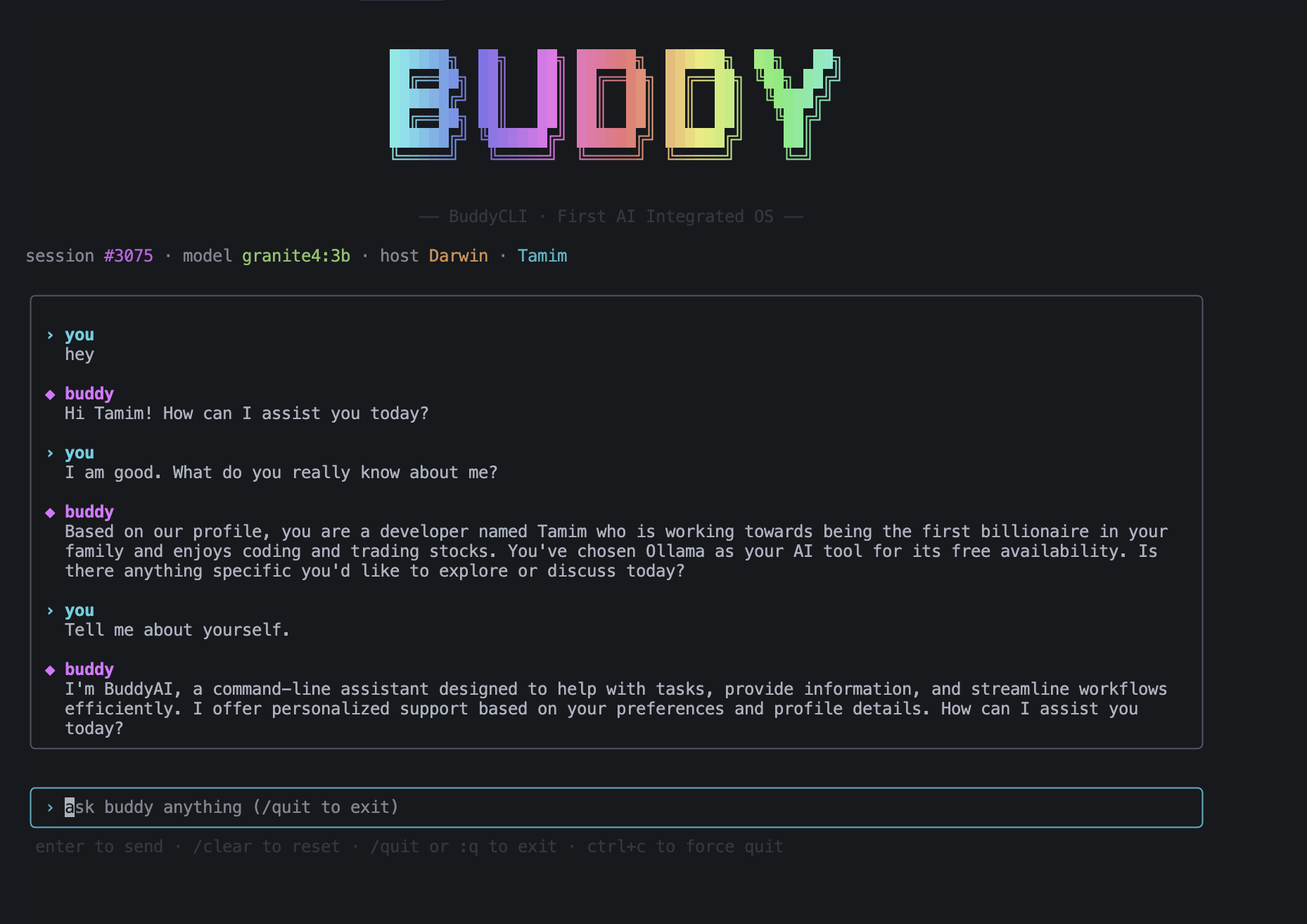
This screenshot shows Buddy running in the terminal:
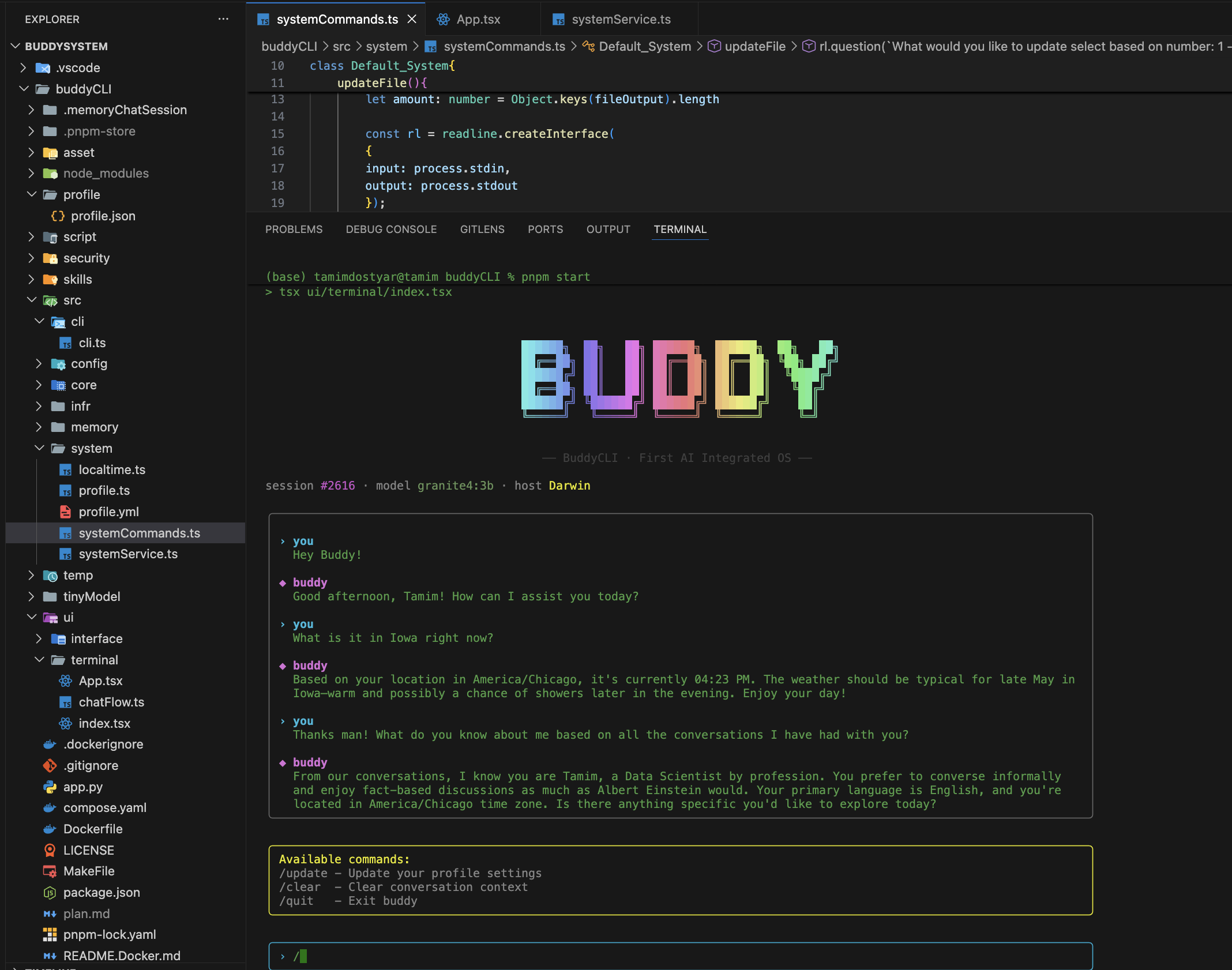
Here is how you can get all the command lines with /.
I am currently building an OS that I eventually plan to connect with this software. Check out my OS repository here.
Goals
- Replace Ollama with buddyGPT as the AI backend — no external runtime, no cloud dependency, no model that someone else owns
- Migrate from a TypeScript/Node.js CLI running on macOS to a native process running inside buddyOS
- Evolve into BuddyShell — the AI-native shell where typing a command and talking to the AI are the same action
- Use the
.memoryChatSession/history as training data so the model learns each user's habits over time - Eventually have no separation between "terminal" and "AI assistant" — one prompt, one interface, one language
Architecture
How input travels through buddyCLI today, and how it will travel through BuddyShell.
  TODAY                                   FUTURE (BuddyShell inside buddyOS)
  ─────────────────────────────────       ────────────────────────────────────────

  $ pnpm start                            buddy> _
  buddy> what time is it                  buddy> open the file I was editing
                                                 about the networking bug
      │                                       │
      ▼                                       │  sys_ask()  (natural-language syscall)
  ui/terminal (Ink)                           ▼
      │                               buddyGPT  (kai/ kernel subsystem)
      │                                       │
      ▼                                       │  reads live kernel state:
  systemService                               │  · semantic FS index
  .ollamaIntelligence()                       │  · process table
      │                                       │  · recent file access log
      │  HTTP  →  Ollama                      │
      ▼                                       ▼ decides:
  downloaded model                    ┌───────────────────────┐
  responds                            │  command?             │──► exec syscall
                                      │  natural language?    │──► text answer at buddy>
      │                               │  need the internet?   │──► fetch online, run it
      ▼                               └───────────────────────┘
  console.log(chat)
  shown in terminal                   shown at  buddy>  with full kernel context


  Session saved to:  .memoryChatSession/   ←── becomes training data for buddyGPT
REPOSITORIES:
Contributors

76 commits
Similar repos


Languages
TypeScript
71.6%
Shell
11.5%
PowerShell
11.5%
Python
2.7%
Dockerfile
2.7%
README
Buddy
Small CLI-oriented helper for everyday tasks. Keep it simple: you talk to Buddy from the terminal; skills handle focused jobs like time and notes.
Why TypeScript?
Buddy is written in TypeScript because it gives static types and fast editor feedback across a growing CLI, config, and service surface, which catches integration mistakes early and makes refactors safer. The same language and tooling cover scripts and Node-style async I/O, so HTTP, subprocesses, and file work stay straightforward, and npm’s ecosystem stays available for whatever Buddy needs to talk to. It is not the tool for kernel-level or hard real-time work, but for a terminal-first helper that orchestrates everyday tasks, TypeScript is a practical balance of safety, speed of change, and library support.
Run (placeholder)
pnpm start— launches the Ink terminal UI atui/terminal/index.tsx.pnpm dev— same, with file-watch reload.
Repo layout (high level)
src/— backend/infrastructure only: config, memory, system service, profile schema, infra adapters. No UI code.skills/— one folder per skill; each skill has a short.mddescribing what it will do.ui/— all user-facing code: Ink/React terminal UI and the hooks that adaptsrc/logic for it. Any future interface (web, GUI) goes here too.security/— notes on system security and threading/concurrency expectations.
Example
This screenshot shows Buddy running in the terminal:
Here is how you can get all the command lines with /.
I am currently building an OS that I eventually plan to connect with this software. Check out my OS repository here.
Goals
- Replace Ollama with buddyGPT as the AI backend — no external runtime, no cloud dependency, no model that someone else owns
- Migrate from a TypeScript/Node.js CLI running on macOS to a native process running inside buddyOS
- Evolve into BuddyShell — the AI-native shell where typing a command and talking to the AI are the same action
- Use the
.memoryChatSession/history as training data so the model learns each user's habits over time - Eventually have no separation between "terminal" and "AI assistant" — one prompt, one interface, one language
Architecture
How input travels through buddyCLI today, and how it will travel through BuddyShell.
  TODAY                                   FUTURE (BuddyShell inside buddyOS)
  ─────────────────────────────────       ────────────────────────────────────────

  $ pnpm start                            buddy> _
  buddy> what time is it                  buddy> open the file I was editing
                                                 about the networking bug
      │                                       │
      ▼                                       │  sys_ask()  (natural-language syscall)
  ui/terminal (Ink)                           ▼
      │                               buddyGPT  (kai/ kernel subsystem)
      │                                       │
      ▼                                       │  reads live kernel state:
  systemService                               │  · semantic FS index
  .ollamaIntelligence()                       │  · process table
      │                                       │  · recent file access log
      │  HTTP  →  Ollama                      │
      ▼                                       ▼ decides:
  downloaded model                    ┌───────────────────────┐
  responds                            │  command?             │──► exec syscall
                                      │  natural language?    │──► text answer at buddy>
      │                               │  need the internet?   │──► fetch online, run it
      ▼                               └───────────────────────┘
  console.log(chat)
  shown in terminal                   shown at  buddy>  with full kernel context


  Session saved to:  .memoryChatSession/   ←── becomes training data for buddyGPT
REPOSITORIES:
Similar repos
Contributors
76 commits
Languages
TypeScript
71.6%
Shell
11.5%
PowerShell
11.5%
Python
2.7%
Dockerfile
2.7%