From a universe of models to Collective Model Intelligence.
See the code
Toward Collective Model Intelligence: Characterizing and Coordinating Models
Tech Report · Results · Try Mio · Open-Source Dataset · 中文
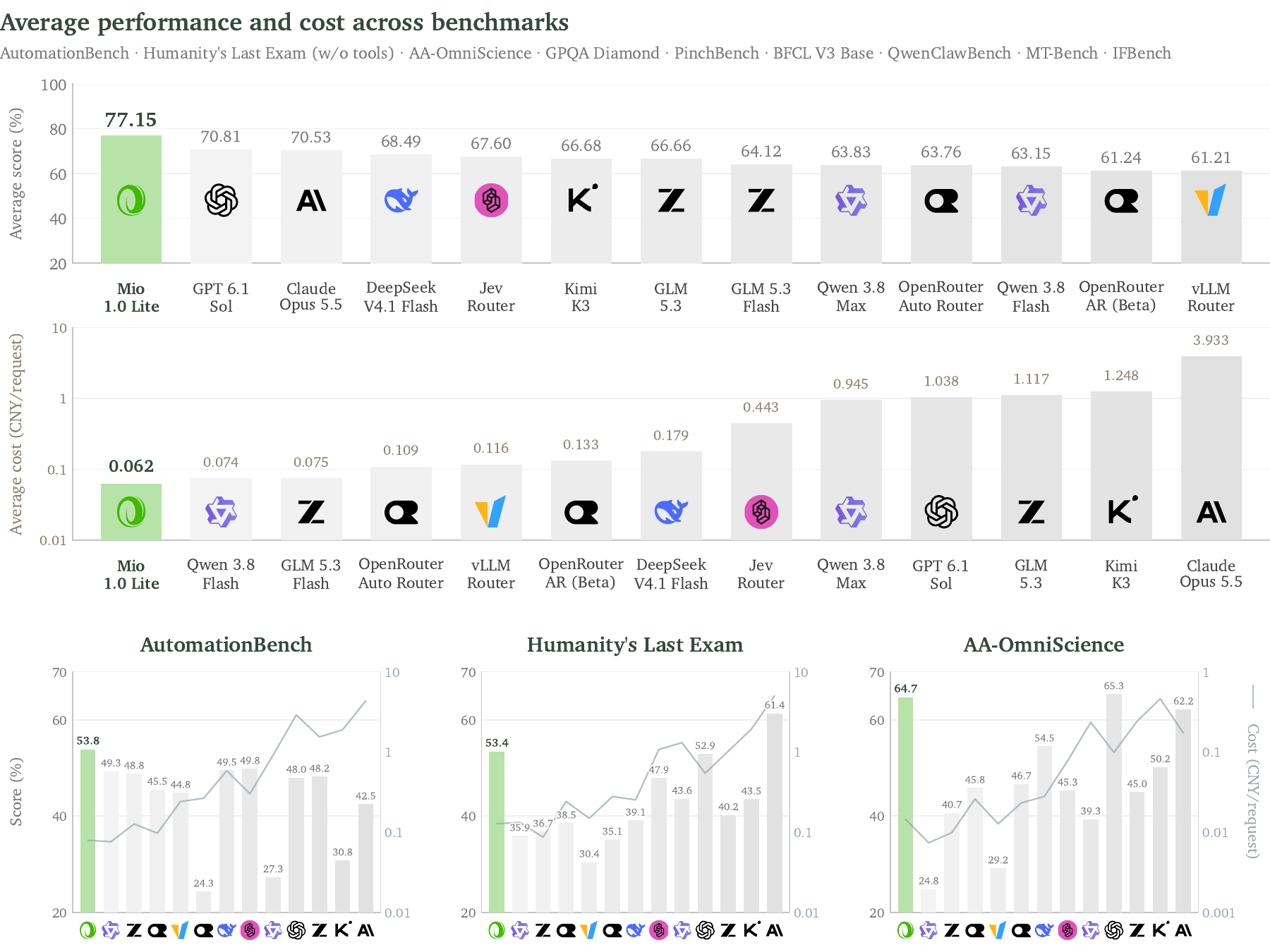
Across nine public benchmarks, Mio achieves 77.15/100 mean score at 0.0621 CNY/request: the highest mean score and lowest mean cost among 13 compared methods. Benchmarks are weighted equally; these are the report's offline evaluation results.
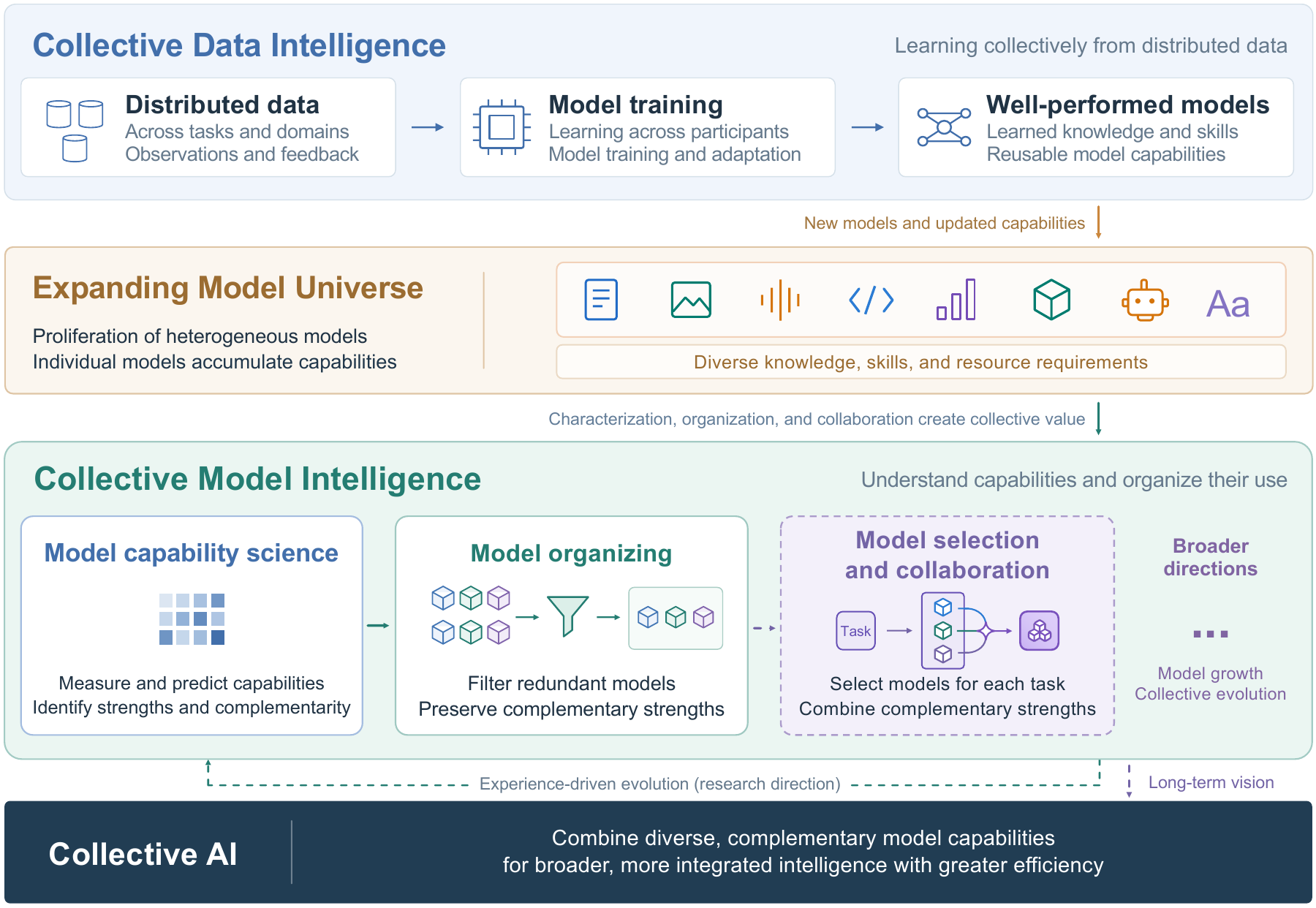
Collective Model Intelligence aims to improve task outcomes and resource efficiency by understanding, reusing, and coordinating capabilities across an evolving population of independently developed models. The key is complementarity: a specialist can supply a missing capability, and different models can contribute at different stages as task needs and remaining cost and latency budgets change.
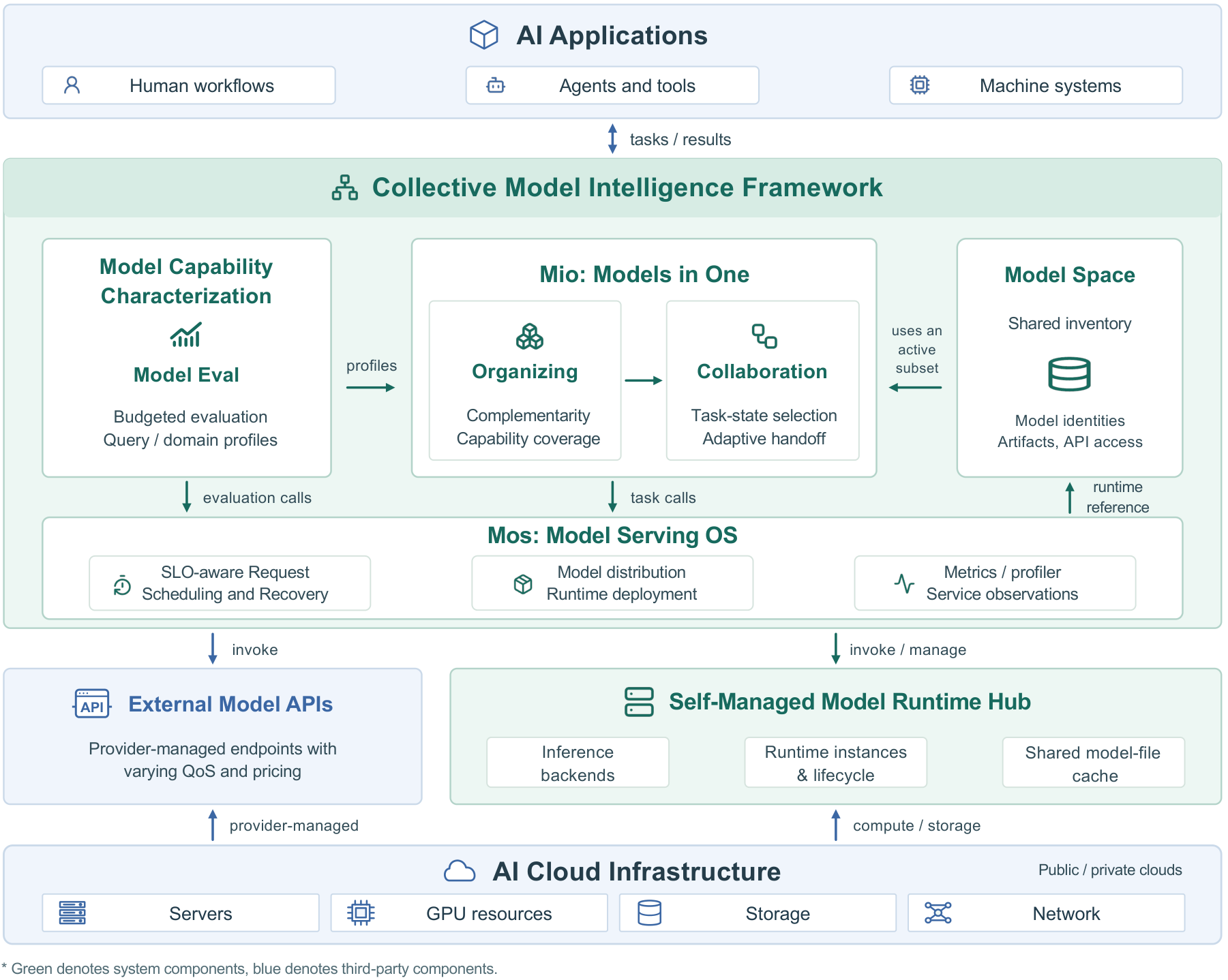
Model Space provides shared model identities and resource references, linking capability evidence, candidate pools, and execution.
RobustRouteBench contains 35,278 instances across General Text (63 candidate models), Multimodal (45), and Chinese (10). Final report scoring retains 18,982 requests after excluding development source groups and linked variants.
Use Python 3.10+. The examples need no model API key.
git clone https://github.com/SinapisAI/collective-model-intelligence.git
cd collective-model-intelligence
python -m venv .venv
source .venv/bin/activate
python -m pip install -e '.[data,orbit]'
python examples/quickstart.py --scenario text  # train and evaluate on validation
Other scenarios: --scenario multimodal or --scenario chinese.
Replay the 65 prediction runs across 13 methods with the report's split exclusions and nominal-budget nAUC:
python -m examples.reproduce_report --mode replay --output runs/report-replay
Dataset and protocol · Reproduction guide · Comparison methods
@techreport{sinapisai2026collectivemodelintelligence,
  title       = {Toward Collective Model Intelligence:
                 Characterizing and Coordinating Models},
  author      = {{SinapisAI Team}},
  institution = {SinapisAI},
  year        = {2026},
  url         = {https://github.com/SinapisAI/collective-model-intelligence}
}
Citation metadata: CITATION.cff. Code uses Apache-2.0, with MIT-licensed ORBIT components. The dataset follows its upstream terms; report materials and embedded logos retain their attribution.
From a universe of models to Collective Model Intelligence.
See the code
Toward Collective Model Intelligence: Characterizing and Coordinating Models
Tech Report · Results · Try Mio · Open-Source Dataset · 中文
Across nine public benchmarks, Mio achieves 77.15/100 mean score at 0.0621 CNY/request: the highest mean score and lowest mean cost among 13 compared methods. Benchmarks are weighted equally; these are the report's offline evaluation results.
Collective Model Intelligence aims to improve task outcomes and resource efficiency by understanding, reusing, and coordinating capabilities across an evolving population of independently developed models. The key is complementarity: a specialist can supply a missing capability, and different models can contribute at different stages as task needs and remaining cost and latency budgets change.
Model Space provides shared model identities and resource references, linking capability evidence, candidate pools, and execution.
RobustRouteBench contains 35,278 instances across General Text (63 candidate models), Multimodal (45), and Chinese (10). Final report scoring retains 18,982 requests after excluding development source groups and linked variants.
Use Python 3.10+. The examples need no model API key.
git clone https://github.com/SinapisAI/collective-model-intelligence.git
cd collective-model-intelligence
python -m venv .venv
source .venv/bin/activate
python -m pip install -e '.[data,orbit]'
python examples/quickstart.py --scenario text  # train and evaluate on validation
Other scenarios: --scenario multimodal or --scenario chinese.
Replay the 65 prediction runs across 13 methods with the report's split exclusions and nominal-budget nAUC:
python -m examples.reproduce_report --mode replay --output runs/report-replay
Dataset and protocol · Reproduction guide · Comparison methods
@techreport{sinapisai2026collectivemodelintelligence,
  title       = {Toward Collective Model Intelligence:
                 Characterizing and Coordinating Models},
  author      = {{SinapisAI Team}},
  institution = {SinapisAI},
  year        = {2026},
  url         = {https://github.com/SinapisAI/collective-model-intelligence}
}
Citation metadata: CITATION.cff. Code uses Apache-2.0, with MIT-licensed ORBIT components. The dataset follows its upstream terms; report materials and embedded logos retain their attribution.



