
README
Packwerk 
"I know who you are and because of that I know what you do." This knowledge is a dependency that raises the cost of change.
-- Sandi Metz, Practical Object-Oriented Design in Ruby
Packwerk is a Ruby gem used to enforce boundaries and modularize Rails applications.
Packwerk can be used to:
- Combine groups of files into packages
- Define package-level constant visibility (i.e. have publicly accessible constants)
- Help existing codebases to become more modular without obstructing development
Prerequisites
Packwerk needs Zeitwerk enabled, which comes with Rails 6.
Packwerk supports MRI versions 2.7 and above.
Demo
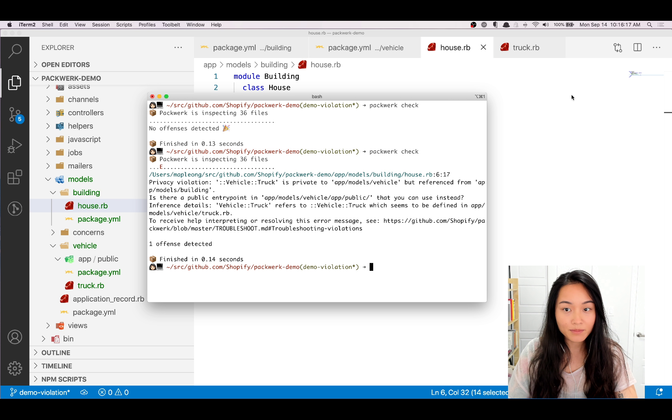
Watch a 1-minute video demo on how Packwerk works.
Installation
- Add this line to your application's Gemfile:
gem 'packwerk'
- Install the gem
Execute:
$ bundle install
Or install it yourself as:
$ gem install packwerk
2. Run bundle binstub packwerk to generate the binstub
3. Run bin/packwerk init to generate the configuration files
Usage
Read USAGE.md for usage once Packwerk is installed on your project.
Pronunciation
"Packwerk" is pronounced [ˈpakvɛʁk].
Ecosystem
Various third parties have built tooling on top of packwerk. Here's a selection of some that might prove useful:
- https://github.com/bellroy/graphwerk draws a graph of your package dependencies
- https://github.com/rubyatscale/packwerk-vscode integrates packwerk into Visual Studio Code so you can see violations right in your editor
- https://github.com/vinted/packwerk-intellij integrates packwerk into RubyMine so you can see violations right in your editor
- https://github.com/rubyatscale/packs-rails sets up Rails autoloading, as well as
rspecandFactoryBotintegration, for packages arranged in a flat list. packs-rails is quite convenient, but for autoloading we recommend to useRails::Engines instead. - https://github.com/rubyatscale/danger-packwerk integrates packwerk with danger.systems to provide packwerk feedback as Github inline PR comments
- https://github.com/rubyatscale/packwerk-extensions contains extensions for packwerk, including a checker for packwerk that allows you to enforce public API boundaries. This was originally extracted from
packwerkitself. - https://github.com/alexevanczuk/packs is a Rust implementation of packwerk that has experimental support for non-Rails, non-Zeitwerk applications.
Development
After checking out the repo, run bin/setup to install dependencies. Then, run rake test to run the tests. You can also run bin/console for an interactive prompt that will allow you to experiment.
Limitations
With Ruby being a very dynamic language, static analysis tools such as Packwerk are bound to have limitations. To reduce the impact of those limitations, Packwerk is designed to avoid false positives (reporting references as violations that are actually fine) at any cost, and we pay the cost by accepting a small number of false negatives (failing to report actual violations).
- Packwerk can only resolve references to constants that are defined in code loaded by the application's Zeitwerk autoloader.
This is because we rely on Zeitwerk's conventions, and code that is loaded differently (like through an explicit
require) often doesn't follow these conventions. - Method calls and objects passed around the application are completely ignored. Packwerk only cares about static constant references. That said, if you want Packwerk to analyze parameters of a method, you can use Sorbet to define a type signature. Sorbet signatures are pure Ruby code and use constants to express types, and Packwerk understands that.
- Support for custom Zeitwerk configuration is limited. If custom ActiveSupport inflections are used, Packwerk will understand that and everything is fine. However, if Zeitwerk is directly configured with custom Zeitwerk inflections or to collapse directories, Packwerk will get confused and produce false positives.
Contributing
Bug reports and pull requests are welcome on GitHub at https://github.com/Shopify/packwerk.
Read and follow the guidelines in CONTRIBUTING.md.
License
The gem is available as open source under the terms of the MIT License.
Significant stargazers
(top 24 of 38)

416 followers · starred May 2021

530 followers · starred Apr 2026

148 followers · starred Sep 2020

306 followers · starred Dec 2020
Similar repos


Languages
Ruby
98.4%
Shell
1.3%
README
Packwerk
"I know who you are and because of that I know what you do." This knowledge is a dependency that raises the cost of change.
-- Sandi Metz, Practical Object-Oriented Design in Ruby
Packwerk is a Ruby gem used to enforce boundaries and modularize Rails applications.
Packwerk can be used to:
- Combine groups of files into packages
- Define package-level constant visibility (i.e. have publicly accessible constants)
- Help existing codebases to become more modular without obstructing development
Prerequisites
Packwerk needs Zeitwerk enabled, which comes with Rails 6.
Packwerk supports MRI versions 2.7 and above.
Demo
Watch a 1-minute video demo on how Packwerk works.
Installation
- Add this line to your application's Gemfile:
gem 'packwerk'
- Install the gem
Execute:
$ bundle install
Or install it yourself as:
$ gem install packwerk
2. Run bundle binstub packwerk to generate the binstub
3. Run bin/packwerk init to generate the configuration files
Usage
Read USAGE.md for usage once Packwerk is installed on your project.
Pronunciation
"Packwerk" is pronounced [ˈpakvɛʁk].
Ecosystem
Various third parties have built tooling on top of packwerk. Here's a selection of some that might prove useful:
- https://github.com/bellroy/graphwerk draws a graph of your package dependencies
- https://github.com/rubyatscale/packwerk-vscode integrates packwerk into Visual Studio Code so you can see violations right in your editor
- https://github.com/vinted/packwerk-intellij integrates packwerk into RubyMine so you can see violations right in your editor
- https://github.com/rubyatscale/packs-rails sets up Rails autoloading, as well as
rspecandFactoryBotintegration, for packages arranged in a flat list. packs-rails is quite convenient, but for autoloading we recommend to useRails::Engines instead. - https://github.com/rubyatscale/danger-packwerk integrates packwerk with danger.systems to provide packwerk feedback as Github inline PR comments
- https://github.com/rubyatscale/packwerk-extensions contains extensions for packwerk, including a checker for packwerk that allows you to enforce public API boundaries. This was originally extracted from
packwerkitself. - https://github.com/alexevanczuk/packs is a Rust implementation of packwerk that has experimental support for non-Rails, non-Zeitwerk applications.
Development
After checking out the repo, run bin/setup to install dependencies. Then, run rake test to run the tests. You can also run bin/console for an interactive prompt that will allow you to experiment.
Limitations
With Ruby being a very dynamic language, static analysis tools such as Packwerk are bound to have limitations. To reduce the impact of those limitations, Packwerk is designed to avoid false positives (reporting references as violations that are actually fine) at any cost, and we pay the cost by accepting a small number of false negatives (failing to report actual violations).
- Packwerk can only resolve references to constants that are defined in code loaded by the application's Zeitwerk autoloader.
This is because we rely on Zeitwerk's conventions, and code that is loaded differently (like through an explicit
require) often doesn't follow these conventions. - Method calls and objects passed around the application are completely ignored. Packwerk only cares about static constant references. That said, if you want Packwerk to analyze parameters of a method, you can use Sorbet to define a type signature. Sorbet signatures are pure Ruby code and use constants to express types, and Packwerk understands that.
- Support for custom Zeitwerk configuration is limited. If custom ActiveSupport inflections are used, Packwerk will understand that and everything is fine. However, if Zeitwerk is directly configured with custom Zeitwerk inflections or to collapse directories, Packwerk will get confused and produce false positives.
Contributing
Bug reports and pull requests are welcome on GitHub at https://github.com/Shopify/packwerk.
Read and follow the guidelines in CONTRIBUTING.md.
License
The gem is available as open source under the terms of the MIT License.
Similar repos
Significant stargazers
(top 24 of 38)
416 followers · starred May 2021
530 followers · starred Apr 2026
148 followers · starred Sep 2020
306 followers · starred Dec 2020
Languages
Ruby
98.4%
Shell
1.3%