
The open-source code for the NeurIPS 2025 paper, "Beyond the 80/20 Rule: High-Entropy Minority Tokens Drive Effective Reinforcement Learning for LLM Reasoning."
See the codeREADME
Beyond the 80/20 Rule: High-Entropy Minority Tokens Drive Effective Reinforcement Learning for LLM Reasoning



👋 Hi, everyone!
Welcome to the open-source code for the NeurIPS 2025 paper, "Beyond the 80/20 Rule: High-Entropy Minority Tokens Drive Effective Reinforcement Learning for LLM Reasoning." Thank you for your interest!
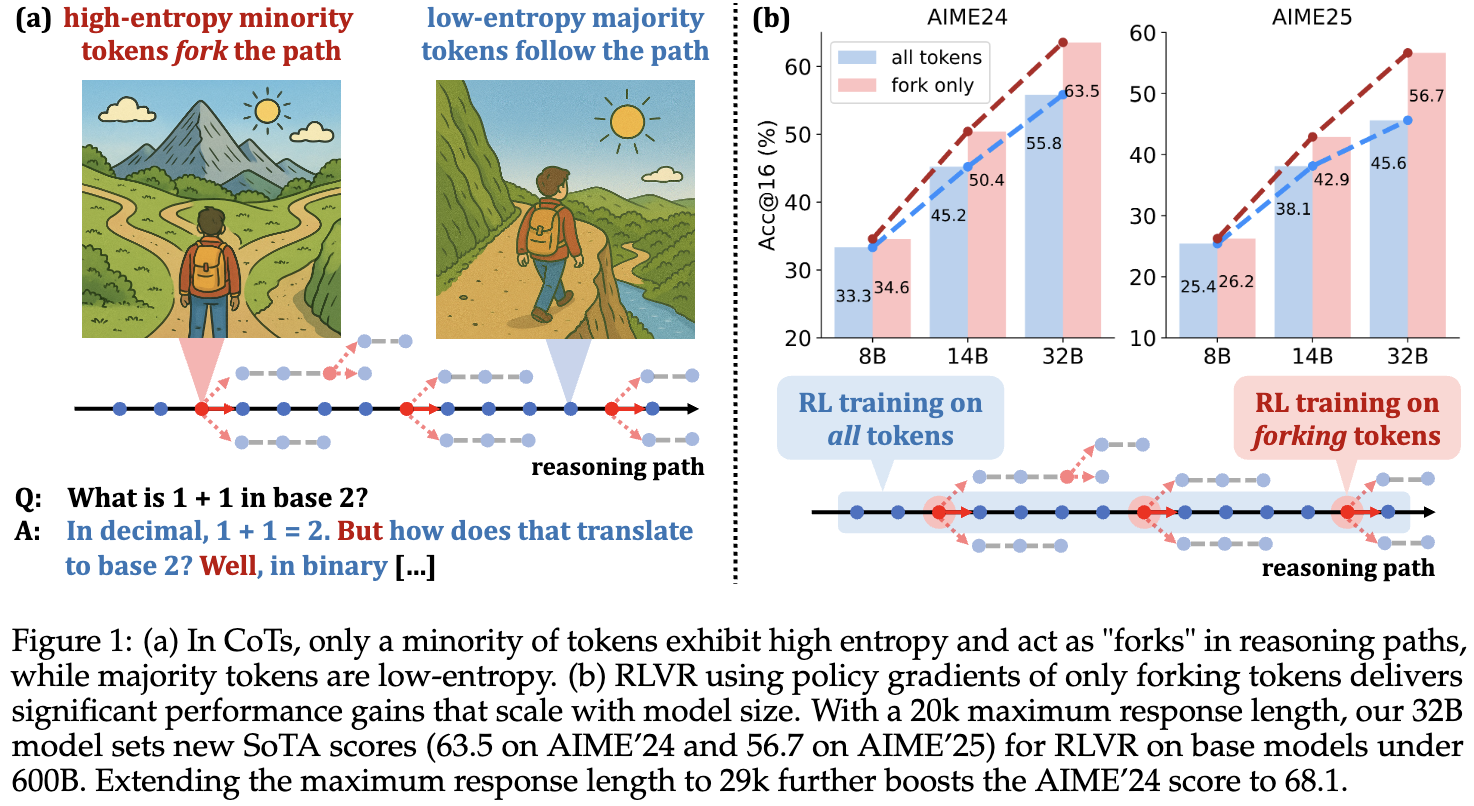
Installation
Our code is based on verl (commit id 6cf90ceb079bdc0721b51c23e0107410651ccd82).
We recommend using this Docker image, with the following command:
docker pull hiyouga/verl:ngc-th2.7.1-cu12.6-vllm0.10.0
Alternatively, you can refer to the verl documentation for instructions on installing the environment. We recommend aligning the installed environment with the Docker image mentioned above.
[!IMPORTANT]
CRITICAL UPDATE: Please ensure you are using the latest version of the code.
A bug was introduced during the process of converting the repository to open source, which has now been fixed in this commit.
You must use code from commit
137d8d1e253c355d4cf86b8bb2dded5aa0d93580or later for correct results.(Note: The code used to generate the results presented in our paper and on WandB was unaffected.)
Dataset Preparation
For the training dataset, we recommend using the math dataset from the Reasoning360 paper, as it is more comprehensive than the DAPO-Math-17k dataset used in our paper.
For evaluation, we use the AIME24 and MATH500 benchmarks, duplicating the AIME split so that the AIME24 score reflects avg@32.
The helper script recipe/rlvr_with_high_entropy_tokens_only/prepare_train_test_datasets.sh downloads the recommended training split, fetches the validation sets, filters the test datasets to keep only the required keys (data_source, prompt, reward_model, extra_info) using recipe/rlvr_with_high_entropy_tokens_only/filter_test_dataset_keys.py, and invokes recipe/rlvr_with_high_entropy_tokens_only/duplicate_aime.sh to materialize data/math__aime_repeated_32x_960.parquet. Both data/math__aime_repeated_32x_960.parquet and data/math__math_500.parquet are then referenced by the run scripts through data.val_files.
Model Preparation
For the base model, we recommend using Qwen3-14B-Base. According to our paper, RLVR with the top 20% of high-entropy tokens results in a significant performance improvement when scaling the model to 14B or larger. You can download the Qwen3-14B-Base model to the path ${VERL_HOME}/models/Qwen3-14B-Base/ .
[!NOTE]
We currently only support the FSDP backend for RLVR with high-entropy tokens. The Megatron backend is not yet supported or verified.
How to Run
For the DAPO baseline on Qwen3-14B-Base, please refer to the script recipe/rlvr_with_high_entropy_tokens_only/run_dapo_qwen3_14b.sh.
For our proposed method, i.e. DAPO with the top 20% high-entropy tokens, on Qwen3-14B-Base, please refer to the script recipe/rlvr_with_high_entropy_tokens_only/run_only_top20_high_entropy_tokens_dapo_qwen3_14b.sh.
The training record of Qwen3-14B-Base is published in W&B.
Citation
If you find our work useful, we would appreciate it if you could cite it:
@inproceedings{
  wang2025beyond,
  title={Beyond the 80/20 Rule: High-Entropy Minority Tokens Drive Effective Reinforcement Learning for {LLM} Reasoning},
  author={Shenzhi Wang and Le Yu and Chang Gao and Chujie Zheng and Shixuan Liu and Rui Lu and Kai Dang and Xiong-Hui Chen and Jianxin Yang and Zhenru Zhang and Yuqiong Liu and An Yang and Andrew Zhao and Yang Yue and Shiji Song and Bowen Yu and Gao Huang and Junyang Lin},
  booktitle={The Thirty-ninth Annual Conference on Neural Information Processing Systems},
  year={2025},
  url={https://openreview.net/forum?id=yfcpdY4gMP}
}
Acknowledgement
We greatly appreciate Xiangxin Zhou's efforts in reproducing our paper on the public verl codebase.
We also sincerely appreciate the work that our research builds upon, especially verl for their codebase, DAPO for their algorithm and datasets, and Reasoning360 for their datasets.
Contributors
(top 30 of 366)



Similar repos




Languages
Python
90.8%
Shell
8.7%
The open-source code for the NeurIPS 2025 paper, "Beyond the 80/20 Rule: High-Entropy Minority Tokens Drive Effective Reinforcement Learning for LLM Reasoning."
See the codeREADME
Beyond the 80/20 Rule: High-Entropy Minority Tokens Drive Effective Reinforcement Learning for LLM Reasoning
👋 Hi, everyone!
Welcome to the open-source code for the NeurIPS 2025 paper, "Beyond the 80/20 Rule: High-Entropy Minority Tokens Drive Effective Reinforcement Learning for LLM Reasoning." Thank you for your interest!
Installation
Our code is based on verl (commit id 6cf90ceb079bdc0721b51c23e0107410651ccd82).
We recommend using this Docker image, with the following command:
docker pull hiyouga/verl:ngc-th2.7.1-cu12.6-vllm0.10.0
Alternatively, you can refer to the verl documentation for instructions on installing the environment. We recommend aligning the installed environment with the Docker image mentioned above.
[!IMPORTANT]
CRITICAL UPDATE: Please ensure you are using the latest version of the code.
A bug was introduced during the process of converting the repository to open source, which has now been fixed in this commit.
You must use code from commit
137d8d1e253c355d4cf86b8bb2dded5aa0d93580or later for correct results.(Note: The code used to generate the results presented in our paper and on WandB was unaffected.)
Dataset Preparation
For the training dataset, we recommend using the math dataset from the Reasoning360 paper, as it is more comprehensive than the DAPO-Math-17k dataset used in our paper.
For evaluation, we use the AIME24 and MATH500 benchmarks, duplicating the AIME split so that the AIME24 score reflects avg@32.
The helper script recipe/rlvr_with_high_entropy_tokens_only/prepare_train_test_datasets.sh downloads the recommended training split, fetches the validation sets, filters the test datasets to keep only the required keys (data_source, prompt, reward_model, extra_info) using recipe/rlvr_with_high_entropy_tokens_only/filter_test_dataset_keys.py, and invokes recipe/rlvr_with_high_entropy_tokens_only/duplicate_aime.sh to materialize data/math__aime_repeated_32x_960.parquet. Both data/math__aime_repeated_32x_960.parquet and data/math__math_500.parquet are then referenced by the run scripts through data.val_files.
Model Preparation
For the base model, we recommend using Qwen3-14B-Base. According to our paper, RLVR with the top 20% of high-entropy tokens results in a significant performance improvement when scaling the model to 14B or larger. You can download the Qwen3-14B-Base model to the path ${VERL_HOME}/models/Qwen3-14B-Base/ .
[!NOTE]
We currently only support the FSDP backend for RLVR with high-entropy tokens. The Megatron backend is not yet supported or verified.
How to Run
For the DAPO baseline on Qwen3-14B-Base, please refer to the script recipe/rlvr_with_high_entropy_tokens_only/run_dapo_qwen3_14b.sh.
For our proposed method, i.e. DAPO with the top 20% high-entropy tokens, on Qwen3-14B-Base, please refer to the script recipe/rlvr_with_high_entropy_tokens_only/run_only_top20_high_entropy_tokens_dapo_qwen3_14b.sh.
The training record of Qwen3-14B-Base is published in W&B.
Citation
If you find our work useful, we would appreciate it if you could cite it:
@inproceedings{
  wang2025beyond,
  title={Beyond the 80/20 Rule: High-Entropy Minority Tokens Drive Effective Reinforcement Learning for {LLM} Reasoning},
  author={Shenzhi Wang and Le Yu and Chang Gao and Chujie Zheng and Shixuan Liu and Rui Lu and Kai Dang and Xiong-Hui Chen and Jianxin Yang and Zhenru Zhang and Yuqiong Liu and An Yang and Andrew Zhao and Yang Yue and Shiji Song and Bowen Yu and Gao Huang and Junyang Lin},
  booktitle={The Thirty-ninth Annual Conference on Neural Information Processing Systems},
  year={2025},
  url={https://openreview.net/forum?id=yfcpdY4gMP}
}
Acknowledgement
We greatly appreciate Xiangxin Zhou's efforts in reproducing our paper on the public verl codebase.
We also sincerely appreciate the work that our research builds upon, especially verl for their codebase, DAPO for their algorithm and datasets, and Reasoning360 for their datasets.
Similar repos
Contributors
(top 30 of 366)
Languages
Python
90.8%
Shell
8.7%