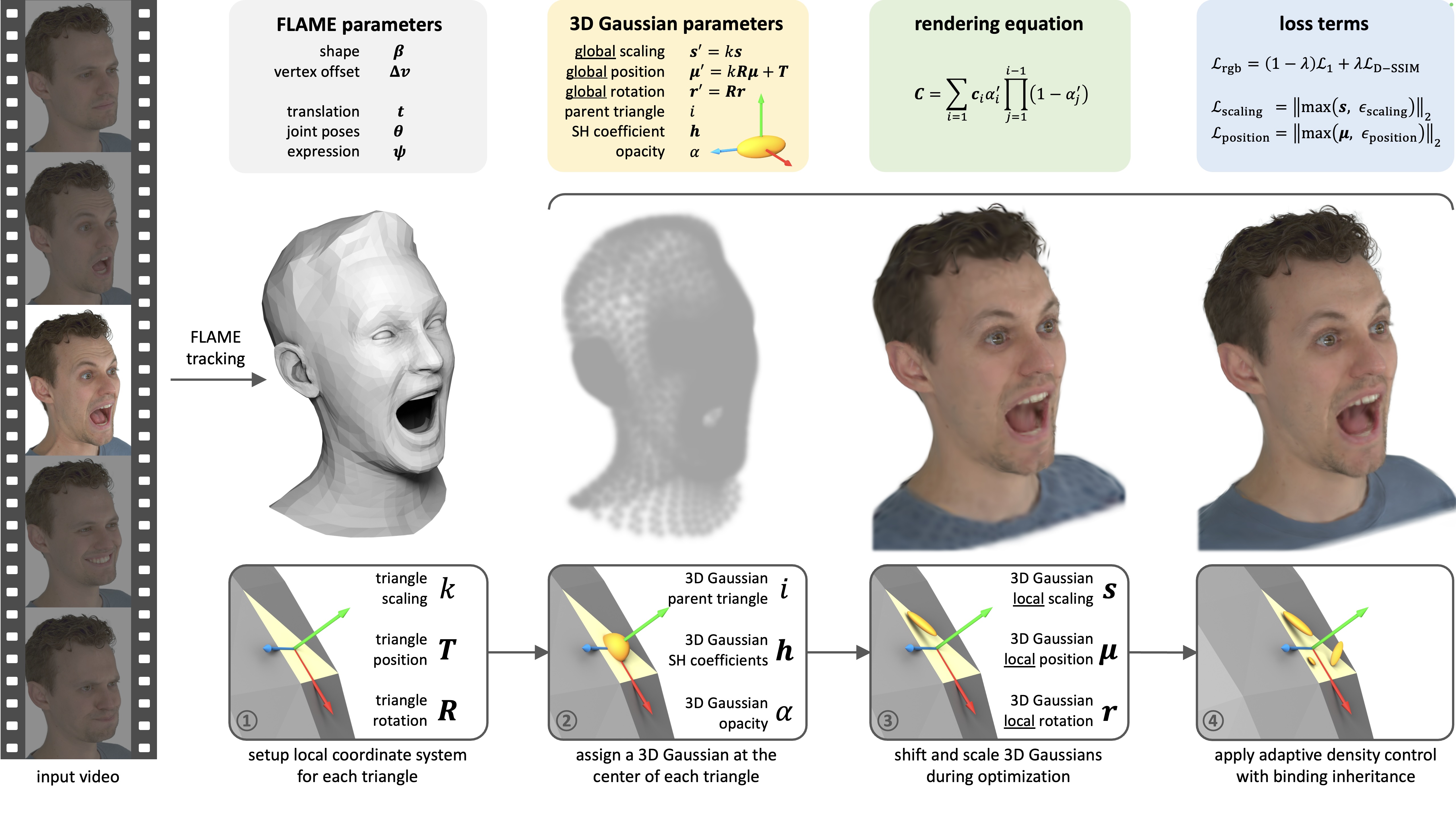
[CVPR 2024 Highlight] The official repo for "GaussianAvatars: Photorealistic Head Avatars with Rigged 3D Gaussians"
See the codeThis work is made available under CC-BY-NC-SA-4.0 and is subject to the following statement:
Toyota Motor Europe NV/SA and its affiliated companies retain all intellectual property and proprietary rights in and to this software and related documentation. Any commercial use, reproduction, disclosure or distribution of this software and related documentation without an express license agreement from Toyota Motor Europe NV/SA is strictly prohibited.
This project uses Gaussian Splatting, which carries its original license. The GUI is inspired by INSTA. The mesh rendering operations are adapted from NVDiffRec and NVDiffRast.
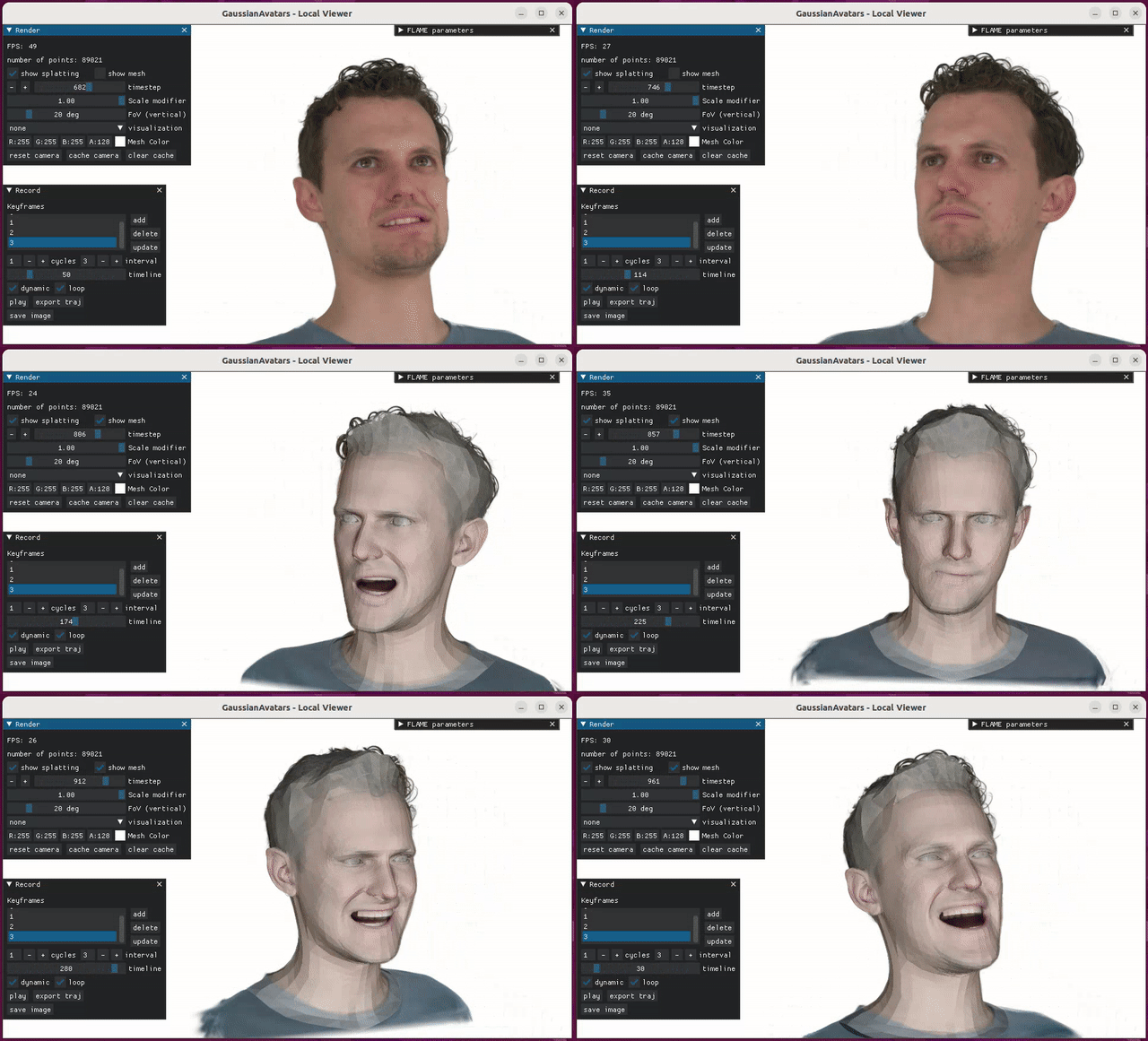
You can play with a trained GaussianAvatar without downloading the dataset:
python local_viewer.py --point_path media/306/point_cloud.ply
SUBJECT=306

python train.py \
-s data/UNION10_${SUBJECT}_EMO1234EXP234589_v16_DS2-0.5x_lmkSTAR_teethV3_SMOOTH_offsetS_whiteBg_maskBelowLine \
-m output/UNION10EMOEXP_${SUBJECT}_eval_600k \
--eval --bind_to_mesh --white_background --port 60000
--source_path / -s
Path to the source directory containing a COLMAP or Synthetic NeRF data set.
--model_path / -m
Path where the trained model should be stored (output/<random> by default).
--eval
Add this flag to use a training/val/test split for evaluation. Otherwise, all images are used for training.
--bind_to_mesh
Add this flag to bind 3D Gaussians to a driving mesh, e.g., FLAME.
--resolution / -r
Specifies resolution of the loaded images before training. If provided 1, 2, 4 or 8, uses original, 1/2, 1/4 or 1/8 resolution, respectively. For all other values, rescales the width to the given number while maintaining image aspect. If not set and input image width exceeds 1.6K pixels, inputs are automatically rescaled to this target.
--white_background / -w
Add this flag to use white background instead of black (default), e.g., for evaluation of NeRF Synthetic dataset.
--sh_degree
Order of spherical harmonics to be used (no larger than 3). 3 by default.
--iterations
Number of total iterations to train for, 30_000 by default.
--port
Port to use for GUI server, 60000 by default.
[!NOTE] During training, a complete evaluation are conducted on both the validation set (novel-view synthesis) and test set (self-reenactment) every
--intervaliterations. You can check the metrics in the commandline or Tensorboard. The metrics are computed on all images, although we only save partial images in Tensorboard.
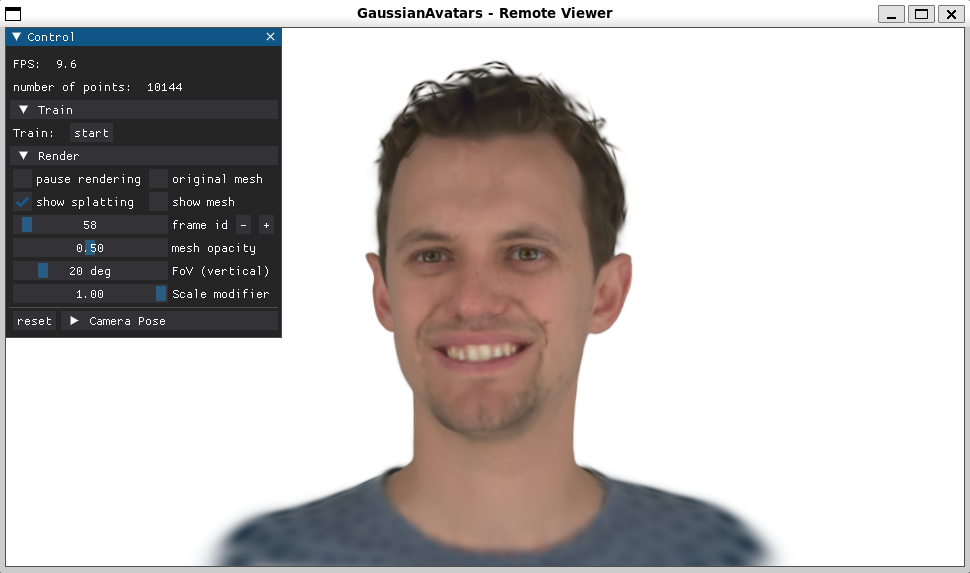
During training, one can monitor the training progress with the remote viewer
python remote_viewer.py --port 60000
[!NOTE]
The remote viewer can slow down training a lot. You may want to close it or check "pause rendering" when not viewing.
The viewer could get frozen and disconnected the first time you enable "show mesh". You can try switching it on and off or simply wait for a few seconds.
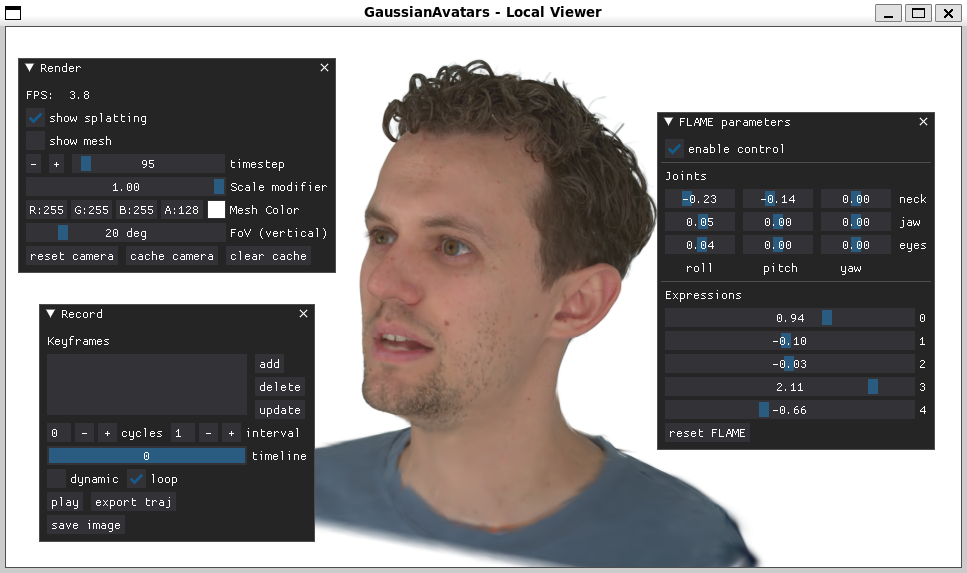
After training, one can load and render the optimized 3D Gaussians with the local viewer
SUBJECT=306
ITER=300000

python local_viewer.py \
--point_path output/UNION10EMOEXP_${SUBJECT}_eval_600k/point_cloud/iteration_${ITER}/point_cloud.ply
--point_path
Path to the gaussian splatting file (ply)
--motion_path
Path to the motion file (npz). You only need this if you want to load a different motion sequence than the original one for training.
[!WARNING] The viewer is implemented in Python, making development convenient but not ideal for performance benchmarking. As such, please avoid using the viewer to measure the rendering frame rate of our method. Instead, use the FPS benchmark script for accurate performance evaluation.
If you find our paper or code useful in your research, please cite with the following BibTeX entry:
@inproceedings{qian2024gaussianavatars,
  title={Gaussianavatars: Photorealistic head avatars with rigged 3d gaussians},
  author={Qian, Shenhan and Kirschstein, Tobias and Schoneveld, Liam and Davoli, Davide and Giebenhain, Simon and Nie{\ss}ner, Matthias},
  booktitle={Proceedings of the IEEE/CVF Conference on Computer Vision and Pattern Recognition},
  pages={20299--20309},
  year={2024}
}
400 followers · starred Mar 2024
6,520 followers · starred Dec 2024
231 followers · starred Feb 2024
260 followers · starred Nov 2024
[CVPR 2024 Highlight] The official repo for "GaussianAvatars: Photorealistic Head Avatars with Rigged 3D Gaussians"
See the codeThis work is made available under CC-BY-NC-SA-4.0 and is subject to the following statement:
Toyota Motor Europe NV/SA and its affiliated companies retain all intellectual property and proprietary rights in and to this software and related documentation. Any commercial use, reproduction, disclosure or distribution of this software and related documentation without an express license agreement from Toyota Motor Europe NV/SA is strictly prohibited.
This project uses Gaussian Splatting, which carries its original license. The GUI is inspired by INSTA. The mesh rendering operations are adapted from NVDiffRec and NVDiffRast.
You can play with a trained GaussianAvatar without downloading the dataset:
python local_viewer.py --point_path media/306/point_cloud.ply
SUBJECT=306

python train.py \
-s data/UNION10_${SUBJECT}_EMO1234EXP234589_v16_DS2-0.5x_lmkSTAR_teethV3_SMOOTH_offsetS_whiteBg_maskBelowLine \
-m output/UNION10EMOEXP_${SUBJECT}_eval_600k \
--eval --bind_to_mesh --white_background --port 60000
--source_path / -s
Path to the source directory containing a COLMAP or Synthetic NeRF data set.
--model_path / -m
Path where the trained model should be stored (output/<random> by default).
--eval
Add this flag to use a training/val/test split for evaluation. Otherwise, all images are used for training.
--bind_to_mesh
Add this flag to bind 3D Gaussians to a driving mesh, e.g., FLAME.
--resolution / -r
Specifies resolution of the loaded images before training. If provided 1, 2, 4 or 8, uses original, 1/2, 1/4 or 1/8 resolution, respectively. For all other values, rescales the width to the given number while maintaining image aspect. If not set and input image width exceeds 1.6K pixels, inputs are automatically rescaled to this target.
--white_background / -w
Add this flag to use white background instead of black (default), e.g., for evaluation of NeRF Synthetic dataset.
--sh_degree
Order of spherical harmonics to be used (no larger than 3). 3 by default.
--iterations
Number of total iterations to train for, 30_000 by default.
--port
Port to use for GUI server, 60000 by default.
[!NOTE] During training, a complete evaluation are conducted on both the validation set (novel-view synthesis) and test set (self-reenactment) every
--intervaliterations. You can check the metrics in the commandline or Tensorboard. The metrics are computed on all images, although we only save partial images in Tensorboard.
During training, one can monitor the training progress with the remote viewer
python remote_viewer.py --port 60000
[!NOTE]
The remote viewer can slow down training a lot. You may want to close it or check "pause rendering" when not viewing.
The viewer could get frozen and disconnected the first time you enable "show mesh". You can try switching it on and off or simply wait for a few seconds.
After training, one can load and render the optimized 3D Gaussians with the local viewer
SUBJECT=306
ITER=300000

python local_viewer.py \
--point_path output/UNION10EMOEXP_${SUBJECT}_eval_600k/point_cloud/iteration_${ITER}/point_cloud.ply
--point_path
Path to the gaussian splatting file (ply)
--motion_path
Path to the motion file (npz). You only need this if you want to load a different motion sequence than the original one for training.
[!WARNING] The viewer is implemented in Python, making development convenient but not ideal for performance benchmarking. As such, please avoid using the viewer to measure the rendering frame rate of our method. Instead, use the FPS benchmark script for accurate performance evaluation.
If you find our paper or code useful in your research, please cite with the following BibTeX entry:
@inproceedings{qian2024gaussianavatars,
  title={Gaussianavatars: Photorealistic head avatars with rigged 3d gaussians},
  author={Qian, Shenhan and Kirschstein, Tobias and Schoneveld, Liam and Davoli, Davide and Giebenhain, Simon and Nie{\ss}ner, Matthias},
  booktitle={Proceedings of the IEEE/CVF Conference on Computer Vision and Pattern Recognition},
  pages={20299--20309},
  year={2024}
}
400 followers · starred Mar 2024
6,520 followers · starred Dec 2024
231 followers · starred Feb 2024
260 followers · starred Nov 2024