DFVG: A Heterogeneous Architecture for Speculative Decoding with Draft-on-FPGA and Verify-on-GPU.
C++
29
188 commits
updated Nov 26, 2025
Welcome to the official code repository for "[https://anonymous.4open.science/r/DFVG-DE39]".
⭐⭐⭐Your star means a lot to us in developing this project!
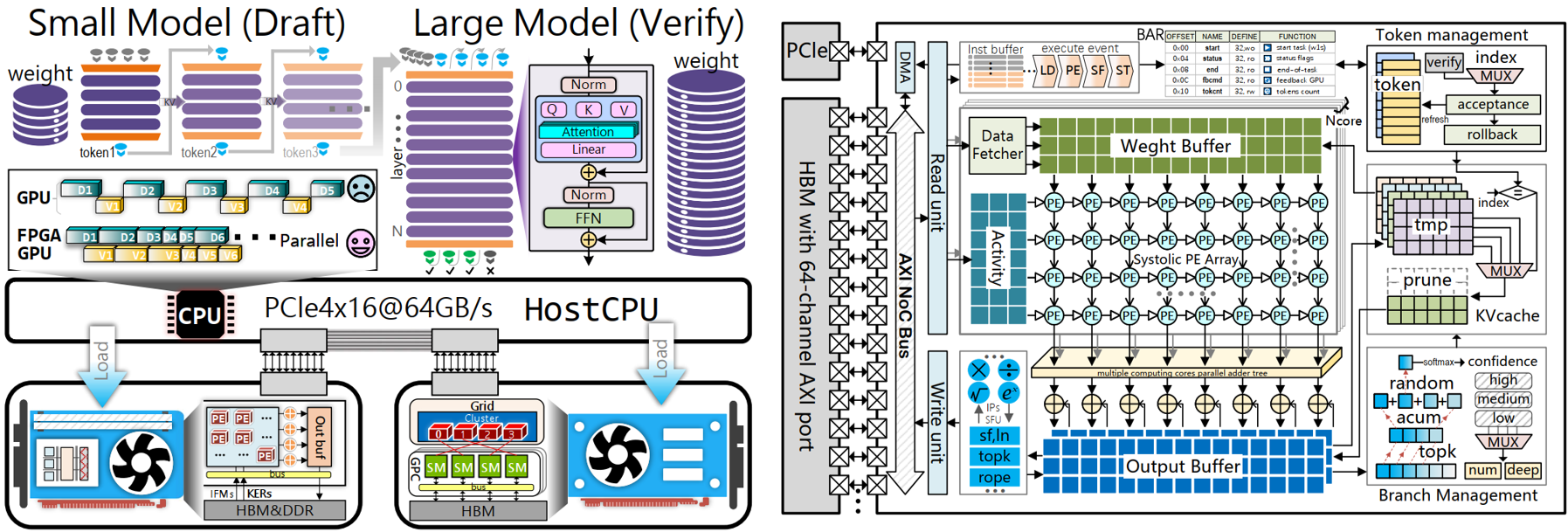
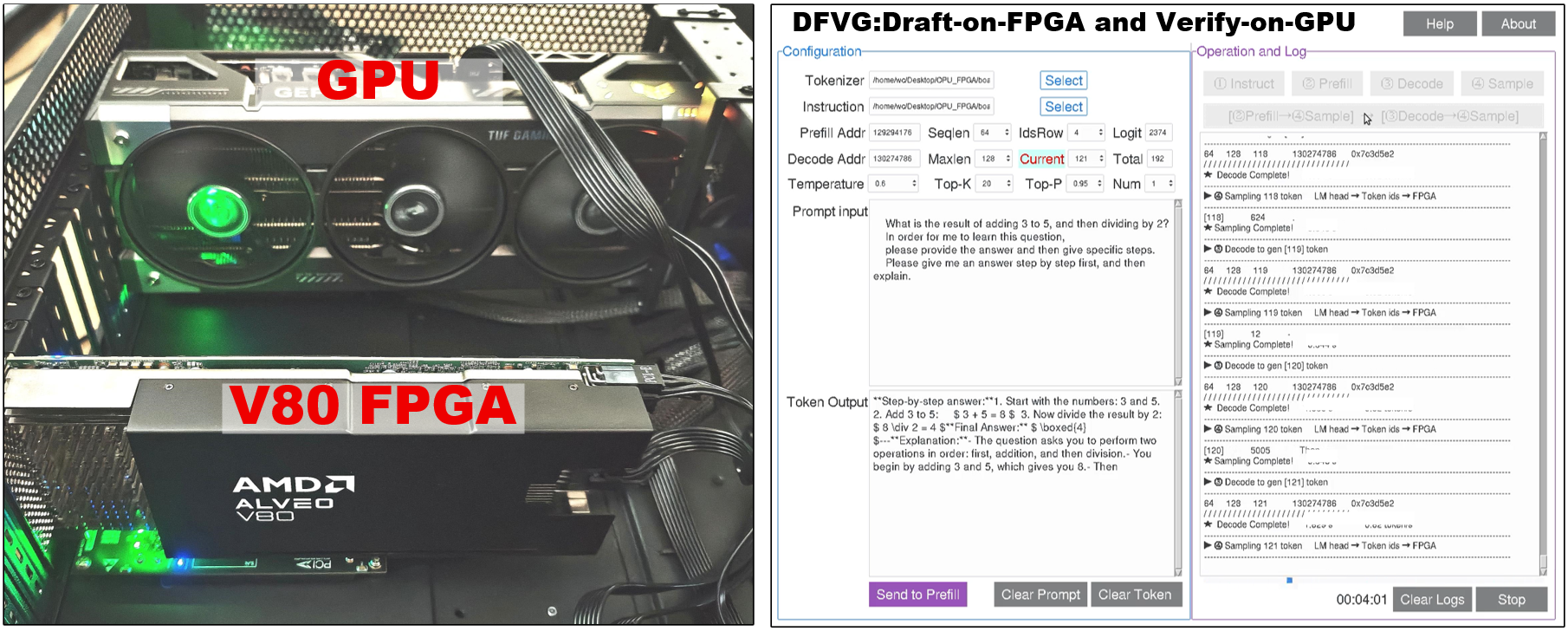
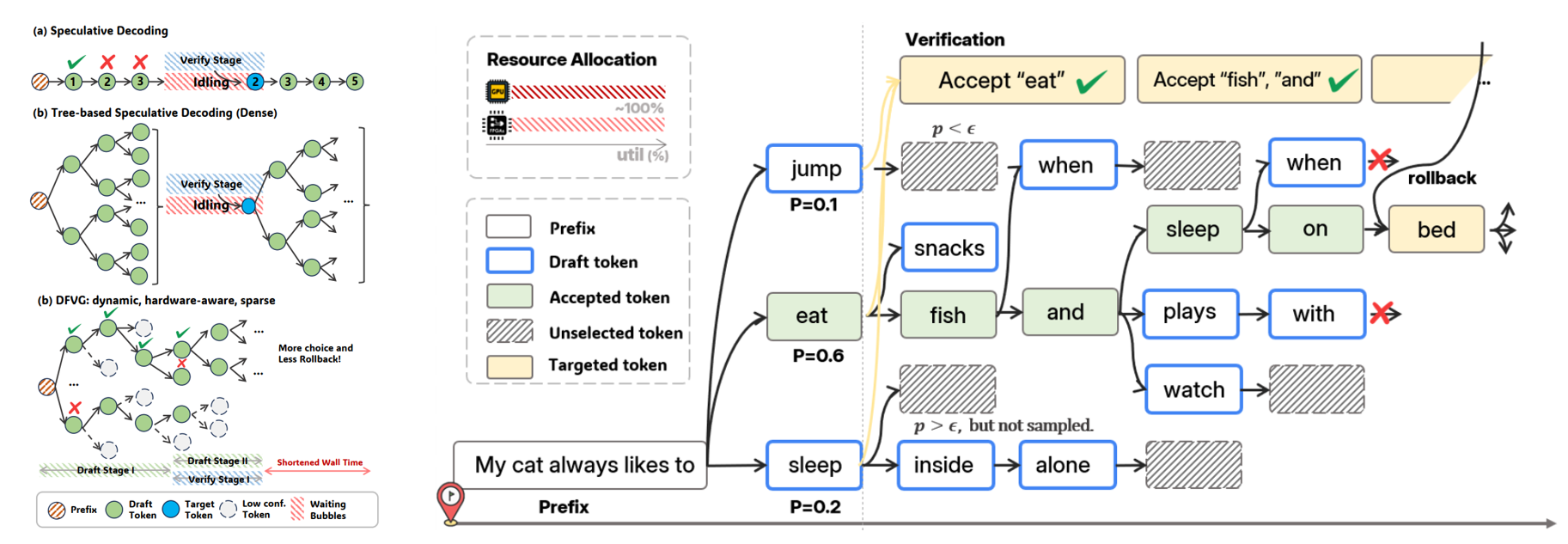
DFVG (Draft-on-FPGA, Verify-on-GPU) is a heterogeneous computing architecture designed for
speculative decoding in large language models.
The key idea is to perform the draft generation stage on FPGAs for fast parallel candidate generation,
and the verification stage on GPUs for efficient matrix computation. This design fully leverages
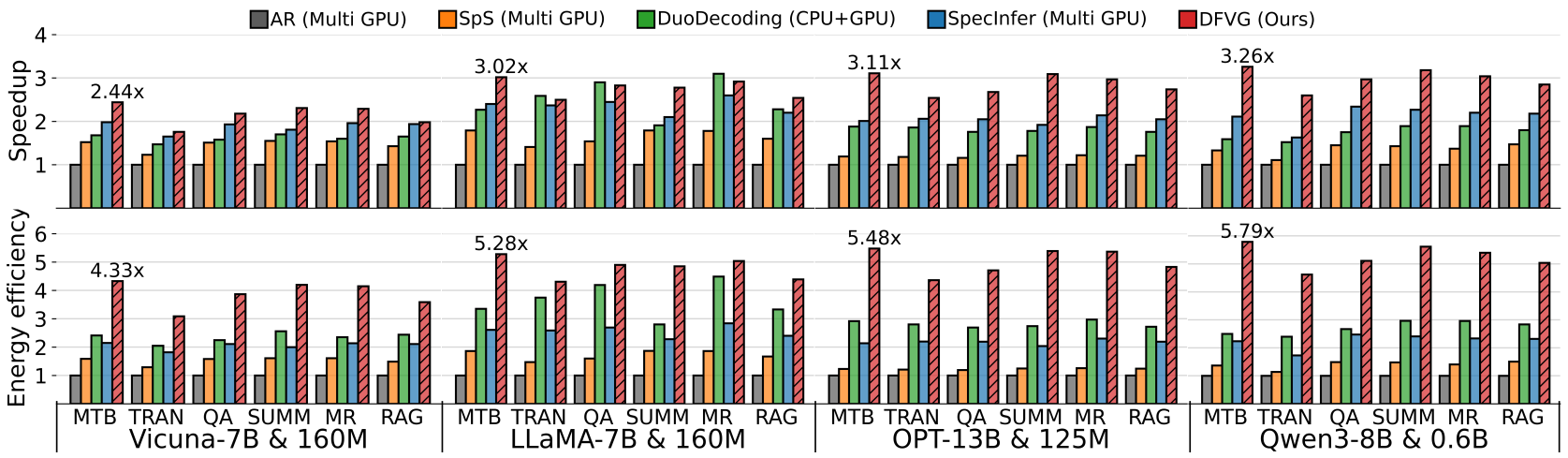
the complementary strengths of both hardware platforms to achieve low latency and high throughput decoding.

DFVG/
├── fpga/                 # FPGA-side draft generation pipeline
├── gpu/                  # GPU-side verification kernels & parallel schedulers
├── cpu/                  # Host runtime: task orchestration, scheduling, I/O
├── scripts/              # Dataset prep, model conversion, experiment launcher
├── results/              # Auto-generated logs, metrics, plots, bitstreams
└── README.md             # Project overview and usage instructions
git clone https://anonymous.4open.science/r/DFVG-DE39
cd DFVG
Make sure you are using Python 3.10+.
sudo apt update
sudo apt install -y build-essential cmake
pip install -r requirements.txt
Before building the bitstream, configure the Xilinx environment:
source /opt/xilinx/xrt/setup.sh
export XILINX_VIVADO=/opt/Xilinx/Vivado/2024.1
This generates the FPGA bitstream used for draft generation.
cd fpga/
make synthesize
make implement
This compiles all GPU kernels required for verification stage.
cd gpu/
make all
This script fetches both target model and draft model used in DFVG.
python scripts/download_models.py
(1) Run experiments:
python scripts/run_experiments.py --config configs/llama7b.yaml
(2) Collect results:
python scripts/collect_results.py --output results/
• performance_summary.json: Overall speedup and efficiency metrics
• energy_analysis.csv: Detailed energy consumption breakdown
• ablation_results.json: Component-wise performance contributions
• resource_utilization.log: FPGA and GPU resource usage
• Draft Length: Modify configs/draft_params.yaml
• Batch Size: Adjust BATCH_SIZE in configuration files
• Model Selection: Change TARGET_MODEL and DRAFT_MODEL
• Hardware Mapping: Modify device assignments in device_config.yaml
(1) Add a New Model
python scripts/add_model.py \
  --target new_model \
  --draft new_draft
(2) Prepare a Custom Dataset
python scripts/prepare_dataset.py
--input custom_data.json
python scripts/run_all.py \
  --model-path /path/to/model \
  --dataset-path data/custom_data.json \
  --max-new-tokens 128 \
  --draft-length 8 \
  --batch-size 1 \
  --num-runs 5 \
  --tag qwen3-test
Please cite our work if you use our code or discuss our findings in your own research:
@article{dfvg2025specdecoding,
  title={DFVG: A Heterogeneous Architecture for Speculative Decoding with Draft-on-FPGA and Verify-on-GPU},
  author={xxx, xxx},
  journal={xxx, xxx},
  year={2025}
}
Explore related work on speculative decoding and heterogeneous acceleration:
[Ghidorah].Ghidorah: Fast LLM Inference on Edge with Speculative Decoding and Hetero-Core Parallelism.
Jinhui Wei, Ye Huang, Yuhui Zhou, Jiazhi Jiang, Jiangsu Du, and Yutong Lu.
[DuoDecoding] DuoDecoding: Hardware-aware Heterogeneous Speculative Decoding with Dynamic Multi-Sequence Drafting.
Ai Lv, Honglin Guo, Qipeng Guo, and Xipeng Qiu.
[SpecInfer].SpecInfer: Accelerating Large Language Model Serving with Tree-based Speculative Inference and Verification.
Xupeng Miao, Gabriele Oliaro, Zhihao Zhang, Xinhao Cheng, Zeyu Wang, Zhengxin Zhang, Rae Ying Yee Wong, Alan Zhu, Lijie Yang, Xiaoxiang Shi, et al.
The 29th ACM International Conference on Architectural Support for Programming Languages and Operating Systems (ASPLOS), 2024.
[SpecPIM].SpecPIM: Accelerating Speculative Inference on PIM-enabled System via Architecture–Dataflow Co-exploration.
Cong Li, Zhe Zhou, Size Zheng, Jiaxi Zhang, Yun Liang, and Guangyu Sun.
Proceedings of the 29th ACM International Conference on Architectural Support for Programming Languages and Operating Systems (ASPLOS), 2024.
DFVG: A Heterogeneous Architecture for Speculative Decoding with Draft-on-FPGA and Verify-on-GPU.
C++
29
188 commits
updated Nov 26, 2025
Welcome to the official code repository for "[https://anonymous.4open.science/r/DFVG-DE39]".
⭐⭐⭐Your star means a lot to us in developing this project!
DFVG (Draft-on-FPGA, Verify-on-GPU) is a heterogeneous computing architecture designed for
speculative decoding in large language models.
The key idea is to perform the draft generation stage on FPGAs for fast parallel candidate generation,
and the verification stage on GPUs for efficient matrix computation. This design fully leverages
the complementary strengths of both hardware platforms to achieve low latency and high throughput decoding.
DFVG/
├── fpga/                 # FPGA-side draft generation pipeline
├── gpu/                  # GPU-side verification kernels & parallel schedulers
├── cpu/                  # Host runtime: task orchestration, scheduling, I/O
├── scripts/              # Dataset prep, model conversion, experiment launcher
├── results/              # Auto-generated logs, metrics, plots, bitstreams
└── README.md             # Project overview and usage instructions
git clone https://anonymous.4open.science/r/DFVG-DE39
cd DFVG
Make sure you are using Python 3.10+.
sudo apt update
sudo apt install -y build-essential cmake
pip install -r requirements.txt
Before building the bitstream, configure the Xilinx environment:
source /opt/xilinx/xrt/setup.sh
export XILINX_VIVADO=/opt/Xilinx/Vivado/2024.1
This generates the FPGA bitstream used for draft generation.
cd fpga/
make synthesize
make implement
This compiles all GPU kernels required for verification stage.
cd gpu/
make all
This script fetches both target model and draft model used in DFVG.
python scripts/download_models.py
(1) Run experiments:
python scripts/run_experiments.py --config configs/llama7b.yaml
(2) Collect results:
python scripts/collect_results.py --output results/
• performance_summary.json: Overall speedup and efficiency metrics
• energy_analysis.csv: Detailed energy consumption breakdown
• ablation_results.json: Component-wise performance contributions
• resource_utilization.log: FPGA and GPU resource usage
• Draft Length: Modify configs/draft_params.yaml
• Batch Size: Adjust BATCH_SIZE in configuration files
• Model Selection: Change TARGET_MODEL and DRAFT_MODEL
• Hardware Mapping: Modify device assignments in device_config.yaml
(1) Add a New Model
python scripts/add_model.py \
  --target new_model \
  --draft new_draft
(2) Prepare a Custom Dataset
python scripts/prepare_dataset.py
--input custom_data.json
python scripts/run_all.py \
  --model-path /path/to/model \
  --dataset-path data/custom_data.json \
  --max-new-tokens 128 \
  --draft-length 8 \
  --batch-size 1 \
  --num-runs 5 \
  --tag qwen3-test
Please cite our work if you use our code or discuss our findings in your own research:
@article{dfvg2025specdecoding,
  title={DFVG: A Heterogeneous Architecture for Speculative Decoding with Draft-on-FPGA and Verify-on-GPU},
  author={xxx, xxx},
  journal={xxx, xxx},
  year={2025}
}
Explore related work on speculative decoding and heterogeneous acceleration:
[Ghidorah].Ghidorah: Fast LLM Inference on Edge with Speculative Decoding and Hetero-Core Parallelism.
Jinhui Wei, Ye Huang, Yuhui Zhou, Jiazhi Jiang, Jiangsu Du, and Yutong Lu.
[DuoDecoding] DuoDecoding: Hardware-aware Heterogeneous Speculative Decoding with Dynamic Multi-Sequence Drafting.
Ai Lv, Honglin Guo, Qipeng Guo, and Xipeng Qiu.
[SpecInfer].SpecInfer: Accelerating Large Language Model Serving with Tree-based Speculative Inference and Verification.
Xupeng Miao, Gabriele Oliaro, Zhihao Zhang, Xinhao Cheng, Zeyu Wang, Zhengxin Zhang, Rae Ying Yee Wong, Alan Zhu, Lijie Yang, Xiaoxiang Shi, et al.
The 29th ACM International Conference on Architectural Support for Programming Languages and Operating Systems (ASPLOS), 2024.
[SpecPIM].SpecPIM: Accelerating Speculative Inference on PIM-enabled System via Architecture–Dataflow Co-exploration.
Cong Li, Zhe Zhou, Size Zheng, Jiaxi Zhang, Yun Liang, and Guangyu Sun.
Proceedings of the 29th ACM International Conference on Architectural Support for Programming Languages and Operating Systems (ASPLOS), 2024.



