Building actual open source Multilingual speech model including dataset.
Jupyter Notebook
58
138 commits
updated Oct 1, 2026
Qwen3 backbones continued-pretrained on NeuCodec speech tokens at 50 TPS. The model speaks and listens: text-to-speech and voice cloning in 150+ languages, speech-to-text from either speech tokens or raw whisper log-mel, plus expressive and non-verbal control.
V1 — the TTS-only era — lives in README_V1.md: released checkpoints, the 76-language CER/MOS and speaker-similarity benchmarks, the base and expressive datasets, and the one-epoch and learning-rate ablations.
Every task is one packed document. Audio arrives as codec tokens or as raw mel, both at 50 positions per second, so the same utterance costs the same context either way.
TTS        speaker: text              ->  <|speech_start|> s₀ s₁ s₂ … sₙ
STT        s₀ s₁ s₂ … sₙ              ->  <|lang|> text
STT (mel)  ░░ 128-bin log-mel ░░      ->  <|lang|> text
Documents are greedily packed into 10,240-token blocks and kept attention-isolated:
position_ids reset per document, attention_mask carries per-document lengths, and the
trainer rebuilds a block-diagonal mask. Nothing attends across a document boundary.
audio + text
   ├─ NeuCodec, 50 TPS ──→ <|s_N|> tokens ─┐
   └─ whisper log-mel ───→ <|mel|> slots ──┤
                                           ├─→ 10,240-token blocks
                                           └─→ ChiniDataset parquet
A held-out test set for the long tail: the 50 lowest-resource languages of malaysia-ai/Multilingual-TTS, 25 utterances each. 1,250 rows, 2.56 hours, 514 speakers, published as malaysia-ai/Low-Language-TTS.
Every row carries audio, NeuCodec tokens and a normalized transcription, so it scores both directions. Coverage runs from Wayuu (1,128 rows in the whole corpus) to Kasem (61,277), and takes in Naga varieties, Quichua, Gronings, Baoulé, Karamojong, Iban, Meitei, Tamazight, Lule Sami, Ladino, Khasi, Hawrami, Kokborok, Kabardian, Vagla and Swiss German.
Languages are not picked by taking the rarest GlotLID labels. Only 3 of the 500 rarest labels survive verification on this corpus: that tail is mostly the detector firing on short lines of other languages. A language qualifies when some subset was collected for it (≥ 50 rows and ≥ 40% of that subset). Each row is then verified on its own:
≥ 40 characters and ≥ 5 words
GlotLID v3 reproduces the stored label, probability ≥ 0.90, margin ≥ 0.50
decoded audio length matches len(tokens) / 50
Preparation: low-language-testset
Voice cloning, multi-speaker and multilingual: 37.34B tokens over six packed corpora, up from 35.88B in V1. The increase is YouTube-Cantonese-Emilia.
| corpus | blocks | tokens |
|---|---|---|
| Emilia-YODAS | 1,902,702 | ~19.48B |
| Malaysian-Emilia | 775,589 | ~7.94B |
| Malaysian-Emilia-dialects | 565,604 | ~5.79B |
| Malaysian-Chinese-Emilia | 178,271 | ~1.83B |
| YouTube-Cantonese-Emilia | 142,711 | ~1.46B |
| Malaysian-Tamil-Emilia | 81,723 | ~0.84B |
| total | 3,646,600 | ~37.34B |
Blocks × 10,240; greedy packing puts true counts slightly below. Malaysian-Emilia and Malaysian-Emilia-dialects are two disjoint configs of one HF repo, not one corpus counted twice. Per-dataset configs, reject filters and pack targets: preparation/README.md.
The TTS source corpus malaysia-ai/Multilingual-TTS now holds 121.8M rows across 1,552
subsets (4.64TB of audio zips and NeuCodec tokens), up from the 25.35B-token pack V1
trained on.
Sources: Multilingual-TTS · Emilia-YODAS-Voice-Conversion · Malaysian-Emilia · YouTube-Cantonese-Emilia
Preparation: preparation
Laughter, cough, sigh and similar events, mined with PANNs SED, verified with CLAP, and
placed by whisper word timestamps. Two renderings per row: Higgs-TTS style
(<|sfx:laughter|>Haha) and Emilia-NV style ([Laughter]).
| source | output | rows | events |
|---|---|---|---|
| Malaysian-Emilia | Malaysian-Emilia-Nonverbal-Tags | 8,702 | 8,985 |
| Malaysian-Tamil-Emilia | Malaysian-Tamil-Emilia-Nonverbal-Tags | 2,383 | 2,539 |
| Malaysian-Chinese-Emilia | Malaysian-Chinese-Emilia-Nonverbal-Tags | 1,655 | 1,694 |
Preparation: nonverbal-tagging
The inverse task, in two packs — one per audio representation.
| pack | document | audio as |
|---|---|---|
multipacking_stt.py | <|im_start|><|STT|>{speech tokens}<|{lang}|>{text}<|im_end|> | NeuCodec <|s_N|>, 50 tokens/s |
multipacking_stt_mel.py | <|im_start|><|STT|><|mel_start|>{P × <|mel|>}<|mel_end|><|{lang}|>{text}<|im_end|> | whisper log-mel, 50 positions/s |
Same rate, same context cost. The codec's information loss is the only difference.
Source: malaysia-ai/Multilingual-TTS-language,
118M rows over 1,493 subsets, with GlotLID v3 language and rule-normalized
post-normalized columns.
Preparation: stt
hyperparameter_search.py drives qwen3_optimizer_search.py, a trainer with a pluggable optimizer. Each optimizer gets its own LR grid.
| optimizer | applied to | swept LRs |
|---|---|---|
adamw | everything | 5e-4 · 1e-3 · 2e-3 |
muon | 2D hidden weights (AdamW on the rest) | matrix 5e-3 · 1e-2 · 2e-2 |
soap | 2D hidden weights (AdamW on the rest) | matrix 1e-3 · 3e-3 · 1e-2 |
shampoo (ScalableShampoo) | 2D hidden weights (AdamW on the rest) | matrix 5e-4 · 1e-3 · 3e-3 |
lion | everything | 1e-4 · 3e-4 (wd 0.1) |
ademamix | everything | 5e-4 · 1e-3 |
Hybrids use Muon's 2D-hidden-weight split ("Muon is Scalable for LLM Training",
arXiv:2502.16982), so the comparison is like for like. Runs resume by name from
search_state/<prefix>/<run>.json.
pip install pytorch_optimizer            # shampoo / soap / lion / ademamix

python hyperparameter_search.py --train-file <pack dir>
python hyperparameter_search.py --train-file <pack dir> --optimizers muon soap
python hyperparameter_search.py --train-file <pack dir> --dry-run
Those are the built-in grids. A --grid-json file replaces them and defines the sweep —
the FLEURS sweep below uses one. Name every sweep with PREFIX: run names carry
the optimizer and LRs but not the batch size, so two sweeps at different batches share
resume markers and the second one silently reprints the first one's ranking.
Question. Which optimizer trains a model that does all three tasks at once, and does a small corpus even support that?
Setup. One run trains on a mixture of all six packs. Each task is then scored on its own dev split.
 fleurs-tts  ┐                                              ┌ eval_fleurs_tts
 fleurs-stt  │                                              │ eval_fleurs_stt
 fleurs-mel  ├─→  561,123 blocks  ─→  200 steps        ─→   ├ eval_fleurs_mel
 cv22-tts    │    mixed 1:1:1:1:1:1   21M tokens/step       │ eval_cv22_tts
 cv22-stt    │                        Qwen3-1.7B-Base       │ eval_cv22_stt
 cv22-mel    ┘                                              └ eval_cv22_mel
| pack | train blocks | dev blocks |
|---|---|---|
fleurs-tts | 18,148 | 2,231 |
fleurs-stt | 17,984 | 2,208 |
fleurs-mel | 18,026 | 2,213 |
cv22-tts | 166,130 | 12,321 |
cv22-stt | 158,979 | 11,778 |
cv22-mel | 181,856 | 13,934 |
common-voice-22 in
malaysia-ai/Multilingual-TTS,
29.1% of raw CV22. Tokens and audio from
malaysia-ai/common_voice_22_0.All six packs cover the same rows, so only the representation and the direction change. 5.75B tokens total. A 200-step run sees 4.2B of them, so nothing is replayed.
CV22 adds 130 language tags to FLEURS' 102, and the mel tokens are appended after the
language tags. Packing the corpora separately would shift <|mel|>'s id between them, so
both packers read one shared 236-token list.
python preparation/multipacking_cv22.py --base-dir <cv22> --stage tokens-file
python preparation/multipacking_cv22.py --base-dir <cv22> --stage tokens   # 6.1GB
python preparation/multipacking_cv22.py --base-dir <cv22> --stage audio    # 286GB, filtered rows only
python preparation/multipacking_cv22.py --base-dir <cv22> --task all --workers 96
python preparation/multipacking_fleurs.py --base-dir <base> --task all \
    --added-tokens-file <cv22>/out/added_tokens.json --audio-base <audio>
bash preparation/link_audio_root.sh      # one audio root for both corpora
PREFIX=fleurs-b2040 bash scripts/ablation-fleurs.sh
python plot_fleurs_ablation.py --out-dir docs
Protocol. Qwen3-1.7B-Base, 21M tokens/step, warmup 50, FP32-BF16, WSD LR, 200 steps. Two departures from V1:
| V1 | here | why | |
|---|---|---|---|
| steps | 100 | 200 | the V1 winner separates only after ~step 50 and is still descending at 100 |
| batch shape | 8 × 32 | 4 × 64 | micro-batch 8 peaks a rank at 143,137 MiB of a 143,771 MiB card |
Ten configurations ran. Nine finished; adamw 1e-3 diverged.
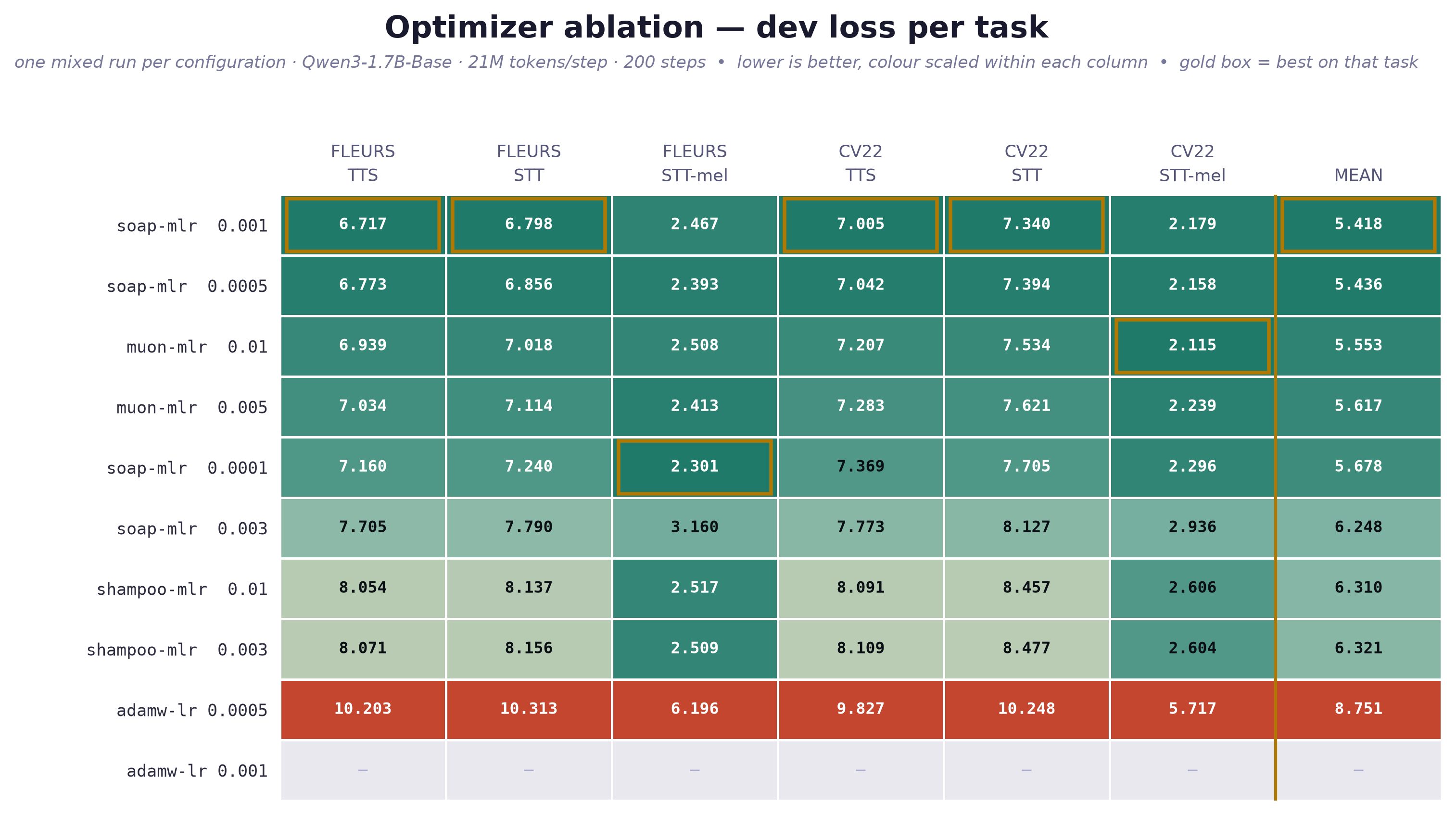
Colour is scaled within each column, because the tasks do not share a scale: TTS and token-STT predict into 65,536 speech tokens, the mel tasks predict text. Runs rank on the mean so no single scale decides the order. Full table: docs/fleurs-ablation-results.md.
Live curves: wandb.ai/aies-scicom-scicom-ai/Multilingual-TTS
— every run logs eval_fleurs_{tts,stt,mel}_loss and eval_cv22_{tts,stt,mel}_loss
separately, plus train loss and grad-norm per step.
| sweep | run names | what it is |
|---|---|---|
| this one | fleurs-b2040-* | 10 configs, 2040-block batch, 200 steps |
| the screen | fleurs-* (no b2040) | 16 configs, 48-block batch, 100 steps |
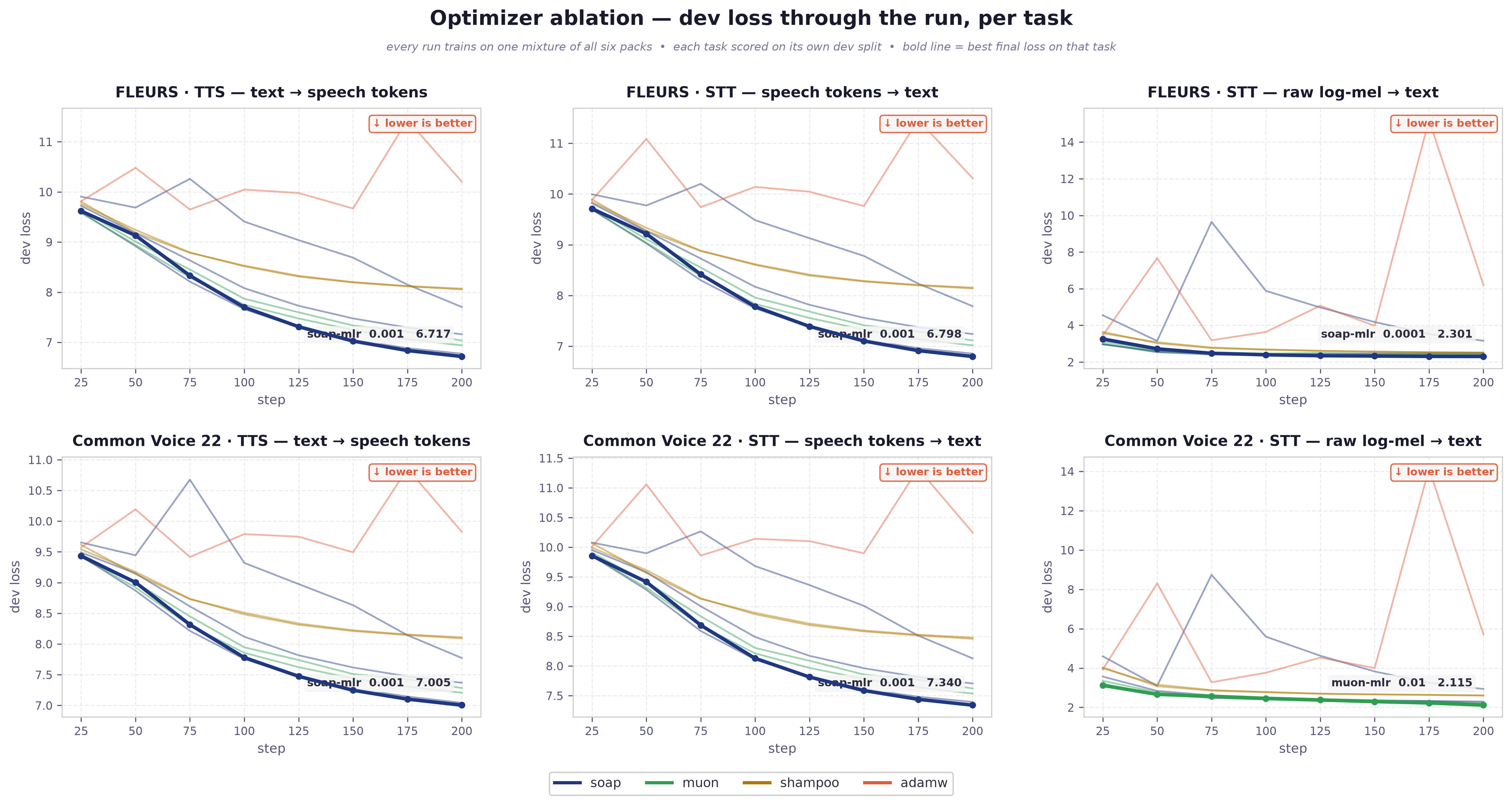
grad_norm goes 272 → 45,610 despite clipping at 1.0, and every dev curve
reverses. At 5e-4 it survives but oscillates — its final losses sit 0.4–3.0 nats above
its own best. The red lines in the figure above are that failure.Yes. The best run's six dev losses all fall monotonically, from one mixture, in 200 steps.
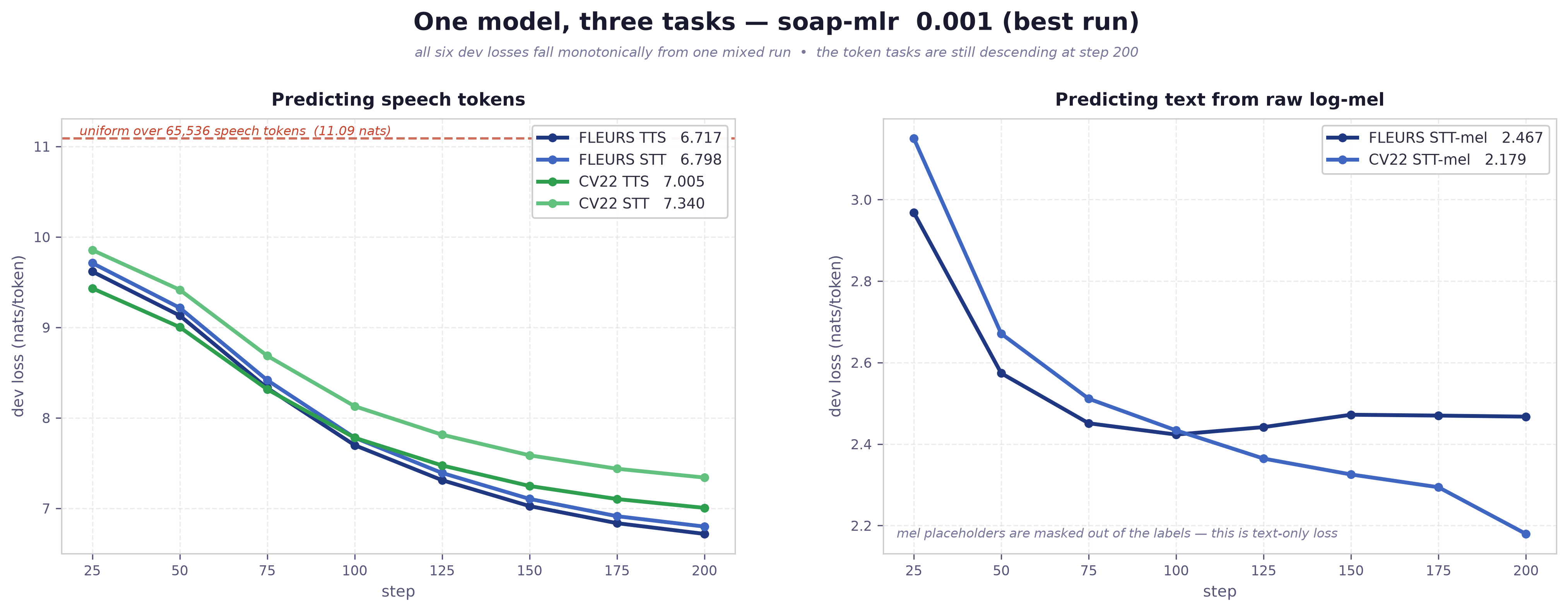
| task | step 25 | step 200 | drop | perplexity |
|---|---|---|---|---|
| FLEURS TTS | 9.617 | 6.717 | 2.900 | 826 |
| FLEURS STT | 9.711 | 6.798 | 2.913 | 896 |
| FLEURS STT-mel | 2.968 | 2.467 | 0.501 | 11.8 |
| CV22 TTS | 9.432 | 7.005 | 2.428 | 1,102 |
| CV22 STT | 9.855 | 7.340 | 2.515 | 1,540 |
| CV22 STT-mel | 3.150 | 2.179 | 0.971 | 8.8 |
Read against the uniform baselines: speech-token prediction starts from ln(65,536) = 11.09 nats and ends at 6.72, so perplexity drops from 65,536 to 826. Text from raw mel ends at 8.8–11.8 perplexity against a 217,448-token vocabulary. No task is starved by the others.
Three qualifications:
<|mel|> placeholders are
masked out of the labels, since audio is an input, not a prediction target. So the mel
task scores text only, while token-STT also scores the ~90% of positions that are speech
tokens. A codec-vs-mel comparison needs a text-only metric on the token side.# 0.6B
bash scripts/0.6B-mel.sh
# 1.7B
bash scripts/1.7B-mel.sh
The mix is a launch flag, not a property of the data. --train_file takes dir:weight
entries, where the weight is how many epochs of that pack go into one training epoch, so
ratios change without repacking. The mel pack stores audio paths: point --audio_dir at
the extracted audio tree. Files are read and resampled in the dataloader workers, and the
STFT runs on the GPU.
Weight the mel pack down on purpose. It makes micro-batches with no mel document common, which is the case that hangs DDP if the projector leaves the autograd graph.
Smoke test — synthetic packs for all three tasks, built with the real tokenizer, so every id is the id training would see:
python dryrun_pack.py --out /root/share/mel-dryrun
torchrun --nproc_per_node 2 -m qwen3_mel_adamw \
  --model_name_or_path Qwen/Qwen3-0.6B-Base \
  --stt_tokens_file /root/share/mel-dryrun/stt_added_tokens.json \
  --audio_dir /root/share/mel-dryrun/audio \
  --train_file "/root/share/mel-dryrun/multipacking-tts:1.0,/root/share/mel-dryrun/multipacking-stt:1.0,/root/share/mel-dryrun/multipacking-stt-mel:0.3" \
  --block_size 10240 --max_steps 20 --do_train --bf16 --torch_dtype float32 \
  --per_device_train_batch_size 2 --gradient_checkpointing true \
  --ddp_find_unused_parameters false --remove_unused_columns false \
  --output_dir /root/share/mel-dryrun/out --logging_steps 1 --save_strategy no
Audio reaches the LLM with no speech tokenizer and no whisper encoder. Only whisper's mel front end survives; the LLM does the acoustic modelling.
waveform 16kHz
  └─ whisper log-mel          100 fps, 128 bins   (feature extractor unchanged)
      └─ stack 2 frames       [T/2, 256]
          └─ LayerNorm → Linear(256→H) → GELU → Linear(H→H)
              └─ 50 positions/s, written over the <|mel|> placeholder embeddings
Stack, don't pool. A reshape of 2 frames preserves information and equals
Conv1d(128, H, kernel_size=2, stride=2). An average pool commits to one fixed mixing and
low-passes away the ~10ms cues — plosive bursts, stop closures, onset edges — that
separate phonemes. Qwen2-Audio can pool because its stride-2 pool sits after 32 transformer
layers that already made neighbouring positions redundant. With no encoder, adjacent mel
frames are not redundant. 50 positions/s is also whisper's own encoder output rate, and the
NeuCodec rate.
Implementation: mel_audio.py, qwen3_mel_adamw.py. Tests: stt/test_mel_pipeline.py.
| area | what |
|---|---|
| preparation | multipacking: (text, speech-token) pairs → 10,240-token attention-isolated blocks |
| stt | the inverse task, in two packs: NeuCodec tokens and raw log-mel |
| fleurs-dataset | FLEURS-R + NeuCodec tokens for 102 locales, and the speaker labels derived for it |
| low-language-testset | the long-tail test set |
| nonverbal-tagging | non-verbal event mining into inline tags |
| synthetic-description | expressive-TTS descriptions: acoustic stats + classifiers → LLM summary |
| dnsmos | DNSMOS quality filtering |
| tts-evaluation, vc-evaluation | the 76-language benchmarks (V1) |
341 followers · starred Mar 2026
Building actual open source Multilingual speech model including dataset.
Jupyter Notebook
58
138 commits
updated Oct 1, 2026
Qwen3 backbones continued-pretrained on NeuCodec speech tokens at 50 TPS. The model speaks and listens: text-to-speech and voice cloning in 150+ languages, speech-to-text from either speech tokens or raw whisper log-mel, plus expressive and non-verbal control.
V1 — the TTS-only era — lives in README_V1.md: released checkpoints, the 76-language CER/MOS and speaker-similarity benchmarks, the base and expressive datasets, and the one-epoch and learning-rate ablations.
Every task is one packed document. Audio arrives as codec tokens or as raw mel, both at 50 positions per second, so the same utterance costs the same context either way.
TTS        speaker: text              ->  <|speech_start|> s₀ s₁ s₂ … sₙ
STT        s₀ s₁ s₂ … sₙ              ->  <|lang|> text
STT (mel)  ░░ 128-bin log-mel ░░      ->  <|lang|> text
Documents are greedily packed into 10,240-token blocks and kept attention-isolated:
position_ids reset per document, attention_mask carries per-document lengths, and the
trainer rebuilds a block-diagonal mask. Nothing attends across a document boundary.
audio + text
   ├─ NeuCodec, 50 TPS ──→ <|s_N|> tokens ─┐
   └─ whisper log-mel ───→ <|mel|> slots ──┤
                                           ├─→ 10,240-token blocks
                                           └─→ ChiniDataset parquet
A held-out test set for the long tail: the 50 lowest-resource languages of malaysia-ai/Multilingual-TTS, 25 utterances each. 1,250 rows, 2.56 hours, 514 speakers, published as malaysia-ai/Low-Language-TTS.
Every row carries audio, NeuCodec tokens and a normalized transcription, so it scores both directions. Coverage runs from Wayuu (1,128 rows in the whole corpus) to Kasem (61,277), and takes in Naga varieties, Quichua, Gronings, Baoulé, Karamojong, Iban, Meitei, Tamazight, Lule Sami, Ladino, Khasi, Hawrami, Kokborok, Kabardian, Vagla and Swiss German.
Languages are not picked by taking the rarest GlotLID labels. Only 3 of the 500 rarest labels survive verification on this corpus: that tail is mostly the detector firing on short lines of other languages. A language qualifies when some subset was collected for it (≥ 50 rows and ≥ 40% of that subset). Each row is then verified on its own:
≥ 40 characters and ≥ 5 words
GlotLID v3 reproduces the stored label, probability ≥ 0.90, margin ≥ 0.50
decoded audio length matches len(tokens) / 50
Preparation: low-language-testset
Voice cloning, multi-speaker and multilingual: 37.34B tokens over six packed corpora, up from 35.88B in V1. The increase is YouTube-Cantonese-Emilia.
| corpus | blocks | tokens |
|---|---|---|
| Emilia-YODAS | 1,902,702 | ~19.48B |
| Malaysian-Emilia | 775,589 | ~7.94B |
| Malaysian-Emilia-dialects | 565,604 | ~5.79B |
| Malaysian-Chinese-Emilia | 178,271 | ~1.83B |
| YouTube-Cantonese-Emilia | 142,711 | ~1.46B |
| Malaysian-Tamil-Emilia | 81,723 | ~0.84B |
| total | 3,646,600 | ~37.34B |
Blocks × 10,240; greedy packing puts true counts slightly below. Malaysian-Emilia and Malaysian-Emilia-dialects are two disjoint configs of one HF repo, not one corpus counted twice. Per-dataset configs, reject filters and pack targets: preparation/README.md.
The TTS source corpus malaysia-ai/Multilingual-TTS now holds 121.8M rows across 1,552
subsets (4.64TB of audio zips and NeuCodec tokens), up from the 25.35B-token pack V1
trained on.
Sources: Multilingual-TTS · Emilia-YODAS-Voice-Conversion · Malaysian-Emilia · YouTube-Cantonese-Emilia
Preparation: preparation
Laughter, cough, sigh and similar events, mined with PANNs SED, verified with CLAP, and
placed by whisper word timestamps. Two renderings per row: Higgs-TTS style
(<|sfx:laughter|>Haha) and Emilia-NV style ([Laughter]).
| source | output | rows | events |
|---|---|---|---|
| Malaysian-Emilia | Malaysian-Emilia-Nonverbal-Tags | 8,702 | 8,985 |
| Malaysian-Tamil-Emilia | Malaysian-Tamil-Emilia-Nonverbal-Tags | 2,383 | 2,539 |
| Malaysian-Chinese-Emilia | Malaysian-Chinese-Emilia-Nonverbal-Tags | 1,655 | 1,694 |
Preparation: nonverbal-tagging
The inverse task, in two packs — one per audio representation.
| pack | document | audio as |
|---|---|---|
multipacking_stt.py | <|im_start|><|STT|>{speech tokens}<|{lang}|>{text}<|im_end|> | NeuCodec <|s_N|>, 50 tokens/s |
multipacking_stt_mel.py | <|im_start|><|STT|><|mel_start|>{P × <|mel|>}<|mel_end|><|{lang}|>{text}<|im_end|> | whisper log-mel, 50 positions/s |
Same rate, same context cost. The codec's information loss is the only difference.
Source: malaysia-ai/Multilingual-TTS-language,
118M rows over 1,493 subsets, with GlotLID v3 language and rule-normalized
post-normalized columns.
Preparation: stt
hyperparameter_search.py drives qwen3_optimizer_search.py, a trainer with a pluggable optimizer. Each optimizer gets its own LR grid.
| optimizer | applied to | swept LRs |
|---|---|---|
adamw | everything | 5e-4 · 1e-3 · 2e-3 |
muon | 2D hidden weights (AdamW on the rest) | matrix 5e-3 · 1e-2 · 2e-2 |
soap | 2D hidden weights (AdamW on the rest) | matrix 1e-3 · 3e-3 · 1e-2 |
shampoo (ScalableShampoo) | 2D hidden weights (AdamW on the rest) | matrix 5e-4 · 1e-3 · 3e-3 |
lion | everything | 1e-4 · 3e-4 (wd 0.1) |
ademamix | everything | 5e-4 · 1e-3 |
Hybrids use Muon's 2D-hidden-weight split ("Muon is Scalable for LLM Training",
arXiv:2502.16982), so the comparison is like for like. Runs resume by name from
search_state/<prefix>/<run>.json.
pip install pytorch_optimizer            # shampoo / soap / lion / ademamix

python hyperparameter_search.py --train-file <pack dir>
python hyperparameter_search.py --train-file <pack dir> --optimizers muon soap
python hyperparameter_search.py --train-file <pack dir> --dry-run
Those are the built-in grids. A --grid-json file replaces them and defines the sweep —
the FLEURS sweep below uses one. Name every sweep with PREFIX: run names carry
the optimizer and LRs but not the batch size, so two sweeps at different batches share
resume markers and the second one silently reprints the first one's ranking.
Question. Which optimizer trains a model that does all three tasks at once, and does a small corpus even support that?
Setup. One run trains on a mixture of all six packs. Each task is then scored on its own dev split.
 fleurs-tts  ┐                                              ┌ eval_fleurs_tts
 fleurs-stt  │                                              │ eval_fleurs_stt
 fleurs-mel  ├─→  561,123 blocks  ─→  200 steps        ─→   ├ eval_fleurs_mel
 cv22-tts    │    mixed 1:1:1:1:1:1   21M tokens/step       │ eval_cv22_tts
 cv22-stt    │                        Qwen3-1.7B-Base       │ eval_cv22_stt
 cv22-mel    ┘                                              └ eval_cv22_mel
| pack | train blocks | dev blocks |
|---|---|---|
fleurs-tts | 18,148 | 2,231 |
fleurs-stt | 17,984 | 2,208 |
fleurs-mel | 18,026 | 2,213 |
cv22-tts | 166,130 | 12,321 |
cv22-stt | 158,979 | 11,778 |
cv22-mel | 181,856 | 13,934 |
common-voice-22 in
malaysia-ai/Multilingual-TTS,
29.1% of raw CV22. Tokens and audio from
malaysia-ai/common_voice_22_0.All six packs cover the same rows, so only the representation and the direction change. 5.75B tokens total. A 200-step run sees 4.2B of them, so nothing is replayed.
CV22 adds 130 language tags to FLEURS' 102, and the mel tokens are appended after the
language tags. Packing the corpora separately would shift <|mel|>'s id between them, so
both packers read one shared 236-token list.
python preparation/multipacking_cv22.py --base-dir <cv22> --stage tokens-file
python preparation/multipacking_cv22.py --base-dir <cv22> --stage tokens   # 6.1GB
python preparation/multipacking_cv22.py --base-dir <cv22> --stage audio    # 286GB, filtered rows only
python preparation/multipacking_cv22.py --base-dir <cv22> --task all --workers 96
python preparation/multipacking_fleurs.py --base-dir <base> --task all \
    --added-tokens-file <cv22>/out/added_tokens.json --audio-base <audio>
bash preparation/link_audio_root.sh      # one audio root for both corpora
PREFIX=fleurs-b2040 bash scripts/ablation-fleurs.sh
python plot_fleurs_ablation.py --out-dir docs
Protocol. Qwen3-1.7B-Base, 21M tokens/step, warmup 50, FP32-BF16, WSD LR, 200 steps. Two departures from V1:
| V1 | here | why | |
|---|---|---|---|
| steps | 100 | 200 | the V1 winner separates only after ~step 50 and is still descending at 100 |
| batch shape | 8 × 32 | 4 × 64 | micro-batch 8 peaks a rank at 143,137 MiB of a 143,771 MiB card |
Ten configurations ran. Nine finished; adamw 1e-3 diverged.
Colour is scaled within each column, because the tasks do not share a scale: TTS and token-STT predict into 65,536 speech tokens, the mel tasks predict text. Runs rank on the mean so no single scale decides the order. Full table: docs/fleurs-ablation-results.md.
Live curves: wandb.ai/aies-scicom-scicom-ai/Multilingual-TTS
— every run logs eval_fleurs_{tts,stt,mel}_loss and eval_cv22_{tts,stt,mel}_loss
separately, plus train loss and grad-norm per step.
| sweep | run names | what it is |
|---|---|---|
| this one | fleurs-b2040-* | 10 configs, 2040-block batch, 200 steps |
| the screen | fleurs-* (no b2040) | 16 configs, 48-block batch, 100 steps |
grad_norm goes 272 → 45,610 despite clipping at 1.0, and every dev curve
reverses. At 5e-4 it survives but oscillates — its final losses sit 0.4–3.0 nats above
its own best. The red lines in the figure above are that failure.Yes. The best run's six dev losses all fall monotonically, from one mixture, in 200 steps.
| task | step 25 | step 200 | drop | perplexity |
|---|---|---|---|---|
| FLEURS TTS | 9.617 | 6.717 | 2.900 | 826 |
| FLEURS STT | 9.711 | 6.798 | 2.913 | 896 |
| FLEURS STT-mel | 2.968 | 2.467 | 0.501 | 11.8 |
| CV22 TTS | 9.432 | 7.005 | 2.428 | 1,102 |
| CV22 STT | 9.855 | 7.340 | 2.515 | 1,540 |
| CV22 STT-mel | 3.150 | 2.179 | 0.971 | 8.8 |
Read against the uniform baselines: speech-token prediction starts from ln(65,536) = 11.09 nats and ends at 6.72, so perplexity drops from 65,536 to 826. Text from raw mel ends at 8.8–11.8 perplexity against a 217,448-token vocabulary. No task is starved by the others.
Three qualifications:
<|mel|> placeholders are
masked out of the labels, since audio is an input, not a prediction target. So the mel
task scores text only, while token-STT also scores the ~90% of positions that are speech
tokens. A codec-vs-mel comparison needs a text-only metric on the token side.# 0.6B
bash scripts/0.6B-mel.sh
# 1.7B
bash scripts/1.7B-mel.sh
The mix is a launch flag, not a property of the data. --train_file takes dir:weight
entries, where the weight is how many epochs of that pack go into one training epoch, so
ratios change without repacking. The mel pack stores audio paths: point --audio_dir at
the extracted audio tree. Files are read and resampled in the dataloader workers, and the
STFT runs on the GPU.
Weight the mel pack down on purpose. It makes micro-batches with no mel document common, which is the case that hangs DDP if the projector leaves the autograd graph.
Smoke test — synthetic packs for all three tasks, built with the real tokenizer, so every id is the id training would see:
python dryrun_pack.py --out /root/share/mel-dryrun
torchrun --nproc_per_node 2 -m qwen3_mel_adamw \
  --model_name_or_path Qwen/Qwen3-0.6B-Base \
  --stt_tokens_file /root/share/mel-dryrun/stt_added_tokens.json \
  --audio_dir /root/share/mel-dryrun/audio \
  --train_file "/root/share/mel-dryrun/multipacking-tts:1.0,/root/share/mel-dryrun/multipacking-stt:1.0,/root/share/mel-dryrun/multipacking-stt-mel:0.3" \
  --block_size 10240 --max_steps 20 --do_train --bf16 --torch_dtype float32 \
  --per_device_train_batch_size 2 --gradient_checkpointing true \
  --ddp_find_unused_parameters false --remove_unused_columns false \
  --output_dir /root/share/mel-dryrun/out --logging_steps 1 --save_strategy no
Audio reaches the LLM with no speech tokenizer and no whisper encoder. Only whisper's mel front end survives; the LLM does the acoustic modelling.
waveform 16kHz
  └─ whisper log-mel          100 fps, 128 bins   (feature extractor unchanged)
      └─ stack 2 frames       [T/2, 256]
          └─ LayerNorm → Linear(256→H) → GELU → Linear(H→H)
              └─ 50 positions/s, written over the <|mel|> placeholder embeddings
Stack, don't pool. A reshape of 2 frames preserves information and equals
Conv1d(128, H, kernel_size=2, stride=2). An average pool commits to one fixed mixing and
low-passes away the ~10ms cues — plosive bursts, stop closures, onset edges — that
separate phonemes. Qwen2-Audio can pool because its stride-2 pool sits after 32 transformer
layers that already made neighbouring positions redundant. With no encoder, adjacent mel
frames are not redundant. 50 positions/s is also whisper's own encoder output rate, and the
NeuCodec rate.
Implementation: mel_audio.py, qwen3_mel_adamw.py. Tests: stt/test_mel_pipeline.py.
| area | what |
|---|---|
| preparation | multipacking: (text, speech-token) pairs → 10,240-token attention-isolated blocks |
| stt | the inverse task, in two packs: NeuCodec tokens and raw log-mel |
| fleurs-dataset | FLEURS-R + NeuCodec tokens for 102 locales, and the speaker labels derived for it |
| low-language-testset | the long-tail test set |
| nonverbal-tagging | non-verbal event mining into inline tags |
| synthetic-description | expressive-TTS descriptions: acoustic stats + classifiers → LLM summary |
| dnsmos | DNSMOS quality filtering |
| tts-evaluation, vc-evaluation | the 76-language benchmarks (V1) |
341 followers · starred Mar 2026



