
DiffusionBlocks: Block-wise Neural Network Training via Diffusion Interpretation
See the codeREADME
DiffusionBlocks (ICLR 2026)
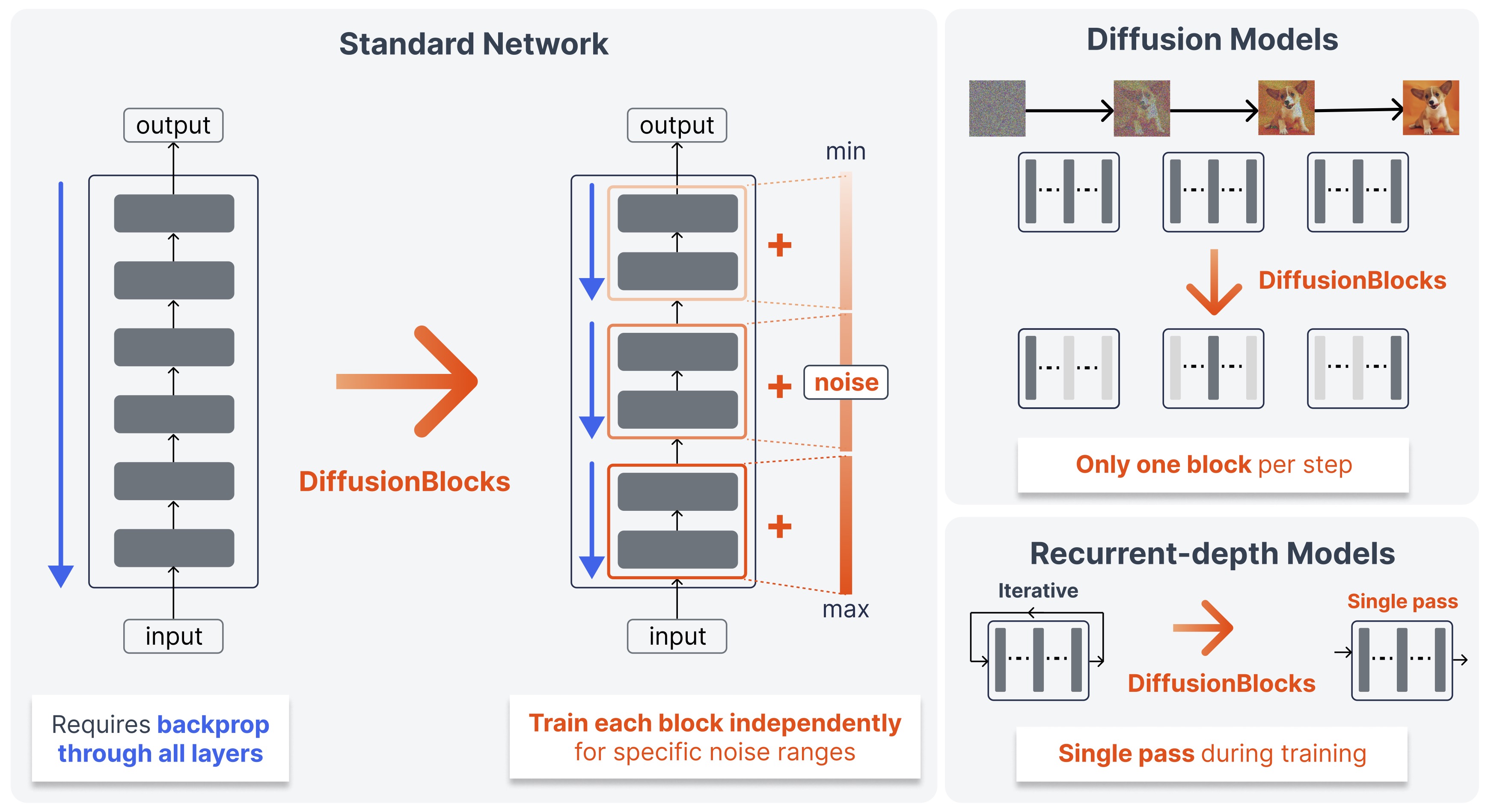
We propose DiffusionBlocks, a principled framework that partitions transformers into independently trainable blocks, reducing memory requirements proportionally while maintaining competitive performance across diverse architectures and tasks.
This is an official implementation of DiffusionBlocks on image classification using Vision Transformers (ViT).
Installation
Please install uv. Then, run:
# Install dependencies
uv sync

# make sure to login huggingface and wandb
uv run huggingface-cli login
uv run wandb login
We conducted our experiments in the following environment: Python Version 3.12 and CUDA Version 12.2 H100.
Training
The model checkpoints are saved in logs folder.
Baseline (ViT):
uv run main.py train cifar100 --model_type vit
DiffusionBlocks:
uv run main.py train cifar100 --model_type dblock
- NOTE: the total epochs in DiffusionBlocks is multiplied by the number of blocks to align the total number of iterations with the baseline as one step in DiffusionBlocks corresponds to training for one block.
In the base setting, we don't reply on techniques such as heavy data augmentation. In case you want to see the performance with heavy data augmentation and learning rate scheduler, run as follows:
Baseline (ViT):
BATCH_SIZE=128
EPOCHS=1000
POSTFIX="-rand-augment"
WARMUP_STEPS=3900
MODEL_TYPE="dblock"
srun uv run main.py train cifar100 \
    --model_type $MODEL_TYPE \
    --batch_size $BATCH_SIZE --num_epochs $EPOCHS --postfix=$POSTFIX \
    --scheduler_type cosine_with_min_lr --num_warmup_steps $WARMUP_STEPS --lr 5e-4 \
    --scheduler_specific_kwargs '{"min_lr": 5e-5}' \
    --add_rand_aug
DiffusionBlocks:
BATCH_SIZE=128
EPOCHS=1000
POSTFIX="-rand-augment"
WARMUP_STEPS=$((3900 * 3)) # 3 indicates the number of blocks
MODEL_TYPE="dblock"
srun uv run main.py train cifar100 \
    --model_type $MODEL_TYPE \
    --batch_size $BATCH_SIZE --num_epochs $EPOCHS --postfix=$POSTFIX \
    --scheduler_type cosine_with_min_lr --num_warmup_steps $WARMUP_STEPS --lr 5e-4 \
    --scheduler_specific_kwargs '{"min_lr": 5e-5}' \
    --add_rand_aug
Evaluation
Baseline (ViT):
CKPT_PATH="logs/path-to-last.ckpt"
uv run main.py test cifar100 --model_type vit --ckpt_path $CKPT
DiffusionBlocks:
CKPT_PATH="logs/path-to-last.ckpt"
uv run main.py test cifar100 --model_type dblock --ckpt_path $CKPT
Acknowledgement
The implementation of Vision Transformer in vit.py is based on HuggingFace Transformers. And, the implementation of EDM is based on Stability-AI/generative-models.
We are grateful for their work.
Citation
To cite our work, please use the following BibTeX:
@inproceedings{shing2026diffusionblocks,
  title     = {DiffusionBlocks: Block-wise Neural Network Training via Diffusion Interpretation},
  author.   = {Makoto Shing and Masanori Koyama and Takuya Akiba},
  booktitle = {The Fourteenth International Conference on Learning Representations},
  year      = {2026},
  url       = {https://openreview.net/forum?id=pwVSmK71cS}
}
Contributors

1 commits
Similar repos


Languages
Python
100.0%
DiffusionBlocks: Block-wise Neural Network Training via Diffusion Interpretation
See the codeREADME
DiffusionBlocks (ICLR 2026)
We propose DiffusionBlocks, a principled framework that partitions transformers into independently trainable blocks, reducing memory requirements proportionally while maintaining competitive performance across diverse architectures and tasks.
This is an official implementation of DiffusionBlocks on image classification using Vision Transformers (ViT).
Installation
Please install uv. Then, run:
# Install dependencies
uv sync

# make sure to login huggingface and wandb
uv run huggingface-cli login
uv run wandb login
We conducted our experiments in the following environment: Python Version 3.12 and CUDA Version 12.2 H100.
Training
The model checkpoints are saved in logs folder.
Baseline (ViT):
uv run main.py train cifar100 --model_type vit
DiffusionBlocks:
uv run main.py train cifar100 --model_type dblock
- NOTE: the total epochs in DiffusionBlocks is multiplied by the number of blocks to align the total number of iterations with the baseline as one step in DiffusionBlocks corresponds to training for one block.
In the base setting, we don't reply on techniques such as heavy data augmentation. In case you want to see the performance with heavy data augmentation and learning rate scheduler, run as follows:
Baseline (ViT):
BATCH_SIZE=128
EPOCHS=1000
POSTFIX="-rand-augment"
WARMUP_STEPS=3900
MODEL_TYPE="dblock"
srun uv run main.py train cifar100 \
    --model_type $MODEL_TYPE \
    --batch_size $BATCH_SIZE --num_epochs $EPOCHS --postfix=$POSTFIX \
    --scheduler_type cosine_with_min_lr --num_warmup_steps $WARMUP_STEPS --lr 5e-4 \
    --scheduler_specific_kwargs '{"min_lr": 5e-5}' \
    --add_rand_aug
DiffusionBlocks:
BATCH_SIZE=128
EPOCHS=1000
POSTFIX="-rand-augment"
WARMUP_STEPS=$((3900 * 3)) # 3 indicates the number of blocks
MODEL_TYPE="dblock"
srun uv run main.py train cifar100 \
    --model_type $MODEL_TYPE \
    --batch_size $BATCH_SIZE --num_epochs $EPOCHS --postfix=$POSTFIX \
    --scheduler_type cosine_with_min_lr --num_warmup_steps $WARMUP_STEPS --lr 5e-4 \
    --scheduler_specific_kwargs '{"min_lr": 5e-5}' \
    --add_rand_aug
Evaluation
Baseline (ViT):
CKPT_PATH="logs/path-to-last.ckpt"
uv run main.py test cifar100 --model_type vit --ckpt_path $CKPT
DiffusionBlocks:
CKPT_PATH="logs/path-to-last.ckpt"
uv run main.py test cifar100 --model_type dblock --ckpt_path $CKPT
Acknowledgement
The implementation of Vision Transformer in vit.py is based on HuggingFace Transformers. And, the implementation of EDM is based on Stability-AI/generative-models.
We are grateful for their work.
Citation
To cite our work, please use the following BibTeX:
@inproceedings{shing2026diffusionblocks,
  title     = {DiffusionBlocks: Block-wise Neural Network Training via Diffusion Interpretation},
  author.   = {Makoto Shing and Masanori Koyama and Takuya Akiba},
  booktitle = {The Fourteenth International Conference on Learning Representations},
  year      = {2026},
  url       = {https://openreview.net/forum?id=pwVSmK71cS}
}
Similar repos
Contributors
1 commits
Languages
Python
100.0%