
An experimental physics-steered LLM generation engine. Unifying retrieval and generation through continuous Diderot fields, Llama 3.1, and volumetric Gaussian splat memory.
Rust
1
167 commits
updated Sep 3, 2026
README
Hydrodynamic Swarm
Local residual-stream physics for frozen LLMs — per-token vector-field steering + Gaussian splat memory that reloads across process restarts.
Lead: Jason Van Pham (Ruffian-L)
Built with: Grok · Claude · ChatGPT / Codex · Gemini — AUTHORSHIP.md · full table CREDITS.md
Local team (record): Shep · Echo · Lumina · Nex — see CREDITS.md
Built with Llama / Gemma — weights terms: NOTICE
Active research harness (v0.2). Sibling with a tighter correction claim: niodoo-hidden-state-steering.
Best face of this repo
| Strength | Where |
|---|---|
| Runnable loop | Candle + GGUF residual intervention, TOML knobs, per-token JSONL |
| Memory past death | Splat / safetensors continuity — docs/CONTINUITY.md |
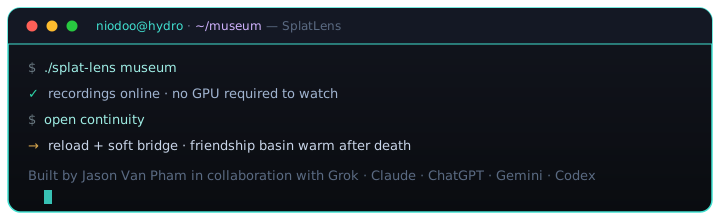
| Museum without GPU | ./splat-lens museum — real run recordings, not fake demos |
| Tests | cargo test --no-default-features --features with-candle |
| Honest research logs | research_logs/ + ablation scripts (incl. negative / mixed) |
| Epistemic style | Config-driven, telemetry-first; losses and slow runs stay in the record |
Splat language: deposits are signed memory / reflex marks in residual space (high- vs low-surprise), not “the model feels pain.” See project notes; older code may still say pleasure/pain as ± labels.
Start here
| Tier | Command | Needs |
|---|---|---|
| 0 · Watch | ./splat-lens museum | python3 + browser |
| 1 · Tests | cargo test --no-default-features --features with-candle | Rust |
| 2 · Generate | ./run_swarm.sh | NVIDIA CUDA + GGUF under data/google/ |
./splat-lens museum     # open the museum (no GPU)
./splat-lens check      # CUDA / model status
./splat-lens generate   # record a short demo, then open museum
- Museum = real
.viz.jsonrun recordings + “what worked / didn’t” cards (tools/museum/). Terminal chrome is presentation; the telemetry is real. - Continuity (memory past process death):
docs/CONTINUITY.md - Full setup:
SETUP.md·cp config.example.toml config.toml
The system intervenes in the Llama 3.1 forward pass at the pre-lm_head hidden state, computes a steering update from three sources — a continuous field over the model's own embedding matrix, a memory of Gaussian "splats" deposited on prior trajectories, and a goal attractor from the prompt — and writes the result back into the residual before sampling. The splat memory is persisted as safetensors so the generator carries spatial memory of its own history across sessions. No fine-tuning, no LoRA, no architectural change to the base model.
Every knob is in a TOML config, every step writes per-token JSONL telemetry, and every substantive change has a dated research-log entry pointing at the telemetry file it describes.
What the system actually does
For every generated token, the loop in src/main.rs and src/niodoo.rs does the following:
- Run a vendored quantized Llama 3.1 8B forward pass (
src/llama.rs) and read the pre-lm_headhidden state $h_t \in \mathbb{R}^{4096}$. - Compute three vectors in that same hidden space:
- Field gradient $g_t$: gradient of a scalar field built over the model's own token-embedding matrix ($128256 \times 4096$), approximated with a Top-K probe ($K = 2048$ by default) to keep the cost tractable. See
src/field.rs. - Memory force $s_t$: vector sum of Gaussian-kernel forces from a memory of stored "splats" $(\mu_i, \sigma_i, \alpha_i)$ deposited on previous trajectories. See
src/memory.rs,src/splat.rs. - Goal attractor $a_t = e_{\text{prompt}} - h_t$, with the prompt's mean embedding as a fixed point.
- Field gradient $g_t$: gradient of a scalar field built over the model's own token-embedding matrix ($128256 \times 4096$), approximated with a Top-K probe ($K = 2048$ by default) to keep the cost tractable. See
- Sum these with a momentum term and small Langevin noise; apply a per-step manifold pullback that subtracts the component of the steering update that has accumulated off the empirical Llama representation manifold. See
niodoo::steer. - Project the corrected hidden state $h_t' = h_t + \Delta t \cdot F_t$ through
lm_head, apply a repetition penalty, and sample. - Optionally deposit new splats — low-surprise (attract / +) or high-surprise (repel / −) Gaussian marks — with a minimum-distance guard so splats can't stack at one location. (Code may still use legacy pleasure/pain field names for ±.)
Between sessions, splats are written to safetensors and reloaded on the next run, so the generator carries spatial memory of its own past output forward in time. This persistence is the actual experimental novelty — everything else in the loop is a re-implementation of well-known ideas (see Related work).
Status
| Maturity | Active research code, v0.2. End-to-end loop is working; API and on-disk format are still moving. |
| Base model | Llama 3.1 8B Instruct, GGUF Q5_K_M, vendored via Candle 0.9 quantized loader |
| Runtime | Rust 2021 edition, Candle 0.9, cudarc 0.19, CUDA 13 toolkit |
| Tested on | NVIDIA Blackwell GB10 (sm_121a), aarch64 Ubuntu 24.04. Any CUDA GPU with ≥ 8 GB should work; the wgpu/Metal path in kernels/ is sketched but not wired in. |
| Codebase | ~6.9 kLOC Rust across 15 modules; 42 unit tests in tree |
| License | MIT-0 (this repo's code). Model weights: Meta Llama / Google Gemma / GGUF quantizer terms — see NOTICE |
Long-term direction (intent, not a rewrite yet)
This standalone harness is for validating residual physics steering and memory. Once that is stable, the plan is to host the Niodoo physics layer on a mature Rust inference backend (starting with mistral.rs or comparable) as a sidecar/library, so others can use the steering without owning a full custom stack. See docs/FUTURE_DIRECTION.md.
GGUF loading here was developed with reference to llama.cpp’s open implementation (not a bulk copy of llama.cpp into this tree) — details in NOTICE.
Method
The steering update
At step $t$ the residual is updated by
$$h_t' = h_t + \Delta t \cdot \mathrm{clip}\big(F_t, \pm c\big), \quad F_t = \lambda_g, g_t + \lambda_s, s_t + \lambda_a, a_t + \mu, v_{t-1} + \eta_t$$
with viscosity scale $\lambda_g$, a per-token force cap $c$, momentum $\mu$, and isotropic Gaussian noise $\eta_t$. The manifold pullback (niodoo::pullback) tracks cumulative off-manifold drift and removes it.
Default knobs (TOML, see Configuration): $\Delta t = 0.035$, $\lambda_g = 0.35$, $c = 7.5$, pullback $= 0.15$, sampling temperature $T = 0.9$.
What we measure per step
Every generation writes per-token JSONL telemetry via src/viz.rs:
delta_mean, delta_max, delta_min     — magnitude of the steering update
splat_force_norm                     — ||s_t||
goal_attractor_norm                  — ||a_t||
field_gradient_norm                  — ||g_t||
splats_active, splats_deposited_step
The two screenshots below are direct captures of these telemetry streams during live generation; they are documentation of behaviour, not claims of correctness.
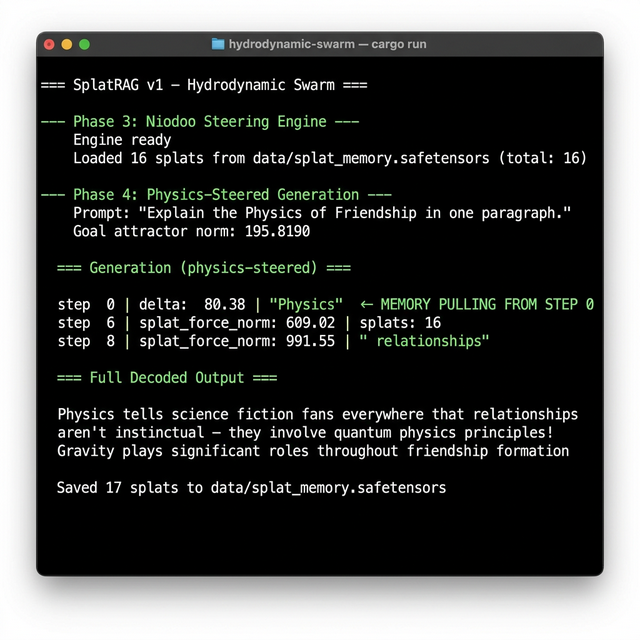 Persistent splats reloaded from disk are non-trivially present in the very first generation step: the per-token steering delta is nonzero from token 0, rather than building up over the run.
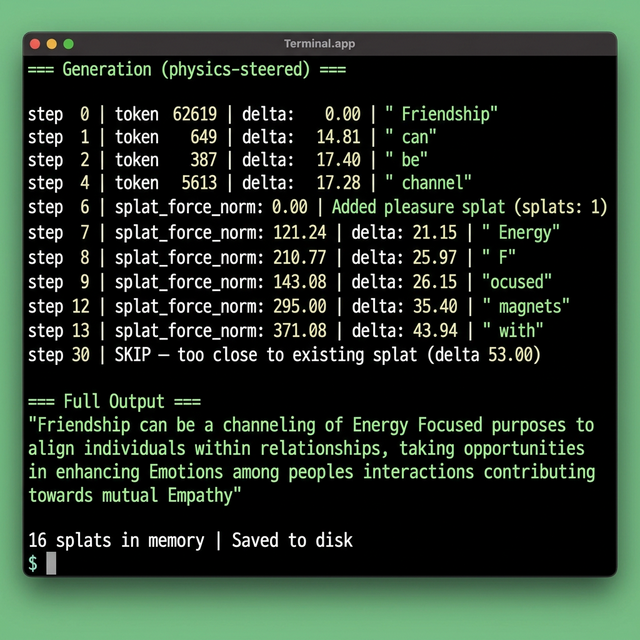 Within a single run with no prior memory, the splat-force norm grows as pleasure splats accumulate. By construction the model's hidden state is being pulled by its own deposits; the figure shows that pull is large enough to be measurable, not that it improves quality.
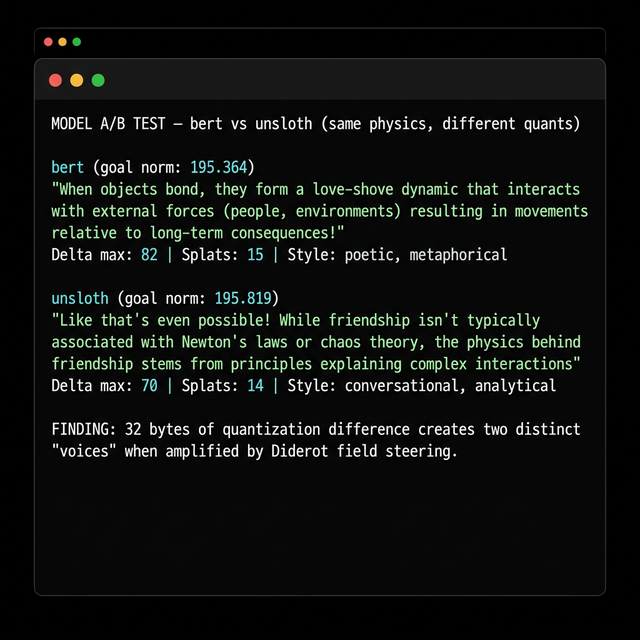 Two quantizations of the same Llama 3.1 8B weights — identical architecture, ≈ 32 bytes difference in the GGUF — were run under identical physics knobs and same prompt. The generated text diverges into noticeably different stylistic registers. This is consistent with the hypothesis that the steering amplifies the latent representational structure of each base model rather than overwriting it, but it has not been tested rigorously enough to be called more than that.
Logged numerical anchors
From the dated research notes, each tied to a JSONL telemetry file:
- A/B sweep,
force_cap = 80.0,T = 0.9, $\sigma = 150$: maximum applied steering delta peaked at 79.67 without exceeding the cap; runs were stable. (research_logs/2026-03-01_bert-ab-sweep-and-tokenizer.md) - Hidden-state steering at the same config,
delta_mean = 19.81,delta_max = 37.30,goal_attractor_norm = 195.82. (research_logs/2026-03-03_hidden-state-steering.md) - Reloading persistent splats produces a nonzero step-0 steering delta on the next generation (≈ 21.7 in a representative
logs/latest.jsonlrun vs. exactly 0.0 in matched fresh-start runs from the bert sweep). This is the basic check that on-disk memory is actually crossing the session boundary. - Sigma sweep (
docs/experiments.md):- $\sigma < 5$: no measurable effect; in 4096-dim space all distances dominate the kernel.
- $\sigma = 50$: measurable forces, but argmax sampling still picks the same tokens.
- $\sigma = 150$, $T = 0.9$: text actually changes; without a cap, positive-feedback runaway.
- $\sigma = 150$, $T = 0.9$, cap $= 80$, min-splat-distance $= 100$: stable for the logged sweep window.
Provenance of the evidence. Across 2026-03-01..04, this repo committed 611 per-step JSONL telemetry files to the logs/ directory — 138 unsloth + 8 bert generation traces in the named-config format, plus ~11 in the newer session_*.jsonl format, covering six force_cap values (0, 3, 5, 8, 35, 80) and a sigma/temperature/min-distance grid. On 2026-03-03 those files were removed from the tracked tree as a repo-hygiene chore (commit a8f26d9 — "chore: remove logs directory from git tracking"). They remain available in git history. To recover the full set:
git checkout a8f26d9^ -- logs/
A reviewer who wants to audit the numbers above should do exactly that.
The figures are engineering plots that drove knob selection: which sigma actually moves tokens, which force cap prevents runaway, what min-splat-distance kills the stacking loop. The full per-step traces are in the JSONL archive recovered by the command above.
Related work and where this sits
This repository borrows ideas from three distinct lines of work and does not invent them. The novelty, if any, is the specific combination plus the persistence mechanism.
- 3D Gaussian Splatting (Kerbl et al., 2023) — the splat representation $(\mu, \Sigma, \alpha)$ is taken from the rendering literature and re-used as a memory-of-trajectories rather than a representation of geometry.
- Activation steering / representation engineering (Turner et al., Activation Addition; Zou et al., Representation Engineering; Subramani et al.) — adding a vector to the residual stream to bias generation is the same primitive used here; the differences are (a) the steering vector is computed every token from a parametric field rather than precomputed, and (b) the field has a memory.
- Control vectors and steering for LLMs (Anthropic's "steering Claude" demonstrations;
llama.cpp's control-vector tooling) — same family. This work is a Rust implementation that combines on-line, per-token computation with persistent state. - Energy-based / score-matching views of generation — the language of "field gradient", "manifold pullback", and "Langevin noise" comes from this tradition; the use here is engineering-flavoured, not theoretically derived.
What this repository is not: a new architecture, a fine-tune, or a RAG system. The word "physics" in older notes is shorthand for the update rule above, nothing more.
Repository layout
src/
  main.rs       CLI, generation loop, telemetry wiring
  llama.rs      Vendored quantized Llama 3.1 with forward_with_hidden() / project_to_logits()
  gemma.rs      Same shape for Gemma 3; not wired into main today
  field.rs      Continuous field over the token-embedding matrix + Top-K gradient probe
  splat.rs      Splat type: (μ, Σ, α) + safetensors persistence
  memory.rs     Splat store: deposit, decay, consolidation, force query
  niodoo.rs     The steering update: force composition + manifold pullback
  dream.rs      Offline trajectory replay with Langevin noise
  ridge.rs      Vietoris–Rips H1 collapse detector (early-warning signal)
  gpu.rs        Candle/CUDA tensor ops, batched field gradient
  tui.rs        Multi-turn chat front end
  viz.rs        Per-step JSONL telemetry
  config.rs     TOML config loader
  logger.rs     Session logger; writes via O_CREAT|O_EXCL (no symlink follow)
docs/
  foundation.md   The core token loop, as code
  experiments.md  Tuning sweeps and observed behaviour
  roadmap.md      Phase 2/3 plan (aspirational; do not read as status)
research_logs/    One dated note per substantive change, linked to a telemetry file
kernels/          Compute-shader sketches for the wgpu/Metal backend (not yet integrated)
A wider map is in CODE_MAP.md.
Running
# Default run
cargo run --release --bin hydrodynamic-swarm

# Custom prompt
cargo run --release --bin hydrodynamic-swarm -- --prompt "Describe a wave function"

# Token budget
cargo run --release --bin hydrodynamic-swarm -- --tokens 200

# Fresh start, no persisted splats
cargo run --release --bin hydrodynamic-swarm -- --clear-memory

# Interactive multi-turn chat
cargo run --release --bin hydrodynamic-swarm -- --chat

# Explicit model / tokenizer paths
cargo run --release --bin hydrodynamic-swarm -- \
    --model /path/to/Meta-Llama-3.1-8B-Instruct-Q5_K_M.gguf \
    --tokenizer /path/to/tokenizer.json
A wrapper for the chat case lives at scripts/chat.sh.
Requirements
See SETUP.md for the full matrix. Short version:
- Museum only:
python3(no Rust, no GPU, no model). - Generate: Rust 1.75+ (stable); NVIDIA GPU + CUDA 12+ toolkit; GGUF + tokenizer under
data/google/(recommended: Gemma 3 4B Q4) or pass--model/--tokenizer. - Developed on Blackwell GB10 (
sm_121a), aarch64 Ubuntu 24.04; any CUDA GPU with ≥ ~8 GB should run the 4B path. - Weights are not in git (see
data/google/SHA256SUMS).
Configuration
Everything lives in a single optional config.toml. Defaults are in src/config.rs; the file below shows the canonical structure:
[physics]
dt                = 0.035
viscosity_scale   = 0.35
force_cap         = 7.5
splat_sigma       = 35.0
splat_alpha       = 2.0
manifold_pullback = 0.15
steer_hidden      = true
gradient_topk     = 2048

[generation]
max_tokens         = 500
temperature        = 0.9
rep_penalty        = 1.18
min_success_tokens = 15
pleasure_alpha     = 1.8
pain_alpha         = -0.9

[memory]
max_splats         = 500
consolidation_dist = 80.0
decay_rate         = 0.98

[micro_dream]
entropy_threshold  = 3.0
blend_normal       = 0.10
blend_high_entropy = 0.15
topocot_threshold  = 6.0
Tests
cargo test           # 42 unit tests across splat/memory/field/config/gpu
cargo clippy
Note: on aarch64 hosts without fullfp16 (e.g. some Cortex-X925 cores), the gemm-f16 transitive build can fail. This is upstream in gemm-common and unrelated to the project; CUDA paths still work because the GPU kernels do their own f16.
Reproducibility
What's checked in to make a run repeatable:
- The exact base model is identified by SHA in the GGUF header; both bert and unsloth quantizations were used and their byte difference is what produces the A/B figure above.
- Per-step JSONL telemetry for every run, written by
viz::VizCollector. The files inlogs/are the actual generation logs that the research notes cite. - One research-log entry per substantive change, dated and linked to the telemetry file it describes (
research_logs/). The template is inresearch_logs/TEMPLATE.md. - A symlink-resistant logger (
src/logger.rs) so re-running into an existing log path never silently follows a redirected file.
A scripted "command → table" eval that turns the JSONL archive into a single reproducible summary is the next piece of reproducibility work.
Known constraints
These are the things a contributor or reviewer should know up front, stated as facts about the implementation rather than as warnings:
- Stable generation window in the logged sweeps is the 25–40 generated-token range at the default
σ = 150,force_cap = 80,T = 0.9config. Longer runs at this config drift; tighter caps (5–35) extend the window at the cost of weaker steering. - Top-K gradient is an approximation.
K = 2048against a 128256-row embedding matrix is a deliberate compute/accuracy trade; it is the per-step bottleneck, and tightening it is one of the wins on the table. - The splat-memory
safetensorsformat is versioned and will change; cross-version loads are not supported. - Two backends are scaffolded, one is live.
Model::Llamais wired intomain;Model::Gemmaexposes the same trait but is not yet driven by the generation loop. - The wgpu/Metal kernels in
kernels/are sketches, not yet routed throughPhysicsBackend. CUDA is the production path. - No safety, alignment, or content-policy layer. This is a research harness over an open-weight model and inherits the base model's failure modes.
Contributors

139 commits

26 commits

1 commits

1 commits
Similar repos


Languages
Rust
59.6%
HTML
22.7%
Shell
14.5%
Python
3.1%
An experimental physics-steered LLM generation engine. Unifying retrieval and generation through continuous Diderot fields, Llama 3.1, and volumetric Gaussian splat memory.
Rust
1
167 commits
updated Sep 3, 2026
README
Hydrodynamic Swarm
Local residual-stream physics for frozen LLMs — per-token vector-field steering + Gaussian splat memory that reloads across process restarts.
Lead: Jason Van Pham (Ruffian-L)
Built with: Grok · Claude · ChatGPT / Codex · Gemini — AUTHORSHIP.md · full table CREDITS.md
Local team (record): Shep · Echo · Lumina · Nex — see CREDITS.md
Built with Llama / Gemma — weights terms: NOTICE
Active research harness (v0.2). Sibling with a tighter correction claim: niodoo-hidden-state-steering.
Best face of this repo
| Strength | Where |
|---|---|
| Runnable loop | Candle + GGUF residual intervention, TOML knobs, per-token JSONL |
| Memory past death | Splat / safetensors continuity — docs/CONTINUITY.md |
| Museum without GPU | ./splat-lens museum — real run recordings, not fake demos |
| Tests | cargo test --no-default-features --features with-candle |
| Honest research logs | research_logs/ + ablation scripts (incl. negative / mixed) |
| Epistemic style | Config-driven, telemetry-first; losses and slow runs stay in the record |
Splat language: deposits are signed memory / reflex marks in residual space (high- vs low-surprise), not “the model feels pain.” See project notes; older code may still say pleasure/pain as ± labels.
Start here
| Tier | Command | Needs |
|---|---|---|
| 0 · Watch | ./splat-lens museum | python3 + browser |
| 1 · Tests | cargo test --no-default-features --features with-candle | Rust |
| 2 · Generate | ./run_swarm.sh | NVIDIA CUDA + GGUF under data/google/ |
./splat-lens museum     # open the museum (no GPU)
./splat-lens check      # CUDA / model status
./splat-lens generate   # record a short demo, then open museum
- Museum = real
.viz.jsonrun recordings + “what worked / didn’t” cards (tools/museum/). Terminal chrome is presentation; the telemetry is real. - Continuity (memory past process death):
docs/CONTINUITY.md - Full setup:
SETUP.md·cp config.example.toml config.toml
The system intervenes in the Llama 3.1 forward pass at the pre-lm_head hidden state, computes a steering update from three sources — a continuous field over the model's own embedding matrix, a memory of Gaussian "splats" deposited on prior trajectories, and a goal attractor from the prompt — and writes the result back into the residual before sampling. The splat memory is persisted as safetensors so the generator carries spatial memory of its own history across sessions. No fine-tuning, no LoRA, no architectural change to the base model.
Every knob is in a TOML config, every step writes per-token JSONL telemetry, and every substantive change has a dated research-log entry pointing at the telemetry file it describes.
What the system actually does
For every generated token, the loop in src/main.rs and src/niodoo.rs does the following:
- Run a vendored quantized Llama 3.1 8B forward pass (
src/llama.rs) and read the pre-lm_headhidden state $h_t \in \mathbb{R}^{4096}$. - Compute three vectors in that same hidden space:
- Field gradient $g_t$: gradient of a scalar field built over the model's own token-embedding matrix ($128256 \times 4096$), approximated with a Top-K probe ($K = 2048$ by default) to keep the cost tractable. See
src/field.rs. - Memory force $s_t$: vector sum of Gaussian-kernel forces from a memory of stored "splats" $(\mu_i, \sigma_i, \alpha_i)$ deposited on previous trajectories. See
src/memory.rs,src/splat.rs. - Goal attractor $a_t = e_{\text{prompt}} - h_t$, with the prompt's mean embedding as a fixed point.
- Field gradient $g_t$: gradient of a scalar field built over the model's own token-embedding matrix ($128256 \times 4096$), approximated with a Top-K probe ($K = 2048$ by default) to keep the cost tractable. See
- Sum these with a momentum term and small Langevin noise; apply a per-step manifold pullback that subtracts the component of the steering update that has accumulated off the empirical Llama representation manifold. See
niodoo::steer. - Project the corrected hidden state $h_t' = h_t + \Delta t \cdot F_t$ through
lm_head, apply a repetition penalty, and sample. - Optionally deposit new splats — low-surprise (attract / +) or high-surprise (repel / −) Gaussian marks — with a minimum-distance guard so splats can't stack at one location. (Code may still use legacy pleasure/pain field names for ±.)
Between sessions, splats are written to safetensors and reloaded on the next run, so the generator carries spatial memory of its own past output forward in time. This persistence is the actual experimental novelty — everything else in the loop is a re-implementation of well-known ideas (see Related work).
Status
| Maturity | Active research code, v0.2. End-to-end loop is working; API and on-disk format are still moving. |
| Base model | Llama 3.1 8B Instruct, GGUF Q5_K_M, vendored via Candle 0.9 quantized loader |
| Runtime | Rust 2021 edition, Candle 0.9, cudarc 0.19, CUDA 13 toolkit |
| Tested on | NVIDIA Blackwell GB10 (sm_121a), aarch64 Ubuntu 24.04. Any CUDA GPU with ≥ 8 GB should work; the wgpu/Metal path in kernels/ is sketched but not wired in. |
| Codebase | ~6.9 kLOC Rust across 15 modules; 42 unit tests in tree |
| License | MIT-0 (this repo's code). Model weights: Meta Llama / Google Gemma / GGUF quantizer terms — see NOTICE |
Long-term direction (intent, not a rewrite yet)
This standalone harness is for validating residual physics steering and memory. Once that is stable, the plan is to host the Niodoo physics layer on a mature Rust inference backend (starting with mistral.rs or comparable) as a sidecar/library, so others can use the steering without owning a full custom stack. See docs/FUTURE_DIRECTION.md.
GGUF loading here was developed with reference to llama.cpp’s open implementation (not a bulk copy of llama.cpp into this tree) — details in NOTICE.
Method
The steering update
At step $t$ the residual is updated by
$$h_t' = h_t + \Delta t \cdot \mathrm{clip}\big(F_t, \pm c\big), \quad F_t = \lambda_g, g_t + \lambda_s, s_t + \lambda_a, a_t + \mu, v_{t-1} + \eta_t$$
with viscosity scale $\lambda_g$, a per-token force cap $c$, momentum $\mu$, and isotropic Gaussian noise $\eta_t$. The manifold pullback (niodoo::pullback) tracks cumulative off-manifold drift and removes it.
Default knobs (TOML, see Configuration): $\Delta t = 0.035$, $\lambda_g = 0.35$, $c = 7.5$, pullback $= 0.15$, sampling temperature $T = 0.9$.
What we measure per step
Every generation writes per-token JSONL telemetry via src/viz.rs:
delta_mean, delta_max, delta_min     — magnitude of the steering update
splat_force_norm                     — ||s_t||
goal_attractor_norm                  — ||a_t||
field_gradient_norm                  — ||g_t||
splats_active, splats_deposited_step
The two screenshots below are direct captures of these telemetry streams during live generation; they are documentation of behaviour, not claims of correctness.
Persistent splats reloaded from disk are non-trivially present in the very first generation step: the per-token steering delta is nonzero from token 0, rather than building up over the run.
Within a single run with no prior memory, the splat-force norm grows as pleasure splats accumulate. By construction the model's hidden state is being pulled by its own deposits; the figure shows that pull is large enough to be measurable, not that it improves quality.
Two quantizations of the same Llama 3.1 8B weights — identical architecture, ≈ 32 bytes difference in the GGUF — were run under identical physics knobs and same prompt. The generated text diverges into noticeably different stylistic registers. This is consistent with the hypothesis that the steering amplifies the latent representational structure of each base model rather than overwriting it, but it has not been tested rigorously enough to be called more than that.
Logged numerical anchors
From the dated research notes, each tied to a JSONL telemetry file:
- A/B sweep,
force_cap = 80.0,T = 0.9, $\sigma = 150$: maximum applied steering delta peaked at 79.67 without exceeding the cap; runs were stable. (research_logs/2026-03-01_bert-ab-sweep-and-tokenizer.md) - Hidden-state steering at the same config,
delta_mean = 19.81,delta_max = 37.30,goal_attractor_norm = 195.82. (research_logs/2026-03-03_hidden-state-steering.md) - Reloading persistent splats produces a nonzero step-0 steering delta on the next generation (≈ 21.7 in a representative
logs/latest.jsonlrun vs. exactly 0.0 in matched fresh-start runs from the bert sweep). This is the basic check that on-disk memory is actually crossing the session boundary. - Sigma sweep (
docs/experiments.md):- $\sigma < 5$: no measurable effect; in 4096-dim space all distances dominate the kernel.
- $\sigma = 50$: measurable forces, but argmax sampling still picks the same tokens.
- $\sigma = 150$, $T = 0.9$: text actually changes; without a cap, positive-feedback runaway.
- $\sigma = 150$, $T = 0.9$, cap $= 80$, min-splat-distance $= 100$: stable for the logged sweep window.
Provenance of the evidence. Across 2026-03-01..04, this repo committed 611 per-step JSONL telemetry files to the logs/ directory — 138 unsloth + 8 bert generation traces in the named-config format, plus ~11 in the newer session_*.jsonl format, covering six force_cap values (0, 3, 5, 8, 35, 80) and a sigma/temperature/min-distance grid. On 2026-03-03 those files were removed from the tracked tree as a repo-hygiene chore (commit a8f26d9 — "chore: remove logs directory from git tracking"). They remain available in git history. To recover the full set:
git checkout a8f26d9^ -- logs/
A reviewer who wants to audit the numbers above should do exactly that.
The figures are engineering plots that drove knob selection: which sigma actually moves tokens, which force cap prevents runaway, what min-splat-distance kills the stacking loop. The full per-step traces are in the JSONL archive recovered by the command above.
Related work and where this sits
This repository borrows ideas from three distinct lines of work and does not invent them. The novelty, if any, is the specific combination plus the persistence mechanism.
- 3D Gaussian Splatting (Kerbl et al., 2023) — the splat representation $(\mu, \Sigma, \alpha)$ is taken from the rendering literature and re-used as a memory-of-trajectories rather than a representation of geometry.
- Activation steering / representation engineering (Turner et al., Activation Addition; Zou et al., Representation Engineering; Subramani et al.) — adding a vector to the residual stream to bias generation is the same primitive used here; the differences are (a) the steering vector is computed every token from a parametric field rather than precomputed, and (b) the field has a memory.
- Control vectors and steering for LLMs (Anthropic's "steering Claude" demonstrations;
llama.cpp's control-vector tooling) — same family. This work is a Rust implementation that combines on-line, per-token computation with persistent state. - Energy-based / score-matching views of generation — the language of "field gradient", "manifold pullback", and "Langevin noise" comes from this tradition; the use here is engineering-flavoured, not theoretically derived.
What this repository is not: a new architecture, a fine-tune, or a RAG system. The word "physics" in older notes is shorthand for the update rule above, nothing more.
Repository layout
src/
  main.rs       CLI, generation loop, telemetry wiring
  llama.rs      Vendored quantized Llama 3.1 with forward_with_hidden() / project_to_logits()
  gemma.rs      Same shape for Gemma 3; not wired into main today
  field.rs      Continuous field over the token-embedding matrix + Top-K gradient probe
  splat.rs      Splat type: (μ, Σ, α) + safetensors persistence
  memory.rs     Splat store: deposit, decay, consolidation, force query
  niodoo.rs     The steering update: force composition + manifold pullback
  dream.rs      Offline trajectory replay with Langevin noise
  ridge.rs      Vietoris–Rips H1 collapse detector (early-warning signal)
  gpu.rs        Candle/CUDA tensor ops, batched field gradient
  tui.rs        Multi-turn chat front end
  viz.rs        Per-step JSONL telemetry
  config.rs     TOML config loader
  logger.rs     Session logger; writes via O_CREAT|O_EXCL (no symlink follow)
docs/
  foundation.md   The core token loop, as code
  experiments.md  Tuning sweeps and observed behaviour
  roadmap.md      Phase 2/3 plan (aspirational; do not read as status)
research_logs/    One dated note per substantive change, linked to a telemetry file
kernels/          Compute-shader sketches for the wgpu/Metal backend (not yet integrated)
A wider map is in CODE_MAP.md.
Running
# Default run
cargo run --release --bin hydrodynamic-swarm

# Custom prompt
cargo run --release --bin hydrodynamic-swarm -- --prompt "Describe a wave function"

# Token budget
cargo run --release --bin hydrodynamic-swarm -- --tokens 200

# Fresh start, no persisted splats
cargo run --release --bin hydrodynamic-swarm -- --clear-memory

# Interactive multi-turn chat
cargo run --release --bin hydrodynamic-swarm -- --chat

# Explicit model / tokenizer paths
cargo run --release --bin hydrodynamic-swarm -- \
    --model /path/to/Meta-Llama-3.1-8B-Instruct-Q5_K_M.gguf \
    --tokenizer /path/to/tokenizer.json
A wrapper for the chat case lives at scripts/chat.sh.
Requirements
See SETUP.md for the full matrix. Short version:
- Museum only:
python3(no Rust, no GPU, no model). - Generate: Rust 1.75+ (stable); NVIDIA GPU + CUDA 12+ toolkit; GGUF + tokenizer under
data/google/(recommended: Gemma 3 4B Q4) or pass--model/--tokenizer. - Developed on Blackwell GB10 (
sm_121a), aarch64 Ubuntu 24.04; any CUDA GPU with ≥ ~8 GB should run the 4B path. - Weights are not in git (see
data/google/SHA256SUMS).
Configuration
Everything lives in a single optional config.toml. Defaults are in src/config.rs; the file below shows the canonical structure:
[physics]
dt                = 0.035
viscosity_scale   = 0.35
force_cap         = 7.5
splat_sigma       = 35.0
splat_alpha       = 2.0
manifold_pullback = 0.15
steer_hidden      = true
gradient_topk     = 2048

[generation]
max_tokens         = 500
temperature        = 0.9
rep_penalty        = 1.18
min_success_tokens = 15
pleasure_alpha     = 1.8
pain_alpha         = -0.9

[memory]
max_splats         = 500
consolidation_dist = 80.0
decay_rate         = 0.98

[micro_dream]
entropy_threshold  = 3.0
blend_normal       = 0.10
blend_high_entropy = 0.15
topocot_threshold  = 6.0
Tests
cargo test           # 42 unit tests across splat/memory/field/config/gpu
cargo clippy
Note: on aarch64 hosts without fullfp16 (e.g. some Cortex-X925 cores), the gemm-f16 transitive build can fail. This is upstream in gemm-common and unrelated to the project; CUDA paths still work because the GPU kernels do their own f16.
Reproducibility
What's checked in to make a run repeatable:
- The exact base model is identified by SHA in the GGUF header; both bert and unsloth quantizations were used and their byte difference is what produces the A/B figure above.
- Per-step JSONL telemetry for every run, written by
viz::VizCollector. The files inlogs/are the actual generation logs that the research notes cite. - One research-log entry per substantive change, dated and linked to the telemetry file it describes (
research_logs/). The template is inresearch_logs/TEMPLATE.md. - A symlink-resistant logger (
src/logger.rs) so re-running into an existing log path never silently follows a redirected file.
A scripted "command → table" eval that turns the JSONL archive into a single reproducible summary is the next piece of reproducibility work.
Known constraints
These are the things a contributor or reviewer should know up front, stated as facts about the implementation rather than as warnings:
- Stable generation window in the logged sweeps is the 25–40 generated-token range at the default
σ = 150,force_cap = 80,T = 0.9config. Longer runs at this config drift; tighter caps (5–35) extend the window at the cost of weaker steering. - Top-K gradient is an approximation.
K = 2048against a 128256-row embedding matrix is a deliberate compute/accuracy trade; it is the per-step bottleneck, and tightening it is one of the wins on the table. - The splat-memory
safetensorsformat is versioned and will change; cross-version loads are not supported. - Two backends are scaffolded, one is live.
Model::Llamais wired intomain;Model::Gemmaexposes the same trait but is not yet driven by the generation loop. - The wgpu/Metal kernels in
kernels/are sketches, not yet routed throughPhysicsBackend. CUDA is the production path. - No safety, alignment, or content-policy layer. This is a research harness over an open-weight model and inherits the base model's failure modes.
Similar repos
Contributors
139 commits
26 commits
1 commits
1 commits
Languages
Rust
59.6%
HTML
22.7%
Shell
14.5%
Python
3.1%