This is the official implementation of *GAR: Generative Adversarial Reinforcement Learning for Formal Theorem Proving*
Python
0
3 commits
updated Mar 1, 2026
This is the official training code implementation of GAR: Generative Adversarial Reinforcement Learning for Formal Theorem Proving. The trained model is available at:
The base datasets are available at:
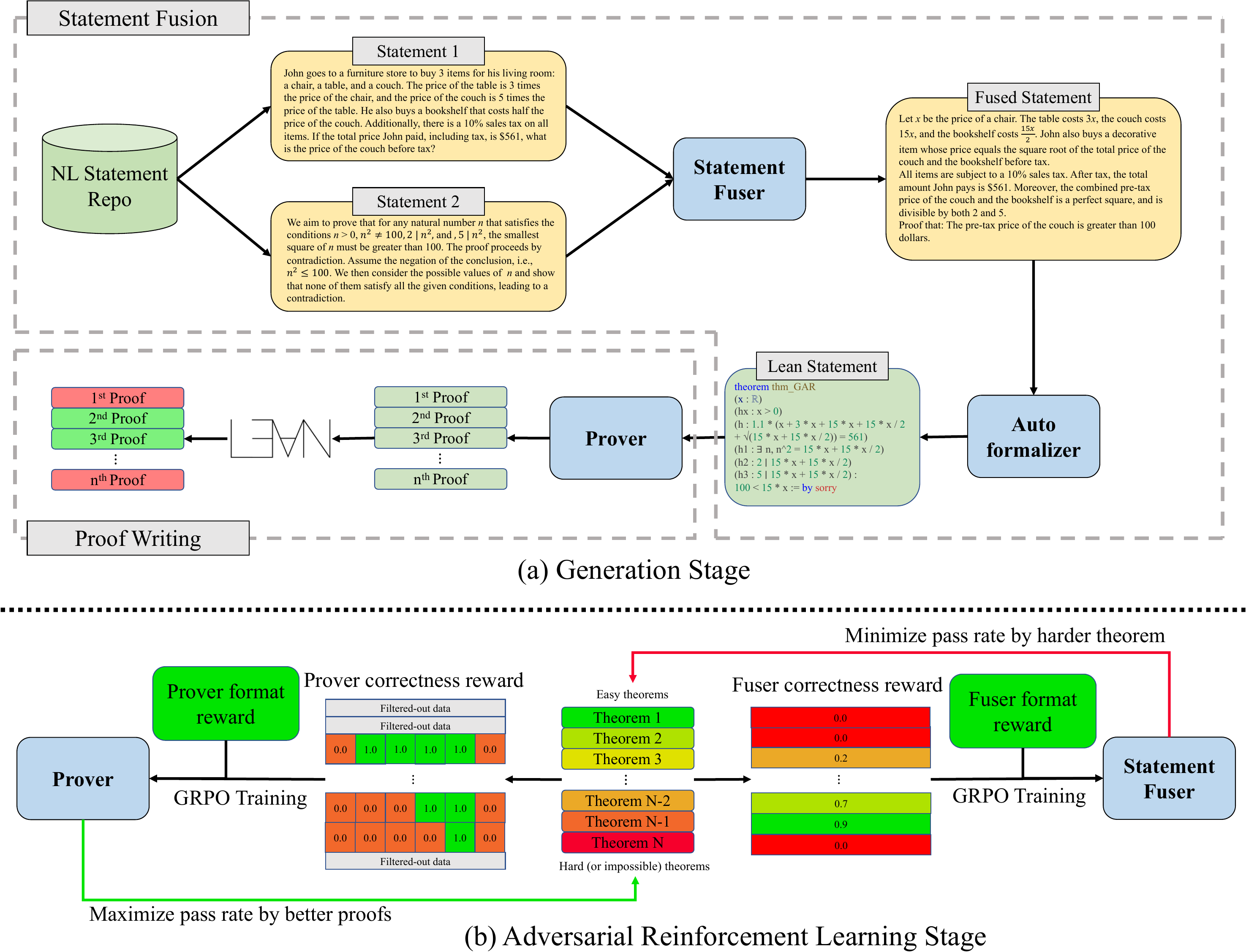
We introduce GAR: Generative Adversarial Reinforcement Learning, an RL training method that intends to solve inefficiency and suboptimial performance in formal theorem prover training caused by fixed problem sets. GAR jointly trains the problem composer and solver in an adversarial loop, which introduces an implicit curriculum learning mechanism, aligning the task difficulty with the prover's evolving capability to improve training efficiency and enabling stronger model performance. Experiments indicates that GAR trained model achieves an avarage of 4.20% of enhancement on MiniF2F-Test under pass@32, and improve the DeepSeek-Prover-V2's pass@32 performance on ProofNet-Test from 22.58% to 25.81%. Beyond theorem proving, GAR establishes a general RL paradigm for co-evolution of problem generation and solving under verifiable environments.
Clone the repo using the following command:
git clone --recurse-submodules [email protected]:RickySkywalker/GAR-Official.git
We apply KiminaLeanServer as the Lean verification server. It can be initialized by:
cd KiminaLeanServer
cp .env.template .env
docker compose up -d
The environment can be set up by running the following command:
conda env create -f environment.yaml
Clone and transform the dataset into JSON form:
from datasets import load_dataset
ds = load_dataset("RickyDeSkywalker/GAR_baseDataset_NuminaMath")
ds["train"].to_json("./base_data/GAR_base_data_Numina-Math.json")
The GAR training can be initialized throught the following command, detailed training config can be found in ./main.py.
python -u ./main.py \
    --training_name GAR-Prover \
    --base_data_path ./base_data/GAR_base_data_Numina-Math.json
@article{wang2025gar,
  title={GAR: Generative Adversarial Reinforcement Learning for Formal Theorem Proving},
  author={Wang, Ruida and Yao, Jiarui and Pan, Rui and Diao, Shizhe and Zhang, Tong},
  journal={arXiv preprint arXiv:2510.11769},
  year={2025}
}
This material is based upon work supported partially by NSF under Grant No. 2416897, Grant No. 2505932, and by ORN under Grant No. N000142512318. This research used both Delta (NSF award OAC 2005572) and DeltaAI (NSF award OAC 2320345) advanced computing systems, and computing resources provided by NAIRR Pilot NAIRR250157.
This is the official implementation of *GAR: Generative Adversarial Reinforcement Learning for Formal Theorem Proving*
Python
0
3 commits
updated Mar 1, 2026
This is the official training code implementation of GAR: Generative Adversarial Reinforcement Learning for Formal Theorem Proving. The trained model is available at:
The base datasets are available at:
We introduce GAR: Generative Adversarial Reinforcement Learning, an RL training method that intends to solve inefficiency and suboptimial performance in formal theorem prover training caused by fixed problem sets. GAR jointly trains the problem composer and solver in an adversarial loop, which introduces an implicit curriculum learning mechanism, aligning the task difficulty with the prover's evolving capability to improve training efficiency and enabling stronger model performance. Experiments indicates that GAR trained model achieves an avarage of 4.20% of enhancement on MiniF2F-Test under pass@32, and improve the DeepSeek-Prover-V2's pass@32 performance on ProofNet-Test from 22.58% to 25.81%. Beyond theorem proving, GAR establishes a general RL paradigm for co-evolution of problem generation and solving under verifiable environments.
Clone the repo using the following command:
git clone --recurse-submodules [email protected]:RickySkywalker/GAR-Official.git
We apply KiminaLeanServer as the Lean verification server. It can be initialized by:
cd KiminaLeanServer
cp .env.template .env
docker compose up -d
The environment can be set up by running the following command:
conda env create -f environment.yaml
Clone and transform the dataset into JSON form:
from datasets import load_dataset
ds = load_dataset("RickyDeSkywalker/GAR_baseDataset_NuminaMath")
ds["train"].to_json("./base_data/GAR_base_data_Numina-Math.json")
The GAR training can be initialized throught the following command, detailed training config can be found in ./main.py.
python -u ./main.py \
    --training_name GAR-Prover \
    --base_data_path ./base_data/GAR_base_data_Numina-Math.json
@article{wang2025gar,
  title={GAR: Generative Adversarial Reinforcement Learning for Formal Theorem Proving},
  author={Wang, Ruida and Yao, Jiarui and Pan, Rui and Diao, Shizhe and Zhang, Tong},
  journal={arXiv preprint arXiv:2510.11769},
  year={2025}
}
This material is based upon work supported partially by NSF under Grant No. 2416897, Grant No. 2505932, and by ORN under Grant No. N000142512318. This research used both Delta (NSF award OAC 2005572) and DeltaAI (NSF award OAC 2320345) advanced computing systems, and computing resources provided by NAIRR Pilot NAIRR250157.