
If the agent bill went up and nothing errored, a prompt cache broke. Replay Doctor names the turn it broke on, the cause, and the tokens re-billed at write prices. Reads Claude Code, Codex and Cursor transcripts already on disk. Local Go CLI, zero dependencies, no account, no telemetry: nothing is sent unless you ask.
1
stars
589
commits
Go
primary language
Sep 14, 2026
updated
README
Replay








GitHub labels this repository 'Other' because its licence detector does not know BUSL-1.1; the licence is the Business Source License 1.1, converting to the Apache License 2.0 on 2029-09-06, and the text is in LICENSE.
If the agent bill went up and nothing errored, a prompt cache broke. Replay Doctor reads the transcripts already on your disk and names the turn it broke on, the cause, and the tokens re-billed at write prices.

The refusals are the feature. Anything this tool cannot measure, it declines to print — and says why, in the place the number would have gone.
replay routewill not quote you dollars for a model pair it has never seen on the wire.replay contexttells you when its own answer is incomplete because the session was compacted. Every figure carries the population it was measured on and the date it was read. When a number here turns out to be wrong, the correction ships as a new dated file and the old reading stays visible — including the time this README overstated its own sample size twentyfold.
Start with the question you actually have
| You want to know | Type this |
|---|---|
| What did all this cost me? | replay |
| Which turn got billed twice, and why? | replay diff <transcript|dir> |
| What should I change? | replay advise <dir> |
| What is filling my context? | replay context <transcript|dir> |
| Would another model be cheaper? | replay route <dir> --to <model> |
| Is anything on this machine broken? | replay doctor |
| All of it, as screens | replay tui |
If you already run ccusage, this is the next question rather than a replacement for it. ccusage tells you what you spent, and it is better at that than anything here. Replay answers something narrower: which turn got billed twice, and what changed on that turn to cause it. A total and a cause are different questions, and only one of them is answered by adding numbers up.
When a prompt cache breaks, the provider re-bills the whole conversation history at write prices. Nothing errors. Nothing warns. The only trace is a bill that looks like ordinary growth in usage. Replay replays your sessions against the provider's caching rules, turn by turn, and names the one that broke.
Every route below ends at the same signed release; verify any download with cosign as shown in the Releases footer.
Installer script (vendored)
curl -fsSL https://replay.doctor/replay.sh | sh
Check: curl -sI https://replay.doctor/replay.sh | grep x-replay-installer-sha256
go install
go install github.com/RedRobotKK/Replay/cmd/replay@latest
Check: replay version
GitHub Releases (signed tarballs, SBOMs)
cosign verify-blob --certificate checksums.txt.pem --signature checksums.txt.sig --certificate-identity-regexp 'https://github.com/RedRobotKK/Replay/.*' --certificate-oidc-issuer https://token.actions.githubusercontent.com checksums.txt
Check: sha256sum --check --ignore-missing checksums.txt
replay upgrade
replay upgrade
Check: replay version
mise via ubi
mise use -g ubi:RedRobotKK/Replay
Check: mise ls
eget / binenv / ubi direct
eget RedRobotKK/Replay
Check: ./replay version
Coming: .deb on the release page, .rpm on the release page, .apk on the release page, npm (npx), PyPI (uvx / pipx), bunx / deno (via npm).
Not offered: homebrew-core (OSI; notability thresholds)
Not offered: nixpkgs (BSL is unfree in nixpkgs; users would need allowUnfree)
Not offered: GNU Guix (free software only)
Packages are on the releases page
in deb, rpm, apk and Arch form for amd64 and arm64. Every one of them is
listed in checksums.txt, and that file is what cosign signs, so a package
inherits the same verification chain as the tarball rather than a weaker one.
What that is not. There is no hosted yum or apt repository, so there is no
dnf install replay from a configured remote and no automatic upgrade. You
download a file and install it. "We build an rpm" and "we run a repository" are
different promises, and only the first is being made: the second needs a signing
key with a lifetime and somebody to answer for a broken metadata refresh, and
neither exists yet. replay upgrade is the upgrade path in the meantime.
The packages declare no dependencies, which is a fact rather than an omission. The binary links nothing outside the standard library.
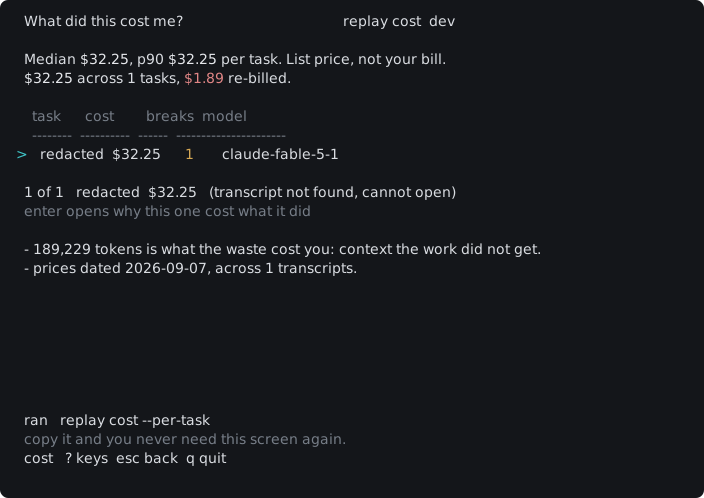
replay tui puts the same answers on ten screens, one keystroke apart. The images in this README
are generated from those screens and checked against them by a test, so a screenshot here cannot
drift from what the tool prints. The doctor and safe screens are deliberately absent from
docs/screens. Doctor renders your machine, and one of its rows counts days from the
compiled price table to today, so an image of it is correct for one day and wrong after. Safe lists
what Replay has written to your disk, and a picture of somebody else's byte counts is not an answer
to "what does this thing know about me". Both would be illustrations pretending to be readings;
cmd/replay/screens_svg_test.go holds the list and the reasons.
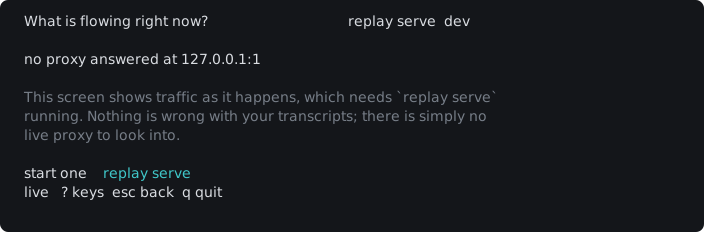
If you are pointing an agent through the proxy, l answers the question the transcripts cannot:
Reading it first is reasonable, and the script is written expecting you to:
curl -fsSL https://replay.doctor/replay.sh | less                  # read it
curl -fsSL https://replay.doctor/replay.sh | sh -s -- --dry-run    # see what it would do
It verifies a checksum and refuses to fall back to building from source when it cannot verify. Release binaries are on the releases page if you would rather skip the script.
Then, with no proxy, no configuration, no account and no arguments:
replay
Cost per task, across 122 sessions (1957 agent lanes) of Claude Code, at list prices dated 2026-09-07 (caching rules anthropic-2026-09-01).

  cache write    $2023.72
  cache read     $9812.82
  uncached       $1.82
  output         $823.07
  total          $12661.43
  median task    $0.79
  p90 task       $5.62
  re-billed      $349.02  (3% of the total)
                 71.5M tokens re-billed

Re-billed is the part nobody chose: tokens billed twice because a prompt cache
broke. It is not a forecast of savings, it is what was already spent twice.
Those are one machine's numbers, read 2026-09-13 at 00:29 PDT, generated by running the command rather than typed into this file. The time is there as well as the date because the corpus grows while it is being read: this machine adds about six requests a minute to it, so two runs an hour apart will not match to the cent. They are a session count, not a transcript count: a session writes one transcript per agent lane, and the three totals published before this one disagreed with each other because that distinction was lost between them. A fourth disagreement has since been measured and it is not a counting bug: this block read 5% on v0.5.4 and reads 3% on the build that ships it, because the newer binary reads 27,067 more requests out of the same files and prices six models the old one declined to price (two builds, one corpus). Point it at yours, or give it a directory of your own.
The re-billed figure is stated twice on purpose. Most of the people who run this hold a flat seat, and a dollar figure addressed to someone else reads as a number that does not apply — which is how a real finding gets dismissed. The tokens apply to everyone: a re-billed token is context the work did not get, on a window you are rate-limited against either way. Whether a break also burns a subscription quota the way it burns a bill is measured, unresolved, and written up as null rather than assumed in either direction.
transcripts counts files, not sessions: a session writes one transcript per agent lane, so a
session that spawned sub-agents contributes several. replay doctor reports both figures side by
side. The same fan-out means a sub-agent lane re-renders its parent's requests, so a few requests are
read from more than one file; the report says how many rather than implying the total is exact — 430
of 30,977 requests, 1.4%, on the run above.
What actually broke the cache
replay diff classifies every break, so the money has a cause attached rather than a total. It
prints one line per event with its cause, on your transcripts, dated by the run that produced it.
Run it. There is no table of shares here on purpose, and the reason is worth more than the table
was.
Two causes dominate, and they have opposite shapes:
- A client re-render — the history is rebuilt after the system prefix — is frequent and small. It happens constantly and re-bills a little each time.
- A TTL expiry — the gap between two requests outlives the cache — is rare and enormous. One developer going to lunch costs more than a great many re-renders.
That is a statement about mechanism, and mechanism does not rot. The shares did. This README carried a five-row table of percentages measured on 2026-09-06. By 2026-09-11 the two leading causes had converged to within half a point of each other, and a second reading taken hours later the same day put them in the opposite order — the corpus is this machine's own transcripts, so it grows while you work. That first move was the corpus alone: re-running the same classifier over the larger set reproduces it. Later readings also crossed a change in the classifier, and those two effects cannot be separated after the fact.
So the sentence this section used to end on — that the shapes matter more than the ranking — was right in a way that flattered it. The shapes held across every reading. The ranking it waved away is precisely the part that flipped.
Two further reasons not to quote a share, both of which survived the re-runs:
- Sorting by size selects for the cause. The same measurement over the largest sessions alone nearly reverses the order, because the largest sessions are the long-running ones, long-running sessions contain long gaps, and long gaps are what a TTL expiry is.
- The per-event token counts are rounded to thousands before they are summed, so a total built from them carries far fewer significant figures than its digits suggest.
Method, limits, and every reading with its date.
Every number says how it was obtained
This is the part that matters, and it is enforced in code rather than promised in a README.
| Tier | Meaning |
|---|---|
| measured | Read from the provider's own usage counters, via the proxy |
| estimated | Derived through a byte-to-token fit, printed with its error bar |
| structural | A property of the request shape, not a measurement |
Nothing prints without one. replay route --to <model> refuses to give a dollar figure for a
model pair it has not measured, rather than guessing — which is the behaviour a tool that wants to
be trusted has to have, and the behaviour that makes it less impressive on first run.
The same instinct applies to the answer as well as the input. replay route --to now prices the
move itself: the destination model starts cold and has to write the shared prefix again before it
reads any of it, so a cheaper model is not automatically cheaper. It reports the switch cost, the
saving per turn, and the turn on which those cross — and says plainly when that turn lies beyond the
number of turns actually measured, which is the case a comparison of two price-per-token figures
cannot see at all. Dollar figures also carry the age of the table they came from, because a date
tells a reader what was used and only a subtraction tells them it is stale.
Where you sit, against somebody else's population
A figure about one machine is not actionable on its own. "This session cost $3.40" leaves you asking whether that is high, and until now this tool could not answer: the pooled corpus it collects from contributors has one member, and publishing a population figure derived from one machine is the shape of claim this project has already retracted twice.
Two 2026 papers supply a population without anyone contributing anything.
| Source | Population | What it measures |
|---|---|---|
| TraceLab, arXiv:2606.30560 | 4,265 sessions, 43 developers, Claude Code and Codex | prefix cache hit rate, prefill amplification, prefix share of cost |
| Agentic Coding in the Wild, arXiv:2608.00101 | 13.5M sessions, 760.5M LLM calls, 95T tokens | cache hit rate within and across turns, idle-gap decay, prompt composition |
replay context now ends with one line placing your system prompt against the second of those:
system prompt: 8.0% here, 14.0% across 13.5M sessions, 760.5M LLM calls (arXiv:2608.00101)
The population travels with the figure on the same line, every time. That is the whole design: "8.0% here, 14.0% across 13.5M sessions" is a sentence you can weigh, and "8.0%, well under average" is not. Copilot's 13.5M sessions are Copilot users on Copilot's harness, so a difference is in the first instance a difference in what the two are doing — not evidence that anyone is doing it wrong. There is no "high", no "typical" and no "should" anywhere in the vocabulary, and a test asserts there never will be.
The verdict is computed from the two figures and is never written into the reference, for the same reason a provider claim's verdict is not: a hand-written "typical" is another claim wearing a verdict's clothes. See docs/design/reference-distribution.md.
What those papers say that this tool independently found
Two of their results were reproduced here by different methods, on a different corpus, before the papers were read.
Tool results dominate the prompt. Don't Break the Cache (arXiv:2601.06007)
reports 78.5% cost savings on Sonnet 4.5 from excluding dynamic tool results from the cached prefix.
replay blame puts tool results and tool calls at ranks 1, 3 and 4 on the largest session in this
repository's own corpus — theirs by A/B-ing three providers, this by attributing carried prompt
tokens in transcripts nobody wrote for the purpose.
Caches die of prefix churn, not idleness. Keeping the Cache Warm Pays
(arXiv:2607.19214) derives a break-even horizon for holding a
cache open with periodic pings. Measured against this corpus, 87% of cache-creation spend happens on
gaps under five minutes, where the cache had not expired at all — $509 against $77 in the bands any
ping could bridge. The published Copilot decay curve says the same thing from the other side: a
plateau above 95% under two minutes, a cliff between two and ten. The conclusion is do not build keepalive: it is the wrong lever here by roughly seven times, and
the measurement behind that is filed under docs/evidence/.
What it does
replay                             # cost per task across the transcripts on this machine
replay diff      <session>         # where the cache broke, and why
replay advise    <dir>             # what to change, from your own history
replay serve                       # a local proxy, for measured rather than estimated figures

replay cost                        # the cost report on its own, over the same discovered root
replay context   <session>         # what is filling your context, ranked
replay blame     <session>         # which content cost the most, carried across turns
replay route     <dir> --to <model>   # what a switch changes, including what the switch costs
replay doctor                      # what is on this machine, and what to run next
Every command and every flag is in the CLI reference, which is generated from the binary rather than written by hand, so it cannot drift from what the tool accepts. It marks which commands reach the network and which write, because those are the two things worth knowing before letting an agent run one unattended.
replay cost and replay corpus take a directory, but no longer require one: with no argument they
read the transcript root replay doctor already discovers, and say on stderr which root that was. The
argument still wins when you give it. This is not a convenience — a first command that needs a path
the reader does not know yet is a command they do not run.
replay --help lists all thirty, grouped and ordered by what they are worth rather than
alphabetically, because the list is what a person reads before they know which of them matters. That
number is compared against the binary's dispatch switch by internal/regression RC1, which is why it
is allowed to be here and why the same figure is not written into the other documents. Full
reference: docs/guide/commands.md, and
docs/CLI.md generated from the binary.
replay context now says when its own answer is incomplete. Claude Code records a compaction with the
prompt size before and after it, and nothing here was reading that field, so a session that compacted
was attributed as though everything it ever loaded were still present. It is not: the attribution
describes what remains, and the report now names how many compactions fired, how many tokens the
client says they dropped, and therefore by how much the ranking above it overstates. Where the
compaction recorded no size, it says that instead of guessing — an unmeasured overstatement is still
worth declaring.
Footprint
- No account, no telemetry, no first-run prompt. Nothing to opt out of.
- One ask, at most once every thirty days. If
costhas just found more than $5 you paid twice, it prints one line about the tip jar. That is the only time this tool asks you for anything. It opens no browser and sends nothing:~/.replay/tip.jsonholds the date it last asked and a random local seed, and the seed only picks which of two wordings you see. Once a month, because asking every run would train you to skip the last paragraph, and the last paragraph is often where the caveat is. - The binary originates four network requests, each of which you type:
rules --check-pricesfetches a public price table;probe --executesends billable measurement requests to your own provider on your own key, after printing the plan and asking;upgradefetches the release index and an archive fromgithub.comand then executes the binary it just wrote; andrules --update <url>fetches from whatever host you name. The proxy forwards your own traffic and nothing else. One request is not typed:replay burnprobes127.0.0.1:11434for a local Ollama on every run, which never leaves the machine. Earlier versions of this file said "two network requests", omittingupgradeandrules --update;docs/SURFACES.mddocumentedupgradewhile this file denied it. Every outbound and on-disk surface is enumerated indocs/SURFACES.md, including the ones that were wrong in earlier versions of this file. - The ledger never stores message text. It stores block kinds, sizes, timings and usage counts. Tool names are kept in the clear; the path argument is HMAC'd with a machine-local key, so two lanes reading the same file are visibly the same file without the file ever being named. Tool calls are HMAC'd too, on both halves of a record since 2026-09-10. The response half used to be a plain SHA-256 of the tool input, which meant anyone holding a ledger file could test a guessed shell command or file path against it offline and get a yes or no.
- What the local listener refuses, and what it does not. It binds loopback only. It refuses any
request carrying
OriginorSec-Fetch-Mode, and — since 2026-09-10 — any request whoseHostheader names somewhere other than this machine, which is what a page at a name pointed at127.0.0.1necessarily sends./replay/healthzcarries both checks and not the token, soreplay doctorcan still tell you why your agent is failing; what it discloses to a local process is that something answers here, whichconnect(2)already tells it. What it does not do:/replay/statusand/replay/metricsare unauthenticated unless you set--token, so any process on the machine can read your model names, token counts and per-session list-price dollars. Set a token if that matters to you. ~/.replayis checked, not assumed. The ledger and vault directories and their key files are verified owner-only every time they are opened, tightened when they are not, and Replay refuses to start when they cannot be. They used to be created0700and never looked at again, so a directory that arrived from an archive or amkdir -m 777stayed readable by every account on the machine.- Masked secrets expire.
--maskwrites the secrets it replaces into~/.replay/vault, which turns a transient credential into one at rest. Entries are evicted after 24 hours (--mask-ttl;0keeps them indefinitely). This bounds the window and nothing more: the vault key file sits next to the ciphertext it decrypts, so anyone who can read that directory within the window can read the secrets. Masking is a control on what leaves the machine, not storage you should rely on. This is a known open finding, recorded in the security review. - A break says which tools changed. Not "system prompt or tool definitions changed", which names two causes and settles neither. It names the ones that arrived: added 3 tool(s): mcp__claude_ai_Otter_ai__otter_fetch, otter_get_user_info, otter_search; removed 1 tool(s): WaitForMcpServers. That break cost 157,080 tokens.
- Sessions that spawn subagents are measured per lane, and a report covering one lane says so rather than calling itself complete.
- Business Source License 1.1, no dependencies.
go.modis three lines. Free for any use inside your own organisation, including commercially and in production; converts to Apache 2.0 on 2029-09-06. Selling Replay itself as a service is the one thing it does not permit.
How far to trust it
The engine reproduces the provider's own cache reads on 97.79% of compared turns across 1751
transcripts — but those transcripts come from 116 distinct sessions on one machine, one account
and one operator. A session writes one transcript per lane, so subagents multiply the file count
without adding an independent draw. Read the sample as 116, not 1751. Figures as of 2026-09-10:
docs/evidence/calibration-corpus-2026-09-10.md.
That 97.79% counts two things: turns the engine reproduced exactly, and turns where the provider served more cached prefix than the engine predicted — usually because a concurrent sibling lane extended it. The second kind is a prediction that was wrong in the generous direction, and until 2026-09-11 no report broke the two apart. On a re-reading of the same corpus root on 2026-09-11 (1816 transcripts, 118 sessions, 38111 compared turns) the split is 94.10% reproduced exactly, 3.78% read more than predicted, 2.12% broken — a 97.89% match rate of which 3.86% is a read the engine did not predict. Both rates are now printed side by side wherever a match rate appears. The addendum in the evidence file above has the working.
Earlier versions of this document said "1363 sessions" while counting files, overstating the
independent sample roughly twentyfold. The correction, with the reasoning, is in
docs/evidence/calibration-corpus-2026-09-06.md.
This document then carried that file's 97.46% across 1450 transcripts in the present tense for
four days after the corpus and the engine had both moved, which is a dated reading presented as a
current one. Every figure above now names the date it was read on.
Every evidence file is dated, and a correction that leaves the original reading standing is a new
file. That rule has not held uniformly, and the exceptions are in the history rather than in the
files. Sixteen of the twenty-five dated files under docs/evidence/ carry more than one commit,
and several replace rather than append: rehydration-boundary-2026-09-05.md lost an eight-line
section at ad7e884, and routing-baseline-2026-09-06.md lost a published 85.10% at a6b259b.
Read a dated file as its reading on that date plus whatever was appended to it, and git log -p
as the only complete record.
The open gap is independence, and no amount of data from this machine closes it. That is stated in the roadmap rather than buried.
The largest correction is the most recent. On 2026-09-06 the proxy measured a session running
parallel subagents and reported that 98.8% of its re-billed tokens came from one cause. That
figure was wrong, and it was wrong because every comparison the proxy made was against a single
session-wide slot: with several lanes running at once, each was judged against whichever sibling
wrote last. Read lane by lane, 31 of the 34 events had not happened, and the real answer is
4.2%. Both numbers, and the retraction, are in
docs/evidence/lane-isolation-2026-09-06.md and in
the commit history. The wrong one is still there.
Five fields carried that defect. The lesson had already been written down against a sixth, with a comment explaining exactly why it had to be keyed per lane, and it had been applied to one field out of six.
The second open gap is the one the flat-seat framing above rests on. A metered user is re-billed for a broken cache; whether a subscriber's rate-limit window is charged the same way is undocumented, so it was measured: matched cold-write and warm-read arms, 3.09M tokens, and the utilisation counter moved zero steps. That is a null result and it is published as one. It also voided an earlier figure in this repository — a counter step attributed to four probe requests, on an account-wide counter that an interactive session was moving at the same time. The instrument now refuses rather than reports: it names which arm is short instead of dividing anyway, after simulation showed the first estimator returning exactly 1.00 whether the true ratio was 12.5 or 1.0.
Who should not use this yet
- You do not use a coding agent that keeps transcripts. There is nothing to read.
- You want a savings forecast. Replay reports what was already spent, not what you will save.
- You want a number without a caveat. Most figures here carry one, because most of them earn one.
- You are on Windows. See below.
Platform support: macOS and Linux only
The Windows job passes, and Replay is still not supported on Windows. Those are not in tension, and the gap between them is the point.
The CI matrix listed a Windows job for a long time that never ran a single
test: it failed at go vet on a helper in a file tagged //go:build unix.
The compile error was fixed on 2026-09-06 and the first real run failed
fourteen tests. All fourteen are fixed and the job has since passed.
Two of them were real defects rather than portability chores, and both were
found only because that job finally ran. The consent gate read Unix
permission bits, which Windows does not have: Go synthesises 0666 for any
writable file, so the gate refused every consent file a user had just written
and a Windows user could not opt into the corpus or grant update consent at
all. Separately, the spend table evicted by wall-clock timestamp, which is
least-recently-used only if the clock can separate two records; under a coarse
clock it silently became evict-anything, and that was true on every platform.
What green does not mean is supported. Decision.OwnershipChecked is false
on Windows, because the check cannot run there and says so rather than
implying a guarantee it never made. The tests that assert Unix mode semantics
now skip on Windows with the reason stated, which is honest and is not the
same as passing. So a Windows build would still be a binary that reads your
consent decision without being able to verify the file is yours. Until there
is a real ownership story on that platform, that is not a promise worth
shipping.
macOS and Linux are tested on every push, with go vet and
go test -race. WSL works, because it is Linux.
How the tests work here
The project's governing rule is ADR-0014: a check is not evidence until it has been observed to fail. Roughly twenty defects in a single day shared one shape — a verification that could not fail — so the rule is now mechanical.
internal/mutation keeps 76 real past defects frozen as re-runnable mutants (numbered M1 to
M77; M71 was retired), each with the named test that must catch it.
go test -tags mutation ./internal/mutation/ re-applies them all.
It has already caught a false kill (a mutant the compiler rejected, scored as caught), a test that
hung instead of failing, and a catalogue entry naming a test that was not actually load-bearing.
This is error seeding, not mutation analysis: the denominator is the 76 chosen edits themselves, not a generated operator population, and a first run is a kill by construction. The value is temporal, asking whether each guard still exists and still discriminates on a tree that has moved.
The mutation score, which is a different figure and was missing until 2026-09-13. A catalogue
has a numerator and no denominator, so it cannot say what fraction of the mutants this tree admits
are caught, which means it cannot say whether that fraction is rising or falling. Measured now:
73.3% of viable, non-equivalent mutants killed (275 of 375), 95% CI [68.6%, 77.6%], on a
uniform random sample of 400 drawn with seed 20260913 from a generated population of 8,150
mutants across 206 production files, six operators, read at commit c0ed888. Nine equivalent
mutants were identified by hand and excluded; the other 100 survivors were not examined, so the
tree-wide equivalent rate is unknown and the true score is somewhat higher than 73.3%.
The actionable part is not the headline. By operator, negate-conditional is killed 85% of the time and conditional-boundary only 49%: the suite tests what a branch decides far better than it tests where the branch sits. The full reading, including the worst packages and every named equivalent, is in the evidence file.
Until 2026-09-09 that catalogue had never run. It sits behind a build tag, no CI job passed the tag, and the run needs 659 seconds against Go's 10-minute default — so the obvious invocation dies around mutant 66 of 72 and looks like a broken harness. Both had to be wrong for it to stay hidden. It now runs on every push with a 45-minute ceiling, and three cheap tests in the normal suite assert that it is still wired up, because the expensive job proves the mutants die and something has to prove the expensive job still exists.
The test suite does not touch your home directory. It did: running go test ./cmd/replay/
rewrote this machine's own ~/.replay/advice.json, replacing 141 findings from 1,744 transcripts
with three from a two-session fixture, and taking the applied markers with them. A later test then
read that file back, which is why two screens passed alone and failed together on CI.
internal/regression now computes which packages can reach a home directory — by walking imports,
not by assuming — and fails if any of them runs tests without replacing HOME and USERPROFILE
first. A new package that starts resolving a home directory is caught the day it does.
ADR-0018 is the companion rule for the output rather than the tests: provenance is a field, not a comment, and absence, zero and unknown are three different values. Nine defects in one day shared that shape, and none of them was a miscalculation — the arithmetic was right every time, and nothing on the screen said what the numbers were.
Documentation
Start at docs/, indexed by why you came. Highlights:
- Commands — every flag, and what it refuses to do
- What you get — and the three levers worth more than this one
- Surfaces — every file and endpoint touched
- Evidence — dated measurements, including the corrections
- Open design questions — written up before a decision, not after
- ADRs — the decisions, including the ones that were reversed
Contributing
Issues and pull requests welcome; see CONTRIBUTING.md. The project is early and the roadmap says plainly what is unfinished.
If it saved you something, FUNDING.md says how to say so. The tool is free; the measurements behind it are real API spend.
What it costs
Nothing, and nothing is for sale today.
Every command works, on every model, with no account and no key.
It is not a binary that never touches the network, and this page is not going
to say it is. The promise, as cmd/replay/upgrade.go states it, is that
replay originates no request you did not type. Reading your transcripts sends
nothing. Five packages can reach the network and every one of them is written
down in SURFACES.md and derived from the code by
TestOutboundSurfacesAreAllDocumented, which fails when a new one appears:
the proxy forwarding your own traffic, probe --execute originating billable
requests on your own key, rules --check-prices fetching a public price table,
doctor probing loopback, and replay upgrade downloading a release you asked
for.
That sentence said "and no network call" until 2026-09-13, and it was false.
The drift test above exists because the same sentence went false once before,
when probe shipped and nothing edited the claim.
Nothing that works in a release you already have will ever move behind a payment: that is a promise in SPONSORS.md, and it is narrower and more useful than the sentence it replaced, which is recorded there too. If a paid capability is ever added it will be something that does not exist today, and it will not be gated on sponsorship either.
There is one paid thing that does exist and it is not a tier: a week of the maintainer's attention over your own corpus, described and priced in the deliverable, with three commands you run yourself that tell you before any money is discussed whether it is worth either side's time. Nobody has bought one.
The money path is the whole commercial argument, including the arithmetic that says a per-seat subscription does not survive this project's own numbers.
About the author

Replay Doctor is written and maintained by Daniel Saito, founder of Red Robot K.K., Tokyo. One person, one machine, one account: every figure this project publishes was measured on that machine, and every report says so rather than implying a population it does not have.
One maintainer cannot review his own diff twice, so the tests do it: every guard here is neutralised in the source and watched to go red before it is trusted. And a figure that turns out wrong stays on the page with its correction beside it. A 98.8% that became 4.2% is still readable in docs/evidence, because a project that publishes only its wins is one whose numbers you cannot check.
LinkedIn · X @redrobotfdn · GitHub · Hire me on Upwork · daniel@redrobot.jp
Support the work · GitHub Sponsors · What it pays for
A note from Daniel, who maintains this
Replay is free to run and stays that way: every command, every model, no account and no key. It originates no request you did not type, which is a narrower claim than "no network call" and is the true one. Nothing that works in a release you already have will ever move behind a payment.
What is not free is the measurement behind it. Replay's cache figures are measured rather than estimated because they were calibrated against 32,188 real requests across 115 sessions of my own agent work, read on 2026-09-07. Adding each provider costs the same again: the Codex support came out of 148 sessions and 610 million tokens of my own logs.
I am not going to pretend that corpus was money out of my pocket. I was on a subscription, so what I actually paid was the monthly fee and the time. At list prices it is a four-figure sum, and the exact number lives in FUNDING.md with its date rather than here, because a figure typed into a second file drifts from the first and nothing notices. Replay prints that same caveat every time it prints a dollar, and an appeal that quietly dropped it would be the one place the tool's own rule did not apply.
The tool found five percent of my own bill re-billed by broken caches before it found anyone else's. If it found something on your machine that you had already paid for once, a share of that back is what keeps this maintained.
Support the work · What it pays for · Sponsors
There is no deadline, no counter, and nothing stops if nobody pays. None of those would be true.
License
BUSL 1.1 is a source-available licence, not an OSI-approved open-source one. Saying that here rather than leaving it to be pointed out: the distinction is real and the project does not get to blur it.
What the licence actually permits is wider than the label suggests. Running Replay at work, in production, at any scale, on any number of machines, in CI, and using everything it outputs, is free and unrestricted. The one thing it forbids is reselling it as a hosted or managed service. It converts to Apache 2.0 on 2029-09-06, which is three years rather than the indefinite Change Date some adopters choose.
See LICENSE, NOTICE and ADR-0016, which records that this was Apache 2.0 until 2026-09-06 and why that changed.
GitHub labels this repository 'Other' because its licence detector does not know BUSL-1.1; the licence is the Business Source License 1.1, converting to the Apache License 2.0 on 2029-09-06, and the text is in LICENSE.
Contributors


See what people are saying
Similar repos


Languages
Go
96.7%
Shell
1.7%
Python
1.2%
If the agent bill went up and nothing errored, a prompt cache broke. Replay Doctor names the turn it broke on, the cause, and the tokens re-billed at write prices. Reads Claude Code, Codex and Cursor transcripts already on disk. Local Go CLI, zero dependencies, no account, no telemetry: nothing is sent unless you ask.
1
stars
589
commits
Go
primary language
Sep 14, 2026
updated
README
Replay
GitHub labels this repository 'Other' because its licence detector does not know BUSL-1.1; the licence is the Business Source License 1.1, converting to the Apache License 2.0 on 2029-09-06, and the text is in LICENSE.
If the agent bill went up and nothing errored, a prompt cache broke. Replay Doctor reads the transcripts already on your disk and names the turn it broke on, the cause, and the tokens re-billed at write prices.
The refusals are the feature. Anything this tool cannot measure, it declines to print — and says why, in the place the number would have gone.
replay routewill not quote you dollars for a model pair it has never seen on the wire.replay contexttells you when its own answer is incomplete because the session was compacted. Every figure carries the population it was measured on and the date it was read. When a number here turns out to be wrong, the correction ships as a new dated file and the old reading stays visible — including the time this README overstated its own sample size twentyfold.
Start with the question you actually have
| You want to know | Type this |
|---|---|
| What did all this cost me? | replay |
| Which turn got billed twice, and why? | replay diff <transcript|dir> |
| What should I change? | replay advise <dir> |
| What is filling my context? | replay context <transcript|dir> |
| Would another model be cheaper? | replay route <dir> --to <model> |
| Is anything on this machine broken? | replay doctor |
| All of it, as screens | replay tui |
If you already run ccusage, this is the next question rather than a replacement for it. ccusage tells you what you spent, and it is better at that than anything here. Replay answers something narrower: which turn got billed twice, and what changed on that turn to cause it. A total and a cause are different questions, and only one of them is answered by adding numbers up.
When a prompt cache breaks, the provider re-bills the whole conversation history at write prices. Nothing errors. Nothing warns. The only trace is a bill that looks like ordinary growth in usage. Replay replays your sessions against the provider's caching rules, turn by turn, and names the one that broke.
Every route below ends at the same signed release; verify any download with cosign as shown in the Releases footer.
Installer script (vendored)
curl -fsSL https://replay.doctor/replay.sh | sh
Check: curl -sI https://replay.doctor/replay.sh | grep x-replay-installer-sha256
go install
go install github.com/RedRobotKK/Replay/cmd/replay@latest
Check: replay version
GitHub Releases (signed tarballs, SBOMs)
cosign verify-blob --certificate checksums.txt.pem --signature checksums.txt.sig --certificate-identity-regexp 'https://github.com/RedRobotKK/Replay/.*' --certificate-oidc-issuer https://token.actions.githubusercontent.com checksums.txt
Check: sha256sum --check --ignore-missing checksums.txt
replay upgrade
replay upgrade
Check: replay version
mise via ubi
mise use -g ubi:RedRobotKK/Replay
Check: mise ls
eget / binenv / ubi direct
eget RedRobotKK/Replay
Check: ./replay version
Coming: .deb on the release page, .rpm on the release page, .apk on the release page, npm (npx), PyPI (uvx / pipx), bunx / deno (via npm).
Not offered: homebrew-core (OSI; notability thresholds)
Not offered: nixpkgs (BSL is unfree in nixpkgs; users would need allowUnfree)
Not offered: GNU Guix (free software only)
Packages are on the releases page
in deb, rpm, apk and Arch form for amd64 and arm64. Every one of them is
listed in checksums.txt, and that file is what cosign signs, so a package
inherits the same verification chain as the tarball rather than a weaker one.
What that is not. There is no hosted yum or apt repository, so there is no
dnf install replay from a configured remote and no automatic upgrade. You
download a file and install it. "We build an rpm" and "we run a repository" are
different promises, and only the first is being made: the second needs a signing
key with a lifetime and somebody to answer for a broken metadata refresh, and
neither exists yet. replay upgrade is the upgrade path in the meantime.
The packages declare no dependencies, which is a fact rather than an omission. The binary links nothing outside the standard library.
replay tui puts the same answers on ten screens, one keystroke apart. The images in this README
are generated from those screens and checked against them by a test, so a screenshot here cannot
drift from what the tool prints. The doctor and safe screens are deliberately absent from
docs/screens. Doctor renders your machine, and one of its rows counts days from the
compiled price table to today, so an image of it is correct for one day and wrong after. Safe lists
what Replay has written to your disk, and a picture of somebody else's byte counts is not an answer
to "what does this thing know about me". Both would be illustrations pretending to be readings;
cmd/replay/screens_svg_test.go holds the list and the reasons.
If you are pointing an agent through the proxy, l answers the question the transcripts cannot:
Reading it first is reasonable, and the script is written expecting you to:
curl -fsSL https://replay.doctor/replay.sh | less                  # read it
curl -fsSL https://replay.doctor/replay.sh | sh -s -- --dry-run    # see what it would do
It verifies a checksum and refuses to fall back to building from source when it cannot verify. Release binaries are on the releases page if you would rather skip the script.
Then, with no proxy, no configuration, no account and no arguments:
replay
Cost per task, across 122 sessions (1957 agent lanes) of Claude Code, at list prices dated 2026-09-07 (caching rules anthropic-2026-09-01).

  cache write    $2023.72
  cache read     $9812.82
  uncached       $1.82
  output         $823.07
  total          $12661.43
  median task    $0.79
  p90 task       $5.62
  re-billed      $349.02  (3% of the total)
                 71.5M tokens re-billed

Re-billed is the part nobody chose: tokens billed twice because a prompt cache
broke. It is not a forecast of savings, it is what was already spent twice.
Those are one machine's numbers, read 2026-09-13 at 00:29 PDT, generated by running the command rather than typed into this file. The time is there as well as the date because the corpus grows while it is being read: this machine adds about six requests a minute to it, so two runs an hour apart will not match to the cent. They are a session count, not a transcript count: a session writes one transcript per agent lane, and the three totals published before this one disagreed with each other because that distinction was lost between them. A fourth disagreement has since been measured and it is not a counting bug: this block read 5% on v0.5.4 and reads 3% on the build that ships it, because the newer binary reads 27,067 more requests out of the same files and prices six models the old one declined to price (two builds, one corpus). Point it at yours, or give it a directory of your own.
The re-billed figure is stated twice on purpose. Most of the people who run this hold a flat seat, and a dollar figure addressed to someone else reads as a number that does not apply — which is how a real finding gets dismissed. The tokens apply to everyone: a re-billed token is context the work did not get, on a window you are rate-limited against either way. Whether a break also burns a subscription quota the way it burns a bill is measured, unresolved, and written up as null rather than assumed in either direction.
transcripts counts files, not sessions: a session writes one transcript per agent lane, so a
session that spawned sub-agents contributes several. replay doctor reports both figures side by
side. The same fan-out means a sub-agent lane re-renders its parent's requests, so a few requests are
read from more than one file; the report says how many rather than implying the total is exact — 430
of 30,977 requests, 1.4%, on the run above.
What actually broke the cache
replay diff classifies every break, so the money has a cause attached rather than a total. It
prints one line per event with its cause, on your transcripts, dated by the run that produced it.
Run it. There is no table of shares here on purpose, and the reason is worth more than the table
was.
Two causes dominate, and they have opposite shapes:
- A client re-render — the history is rebuilt after the system prefix — is frequent and small. It happens constantly and re-bills a little each time.
- A TTL expiry — the gap between two requests outlives the cache — is rare and enormous. One developer going to lunch costs more than a great many re-renders.
That is a statement about mechanism, and mechanism does not rot. The shares did. This README carried a five-row table of percentages measured on 2026-09-06. By 2026-09-11 the two leading causes had converged to within half a point of each other, and a second reading taken hours later the same day put them in the opposite order — the corpus is this machine's own transcripts, so it grows while you work. That first move was the corpus alone: re-running the same classifier over the larger set reproduces it. Later readings also crossed a change in the classifier, and those two effects cannot be separated after the fact.
So the sentence this section used to end on — that the shapes matter more than the ranking — was right in a way that flattered it. The shapes held across every reading. The ranking it waved away is precisely the part that flipped.
Two further reasons not to quote a share, both of which survived the re-runs:
- Sorting by size selects for the cause. The same measurement over the largest sessions alone nearly reverses the order, because the largest sessions are the long-running ones, long-running sessions contain long gaps, and long gaps are what a TTL expiry is.
- The per-event token counts are rounded to thousands before they are summed, so a total built from them carries far fewer significant figures than its digits suggest.
Method, limits, and every reading with its date.
Every number says how it was obtained
This is the part that matters, and it is enforced in code rather than promised in a README.
| Tier | Meaning |
|---|---|
| measured | Read from the provider's own usage counters, via the proxy |
| estimated | Derived through a byte-to-token fit, printed with its error bar |
| structural | A property of the request shape, not a measurement |
Nothing prints without one. replay route --to <model> refuses to give a dollar figure for a
model pair it has not measured, rather than guessing — which is the behaviour a tool that wants to
be trusted has to have, and the behaviour that makes it less impressive on first run.
The same instinct applies to the answer as well as the input. replay route --to now prices the
move itself: the destination model starts cold and has to write the shared prefix again before it
reads any of it, so a cheaper model is not automatically cheaper. It reports the switch cost, the
saving per turn, and the turn on which those cross — and says plainly when that turn lies beyond the
number of turns actually measured, which is the case a comparison of two price-per-token figures
cannot see at all. Dollar figures also carry the age of the table they came from, because a date
tells a reader what was used and only a subtraction tells them it is stale.
Where you sit, against somebody else's population
A figure about one machine is not actionable on its own. "This session cost $3.40" leaves you asking whether that is high, and until now this tool could not answer: the pooled corpus it collects from contributors has one member, and publishing a population figure derived from one machine is the shape of claim this project has already retracted twice.
Two 2026 papers supply a population without anyone contributing anything.
| Source | Population | What it measures |
|---|---|---|
| TraceLab, arXiv:2606.30560 | 4,265 sessions, 43 developers, Claude Code and Codex | prefix cache hit rate, prefill amplification, prefix share of cost |
| Agentic Coding in the Wild, arXiv:2608.00101 | 13.5M sessions, 760.5M LLM calls, 95T tokens | cache hit rate within and across turns, idle-gap decay, prompt composition |
replay context now ends with one line placing your system prompt against the second of those:
system prompt: 8.0% here, 14.0% across 13.5M sessions, 760.5M LLM calls (arXiv:2608.00101)
The population travels with the figure on the same line, every time. That is the whole design: "8.0% here, 14.0% across 13.5M sessions" is a sentence you can weigh, and "8.0%, well under average" is not. Copilot's 13.5M sessions are Copilot users on Copilot's harness, so a difference is in the first instance a difference in what the two are doing — not evidence that anyone is doing it wrong. There is no "high", no "typical" and no "should" anywhere in the vocabulary, and a test asserts there never will be.
The verdict is computed from the two figures and is never written into the reference, for the same reason a provider claim's verdict is not: a hand-written "typical" is another claim wearing a verdict's clothes. See docs/design/reference-distribution.md.
What those papers say that this tool independently found
Two of their results were reproduced here by different methods, on a different corpus, before the papers were read.
Tool results dominate the prompt. Don't Break the Cache (arXiv:2601.06007)
reports 78.5% cost savings on Sonnet 4.5 from excluding dynamic tool results from the cached prefix.
replay blame puts tool results and tool calls at ranks 1, 3 and 4 on the largest session in this
repository's own corpus — theirs by A/B-ing three providers, this by attributing carried prompt
tokens in transcripts nobody wrote for the purpose.
Caches die of prefix churn, not idleness. Keeping the Cache Warm Pays
(arXiv:2607.19214) derives a break-even horizon for holding a
cache open with periodic pings. Measured against this corpus, 87% of cache-creation spend happens on
gaps under five minutes, where the cache had not expired at all — $509 against $77 in the bands any
ping could bridge. The published Copilot decay curve says the same thing from the other side: a
plateau above 95% under two minutes, a cliff between two and ten. The conclusion is do not build keepalive: it is the wrong lever here by roughly seven times, and
the measurement behind that is filed under docs/evidence/.
What it does
replay                             # cost per task across the transcripts on this machine
replay diff      <session>         # where the cache broke, and why
replay advise    <dir>             # what to change, from your own history
replay serve                       # a local proxy, for measured rather than estimated figures

replay cost                        # the cost report on its own, over the same discovered root
replay context   <session>         # what is filling your context, ranked
replay blame     <session>         # which content cost the most, carried across turns
replay route     <dir> --to <model>   # what a switch changes, including what the switch costs
replay doctor                      # what is on this machine, and what to run next
Every command and every flag is in the CLI reference, which is generated from the binary rather than written by hand, so it cannot drift from what the tool accepts. It marks which commands reach the network and which write, because those are the two things worth knowing before letting an agent run one unattended.
replay cost and replay corpus take a directory, but no longer require one: with no argument they
read the transcript root replay doctor already discovers, and say on stderr which root that was. The
argument still wins when you give it. This is not a convenience — a first command that needs a path
the reader does not know yet is a command they do not run.
replay --help lists all thirty, grouped and ordered by what they are worth rather than
alphabetically, because the list is what a person reads before they know which of them matters. That
number is compared against the binary's dispatch switch by internal/regression RC1, which is why it
is allowed to be here and why the same figure is not written into the other documents. Full
reference: docs/guide/commands.md, and
docs/CLI.md generated from the binary.
replay context now says when its own answer is incomplete. Claude Code records a compaction with the
prompt size before and after it, and nothing here was reading that field, so a session that compacted
was attributed as though everything it ever loaded were still present. It is not: the attribution
describes what remains, and the report now names how many compactions fired, how many tokens the
client says they dropped, and therefore by how much the ranking above it overstates. Where the
compaction recorded no size, it says that instead of guessing — an unmeasured overstatement is still
worth declaring.
Footprint
- No account, no telemetry, no first-run prompt. Nothing to opt out of.
- One ask, at most once every thirty days. If
costhas just found more than $5 you paid twice, it prints one line about the tip jar. That is the only time this tool asks you for anything. It opens no browser and sends nothing:~/.replay/tip.jsonholds the date it last asked and a random local seed, and the seed only picks which of two wordings you see. Once a month, because asking every run would train you to skip the last paragraph, and the last paragraph is often where the caveat is. - The binary originates four network requests, each of which you type:
rules --check-pricesfetches a public price table;probe --executesends billable measurement requests to your own provider on your own key, after printing the plan and asking;upgradefetches the release index and an archive fromgithub.comand then executes the binary it just wrote; andrules --update <url>fetches from whatever host you name. The proxy forwards your own traffic and nothing else. One request is not typed:replay burnprobes127.0.0.1:11434for a local Ollama on every run, which never leaves the machine. Earlier versions of this file said "two network requests", omittingupgradeandrules --update;docs/SURFACES.mddocumentedupgradewhile this file denied it. Every outbound and on-disk surface is enumerated indocs/SURFACES.md, including the ones that were wrong in earlier versions of this file. - The ledger never stores message text. It stores block kinds, sizes, timings and usage counts. Tool names are kept in the clear; the path argument is HMAC'd with a machine-local key, so two lanes reading the same file are visibly the same file without the file ever being named. Tool calls are HMAC'd too, on both halves of a record since 2026-09-10. The response half used to be a plain SHA-256 of the tool input, which meant anyone holding a ledger file could test a guessed shell command or file path against it offline and get a yes or no.
- What the local listener refuses, and what it does not. It binds loopback only. It refuses any
request carrying
OriginorSec-Fetch-Mode, and — since 2026-09-10 — any request whoseHostheader names somewhere other than this machine, which is what a page at a name pointed at127.0.0.1necessarily sends./replay/healthzcarries both checks and not the token, soreplay doctorcan still tell you why your agent is failing; what it discloses to a local process is that something answers here, whichconnect(2)already tells it. What it does not do:/replay/statusand/replay/metricsare unauthenticated unless you set--token, so any process on the machine can read your model names, token counts and per-session list-price dollars. Set a token if that matters to you. ~/.replayis checked, not assumed. The ledger and vault directories and their key files are verified owner-only every time they are opened, tightened when they are not, and Replay refuses to start when they cannot be. They used to be created0700and never looked at again, so a directory that arrived from an archive or amkdir -m 777stayed readable by every account on the machine.- Masked secrets expire.
--maskwrites the secrets it replaces into~/.replay/vault, which turns a transient credential into one at rest. Entries are evicted after 24 hours (--mask-ttl;0keeps them indefinitely). This bounds the window and nothing more: the vault key file sits next to the ciphertext it decrypts, so anyone who can read that directory within the window can read the secrets. Masking is a control on what leaves the machine, not storage you should rely on. This is a known open finding, recorded in the security review. - A break says which tools changed. Not "system prompt or tool definitions changed", which names two causes and settles neither. It names the ones that arrived: added 3 tool(s): mcp__claude_ai_Otter_ai__otter_fetch, otter_get_user_info, otter_search; removed 1 tool(s): WaitForMcpServers. That break cost 157,080 tokens.
- Sessions that spawn subagents are measured per lane, and a report covering one lane says so rather than calling itself complete.
- Business Source License 1.1, no dependencies.
go.modis three lines. Free for any use inside your own organisation, including commercially and in production; converts to Apache 2.0 on 2029-09-06. Selling Replay itself as a service is the one thing it does not permit.
How far to trust it
The engine reproduces the provider's own cache reads on 97.79% of compared turns across 1751
transcripts — but those transcripts come from 116 distinct sessions on one machine, one account
and one operator. A session writes one transcript per lane, so subagents multiply the file count
without adding an independent draw. Read the sample as 116, not 1751. Figures as of 2026-09-10:
docs/evidence/calibration-corpus-2026-09-10.md.
That 97.79% counts two things: turns the engine reproduced exactly, and turns where the provider served more cached prefix than the engine predicted — usually because a concurrent sibling lane extended it. The second kind is a prediction that was wrong in the generous direction, and until 2026-09-11 no report broke the two apart. On a re-reading of the same corpus root on 2026-09-11 (1816 transcripts, 118 sessions, 38111 compared turns) the split is 94.10% reproduced exactly, 3.78% read more than predicted, 2.12% broken — a 97.89% match rate of which 3.86% is a read the engine did not predict. Both rates are now printed side by side wherever a match rate appears. The addendum in the evidence file above has the working.
Earlier versions of this document said "1363 sessions" while counting files, overstating the
independent sample roughly twentyfold. The correction, with the reasoning, is in
docs/evidence/calibration-corpus-2026-09-06.md.
This document then carried that file's 97.46% across 1450 transcripts in the present tense for
four days after the corpus and the engine had both moved, which is a dated reading presented as a
current one. Every figure above now names the date it was read on.
Every evidence file is dated, and a correction that leaves the original reading standing is a new
file. That rule has not held uniformly, and the exceptions are in the history rather than in the
files. Sixteen of the twenty-five dated files under docs/evidence/ carry more than one commit,
and several replace rather than append: rehydration-boundary-2026-09-05.md lost an eight-line
section at ad7e884, and routing-baseline-2026-09-06.md lost a published 85.10% at a6b259b.
Read a dated file as its reading on that date plus whatever was appended to it, and git log -p
as the only complete record.
The open gap is independence, and no amount of data from this machine closes it. That is stated in the roadmap rather than buried.
The largest correction is the most recent. On 2026-09-06 the proxy measured a session running
parallel subagents and reported that 98.8% of its re-billed tokens came from one cause. That
figure was wrong, and it was wrong because every comparison the proxy made was against a single
session-wide slot: with several lanes running at once, each was judged against whichever sibling
wrote last. Read lane by lane, 31 of the 34 events had not happened, and the real answer is
4.2%. Both numbers, and the retraction, are in
docs/evidence/lane-isolation-2026-09-06.md and in
the commit history. The wrong one is still there.
Five fields carried that defect. The lesson had already been written down against a sixth, with a comment explaining exactly why it had to be keyed per lane, and it had been applied to one field out of six.
The second open gap is the one the flat-seat framing above rests on. A metered user is re-billed for a broken cache; whether a subscriber's rate-limit window is charged the same way is undocumented, so it was measured: matched cold-write and warm-read arms, 3.09M tokens, and the utilisation counter moved zero steps. That is a null result and it is published as one. It also voided an earlier figure in this repository — a counter step attributed to four probe requests, on an account-wide counter that an interactive session was moving at the same time. The instrument now refuses rather than reports: it names which arm is short instead of dividing anyway, after simulation showed the first estimator returning exactly 1.00 whether the true ratio was 12.5 or 1.0.
Who should not use this yet
- You do not use a coding agent that keeps transcripts. There is nothing to read.
- You want a savings forecast. Replay reports what was already spent, not what you will save.
- You want a number without a caveat. Most figures here carry one, because most of them earn one.
- You are on Windows. See below.
Platform support: macOS and Linux only
The Windows job passes, and Replay is still not supported on Windows. Those are not in tension, and the gap between them is the point.
The CI matrix listed a Windows job for a long time that never ran a single
test: it failed at go vet on a helper in a file tagged //go:build unix.
The compile error was fixed on 2026-09-06 and the first real run failed
fourteen tests. All fourteen are fixed and the job has since passed.
Two of them were real defects rather than portability chores, and both were
found only because that job finally ran. The consent gate read Unix
permission bits, which Windows does not have: Go synthesises 0666 for any
writable file, so the gate refused every consent file a user had just written
and a Windows user could not opt into the corpus or grant update consent at
all. Separately, the spend table evicted by wall-clock timestamp, which is
least-recently-used only if the clock can separate two records; under a coarse
clock it silently became evict-anything, and that was true on every platform.
What green does not mean is supported. Decision.OwnershipChecked is false
on Windows, because the check cannot run there and says so rather than
implying a guarantee it never made. The tests that assert Unix mode semantics
now skip on Windows with the reason stated, which is honest and is not the
same as passing. So a Windows build would still be a binary that reads your
consent decision without being able to verify the file is yours. Until there
is a real ownership story on that platform, that is not a promise worth
shipping.
macOS and Linux are tested on every push, with go vet and
go test -race. WSL works, because it is Linux.
How the tests work here
The project's governing rule is ADR-0014: a check is not evidence until it has been observed to fail. Roughly twenty defects in a single day shared one shape — a verification that could not fail — so the rule is now mechanical.
internal/mutation keeps 76 real past defects frozen as re-runnable mutants (numbered M1 to
M77; M71 was retired), each with the named test that must catch it.
go test -tags mutation ./internal/mutation/ re-applies them all.
It has already caught a false kill (a mutant the compiler rejected, scored as caught), a test that
hung instead of failing, and a catalogue entry naming a test that was not actually load-bearing.
This is error seeding, not mutation analysis: the denominator is the 76 chosen edits themselves, not a generated operator population, and a first run is a kill by construction. The value is temporal, asking whether each guard still exists and still discriminates on a tree that has moved.
The mutation score, which is a different figure and was missing until 2026-09-13. A catalogue
has a numerator and no denominator, so it cannot say what fraction of the mutants this tree admits
are caught, which means it cannot say whether that fraction is rising or falling. Measured now:
73.3% of viable, non-equivalent mutants killed (275 of 375), 95% CI [68.6%, 77.6%], on a
uniform random sample of 400 drawn with seed 20260913 from a generated population of 8,150
mutants across 206 production files, six operators, read at commit c0ed888. Nine equivalent
mutants were identified by hand and excluded; the other 100 survivors were not examined, so the
tree-wide equivalent rate is unknown and the true score is somewhat higher than 73.3%.
The actionable part is not the headline. By operator, negate-conditional is killed 85% of the time and conditional-boundary only 49%: the suite tests what a branch decides far better than it tests where the branch sits. The full reading, including the worst packages and every named equivalent, is in the evidence file.
Until 2026-09-09 that catalogue had never run. It sits behind a build tag, no CI job passed the tag, and the run needs 659 seconds against Go's 10-minute default — so the obvious invocation dies around mutant 66 of 72 and looks like a broken harness. Both had to be wrong for it to stay hidden. It now runs on every push with a 45-minute ceiling, and three cheap tests in the normal suite assert that it is still wired up, because the expensive job proves the mutants die and something has to prove the expensive job still exists.
The test suite does not touch your home directory. It did: running go test ./cmd/replay/
rewrote this machine's own ~/.replay/advice.json, replacing 141 findings from 1,744 transcripts
with three from a two-session fixture, and taking the applied markers with them. A later test then
read that file back, which is why two screens passed alone and failed together on CI.
internal/regression now computes which packages can reach a home directory — by walking imports,
not by assuming — and fails if any of them runs tests without replacing HOME and USERPROFILE
first. A new package that starts resolving a home directory is caught the day it does.
ADR-0018 is the companion rule for the output rather than the tests: provenance is a field, not a comment, and absence, zero and unknown are three different values. Nine defects in one day shared that shape, and none of them was a miscalculation — the arithmetic was right every time, and nothing on the screen said what the numbers were.
Documentation
Start at docs/, indexed by why you came. Highlights:
- Commands — every flag, and what it refuses to do
- What you get — and the three levers worth more than this one
- Surfaces — every file and endpoint touched
- Evidence — dated measurements, including the corrections
- Open design questions — written up before a decision, not after
- ADRs — the decisions, including the ones that were reversed
Contributing
Issues and pull requests welcome; see CONTRIBUTING.md. The project is early and the roadmap says plainly what is unfinished.
If it saved you something, FUNDING.md says how to say so. The tool is free; the measurements behind it are real API spend.
What it costs
Nothing, and nothing is for sale today.
Every command works, on every model, with no account and no key.
It is not a binary that never touches the network, and this page is not going
to say it is. The promise, as cmd/replay/upgrade.go states it, is that
replay originates no request you did not type. Reading your transcripts sends
nothing. Five packages can reach the network and every one of them is written
down in SURFACES.md and derived from the code by
TestOutboundSurfacesAreAllDocumented, which fails when a new one appears:
the proxy forwarding your own traffic, probe --execute originating billable
requests on your own key, rules --check-prices fetching a public price table,
doctor probing loopback, and replay upgrade downloading a release you asked
for.
That sentence said "and no network call" until 2026-09-13, and it was false.
The drift test above exists because the same sentence went false once before,
when probe shipped and nothing edited the claim.
Nothing that works in a release you already have will ever move behind a payment: that is a promise in SPONSORS.md, and it is narrower and more useful than the sentence it replaced, which is recorded there too. If a paid capability is ever added it will be something that does not exist today, and it will not be gated on sponsorship either.
There is one paid thing that does exist and it is not a tier: a week of the maintainer's attention over your own corpus, described and priced in the deliverable, with three commands you run yourself that tell you before any money is discussed whether it is worth either side's time. Nobody has bought one.
The money path is the whole commercial argument, including the arithmetic that says a per-seat subscription does not survive this project's own numbers.
About the author
Replay Doctor is written and maintained by Daniel Saito, founder of Red Robot K.K., Tokyo. One person, one machine, one account: every figure this project publishes was measured on that machine, and every report says so rather than implying a population it does not have.
One maintainer cannot review his own diff twice, so the tests do it: every guard here is neutralised in the source and watched to go red before it is trusted. And a figure that turns out wrong stays on the page with its correction beside it. A 98.8% that became 4.2% is still readable in docs/evidence, because a project that publishes only its wins is one whose numbers you cannot check.
LinkedIn · X @redrobotfdn · GitHub · Hire me on Upwork · daniel@redrobot.jp
Support the work · GitHub Sponsors · What it pays for
A note from Daniel, who maintains this
Replay is free to run and stays that way: every command, every model, no account and no key. It originates no request you did not type, which is a narrower claim than "no network call" and is the true one. Nothing that works in a release you already have will ever move behind a payment.
What is not free is the measurement behind it. Replay's cache figures are measured rather than estimated because they were calibrated against 32,188 real requests across 115 sessions of my own agent work, read on 2026-09-07. Adding each provider costs the same again: the Codex support came out of 148 sessions and 610 million tokens of my own logs.
I am not going to pretend that corpus was money out of my pocket. I was on a subscription, so what I actually paid was the monthly fee and the time. At list prices it is a four-figure sum, and the exact number lives in FUNDING.md with its date rather than here, because a figure typed into a second file drifts from the first and nothing notices. Replay prints that same caveat every time it prints a dollar, and an appeal that quietly dropped it would be the one place the tool's own rule did not apply.
The tool found five percent of my own bill re-billed by broken caches before it found anyone else's. If it found something on your machine that you had already paid for once, a share of that back is what keeps this maintained.
Support the work · What it pays for · Sponsors
There is no deadline, no counter, and nothing stops if nobody pays. None of those would be true.
License
BUSL 1.1 is a source-available licence, not an OSI-approved open-source one. Saying that here rather than leaving it to be pointed out: the distinction is real and the project does not get to blur it.
What the licence actually permits is wider than the label suggests. Running Replay at work, in production, at any scale, on any number of machines, in CI, and using everything it outputs, is free and unrestricted. The one thing it forbids is reselling it as a hosted or managed service. It converts to Apache 2.0 on 2029-09-06, which is three years rather than the indefinite Change Date some adopters choose.
See LICENSE, NOTICE and ADR-0016, which records that this was Apache 2.0 until 2026-09-06 and why that changed.
GitHub labels this repository 'Other' because its licence detector does not know BUSL-1.1; the licence is the Business Source License 1.1, converting to the Apache License 2.0 on 2029-09-06, and the text is in LICENSE.
See what people are saying
Similar repos
Contributors
Languages
Go
96.7%
Shell
1.7%
Python
1.2%