
📄 Awesome OCR multiple programing languages toolkits based on ONNX Runtime, OpenVINO, MNN, PaddlePaddle, TensorRT and PyTorch.
See the codeREADME









📝 Introduction
RapidOCR is a completely open-source, free OCR tool that supports multi-platform, multi-language operation and rapid offline deployment. Its core advantages lie in extreme speed and extensive compatibility.
Supported Languages: Default support for Chinese and English recognition. For other supported languages, please refer to the documentation: Model List.
Project Origin: Considering that PaddleOCR still has room for optimization in engineering aspects, we innovatively converted the models in PaddleOCR into the highly compatible ONNX format to simplify and accelerate the inference deployment of OCR models on various terminal devices. Furthermore, we achieved seamless cross-platform porting based on multiple programming languages such as Python, C++, Java, and C#, enabling developers to get started easily and integrate efficiently.
Name Implication: The name "RapidOCR" embodies our core expectations for the product: Rapid (simple operation, fast response), Good & Economical (low resource consumption, high cost-effectiveness), and Intelligent (achieving accurate and efficient recognition relying on deep learning technology). We focus on leveraging the advantages of artificial intelligence to create compact yet powerful models, relentlessly pursuing speed while ensuring excellent recognition results.
User Guide:
- Direct Deployment: If the models provided in this repository meet your needs, simply refer to the Official Documentation to quickly complete the deployment and usage of RapidOCR.
- Custom Fine-tuning: If the existing models cannot meet specific scenario requirements, you can fine-tune them using your own data based on PaddleOCR, and then apply the optimized models to the RapidOCR deployment process to achieve personalized customization.
If you find this project helpful for your work or study, we kindly ask you to give us a ⭐ Star to provide valuable support and encouragement!
🎥 Visualization

🛠️ Installation
pip install rapidocr onnxruntime
📋 Usage
from rapidocr import RapidOCR

engine = RapidOCR()

img_url = "https://www.modelscope.cn/models/RapidAI/RapidOCR/resolve/master/resources/test_files/ch_en_num.jpg"
result = engine(img_url)
print(result)

result.vis("vis_result.jpg")
🐳 Docker
Docker development environments are available for all supported inference engines:
# Build and test with ONNX Runtime (CPU)
make build-onnxruntime-cpu
make test-onnxruntime-cpu

# Or use any engine: onnxruntime-gpu, tensorrt, paddle, openvino, pytorch, mnn
make build-tensorrt
make shell-tensorrt
See docker/README.md for full setup instructions, GPU configuration, and troubleshooting.
📚 Documentation
Full documentation can be found on docs, in Chinese.
👥 Who use? (more)
- Docling
- CnOCR
- api-for-open-llm
- arknights-mower
- pensieve
- genshin_artifact_auxiliary
- ChatLLM
- langchain
- Langchain-Chatchat
- JamAIBase
- PAI-RAG
- ChatAgent_RAG
- OpenAdapt
- Umi-OCR
For more projects that use RapidOCR, you are welcome to register at the registration address. Registration is solely for product promotion.
🙏 Acknowledgements
- Many thanks to PaddleOCR for everything.
- Many thanks to PaddleOCR2Pytorch for providing the converted PyTorch format models.
- Many thanks to PaddleX for providing the document models.
- Many thanks to DeliciaLaniD for fixing the misplaced start position of scan animation in ocrweb.
- Many thanks to zhsunlight for the suggestion about parameterized call GPU reasoning and the careful and thoughtful testing.
- Many thanks to lzh111222334 for fixing some bugs of rec preprocessing under python version.
- Many thanks to AutumnSun1996 for the suggestion in the #42.
- Many thanks to DeadWood8 for providing the document which packages rapidocr_web to exe by Nuitka.
- Many thanks to Loovelj for fixing the bug of sorting the text boxes. For details see issue 75.
🤝 Contribution Guide
This repository contains the Python component of RapidOCR. Components for other languages have been migrated to separate repositories.
For the complete workflow on contributing to Python development, please refer to: Python CONTRIBUTING.
🎖 Code Contributors
🌟 Sponsors & Backers
RapidOCR is an Apache2.0-licensed open source project with its ongoing development made possible entirely by the support of these awesome backers. If you'd like to join them, please consider sponsoring RapidOCR's development.
Sponsors
| Sponsors | Application | Introduction |
|---|---|---|
 | Quicker | Your fingertip toolbox |
Backers

@zg-young |

@Eunsolfs |

@youzzhang |

@heyq02 |
Lucky-Li-le |
📜 Citation
If you find this project useful in your research, please consider cite:
@misc{RapidOCR 2021,
    title={{Rapid OCR}: OCR Toolbox},
    author={RapidAI Team},
    howpublished = {\url{https://github.com/RapidAI/RapidOCR}},
    year={2021}
}
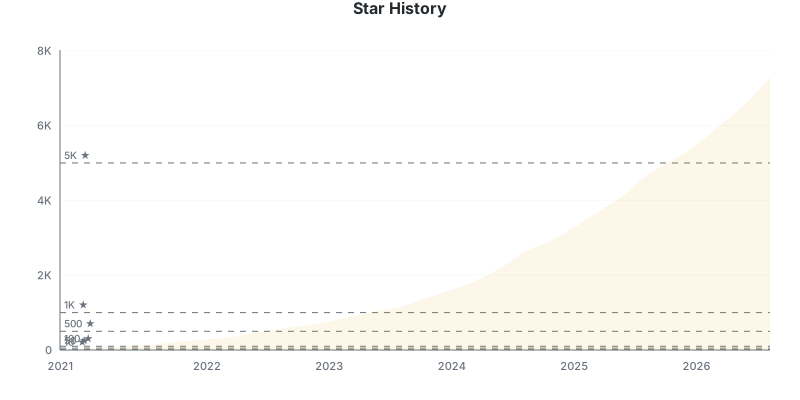
⭐️ Stargazers over time
⚖️ License
License
Source code
RapidOCR source code and engineering components are copyright RapidOCR Authors and licensed under the Apache License, Version 2.0. See LICENSE.
Models
The bundled and hosted OCR model files are derived from official PaddleOCR models. Copyright in the upstream model weights is held by Baidu and/or the respective PaddleOCR rights holders.
The applicable upstream models are distributed under the Apache License, Version 2.0. Converted model artifacts, including ONNX representations produced by RapidOCR, are redistributed under the same license terms.
RapidOCR does not claim ownership of the upstream model weights. Model-specific sources, hashes, attribution, and conversion information are documented in MODEL_LICENSES.md.
Contributors
(top 30 of 45)


Similar repos


Languages
Python
80.3%
Jupyter Notebook
19.6%
📄 Awesome OCR multiple programing languages toolkits based on ONNX Runtime, OpenVINO, MNN, PaddlePaddle, TensorRT and PyTorch.
See the codeREADME
📝 Introduction
RapidOCR is a completely open-source, free OCR tool that supports multi-platform, multi-language operation and rapid offline deployment. Its core advantages lie in extreme speed and extensive compatibility.
Supported Languages: Default support for Chinese and English recognition. For other supported languages, please refer to the documentation: Model List.
Project Origin: Considering that PaddleOCR still has room for optimization in engineering aspects, we innovatively converted the models in PaddleOCR into the highly compatible ONNX format to simplify and accelerate the inference deployment of OCR models on various terminal devices. Furthermore, we achieved seamless cross-platform porting based on multiple programming languages such as Python, C++, Java, and C#, enabling developers to get started easily and integrate efficiently.
Name Implication: The name "RapidOCR" embodies our core expectations for the product: Rapid (simple operation, fast response), Good & Economical (low resource consumption, high cost-effectiveness), and Intelligent (achieving accurate and efficient recognition relying on deep learning technology). We focus on leveraging the advantages of artificial intelligence to create compact yet powerful models, relentlessly pursuing speed while ensuring excellent recognition results.
User Guide:
- Direct Deployment: If the models provided in this repository meet your needs, simply refer to the Official Documentation to quickly complete the deployment and usage of RapidOCR.
- Custom Fine-tuning: If the existing models cannot meet specific scenario requirements, you can fine-tune them using your own data based on PaddleOCR, and then apply the optimized models to the RapidOCR deployment process to achieve personalized customization.
If you find this project helpful for your work or study, we kindly ask you to give us a ⭐ Star to provide valuable support and encouragement!
🎥 Visualization
🛠️ Installation
pip install rapidocr onnxruntime
📋 Usage
from rapidocr import RapidOCR

engine = RapidOCR()

img_url = "https://www.modelscope.cn/models/RapidAI/RapidOCR/resolve/master/resources/test_files/ch_en_num.jpg"
result = engine(img_url)
print(result)

result.vis("vis_result.jpg")
🐳 Docker
Docker development environments are available for all supported inference engines:
# Build and test with ONNX Runtime (CPU)
make build-onnxruntime-cpu
make test-onnxruntime-cpu

# Or use any engine: onnxruntime-gpu, tensorrt, paddle, openvino, pytorch, mnn
make build-tensorrt
make shell-tensorrt
See docker/README.md for full setup instructions, GPU configuration, and troubleshooting.
📚 Documentation
Full documentation can be found on docs, in Chinese.
👥 Who use? (more)
- Docling
- CnOCR
- api-for-open-llm
- arknights-mower
- pensieve
- genshin_artifact_auxiliary
- ChatLLM
- langchain
- Langchain-Chatchat
- JamAIBase
- PAI-RAG
- ChatAgent_RAG
- OpenAdapt
- Umi-OCR
For more projects that use RapidOCR, you are welcome to register at the registration address. Registration is solely for product promotion.
🙏 Acknowledgements
- Many thanks to PaddleOCR for everything.
- Many thanks to PaddleOCR2Pytorch for providing the converted PyTorch format models.
- Many thanks to PaddleX for providing the document models.
- Many thanks to DeliciaLaniD for fixing the misplaced start position of scan animation in ocrweb.
- Many thanks to zhsunlight for the suggestion about parameterized call GPU reasoning and the careful and thoughtful testing.
- Many thanks to lzh111222334 for fixing some bugs of rec preprocessing under python version.
- Many thanks to AutumnSun1996 for the suggestion in the #42.
- Many thanks to DeadWood8 for providing the document which packages rapidocr_web to exe by Nuitka.
- Many thanks to Loovelj for fixing the bug of sorting the text boxes. For details see issue 75.
🤝 Contribution Guide
This repository contains the Python component of RapidOCR. Components for other languages have been migrated to separate repositories.
For the complete workflow on contributing to Python development, please refer to: Python CONTRIBUTING.
🎖 Code Contributors
🌟 Sponsors & Backers
RapidOCR is an Apache2.0-licensed open source project with its ongoing development made possible entirely by the support of these awesome backers. If you'd like to join them, please consider sponsoring RapidOCR's development.
Sponsors
| Sponsors | Application | Introduction |
|---|---|---|
| Quicker | Your fingertip toolbox |
Backers
|
@zg-young |
@Eunsolfs |
@youzzhang |
@heyq02 |
Lucky-Li-le |
📜 Citation
If you find this project useful in your research, please consider cite:
@misc{RapidOCR 2021,
    title={{Rapid OCR}: OCR Toolbox},
    author={RapidAI Team},
    howpublished = {\url{https://github.com/RapidAI/RapidOCR}},
    year={2021}
}
⭐️ Stargazers over time
⚖️ License
License
Source code
RapidOCR source code and engineering components are copyright RapidOCR Authors and licensed under the Apache License, Version 2.0. See LICENSE.
Models
The bundled and hosted OCR model files are derived from official PaddleOCR models. Copyright in the upstream model weights is held by Baidu and/or the respective PaddleOCR rights holders.
The applicable upstream models are distributed under the Apache License, Version 2.0. Converted model artifacts, including ONNX representations produced by RapidOCR, are redistributed under the same license terms.
RapidOCR does not claim ownership of the upstream model weights. Model-specific sources, hashes, attribution, and conversion information are documented in MODEL_LICENSES.md.
Similar repos
Contributors
(top 30 of 45)
Languages
Python
80.3%
Jupyter Notebook
19.6%