
High performance Python GLMs with all the features!
See the codeREADME
glum






Generalized linear models (GLM) are a core statistical tool that include many common methods like least-squares regression, Poisson regression, and logistic regression as special cases. At QuantCo, we have used GLMs in e-commerce pricing, insurance claims prediction, and more. We have developed glum, a fast Python-first GLM library. The development was based on a fork of scikit-learn, so it has a scikit-learn-like API. We are thankful for the starting point provided by Christian Lorentzen in that PR!
We believe that for GLM development, broad support for distributions, regularization, and statistical inference, along with fast formula-based specification, is key. glum supports
- Built-in cross-validation for optimal regularization, efficiently exploiting a “regularization path”
- L1 regularization, which produces sparse and easily interpretable solutions
- L2 regularization, including variable matrix-valued (Tikhonov) penalties, which are useful in modeling correlated effects
- Elastic net regularization
- Normal, Poisson, binomial, gamma, inverse Gaussian, negative binomial, and Tweedie distributions, plus varied and customizable link functions
- Built-in formula-based model specification using
formulaic, including monotonic constraints - Classical statistical inference for unregularized models
- Box constraints, linear inequality constraints, sample weights, offsets
- Multiple dataframe backends (pandas, polars, and more) via
narwhals
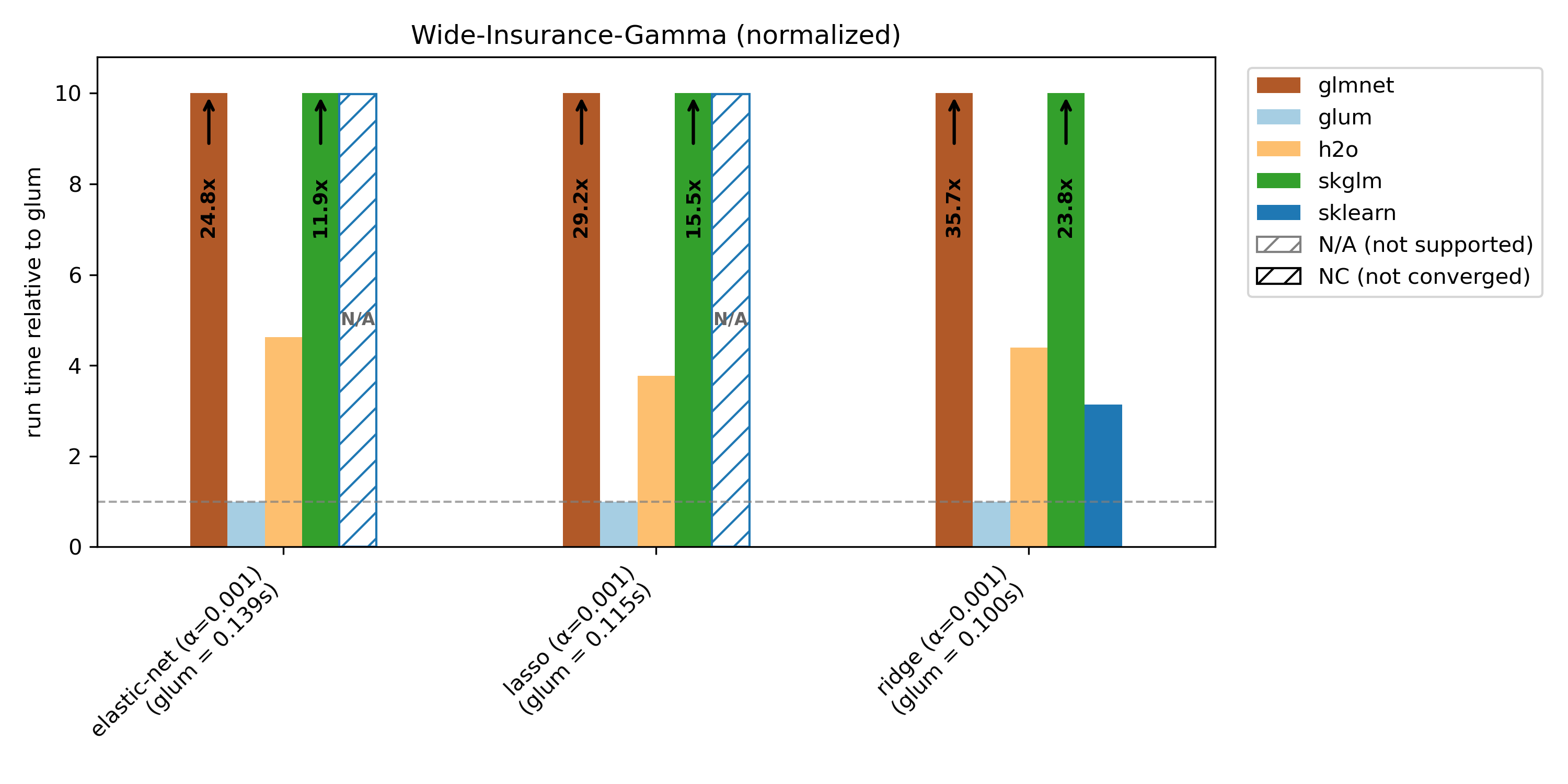
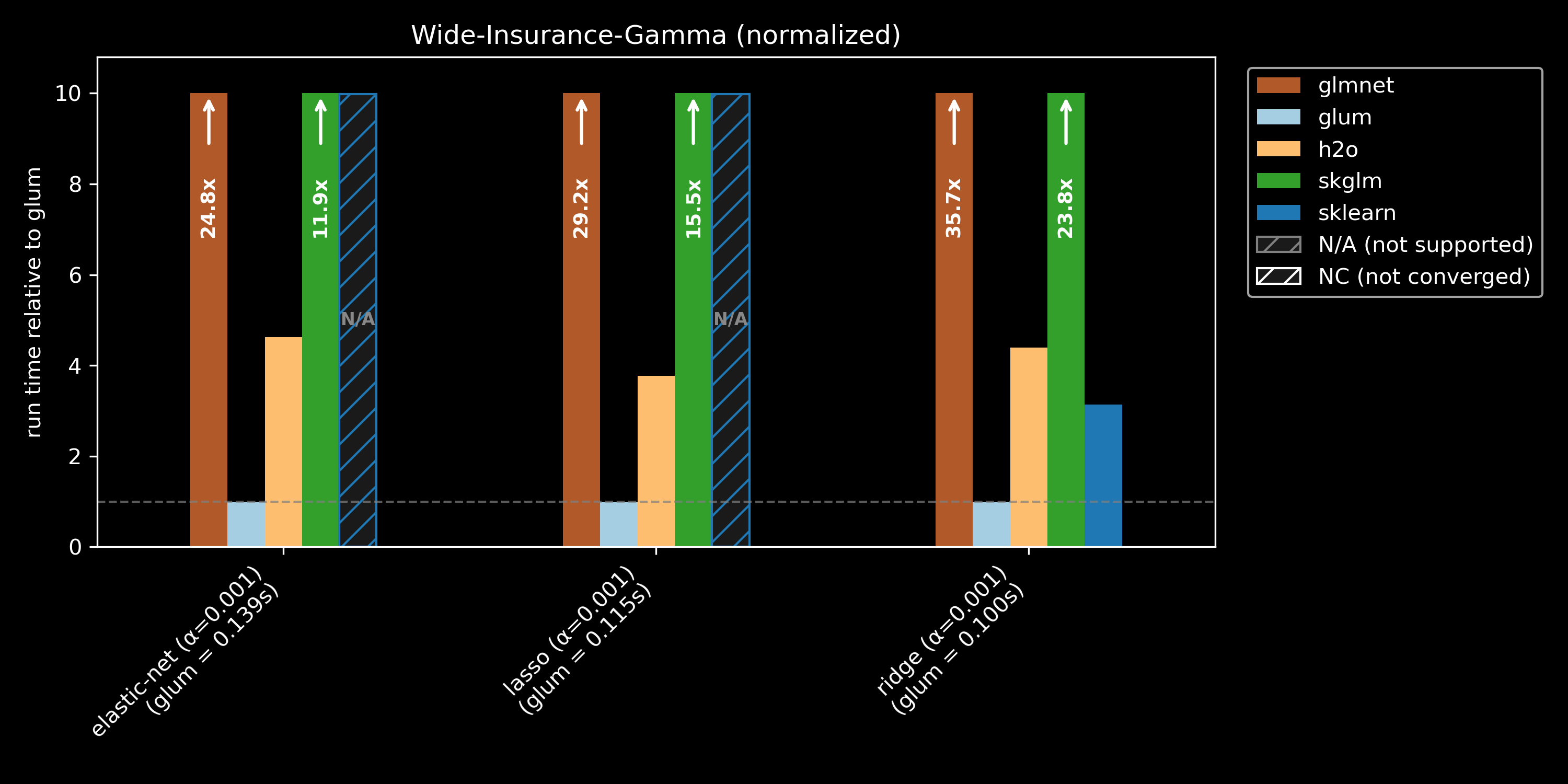
Performance also matters, so we conducted extensive benchmarks against other modern libraries. Although performance depends on the specific problem, we find that when N >> K (there are more observations than predictors), glum is consistently much faster for a wide range of problems. This repo includes the benchmarking tools in the glum_benchmarks module. For details, see here.
For more information on glum, including tutorials and API reference, please see the documentation.
Why did we choose the name glum? We wanted a name that had the letters GLM and wasn't easily confused with any existing implementation. And we thought glum sounded like a funny name (and not glum at all!). If you need a more professional-sounding name, feel free to pronounce it as G-L-um. Or maybe it stands for "Generalized linear... ummm... modeling?"
A classic example predicting housing prices
>>> import pandas as pd
>>> from glum import GeneralizedLinearRegressor
>>>
>>> # This dataset contains house sale prices for King County, which includes
>>> # Seattle. It includes homes sold between May 2014 and May 2015.
>>> # To download, use: sklearn.datasets.fetch_openml(name="house_sales", version=3)
>>> house_data = pd.read_parquet("data/housing.parquet")
>>>
>>> # Use only select features
>>> X = house_data[
...     [
...         "bedrooms",
...         "bathrooms",
...         "sqft_living",
...         "floors",
...         "waterfront",
...         "view",
...         "condition",
...         "grade",
...         "yr_built",
...         "yr_renovated",
...     ]
... ].copy()
>>>
>>> # Model whether a house had an above or below median price via a Binomial
>>> # distribution. We'll be doing L1-regularized logistic regression.
>>> price = house_data["price"]
>>> y = (price < price.median()).values.astype(int)
>>> model = GeneralizedLinearRegressor(
...     family='binomial',
...     l1_ratio=1.0,
...     alpha=0.001
... )
>>>
>>> _ = model.fit(X=X, y=y)
>>>
>>> # Models can also be built with formulas from formulaic.
>>> # Monotonic constraints ensure bathrooms has a non-decreasing effect.
>>> model_formula = GeneralizedLinearRegressor(
...     family='binomial',
...     alpha=0.001,
...     formula="bedrooms + bs(bathrooms, df=5) + bs(sqft_living, 3) + C(waterfront)",
...     monotonic_constraints={"bathrooms": "increasing"}
... )
>>> _ = model_formula.fit(X=house_data, y=y)
Installation
Please install the package through conda-forge:
conda install glum -c conda-forge
Performance
For optimal performance on an x86_64 architecture, we recommend using the MKL library
(conda install mkl). By default, conda usually installs the openblas version, which
is slower, but supported on all major architectures and operating systems.
Contributors
(top 30 of 32)


Similar repos





Languages
Python
95.9%
Cython
4.0%
High performance Python GLMs with all the features!
See the codeREADME
glum
Generalized linear models (GLM) are a core statistical tool that include many common methods like least-squares regression, Poisson regression, and logistic regression as special cases. At QuantCo, we have used GLMs in e-commerce pricing, insurance claims prediction, and more. We have developed glum, a fast Python-first GLM library. The development was based on a fork of scikit-learn, so it has a scikit-learn-like API. We are thankful for the starting point provided by Christian Lorentzen in that PR!
We believe that for GLM development, broad support for distributions, regularization, and statistical inference, along with fast formula-based specification, is key. glum supports
- Built-in cross-validation for optimal regularization, efficiently exploiting a “regularization path”
- L1 regularization, which produces sparse and easily interpretable solutions
- L2 regularization, including variable matrix-valued (Tikhonov) penalties, which are useful in modeling correlated effects
- Elastic net regularization
- Normal, Poisson, binomial, gamma, inverse Gaussian, negative binomial, and Tweedie distributions, plus varied and customizable link functions
- Built-in formula-based model specification using
formulaic, including monotonic constraints - Classical statistical inference for unregularized models
- Box constraints, linear inequality constraints, sample weights, offsets
- Multiple dataframe backends (pandas, polars, and more) via
narwhals
Performance also matters, so we conducted extensive benchmarks against other modern libraries. Although performance depends on the specific problem, we find that when N >> K (there are more observations than predictors), glum is consistently much faster for a wide range of problems. This repo includes the benchmarking tools in the glum_benchmarks module. For details, see here.
For more information on glum, including tutorials and API reference, please see the documentation.
Why did we choose the name glum? We wanted a name that had the letters GLM and wasn't easily confused with any existing implementation. And we thought glum sounded like a funny name (and not glum at all!). If you need a more professional-sounding name, feel free to pronounce it as G-L-um. Or maybe it stands for "Generalized linear... ummm... modeling?"
A classic example predicting housing prices
>>> import pandas as pd
>>> from glum import GeneralizedLinearRegressor
>>>
>>> # This dataset contains house sale prices for King County, which includes
>>> # Seattle. It includes homes sold between May 2014 and May 2015.
>>> # To download, use: sklearn.datasets.fetch_openml(name="house_sales", version=3)
>>> house_data = pd.read_parquet("data/housing.parquet")
>>>
>>> # Use only select features
>>> X = house_data[
...     [
...         "bedrooms",
...         "bathrooms",
...         "sqft_living",
...         "floors",
...         "waterfront",
...         "view",
...         "condition",
...         "grade",
...         "yr_built",
...         "yr_renovated",
...     ]
... ].copy()
>>>
>>> # Model whether a house had an above or below median price via a Binomial
>>> # distribution. We'll be doing L1-regularized logistic regression.
>>> price = house_data["price"]
>>> y = (price < price.median()).values.astype(int)
>>> model = GeneralizedLinearRegressor(
...     family='binomial',
...     l1_ratio=1.0,
...     alpha=0.001
... )
>>>
>>> _ = model.fit(X=X, y=y)
>>>
>>> # Models can also be built with formulas from formulaic.
>>> # Monotonic constraints ensure bathrooms has a non-decreasing effect.
>>> model_formula = GeneralizedLinearRegressor(
...     family='binomial',
...     alpha=0.001,
...     formula="bedrooms + bs(bathrooms, df=5) + bs(sqft_living, 3) + C(waterfront)",
...     monotonic_constraints={"bathrooms": "increasing"}
... )
>>> _ = model_formula.fit(X=house_data, y=y)
Installation
Please install the package through conda-forge:
conda install glum -c conda-forge
Performance
For optimal performance on an x86_64 architecture, we recommend using the MKL library
(conda install mkl). By default, conda usually installs the openblas version, which
is slower, but supported on all major architectures and operating systems.
Similar repos
Contributors
(top 30 of 32)
Languages
Python
95.9%
Cython
4.0%