
A notation for writing trees and a parser for it
See the codeSee what people are saying
README
Brashtag
Brashtag is a notation for specifying trees. Purpose of the notation is to allow you to surround a piece of text with hints that programs can later exploit.
The notation
There are three kinds of nodes blobs, bags, codes.
- Blobs contain text.
- Bags contain blobs, codes and other bags. They can be tagged.
- Codes also contain text. More on them later.
The following snippet constructs tree with a bag tagged "card" that contains
two bags tagged "front" and "back". The bag tagged "front" contains a blob
with text "This is front.". The bag tagged back contains a blob with text
"This is back.".
#card{
   #front{
      This is front.
   }
   #back{
      This is back.
   }
}
Any text is allowed inside tags and blobs except these four characters #, {, },
` (tick).
Because these characters are also used by the notation. If you want to
put text with those characters in the tree you have to surround it by ` ticks. That creates
a node of kind code. You need to surround the code node with more ticks than maximum
number of consecutive ticks inside its text.
Following snippet constructs a code node with tag ` and func main() { fmt.Println("Hello") } text.
`
func main() { fmt.Println("Hello") }
`
And this snippet constructs a code node with tag `` and text Some `code` here. .
``
Some `code` here.
``
Examples Texts and Corresponding Trees
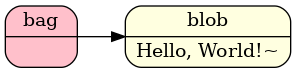
One
Hello, World!
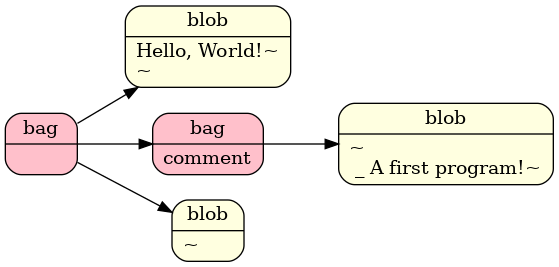
Two
Hello, World!

#comment{
    A first program!
}
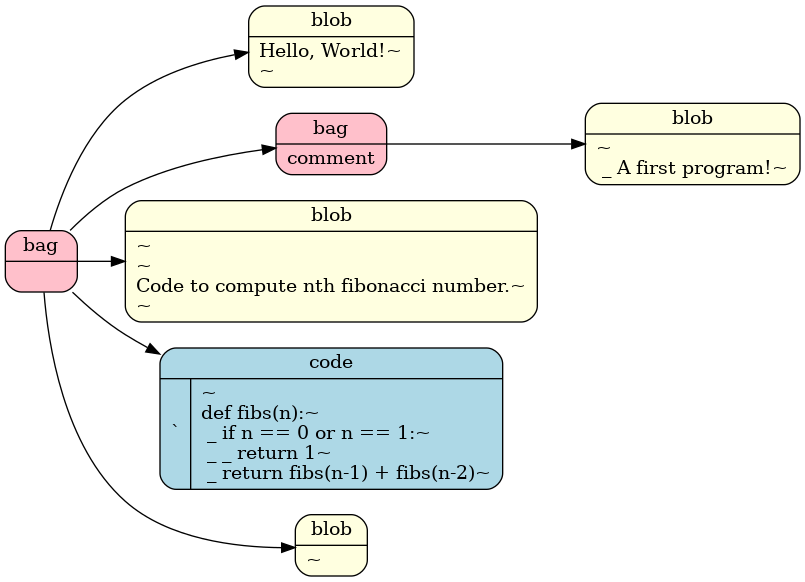
Three
Hello, World!

#comment{
    A first program!
}

Code to compute nth fibonacci number.

`
def fibs(n):
    if n == 0 or n == 1:
        return 1
    return fibs(n-1) + fibs(n-2)
`
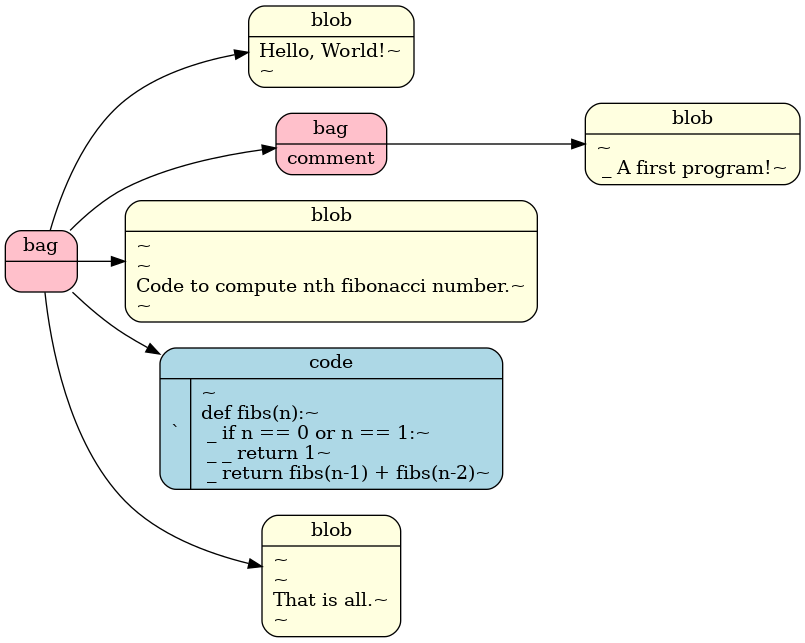
Four
Hello, World!

#comment{
    A first program!
}

Code to compute nth fibonacci number.

`
def fibs(n):
    if n == 0 or n == 1:
        return 1
    return fibs(n-1) + fibs(n-2)
`

That is all.
Some Programs
These are quickly hacked together, unpolished programs. Making this kind of hacking easy is what this notation is invented for.
- barkdown - converts brashtag to html.
- carter - flashcards study program.
- todot - outputs brashtag tree in dot format from a brashtag document.
- notebook - use a brashtag document as a jupyter notebook
Install
Golang:
import "github.com/pratikdeoghare/brashtag"
Python:
pip install git+https://github.com/PratikDeoghare/brashtag.git
Javascript:
npm install git+https://github.com/pratikdeoghare/brashtag.git
TODO
- Write tests.
- Better error reporting.
- Write tutorial.
- Write docs.
Similar repos


Languages
Go
74.2%
HTML
9.4%
Python
7.6%
JavaScript
6.9%
Makefile
1.4%
A notation for writing trees and a parser for it
See the codeSee what people are saying
README
Brashtag
Brashtag is a notation for specifying trees. Purpose of the notation is to allow you to surround a piece of text with hints that programs can later exploit.
The notation
There are three kinds of nodes blobs, bags, codes.
- Blobs contain text.
- Bags contain blobs, codes and other bags. They can be tagged.
- Codes also contain text. More on them later.
The following snippet constructs tree with a bag tagged "card" that contains
two bags tagged "front" and "back". The bag tagged "front" contains a blob
with text "This is front.". The bag tagged back contains a blob with text
"This is back.".
#card{
   #front{
      This is front.
   }
   #back{
      This is back.
   }
}
Any text is allowed inside tags and blobs except these four characters #, {, },
` (tick).
Because these characters are also used by the notation. If you want to
put text with those characters in the tree you have to surround it by ` ticks. That creates
a node of kind code. You need to surround the code node with more ticks than maximum
number of consecutive ticks inside its text.
Following snippet constructs a code node with tag ` and func main() { fmt.Println("Hello") } text.
`
func main() { fmt.Println("Hello") }
`
And this snippet constructs a code node with tag `` and text Some `code` here. .
``
Some `code` here.
``
Examples Texts and Corresponding Trees
One
Hello, World!
Two
Hello, World!

#comment{
    A first program!
}
Three
Hello, World!

#comment{
    A first program!
}

Code to compute nth fibonacci number.

`
def fibs(n):
    if n == 0 or n == 1:
        return 1
    return fibs(n-1) + fibs(n-2)
`
Four
Hello, World!

#comment{
    A first program!
}

Code to compute nth fibonacci number.

`
def fibs(n):
    if n == 0 or n == 1:
        return 1
    return fibs(n-1) + fibs(n-2)
`

That is all.
Some Programs
These are quickly hacked together, unpolished programs. Making this kind of hacking easy is what this notation is invented for.
- barkdown - converts brashtag to html.
- carter - flashcards study program.
- todot - outputs brashtag tree in dot format from a brashtag document.
- notebook - use a brashtag document as a jupyter notebook
Install
Golang:
import "github.com/pratikdeoghare/brashtag"
Python:
pip install git+https://github.com/PratikDeoghare/brashtag.git
Javascript:
npm install git+https://github.com/pratikdeoghare/brashtag.git
TODO
- Write tests.
- Better error reporting.
- Write tutorial.
- Write docs.
Similar repos
Languages
Go
74.2%
HTML
9.4%
Python
7.6%
JavaScript
6.9%
Makefile
1.4%