Free, open source parametric CAD for 3D printing. Sketch, constrain, model and export STEP, STL or 3MF. Windows, macOS and Linux.
TypeScript
10
1,497 commits
updated Oct 12, 2026

Free, open source parametric CAD for 3D printing. Sketch it, constrain it, model it, and export STEP, STL or 3MF. Windows, macOS and Linux.



Download FundaCAD, a
portable Windows exe, a macOS app, and a Flatpak, AppImage, .deb and .rpm for
Linux. No account, no cloud, no subscription, your files stay on your disk.
Built on the Open CASCADE geometry kernel through the Funda Engine (Rust), with a Tauri shell and a Vue + three.js viewport. A part is a timeline of features, so you can go back to any one of them, change it, and the model rebuilds from there.
It started as a fork of SindriCAD and has diverged quite a lot since, mainly UI and a rust backend under the same AGPL-3.0 licence.
This project heavily or exclusively uses AI to generate code and tests. do NOT expect this software to be enterprise grade but it does allow very fast iteration. you may use AI for feature requests or even forking and creating your own. this code open to the public and free forever.
human input is made for decisions, guiding and real usage by me. the goal is it to make this a personalized version of a CAD with features I like and would love to have.
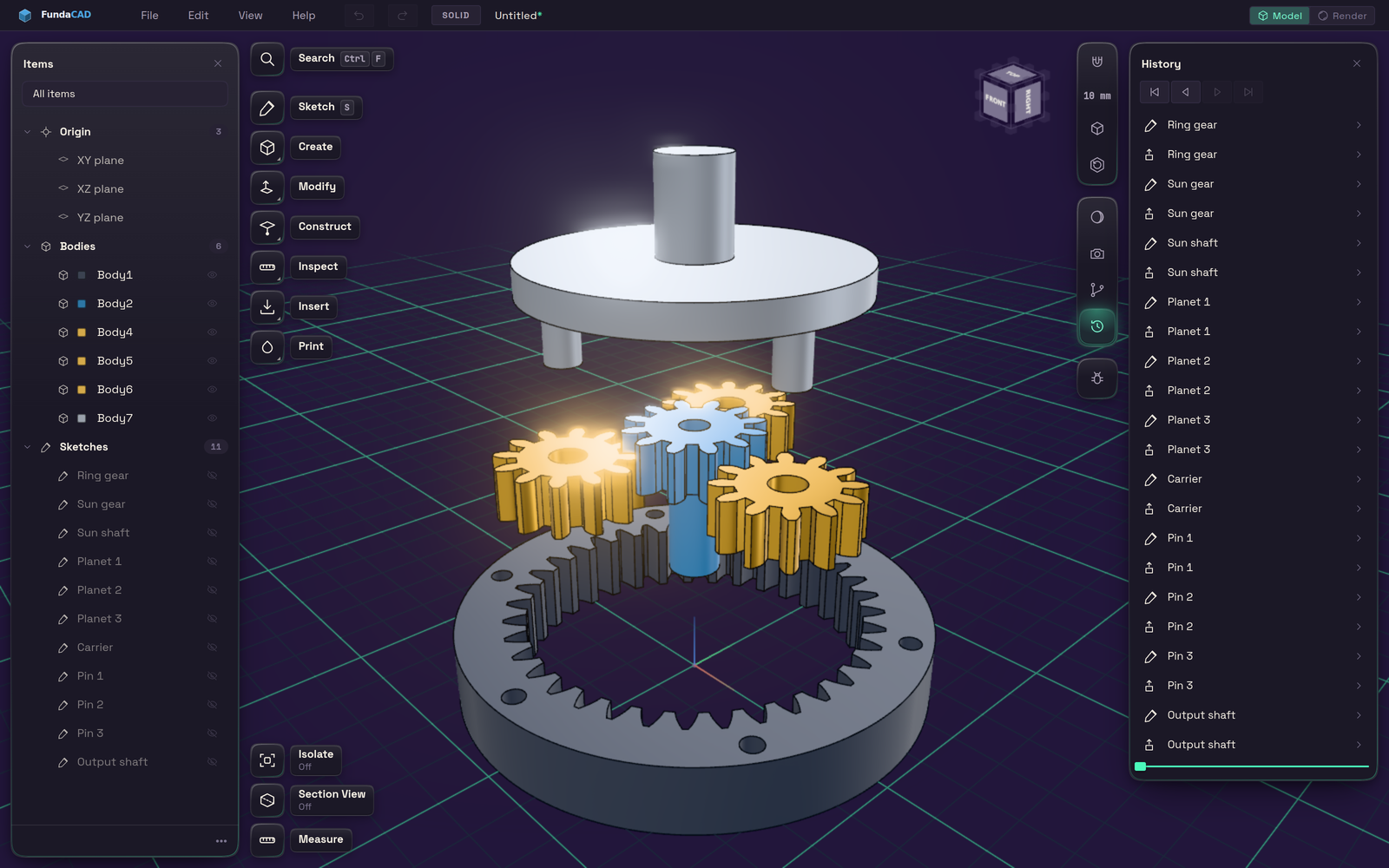
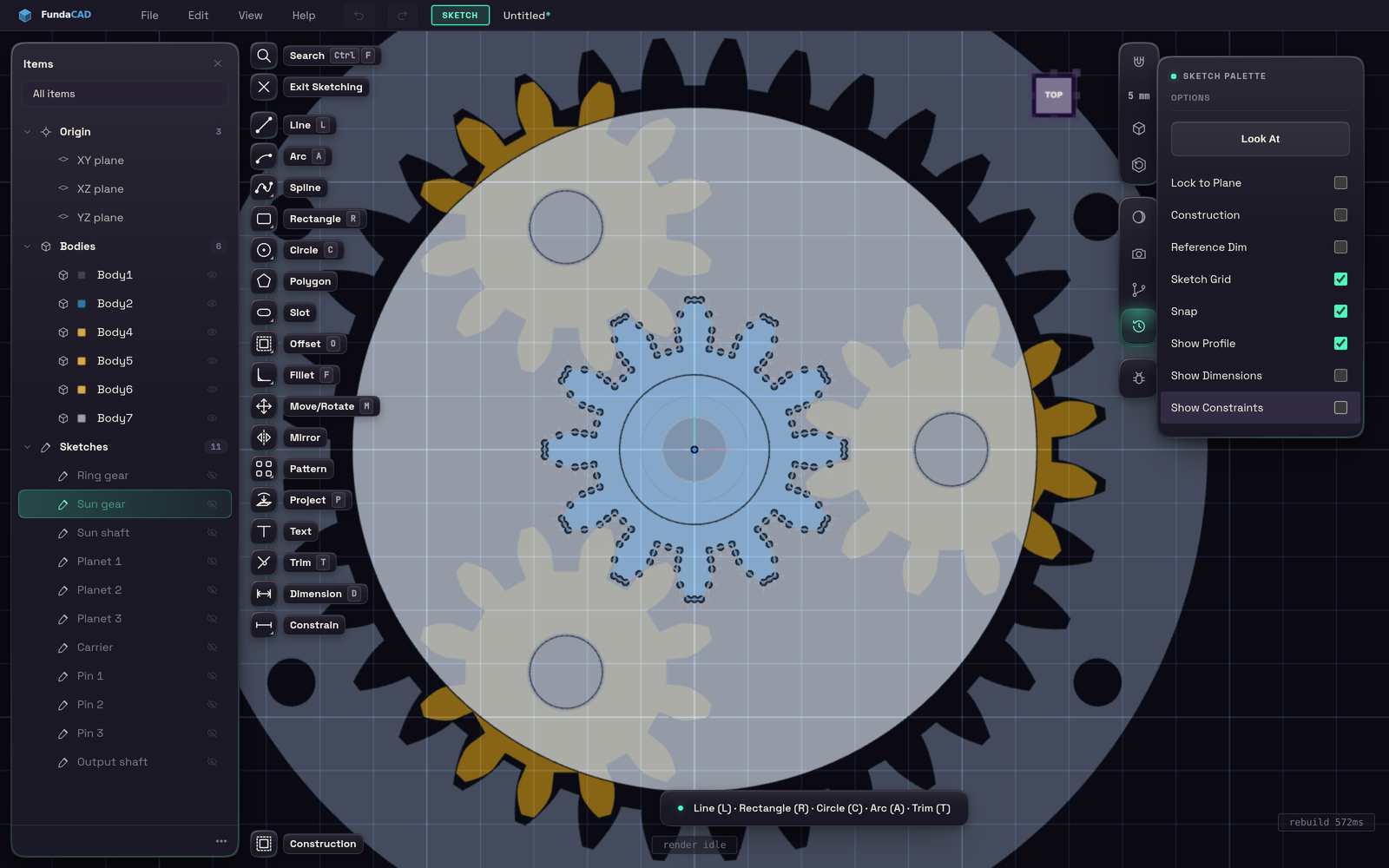
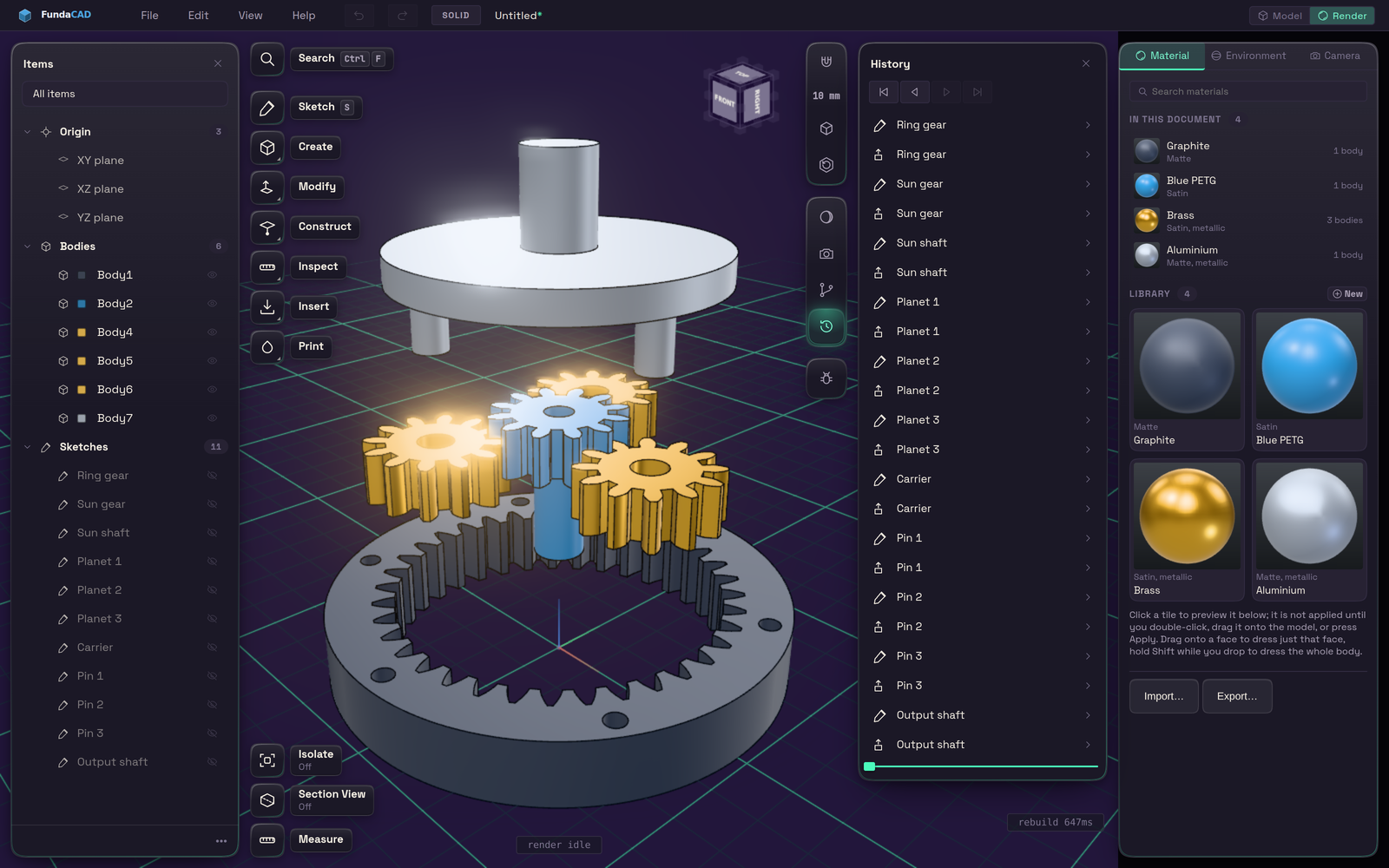
find the binary for your OS on the rolling releases site beta release
The builds are not code signed, so each OS says so in its own way:
Windows, SmartScreen shows "Windows protected your PC". Choose More info, then Run anyway. The portable build says it too, on first run.
macOS, Gatekeeper may report the app as damaged. It is not; that is what an unsigned app looks like to a current macOS. Clear the quarantine flag once, after moving it to Applications:
xattr -dr com.apple.quarantine /Applications/FundaCAD.app
Linux
the Flatpak runs everywhere, NixOS, Fedora Silverblue and SteamOS included, because its runtime carries WebKitGTK and GTK. Install it from the downloaded file:
flatpak install --user ./FundaCAD-linux-x86_64.flatpak
flatpak run dev.fundacad.app
Ubuntu 22.04 or newer, or Debian 12 or newer: Install the .deb with apt
and not with dpkg -i, because dpkg only reports a missing dependency
while apt goes and fetches it:
sudo apt install ./FundaCAD-linux-x86_64.deb
Distributions carrying only the older libwebkit2gtk-4.0-37, or only the
newer libwebkitgtk-6.0-4, cannot satisfy that dependency under the name the
package asks for, and there the Flatpak is the answer.
FundaCAD is a Vue frontend in a Tauri window, with the Funda Engine (Rust) and the OpenCASCADE geometry kernel (C++) compiled into one executable. Running it from a checkout takes a handful of tools, one clone and one command. The very first build also compiles OpenCASCADE itself, which takes about twenty minutes; every build after that reuses it.
Windows (10 or 11, x64):
rustup-init.exe and take the defaults, which install the stable toolchain
for x86_64-pc-windows-msvc. Install it after the Build Tools. If rustup
is already installed, run rustup update to get a current toolchain.The WebView2 runtime the window draws with is already part of Windows 10 and 11. If it was removed, get the Evergreen runtime from Microsoft.
Open a new terminal so it sees the new PATH, and check:
node --version     # v22 or newer
cmake --version    # 3.22 or newer
rustup show        # the active toolchain ends in -pc-windows-msvc, 1.89 or newer
where.exe cargo    # the FIRST line is in C:\Users\<you>\.cargo\bin
If where.exe cargo lists another cargo first, or rustup is not
recognized, see Troubleshooting before going on.
Clone into a short path such as C:\src\fundacad. The OpenCASCADE build nests
deep folders inside the checkout, and a long base path runs into Windows' 260
character path limit (see Troubleshooting).
Linux (Debian or Ubuntu 22.04 and newer; other distributions need the same
packages under their own names, see
Tauri's prerequisites). The
package list is the one CI installs, from
.github/actions/linux-deps/action.yml,
which is the source of truth, plus cmake:
sudo apt-get update
sudo apt-get install -y libwebkit2gtk-4.1-dev build-essential curl wget file \
  libssl-dev libgtk-3-dev libayatana-appindicator3-dev librsvg2-dev \
  libudev-dev patchelf libfuse2 cmake
curl --proto '=https' --tlsv1.2 -sSf https://sh.rustup.rs | sh
plus Node.js 22 or newer from nodejs.org or your package manager.
macOS:
xcode-select --install
brew install cmake node
curl --proto '=https' --tlsv1.2 -sSf https://sh.rustup.rs | sh
git clone https://github.com/Paraxdev/fundacad.git
cd fundacad
npm install
npm run tauri dev
npm run tauri dev starts the Vite dev server, compiles the app and opens the
window. Frontend edits show up live; a Rust edit recompiles and restarts the
app.
The first build takes about twenty minutes, longer on a laptop. Most of it
is spent in OpenCASCADE, a large C++ library that is compiled from source and
linked statically, so the app needs no OpenCASCADE installed on any machine it
runs on. Cargo sits on Building [...] opencascade-sys(build) meanwhile, that
is normal. The kernel lands in target/OCCT at the top of the checkout and is
shared by the app and the engine workspace, so it is compiled once per
checkout. Running cargo clean in the top folder deletes it, and the next
build compiles it again. Another checkout or worktree can reuse it by setting
the FUNDACAD_OCCT_ROOT environment variable to the absolute path of that
target/OCCT, for example C:\src\fundacad\target\OCCT. The details are in
docs/PACKAGING.md.
Builds from before this layout put the kernel in src-tauri/target/OCCT
instead. Nothing reads that folder any more, so it can be deleted to free about
a gigabyte.
npm run tauri build
The installers land in src-tauri/target/release/bundle/: an .msi and an
NSIS -setup.exe on Windows (Tauri downloads WiX and NSIS the first time), a
.dmg and .app on macOS, an AppImage, .deb and .rpm on Linux. The bare
executable is src-tauri/target/release/fundacad.exe on Windows. The release
build compiles the Rust again with optimisations but reuses the kernel.
npm test                 # frontend unit tests (vitest)
npm run typecheck        # vue-tsc
cargo test --workspace --features fundacad-engine/ws   # the engine, from the top folder
cd src-tauri && cargo test --tests                     # the app shell, needs the dist/ that npm run build makes
Two terminals, if you are iterating on the UI in a browser:
cargo run --bin fundacad-engine -- --ws   # ws://127.0.0.1:8765
npm run dev                               # http://localhost:5173
The engine prints TOKEN <t> on its first line and refuses connections without
it, so open http://localhost:5173/?token=<t>. Without it the viewport connects,
is refused, and silently never builds anything. FUNDACAD_ENGINE_TOKEN and
FUNDACAD_ENGINE_PORT fix the token and the port instead.
FundaCAD's kernel crashes when built with the MinGW (windows-gnu) toolchain, or cmake output mentioning MinGW Makefiles. The cargo that
ran targets windows-gnu instead of windows-msvc. Either rustup's default
toolchain is the GNU one, or a second Rust install (from a package manager,
MSYS2 or similar) comes before rustup on the PATH.
Run rustup show. If the default toolchain ends in -windows-gnu, run
rustup default stable-x86_64-pc-windows-msvc.
Run where.exe cargo. If the first line is not in
C:\Users\<you>\.cargo\bin, another Rust is ahead of rustup. Uninstall it,
or move %USERPROFILE%\.cargo\bin above it in the PATH, then open a new
terminal. Windows reads the System Path before the User Path, so a Rust in
the System Path needs .cargo\bin moved there too. To try a build without
changing anything, put rustup first for the current PowerShell only:
$env:PATH = "$HOME\.cargo\bin;$env:PATH"
npm run tauri dev
rustup is not recognized, or where.exe cargo lists nothing in
C:\Users\<you>\.cargo\bin. rustup is either not installed or its folder is
not on the PATH. If C:\Users\<you>\.cargo\bin\rustup.exe exists, add that
folder to the User Path as above and open a new terminal; otherwise install
rustup (step 1).
exceeds the OS max path limit or another MSBuild error about a path
being too long. The checkout sits too deep for the nested OpenCASCADE build
folders. Clone it again into a short path such as C:\src\fundacad.
use of unstable library feature inside opencascade-sys's build
script, or cargo saying the package requires a newer rustc. The toolchain is
older than 1.89; run rustup update.
include could not find requested file: .../OpenCASCADEFoundationClassesTargets.cmake
followed by Builtin OpenCASCADE library not found. Older builds registered
their OpenCASCADE build folders in CMake's package registry, and CMake picked
a broken one from there. The current build ignores that registry, so pull
the latest main. On an older branch, clear the registry entries, which only
ever point at build folders:
reg delete HKCU\Software\Kitware\CMake\Packages\OpenCASCADE /f
On Linux and macOS: rm -rf ~/.cmake/packages/OpenCASCADE. On the current
main those entries are harmless and can stay.
This directory holds an OpenCASCADE kernel built by MinGW or GCC (or
by MSVC, or built for <another target>). A kernel from the other Windows
toolchain, or for another target, is in the folder the message names, often
left by a build with the wrong cargo. Delete that folder and build again;
the kernel is rebuilt there.
FUNDACAD_OCCT_ROOT holds no OpenCASCADE install or FUNDACAD_OCCT_ROOT has to be an absolute path. That environment variable points somewhere
without a kernel, or is relative. Remove it to use the checkout's own
target/OCCT, or set it to the absolute path of a folder that has one.
Compatibility with CMake < 3.5 has been removed from CMake. CMake 4
refuses the minimum OpenCASCADE 7.8.1 declares. The checkout's
.cargo/config.toml sets CMAKE_POLICY_VERSION_MINIMUM=3.5, which cargo
only reads when run inside the checkout; set that environment variable when
building from elsewhere.
could not find any instance of Visual Studio. The Build Tools are
missing the Desktop development with C++ workload; add it from the
Visual Studio Installer.
docs/ARCHITECTURE.md, how the processes fit togetherdocs/ENGINE.md, the Funda Engine: its target architecture, test strategy and golden files, the beta rolling release, and its performance workdocs/PROTOCOL.md, the messages the frontend and the engine exchangedocs/FUNDA-FORMAT.md, the readable .funda JSON document and the self-repairing binary .fundabdocs/PACKAGING.md, how a desktop bundle is builtdocs/MCP.md, MCP, built into the app: how an AI assistant builds, measures and looks at parts, and how to connect onedocs/PLUGINS.md, optional parts of the app, what they may reach, and how that is askedFree, open source parametric CAD for 3D printing. Sketch, constrain, model and export STEP, STL or 3MF. Windows, macOS and Linux.
TypeScript
10
1,497 commits
updated Oct 12, 2026
Free, open source parametric CAD for 3D printing. Sketch it, constrain it, model it, and export STEP, STL or 3MF. Windows, macOS and Linux.
Download FundaCAD, a
portable Windows exe, a macOS app, and a Flatpak, AppImage, .deb and .rpm for
Linux. No account, no cloud, no subscription, your files stay on your disk.
Built on the Open CASCADE geometry kernel through the Funda Engine (Rust), with a Tauri shell and a Vue + three.js viewport. A part is a timeline of features, so you can go back to any one of them, change it, and the model rebuilds from there.
It started as a fork of SindriCAD and has diverged quite a lot since, mainly UI and a rust backend under the same AGPL-3.0 licence.
This project heavily or exclusively uses AI to generate code and tests. do NOT expect this software to be enterprise grade but it does allow very fast iteration. you may use AI for feature requests or even forking and creating your own. this code open to the public and free forever.
human input is made for decisions, guiding and real usage by me. the goal is it to make this a personalized version of a CAD with features I like and would love to have.
find the binary for your OS on the rolling releases site beta release
The builds are not code signed, so each OS says so in its own way:
Windows, SmartScreen shows "Windows protected your PC". Choose More info, then Run anyway. The portable build says it too, on first run.
macOS, Gatekeeper may report the app as damaged. It is not; that is what an unsigned app looks like to a current macOS. Clear the quarantine flag once, after moving it to Applications:
xattr -dr com.apple.quarantine /Applications/FundaCAD.app
Linux
the Flatpak runs everywhere, NixOS, Fedora Silverblue and SteamOS included, because its runtime carries WebKitGTK and GTK. Install it from the downloaded file:
flatpak install --user ./FundaCAD-linux-x86_64.flatpak
flatpak run dev.fundacad.app
Ubuntu 22.04 or newer, or Debian 12 or newer: Install the .deb with apt
and not with dpkg -i, because dpkg only reports a missing dependency
while apt goes and fetches it:
sudo apt install ./FundaCAD-linux-x86_64.deb
Distributions carrying only the older libwebkit2gtk-4.0-37, or only the
newer libwebkitgtk-6.0-4, cannot satisfy that dependency under the name the
package asks for, and there the Flatpak is the answer.
FundaCAD is a Vue frontend in a Tauri window, with the Funda Engine (Rust) and the OpenCASCADE geometry kernel (C++) compiled into one executable. Running it from a checkout takes a handful of tools, one clone and one command. The very first build also compiles OpenCASCADE itself, which takes about twenty minutes; every build after that reuses it.
Windows (10 or 11, x64):
rustup-init.exe and take the defaults, which install the stable toolchain
for x86_64-pc-windows-msvc. Install it after the Build Tools. If rustup
is already installed, run rustup update to get a current toolchain.The WebView2 runtime the window draws with is already part of Windows 10 and 11. If it was removed, get the Evergreen runtime from Microsoft.
Open a new terminal so it sees the new PATH, and check:
node --version     # v22 or newer
cmake --version    # 3.22 or newer
rustup show        # the active toolchain ends in -pc-windows-msvc, 1.89 or newer
where.exe cargo    # the FIRST line is in C:\Users\<you>\.cargo\bin
If where.exe cargo lists another cargo first, or rustup is not
recognized, see Troubleshooting before going on.
Clone into a short path such as C:\src\fundacad. The OpenCASCADE build nests
deep folders inside the checkout, and a long base path runs into Windows' 260
character path limit (see Troubleshooting).
Linux (Debian or Ubuntu 22.04 and newer; other distributions need the same
packages under their own names, see
Tauri's prerequisites). The
package list is the one CI installs, from
.github/actions/linux-deps/action.yml,
which is the source of truth, plus cmake:
sudo apt-get update
sudo apt-get install -y libwebkit2gtk-4.1-dev build-essential curl wget file \
  libssl-dev libgtk-3-dev libayatana-appindicator3-dev librsvg2-dev \
  libudev-dev patchelf libfuse2 cmake
curl --proto '=https' --tlsv1.2 -sSf https://sh.rustup.rs | sh
plus Node.js 22 or newer from nodejs.org or your package manager.
macOS:
xcode-select --install
brew install cmake node
curl --proto '=https' --tlsv1.2 -sSf https://sh.rustup.rs | sh
git clone https://github.com/Paraxdev/fundacad.git
cd fundacad
npm install
npm run tauri dev
npm run tauri dev starts the Vite dev server, compiles the app and opens the
window. Frontend edits show up live; a Rust edit recompiles and restarts the
app.
The first build takes about twenty minutes, longer on a laptop. Most of it
is spent in OpenCASCADE, a large C++ library that is compiled from source and
linked statically, so the app needs no OpenCASCADE installed on any machine it
runs on. Cargo sits on Building [...] opencascade-sys(build) meanwhile, that
is normal. The kernel lands in target/OCCT at the top of the checkout and is
shared by the app and the engine workspace, so it is compiled once per
checkout. Running cargo clean in the top folder deletes it, and the next
build compiles it again. Another checkout or worktree can reuse it by setting
the FUNDACAD_OCCT_ROOT environment variable to the absolute path of that
target/OCCT, for example C:\src\fundacad\target\OCCT. The details are in
docs/PACKAGING.md.
Builds from before this layout put the kernel in src-tauri/target/OCCT
instead. Nothing reads that folder any more, so it can be deleted to free about
a gigabyte.
npm run tauri build
The installers land in src-tauri/target/release/bundle/: an .msi and an
NSIS -setup.exe on Windows (Tauri downloads WiX and NSIS the first time), a
.dmg and .app on macOS, an AppImage, .deb and .rpm on Linux. The bare
executable is src-tauri/target/release/fundacad.exe on Windows. The release
build compiles the Rust again with optimisations but reuses the kernel.
npm test                 # frontend unit tests (vitest)
npm run typecheck        # vue-tsc
cargo test --workspace --features fundacad-engine/ws   # the engine, from the top folder
cd src-tauri && cargo test --tests                     # the app shell, needs the dist/ that npm run build makes
Two terminals, if you are iterating on the UI in a browser:
cargo run --bin fundacad-engine -- --ws   # ws://127.0.0.1:8765
npm run dev                               # http://localhost:5173
The engine prints TOKEN <t> on its first line and refuses connections without
it, so open http://localhost:5173/?token=<t>. Without it the viewport connects,
is refused, and silently never builds anything. FUNDACAD_ENGINE_TOKEN and
FUNDACAD_ENGINE_PORT fix the token and the port instead.
FundaCAD's kernel crashes when built with the MinGW (windows-gnu) toolchain, or cmake output mentioning MinGW Makefiles. The cargo that
ran targets windows-gnu instead of windows-msvc. Either rustup's default
toolchain is the GNU one, or a second Rust install (from a package manager,
MSYS2 or similar) comes before rustup on the PATH.
Run rustup show. If the default toolchain ends in -windows-gnu, run
rustup default stable-x86_64-pc-windows-msvc.
Run where.exe cargo. If the first line is not in
C:\Users\<you>\.cargo\bin, another Rust is ahead of rustup. Uninstall it,
or move %USERPROFILE%\.cargo\bin above it in the PATH, then open a new
terminal. Windows reads the System Path before the User Path, so a Rust in
the System Path needs .cargo\bin moved there too. To try a build without
changing anything, put rustup first for the current PowerShell only:
$env:PATH = "$HOME\.cargo\bin;$env:PATH"
npm run tauri dev
rustup is not recognized, or where.exe cargo lists nothing in
C:\Users\<you>\.cargo\bin. rustup is either not installed or its folder is
not on the PATH. If C:\Users\<you>\.cargo\bin\rustup.exe exists, add that
folder to the User Path as above and open a new terminal; otherwise install
rustup (step 1).
exceeds the OS max path limit or another MSBuild error about a path
being too long. The checkout sits too deep for the nested OpenCASCADE build
folders. Clone it again into a short path such as C:\src\fundacad.
use of unstable library feature inside opencascade-sys's build
script, or cargo saying the package requires a newer rustc. The toolchain is
older than 1.89; run rustup update.
include could not find requested file: .../OpenCASCADEFoundationClassesTargets.cmake
followed by Builtin OpenCASCADE library not found. Older builds registered
their OpenCASCADE build folders in CMake's package registry, and CMake picked
a broken one from there. The current build ignores that registry, so pull
the latest main. On an older branch, clear the registry entries, which only
ever point at build folders:
reg delete HKCU\Software\Kitware\CMake\Packages\OpenCASCADE /f
On Linux and macOS: rm -rf ~/.cmake/packages/OpenCASCADE. On the current
main those entries are harmless and can stay.
This directory holds an OpenCASCADE kernel built by MinGW or GCC (or
by MSVC, or built for <another target>). A kernel from the other Windows
toolchain, or for another target, is in the folder the message names, often
left by a build with the wrong cargo. Delete that folder and build again;
the kernel is rebuilt there.
FUNDACAD_OCCT_ROOT holds no OpenCASCADE install or FUNDACAD_OCCT_ROOT has to be an absolute path. That environment variable points somewhere
without a kernel, or is relative. Remove it to use the checkout's own
target/OCCT, or set it to the absolute path of a folder that has one.
Compatibility with CMake < 3.5 has been removed from CMake. CMake 4
refuses the minimum OpenCASCADE 7.8.1 declares. The checkout's
.cargo/config.toml sets CMAKE_POLICY_VERSION_MINIMUM=3.5, which cargo
only reads when run inside the checkout; set that environment variable when
building from elsewhere.
could not find any instance of Visual Studio. The Build Tools are
missing the Desktop development with C++ workload; add it from the
Visual Studio Installer.
docs/ARCHITECTURE.md, how the processes fit togetherdocs/ENGINE.md, the Funda Engine: its target architecture, test strategy and golden files, the beta rolling release, and its performance workdocs/PROTOCOL.md, the messages the frontend and the engine exchangedocs/FUNDA-FORMAT.md, the readable .funda JSON document and the self-repairing binary .fundabdocs/PACKAGING.md, how a desktop bundle is builtdocs/MCP.md, MCP, built into the app: how an AI assistant builds, measures and looks at parts, and how to connect onedocs/PLUGINS.md, optional parts of the app, what they may reach, and how that is asked


