Python for Algorithmic Trading Cookbook, published by Packt
Jupyter Notebook
1,245
26 commits
updated Mar 2, 2026

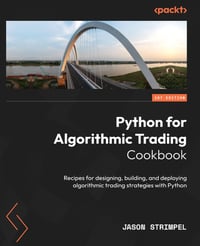
This is the code repository for Python for Algorithmic Trading Cookbook, published by Packt.
Recipes for designing, building, and deploying algorithmic trading strategies with Python.
Explore Python code recipes to use market data for designing and deploying algorithmic trading strategies. By following step-by-step instructions, you’ll be proficient in trading concepts and have hands-on experience in a live trading environment.
This book covers the following exciting features:
If you feel this book is for you, get your copy today!

All of the code is organized into folders.
The code will look like the following:
import datetime as dt
import pandas as pd
from openbb import obb
Following is what you need for this book: Python for Algorithmic Trading Cookbook equips traders, investors, and Python developers with code to design, backtest, and deploy algorithmic trading strategies. You should have experience investing in the stock market, knowledge of Python data structures, and a basic understanding of using Python libraries like pandas. This book is also ideal for individuals with Python experience who are already active in the market or are aspiring to be.
With the following software and hardware list you can run all code files present in the book (Chapter 1-13).
| Chapter | Software required | OS required |
|---|---|---|
| 1-13 | Python version 3.10 | Windows, Mac OS X, and Linux (Any) |
| 1-13 | PostgreSQL | Windows, Mac OS X, and Linux (Any) |
| 1-13 | OpenBB Platform version 4+ | Windows, Mac OS X, and Linux (Any) |
| 1-13 | pandas version 2+ | Windows, Mac OS X, and Linux (Any) |
chains Dataframe contains a column named "option_type" and not "optionType". So, wherever the filter (chains.optionType == "****") is used, it should instead be written as ** (chains.option_type == "****")**stocks.load method …”. However, the method actually used is obb.equity.price.historical.Jason Strimpel is the founder of PyQuant News, with a career spanning over 20 years in trading, risk management, and machine learning. He previously traded for a Chicago-based hedge fund, served as a risk manager at JPMorgan, and managed production risk technology for an energy derivatives trading firm in London. In Singapore, Jason served as the APAC CIO for an agricultural trading firm and built the data science team for a global metals trading firm. He holds undergraduate degrees in finance and economics and a Master’s degree in quantitative finance from the Illinois Institute of Technology. His career has taken him across America, Europe, and Asia. Jason shares his expertise through the PyQuant Newsletter, social media, and teaches the best-selling course Getting Started With Python for Quant Finance.
316 followers · starred Nov 2025
284 followers · starred Aug 2024
52 followers · starred Sep 2025
54 followers · starred Jul 2025
Python for Algorithmic Trading Cookbook, published by Packt
Jupyter Notebook
1,245
26 commits
updated Mar 2, 2026
This is the code repository for Python for Algorithmic Trading Cookbook, published by Packt.
Recipes for designing, building, and deploying algorithmic trading strategies with Python.
Explore Python code recipes to use market data for designing and deploying algorithmic trading strategies. By following step-by-step instructions, you’ll be proficient in trading concepts and have hands-on experience in a live trading environment.
This book covers the following exciting features:
If you feel this book is for you, get your copy today!
All of the code is organized into folders.
The code will look like the following:
import datetime as dt
import pandas as pd
from openbb import obb
Following is what you need for this book: Python for Algorithmic Trading Cookbook equips traders, investors, and Python developers with code to design, backtest, and deploy algorithmic trading strategies. You should have experience investing in the stock market, knowledge of Python data structures, and a basic understanding of using Python libraries like pandas. This book is also ideal for individuals with Python experience who are already active in the market or are aspiring to be.
With the following software and hardware list you can run all code files present in the book (Chapter 1-13).
| Chapter | Software required | OS required |
|---|---|---|
| 1-13 | Python version 3.10 | Windows, Mac OS X, and Linux (Any) |
| 1-13 | PostgreSQL | Windows, Mac OS X, and Linux (Any) |
| 1-13 | OpenBB Platform version 4+ | Windows, Mac OS X, and Linux (Any) |
| 1-13 | pandas version 2+ | Windows, Mac OS X, and Linux (Any) |
chains Dataframe contains a column named "option_type" and not "optionType". So, wherever the filter (chains.optionType == "****") is used, it should instead be written as ** (chains.option_type == "****")**stocks.load method …”. However, the method actually used is obb.equity.price.historical.Jason Strimpel is the founder of PyQuant News, with a career spanning over 20 years in trading, risk management, and machine learning. He previously traded for a Chicago-based hedge fund, served as a risk manager at JPMorgan, and managed production risk technology for an energy derivatives trading firm in London. In Singapore, Jason served as the APAC CIO for an agricultural trading firm and built the data science team for a global metals trading firm. He holds undergraduate degrees in finance and economics and a Master’s degree in quantitative finance from the Illinois Institute of Technology. His career has taken him across America, Europe, and Asia. Jason shares his expertise through the PyQuant Newsletter, social media, and teaches the best-selling course Getting Started With Python for Quant Finance.
316 followers · starred Nov 2025
284 followers · starred Aug 2024
52 followers · starred Sep 2025
54 followers · starred Jul 2025