A unified framework for steering vector extraction, application, and evaluation across 30+ methods.


git clone https://github.com/PQHSGS/SteerBench.git
cd SteerBench
Using Conda (Recommended):
conda create -n sae-steering python=3.11
conda activate sae-steering
Using venv:
python -m venv .venv
source .venv/bin/activate  # Linux/Mac
# or: .venv\Scripts\activate  # Windows
Using pip with requirements.txt (Recommended):
pip install -r requirements.txt
Or install manually:
# Core dependencies
pip install torch torchvision torchaudio --index-url https://download.pytorch.org/whl/cu118

# ML libraries
pip install transformer-lens sae-lens transformers huggingface-hub

# Utilities
pip install numpy pandas scikit-learn tqdm pyyaml

# Development (optional)
pip install pytest pytest-cov black isort mypy
# Set your token (required for gated models like Gemma)
export HF_TOKEN="your_huggingface_token"

# Or login interactively
huggingface-cli login
python -c "from Steering import SteeringPipeline; print('✓ Installation successful')"
# Run steering generation/extraction with a config file
python -m Steering.cli --task run --config Configs/Eval/caa_example.json

# Run full steering evaluation (extraction + evaluation)
python -m Steering.cli --task eval --config Configs/Eval/caa_example.json

# Quiet mode (minimal output)
python -m Steering.cli --task eval --config Configs/Eval/caa_example.json --quiet
from Steering import SteeringPipeline, PipelineConfig

# From config file
config = PipelineConfig.load("Configs/Eval/caa_example.json")
pipeline = SteeringPipeline.from_config(config)
result = pipeline.evaluate_from_config(config)

# Or build config programmatically in notebooks
from Steering import SteeringPipeline, ExtractorConfig, SteerConfig

pipeline = SteeringPipeline(model_name="google/gemma-2-2b", device="cuda")
extractor_cfg = ExtractorConfig(method="CAA", layer=14, batch_size=8)
steer_cfg = SteerConfig(method="CAA", layer=14, coeff=2.0)

result = pipeline.evaluate(
    extractor_config=extractor_cfg,
    steer_config=steer_cfg,
    train_dataset="sycophancy",
    test_dataset="csqa",
)
| Method | Type | Description |
|---|---|---|
| CAA | Dense | Contrastive Activation Addition — mean-difference vector added to residual stream |
| COLD | Dense | In-context One-step Learning Dynamics — finite-difference or kernel variant |
| CAST / CAST_HF | Dense | Conditional Activation Steering — steers only when condition similarity threshold is met |
| MANIFOLD | Dense | Manifold-based steering for reducing overthinking behaviors |
| SPHERICAL | Dense | vMF-gated spherical steering with kappa/alpha/beta hyperparameters |
| SAE-FREE | Dense | Eigendecomposition of activation differences (uses SAE feature space, steers dense) |
| ACT | Transport | Activation Transport / Mean-AcT — affine transport of residual activation distributions |
| ANGULAR | Transport | 2D rotation-based steering with automatic layer selection via cosine similarity |
| CURVEBALL | Transport | Polynomial Kernel-PCA nonlinear steering with pre-image reconstruction |
| FLOW / FLOWGLP | Transport | Flow Matching transport from source to target residual states |
| PID | Transport | Layerwise PID controller over contrastive activation error signals |
| ODE | Transport | Kernel classifier ODE steering (normed-poly / RBF) |
| BIPO | Transport | Bilateral Preference Optimization steering |
| CHARS | Transport | Concept Heterogeneity-Aware Representation Steering |
| LinNEAS | Transport | Linearized Non-linear End-to-end Activation Steering |
| REFT / LOREFT / REPS | Parametric | Low-rank residual fine-tuning / representation engineering |
| FLAS | Parametric | Flow-based Activation Steering — concept-conditioned velocity field with Euler integration |
| WEIGHTSTEER | Weight | Contrastive LoRA weight steering |
| CORRSTEER | SAE | Generation-time correlation between SAE features and behavior |
| SAS | SAE | Contrastive SAE activation differencing |
| SPARE | SAE | Mutual information feature selection with SAE reconstruction |
| SRE | SAE | Sparse Representation Engineering for targeted feature manipulation |
| SRPS | SAE | Semantic token masking + SAE with beta parameter for activation balancing |
| SSV | SAE | Two-stage ANOVA + linear classifier refinement + optimization |
| SAE-RSV | SAE | Multi-component (α1, α2, α3) residual steering vector |
| SAE-TS | SAE | LinearAdapter trained on feature effects |
| SAEIO | SAE | Input/Output score filtering: logit lens + amplification test per feature |
| SAE-COT | SAE | GT SAE latent feature overwrite steering |
| FEAT | SAE | Direct feature list manipulation in SAE latent space |
| FGAA | SAE | Feature-Guided Activation Additions with density threshold |
Dense methods modify residual stream activations directly. Transport methods apply learned or analytic maps (OT, flow, rotation, PCA) to move activations. Parametric methods train a lightweight module (LoRA, flow network) during extraction. SAE methods require a Sparse Autoencoder (currently only available for Gemma models).
Storage constraint for FLAS and REPS: These methods produce very large checkpoints (several GB). All runs must overwrite a single unified path per method to avoid filling disk:
- FLAS:
Vector/FLAS/gemma_gms8k- REPS:
Vector/REPS/gemma_reps_gms8k
All extractors and steer models use strict dict-based types for multi-layer support:
| Parameter | Type | Description |
|---|---|---|
layer | List[int] | Target layer(s) |
steering_vector | Dict[int, Tensor] | Steering vector keyed by layer |
coeff | Dict[int, float] | Steering coefficient keyed by layer |
sae | Dict[int, SAE] | Sparse autoencoder keyed by layer |
conditional_dataset and conditional_layer for condition detectionauto_select_layer=true to auto-select optimal layer via cosine similarityCode/AcT as the ground-truth surface. Code/PID/Mean-AcT overlaps with ACT and adds PID-specific behavior, so PID-specific Mean-AcT changes are tracked under PID.Code/PID/Mean-AcT are reference context and are not part of Steering inference.beta parameter in extractor (not steer) to balance activation vs active dimensionsSteerConfig.coeff maps to flow time T. Requires flas_concept_text at steering time.A central contribution of SAESteeringBench is evaluating the fundamental Pareto trade-off in representation steering: Steering Efficacy (Task Accuracy / Target Alignment) versus Language Modeling Coherence (Perplexity & Non-Degradation).
Aggressive steering often increases target concept expression at the expense of pushing residual representations off the model's manifold, leading to catastrophic repetition or incoherence. The Pareto frontier identifies methods that achieve maximum steering with minimal distribution distortion.
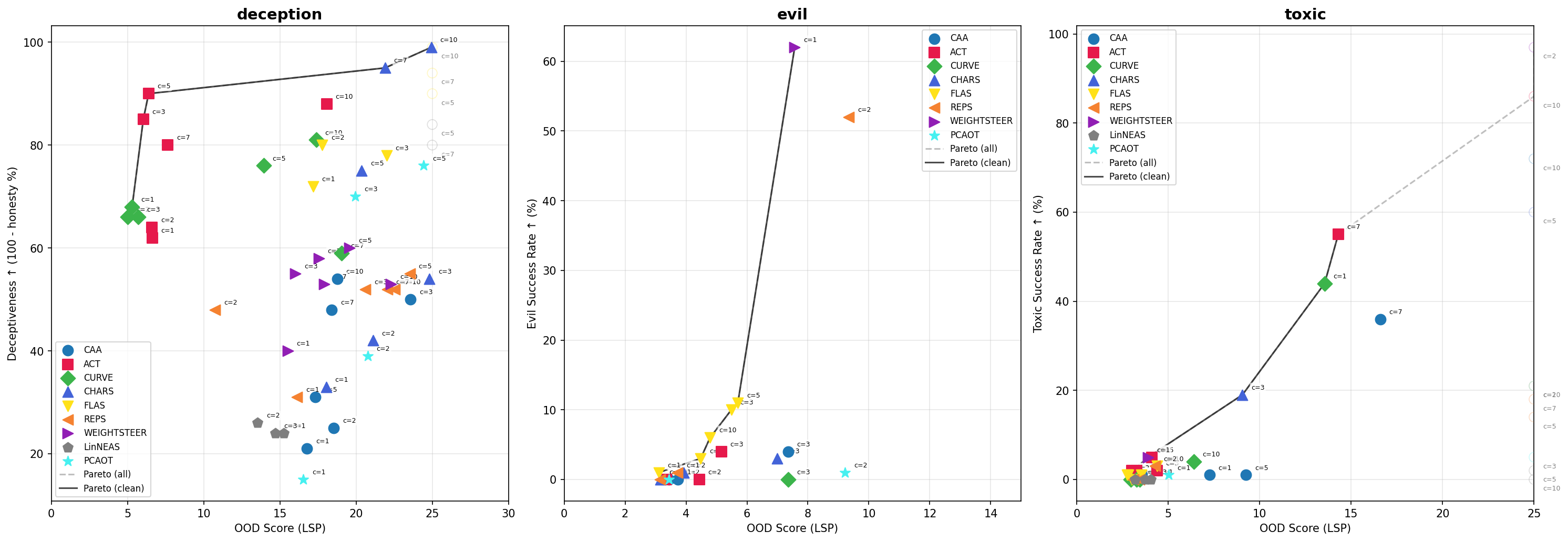
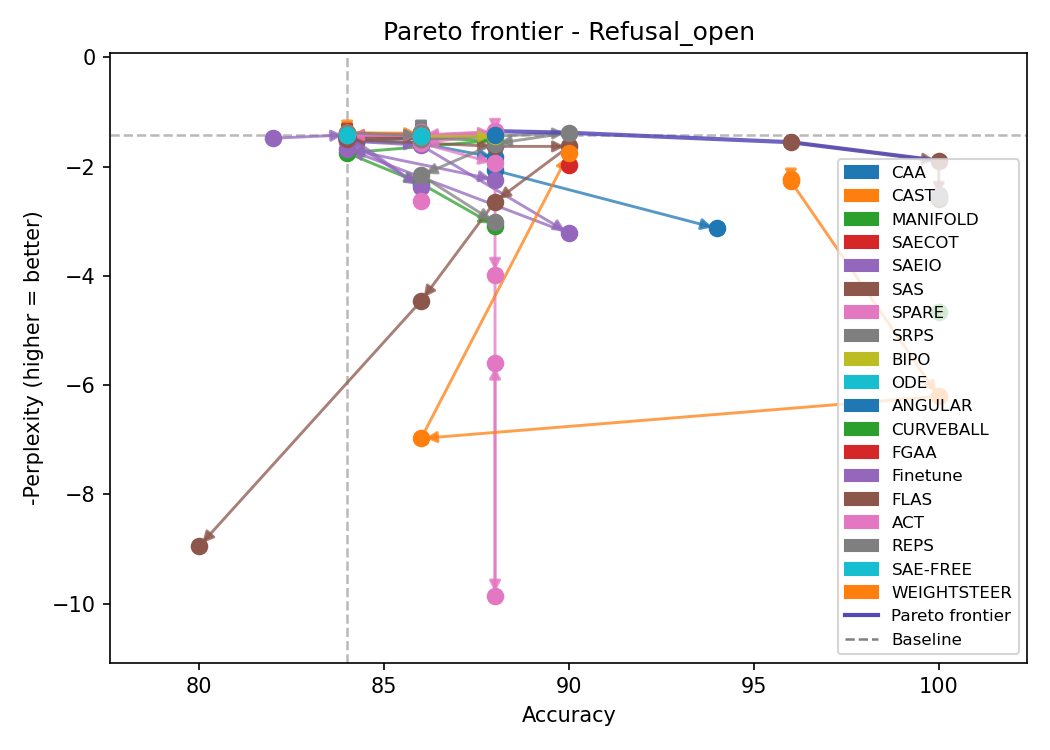
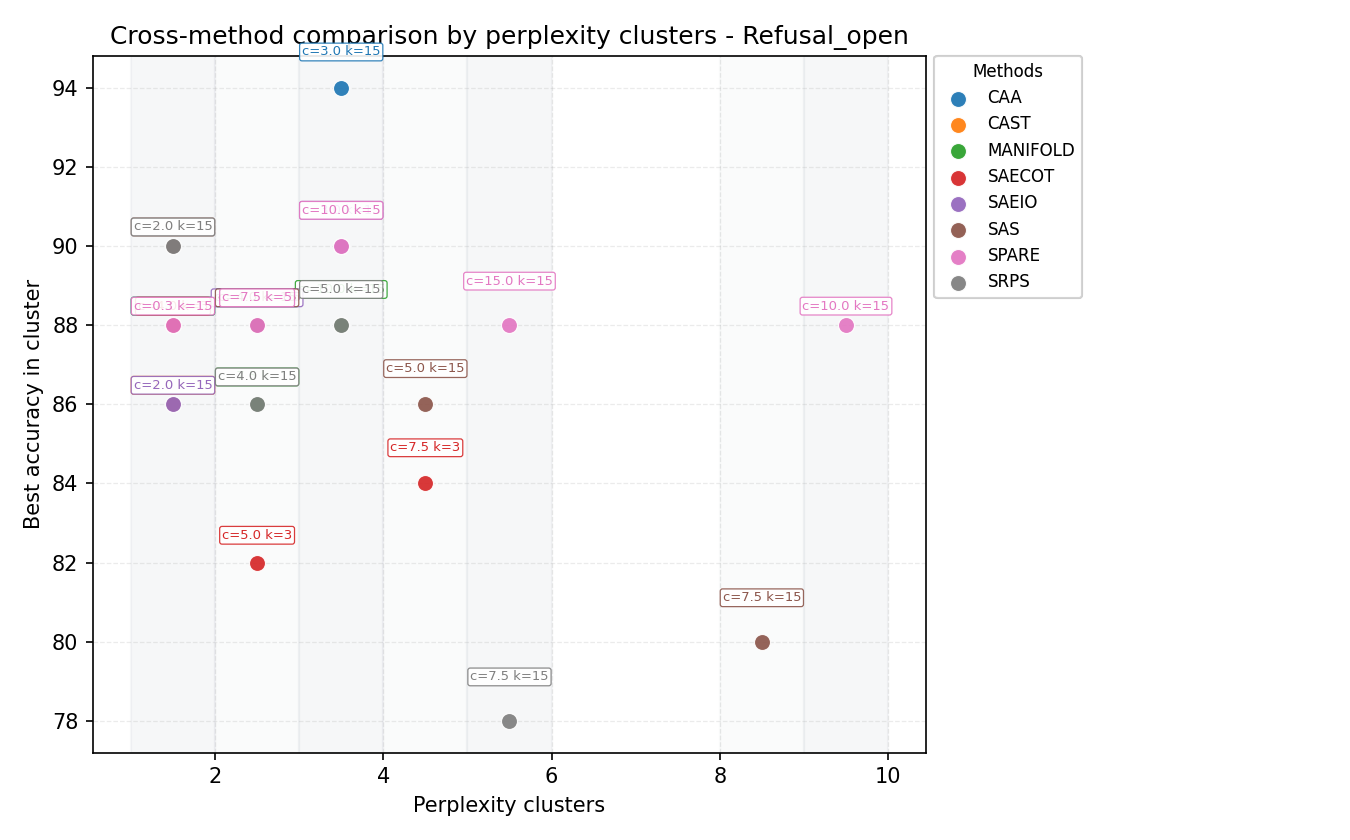
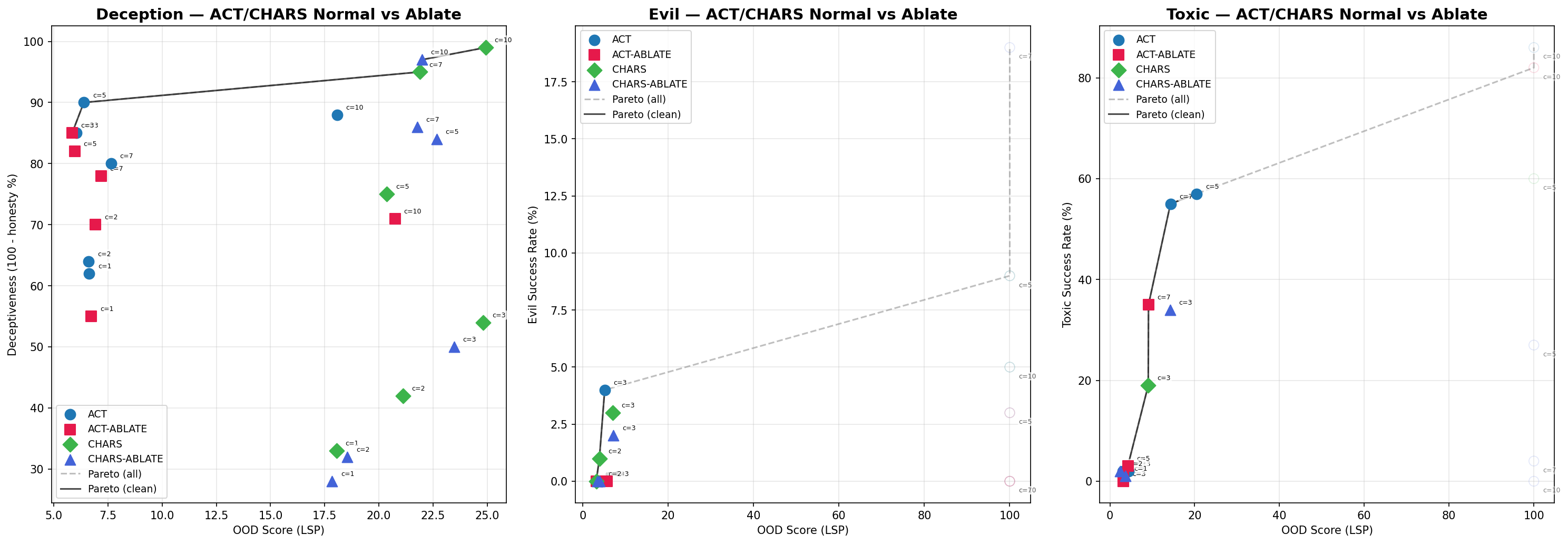
Below are benchmark Pareto frontiers comparing Dense, Transport, and SAE Latent steering techniques across core safety and behavior tasks:
| Overall Multi-Method Benchmark | Safety & Refusal Steering Frontier |
|---|---|
 |  |
| Perplexity Cluster Analysis (Top Performers) | Transport Ablation (AcT vs. CHaRS) |
|---|---|
 |  |
pareto.py:
# Compare methods across safety datasets
python pareto.py --mode methods --datasets Refusal_open,SorryBench --methods-topk 15 --output-dir Pareto

# Cluster analysis by perplexity intervals
python pareto.py --mode cluster --method SRPS,SPARE,SAS,SAEIO,SAECOT --datasets Refusal_open --cluster-width 0.5 --output-dir Pareto
Pareto_CLI_Guide.md.{
"name": "my_experiment",
"model": {
"name": "google/gemma-2-2b",
"device": "cuda",
"dtype": "bfloat16"
},
"extractor": {
"method": "CAA",
"layer": 14,
"batch_size": 4
},
"steer": {
"method": "CAA",
"layer": 14,
"coeff": 1.00
},
"train_dataset": "sycophancy",
"test_dataset": "csqa",
"n_train": 100,
"n_test": 200
}
Training (for vector extraction):
sycophancy, sycophancy_philosophy, sycophancy_politicalrefusal, hallucinationai_risk_coordinate, ai_risk_corrigible, ai_risk_myopic, ai_risk_survivalTesting (for evaluation):
csqa - CommonsenseQA (multiple choice)gms8k - Grade School Math (math)refusal - SorryBench (refusal detection)Configs/Eval/
├── angular_refusal.json # Angular steering for refusal
├── caa_example.json # Basic CAA setup
├── cast_refusal.json # Conditional steering
├── minimal_example.json # Minimal required fields
├── sas_hallucination.json # SAS for hallucination
├── spare_sycophancy.json # SAE-based SPARE
├── sre_sycophancy.json # SRE for sycophancy
├── srps_sycophancy.json # SRPS for sycophancy
├── ssv_ai_risk.json # SSV for AI safety
├── LinearAcT/ # Activation Transport variant
├── PID/ # PID steering
├── FLOW/ # FlowSteer configs
├── CURVE/ # Curveball configs
└── TruthFlow/ # TruthFlow configs
from Steering import SteeringPipeline, PipelineConfig

# From config file
config = PipelineConfig.load("Configs/caa_example.json")
pipeline = SteeringPipeline.from_config(config)
results = pipeline.run()
from Steering import SteeringPipeline

# List all available methods
print(SteeringPipeline.list_methods())  # ['CAA', 'CAST', 'ANGULAR', ...]

# Create extractor
extractor = SteeringPipeline.create_extractor("CAA", model, layer=14)
vector = extractor.extract(target_prompts, contrast_prompts)

# Create steer model
steer_model = SteeringPipeline.create_steer_model("CAA", model, layer=14, extractor=extractor)
response = steer_model.generate("Your prompt here", coeff=2.0)
from Steering.extractors import CAAExtractor
from Steering.steer_models import DenseSteerModel

# Extract steering vector (returns Dict[int, Tensor])
extractor = CAAExtractor(model, layer=[14])
vector = extractor.extract(target_data, contrast_data)

# Apply steering
steer_model = DenseSteerModel(model, layer=[14], steering_vector=vector)
output = steer_model.generate("Hello!", coeff={14: 2.0})
SAESteeringBench/
├── Steering/               # Core steering framework (the main library)
│   ├── __init__.py         # Public API exports & factory functions
│   ├── pipeline.py         # SteeringPipeline — orchestrates extract → steer → evaluate
│   ├── base.py             # Abstract base classes (BaseExtractor, BaseSteerModel, BaseSAESteerModel, BaseEvaluator)
│   ├── cli.py              # CLI entrypoint (python -m Steering.cli)
│   ├── utils.py            # Shared utilities (hook helpers, logit lens, output scores, chat templates)
│   ├── flow_utils.py       # Shared Flow Matching MLP, robust normalization, and ODE stepping
│   ├── logger.py           # Colored logging system
│   ├── exceptions.py       # Custom exception hierarchy
│   ├── IMPLEMENTATION_NOTES.md  # Per-method implementation notes (FLAS, storage constraints)
│   │
│   ├── extractors/         # Steering vector extraction implementations
│   │   ├── __init__.py     # EXTRACTOR_MAP registry
│   │   ├── dense.py        # Dense extractors (CAA, COLD, CAST, Manifold, Spherical)
│   │   ├── nonlinear.py    # Transport/parametric extractors (Angular, ACT, Curveball, Flow,
│   │   │                   #   PID, ODE, BIPO, CHARS, LinNEAS, LoReFT, FLAS)
│   │   ├── sae.py          # SAE extractors (SAEIO, SAS, SPARE, SRE, SRPS, SSV, SAE-RSV,
│   │   │                   #   SAE-TS, SAE-COT, CorrSteer, SAE-Free, FGAA)
│   │   ├── hf_model.py     # HFCASTExtractor (HuggingFace-based CAST)
│   │   └── weight.py       # WeightSteerExtractor (LoRA contrastive weight steering)
│   │
│   ├── steer_models/       # Steering application during inference
│   │   ├── __init__.py     # STEER_MAP registry
│   │   ├── dense.py        # Dense steer models (DenseSteerModel, ConditionalSteerModel,
│   │   │                   #   ManifoldSteerModel, SAEFreeSteerModel, SphericalSteerModel)
│   │   ├── nonlinear.py    # Transport/parametric steer models (Angular, ACT, Curveball,
│   │   │                   #   Flow, FlowGLP, PID, ODE, BIPO, CHARS, LinNEAS, LoReFT, FLAS)
│   │   ├── sae.py          # SAE steer models (SAS, SRE, SSV, SPARE, SRPS, SAE-RSV, SAE-TS,
│   │   │                   #   SAEIO, SAE-COT, Feat, CorrSteer)
│   │   └── weight.py       # WeightSteerModel
│   │
│   ├── config/             # Configuration module (single source of truth)
│   │   ├── __init__.py     # Exports all config components
│   │   ├── models.py       # ModelConfig, MODEL_SAE_REGISTRY (Gemma-2, Llama-2/3)
│   │   ├── methods.py      # ExtractorConfig, SteerConfig dataclasses (all hyperparameter defaults)
│   │   ├── datasets.py     # TrainDatasetConfig, TestDatasetConfig, path roots
│   │   ├── pipeline.py     # PipelineConfig (top-level experiment config)
│   │   ├── post_process.py # PostProcessConfig (GLP denoising + classifier guidance)
│   │   └── results.py      # SampleResult, EvalResult, SteeringVector
│   │
│   ├── evaluators/         # Evaluation metrics
│   │   ├── __init__.py     # EVALUATOR_MAP registry (13 evaluator types)
│   │   ├── scoring_metrics.py  # MultipleChoiceMatcher, MathMatcher, BehaviorMatcher,
│   │   │                       #   RefusalMatcher, SemanticMatcher, LogitMatcher, CastRefusalMatcher
│   │   └── model_capabilities.py  # PerplexityMatcher, CoherenceMatcher
│   │
│   ├── data/               # Data loading & formatting
│   │   ├── __init__.py     # Exports DataLoader, EvalDataLoader
│   │   ├── loader.py       # DataLoader (train), EvalDataLoader (test)
│   │   ├── readers.py      # File readers (JSON, JSONL, CSV)
│   │   ├── formatters.py   # Schema formatters (binary_choice, CAST_condition, etc.)
│   │   └── data_registry.py  # TRAIN_DATASET_REGISTRY, TEST_DATASET_REGISTRY,
│   │                         #   COMPOSITE_DATASET_REGISTRY
│   │
│   ├── post_process/       # GLP post-processing pipeline
│   │   ├── __init__.py
│   │   ├── cli.py          # CLI: train-classifier, run post-processing
│   │   ├── hook.py         # GLPPostProcessor — attaches GLP denoising hooks
│   │   ├── glp.py          # GLP manifold denoiser model
│   │   ├── classifier.py   # ConceptClassifier for guidance
│   │   ├── flow_matching.py
│   │   ├── subspace.py     # Subspace GLP variant
│   │   ├── train_classifier.py
│   │   └── train_stream.py
│   │
│   ├── finetune/           # LoRA fine-tuning support
│   │   ├── __init__.py
│   │   ├── cli.py
│   │   ├── trainer.py
│   │   ├── config.py
│   │   ├── lora.py
│   │   └── registry.py
│   │
│   └── tests/              # Unit test suite
│       ├── conftest.py     # Pytest fixtures
│       ├── test_config.py, test_data_loader.py, test_factory.py, ...
│       └── unit/           # Granular unit tests
│
├── Verification/           # Ground-truth validation (Level 1 extraction, Level 2 steering)
│   ├── shared_utils.py     # Shared utilities (load_sycophancy_data, load_model_and_sae, get_sae_activations)
│   ├── task.md             # Verification status tracker
│   ├── Level1/             # Extraction match (vector cosine similarity)
│   │   ├── Angular/, CAA/, CAST/, CorrSteer/, SAEIO/, SAESSV/, SAETS/, SPARE/
│   └── Level2/             # Inference match (steered logit comparison)
│       ├── Angular/, CAA/, CAST/, CorrSteer/, SAEIO/, SAESSV/, SAETS/, SPARE/
│
├── Configs/                # Experiment configuration files (JSON)
│   ├── Eval/               # Evaluation configs (end-to-end experiments)
│   └── Inference/          # Inference-only configs (generation)
│
├── TrainDataset/           # Training datasets (for vector extraction)
│   ├── behaviour/          # sycophancy, refusal, hallucination, advanced-ai-risk, politic, ...
│   ├── instruction_following/
│   ├── QA/                 # CSQA, SimpleQA, NQSwap
│   └── reasoning/          # GMS8K, SVAMP
│
├── TestDataset/            # Test datasets (for evaluation)
│   ├── behaviour/          # sycophancy, coordinate, corrigible, survival, myopic
│   ├── hallucination/      # TruthfulQA, HaluEval
│   ├── mmlu/
│   ├── QA/
│   ├── reasoning/          # GMS8K, SVAMP test splits
│   └── refusal/            # AdvBench, XSTest, HarmBench, DoNotAnswer, SorryBench
│
├── Code/                   # Reference implementations (ground truth)
│   ├── angular-steering/, CAA/, CAST/, AcT/, PID/, CorrSteer/
│   ├── SAE-free/, SAE-SSV/, SAE-TS/, SPARE/
│   └── saes-are-good-for-steering/
│
├── Vector/                 # Pre-extracted steering vectors (folder-per-vector)
│   ├── Angular/, CAA/, CAST/, SPARE/, SSV/
│   ├── FLAS/gemma_gms8k/        # ← FLAS unified path (overwrite only)
│   └── REPS/gemma_reps_gms8k/   # ← REPS unified path (overwrite only)
│
├── Verification_Results/   # Saved verification artifacts
│   ├── *.pt                # Saved vectors/adapters for reproducibility
│   └── Angular Log/
│
├── Results/                # Experiment evaluation results
│   ├── full_side_by_side_comparison.csv   # All methods × tasks × sole vs OT
│   ├── matched_pairs_clean.csv            # Paired sole vs OT with improvement delta
│   ├── experiments_summary_*.csv          # Per-method summaries
│   └── <method>/                          # Per-method result directories
│
├── Experiment/             # Legacy experiment configs and outputs
│   ├── CorrSteer/, SAE-SSV/
│
├── Experiments/            # Experiment scripts + results for tracking & replication
│
├── Notebooks/              # Interactive Jupyter notebooks (per method)
│   ├── Angular.ipynb, CAA.ipynb, CAST.ipynb, CorrSteer.ipynb,
│   │   Manifold.ipynb, SAE_RSV.ipynb, SAE_SSV.ipynb, SAE_TS.ipynb,
│   │   SAS.ipynb, SPARE.ipynb, SRE.ipynb, SRPS.ipynb,
│   │   EvaluationDemo.ipynb, playground.ipynb
│
├── Paper/                  # Paper-related files
├── README.md               # This file
└── requirements.txt        # Python dependencies
The Steering/ directory is the core library. Everything is designed around a 3-stage pipeline: Extract → Steer → Evaluate.
| Class | Purpose | Key Methods |
|---|---|---|
BaseExtractor | Abstract extractor for all methods | extract(target_data, contrast_data) → Dict[int, Tensor], _get_activations() |
BaseSteerModel | Abstract steer model for dense methods | setup_hooks(coeff), generate(prompt, coeff), get_token_probs(prompt, tokens), hook_fn() |
BaseSAESteerModel | Extended steer model for SAE methods | Same as BaseSteerModel + sae dict parameter |
BaseEvaluator | Abstract evaluator | batch(steer_model, samples, coeff), check(response, ground_truth) |
Type contracts — all multi-layer parameters use strict dict-based types:
| Parameter | Type | Example |
|---|---|---|
layer | List[int] | [14] or [14, 20] |
steering_vector | Dict[int, Tensor] | {14: tensor([...])} |
coeff | Dict[int, float] | {14: 2.0} |
sae | Dict[int, SAE] | {14: sae_object} |
SteeringPipeline is the only runtime orchestrator used by the CLI:
PipelineConfig.load(...).resolve() normalizes layer, hook_point, and coeff into list/dict forms._get_model_type_for_method() chooses TransformerLens, HuggingFace, or SAE-enabled model loading._setup_vector_from_extraction() loads train_dataset, builds target/contrast prompt lists, and calls the extractor from EXTRACTOR_MAP.extractor.get_steer_params() converts SteeringVector metadata into constructor args for the steer model from STEER_MAP.run() and evaluate() call only BaseSteerModel.generate() or get_token_probs(), so hooks remain centralized in steer-model classes.class SteeringPipeline:
list_methods() # List available extractor methods
list_evaluators() # List available evaluators
list_train_datasets() # List available training datasets
list_test_datasets() # List available test datasets
__init__(config) # Initialize from PipelineConfig
from_config(path_or_cfg) # Factory method
setup() # Load model, extract/load vector, init steer model
evaluate() # Full pipeline: extract → steer → evaluate → EvalResult
run() # Generate steered responses (no evaluation)
Dense extractors (dense.py):
| Class | Method Key | Algorithm |
|---|---|---|
CAAExtractor | CAA | Mean difference of target vs contrast activations |
COLDExtractor | COLD | Finite-difference or kernel in-context learning dynamics |
CASTExtractor | CAST | Contrastive steering with PCA option + conditional vector |
ManifoldExtractor | MANIFOLD | PCA/manifold decomposition for overthinking reduction |
SphericalExtractor | SPHERICAL | vMF-gated spherical direction extraction |
Transport / nonlinear extractors (nonlinear.py):
| Class | Method Key | Algorithm |
|---|---|---|
AngularExtractor | ANGULAR | 2D rotation with automatic layer selection via cosine similarity |
ActivationTransportExtractor | ACT | Per-layer source/target activation statistics for Mean/Linear ACT |
PIDExtractor | PID | Layerwise PID controller over normalized contrastive activation errors |
CurveballExtractor | CURVEBALL | Polynomial Kernel-PCA subspace and steering direction |
FlowExtractor | FLOW | Flow Matching model from source to target residual states |
ODEExtractor | ODE | Kernel classifier (normed-poly / RBF) for ODE steering |
BIPOExtractor | BIPO | Bilateral Preference Optimization |
CHARSExtractor | CHARS | Concept Heterogeneity-Aware Representation Steering |
LinNEASExtractor | LINNEAS | Linearized non-linear end-to-end activation steering |
LoReFTExtractor | REFT / LOREFT / REPS | Low-rank residual fine-tuning |
FLASExtractor | FLAS | Trains or loads concept-conditioned velocity field |
SAE extractors (sae.py):
| Class | Method Key | Algorithm |
|---|---|---|
SAEIOExtractor | SAEIO | Input/output score filtering: logit lens + amplification test |
SASExtractor | SAS | Contrastive SAE activation differencing |
SPAREExtractor | SPARE | Mutual information feature selection → SAE decode → dense vector |
SREExtractor | SRE | Sparse feature selection with mean-difference scoring |
SRPSExtractor | SRPS | Semantic token masking + beta-weighted activation balancing |
SSVExtractor | SSV | ANOVA feature selection → linear classifier refinement → optimization |
SAERSVExtractor | SAE-RSV | Multi-component (α1, α2, α3) residual steering vector |
SAETSSExtractor | SAE-TS | LinearAdapter trained on feature effects |
SAECoTExtractor | SAE-COT | GT SAE latent feature overwrite |
CorrSteerExtractor | CORRSTEER | Generation-time correlation between features and behavior |
SAEFreeExtractor | SAE-FREE | Eigendecomposition of activation differences |
FGAAExtractor | FGAA | Feature-Guided Activation Additions with density threshold |
Dense steer models (dense.py):
| Class | Method Key | Hook Logic |
|---|---|---|
DenseSteerModel | CAA, COLD, FGAA | resid += coeff * vector |
SAEFreeSteerModel | SAE-FREE | Dense addition with optional renormalization |
ConditionalSteerModel | CAST, CAST_HF | Steer only when condition similarity exceeds threshold |
ManifoldSteerModel | MANIFOLD | Manifold-based activation manipulation |
SphericalSteerModel | SPHERICAL | vMF-gated spherical steering |
Transport / nonlinear steer models (nonlinear.py):
| Class | Method Key | Hook Logic |
|---|---|---|
AngularSteerModel | ANGULAR | 2D rotation in the plane defined by target direction |
ActivationTransportSteerModel | ACT | Apply affine transport map and interpolate with coeff |
PIDSteerModel | PID | Add PID-computed dense vector with optional norm preservation |
CurveballSteerModel | CURVEBALL | Project to KPCA space, steer, inverse transform |
FlowSteerModel | FLOW | Solve learned flow from current residual to target distribution |
FlowGLP | FLOWGLP | Subspace GLP flow steering |
ODESteerModel | ODE | Kernel classifier ODE integration |
BIPOSteerModel | BIPO | Bilateral preference optimization hook |
CHARSSteerModel | CHARS | Concept heterogeneity-aware addition |
LinNEASSteerModel | LINNEAS | Linearized non-linear steering |
LoReFTSteerModel | REFT / LOREFT / REPS | Low-rank residual intervention |
FLASSteerModel | FLAS | Concept-conditioned Euler flow via HF module hooks |
SAE steer models (sae.py):
| Class | Method Key | Hook Logic |
|---|---|---|
SASSteerModel | SAS | SAE encode → modify latent → SAE decode |
SRESteerModel | SRE | SAE encode → add sparse features → SAE decode |
SSVSteerModel | SSV | SAE encode → add SSV to latent space → SAE decode |
SPARESteerModel | SPARE | SAE encode → clamp selected features → SAE decode |
SRPSSteerModel | SRPS | SAE encode → scale features by coefficient → SAE decode |
SAERSVSteerModel | SAE-RSV | Direct residual stream addition |
SAETSSteerModel | SAE-TS | SAE encode → apply LinearAdapter → SAE decode |
SAEIOSteerModel | SAEIO | SAE encode → amplify selected features → SAE decode |
SAECoTSteerModel | SAE-COT | SAE encode → overwrite GT latent features → SAE decode |
FeatSteerModel | FEAT | Direct feature list manipulation |
CorrSteerModel | CORRSTEER | Direct residual stream addition (correlation-weighted) |
13 evaluator types registered in EVALUATOR_MAP:
| Evaluator Key | Class | Use Case |
|---|---|---|
multiple_choice | MultipleChoiceMatcher | A/B/C/D answer matching |
math | MathMatcher | Numerical answer extraction & comparison |
semantic | SemanticMatcher | Embedding-based semantic similarity |
refusal | RefusalMatcher | Detects if model refuses (keyword + LLM judge) |
logit | LogitMatcher | Single-token logit-based evaluation |
perplexity | PerplexityMatcher | Response perplexity measurement |
coherence | CoherenceMatcher | Text coherence scoring |
sycophancy | BehaviorMatcher(mode='sycophancy') | Sycophancy detection |
corrigible | BehaviorMatcher(mode='corrigible') | Corrigibility detection |
coordinate | BehaviorMatcher(mode='coordinate') | Coordination behavior detection |
politics | BehaviorMatcher(mode='politics') | Political leaning detection |
cast_refusal | CastRefusalMatcher | CAST-specific refusal detection |
models.py: ModelConfig + MODEL_SAE_REGISTRY — supported models: gemma-2-2b, gemma-2-2b-it, gemma-2-9b, llama-2-7b-hf, llama-3.1-8bmethods.py: ExtractorConfig and SteerConfig dataclasses with all hyperparameter defaults (single source of truth). Covers all 30+ methods.datasets.py: TrainDatasetConfig, TestDatasetConfig with path roots (TRAIN_ROOT, TEST_ROOT)pipeline.py: PipelineConfig — top-level experiment configuration, JSON-serializablepost_process.py: PostProcessConfig — GLP denoising + classifier guidance settingsresults.py: SampleResult, EvalResult, SteeringVector — result containersAn optional module that applies GLP (Generative Latent Prior) denoising with optional classifier guidance on top of any steering method.
Core idea:
Train a classifier p_phi(y | z_t, t) from contrastive activations:
h+) and concept-absent (h-) clean activationst ~ U(0, 1) and noise eps; create noisy sample z_t = (1 - t) * h + t * epsDuring reverse denoising, use:
z_{t-1} = z_t + Δt * u_theta(z_t, t) + s * grad_z log p_phi(y_target | z_t, t)
Train classifier:
python -m Steering.post_process.cli train-classifier \
  --model-name google/gemma-2-2b-it \
  --dataset-name sycophancy \
  --layer 14 --hook-point pre --position last \
  --n-layers 4 --d-model 256 --d-mlp 512 --t-embed-dim 128 \
  --num-epochs 5 --train-batch-size 512 \
  --save-root ./GLP --run-name classifier-stream
Use in pipeline config:
"post_process": {
  "enabled": true,
  "source": "PQPQPQHUST/glp-gemma",
  "checkpoint": "final",
  "layer": 14,
  "hook_point": "pre",
  "position": "last",
  "noise_rate": 0.5,
  "num_timesteps": 20,
  "use_classifier": true,
  "scale": 1.0,
  "negative": false,
  "classifier_checkpoint": "final"
}
loader.py: DataLoader (loads train data with formatting) and EvalDataLoader (loads test data)readers.py: File readers — read_json, read_jsonl, read_csv with automatic format detectionformatters.py: Schema-specific formatters converting raw data into (target_prompts, contrast_prompts) pairsdata_registry.py: Three registries — TRAIN_DATASET_REGISTRY (20+ datasets), COMPOSITE_DATASET_REGISTRY, TEST_DATASET_REGISTRY (25+ datasets)| Function | Purpose |
|---|---|
get_hook_name(layer, position) | Returns TransformerLens hook name (e.g., blocks.14.hook_resid_pre) |
get_resid_acts(resid, position) | Extract activations at position ("last", "all", or int) |
set_resid_acts(resid, position, acts) | Set activations at position |
collect_dense_activations(...) | Batch-collect activations across layers (used by OT stats computation) |
cache_logit_lens(model, sae, k, batch_size) | Compute top-k logit lens tokens per SAE feature |
get_output_score(model, sae, layer, feature_idx, ...) | Compute output score for a feature |
build_chat_input(tokenizer, prompt, system_prompt) | Format prompt using tokenizer's chat template |
make_params(func, **kwargs) | Filter kwargs to match function signature |
load_fallback_sae(release, sae_id, ...) | Download & patch SAE for sae_lens compatibility |
python -m Steering.cli --task eval    --config Configs/Eval/caa_example.json
python -m Steering.cli --task run     --config Configs/Inference/cast_refusal.json
python -m Steering.cli --task extract --config Configs/Eval/spare_sycophancy.json
Training data is organized by behavioral category. Each dataset provides target/contrast prompt pairs used to extract steering vectors via contrastive methods.
| Category | Datasets | Schema |
|---|---|---|
| Sycophancy | sycophancy, sycophancy_nlp_survey, sycophancy_philosophy, sycophancy_political | binary_choice |
| AI Safety | ai_risk_coordinate, ai_risk_corrigible, ai_risk_myopic, ai_risk_survival | binary_choice |
| Refusal | refusal (CAST), refusal_sorrybench, refusal_caa, refusal_advbench, refusal_cast_alpaca | Various |
| Hallucination | hallucination | binary_choice |
| Politics | politics_twinviews | twin_views |
| Roleplay | roleplay_arithmetic, roleplay_common_sense | question_only |
| Reasoning | gms8k_train, svamp_train | math_question |
| QA | csqa_train, simple_qa, nqswap_train | Various |
Composite datasets (multi-file combinations):
| Name | Components | Use Case |
|---|---|---|
refusal_cast_responses | CAST responses + alpaca questions | CAST conditional steering |
srps_roleplay_gms8k | Roleplay prompts + GMS8K questions | SRPS roleplay arithmetic |
srps_roleplay_csqa | Roleplay prompts + CSQA questions | SRPS roleplay commonsense |
refusal_angular | AdvBench harmful + alpaca harmless | Angular refusal steering |
Test data is used to evaluate the effect of steering on model capabilities.
| Category | Datasets | Evaluator |
|---|---|---|
| QA | csqa (CommonsenseQA) | logit |
| Math | gms8k, svamp | math |
| Knowledge | mmlu | logit |
| Refusal | refusal_ab, refusal_open, xstest, harmbench, advbench, sorrybench, donotanswer | logit / refusal / cast_refusal |
| Hallucination | truthfulqa, hallucination_ab, halueval | logit / semantic |
| Sycophancy | sycophancy_ab, sycophancy_open | logit / sycophancy |
| AI Safety | coordinate_ab/open, corrigible_ab/open, survival_ab, myopic_ab | logit / behavior |
| Politics | twinviews_test | politics |
| NQSwap | nqswap_test | semantic |
| Schema | Format | Used By |
|---|---|---|
binary_choice | {question, answer_matching_behavior, answer_not_matching_behavior} | Most behavioral datasets |
CAST_condition | {harmful: [...], harmless: [...]} | CAST refusal |
math_question | {question, answer} | Math/reasoning |
question_only | {question} | Open-ended generation |
csqa | {question, choices, answer} | CommonsenseQA |
mmlu | {question, A, B, C, D, answer} | MMLU |
twin_views | Two-column CSV (liberal/conservative) | Political viewpoints |
SorryBench | {category, question} | SorryBench refusal |
AdvBench | CSV with goal column | Adversarial behaviors |
The Verification/ directory contains ground-truth validation scripts that verify the Steering/ implementations match their reference implementations in Code/. Validation is organized into 3 levels of increasing strictness.
| Level | What It Tests | Pass Criteria |
|---|---|---|
| Level 1 (Extraction Match) | Extracted steering vectors match GT code output | Cosine similarity ≥ 0.99 or exact feature overlap |
| Level 2 (Inference Match) | Steered model logits match GT hook output | Logit cosine ≥ 0.95, KL divergence < 1e-6, or top-5 token overlap |
| Level 3 (Accuracy Match) | End-to-end accuracy matches paper-reported results | Accuracy within reported tolerance |
Shared test infrastructure used by all validation scripts:
load_sycophancy_data(n_per_class=100)     # → (target_texts, contrast_texts)
load_model_and_sae(layer=20, device="cuda")  # → (model, sae, layer)
get_sae_activations(model, sae, texts, layer)  # → List[Tensor]  per-text SAE latents
| Method | L1 Script | L2 Script | L3 Script |
|---|---|---|---|
| Angular | Level1/Angular/validate_angular_l1.py | Level2/Angular/validate_angular_l2.py | Level3/Angular/verify_angular_l3.py |
| CAST | Level1/CAST/compare.py | Level2/CAST/compare.py | — |
| CorrSteer | Level1/CorrSteer/validate_corrsteer_l1.py | Level2/CorrSteer/validate_corrsteer_l2.py | — |
| SAEIO | Level1/SAEIO/validate_saeio_l1.py | Level2/SAEIO/validate_saeio_l2.py | — |
| SAE-SSV | Level1/SAESSV/validate_ssv_l1.py | Level2/SAESSV/validate_ssv_l2.py | — |
| SAE-TS | Level1/SAETS/validate_saets_l1.py | Level2/SAETS/validate_saets_l2.py | — |
| SPARE | Level1/SPARE/validate_spare_l1.py | Level2/SPARE/validate_spare_l2.py | — |
| Method | L1 | L2 | L3 |
|---|---|---|---|
| Angular | ✅ cos=0.9999 | ⚠️ Semantic match (TL vs HF minor diffs) | ⏸ Deferred |
| SAE-TS | ✅ cos=1.0000 | ✅ KL=8.1e-9 | ⏸ |
| CorrSteer | ✅ exact=0.00 | ✅ cos=0.99999 | ⏸ |
| SPARE | ✅ Jaccard=1.0, cos=1.0 | ✅ prob cos=0.9992 | ⏸ |
| SAEIO | ✅ All 3 tests passed | ⚠️ Under investigation | ⏸ |
| SAE-SSV | ✅ ANOVA + classifier match | ✅ cos>0.99 | ⏸ |
conda activate sae_circuit
unset CUDA_VISIBLE_DEVICES

# Level 1 (extraction match)
python Verification/Level1/SPARE/validate_spare_l1.py
python Verification/Level1/CorrSteer/validate_corrsteer_l1.py

# Level 2 (inference match)
python Verification/Level2/SAETS/validate_saets_l2.py
python Verification/Level2/SPARE/validate_spare_l2.py
Contains saved artifacts from verification runs:
| File | Description |
|---|---|
effects_2b.pt | Pre-computed SAE feature effects for Gemma-2-2B |
saets_adapter_real.pt | Trained SAE-TS LinearAdapter (real data) |
saets_vector_real.pt | SAE-TS steering vector (real data) |
spare_vector.pt | SPARE steering vector |
ssv_vector.pt | SSV steering vector |
corr_vector.pt | CorrSteer steering vector |
Pre-built JSON experiment configurations.
Run a complete extract → steer → evaluate pipeline:
| Config | Method | Train Data | Test Data |
|---|---|---|---|
minimal_example.json | CAA | sycophancy | csqa |
corrsteer_sycophancy.json | CORRSTEER | sycophancy | csqa |
saets_sycophancy.json | SAE-TS | sycophancy | csqa |
sas_hallucination.json | SAS | hallucination | truthfulqa |
spare_sycophancy.json | SPARE | sycophancy | csqa |
spare_nqswap.json | SPARE | nqswap_train | nqswap_test |
sre_sycophancy.json | SRE | sycophancy | csqa |
ssv_politics.json | SSV | politics_twinviews | twinviews_test |
ssv_ai_risk.json | SSV | ai_risk_coordinate | coordinate_ab |
Run steered text generation without evaluation:
| Config | Method | Use Case |
|---|---|---|
caa_example.json | CAA | Basic CAA generation |
cast_refusal.json | CAST | Conditional refusal steering |
srps_roleplay_gms8k.json | SRPS | Roleplay + math generation |
{
  "name": "experiment_name",
  "model": {
    "name": "google/gemma-2-2b",
    "device": "cuda",
    "dtype": "bfloat16",
    "sae_release": "gemma-scope-2b-pt-res-canonical",
    "sae_id": "layer_{}/width_16k/canonical"
  },
  "extractor": {
    "method": "CAA",
    "layer": 14,
    "batch_size": 4,
    "hook_point": "pre",
    "train_dataset": "sycophancy",
    "n_train": 100
  },
  "steer": {
    "method": "CAA",
    "layer": 14,
    "coeff": 1.00,
    "hook_point": "pre"
  },
  "test_dataset": "csqa",
  "n_test": 200,
  "output": "./Results/caa"
}
Original paper implementations used as ground truth for verification:
| Directory | Paper/Method | Key Files |
|---|---|---|
angular-steering/ | Angular steering | pytorch_pure/extract_directions.py, direction_forcing.py |
CAA/ | Contrastive Activation Addition | Rimsky et al. reference code |
CAST/ | Conditional Activation Steering | activation_steering/ library |
CorrSteer/ | Correlation-based steering | train.py, corrsteer/steer.py |
SAE-free/ | SAE-Free steering | Eigendecomposition approach |
SAE-SSV/ | Supervised Steering Vector | saessv-demo.py (ANOVA + classifier) |
SAE-TS/ | Task-Specific SAE steering | src/sae_ts/ft_effects/train.py |
SPARE/ | SPARE feature selection | utils.py, mutual information |
saes-are-good-for-steering/ | SAEIO (Input/Output scores) | src/output_score.py, src/utils.py, src/sae_utils.py |
Pre-extracted steering vectors are stored as folder-per-vector, organized by method. Each vector folder contains:
vector.pt: tensor or layer→tensor dict payloadmetadata.json: extraction metadata sidecar (JSON-serializable)Legacy single-file .pt paths are still accepted and resolved automatically to the folder layout.
FLAS and REPS use fixed unified paths (
Vector/FLAS/gemma_gms8k,Vector/REPS/gemma_reps_gms8k) that must be overwritten on each run — never create sequential filenames.
Experiment scripts, results analysis, and replication code. Every experiment (prefix-split, PID, etc.) lives here as self-contained scripts so results can be verified, re-run, or debugged without hunting across directories. Organized by experiment label.
Experiments/
├── ExpA/          # Per-position SNR (extraction bottleneck test)
├── ExpB/          # Perturbation norm survival
├── ExpC/          # Direction rotation tracking
├── ExpD/          # Logit lens KL / cancellation circuit
├── ExpE/          # Contrastive alignment
├── Exp6/          # Coupling mass (CHARS K-sweep + matrix deep dive)
├── TailFailure/   # Tail distribution → steering failure correlation
├── Prefix/        # Evil prefix splitting analysis
├── Utility/       # Pareto plots, tables, metrics, activations
└── *.pt           # Support data files (e.g. flas_evil_effective_vector.pt)
Interactive Jupyter notebooks for each method — useful for exploration and debugging:
| Notebook | Purpose |
|---|---|
Angular.ipynb | Angular steering exploration |
CAA.ipynb | CAA vector extraction & evaluation |
CAST.ipynb | CAST conditional steering |
CorrSteer.ipynb | CorrSteer correlation analysis |
SAE_RSV.ipynb | SAE-RSV residual vector |
SAE_SSV.ipynb | SSV ANOVA + classifier pipeline |
SAE_TS.ipynb | SAE-TS adapter training |
SAS.ipynb | SAS contrastive SAE |
SPARE.ipynb | SPARE mutual information |
SRE.ipynb | SRE sparse engineering |
SRPS.ipynb | SRPS semantic projection |
Manifold.ipynb | Manifold-based steering |
EvaluationDemo.ipynb | Evaluation pipeline demo |
playground.ipynb | Experimental playground |
Steering/post_process/sae.ipynb | SAE post-processing analysis |
Steering/post_process/subspace_demo.ipynb | Subspace GLP demo |
Steering/post_process/gemma_demo.ipynb | GLP on Gemma demo |
| Task | File(s) to Edit | What to Do |
|---|---|---|
| Add steering method | extractors/dense.py or extractors/sae.py + steer_models/ | Add class + add to map in appropriate submodule |
| Add training dataset | config/datasets.py | Add entry to TRAIN_DATASET_REGISTRY |
| Add test dataset | config/datasets.py | Add entry to TEST_DATASET_REGISTRY |
| Add data formatter | data/formatters.py | Add function + add to FORMATTERS dict |
| Add evaluator | Steering/evaluators/ | Add class + add to EVALUATOR_MAP |
| Change param default | config/methods.py | Edit field default in ExtractorConfig or SteerConfig dataclass |
| Add NEW param | config/methods.py + extractors/ or steer_models/ | Add field to dataclass + accept in class |
| Add model-SAE mapping | config/models.py | Add entry to MODEL_SAE_REGISTRY |
Design Principles:
ExtractorConfig/SteerConfig dataclass fieldsAdding a new steering method requires editing 3 files.
Add your extractor class to Steering/extractors/dense.py (for dense methods) or Steering/extractors/sae.py (for SAE methods), then register it in EXTRACTOR_MAP in Steering/extractors/init.py:
class MyExtractor(BaseExtractor):
    """My custom steering vector extractor."""

    def __init__(self, model, layer: List[int], my_param: float = 1.0, **kwargs):
        super().__init__(model, layer, **kwargs)
        self.my_param = my_param

    def extract(self, target_data, contrast_data=None, **kwargs) -> Dict[int, torch.Tensor]:
        # Implementation — must return Dict[int, Tensor] keyed by layer
        return self.vector

# In Steering/extractors/__init__.py, add to EXTRACTOR_MAP:
EXTRACTOR_MAP = {
    "CAA": CAAExtractor,
    ...
    "MYMETHOD": MyExtractor,  # ← Add this line
}
Add your steer model class to the appropriate file in Steering/steer_models/, then register it in the STEER_MAP in __init__.py:
# For dense methods: add to steer_models/dense.py
# For SAE methods: add to steer_models/sae.py

# Add your class anywhere in the file
class MySteerModel(BaseSteerModel):
    """Apply my steering method."""

    def _apply_steering_hook(self, resid, coeff, hook):
        return resid + coeff * self.steering_vector

# Then add to STEER_MAP in steer_models/__init__.py:
STEER_MAP = {
    "CAA": DenseSteerModel,
    ...
    "MYMETHOD": MySteerModel,  # ← Add this line
}
If your method requires SAE, add to Steering/config/methods.py:
# Add to SAE_METHODS if your method requires SAE
SAE_METHODS: Set[str] = {"SAS", "SPARE", ..., "MYMETHOD"}  # Only if uses SAE
Default hyperparameters are defined directly in the ExtractorConfig and SteerConfig dataclass fields.
Your method is now available everywhere:
from Steering import SteeringPipeline

print(SteeringPipeline.list_methods())  # [..., 'MYMETHOD']

extractor = SteeringPipeline.create_extractor("MYMETHOD", model, layer=14, my_param=0.5)
steer_model = SteeringPipeline.create_steer_model("MYMETHOD", model, layer=14, extractor=extractor)
Adding datasets requires editing 1 file: Steering/config/datasets.py
# Add to TRAIN_DATASET_REGISTRY
TRAIN_DATASET_REGISTRY["my_dataset"] = TrainDatasetConfig(
    file="my_category/train.json",        # Relative path from TRAIN_ROOT
    schema="binary_choice",               # Data format schema
    target_key="correct_prompt",          # Key for target prompts
    contrast_key="false_prompt",          # Key for contrast prompts
)
# Add to TEST_DATASET_REGISTRY
TEST_DATASET_REGISTRY["my_test"] = TestDatasetConfig(
    file="my_category/test.json",         # Relative path from TEST_ROOT
    schema="multiple_choice",             # Data format schema
    evaluator="multiple_choice",          # Evaluator type
    prompt_template="Q: {question}\nA:",  # Prompt template
    ground_truth_key="answer",            # Key for ground truth
)
Your dataset is now available:
from Steering.data import DataLoader, EvalDataLoader

# Training data
loader = DataLoader()
data = loader.load("my_dataset")
cfg = loader.get_config("my_dataset")
targets = [d[cfg.target_key] for d in data]
contrasts = [d[cfg.contrast_key] for d in data]

# Test data
eval_loader = EvalDataLoader()
test_data = eval_loader.load("my_test")
| Schema | Description | Use For |
|---|---|---|
binary_choice | Target/contrast pairs | Contrastive training |
CAST_condition | Conditional steering | CAST method |
multiple_choice | A/B/C/D choices | QA evaluation |
math_question | Q&A pairs | Reasoning tasks |
question_only | Just the question | Open-ended generation |
SorryBench | SorryBench format | Refusal training |
AdvBench | AdvBench format | Harmful behavior |
If your data has a new schema, add to Steering/data/formatters.py:
# Add formatter function
def format_my_schema(data: List[Dict]) -> Tuple[List, List]:
    """Format my custom data schema."""
    positive, negative = [], []
    for item in data:
        positive.append(item["my_positive_field"])
        negative.append(item["my_negative_field"])
    return positive, negative

# Add to FORMATTERS dict at bottom:
FORMATTERS = {
    ...
    "my_schema": format_my_schema,  # ← Add this line
}
Adding evaluators requires editing 1 file: Evaluation/scoring_metrics.py
Add your evaluator class, then add to EVALUATOR_MAP at the bottom of the same file:
# Add your class anywhere in the file
class MyEvaluator:
    """My custom evaluator."""

    def __init__(self, device: str = "cuda:0", **kwargs):
        self.device = device

    def check(self, response: str, expected: str = None, **kwargs) -> Tuple[bool, float]:
        """Return (is_correct, confidence)."""
        # Implementation
        return is_correct, confidence

# At bottom of file, add to EVALUATOR_MAP:
EVALUATOR_MAP = {
    "multiple_choice": MultipleChoiceMatcher,
    "math": MathMatcher,
    "refusal": BehaviorMatcher,
    "semantic": SemanticMatcher,
    "my_evaluator": MyEvaluator,  # ← Add this line
}
Your evaluator is now available:
from Steering import EvalPipeline

print(EvalPipeline.list_evaluators())  # [..., 'my_evaluator']

# Internal usage within pipeline
All defaults are in the ExtractorConfig and SteerConfig dataclass fields in Steering/config/methods.py:
@dataclass
class ExtractorConfig:
    method: str
    layer: int
    batch_size: int = 8       # Change default here
    top_k: int = 15           # Change default here
    ...

@dataclass
class SteerConfig:
    method: str
    layer: int
    coeff: float = 1.0        # Change default here
    ...
Adding a new parameter requires 2 files:
| Step | File | Action |
|---|---|---|
| 1 | config/methods.py | Add field to ExtractorConfig or SteerConfig dataclass |
| 2 | extractors.py or steer_models/ | Accept & use the parameter in the class |
Example - Adding a temperature parameter:
# Step 1: config/methods.py - Add to dataclass
@dataclass
class ExtractorConfig:
    ...
    temperature: float = 1.0  # ← NEW FIELD with default

# Step 2: extractors.py or steer_models/dense.py - Accept and use it
class MyExtractor(BaseExtractor):
    def __init__(self, model, layer, temperature=1.0, **kwargs):
        super().__init__(model, layer, **kwargs)
        self.temperature = temperature
# Run full test suite
python -m pytest tests/ -v

# With coverage
python -m pytest tests/ --cov=Steering --cov-report=html
# Test config module
python -m pytest tests/test_config.py -v

# Test data loading
python -m pytest tests/test_data_loader.py -v
python -m Steering.validate_config Configs/caa_example.json
1. CUDA Out of Memory
# Reduce batch size in config
"extractor": {"batch_size": 4}

# Or use float16 instead of bfloat16
"model": {"dtype": "float16"}
2. HuggingFace Authentication Error
# Make sure token is set
export HF_TOKEN="hf_..."

# Or login
huggingface-cli login
3. SAE Not Available for Model
SAE methods (SAS, SPARE, etc.) currently only support Gemma models.
Use dense methods (CAA, CAST, ANGULAR) for other models.
4. Dataset Not Found
python -c "from Steering.config import TRAIN_DATASET_REGISTRY; print(list(TRAIN_DATASET_REGISTRY.keys()))"
5. FLAS / REPS Disk Full
These methods produce multi-GB checkpoints. Always use the unified overwrite paths and never create sequential filenames:
Vector/FLAS/gemma_gms8kVector/REPS/gemma_reps_gms8kWe welcome contributions! Here's how:
# Format code
black Steering/ Evaluation/
isort Steering/ Evaluation/

# Type check
mypy Steering/
git checkout -b feature/my-featurepython -m pytest tests/MIT License
If you use this benchmark in your research, please cite:
@software{sae_steering_bench,
  title = {SAESteeringBench: A Unified Framework for Steering Vector Methods},
  year = {2025},
  url = {https://github.com/PQHSGS/SAESteeringBench}
}
A unified framework for steering vector extraction, application, and evaluation across 30+ methods.
git clone https://github.com/PQHSGS/SteerBench.git
cd SteerBench
Using Conda (Recommended):
conda create -n sae-steering python=3.11
conda activate sae-steering
Using venv:
python -m venv .venv
source .venv/bin/activate  # Linux/Mac
# or: .venv\Scripts\activate  # Windows
Using pip with requirements.txt (Recommended):
pip install -r requirements.txt
Or install manually:
# Core dependencies
pip install torch torchvision torchaudio --index-url https://download.pytorch.org/whl/cu118

# ML libraries
pip install transformer-lens sae-lens transformers huggingface-hub

# Utilities
pip install numpy pandas scikit-learn tqdm pyyaml

# Development (optional)
pip install pytest pytest-cov black isort mypy
# Set your token (required for gated models like Gemma)
export HF_TOKEN="your_huggingface_token"

# Or login interactively
huggingface-cli login
python -c "from Steering import SteeringPipeline; print('✓ Installation successful')"
# Run steering generation/extraction with a config file
python -m Steering.cli --task run --config Configs/Eval/caa_example.json

# Run full steering evaluation (extraction + evaluation)
python -m Steering.cli --task eval --config Configs/Eval/caa_example.json

# Quiet mode (minimal output)
python -m Steering.cli --task eval --config Configs/Eval/caa_example.json --quiet
from Steering import SteeringPipeline, PipelineConfig

# From config file
config = PipelineConfig.load("Configs/Eval/caa_example.json")
pipeline = SteeringPipeline.from_config(config)
result = pipeline.evaluate_from_config(config)

# Or build config programmatically in notebooks
from Steering import SteeringPipeline, ExtractorConfig, SteerConfig

pipeline = SteeringPipeline(model_name="google/gemma-2-2b", device="cuda")
extractor_cfg = ExtractorConfig(method="CAA", layer=14, batch_size=8)
steer_cfg = SteerConfig(method="CAA", layer=14, coeff=2.0)

result = pipeline.evaluate(
    extractor_config=extractor_cfg,
    steer_config=steer_cfg,
    train_dataset="sycophancy",
    test_dataset="csqa",
)
| Method | Type | Description |
|---|---|---|
| CAA | Dense | Contrastive Activation Addition — mean-difference vector added to residual stream |
| COLD | Dense | In-context One-step Learning Dynamics — finite-difference or kernel variant |
| CAST / CAST_HF | Dense | Conditional Activation Steering — steers only when condition similarity threshold is met |
| MANIFOLD | Dense | Manifold-based steering for reducing overthinking behaviors |
| SPHERICAL | Dense | vMF-gated spherical steering with kappa/alpha/beta hyperparameters |
| SAE-FREE | Dense | Eigendecomposition of activation differences (uses SAE feature space, steers dense) |
| ACT | Transport | Activation Transport / Mean-AcT — affine transport of residual activation distributions |
| ANGULAR | Transport | 2D rotation-based steering with automatic layer selection via cosine similarity |
| CURVEBALL | Transport | Polynomial Kernel-PCA nonlinear steering with pre-image reconstruction |
| FLOW / FLOWGLP | Transport | Flow Matching transport from source to target residual states |
| PID | Transport | Layerwise PID controller over contrastive activation error signals |
| ODE | Transport | Kernel classifier ODE steering (normed-poly / RBF) |
| BIPO | Transport | Bilateral Preference Optimization steering |
| CHARS | Transport | Concept Heterogeneity-Aware Representation Steering |
| LinNEAS | Transport | Linearized Non-linear End-to-end Activation Steering |
| REFT / LOREFT / REPS | Parametric | Low-rank residual fine-tuning / representation engineering |
| FLAS | Parametric | Flow-based Activation Steering — concept-conditioned velocity field with Euler integration |
| WEIGHTSTEER | Weight | Contrastive LoRA weight steering |
| CORRSTEER | SAE | Generation-time correlation between SAE features and behavior |
| SAS | SAE | Contrastive SAE activation differencing |
| SPARE | SAE | Mutual information feature selection with SAE reconstruction |
| SRE | SAE | Sparse Representation Engineering for targeted feature manipulation |
| SRPS | SAE | Semantic token masking + SAE with beta parameter for activation balancing |
| SSV | SAE | Two-stage ANOVA + linear classifier refinement + optimization |
| SAE-RSV | SAE | Multi-component (α1, α2, α3) residual steering vector |
| SAE-TS | SAE | LinearAdapter trained on feature effects |
| SAEIO | SAE | Input/Output score filtering: logit lens + amplification test per feature |
| SAE-COT | SAE | GT SAE latent feature overwrite steering |
| FEAT | SAE | Direct feature list manipulation in SAE latent space |
| FGAA | SAE | Feature-Guided Activation Additions with density threshold |
Dense methods modify residual stream activations directly. Transport methods apply learned or analytic maps (OT, flow, rotation, PCA) to move activations. Parametric methods train a lightweight module (LoRA, flow network) during extraction. SAE methods require a Sparse Autoencoder (currently only available for Gemma models).
Storage constraint for FLAS and REPS: These methods produce very large checkpoints (several GB). All runs must overwrite a single unified path per method to avoid filling disk:
- FLAS:
Vector/FLAS/gemma_gms8k- REPS:
Vector/REPS/gemma_reps_gms8k
All extractors and steer models use strict dict-based types for multi-layer support:
| Parameter | Type | Description |
|---|---|---|
layer | List[int] | Target layer(s) |
steering_vector | Dict[int, Tensor] | Steering vector keyed by layer |
coeff | Dict[int, float] | Steering coefficient keyed by layer |
sae | Dict[int, SAE] | Sparse autoencoder keyed by layer |
conditional_dataset and conditional_layer for condition detectionauto_select_layer=true to auto-select optimal layer via cosine similarityCode/AcT as the ground-truth surface. Code/PID/Mean-AcT overlaps with ACT and adds PID-specific behavior, so PID-specific Mean-AcT changes are tracked under PID.Code/PID/Mean-AcT are reference context and are not part of Steering inference.beta parameter in extractor (not steer) to balance activation vs active dimensionsSteerConfig.coeff maps to flow time T. Requires flas_concept_text at steering time.A central contribution of SAESteeringBench is evaluating the fundamental Pareto trade-off in representation steering: Steering Efficacy (Task Accuracy / Target Alignment) versus Language Modeling Coherence (Perplexity & Non-Degradation).
Aggressive steering often increases target concept expression at the expense of pushing residual representations off the model's manifold, leading to catastrophic repetition or incoherence. The Pareto frontier identifies methods that achieve maximum steering with minimal distribution distortion.
Below are benchmark Pareto frontiers comparing Dense, Transport, and SAE Latent steering techniques across core safety and behavior tasks:
| Overall Multi-Method Benchmark | Safety & Refusal Steering Frontier |
|---|---|
| |
| Perplexity Cluster Analysis (Top Performers) | Transport Ablation (AcT vs. CHaRS) |
|---|---|
| |
pareto.py:
# Compare methods across safety datasets
python pareto.py --mode methods --datasets Refusal_open,SorryBench --methods-topk 15 --output-dir Pareto

# Cluster analysis by perplexity intervals
python pareto.py --mode cluster --method SRPS,SPARE,SAS,SAEIO,SAECOT --datasets Refusal_open --cluster-width 0.5 --output-dir Pareto
Pareto_CLI_Guide.md.{
"name": "my_experiment",
"model": {
"name": "google/gemma-2-2b",
"device": "cuda",
"dtype": "bfloat16"
},
"extractor": {
"method": "CAA",
"layer": 14,
"batch_size": 4
},
"steer": {
"method": "CAA",
"layer": 14,
"coeff": 1.00
},
"train_dataset": "sycophancy",
"test_dataset": "csqa",
"n_train": 100,
"n_test": 200
}
Training (for vector extraction):
sycophancy, sycophancy_philosophy, sycophancy_politicalrefusal, hallucinationai_risk_coordinate, ai_risk_corrigible, ai_risk_myopic, ai_risk_survivalTesting (for evaluation):
csqa - CommonsenseQA (multiple choice)gms8k - Grade School Math (math)refusal - SorryBench (refusal detection)Configs/Eval/
├── angular_refusal.json # Angular steering for refusal
├── caa_example.json # Basic CAA setup
├── cast_refusal.json # Conditional steering
├── minimal_example.json # Minimal required fields
├── sas_hallucination.json # SAS for hallucination
├── spare_sycophancy.json # SAE-based SPARE
├── sre_sycophancy.json # SRE for sycophancy
├── srps_sycophancy.json # SRPS for sycophancy
├── ssv_ai_risk.json # SSV for AI safety
├── LinearAcT/ # Activation Transport variant
├── PID/ # PID steering
├── FLOW/ # FlowSteer configs
├── CURVE/ # Curveball configs
└── TruthFlow/ # TruthFlow configs
from Steering import SteeringPipeline, PipelineConfig

# From config file
config = PipelineConfig.load("Configs/caa_example.json")
pipeline = SteeringPipeline.from_config(config)
results = pipeline.run()
from Steering import SteeringPipeline

# List all available methods
print(SteeringPipeline.list_methods())  # ['CAA', 'CAST', 'ANGULAR', ...]

# Create extractor
extractor = SteeringPipeline.create_extractor("CAA", model, layer=14)
vector = extractor.extract(target_prompts, contrast_prompts)

# Create steer model
steer_model = SteeringPipeline.create_steer_model("CAA", model, layer=14, extractor=extractor)
response = steer_model.generate("Your prompt here", coeff=2.0)
from Steering.extractors import CAAExtractor
from Steering.steer_models import DenseSteerModel

# Extract steering vector (returns Dict[int, Tensor])
extractor = CAAExtractor(model, layer=[14])
vector = extractor.extract(target_data, contrast_data)

# Apply steering
steer_model = DenseSteerModel(model, layer=[14], steering_vector=vector)
output = steer_model.generate("Hello!", coeff={14: 2.0})
SAESteeringBench/
├── Steering/               # Core steering framework (the main library)
│   ├── __init__.py         # Public API exports & factory functions
│   ├── pipeline.py         # SteeringPipeline — orchestrates extract → steer → evaluate
│   ├── base.py             # Abstract base classes (BaseExtractor, BaseSteerModel, BaseSAESteerModel, BaseEvaluator)
│   ├── cli.py              # CLI entrypoint (python -m Steering.cli)
│   ├── utils.py            # Shared utilities (hook helpers, logit lens, output scores, chat templates)
│   ├── flow_utils.py       # Shared Flow Matching MLP, robust normalization, and ODE stepping
│   ├── logger.py           # Colored logging system
│   ├── exceptions.py       # Custom exception hierarchy
│   ├── IMPLEMENTATION_NOTES.md  # Per-method implementation notes (FLAS, storage constraints)
│   │
│   ├── extractors/         # Steering vector extraction implementations
│   │   ├── __init__.py     # EXTRACTOR_MAP registry
│   │   ├── dense.py        # Dense extractors (CAA, COLD, CAST, Manifold, Spherical)
│   │   ├── nonlinear.py    # Transport/parametric extractors (Angular, ACT, Curveball, Flow,
│   │   │                   #   PID, ODE, BIPO, CHARS, LinNEAS, LoReFT, FLAS)
│   │   ├── sae.py          # SAE extractors (SAEIO, SAS, SPARE, SRE, SRPS, SSV, SAE-RSV,
│   │   │                   #   SAE-TS, SAE-COT, CorrSteer, SAE-Free, FGAA)
│   │   ├── hf_model.py     # HFCASTExtractor (HuggingFace-based CAST)
│   │   └── weight.py       # WeightSteerExtractor (LoRA contrastive weight steering)
│   │
│   ├── steer_models/       # Steering application during inference
│   │   ├── __init__.py     # STEER_MAP registry
│   │   ├── dense.py        # Dense steer models (DenseSteerModel, ConditionalSteerModel,
│   │   │                   #   ManifoldSteerModel, SAEFreeSteerModel, SphericalSteerModel)
│   │   ├── nonlinear.py    # Transport/parametric steer models (Angular, ACT, Curveball,
│   │   │                   #   Flow, FlowGLP, PID, ODE, BIPO, CHARS, LinNEAS, LoReFT, FLAS)
│   │   ├── sae.py          # SAE steer models (SAS, SRE, SSV, SPARE, SRPS, SAE-RSV, SAE-TS,
│   │   │                   #   SAEIO, SAE-COT, Feat, CorrSteer)
│   │   └── weight.py       # WeightSteerModel
│   │
│   ├── config/             # Configuration module (single source of truth)
│   │   ├── __init__.py     # Exports all config components
│   │   ├── models.py       # ModelConfig, MODEL_SAE_REGISTRY (Gemma-2, Llama-2/3)
│   │   ├── methods.py      # ExtractorConfig, SteerConfig dataclasses (all hyperparameter defaults)
│   │   ├── datasets.py     # TrainDatasetConfig, TestDatasetConfig, path roots
│   │   ├── pipeline.py     # PipelineConfig (top-level experiment config)
│   │   ├── post_process.py # PostProcessConfig (GLP denoising + classifier guidance)
│   │   └── results.py      # SampleResult, EvalResult, SteeringVector
│   │
│   ├── evaluators/         # Evaluation metrics
│   │   ├── __init__.py     # EVALUATOR_MAP registry (13 evaluator types)
│   │   ├── scoring_metrics.py  # MultipleChoiceMatcher, MathMatcher, BehaviorMatcher,
│   │   │                       #   RefusalMatcher, SemanticMatcher, LogitMatcher, CastRefusalMatcher
│   │   └── model_capabilities.py  # PerplexityMatcher, CoherenceMatcher
│   │
│   ├── data/               # Data loading & formatting
│   │   ├── __init__.py     # Exports DataLoader, EvalDataLoader
│   │   ├── loader.py       # DataLoader (train), EvalDataLoader (test)
│   │   ├── readers.py      # File readers (JSON, JSONL, CSV)
│   │   ├── formatters.py   # Schema formatters (binary_choice, CAST_condition, etc.)
│   │   └── data_registry.py  # TRAIN_DATASET_REGISTRY, TEST_DATASET_REGISTRY,
│   │                         #   COMPOSITE_DATASET_REGISTRY
│   │
│   ├── post_process/       # GLP post-processing pipeline
│   │   ├── __init__.py
│   │   ├── cli.py          # CLI: train-classifier, run post-processing
│   │   ├── hook.py         # GLPPostProcessor — attaches GLP denoising hooks
│   │   ├── glp.py          # GLP manifold denoiser model
│   │   ├── classifier.py   # ConceptClassifier for guidance
│   │   ├── flow_matching.py
│   │   ├── subspace.py     # Subspace GLP variant
│   │   ├── train_classifier.py
│   │   └── train_stream.py
│   │
│   ├── finetune/           # LoRA fine-tuning support
│   │   ├── __init__.py
│   │   ├── cli.py
│   │   ├── trainer.py
│   │   ├── config.py
│   │   ├── lora.py
│   │   └── registry.py
│   │
│   └── tests/              # Unit test suite
│       ├── conftest.py     # Pytest fixtures
│       ├── test_config.py, test_data_loader.py, test_factory.py, ...
│       └── unit/           # Granular unit tests
│
├── Verification/           # Ground-truth validation (Level 1 extraction, Level 2 steering)
│   ├── shared_utils.py     # Shared utilities (load_sycophancy_data, load_model_and_sae, get_sae_activations)
│   ├── task.md             # Verification status tracker
│   ├── Level1/             # Extraction match (vector cosine similarity)
│   │   ├── Angular/, CAA/, CAST/, CorrSteer/, SAEIO/, SAESSV/, SAETS/, SPARE/
│   └── Level2/             # Inference match (steered logit comparison)
│       ├── Angular/, CAA/, CAST/, CorrSteer/, SAEIO/, SAESSV/, SAETS/, SPARE/
│
├── Configs/                # Experiment configuration files (JSON)
│   ├── Eval/               # Evaluation configs (end-to-end experiments)
│   └── Inference/          # Inference-only configs (generation)
│
├── TrainDataset/           # Training datasets (for vector extraction)
│   ├── behaviour/          # sycophancy, refusal, hallucination, advanced-ai-risk, politic, ...
│   ├── instruction_following/
│   ├── QA/                 # CSQA, SimpleQA, NQSwap
│   └── reasoning/          # GMS8K, SVAMP
│
├── TestDataset/            # Test datasets (for evaluation)
│   ├── behaviour/          # sycophancy, coordinate, corrigible, survival, myopic
│   ├── hallucination/      # TruthfulQA, HaluEval
│   ├── mmlu/
│   ├── QA/
│   ├── reasoning/          # GMS8K, SVAMP test splits
│   └── refusal/            # AdvBench, XSTest, HarmBench, DoNotAnswer, SorryBench
│
├── Code/                   # Reference implementations (ground truth)
│   ├── angular-steering/, CAA/, CAST/, AcT/, PID/, CorrSteer/
│   ├── SAE-free/, SAE-SSV/, SAE-TS/, SPARE/
│   └── saes-are-good-for-steering/
│
├── Vector/                 # Pre-extracted steering vectors (folder-per-vector)
│   ├── Angular/, CAA/, CAST/, SPARE/, SSV/
│   ├── FLAS/gemma_gms8k/        # ← FLAS unified path (overwrite only)
│   └── REPS/gemma_reps_gms8k/   # ← REPS unified path (overwrite only)
│
├── Verification_Results/   # Saved verification artifacts
│   ├── *.pt                # Saved vectors/adapters for reproducibility
│   └── Angular Log/
│
├── Results/                # Experiment evaluation results
│   ├── full_side_by_side_comparison.csv   # All methods × tasks × sole vs OT
│   ├── matched_pairs_clean.csv            # Paired sole vs OT with improvement delta
│   ├── experiments_summary_*.csv          # Per-method summaries
│   └── <method>/                          # Per-method result directories
│
├── Experiment/             # Legacy experiment configs and outputs
│   ├── CorrSteer/, SAE-SSV/
│
├── Experiments/            # Experiment scripts + results for tracking & replication
│
├── Notebooks/              # Interactive Jupyter notebooks (per method)
│   ├── Angular.ipynb, CAA.ipynb, CAST.ipynb, CorrSteer.ipynb,
│   │   Manifold.ipynb, SAE_RSV.ipynb, SAE_SSV.ipynb, SAE_TS.ipynb,
│   │   SAS.ipynb, SPARE.ipynb, SRE.ipynb, SRPS.ipynb,
│   │   EvaluationDemo.ipynb, playground.ipynb
│
├── Paper/                  # Paper-related files
├── README.md               # This file
└── requirements.txt        # Python dependencies
The Steering/ directory is the core library. Everything is designed around a 3-stage pipeline: Extract → Steer → Evaluate.
| Class | Purpose | Key Methods |
|---|---|---|
BaseExtractor | Abstract extractor for all methods | extract(target_data, contrast_data) → Dict[int, Tensor], _get_activations() |
BaseSteerModel | Abstract steer model for dense methods | setup_hooks(coeff), generate(prompt, coeff), get_token_probs(prompt, tokens), hook_fn() |
BaseSAESteerModel | Extended steer model for SAE methods | Same as BaseSteerModel + sae dict parameter |
BaseEvaluator | Abstract evaluator | batch(steer_model, samples, coeff), check(response, ground_truth) |
Type contracts — all multi-layer parameters use strict dict-based types:
| Parameter | Type | Example |
|---|---|---|
layer | List[int] | [14] or [14, 20] |
steering_vector | Dict[int, Tensor] | {14: tensor([...])} |
coeff | Dict[int, float] | {14: 2.0} |
sae | Dict[int, SAE] | {14: sae_object} |
SteeringPipeline is the only runtime orchestrator used by the CLI:
PipelineConfig.load(...).resolve() normalizes layer, hook_point, and coeff into list/dict forms._get_model_type_for_method() chooses TransformerLens, HuggingFace, or SAE-enabled model loading._setup_vector_from_extraction() loads train_dataset, builds target/contrast prompt lists, and calls the extractor from EXTRACTOR_MAP.extractor.get_steer_params() converts SteeringVector metadata into constructor args for the steer model from STEER_MAP.run() and evaluate() call only BaseSteerModel.generate() or get_token_probs(), so hooks remain centralized in steer-model classes.class SteeringPipeline:
list_methods() # List available extractor methods
list_evaluators() # List available evaluators
list_train_datasets() # List available training datasets
list_test_datasets() # List available test datasets
__init__(config) # Initialize from PipelineConfig
from_config(path_or_cfg) # Factory method
setup() # Load model, extract/load vector, init steer model
evaluate() # Full pipeline: extract → steer → evaluate → EvalResult
run() # Generate steered responses (no evaluation)
Dense extractors (dense.py):
| Class | Method Key | Algorithm |
|---|---|---|
CAAExtractor | CAA | Mean difference of target vs contrast activations |
COLDExtractor | COLD | Finite-difference or kernel in-context learning dynamics |
CASTExtractor | CAST | Contrastive steering with PCA option + conditional vector |
ManifoldExtractor | MANIFOLD | PCA/manifold decomposition for overthinking reduction |
SphericalExtractor | SPHERICAL | vMF-gated spherical direction extraction |
Transport / nonlinear extractors (nonlinear.py):
| Class | Method Key | Algorithm |
|---|---|---|
AngularExtractor | ANGULAR | 2D rotation with automatic layer selection via cosine similarity |
ActivationTransportExtractor | ACT | Per-layer source/target activation statistics for Mean/Linear ACT |
PIDExtractor | PID | Layerwise PID controller over normalized contrastive activation errors |
CurveballExtractor | CURVEBALL | Polynomial Kernel-PCA subspace and steering direction |
FlowExtractor | FLOW | Flow Matching model from source to target residual states |
ODEExtractor | ODE | Kernel classifier (normed-poly / RBF) for ODE steering |
BIPOExtractor | BIPO | Bilateral Preference Optimization |
CHARSExtractor | CHARS | Concept Heterogeneity-Aware Representation Steering |
LinNEASExtractor | LINNEAS | Linearized non-linear end-to-end activation steering |
LoReFTExtractor | REFT / LOREFT / REPS | Low-rank residual fine-tuning |
FLASExtractor | FLAS | Trains or loads concept-conditioned velocity field |
SAE extractors (sae.py):
| Class | Method Key | Algorithm |
|---|---|---|
SAEIOExtractor | SAEIO | Input/output score filtering: logit lens + amplification test |
SASExtractor | SAS | Contrastive SAE activation differencing |
SPAREExtractor | SPARE | Mutual information feature selection → SAE decode → dense vector |
SREExtractor | SRE | Sparse feature selection with mean-difference scoring |
SRPSExtractor | SRPS | Semantic token masking + beta-weighted activation balancing |
SSVExtractor | SSV | ANOVA feature selection → linear classifier refinement → optimization |
SAERSVExtractor | SAE-RSV | Multi-component (α1, α2, α3) residual steering vector |
SAETSSExtractor | SAE-TS | LinearAdapter trained on feature effects |
SAECoTExtractor | SAE-COT | GT SAE latent feature overwrite |
CorrSteerExtractor | CORRSTEER | Generation-time correlation between features and behavior |
SAEFreeExtractor | SAE-FREE | Eigendecomposition of activation differences |
FGAAExtractor | FGAA | Feature-Guided Activation Additions with density threshold |
Dense steer models (dense.py):
| Class | Method Key | Hook Logic |
|---|---|---|
DenseSteerModel | CAA, COLD, FGAA | resid += coeff * vector |
SAEFreeSteerModel | SAE-FREE | Dense addition with optional renormalization |
ConditionalSteerModel | CAST, CAST_HF | Steer only when condition similarity exceeds threshold |
ManifoldSteerModel | MANIFOLD | Manifold-based activation manipulation |
SphericalSteerModel | SPHERICAL | vMF-gated spherical steering |
Transport / nonlinear steer models (nonlinear.py):
| Class | Method Key | Hook Logic |
|---|---|---|
AngularSteerModel | ANGULAR | 2D rotation in the plane defined by target direction |
ActivationTransportSteerModel | ACT | Apply affine transport map and interpolate with coeff |
PIDSteerModel | PID | Add PID-computed dense vector with optional norm preservation |
CurveballSteerModel | CURVEBALL | Project to KPCA space, steer, inverse transform |
FlowSteerModel | FLOW | Solve learned flow from current residual to target distribution |
FlowGLP | FLOWGLP | Subspace GLP flow steering |
ODESteerModel | ODE | Kernel classifier ODE integration |
BIPOSteerModel | BIPO | Bilateral preference optimization hook |
CHARSSteerModel | CHARS | Concept heterogeneity-aware addition |
LinNEASSteerModel | LINNEAS | Linearized non-linear steering |
LoReFTSteerModel | REFT / LOREFT / REPS | Low-rank residual intervention |
FLASSteerModel | FLAS | Concept-conditioned Euler flow via HF module hooks |
SAE steer models (sae.py):
| Class | Method Key | Hook Logic |
|---|---|---|
SASSteerModel | SAS | SAE encode → modify latent → SAE decode |
SRESteerModel | SRE | SAE encode → add sparse features → SAE decode |
SSVSteerModel | SSV | SAE encode → add SSV to latent space → SAE decode |
SPARESteerModel | SPARE | SAE encode → clamp selected features → SAE decode |
SRPSSteerModel | SRPS | SAE encode → scale features by coefficient → SAE decode |
SAERSVSteerModel | SAE-RSV | Direct residual stream addition |
SAETSSteerModel | SAE-TS | SAE encode → apply LinearAdapter → SAE decode |
SAEIOSteerModel | SAEIO | SAE encode → amplify selected features → SAE decode |
SAECoTSteerModel | SAE-COT | SAE encode → overwrite GT latent features → SAE decode |
FeatSteerModel | FEAT | Direct feature list manipulation |
CorrSteerModel | CORRSTEER | Direct residual stream addition (correlation-weighted) |
13 evaluator types registered in EVALUATOR_MAP:
| Evaluator Key | Class | Use Case |
|---|---|---|
multiple_choice | MultipleChoiceMatcher | A/B/C/D answer matching |
math | MathMatcher | Numerical answer extraction & comparison |
semantic | SemanticMatcher | Embedding-based semantic similarity |
refusal | RefusalMatcher | Detects if model refuses (keyword + LLM judge) |
logit | LogitMatcher | Single-token logit-based evaluation |
perplexity | PerplexityMatcher | Response perplexity measurement |
coherence | CoherenceMatcher | Text coherence scoring |
sycophancy | BehaviorMatcher(mode='sycophancy') | Sycophancy detection |
corrigible | BehaviorMatcher(mode='corrigible') | Corrigibility detection |
coordinate | BehaviorMatcher(mode='coordinate') | Coordination behavior detection |
politics | BehaviorMatcher(mode='politics') | Political leaning detection |
cast_refusal | CastRefusalMatcher | CAST-specific refusal detection |
models.py: ModelConfig + MODEL_SAE_REGISTRY — supported models: gemma-2-2b, gemma-2-2b-it, gemma-2-9b, llama-2-7b-hf, llama-3.1-8bmethods.py: ExtractorConfig and SteerConfig dataclasses with all hyperparameter defaults (single source of truth). Covers all 30+ methods.datasets.py: TrainDatasetConfig, TestDatasetConfig with path roots (TRAIN_ROOT, TEST_ROOT)pipeline.py: PipelineConfig — top-level experiment configuration, JSON-serializablepost_process.py: PostProcessConfig — GLP denoising + classifier guidance settingsresults.py: SampleResult, EvalResult, SteeringVector — result containersAn optional module that applies GLP (Generative Latent Prior) denoising with optional classifier guidance on top of any steering method.
Core idea:
Train a classifier p_phi(y | z_t, t) from contrastive activations:
h+) and concept-absent (h-) clean activationst ~ U(0, 1) and noise eps; create noisy sample z_t = (1 - t) * h + t * epsDuring reverse denoising, use:
z_{t-1} = z_t + Δt * u_theta(z_t, t) + s * grad_z log p_phi(y_target | z_t, t)
Train classifier:
python -m Steering.post_process.cli train-classifier \
  --model-name google/gemma-2-2b-it \
  --dataset-name sycophancy \
  --layer 14 --hook-point pre --position last \
  --n-layers 4 --d-model 256 --d-mlp 512 --t-embed-dim 128 \
  --num-epochs 5 --train-batch-size 512 \
  --save-root ./GLP --run-name classifier-stream
Use in pipeline config:
"post_process": {
  "enabled": true,
  "source": "PQPQPQHUST/glp-gemma",
  "checkpoint": "final",
  "layer": 14,
  "hook_point": "pre",
  "position": "last",
  "noise_rate": 0.5,
  "num_timesteps": 20,
  "use_classifier": true,
  "scale": 1.0,
  "negative": false,
  "classifier_checkpoint": "final"
}
loader.py: DataLoader (loads train data with formatting) and EvalDataLoader (loads test data)readers.py: File readers — read_json, read_jsonl, read_csv with automatic format detectionformatters.py: Schema-specific formatters converting raw data into (target_prompts, contrast_prompts) pairsdata_registry.py: Three registries — TRAIN_DATASET_REGISTRY (20+ datasets), COMPOSITE_DATASET_REGISTRY, TEST_DATASET_REGISTRY (25+ datasets)| Function | Purpose |
|---|---|
get_hook_name(layer, position) | Returns TransformerLens hook name (e.g., blocks.14.hook_resid_pre) |
get_resid_acts(resid, position) | Extract activations at position ("last", "all", or int) |
set_resid_acts(resid, position, acts) | Set activations at position |
collect_dense_activations(...) | Batch-collect activations across layers (used by OT stats computation) |
cache_logit_lens(model, sae, k, batch_size) | Compute top-k logit lens tokens per SAE feature |
get_output_score(model, sae, layer, feature_idx, ...) | Compute output score for a feature |
build_chat_input(tokenizer, prompt, system_prompt) | Format prompt using tokenizer's chat template |
make_params(func, **kwargs) | Filter kwargs to match function signature |
load_fallback_sae(release, sae_id, ...) | Download & patch SAE for sae_lens compatibility |
python -m Steering.cli --task eval    --config Configs/Eval/caa_example.json
python -m Steering.cli --task run     --config Configs/Inference/cast_refusal.json
python -m Steering.cli --task extract --config Configs/Eval/spare_sycophancy.json
Training data is organized by behavioral category. Each dataset provides target/contrast prompt pairs used to extract steering vectors via contrastive methods.
| Category | Datasets | Schema |
|---|---|---|
| Sycophancy | sycophancy, sycophancy_nlp_survey, sycophancy_philosophy, sycophancy_political | binary_choice |
| AI Safety | ai_risk_coordinate, ai_risk_corrigible, ai_risk_myopic, ai_risk_survival | binary_choice |
| Refusal | refusal (CAST), refusal_sorrybench, refusal_caa, refusal_advbench, refusal_cast_alpaca | Various |
| Hallucination | hallucination | binary_choice |
| Politics | politics_twinviews | twin_views |
| Roleplay | roleplay_arithmetic, roleplay_common_sense | question_only |
| Reasoning | gms8k_train, svamp_train | math_question |
| QA | csqa_train, simple_qa, nqswap_train | Various |
Composite datasets (multi-file combinations):
| Name | Components | Use Case |
|---|---|---|
refusal_cast_responses | CAST responses + alpaca questions | CAST conditional steering |
srps_roleplay_gms8k | Roleplay prompts + GMS8K questions | SRPS roleplay arithmetic |
srps_roleplay_csqa | Roleplay prompts + CSQA questions | SRPS roleplay commonsense |
refusal_angular | AdvBench harmful + alpaca harmless | Angular refusal steering |
Test data is used to evaluate the effect of steering on model capabilities.
| Category | Datasets | Evaluator |
|---|---|---|
| QA | csqa (CommonsenseQA) | logit |
| Math | gms8k, svamp | math |
| Knowledge | mmlu | logit |
| Refusal | refusal_ab, refusal_open, xstest, harmbench, advbench, sorrybench, donotanswer | logit / refusal / cast_refusal |
| Hallucination | truthfulqa, hallucination_ab, halueval | logit / semantic |
| Sycophancy | sycophancy_ab, sycophancy_open | logit / sycophancy |
| AI Safety | coordinate_ab/open, corrigible_ab/open, survival_ab, myopic_ab | logit / behavior |
| Politics | twinviews_test | politics |
| NQSwap | nqswap_test | semantic |
| Schema | Format | Used By |
|---|---|---|
binary_choice | {question, answer_matching_behavior, answer_not_matching_behavior} | Most behavioral datasets |
CAST_condition | {harmful: [...], harmless: [...]} | CAST refusal |
math_question | {question, answer} | Math/reasoning |
question_only | {question} | Open-ended generation |
csqa | {question, choices, answer} | CommonsenseQA |
mmlu | {question, A, B, C, D, answer} | MMLU |
twin_views | Two-column CSV (liberal/conservative) | Political viewpoints |
SorryBench | {category, question} | SorryBench refusal |
AdvBench | CSV with goal column | Adversarial behaviors |
The Verification/ directory contains ground-truth validation scripts that verify the Steering/ implementations match their reference implementations in Code/. Validation is organized into 3 levels of increasing strictness.
| Level | What It Tests | Pass Criteria |
|---|---|---|
| Level 1 (Extraction Match) | Extracted steering vectors match GT code output | Cosine similarity ≥ 0.99 or exact feature overlap |
| Level 2 (Inference Match) | Steered model logits match GT hook output | Logit cosine ≥ 0.95, KL divergence < 1e-6, or top-5 token overlap |
| Level 3 (Accuracy Match) | End-to-end accuracy matches paper-reported results | Accuracy within reported tolerance |
Shared test infrastructure used by all validation scripts:
load_sycophancy_data(n_per_class=100)     # → (target_texts, contrast_texts)
load_model_and_sae(layer=20, device="cuda")  # → (model, sae, layer)
get_sae_activations(model, sae, texts, layer)  # → List[Tensor]  per-text SAE latents
| Method | L1 Script | L2 Script | L3 Script |
|---|---|---|---|
| Angular | Level1/Angular/validate_angular_l1.py | Level2/Angular/validate_angular_l2.py | Level3/Angular/verify_angular_l3.py |
| CAST | Level1/CAST/compare.py | Level2/CAST/compare.py | — |
| CorrSteer | Level1/CorrSteer/validate_corrsteer_l1.py | Level2/CorrSteer/validate_corrsteer_l2.py | — |
| SAEIO | Level1/SAEIO/validate_saeio_l1.py | Level2/SAEIO/validate_saeio_l2.py | — |
| SAE-SSV | Level1/SAESSV/validate_ssv_l1.py | Level2/SAESSV/validate_ssv_l2.py | — |
| SAE-TS | Level1/SAETS/validate_saets_l1.py | Level2/SAETS/validate_saets_l2.py | — |
| SPARE | Level1/SPARE/validate_spare_l1.py | Level2/SPARE/validate_spare_l2.py | — |
| Method | L1 | L2 | L3 |
|---|---|---|---|
| Angular | ✅ cos=0.9999 | ⚠️ Semantic match (TL vs HF minor diffs) | ⏸ Deferred |
| SAE-TS | ✅ cos=1.0000 | ✅ KL=8.1e-9 | ⏸ |
| CorrSteer | ✅ exact=0.00 | ✅ cos=0.99999 | ⏸ |
| SPARE | ✅ Jaccard=1.0, cos=1.0 | ✅ prob cos=0.9992 | ⏸ |
| SAEIO | ✅ All 3 tests passed | ⚠️ Under investigation | ⏸ |
| SAE-SSV | ✅ ANOVA + classifier match | ✅ cos>0.99 | ⏸ |
conda activate sae_circuit
unset CUDA_VISIBLE_DEVICES

# Level 1 (extraction match)
python Verification/Level1/SPARE/validate_spare_l1.py
python Verification/Level1/CorrSteer/validate_corrsteer_l1.py

# Level 2 (inference match)
python Verification/Level2/SAETS/validate_saets_l2.py
python Verification/Level2/SPARE/validate_spare_l2.py
Contains saved artifacts from verification runs:
| File | Description |
|---|---|
effects_2b.pt | Pre-computed SAE feature effects for Gemma-2-2B |
saets_adapter_real.pt | Trained SAE-TS LinearAdapter (real data) |
saets_vector_real.pt | SAE-TS steering vector (real data) |
spare_vector.pt | SPARE steering vector |
ssv_vector.pt | SSV steering vector |
corr_vector.pt | CorrSteer steering vector |
Pre-built JSON experiment configurations.
Run a complete extract → steer → evaluate pipeline:
| Config | Method | Train Data | Test Data |
|---|---|---|---|
minimal_example.json | CAA | sycophancy | csqa |
corrsteer_sycophancy.json | CORRSTEER | sycophancy | csqa |
saets_sycophancy.json | SAE-TS | sycophancy | csqa |
sas_hallucination.json | SAS | hallucination | truthfulqa |
spare_sycophancy.json | SPARE | sycophancy | csqa |
spare_nqswap.json | SPARE | nqswap_train | nqswap_test |
sre_sycophancy.json | SRE | sycophancy | csqa |
ssv_politics.json | SSV | politics_twinviews | twinviews_test |
ssv_ai_risk.json | SSV | ai_risk_coordinate | coordinate_ab |
Run steered text generation without evaluation:
| Config | Method | Use Case |
|---|---|---|
caa_example.json | CAA | Basic CAA generation |
cast_refusal.json | CAST | Conditional refusal steering |
srps_roleplay_gms8k.json | SRPS | Roleplay + math generation |
{
  "name": "experiment_name",
  "model": {
    "name": "google/gemma-2-2b",
    "device": "cuda",
    "dtype": "bfloat16",
    "sae_release": "gemma-scope-2b-pt-res-canonical",
    "sae_id": "layer_{}/width_16k/canonical"
  },
  "extractor": {
    "method": "CAA",
    "layer": 14,
    "batch_size": 4,
    "hook_point": "pre",
    "train_dataset": "sycophancy",
    "n_train": 100
  },
  "steer": {
    "method": "CAA",
    "layer": 14,
    "coeff": 1.00,
    "hook_point": "pre"
  },
  "test_dataset": "csqa",
  "n_test": 200,
  "output": "./Results/caa"
}
Original paper implementations used as ground truth for verification:
| Directory | Paper/Method | Key Files |
|---|---|---|
angular-steering/ | Angular steering | pytorch_pure/extract_directions.py, direction_forcing.py |
CAA/ | Contrastive Activation Addition | Rimsky et al. reference code |
CAST/ | Conditional Activation Steering | activation_steering/ library |
CorrSteer/ | Correlation-based steering | train.py, corrsteer/steer.py |
SAE-free/ | SAE-Free steering | Eigendecomposition approach |
SAE-SSV/ | Supervised Steering Vector | saessv-demo.py (ANOVA + classifier) |
SAE-TS/ | Task-Specific SAE steering | src/sae_ts/ft_effects/train.py |
SPARE/ | SPARE feature selection | utils.py, mutual information |
saes-are-good-for-steering/ | SAEIO (Input/Output scores) | src/output_score.py, src/utils.py, src/sae_utils.py |
Pre-extracted steering vectors are stored as folder-per-vector, organized by method. Each vector folder contains:
vector.pt: tensor or layer→tensor dict payloadmetadata.json: extraction metadata sidecar (JSON-serializable)Legacy single-file .pt paths are still accepted and resolved automatically to the folder layout.
FLAS and REPS use fixed unified paths (
Vector/FLAS/gemma_gms8k,Vector/REPS/gemma_reps_gms8k) that must be overwritten on each run — never create sequential filenames.
Experiment scripts, results analysis, and replication code. Every experiment (prefix-split, PID, etc.) lives here as self-contained scripts so results can be verified, re-run, or debugged without hunting across directories. Organized by experiment label.
Experiments/
├── ExpA/          # Per-position SNR (extraction bottleneck test)
├── ExpB/          # Perturbation norm survival
├── ExpC/          # Direction rotation tracking
├── ExpD/          # Logit lens KL / cancellation circuit
├── ExpE/          # Contrastive alignment
├── Exp6/          # Coupling mass (CHARS K-sweep + matrix deep dive)
├── TailFailure/   # Tail distribution → steering failure correlation
├── Prefix/        # Evil prefix splitting analysis
├── Utility/       # Pareto plots, tables, metrics, activations
└── *.pt           # Support data files (e.g. flas_evil_effective_vector.pt)
Interactive Jupyter notebooks for each method — useful for exploration and debugging:
| Notebook | Purpose |
|---|---|
Angular.ipynb | Angular steering exploration |
CAA.ipynb | CAA vector extraction & evaluation |
CAST.ipynb | CAST conditional steering |
CorrSteer.ipynb | CorrSteer correlation analysis |
SAE_RSV.ipynb | SAE-RSV residual vector |
SAE_SSV.ipynb | SSV ANOVA + classifier pipeline |
SAE_TS.ipynb | SAE-TS adapter training |
SAS.ipynb | SAS contrastive SAE |
SPARE.ipynb | SPARE mutual information |
SRE.ipynb | SRE sparse engineering |
SRPS.ipynb | SRPS semantic projection |
Manifold.ipynb | Manifold-based steering |
EvaluationDemo.ipynb | Evaluation pipeline demo |
playground.ipynb | Experimental playground |
Steering/post_process/sae.ipynb | SAE post-processing analysis |
Steering/post_process/subspace_demo.ipynb | Subspace GLP demo |
Steering/post_process/gemma_demo.ipynb | GLP on Gemma demo |
| Task | File(s) to Edit | What to Do |
|---|---|---|
| Add steering method | extractors/dense.py or extractors/sae.py + steer_models/ | Add class + add to map in appropriate submodule |
| Add training dataset | config/datasets.py | Add entry to TRAIN_DATASET_REGISTRY |
| Add test dataset | config/datasets.py | Add entry to TEST_DATASET_REGISTRY |
| Add data formatter | data/formatters.py | Add function + add to FORMATTERS dict |
| Add evaluator | Steering/evaluators/ | Add class + add to EVALUATOR_MAP |
| Change param default | config/methods.py | Edit field default in ExtractorConfig or SteerConfig dataclass |
| Add NEW param | config/methods.py + extractors/ or steer_models/ | Add field to dataclass + accept in class |
| Add model-SAE mapping | config/models.py | Add entry to MODEL_SAE_REGISTRY |
Design Principles:
ExtractorConfig/SteerConfig dataclass fieldsAdding a new steering method requires editing 3 files.
Add your extractor class to Steering/extractors/dense.py (for dense methods) or Steering/extractors/sae.py (for SAE methods), then register it in EXTRACTOR_MAP in Steering/extractors/init.py:
class MyExtractor(BaseExtractor):
    """My custom steering vector extractor."""

    def __init__(self, model, layer: List[int], my_param: float = 1.0, **kwargs):
        super().__init__(model, layer, **kwargs)
        self.my_param = my_param

    def extract(self, target_data, contrast_data=None, **kwargs) -> Dict[int, torch.Tensor]:
        # Implementation — must return Dict[int, Tensor] keyed by layer
        return self.vector

# In Steering/extractors/__init__.py, add to EXTRACTOR_MAP:
EXTRACTOR_MAP = {
    "CAA": CAAExtractor,
    ...
    "MYMETHOD": MyExtractor,  # ← Add this line
}
Add your steer model class to the appropriate file in Steering/steer_models/, then register it in the STEER_MAP in __init__.py:
# For dense methods: add to steer_models/dense.py
# For SAE methods: add to steer_models/sae.py

# Add your class anywhere in the file
class MySteerModel(BaseSteerModel):
    """Apply my steering method."""

    def _apply_steering_hook(self, resid, coeff, hook):
        return resid + coeff * self.steering_vector

# Then add to STEER_MAP in steer_models/__init__.py:
STEER_MAP = {
    "CAA": DenseSteerModel,
    ...
    "MYMETHOD": MySteerModel,  # ← Add this line
}
If your method requires SAE, add to Steering/config/methods.py:
# Add to SAE_METHODS if your method requires SAE
SAE_METHODS: Set[str] = {"SAS", "SPARE", ..., "MYMETHOD"}  # Only if uses SAE
Default hyperparameters are defined directly in the ExtractorConfig and SteerConfig dataclass fields.
Your method is now available everywhere:
from Steering import SteeringPipeline

print(SteeringPipeline.list_methods())  # [..., 'MYMETHOD']

extractor = SteeringPipeline.create_extractor("MYMETHOD", model, layer=14, my_param=0.5)
steer_model = SteeringPipeline.create_steer_model("MYMETHOD", model, layer=14, extractor=extractor)
Adding datasets requires editing 1 file: Steering/config/datasets.py
# Add to TRAIN_DATASET_REGISTRY
TRAIN_DATASET_REGISTRY["my_dataset"] = TrainDatasetConfig(
    file="my_category/train.json",        # Relative path from TRAIN_ROOT
    schema="binary_choice",               # Data format schema
    target_key="correct_prompt",          # Key for target prompts
    contrast_key="false_prompt",          # Key for contrast prompts
)
# Add to TEST_DATASET_REGISTRY
TEST_DATASET_REGISTRY["my_test"] = TestDatasetConfig(
    file="my_category/test.json",         # Relative path from TEST_ROOT
    schema="multiple_choice",             # Data format schema
    evaluator="multiple_choice",          # Evaluator type
    prompt_template="Q: {question}\nA:",  # Prompt template
    ground_truth_key="answer",            # Key for ground truth
)
Your dataset is now available:
from Steering.data import DataLoader, EvalDataLoader

# Training data
loader = DataLoader()
data = loader.load("my_dataset")
cfg = loader.get_config("my_dataset")
targets = [d[cfg.target_key] for d in data]
contrasts = [d[cfg.contrast_key] for d in data]

# Test data
eval_loader = EvalDataLoader()
test_data = eval_loader.load("my_test")
| Schema | Description | Use For |
|---|---|---|
binary_choice | Target/contrast pairs | Contrastive training |
CAST_condition | Conditional steering | CAST method |
multiple_choice | A/B/C/D choices | QA evaluation |
math_question | Q&A pairs | Reasoning tasks |
question_only | Just the question | Open-ended generation |
SorryBench | SorryBench format | Refusal training |
AdvBench | AdvBench format | Harmful behavior |
If your data has a new schema, add to Steering/data/formatters.py:
# Add formatter function
def format_my_schema(data: List[Dict]) -> Tuple[List, List]:
    """Format my custom data schema."""
    positive, negative = [], []
    for item in data:
        positive.append(item["my_positive_field"])
        negative.append(item["my_negative_field"])
    return positive, negative

# Add to FORMATTERS dict at bottom:
FORMATTERS = {
    ...
    "my_schema": format_my_schema,  # ← Add this line
}
Adding evaluators requires editing 1 file: Evaluation/scoring_metrics.py
Add your evaluator class, then add to EVALUATOR_MAP at the bottom of the same file:
# Add your class anywhere in the file
class MyEvaluator:
    """My custom evaluator."""

    def __init__(self, device: str = "cuda:0", **kwargs):
        self.device = device

    def check(self, response: str, expected: str = None, **kwargs) -> Tuple[bool, float]:
        """Return (is_correct, confidence)."""
        # Implementation
        return is_correct, confidence

# At bottom of file, add to EVALUATOR_MAP:
EVALUATOR_MAP = {
    "multiple_choice": MultipleChoiceMatcher,
    "math": MathMatcher,
    "refusal": BehaviorMatcher,
    "semantic": SemanticMatcher,
    "my_evaluator": MyEvaluator,  # ← Add this line
}
Your evaluator is now available:
from Steering import EvalPipeline

print(EvalPipeline.list_evaluators())  # [..., 'my_evaluator']

# Internal usage within pipeline
All defaults are in the ExtractorConfig and SteerConfig dataclass fields in Steering/config/methods.py:
@dataclass
class ExtractorConfig:
    method: str
    layer: int
    batch_size: int = 8       # Change default here
    top_k: int = 15           # Change default here
    ...

@dataclass
class SteerConfig:
    method: str
    layer: int
    coeff: float = 1.0        # Change default here
    ...
Adding a new parameter requires 2 files:
| Step | File | Action |
|---|---|---|
| 1 | config/methods.py | Add field to ExtractorConfig or SteerConfig dataclass |
| 2 | extractors.py or steer_models/ | Accept & use the parameter in the class |
Example - Adding a temperature parameter:
# Step 1: config/methods.py - Add to dataclass
@dataclass
class ExtractorConfig:
    ...
    temperature: float = 1.0  # ← NEW FIELD with default

# Step 2: extractors.py or steer_models/dense.py - Accept and use it
class MyExtractor(BaseExtractor):
    def __init__(self, model, layer, temperature=1.0, **kwargs):
        super().__init__(model, layer, **kwargs)
        self.temperature = temperature
# Run full test suite
python -m pytest tests/ -v

# With coverage
python -m pytest tests/ --cov=Steering --cov-report=html
# Test config module
python -m pytest tests/test_config.py -v

# Test data loading
python -m pytest tests/test_data_loader.py -v
python -m Steering.validate_config Configs/caa_example.json
1. CUDA Out of Memory
# Reduce batch size in config
"extractor": {"batch_size": 4}

# Or use float16 instead of bfloat16
"model": {"dtype": "float16"}
2. HuggingFace Authentication Error
# Make sure token is set
export HF_TOKEN="hf_..."

# Or login
huggingface-cli login
3. SAE Not Available for Model
SAE methods (SAS, SPARE, etc.) currently only support Gemma models.
Use dense methods (CAA, CAST, ANGULAR) for other models.
4. Dataset Not Found
python -c "from Steering.config import TRAIN_DATASET_REGISTRY; print(list(TRAIN_DATASET_REGISTRY.keys()))"
5. FLAS / REPS Disk Full
These methods produce multi-GB checkpoints. Always use the unified overwrite paths and never create sequential filenames:
Vector/FLAS/gemma_gms8kVector/REPS/gemma_reps_gms8kWe welcome contributions! Here's how:
# Format code
black Steering/ Evaluation/
isort Steering/ Evaluation/

# Type check
mypy Steering/
git checkout -b feature/my-featurepython -m pytest tests/MIT License
If you use this benchmark in your research, please cite:
@software{sae_steering_bench,
  title = {SAESteeringBench: A Unified Framework for Steering Vector Methods},
  year = {2025},
  url = {https://github.com/PQHSGS/SAESteeringBench}
}



