
PyTorch implementation of Looped Diffusion Transformer
Python
36
5 commits
updated Oct 5, 2026
See what people are saying
README
Looped-DiT: Looped Diffusion Transformer


Official PyTorch implementation of Looped-DiT.
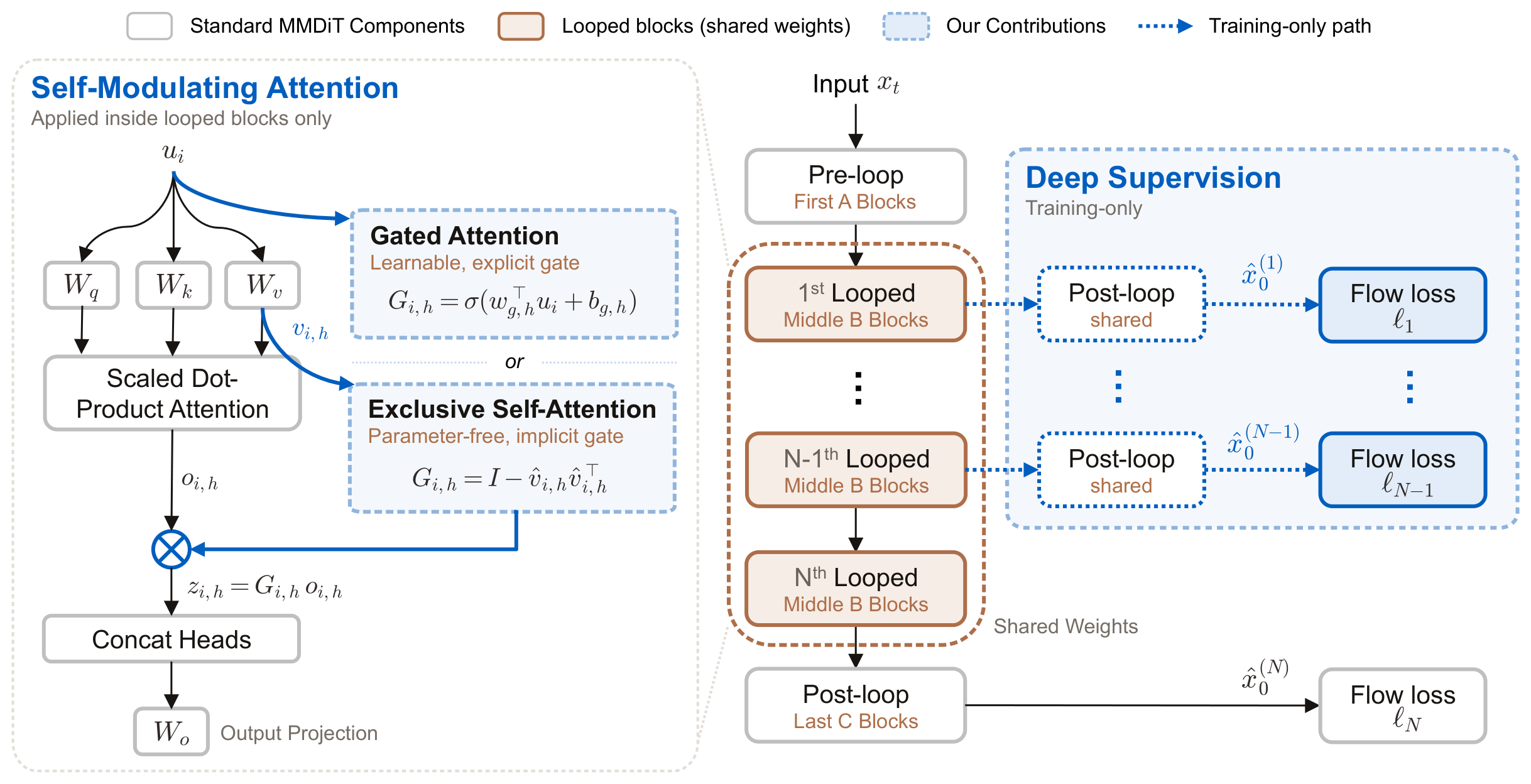
Looped-DiT scales the computation of a text-to-image diffusion transformer by running a shared group of transformer blocks several times within each denoising step: the model gets deeper without getting larger. Naive looping does not reliably help, so Looped-DiT adds two components. Deep Supervision decodes the state after every loop through the post-loop blocks and trains each of these predictions on the same clean-image target. Self-Modulating Attention (exclusive self-attention, XSA, or a head-wise attention gate) regulates the attention updates inside the loop. The backbone is the pixel-space MMDiT of MiniT2I, conditioned on a frozen FLAN-T5-Large.
This repository includes:
- Training code for Looped-DiT B/32, B/16 and L/16 (pretraining and fine-tuning).
- Inference at any loop depth.
- Evaluation on GenEval, DPG-Bench, PRISM-Bench, T2I-CoReBench, SpatialGenEval and TIIF-Short.
- Data preparation scripts for every training set.
Table of Contents
Model Zoo
| Model | Patch | GenEval | DPG | PRISM | CoRe | Spatial | TIIF | Avg | Checkpoint |
|---|---|---|---|---|---|---|---|---|---|
| Looped-DiT B/32 | 32 | 85.1 | 85.3 | 54.4 | 44.5 | 52.3 | 76.1 | 66.3 | sensenova/Looped-DiT-B32 |
| Looped-DiT B/16 | 16 | 87.4 | 87.0 | 67.0 | 53.5 | 54.6 | 79.7 | 71.5 | sensenova/Looped-DiT-B16 |
Scores use the EMA weights, 100 Euler steps, guidance 6.0 and loop depth 4.
Spatial denotes SpatialGenEval. TIIF denotes the short-prompt version of TIIF-Bench.
Repository Layout
.
├── configs/          # training configs (B/32, B/16, L/16) and the evaluation config
├── looped_dit/       # model, training, sampling
│   └── eval/         # benchmark image generation and scoring
├── tools/            # dataset preparation
├── tests/            # unit tests
└── assets/
Installation
Create a Python environment with a CUDA build of PyTorch (2.1 or newer), then install the dependencies:
pip install -r requirements.txt
Run all commands from the repository root. Configs refer to ${DATA_ROOT} (training data),
${ASSET_ROOT} (benchmark files) and ${OUTPUT_ROOT} (checkpoints and results in the
evaluation config). They default to data/, eval_assets/ and outputs/ in the
repository and can be set as environment variables.
Sanity-check the environment with the unit tests (CPU, under a minute):
python -m pytest tests
Inference
Download a checkpoint from the Model Zoo, then generate. --loops sets the
loop depth, and several depths give one row each:
hf download sensenova/Looped-DiT-B16 looped-dit-b16.pt --local-dir checkpoints

python -m looped_dit.sample --checkpoint checkpoints/looped-dit-b16.pt \
    --prompt "a red cube on top of a blue sphere" --out sample.png

python -m looped_dit.sample --checkpoint checkpoints/looped-dit-b16.pt \
    --prompt "a red cube on top of a blue sphere" --loops 1 2 3 4 --out loops.png
From Python:
import torch
from looped_dit.pipeline import TextEncoder, generate, load_model

device = torch.device("cuda")
model, cfg = load_model("checkpoints/looped-dit-b16.pt", device)  # EMA weights, bf16
text_encoder = TextEncoder(cfg.text_encoder, cfg.prompt_length, device)
torch.manual_seed(0)
image = generate(model, text_encoder, ["a red cube on top of a blue sphere"], num_loops=4)[0]
image.save("sample.png")
Recommended Inference Settings
These are the settings of the paper's main results and the defaults of the scripts.
| Setting | Value |
|---|---|
| Sampler | Euler, 100 steps |
| Classifier-free guidance scale | 6.0 |
| Loop depth | 4, the trained depth (other depths work without retraining) |
| Weights / precision | EMA, bfloat16 |
| Resolution | 512 x 512 |
Evaluation
Evaluation Metrics
This repository does not include benchmark data. Copy the files below from the benchmark
repositories into ${ASSET_ROOT}. The paths are the defaults of configs/eval.yml, and the
folder of the benchmark repository a file comes from is in parentheses. The judge and
scorer models (Qwen, mPLUG, CLIP) are downloaded on first use, but the Mask2Former weights
are not.
| Benchmark | Assets | Scorer | Extra packages |
|---|---|---|---|
| GenEval | geneval/evaluation_metadata.jsonl (from prompts/), Mask2Former weights in geneval/detector/ (from evaluation/download_models.sh) | Mask2Former + CLIP | mmdet 2.x, mmcv-full, open_clip_torch, clip-benchmark |
| DPG-Bench | loaded from the Hugging Face Hub | mPLUG-large VQA | modelscope |
| PRISM-Bench | prism/captions/en/, prism/eval_qwen25.py (from evaluation/) | Qwen2.5-VL-72B-Instruct | vllm, qwen-vl-utils |
| T2I-CoReBench | corebench/data/ | Qwen3-VL-32B-Thinking | vllm, qwen-vl-utils |
| SpatialGenEval | spatial_geneval/SpatialGenEval_T2I_Prompts.jsonl (from eval/) | Qwen2.5-VL-72B-Instruct, 5 rollouts, 4/5 majority | vllm, qwen-vl-utils |
| TIIF-Bench (short prompts) | tiif/data/, tiif/eval_with_vlm.py (from eval/) | GPT-4o through the OpenAI API | requests |
The Qwen judges run locally with vLLM on 8 GPUs (set tensor_parallel_size under a
benchmark to change this). GenEval (mmdet) and the judges (vLLM) usually need their own
Python environments. Set them under python: in the eval config. We used mmdet 2.28.2 with
mmcv-full 1.7.2 for GenEval, and vLLM 0.24 with transformers 5.12 and qwen-vl-utils 0.0.14
for the judges. TIIF-Bench is judged by GPT-4o: set OPENAI_API_KEY (api_base in the eval
config accepts any OpenAI-compatible endpoint).
The GenEval scorer looks for the Mask2Former config in an mmdetection 2.x source checkout,
as in the GenEval instructions. With a pip-installed mmdet, set detector_config.
Evaluate Checkpoints
Set checkpoint and output_dir in configs/eval.yml, then run:
python -m looped_dit.eval.run --config configs/eval.yml
This generates the images of all six benchmarks on 8 GPUs, scores them and prints a table
(scores.json in the output directory). Finished benchmarks are skipped on a rerun. The
noise seed of a prompt depends on the GPU that renders it, so use 8 GPUs to reproduce a
run exactly. Each step can also be run on its own, see looped_dit/eval/.
Full Training
Configurations
| Model | Patch | Blocks (pre-loop, looped, post-loop) | Pretraining | Fine-tuning | Configs |
|---|---|---|---|---|---|
| Looped-DiT B/32 | 32 | [6,5,6] | CC12M, 250k steps | Std-120K, 40k steps | configs/b32_*.yml |
| Looped-DiT B/16 | 16 | [6,5,6] | CC12M + FLUX-Reason-6M, 500k steps | Std-120K + Fine-T2I, 80k steps | configs/b16_*.yml |
| Looped-DiT L/16 | 16 | [8,7,8] | CC12M + FLUX-Reason-6M, 500k steps | Std-120K + Fine-T2I, 80k steps | configs/l16_*.yml |
All models generate 512 x 512 images with a frozen FLAN-T5-Large text encoder. The looped blocks run 4 times, so B/32 and B/16 apply 32 blocks per forward pass with 17 distinct blocks (L/16: 44 with 23). The configs train with deep supervision (Final + Mean weighting) and XSA.
Dataset Preparation
Training data goes into ${DATA_ROOT}:
data/
├── cc12m_chunks/         # pretraining tensor chunks (chunk_*.pt)
├── fluxreason_chunks/
└── finetune/             # WebDataset shards of (jpg or png, txt) pairs
    ├── blip3o_60k/  dalle3/  sharegpt4o/  fine_t2i/
The pretraining chunks hold decoded 512 x 512 images, about 0.8 GB per 1,024 samples: roughly 5 TB each for CC12M and FLUX-Reason-6M.
CC12M. Pretraining uses CC12M with the LLaVA-NeXT captions of
CaptionEmporium/conceptual-captions-cc12m-llavanext.
Download the images with img2dataset, installed
in a separate environment (it requires an older webdataset than this repository), then
write tensor chunks:
hf download CaptionEmporium/conceptual-captions-cc12m-llavanext --repo-type dataset \
    --include "*.jsonl.gz" --local-dir data/cc12m_meta
python -c "import pandas as pd; df = pd.read_json('data/cc12m_meta/train.jsonl.gz', lines=True); \
df[df.status == 'success'][['url', 'caption_llava']].to_parquet('data/cc12m_meta/urls.parquet')"
img2dataset --url_list data/cc12m_meta/urls.parquet --input_format parquet \
    --url_col url --caption_col caption_llava --output_format webdataset \
    --output_folder data/cc12m_wds --image_size 512 --resize_mode center_crop \
    --encode_format jpg --number_sample_per_shard 10000 --processes_count 16 --thread_count 64
python tools/make_chunks.py --webdataset data/cc12m_wds --out data/cc12m_chunks
FLUX-Reason-6M. B/16 and L/16 also pretrain on
FLUX-Reason-6M images with the
dense captions released with i1:
five captions per image, of which make_chunks.py keeps one, chosen at random but the same
on every run. Download the FLUX-Reason part of the captions (10 GB), then point --captions
at it:
hf download zlab-princeton/i1-captions --repo-type dataset --include "fluxreason/*" \
    --local-dir data/i1-captions
python tools/make_chunks.py --hf-dataset LucasFang/FLUX-Reason-6M --id-column id \
    --captions data/i1-captions/fluxreason --out data/fluxreason_chunks
Fine-tuning data. Std-120K mixes BLIP3o-60K, DALL-E 3 and the text-to-image part of ShareGPT-4o-Image with weights 0.06 / 0.016 / 0.04. B/16 and L/16 add Fine-T2I for half of the samples:
python tools/prepare_finetune_data.py --out data/finetune                      # Std-120K
python tools/prepare_finetune_data.py --out data/finetune --sources fine_t2i   # Fine-T2I
Pretraining
Launch on every node with torchrun. The global batch is 1024: each step accumulates
gradients over 1024 / (micro_batch_size x GPUs) micro-batches, so that product must divide
1024 (change micro_batch_size with --set if it does not). A run resumes from the newest
checkpoint in its output directory.
torchrun --nnodes 2 --nproc_per_node 8 --node_rank $NODE_RANK \
    --master_addr $MASTER_ADDR --master_port 29500 \
    -m looped_dit.train --config configs/b32_pretrain.yml --output-dir outputs/b32_pretrain
The reference setups are 2 nodes for B/32, 4 for B/16 and 8 for L/16 (8 GPUs with 80 GB
each). Each data-loader worker keeps a shuffle buffer of 4,096 decoded images (about 3 GB),
so pretraining needs about 150 GB of host memory per 8-GPU node. Lower shuffle_buffer or
num_workers if that is too much. Add --wandb to log to Weights & Biases.
| B/32 | B/16 | L/16 | |
|---|---|---|---|
| Steps | 250k | 500k | 500k |
| Learning rate (after 5k warmup) | 4e-4 | 4e-4 | 2e-4 |
| EMA decay | 0.99995 | 0.99995 | 0.9999 |
All models use AdamW with betas (0.9, 0.95) and no weight decay, gradient clipping at 0.1, bf16 autocast, noise scale 2.0, logit-normal timesteps (mean -0.8, std 0.8) and 10% prompt dropout.
Fine-Tuning
Fine-tuning starts from the pretrained weights, EMA and optimizer state and continues the step counter, without warmup (learning rate 4e-4 and EMA 0.99995 for every model):
torchrun ... -m looped_dit.train --config configs/b32_finetune.yml --output-dir outputs/b32_finetune \
    --init-from outputs/b32_pretrain/checkpoints/checkpoint_0250000.pt
Ablation Toggles
Each Looped-DiT component is a config switch, so the ablations of the paper are config edits
(or command-line overrides such as --set use_xsa=false use_attn_gate=true). Each row lists
only the switches to change. Everything else stays as in the shipped configs, which train with
deep supervision (Final + Mean) and XSA. For example, the gated-attention row keeps deep
supervision on, so add deep_supervision: false to train the gate alone:
| Model | Config |
|---|---|
| MiniT2I baseline without looping (the same 17 blocks, each run once) | num_loops: 1, deep_supervision: false, use_xsa: false |
| Deeper MiniT2I (32 blocks without weight sharing, compute-matched) | share_loop_weights: false, deep_supervision: false, use_xsa: false |
| Naive looping | deep_supervision: false, use_xsa: false |
| Other deep-supervision weightings (the paper's Exponential, or uniform) | deep_supervision_weighting: exponential or uniform |
| Gated attention instead of XSA | use_xsa: false, use_attn_gate: true |
Acknowledgments
This codebase builds on:
- MiniT2I and its PyTorch implementation: the backbone, data pipeline and training recipe.
- GenEval: the object-detection scorer in
looped_dit/eval/geneval/, adapted with a progress bar and a JSON summary (MIT license). - The authors of the datasets and benchmarks linked above.
This project is released under the MIT License.
Similar repos


PyTorch implementation of Looped Diffusion Transformer
Python
36
5 commits
updated Oct 5, 2026
See what people are saying
README
Looped-DiT: Looped Diffusion Transformer
Official PyTorch implementation of Looped-DiT.
Looped-DiT scales the computation of a text-to-image diffusion transformer by running a shared group of transformer blocks several times within each denoising step: the model gets deeper without getting larger. Naive looping does not reliably help, so Looped-DiT adds two components. Deep Supervision decodes the state after every loop through the post-loop blocks and trains each of these predictions on the same clean-image target. Self-Modulating Attention (exclusive self-attention, XSA, or a head-wise attention gate) regulates the attention updates inside the loop. The backbone is the pixel-space MMDiT of MiniT2I, conditioned on a frozen FLAN-T5-Large.
This repository includes:
- Training code for Looped-DiT B/32, B/16 and L/16 (pretraining and fine-tuning).
- Inference at any loop depth.
- Evaluation on GenEval, DPG-Bench, PRISM-Bench, T2I-CoReBench, SpatialGenEval and TIIF-Short.
- Data preparation scripts for every training set.
Table of Contents
Model Zoo
| Model | Patch | GenEval | DPG | PRISM | CoRe | Spatial | TIIF | Avg | Checkpoint |
|---|---|---|---|---|---|---|---|---|---|
| Looped-DiT B/32 | 32 | 85.1 | 85.3 | 54.4 | 44.5 | 52.3 | 76.1 | 66.3 | sensenova/Looped-DiT-B32 |
| Looped-DiT B/16 | 16 | 87.4 | 87.0 | 67.0 | 53.5 | 54.6 | 79.7 | 71.5 | sensenova/Looped-DiT-B16 |
Scores use the EMA weights, 100 Euler steps, guidance 6.0 and loop depth 4.
Spatial denotes SpatialGenEval. TIIF denotes the short-prompt version of TIIF-Bench.
Repository Layout
.
├── configs/          # training configs (B/32, B/16, L/16) and the evaluation config
├── looped_dit/       # model, training, sampling
│   └── eval/         # benchmark image generation and scoring
├── tools/            # dataset preparation
├── tests/            # unit tests
└── assets/
Installation
Create a Python environment with a CUDA build of PyTorch (2.1 or newer), then install the dependencies:
pip install -r requirements.txt
Run all commands from the repository root. Configs refer to ${DATA_ROOT} (training data),
${ASSET_ROOT} (benchmark files) and ${OUTPUT_ROOT} (checkpoints and results in the
evaluation config). They default to data/, eval_assets/ and outputs/ in the
repository and can be set as environment variables.
Sanity-check the environment with the unit tests (CPU, under a minute):
python -m pytest tests
Inference
Download a checkpoint from the Model Zoo, then generate. --loops sets the
loop depth, and several depths give one row each:
hf download sensenova/Looped-DiT-B16 looped-dit-b16.pt --local-dir checkpoints

python -m looped_dit.sample --checkpoint checkpoints/looped-dit-b16.pt \
    --prompt "a red cube on top of a blue sphere" --out sample.png

python -m looped_dit.sample --checkpoint checkpoints/looped-dit-b16.pt \
    --prompt "a red cube on top of a blue sphere" --loops 1 2 3 4 --out loops.png
From Python:
import torch
from looped_dit.pipeline import TextEncoder, generate, load_model

device = torch.device("cuda")
model, cfg = load_model("checkpoints/looped-dit-b16.pt", device)  # EMA weights, bf16
text_encoder = TextEncoder(cfg.text_encoder, cfg.prompt_length, device)
torch.manual_seed(0)
image = generate(model, text_encoder, ["a red cube on top of a blue sphere"], num_loops=4)[0]
image.save("sample.png")
Recommended Inference Settings
These are the settings of the paper's main results and the defaults of the scripts.
| Setting | Value |
|---|---|
| Sampler | Euler, 100 steps |
| Classifier-free guidance scale | 6.0 |
| Loop depth | 4, the trained depth (other depths work without retraining) |
| Weights / precision | EMA, bfloat16 |
| Resolution | 512 x 512 |
Evaluation
Evaluation Metrics
This repository does not include benchmark data. Copy the files below from the benchmark
repositories into ${ASSET_ROOT}. The paths are the defaults of configs/eval.yml, and the
folder of the benchmark repository a file comes from is in parentheses. The judge and
scorer models (Qwen, mPLUG, CLIP) are downloaded on first use, but the Mask2Former weights
are not.
| Benchmark | Assets | Scorer | Extra packages |
|---|---|---|---|
| GenEval | geneval/evaluation_metadata.jsonl (from prompts/), Mask2Former weights in geneval/detector/ (from evaluation/download_models.sh) | Mask2Former + CLIP | mmdet 2.x, mmcv-full, open_clip_torch, clip-benchmark |
| DPG-Bench | loaded from the Hugging Face Hub | mPLUG-large VQA | modelscope |
| PRISM-Bench | prism/captions/en/, prism/eval_qwen25.py (from evaluation/) | Qwen2.5-VL-72B-Instruct | vllm, qwen-vl-utils |
| T2I-CoReBench | corebench/data/ | Qwen3-VL-32B-Thinking | vllm, qwen-vl-utils |
| SpatialGenEval | spatial_geneval/SpatialGenEval_T2I_Prompts.jsonl (from eval/) | Qwen2.5-VL-72B-Instruct, 5 rollouts, 4/5 majority | vllm, qwen-vl-utils |
| TIIF-Bench (short prompts) | tiif/data/, tiif/eval_with_vlm.py (from eval/) | GPT-4o through the OpenAI API | requests |
The Qwen judges run locally with vLLM on 8 GPUs (set tensor_parallel_size under a
benchmark to change this). GenEval (mmdet) and the judges (vLLM) usually need their own
Python environments. Set them under python: in the eval config. We used mmdet 2.28.2 with
mmcv-full 1.7.2 for GenEval, and vLLM 0.24 with transformers 5.12 and qwen-vl-utils 0.0.14
for the judges. TIIF-Bench is judged by GPT-4o: set OPENAI_API_KEY (api_base in the eval
config accepts any OpenAI-compatible endpoint).
The GenEval scorer looks for the Mask2Former config in an mmdetection 2.x source checkout,
as in the GenEval instructions. With a pip-installed mmdet, set detector_config.
Evaluate Checkpoints
Set checkpoint and output_dir in configs/eval.yml, then run:
python -m looped_dit.eval.run --config configs/eval.yml
This generates the images of all six benchmarks on 8 GPUs, scores them and prints a table
(scores.json in the output directory). Finished benchmarks are skipped on a rerun. The
noise seed of a prompt depends on the GPU that renders it, so use 8 GPUs to reproduce a
run exactly. Each step can also be run on its own, see looped_dit/eval/.
Full Training
Configurations
| Model | Patch | Blocks (pre-loop, looped, post-loop) | Pretraining | Fine-tuning | Configs |
|---|---|---|---|---|---|
| Looped-DiT B/32 | 32 | [6,5,6] | CC12M, 250k steps | Std-120K, 40k steps | configs/b32_*.yml |
| Looped-DiT B/16 | 16 | [6,5,6] | CC12M + FLUX-Reason-6M, 500k steps | Std-120K + Fine-T2I, 80k steps | configs/b16_*.yml |
| Looped-DiT L/16 | 16 | [8,7,8] | CC12M + FLUX-Reason-6M, 500k steps | Std-120K + Fine-T2I, 80k steps | configs/l16_*.yml |
All models generate 512 x 512 images with a frozen FLAN-T5-Large text encoder. The looped blocks run 4 times, so B/32 and B/16 apply 32 blocks per forward pass with 17 distinct blocks (L/16: 44 with 23). The configs train with deep supervision (Final + Mean weighting) and XSA.
Dataset Preparation
Training data goes into ${DATA_ROOT}:
data/
├── cc12m_chunks/         # pretraining tensor chunks (chunk_*.pt)
├── fluxreason_chunks/
└── finetune/             # WebDataset shards of (jpg or png, txt) pairs
    ├── blip3o_60k/  dalle3/  sharegpt4o/  fine_t2i/
The pretraining chunks hold decoded 512 x 512 images, about 0.8 GB per 1,024 samples: roughly 5 TB each for CC12M and FLUX-Reason-6M.
CC12M. Pretraining uses CC12M with the LLaVA-NeXT captions of
CaptionEmporium/conceptual-captions-cc12m-llavanext.
Download the images with img2dataset, installed
in a separate environment (it requires an older webdataset than this repository), then
write tensor chunks:
hf download CaptionEmporium/conceptual-captions-cc12m-llavanext --repo-type dataset \
    --include "*.jsonl.gz" --local-dir data/cc12m_meta
python -c "import pandas as pd; df = pd.read_json('data/cc12m_meta/train.jsonl.gz', lines=True); \
df[df.status == 'success'][['url', 'caption_llava']].to_parquet('data/cc12m_meta/urls.parquet')"
img2dataset --url_list data/cc12m_meta/urls.parquet --input_format parquet \
    --url_col url --caption_col caption_llava --output_format webdataset \
    --output_folder data/cc12m_wds --image_size 512 --resize_mode center_crop \
    --encode_format jpg --number_sample_per_shard 10000 --processes_count 16 --thread_count 64
python tools/make_chunks.py --webdataset data/cc12m_wds --out data/cc12m_chunks
FLUX-Reason-6M. B/16 and L/16 also pretrain on
FLUX-Reason-6M images with the
dense captions released with i1:
five captions per image, of which make_chunks.py keeps one, chosen at random but the same
on every run. Download the FLUX-Reason part of the captions (10 GB), then point --captions
at it:
hf download zlab-princeton/i1-captions --repo-type dataset --include "fluxreason/*" \
    --local-dir data/i1-captions
python tools/make_chunks.py --hf-dataset LucasFang/FLUX-Reason-6M --id-column id \
    --captions data/i1-captions/fluxreason --out data/fluxreason_chunks
Fine-tuning data. Std-120K mixes BLIP3o-60K, DALL-E 3 and the text-to-image part of ShareGPT-4o-Image with weights 0.06 / 0.016 / 0.04. B/16 and L/16 add Fine-T2I for half of the samples:
python tools/prepare_finetune_data.py --out data/finetune                      # Std-120K
python tools/prepare_finetune_data.py --out data/finetune --sources fine_t2i   # Fine-T2I
Pretraining
Launch on every node with torchrun. The global batch is 1024: each step accumulates
gradients over 1024 / (micro_batch_size x GPUs) micro-batches, so that product must divide
1024 (change micro_batch_size with --set if it does not). A run resumes from the newest
checkpoint in its output directory.
torchrun --nnodes 2 --nproc_per_node 8 --node_rank $NODE_RANK \
    --master_addr $MASTER_ADDR --master_port 29500 \
    -m looped_dit.train --config configs/b32_pretrain.yml --output-dir outputs/b32_pretrain
The reference setups are 2 nodes for B/32, 4 for B/16 and 8 for L/16 (8 GPUs with 80 GB
each). Each data-loader worker keeps a shuffle buffer of 4,096 decoded images (about 3 GB),
so pretraining needs about 150 GB of host memory per 8-GPU node. Lower shuffle_buffer or
num_workers if that is too much. Add --wandb to log to Weights & Biases.
| B/32 | B/16 | L/16 | |
|---|---|---|---|
| Steps | 250k | 500k | 500k |
| Learning rate (after 5k warmup) | 4e-4 | 4e-4 | 2e-4 |
| EMA decay | 0.99995 | 0.99995 | 0.9999 |
All models use AdamW with betas (0.9, 0.95) and no weight decay, gradient clipping at 0.1, bf16 autocast, noise scale 2.0, logit-normal timesteps (mean -0.8, std 0.8) and 10% prompt dropout.
Fine-Tuning
Fine-tuning starts from the pretrained weights, EMA and optimizer state and continues the step counter, without warmup (learning rate 4e-4 and EMA 0.99995 for every model):
torchrun ... -m looped_dit.train --config configs/b32_finetune.yml --output-dir outputs/b32_finetune \
    --init-from outputs/b32_pretrain/checkpoints/checkpoint_0250000.pt
Ablation Toggles
Each Looped-DiT component is a config switch, so the ablations of the paper are config edits
(or command-line overrides such as --set use_xsa=false use_attn_gate=true). Each row lists
only the switches to change. Everything else stays as in the shipped configs, which train with
deep supervision (Final + Mean) and XSA. For example, the gated-attention row keeps deep
supervision on, so add deep_supervision: false to train the gate alone:
| Model | Config |
|---|---|
| MiniT2I baseline without looping (the same 17 blocks, each run once) | num_loops: 1, deep_supervision: false, use_xsa: false |
| Deeper MiniT2I (32 blocks without weight sharing, compute-matched) | share_loop_weights: false, deep_supervision: false, use_xsa: false |
| Naive looping | deep_supervision: false, use_xsa: false |
| Other deep-supervision weightings (the paper's Exponential, or uniform) | deep_supervision_weighting: exponential or uniform |
| Gated attention instead of XSA | use_xsa: false, use_attn_gate: true |
Acknowledgments
This codebase builds on:
- MiniT2I and its PyTorch implementation: the backbone, data pipeline and training recipe.
- GenEval: the object-detection scorer in
looped_dit/eval/geneval/, adapted with a progress bar and a JSON summary (MIT license). - The authors of the datasets and benchmarks linked above.
This project is released under the MIT License.