
Official repository of AURA, a chat music editor model
Python
0
8 commits
updated Sep 15, 2026
README
AURA: Unified Multimodal Framework for Conversational Music Editing
Quoc-Huy Trinh¹⁴ · Minh-Van Nguyen²⁴ · Debesh Jha³
¹ Aalto University · ² Technical University of Denmark · ³ University of South Dakota · ⁴ OpenRB Lab




Chat with a song, ask for edits in natural language, get edited audio back.
News
- [2026.9.13] AURA model and AURA-Chat-Edit dataset are released on Hugging Face!
- [2026.9.13] Training, inference, and evaluation code is released. Checkpoints and demo coming soon!
- [2026.9.13] AURA paper is released on arXiv. Welcome to check it out!
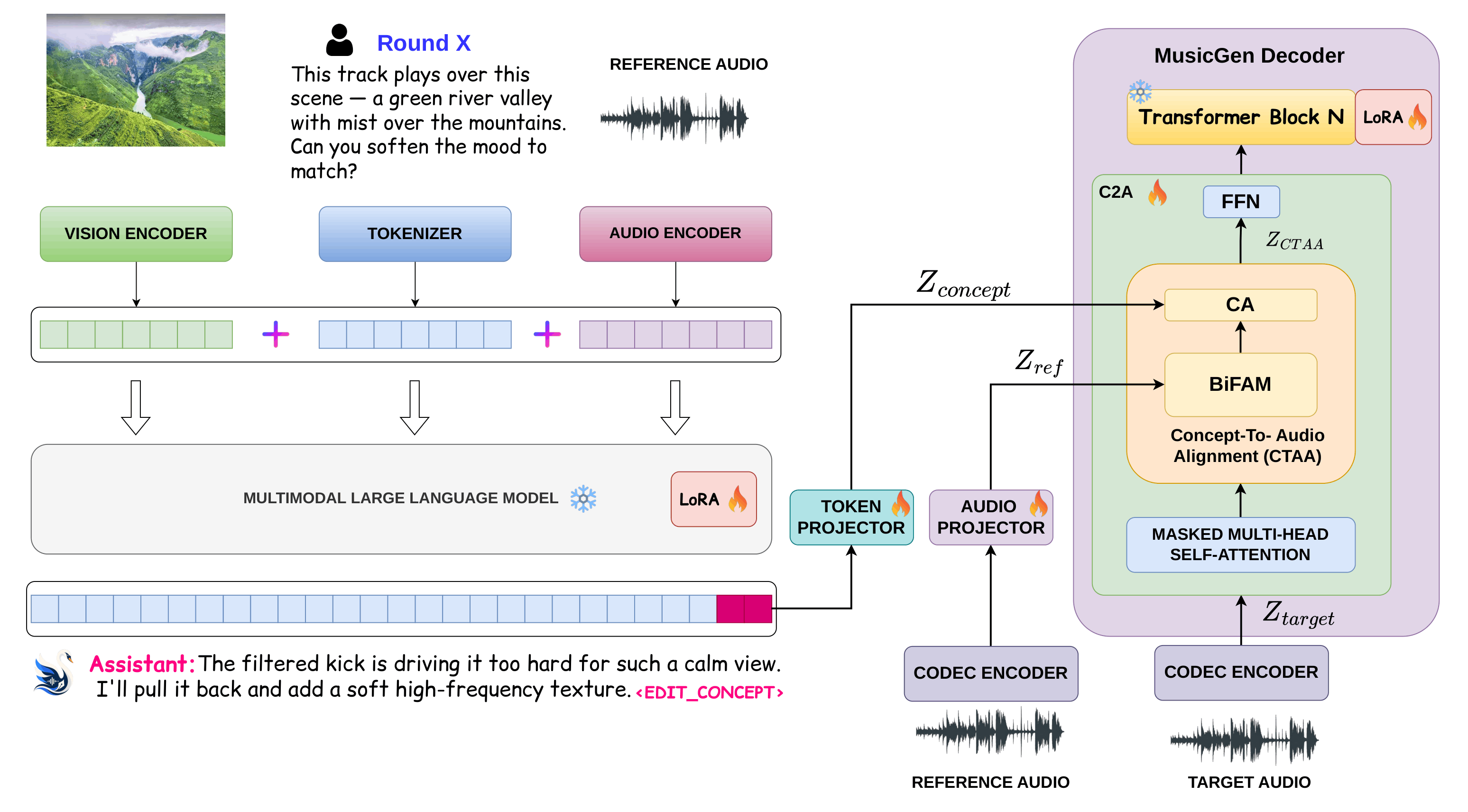
Architecture: a Qwen2.5-Omni-7B thinker (LoRA-tuned) listens to the music
and the request, replies conversationally, and emits a typed edit-token block
[EDIT_<KIND>][EDIT_0..7] (7 kinds: ADD / REMOVE / REPLACE / EXTRACT /
REBALANCE / EFFECT / MOOD). The 9 hidden states at those tokens condition a
dual-stream fusion MusicGen bridge (frozen MusicGen-medium decoder; a
music-free source stream fused per layer via bi-dual cross-attention + gated
FiLM; edit tokens as cross-attention K/V with LoRA) that renders the edited
audio through EnCodec. Localized edits are code-anchored outside the requested
segment and seam-crossfaded.
1. Installation
conda env create -f src/environment.yml     # creates env "music-edit"
conda activate music-edit
Notes:
- Model weights (Qwen2.5-Omni-7B, MusicGen-medium, MuQ-MuLan, CLAP)
auto-download on first use into
weights/(setHF_HUB_CACHE=$PWD/weights). - Trained adapters are expected under
ckpts/edit_agent/(not in git). - The code disables cuDNN at import (
torch.backends.cudnn) — no action needed. - Optional MultiBand-Diffusion decoding needs a separate audiocraft env.
2. Dataset generation
The training data is built in stages (all under data/edit_dataset/):
# a) Slakh stem-edit pairs (exact mixes; add/remove/isolate/rebalance/swap)
python src/edit_agent/slakh_edits.py \
    --slakh-root data/edit_dataset/slakh_raw/slakh2100_flac_redux/train \
    --max-tracks 600 --pairs-per-chunk 2 --traj-per-track 1
#    (--ops isolate to restrict ops; --force-split test for held-out builds)

# b) Conversations for the pairs (needs an OpenAI-compatible LLM endpoint,
#    see src/data_utils/llm_client.py — default http://localhost:9003)
python src/edit_agent/synth_dialogues_slakh.py --workers 16

# c) Bridge training caches: manifest -> hidden states -> EnCodec codes
python src/edit_agent/precompute_bridge.py --phase manifest
python src/edit_agent/precompute_bridge.py --phase hidden   # GPU; SFT thinker
python src/edit_agent/precompute_encodec.py                 # GPU (needs hidden first)

# d) Optional data-quality score used by --silence-filter
python src/edit_agent/filter_silence.py
Held-out evaluation sets:
# Instruct-MusicGen-comparable benchmark from the Slakh TEST split
python src/edit_agent/build_impg_benchmark.py     # -> results/impg_bench/
3. Training
Stage 1 — thinker SFT (edit-token emission + music chat; see
train_sft.py): produces ckpts/edit_agent/sft/final.
Stage 2 — bridge (MusicGen fusion adapter on cached hidden states):
torchrun --nproc_per_node=2 src/edit_agent/train_musicgen_bridge.py \
    --arch fusion --lora-r 64 --lora-alpha 128 \
    --batch 8 --accum 2 --steps 40000 --lr 5e-5 --silence-filter
# checkpoints -> ckpts/edit_agent/musicgen_fusion/step_*
# IMPORTANT: select checkpoints with the audio probe, never with CE:
python src/edit_agent/probe_musicgen.py \
    --adapter ckpts/edit_agent/musicgen_fusion/step_30000 --arch fusion
Stage 3 — joint (live thinker + bridge; loss = λ·CE_musicgen + (1−λ)·CE_LM, the LM term is Qwen's built-in loss and keeps chat/QA ability):
python src/edit_agent/train_joint.py --arch fusion \
    --mg-init ckpts/edit_agent/musicgen_fusion/step_30000 \
    --steps 4000 --lam 0.5
# -> ckpts/edit_agent/joint/final/{qwen,musicgen}
Verification: verify_sft.py (edit-token emission), eval_musicgen.py
(60-clip benchmark + FAD), run_impg_bench.py + score_impg_bench.py
(FAD/CLAP/KL/SSIM/P-Demucs/SI-SDR vs published baselines).
4. Serving
HTTP API (production path)
API_GPU=1 API_PORT=9004 bash src/scripts/serve_musicgen_api.sh
Endpoints (docs/API.md has full schemas + clients; Swagger at /docs):
POST /chat{text, audio(base64)}→{text}POST /edit{text, audio(base64), segment?, guidance?, seed?}→{text, audio(base64 wav 32 kHz), ...}
Gradio web UI (interactive testing)
The Gradio app chats with the thinker, chunks an uploaded song, and sends edit requests to a render worker. Point it at the production API:
# terminal 1 — the model API (render worker)
API_GPU=1 API_PORT=9004 bash src/scripts/serve_musicgen_api.sh

# terminal 2 — the Gradio UI
WORKER_URL=http://127.0.0.1:9004 \
SFT_ADAPTER=ckpts/edit_agent/joint_fusion_r64/final/qwen \
WEBAPP_PORT=7862 CUDA_VISIBLE_DEVICES=0 \
conda run -n music-edit python src/edit_agent/webapp.py
Open http://localhost:7862: upload a song, pick a chunk, chat
("make the chorus more energetic", "remove the drums from 4 to 8 seconds") and
listen to rendered edits inline. The API accepts the webapp's legacy prompt
field, so no further glue is needed.
Citation
@misc{trinh2026auraunifiedmultimodalframework,
      title={AURA: Unified Multimodal Framework for Conversational Music Editing},
      author={Quoc-Huy Trinh and Minh-Van Nguyen and Debesh Jha},
      year={2026},
      eprint={2609.14344},
      archivePrefix={arXiv},
      primaryClass={cs.SD},
      url={https://arxiv.org/abs/2609.14344},
}
Contributors

8 commits
Similar repos





Languages
Python
91.7%
HTML
5.4%
Shell
2.8%
Official repository of AURA, a chat music editor model
Python
0
8 commits
updated Sep 15, 2026
README
AURA: Unified Multimodal Framework for Conversational Music Editing
Quoc-Huy Trinh¹⁴ · Minh-Van Nguyen²⁴ · Debesh Jha³
¹ Aalto University · ² Technical University of Denmark · ³ University of South Dakota · ⁴ OpenRB Lab
Chat with a song, ask for edits in natural language, get edited audio back.
News
- [2026.9.13] AURA model and AURA-Chat-Edit dataset are released on Hugging Face!
- [2026.9.13] Training, inference, and evaluation code is released. Checkpoints and demo coming soon!
- [2026.9.13] AURA paper is released on arXiv. Welcome to check it out!
Architecture: a Qwen2.5-Omni-7B thinker (LoRA-tuned) listens to the music
and the request, replies conversationally, and emits a typed edit-token block
[EDIT_<KIND>][EDIT_0..7] (7 kinds: ADD / REMOVE / REPLACE / EXTRACT /
REBALANCE / EFFECT / MOOD). The 9 hidden states at those tokens condition a
dual-stream fusion MusicGen bridge (frozen MusicGen-medium decoder; a
music-free source stream fused per layer via bi-dual cross-attention + gated
FiLM; edit tokens as cross-attention K/V with LoRA) that renders the edited
audio through EnCodec. Localized edits are code-anchored outside the requested
segment and seam-crossfaded.
1. Installation
conda env create -f src/environment.yml     # creates env "music-edit"
conda activate music-edit
Notes:
- Model weights (Qwen2.5-Omni-7B, MusicGen-medium, MuQ-MuLan, CLAP)
auto-download on first use into
weights/(setHF_HUB_CACHE=$PWD/weights). - Trained adapters are expected under
ckpts/edit_agent/(not in git). - The code disables cuDNN at import (
torch.backends.cudnn) — no action needed. - Optional MultiBand-Diffusion decoding needs a separate audiocraft env.
2. Dataset generation
The training data is built in stages (all under data/edit_dataset/):
# a) Slakh stem-edit pairs (exact mixes; add/remove/isolate/rebalance/swap)
python src/edit_agent/slakh_edits.py \
    --slakh-root data/edit_dataset/slakh_raw/slakh2100_flac_redux/train \
    --max-tracks 600 --pairs-per-chunk 2 --traj-per-track 1
#    (--ops isolate to restrict ops; --force-split test for held-out builds)

# b) Conversations for the pairs (needs an OpenAI-compatible LLM endpoint,
#    see src/data_utils/llm_client.py — default http://localhost:9003)
python src/edit_agent/synth_dialogues_slakh.py --workers 16

# c) Bridge training caches: manifest -> hidden states -> EnCodec codes
python src/edit_agent/precompute_bridge.py --phase manifest
python src/edit_agent/precompute_bridge.py --phase hidden   # GPU; SFT thinker
python src/edit_agent/precompute_encodec.py                 # GPU (needs hidden first)

# d) Optional data-quality score used by --silence-filter
python src/edit_agent/filter_silence.py
Held-out evaluation sets:
# Instruct-MusicGen-comparable benchmark from the Slakh TEST split
python src/edit_agent/build_impg_benchmark.py     # -> results/impg_bench/
3. Training
Stage 1 — thinker SFT (edit-token emission + music chat; see
train_sft.py): produces ckpts/edit_agent/sft/final.
Stage 2 — bridge (MusicGen fusion adapter on cached hidden states):
torchrun --nproc_per_node=2 src/edit_agent/train_musicgen_bridge.py \
    --arch fusion --lora-r 64 --lora-alpha 128 \
    --batch 8 --accum 2 --steps 40000 --lr 5e-5 --silence-filter
# checkpoints -> ckpts/edit_agent/musicgen_fusion/step_*
# IMPORTANT: select checkpoints with the audio probe, never with CE:
python src/edit_agent/probe_musicgen.py \
    --adapter ckpts/edit_agent/musicgen_fusion/step_30000 --arch fusion
Stage 3 — joint (live thinker + bridge; loss = λ·CE_musicgen + (1−λ)·CE_LM, the LM term is Qwen's built-in loss and keeps chat/QA ability):
python src/edit_agent/train_joint.py --arch fusion \
    --mg-init ckpts/edit_agent/musicgen_fusion/step_30000 \
    --steps 4000 --lam 0.5
# -> ckpts/edit_agent/joint/final/{qwen,musicgen}
Verification: verify_sft.py (edit-token emission), eval_musicgen.py
(60-clip benchmark + FAD), run_impg_bench.py + score_impg_bench.py
(FAD/CLAP/KL/SSIM/P-Demucs/SI-SDR vs published baselines).
4. Serving
HTTP API (production path)
API_GPU=1 API_PORT=9004 bash src/scripts/serve_musicgen_api.sh
Endpoints (docs/API.md has full schemas + clients; Swagger at /docs):
POST /chat{text, audio(base64)}→{text}POST /edit{text, audio(base64), segment?, guidance?, seed?}→{text, audio(base64 wav 32 kHz), ...}
Gradio web UI (interactive testing)
The Gradio app chats with the thinker, chunks an uploaded song, and sends edit requests to a render worker. Point it at the production API:
# terminal 1 — the model API (render worker)
API_GPU=1 API_PORT=9004 bash src/scripts/serve_musicgen_api.sh

# terminal 2 — the Gradio UI
WORKER_URL=http://127.0.0.1:9004 \
SFT_ADAPTER=ckpts/edit_agent/joint_fusion_r64/final/qwen \
WEBAPP_PORT=7862 CUDA_VISIBLE_DEVICES=0 \
conda run -n music-edit python src/edit_agent/webapp.py
Open http://localhost:7862: upload a song, pick a chunk, chat
("make the chorus more energetic", "remove the drums from 4 to 8 seconds") and
listen to rendered edits inline. The API accepts the webapp's legacy prompt
field, so no further glue is needed.
Citation
@misc{trinh2026auraunifiedmultimodalframework,
      title={AURA: Unified Multimodal Framework for Conversational Music Editing},
      author={Quoc-Huy Trinh and Minh-Van Nguyen and Debesh Jha},
      year={2026},
      eprint={2609.14344},
      archivePrefix={arXiv},
      primaryClass={cs.SD},
      url={https://arxiv.org/abs/2609.14344},
}
Similar repos
Contributors
8 commits
Languages
Python
91.7%
HTML
5.4%
Shell
2.8%