
PhoCoLens: Photorealistic and Consistent Reconstruction in Lensless Imaging
Python
34
10 commits
updated Mar 29, 2025
README
PhocoLens: Photorealistic and Consistent Reconstruction in Lensless Imaging




Official PyTorch implementation of the NeurIPS 2024 paper "PhocoLens: Photorealistic and Consistent Reconstruction in Lensless Imaging"
📌 Table of Contents
- Introduction
- Method Overview
- Getting Started
- Data Preparation
- Training
- Inference
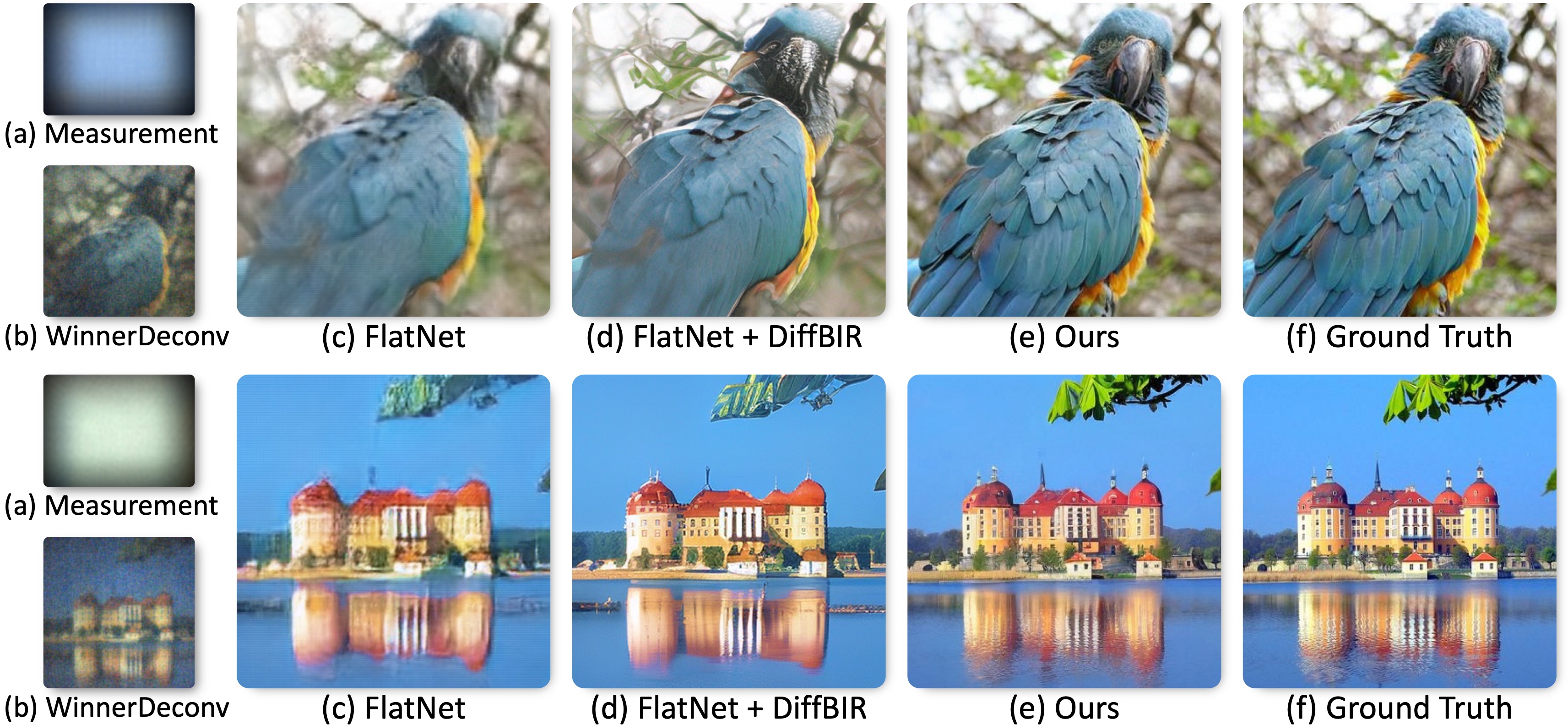
- Results
- Citation
- License
🌟 Introduction
Lensless imaging systems offer advantages in size, cost, and field-of-view, but typically produce low-quality images. PhocoLens addresses this by decomposing the reconstruction problem into two domains: the range space (measured signals) and null space (lost information). Our approach delivers photorealistic reconstructions with unprecedented quality for lensless imaging.
🔍 Method Overview
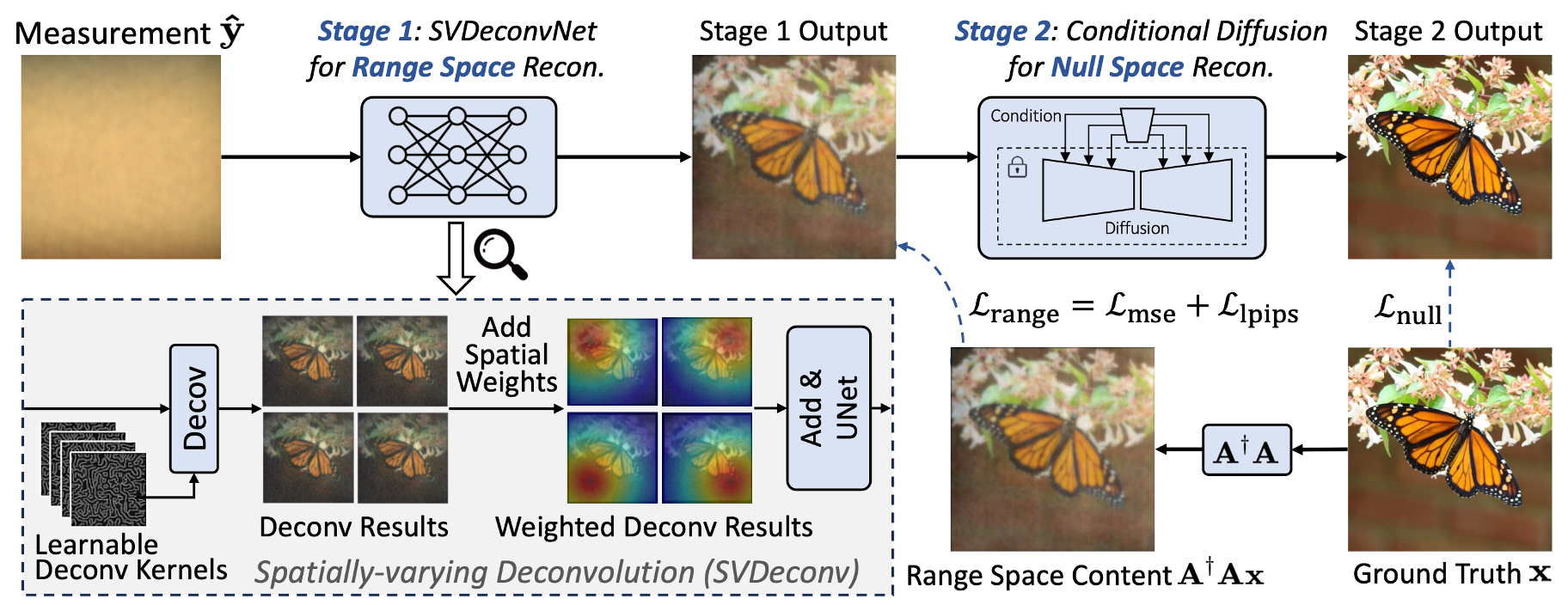
PhocoLens employs a novel two-stage reconstruction pipeline:
-
Range-Null Space Decomposition: We mathematically divide the reconstruction problem into recoverable (range space) and lost (null space) information.
-
Spatially-Varying Deconvolution Network (SVDeconv): Our first stage recovers high-fidelity content from the range space using a specialized deconvolution network.
-
Null Space Content Recovery (NullSpaceDiff): The second stage uses conditional diffusion models to recover lost details while maintaining consistency with first-stage output.
🚀 Getting Started
Prerequisites
- NVIDIA GPU with at least 12GB VRAM (24GB recommended for training)
- CUDA 11.7+
- Python 3.9+
- PyTorch 1.13+
Installation
# Clone the repository
git clone https://github.com/OpenImagingLab/PhoCoLens.git
cd PhoCoLens

# Create conda environment
conda create -n phocolens python=3.9
conda activate phocolens

# Install core dependencies
pip install -r requirements.txt
📥 Data Preparation
PhocoLens supports two lensless imaging datasets:
- PhlatCam: Download Page
- DiffuserCam: Download Page
Expected directory structure:
phocolens
├── data
│   ├── phlatcam
│   │   ├── orig
│   │   ├── phase_psf
│   │   ├── text_files
│   │   └── imagenet_caps_384_12bit_Feb_19
│   └── diffusercam
│       ├── psf.tiff
│       ├── dataset_train.csv
│       ├── dataset_test.csv
│       ├── diffuser_images
│       └── ground_truth_lensed
Preparing PhlatCam Dataset
# Copy ground truth data
python tools/copy_gt.py
🏋️ Training
Stage 1: Range Space Reconstruction (SVDeconv)
Navigate to the SVDeconv directory:
cd SVDeconv

# Create soft links to data
ln -s ../data data


# Generate range space data for training
python tools/decode_and_sim_rgb.py --psf_path data/phlatcam/phase_psf/psf.npy \
    --obj_path data/phlatcam/flatnet/train/gts \
    --save_path data/phlatcam/train/decoded_sim_captures

# Generate range space data for validation
python tools/decode_and_sim_rgb.py --psf_path data/phlatcam/phase_psf/psf.npy \
    --obj_path data/phlatcam/train/gts \
    --save_path data/phlatcam/val/decoded_sim_captures
Single-GPU Training
# Train with default configuration
python train.py with ours_meas_1280_1408_decoded_sim_svd -p
Multi-GPU Training
# Train with 8 GPUs
python -m torch.distributed.launch --nproc_per_node=8 --use_env \
    train.py with ours_meas_1280_1408_decoded_sim_svd distdataparallel=True -p
You can modify training parameters in config.py.
Process Intermediate Results
After Stage 1 training, generate inputs for Stage 2:
python val.py with ours_meas_1280_1408_decoded_sim_svd -p
python val.py with ours_meas_1280_1408_decoded_sim_svd infer_train -p
cd ..
python tools/data_process.py
Stage 2: Null Space Recovery (NullSpaceDiff)
cd NullSpaceDiff
Download the StableSR pre-trained model to the ckpts folder first.
# Multi-GPU Training
python main.py --train \
    --base configs/NullSpaceDiff/phlatcam_decoded_sim_multi_T_512.yaml \
    --gpus 0,1,2,3,4,5,6,7, \
    --name svd_nullspace_diff
🧪 Inference
Stage 1 (SVDeconv)
cd SVDeconv
python val.py with ours_meas_1280_1408_decoded_sim_svd -p
Stage 2 (NullSpaceDiff)
cd NullSpaceDiff
python ./scripts/sr_val_ddpm_lensless.py \
    --init-img path/to/stage1/output \
    --outdir path/to/save/results \
    --ckpt path/to/trained/model \
    --n_samples 5 \
    --ddpm_steps 200
📜 Citation
If you find our work useful in your research, please consider citing:
@article{cai2024phocolens,
  title={Phocolens: Photorealistic and consistent reconstruction in lensless imaging},
  author={Cai, Xin and You, Zhiyuan and Zhang, Hailong and Gu, Jinwei and Liu, Wentao and Xue, Tianfan},
  journal={Advances in Neural Information Processing Systems},
  volume={37},
  pages={12219--12242},
  year={2024}
}
📄 License
This project is licensed under the MIT License - see the LICENSE file for details.
Contributors

10 commits
Similar repos


Languages
Python
100.0%
PhoCoLens: Photorealistic and Consistent Reconstruction in Lensless Imaging
Python
34
10 commits
updated Mar 29, 2025
README
PhocoLens: Photorealistic and Consistent Reconstruction in Lensless Imaging
Official PyTorch implementation of the NeurIPS 2024 paper "PhocoLens: Photorealistic and Consistent Reconstruction in Lensless Imaging"
📌 Table of Contents
- Introduction
- Method Overview
- Getting Started
- Data Preparation
- Training
- Inference
- Results
- Citation
- License
🌟 Introduction
Lensless imaging systems offer advantages in size, cost, and field-of-view, but typically produce low-quality images. PhocoLens addresses this by decomposing the reconstruction problem into two domains: the range space (measured signals) and null space (lost information). Our approach delivers photorealistic reconstructions with unprecedented quality for lensless imaging.
🔍 Method Overview
PhocoLens employs a novel two-stage reconstruction pipeline:
-
Range-Null Space Decomposition: We mathematically divide the reconstruction problem into recoverable (range space) and lost (null space) information.
-
Spatially-Varying Deconvolution Network (SVDeconv): Our first stage recovers high-fidelity content from the range space using a specialized deconvolution network.
-
Null Space Content Recovery (NullSpaceDiff): The second stage uses conditional diffusion models to recover lost details while maintaining consistency with first-stage output.
🚀 Getting Started
Prerequisites
- NVIDIA GPU with at least 12GB VRAM (24GB recommended for training)
- CUDA 11.7+
- Python 3.9+
- PyTorch 1.13+
Installation
# Clone the repository
git clone https://github.com/OpenImagingLab/PhoCoLens.git
cd PhoCoLens

# Create conda environment
conda create -n phocolens python=3.9
conda activate phocolens

# Install core dependencies
pip install -r requirements.txt
📥 Data Preparation
PhocoLens supports two lensless imaging datasets:
- PhlatCam: Download Page
- DiffuserCam: Download Page
Expected directory structure:
phocolens
├── data
│   ├── phlatcam
│   │   ├── orig
│   │   ├── phase_psf
│   │   ├── text_files
│   │   └── imagenet_caps_384_12bit_Feb_19
│   └── diffusercam
│       ├── psf.tiff
│       ├── dataset_train.csv
│       ├── dataset_test.csv
│       ├── diffuser_images
│       └── ground_truth_lensed
Preparing PhlatCam Dataset
# Copy ground truth data
python tools/copy_gt.py
🏋️ Training
Stage 1: Range Space Reconstruction (SVDeconv)
Navigate to the SVDeconv directory:
cd SVDeconv

# Create soft links to data
ln -s ../data data


# Generate range space data for training
python tools/decode_and_sim_rgb.py --psf_path data/phlatcam/phase_psf/psf.npy \
    --obj_path data/phlatcam/flatnet/train/gts \
    --save_path data/phlatcam/train/decoded_sim_captures

# Generate range space data for validation
python tools/decode_and_sim_rgb.py --psf_path data/phlatcam/phase_psf/psf.npy \
    --obj_path data/phlatcam/train/gts \
    --save_path data/phlatcam/val/decoded_sim_captures
Single-GPU Training
# Train with default configuration
python train.py with ours_meas_1280_1408_decoded_sim_svd -p
Multi-GPU Training
# Train with 8 GPUs
python -m torch.distributed.launch --nproc_per_node=8 --use_env \
    train.py with ours_meas_1280_1408_decoded_sim_svd distdataparallel=True -p
You can modify training parameters in config.py.
Process Intermediate Results
After Stage 1 training, generate inputs for Stage 2:
python val.py with ours_meas_1280_1408_decoded_sim_svd -p
python val.py with ours_meas_1280_1408_decoded_sim_svd infer_train -p
cd ..
python tools/data_process.py
Stage 2: Null Space Recovery (NullSpaceDiff)
cd NullSpaceDiff
Download the StableSR pre-trained model to the ckpts folder first.
# Multi-GPU Training
python main.py --train \
    --base configs/NullSpaceDiff/phlatcam_decoded_sim_multi_T_512.yaml \
    --gpus 0,1,2,3,4,5,6,7, \
    --name svd_nullspace_diff
🧪 Inference
Stage 1 (SVDeconv)
cd SVDeconv
python val.py with ours_meas_1280_1408_decoded_sim_svd -p
Stage 2 (NullSpaceDiff)
cd NullSpaceDiff
python ./scripts/sr_val_ddpm_lensless.py \
    --init-img path/to/stage1/output \
    --outdir path/to/save/results \
    --ckpt path/to/trained/model \
    --n_samples 5 \
    --ddpm_steps 200
📜 Citation
If you find our work useful in your research, please consider citing:
@article{cai2024phocolens,
  title={Phocolens: Photorealistic and consistent reconstruction in lensless imaging},
  author={Cai, Xin and You, Zhiyuan and Zhang, Hailong and Gu, Jinwei and Liu, Wentao and Xue, Tianfan},
  journal={Advances in Neural Information Processing Systems},
  volume={37},
  pages={12219--12242},
  year={2024}
}
📄 License
This project is licensed under the MIT License - see the LICENSE file for details.
Similar repos
Contributors
10 commits
Languages
Python
100.0%