
README
🚀 MathQ-Verify
🔥 News
- 📁 The ValiMath dataset has been released for research use.
- 🧩 The source code is now available for the research community!
🌟 Overview
Large Language Models (LLMs) often generate math problems with hidden flaws, such as contradictions or missing premises. To address this issue, we propose MathQ-Verify, a five-stage pipeline designed to rigorously filter ill-posed math questions and improve the overall quality of math datasets.
🔍 Key Contributions
-
MathQ-Verify Framework
- Detects various types of errors in math problems: contaminated instructions, linguistic errors, atomic condition flaws, logical contradictions, and completeness gaps.
- Achieves 90% precision and 63% recall using lightweight model voting strategies.
-
ValiMath Benchmark 📊
- Contains 2,147 math questions with fine-grained stepwise validity labels across 5 error categories.
-
Comprehensive Evaluation 📈
- Outperforms baseline methods by +15% in F1 score on the ValiMath benchmark.
- Ablation studies demonstrate the effectiveness of each verification stage.
🧩 Framework
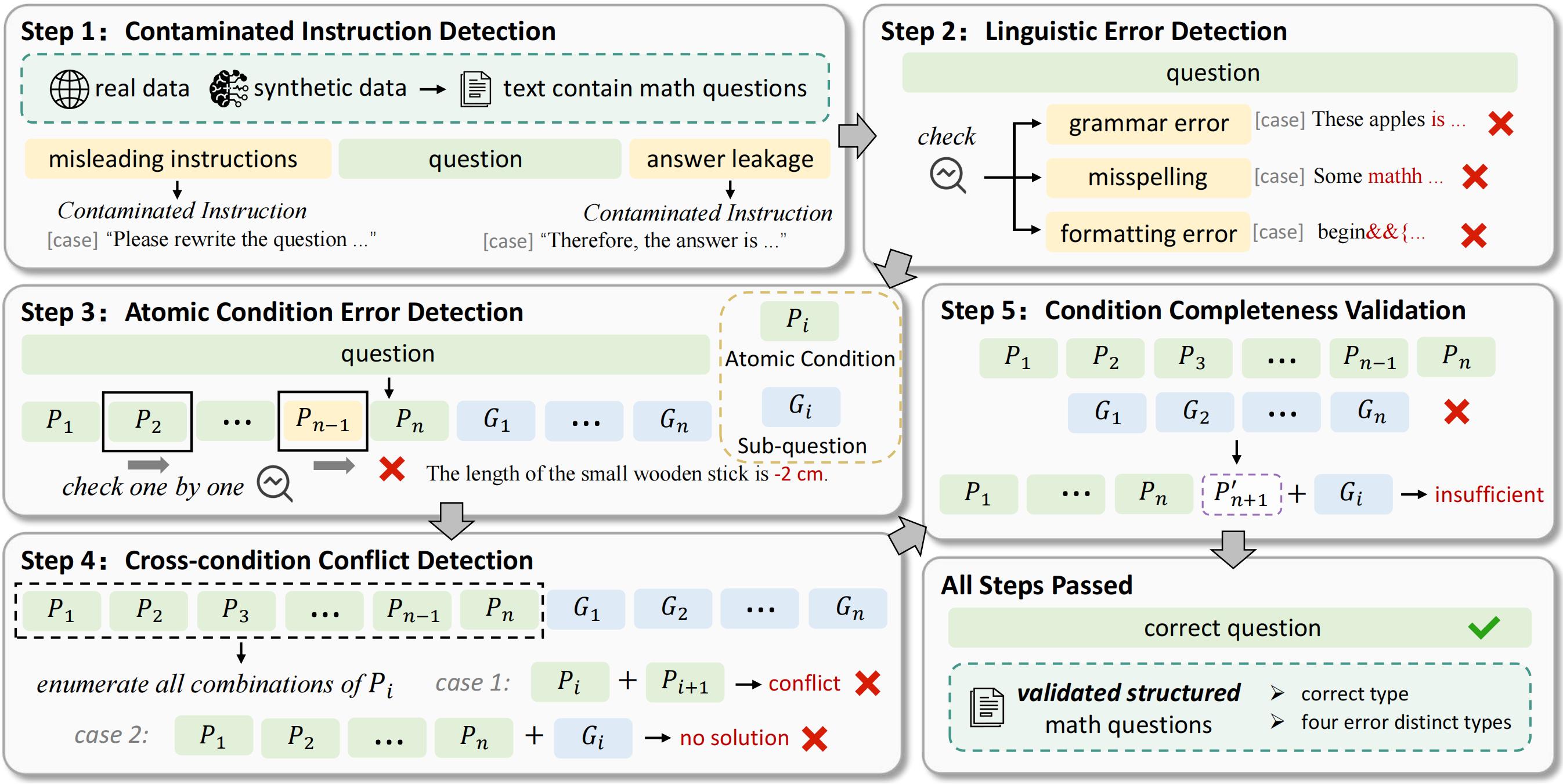
📦 Dataset Overview
We provide a high-quality dataset for evaluating math question validity. It includes:
- 2,147 math problems in total (split into correct and incorrect subsets).
- Each problem is annotated with step-by-step validity labels.
- Supports detailed analysis of error types such as contradictions, incompleteness, and domain mismatches.
🛠️ Installation
# Clone the repository
git clone https://github.com/your-username/MathQ-Verify.git
cd MathQ-Verify

# Install dependencies
pip install -r requirements.txt
🚀 Quick Start Guide
1. Dataset Exploration
The ValiMath dataset is provided in JSONL format with each entry containing:
- Question text
- Validity labels for each verification step
- Category and difficulty information
# View dataset statistics
python src/draw/distribution.py
2. Running the Verification Pipeline
The verification pipeline consists of 5 sequential steps:
# Step 0: Check if the input is a proper math problem
python src/verification/step0.py --input path/to/your/questions.json --output results/step0_results.json

# Step 1: Check for linguistic errors
python src/verification/step1.py --input results/step0_results.json --output results/step1_results.json

# Step 2: Check for atomic condition flaws
python src/verification/step2.py --input results/step1_results.json --output results/step2_results.json

# Step 3: Check for logical contradictions
python src/verification/step3.py --input results/step2_results.json --output results/step3_results.json

# Step 4: Check for completeness
python src/verification/step4.py --input results/step3_results.json --output results/step4_results.json
3. Classifying Your Math Questions
# Classify by category
python src/classification/category.py --input path/to/your/questions.json --output results/category_results.json

# Classify by difficulty
python src/classification/difficulty.py --input path/to/your/questions.json --output results/difficulty_results.json
4. Evaluating Results
# Calculate metrics for a single verification step
python src/eval/metrics.py --input results/step4_results.json

# Merge results from all steps and apply voting
python src/eval/merge_result.py --input_dir results/ --output results/merged_results.json
python src/eval/voting.py --input results/merged_results.json --output results/final_results.json

# Calculate metrics across multiple files
python src/eval/multifile_metrics.py --input_dir results/
📋 Input Format
Your input file should be a JSON or JSONL file with each entry containing at least:
{
  "question_no": 1,
  "question": "Your math question text here"
}
🔧 Customization
- Modify the API settings in each verification step file to use your preferred LLM.
- Adjust the prompts in each step to fit your specific requirements.
- Configure voting strategies in
src/eval/voting.pyto optimize for precision or recall.
📚 Citation
If you find our work useful in your research, please cite:
@misc{shen2025letsverifymathquestions,
      title={Let's Verify Math Questions Step by Step},
      author={Chengyu Shen and Zhen Hao Wong and Runming He and Hao Liang and Meiyi Qiang and Zimo Meng and Zhengyang Zhao and Bohan Zeng and Zhengzhou Zhu and Bin Cui and Wentao Zhang},
      year={2025},
      eprint={2505.13903},
      archivePrefix={arXiv},
      primaryClass={cs.CL},
      url={https://arxiv.org/abs/2505.13903},
}
✅ Note: Some features may be updated as we continue to improve the codebase. Please check for updates regularly.
Contributors

13 commits
Similar repos


Languages
Python
100.0%
README
🚀 MathQ-Verify
🔥 News
- 📁 The ValiMath dataset has been released for research use.
- 🧩 The source code is now available for the research community!
🌟 Overview
Large Language Models (LLMs) often generate math problems with hidden flaws, such as contradictions or missing premises. To address this issue, we propose MathQ-Verify, a five-stage pipeline designed to rigorously filter ill-posed math questions and improve the overall quality of math datasets.
🔍 Key Contributions
-
MathQ-Verify Framework
- Detects various types of errors in math problems: contaminated instructions, linguistic errors, atomic condition flaws, logical contradictions, and completeness gaps.
- Achieves 90% precision and 63% recall using lightweight model voting strategies.
-
ValiMath Benchmark 📊
- Contains 2,147 math questions with fine-grained stepwise validity labels across 5 error categories.
-
Comprehensive Evaluation 📈
- Outperforms baseline methods by +15% in F1 score on the ValiMath benchmark.
- Ablation studies demonstrate the effectiveness of each verification stage.
🧩 Framework
📦 Dataset Overview
We provide a high-quality dataset for evaluating math question validity. It includes:
- 2,147 math problems in total (split into correct and incorrect subsets).
- Each problem is annotated with step-by-step validity labels.
- Supports detailed analysis of error types such as contradictions, incompleteness, and domain mismatches.
🛠️ Installation
# Clone the repository
git clone https://github.com/your-username/MathQ-Verify.git
cd MathQ-Verify

# Install dependencies
pip install -r requirements.txt
🚀 Quick Start Guide
1. Dataset Exploration
The ValiMath dataset is provided in JSONL format with each entry containing:
- Question text
- Validity labels for each verification step
- Category and difficulty information
# View dataset statistics
python src/draw/distribution.py
2. Running the Verification Pipeline
The verification pipeline consists of 5 sequential steps:
# Step 0: Check if the input is a proper math problem
python src/verification/step0.py --input path/to/your/questions.json --output results/step0_results.json

# Step 1: Check for linguistic errors
python src/verification/step1.py --input results/step0_results.json --output results/step1_results.json

# Step 2: Check for atomic condition flaws
python src/verification/step2.py --input results/step1_results.json --output results/step2_results.json

# Step 3: Check for logical contradictions
python src/verification/step3.py --input results/step2_results.json --output results/step3_results.json

# Step 4: Check for completeness
python src/verification/step4.py --input results/step3_results.json --output results/step4_results.json
3. Classifying Your Math Questions
# Classify by category
python src/classification/category.py --input path/to/your/questions.json --output results/category_results.json

# Classify by difficulty
python src/classification/difficulty.py --input path/to/your/questions.json --output results/difficulty_results.json
4. Evaluating Results
# Calculate metrics for a single verification step
python src/eval/metrics.py --input results/step4_results.json

# Merge results from all steps and apply voting
python src/eval/merge_result.py --input_dir results/ --output results/merged_results.json
python src/eval/voting.py --input results/merged_results.json --output results/final_results.json

# Calculate metrics across multiple files
python src/eval/multifile_metrics.py --input_dir results/
📋 Input Format
Your input file should be a JSON or JSONL file with each entry containing at least:
{
  "question_no": 1,
  "question": "Your math question text here"
}
🔧 Customization
- Modify the API settings in each verification step file to use your preferred LLM.
- Adjust the prompts in each step to fit your specific requirements.
- Configure voting strategies in
src/eval/voting.pyto optimize for precision or recall.
📚 Citation
If you find our work useful in your research, please cite:
@misc{shen2025letsverifymathquestions,
      title={Let's Verify Math Questions Step by Step},
      author={Chengyu Shen and Zhen Hao Wong and Runming He and Hao Liang and Meiyi Qiang and Zimo Meng and Zhengyang Zhao and Bohan Zeng and Zhengzhou Zhu and Bin Cui and Wentao Zhang},
      year={2025},
      eprint={2505.13903},
      archivePrefix={arXiv},
      primaryClass={cs.CL},
      url={https://arxiv.org/abs/2505.13903},
}
✅ Note: Some features may be updated as we continue to improve the codebase. Please check for updates regularly.
Similar repos
Contributors
13 commits
Languages
Python
100.0%