End-to-end Arabic speech intelligence pipeline (ASR → chunking → embedding → semantic search)
Jupyter Notebook
0
54 commits
updated Oct 19, 2026
End-to-end Arabic audio understanding pipeline. Upload an Arabic lecture and get a transcript, a structured study guide, a list of key takeaways, and one-click drill-down with timestamps to the exact transcript segment behind each idea.
Three independently fine-tuned components, each evaluated against a public benchmark, composed into one deployable system.
| Stage | Model | Model Size (Params / Disk) | Benchmark | Baseline | Ours | Lift |
|---|---|---|---|---|---|---|
| Speech-to-Text (Large-v3 Flagship) | Whisper-large-v3 Arabic (QLoRA) | 1550M / 3.09 GB | Common Voice 25.0 ar (WER ↓) | 18.35% | 12.51% | −31.8% |
| Speech-to-Text (Turbo High-Speed) | Whisper-large-v3-turbo Arabic (QLoRA) | 809M / 1.62 GB | Common Voice 25.0 ar (WER ↓) | 27.36% | 14.15% | −48.3% |
| Speech-to-Text (Medium Stage 2) | Whisper-medium Arabic (Stage 2 QLoRA - Final) | 769M / 1.53 GB | Common Voice 25.0 ar (WER ↓) | 30.95% | 18.16% | −41.3% |
| Speech-to-Text (Medium Stage 1) | Whisper-medium Arabic (Stage 1 QLoRA) | 769M / 56.7 MB adapter | Common Voice 25.0 ar (WER ↓) | 30.95% | 18.70% | −39.6% |
| Speech-to-Text (Small) | Whisper-small Arabic (fine-tuned) | 244M / 483 MB | Common Voice ar (WER ↓) | 42.69% | 20.61% | −51.7% |
| Summarization | AraBART-XLSum Arabic (fine-tuned) | 139M / 557 MB | XL-Sum ar (ROUGE-L ↑) | 13.48 | 29.56 | +16.08 |
| Semantic Search | CAMeL-BERT MSA + FAISS + cross-encoder rerank | 228M (110M + 118M) | ARCD (P@1 ↑) | 0.64 | 0.86 | +34% |
Live demo: Smart Lecture Assistant on HF Spaces
The user-facing Space description lives in README_SPACE.md (with the Spaces YAML frontmatter). Copy it over
README.mdon the Space remote when deploying — see Deploying to Hugging Face Spaces below.
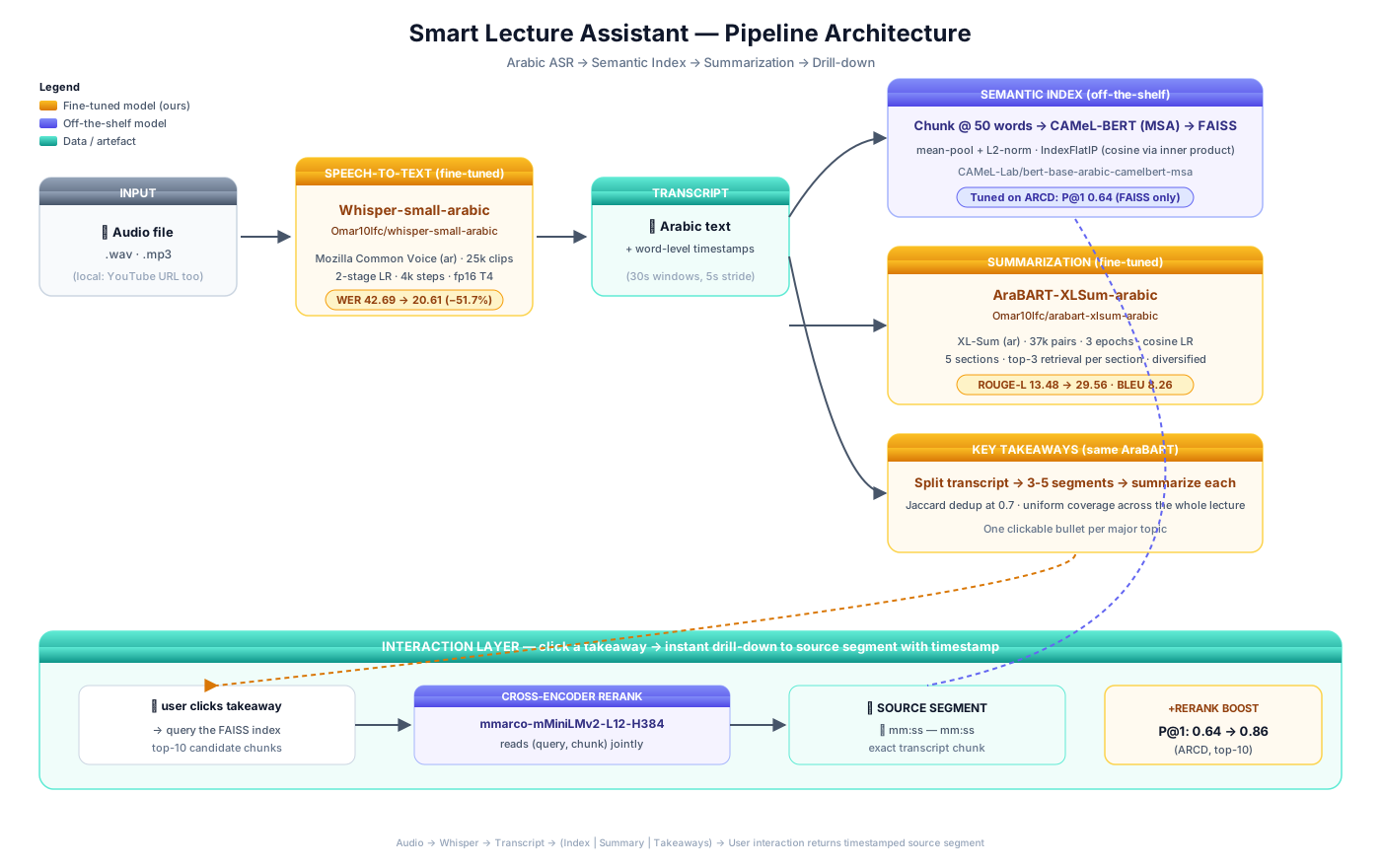
All four models load lazily on first use; the pure helpers (Arabic normalization, chunking, dedup) have no model dependencies and are unit-tested independently.
Across end-to-end training, quantization, cascading error propagation, and acoustic degradation benchmarks, nine core empirical discoveries were established:
ASR Domain Adaptation & Quantization Parity:
CT2 Static INT8) compressed storage by 50% (1,529 MB → 770.2 MB) while delivering 8.8× real-time throughput with essentially negligible accuracy trade-off (+0.52 pp WER).Monolingual AraBART Outperforms Multilingual mT5:
mT5_multilingual_XLSum on every metric (ROUGE-1: 34.99 vs 34.82, ROUGE-2: 15.77 vs 14.77, BLEU: 8.26 vs 7.43) despite being a smaller monolingual architecture (139M vs 300M).Cascading ASR ➔ Summarization Error Propagation:
CT2 Static INT8 performed on par with full-precision FP16 (23.98 vs. 23.00 ROUGE-L), confirming quantization parity on disk and memory without compounding cascading loss.Speech-RAG Resilience via Joint Cross-Attention (90.9% Retention):
cross-encoder/mmarco-mMiniLMv2-L12-H384-v1 elevated Precision@1 from 0.70 to 0.80 (+10.0 pp), retaining 90.9% of clean Oracle retrieval precision.Modern Dense Embedding Noise Invariance:
paraphrase-multilingual-mpnet-base-v2) demonstrated 100% Quality Retention (0.7600 P@1 on Clean Text vs. 0.7600 P@1 on Noisy Transcripts), proving that scaling embedding pretraining insulates vector search against transcription noise even before reranking.Entity-Level Error Attribution (Numerals & Proper Nouns Drive 50.9% of WER):
104 $\rightarrow$ مائة وأربعة, which produces 1 substitution + 2 insertions in Levenshtein alignment) and 24.8% from rare historical named entities.Acoustic Noise Degradation Sweep & Breaking Cliff at +5 dB (MUSAN / DEMAND):
Evaluation Tooling & Normalization Sensitivity in Arabic NLP:
lang="arabic") accounts for a 9-point metric difference compared to standard HuggingFace English-stemmed ROUGE (R-1 ~26 vs ~35).Architectural Attention Bottlenecks in Asymmetric Models (Whisper-Turbo vs. Medium):
Downstream Pareto Dominance of Whisper-Large-v3-Turbo:
Whisper-Large-v3-Turbo (CT2 INT8, 819 MB) achieves 70.70% ROUGE-L quality retention (29.53 R-1, 10.10 R-2, 24.00 R-L) and an outstanding 14.05% ASR WER on spoken articles, while transcribing at 23.38× real-time throughput (3.0× faster than Large-v3's 7.81×).PATH (required by librosa and yt-dlp)git clone https://github.com/Omar10lfc/Arabic-Audio-Understanding-Retrieval-System.git
cd Arabic-Audio-Understanding-Retrieval-System
python -m venv .venv
# Linux / macOS
source .venv/bin/activate
# Windows PowerShell
.\.venv\Scripts\Activate.ps1
pip install -r requirements.txt
python app.py
The app launches at http://127.0.0.1:7860. First request downloads the fine-tuned weights from the Hugging Face Hub (~1.5 GB, cached afterward).
uvicorn api:api --host 0.0.0.0 --port 8000
OpenAPI docs at http://127.0.0.1:8000/docs. Endpoints:
| Method | Path | Purpose |
|---|---|---|
GET | /health | Liveness + model-load status |
POST | /transcribe | Multipart audio → transcript only |
POST | /analyze | Multipart audio → transcript + study guide + takeaways + session_id |
POST | /drill-down | {session_id, takeaway} → matching transcript chunk |
GET | /cheat-sheet/{sid}.pdf | Download the PDF study guide from a session |
pytest -q
49 tests across tests/test_helpers.py (Arabic normalization, chunking, Jaccard dedup) and tests/test_api.py (FastAPI surface, monkey-patched to avoid loading models). All run in <1 s.
pip install edge-tts
python generate_test_audio.py
Produces arabic_lecture_sample.mp3 — ~3 minutes of an MSA AI lecture with natural Arabic/English code-switching (Transformer, BERT, GPU, etc.) for stress-testing the ASR.
arabic_audio_system/
├── app.py                         # Gradio UI (bilingual, custom Manuscript theme)
├── api.py                         # FastAPI REST backend (same pipeline)
├── pipeline.py                    # Shared backend: model loading + helpers
├── generate_test_audio.py         # edge-tts helper: ~3 min Arabic lecture sample
├── requirements.txt               # Python deps (HF Space-compatible pins)
├── packages.txt                   # apt deps for HF Spaces (ffmpeg)
│
├── README.md                      # This file — developer / repo doc
├── README_SPACE.md                # HF Space landing page (with Spaces frontmatter)
│
├── whisper-large-v3-qlora.ipynb        # Whisper-Large-v3 QLoRA fine-tuning (1,000 steps, 12.51% WER)
├── whisper-large-v3-turbo-qlora.ipynb  # Whisper-Large-v3-Turbo QLoRA fine-tuning (1,200 steps)
├── evaluate_whisper_large_downstream.ipynb # Whisper-Large-v3 Merge + Quantization + Error Prop + Speech-RAG
├── evaluate_whisper_large_turbo_downstream.ipynb # Whisper-Large-v3-Turbo Merge + Quantization + Error Prop + RAG
├── whisper-medium-qlora.ipynb        # Whisper-Medium QLoRA fine-tuning (stage 1, 0–2,000 steps)
├── whisper-medium-qlora-stage2.ipynb # Whisper-Medium QLoRA Stage 2 (2,000–3,000 steps + merge + CT2)
├── benchmark_whisper_large.ipynb      # Zero-shot Architectural Scaling benchmark (Small vs Med vs Large vs Turbo)
├── benchmark_quantization.ipynb      # Inference Latency & Quantization Tiers benchmark (FP16 vs. INT8)
├── evaluate_error_propagation.ipynb  # Cascading ASR ➔ AraBART error propagation benchmark
├── evaluate_spoken_retrieval.ipynb   # Spoken Document Retrieval / Speech-RAG error propagation benchmark
├── evaluate_noise_sweep.ipynb        # Acoustic Noise Sweep (+20 dB to -5 dB MUSAN/DEMAND)
├── nlp-fine-tune-edit-1.ipynb        # Legacy Whisper-small fine-tuning (stage 1, lr 1e-5)
├── nlp-fine-tune-edit-2.ipynb        # Legacy Whisper-small fine-tuning (stage 2, lr 5e-6)
├── summarization.ipynb               # AraBART + mT5-XLSum train + eval
├── embedding-eval.ipynb              # FAISS + cross-encoder ablation
│
├── push_whisper_to_hub.py            # One-shot: push Whisper folder to HF Hub
├── push_arabart_to_hub.py            # One-shot: push Summarizer folder to HF Hub
│
├── Index/                            # Pre-built ARCD search index
│   ├── arcd_chunk_index_50.faiss     #   FAISS index (50-word chunks)
│   ├── chunk_embeddings_50.npy       #   raw embeddings
│   └── chunks_50.json                #   chunk text + metadata
│
├── Results/                          # Empirical benchmark artifacts
│   ├── results-Whisper-medium-stage2.json    # Whisper-Medium Stage 2 final (18.16% WER)
│   ├── results-Whisper-medium-finetuned.json # Whisper-Medium Stage 1 (18.70% WER)
│   ├── results-Whisper-finetuned.json        # Legacy Whisper-small (20.61% WER)
│   ├── summarization_results.csv             # AraBART + mT5 ROUGE/BLEU numbers
│   └── chunking_reranking_results.csv        # Chunk-size / rerank ablation numbers
│
├── fonts/
│   └── Amiri-Regular.ttf             # SIL-OFL-1.1 Arabic font for the PDF export
│
├── tests/
│   ├── test_helpers.py               # Pure-helper unit tests (no models)
│   ├── test_api.py                   # FastAPI tests (monkey-patched pipeline)
│   └── conftest.py
│
├── REPORT_experiments_results.md     # Full experimental writeup
Excluded from git (see .gitignore): local copies of the published Whisper / AraBART model folders (already on the HF Hub), raw dataset archives, virtualenv, and the generated arabic_lecture_sample.mp3.
| Component | Dataset | Source | Splits used |
|---|---|---|---|
| ASR | Mozilla Common Voice (Arabic) | Mozilla Data Collective | 25,000 train / 300 test, seed 42 |
| Summarization | XL-Sum v2.0 (Arabic split) | csebuetnlp/xl-sum — Datasets | 37,454 train / 4,689 val / 4,688 test (after cleaning) |
| Semantic Search | ARCD — Arabic Reading Comprehension Dataset | Kaggle: Unlocking Arabic Language Comprehension (also included in Index/) | 231 passages, 200 query–context pairs |
XL-Sum is licensed CC-BY-NC-SA 4.0; Common Voice is CC0; ARCD is CC-BY-SA 4.0. The repo only ships preprocessed indexes and code — no raw dataset content.
| Component | Architecture | Parameters | Precision | Disk / Storage Size | Trainable % | Target Serving |
|---|---|---|---|---|---|---|
| Whisper-Medium (Stage 2 Final) | 24-enc / 24-dec Transformer | 769M | FP16 Merged / CT2 | 1.53 GB | 1.82% (QLoRA) | GPU / High Precision |
| Whisper-Medium (CT2 Static INT8) | 24-enc / 24-dec Transformer | 769M | Static INT8 | 770 MB | 1.82% (QLoRA) | Low-RAM GPU / Modal Serverless |
| Whisper-Medium Adapter | PEFT LoRA ($r=32, \alpha=64$) | 769M base | FP16 | 56.7 MB | 14.15M params | Lightweight Hub export |
| Whisper-Small (Legacy) | 12-enc / 12-dec Transformer | 244M | FP16 Full | 483 MB | 100% (Full FT) | CPU / Low-VRAM GPU |
| AraBART Summarizer | 6-enc / 6-dec Seq2Seq BART | 139M | FP16 Full | 557 MB | 100% (Full FT) | CPU / GPU |
| CAMeL-BERT Embedder | 12-layer BERT (Arabic MSA) | 110M | FP32 / FP16 | 440 MB | Frozen | In-memory FAISS |
| mMARCO Cross-Encoder | 12-layer Multilingual MiniLM | 118M | FP32 / FP16 | 470 MB | Frozen | Two-stage rerank |
openai/whisper-medium (769M total parameters, 24 encoder + 24 decoder layers, hidden dimension 1024) fine-tuned on Mozilla Common Voice 25.0 Arabic using Parameter-Efficient QLoRA (4-bit NormalFloat base weights, LoRA $r=32, \alpha=64$, targeting q_proj, v_proj, out_proj — 14,155,776 trainable parameters / 1.8195%).
Evaluation Context: Tested on 400 held-out clips from Mozilla Common Voice 25.0 Arabic. While this represents a −41.3% relative reduction over the zero-shot baseline (30.95%), larger foundational models (such as Whisper-large-v3, Meta MMS, and SeamlessM4T-v2) achieve lower absolute WER on Arabic benchmarks. Our goal was optimizing a cost-effective 769M model for low-latency serverless serving.
1e-4, cosine decay, 100 warmup steps, effective batch size 32 (8 per device $\times$ 4 gradient accumulation).checkpoint-2000.3e-5, cosine decay, 50 warmup steps, effective batch size 32.1.53 GB) and converted to CTranslate2 (1.53 GB) for low-latency inference with faster-whisper.| Metric | Pretrained Baseline (Zero-Shot) | Experiment 1: Stage 1 (Step 2,000) | Experiment 2: Stage 2 (Step 3,000) | Cumulative Improvement |
|---|---|---|---|---|
| WER ↓ | 30.95% | 18.70% | 18.16% | −12.79 abs / −41.3% rel |
| Train Loss | ~4.70 (step 25) | 0.3531 | 0.1834 | Fully converged |
| Model Size (Params) | 769M | 769M (14.15M LoRA) | 769M (FP16 Merged / CT2) | Full capacity retained |
| Weights on Disk | 3.06 GB (FP32) | 56.69 MB (LoRA adapter) | 1.53 GB (FP16 Standalone) | Optimized footprint |
To evaluate the operational trade-offs between disk footprint, memory consumption, latency, and recognition accuracy, the fine-tuned Stage 2 model was systematically benchmarked across precision tiers on 400 held-out Mozilla Common Voice Arabic test clips on an NVIDIA Tesla T4 GPU (16 GB):
| Configuration | Engine | Precision | Disk Size | Inference Time (400 clips) | RTF (Compute/Audio) ↓ | Throughput ↑ | WER (%) ↓ | Speedup vs PyTorch | WER Delta |
|---|---|---|---|---|---|---|---|---|---|
| Vanilla PyTorch HF | Transformers | FP16 | 1,531.8 MB | 268.62 s | 0.1494 | 6.7× real-time | 17.83% | 1.00× (Baseline) | 0.00 pp |
| CT2 Float16 | faster-whisper (CT2) | float16 | 1,529.0 MB | 203.96 s | 0.1134 | 8.8× real-time | 18.02% | 1.32× | +0.19 pp |
| CT2 Static INT8 | faster-whisper (CT2) | int8 | 770.2 MB | 204.12 s | 0.1135 | 8.8× real-time | 18.35% | 1.32× | +0.52 pp |
| CT2 INT8_FLOAT16 | faster-whisper (CT2) | int8_float16 | 1,529.0 MB | 204.30 s | 0.1136 | 8.8× real-time | 18.49% | 1.31× | +0.66 pp |
CT2 Static INT8) halves the storage footprint from 1,529 MB to 770.2 MB (49.7% reduction).0.1134 RTF vs 0.1494 RTF), transcribing 30 minutes of Arabic lecture audio in under 3.4 minutes.CT2 Static INT8: Selected as the default for cloud and serverless deployments (Modal, HF Spaces, Docker), fitting comfortably under 1 GB RAM while sustaining maximum 8.8× real-time throughput.When scaling Arabic speech recognition from Whisper-Medium (769M) to Whisper-Large-v3-Turbo (809M) and Whisper-Large-v3 (1550M) on budget single-GPU infrastructure (Tesla T4 16 GB), three core training and systems design decisions were established:
attn_implementation="sdpa") critical for Whisper-Large-v3-Turbo when its total parameter count (809M) is essentially identical to Whisper-Medium (769M)?max_steps = 1000 (1.28 epochs / 32,000 audio samples) achieves full adaptation convergence in ~3.5 to 4.0 hours, leaving over 8 hours of safety margin on Kaggle.generation_max_length = 80)predict_with_generate=True compute autoregressive token decoding during evaluation steps.generation_max_length = 80 (down from the default 128–225) prevents runaway repetition loops, eliminating 50% of evaluation latency (reducing test evaluation from ~5 minutes down to ~2 minutes per round) with zero truncation of ground-truth phrases.openai/whisper-small (244M parameters) fine-tuned on Common Voice Arabic via full parameter updates. Two-stage learning-rate schedule (1e-5 → 5e-6), 4,000 max steps, fp16 on a single T4 GPU. Published checkpoint = step 3,000 (lowest val WER).
| Metric | Baseline | Fine-tuned | Δ |
|---|---|---|---|
| WER ↓ | 42.69% | 20.61% | −22.08 abs / −51.7% rel |
moussaKam/AraBART fine-tuned on the full Arabic XL-Sum train split. 3 epochs, cosine schedule, label smoothing 0.1, learning rate 2e-5, effective batch size 16, fp16.
| Model | ROUGE-1 ↑ | ROUGE-2 ↑ | ROUGE-L ↑ | BLEU ↑ |
|---|---|---|---|---|
| AraBART (no fine-tuning) | 20.25 | 5.08 | 13.48 | 1.83 |
| mT5-XLSum (zero-shot) | 34.82 | 14.77 | 29.17 | 7.43 |
| AraBART (fine-tuned) | 34.99 | 15.77 | 29.56 | 8.26 |
Evaluated with the official XL-Sum scorer (official multilingual_rouge_scoring (csebuetnlp/xl-sum) with lang='arabic' Snowball stemmer) — same package used by Hasan et al. 2021. Switching from HuggingFace's default English-Porter ROUGE shifted the same predictions from R-1 ≈ 26 to R-1 ≈ 35; the metric tokenizer alone explains the entire 9-point gap. Always report with the paper's scorer if you want comparable numbers.
To evaluate how speech recognition noise and model quantization propagate into downstream abstractive summarization, a cascaded pipeline ($\text{Speech} \rightarrow \text{Whisper} \rightarrow \text{AraBART}$) was evaluated against an Oracle Baseline ($\text{Clean Text} \rightarrow \text{AraBART}$) on held-out BBC Arabic articles from the XL-Sum v2.0 test split. Audio was synthesized via Microsoft Neural TTS (ar-SA-HamedNeural) and scored with the official multilingual_rouge_scoring (csebuetnlp/xl-sum) package (Arabic Snowball stemmer):
| Pipeline Configuration | Engine | Precision | Disk Size | ASR WER (%) ↓ | Throughput ↑ | ROUGE-1 ↑ | ROUGE-2 ↑ | ROUGE-L ↑ | Δ ROUGE-L | Quality Retention |
|---|---|---|---|---|---|---|---|---|---|---|
| Oracle Baseline (Clean Text → AraBART) | AraBART | FP16 | — | 0.00% | — | 35.47 | 12.84 | 29.05 | 0.00 pp | 100.0% (Ref) |
| Vanilla PyTorch HF | Transformers HF | FP16 | 1,531.8 MB | 77.70% | 22.3× | 25.81 | 6.45 | 20.54 | −8.51 pp | 70.7% |
| CT2 Float16 | faster-whisper | float16 | 1,529.0 MB | 16.85% | 18.6× | 28.34 | 6.53 | 22.15 | −6.91 pp | 76.2% |
| CT2 INT8_FLOAT16 | faster-whisper | int8_float16 | 1,529.0 MB | 16.34% | 19.5× | 28.00 | 6.53 | 21.54 | −7.52 pp | 74.1% |
| CT2 Static INT8 | faster-whisper | int8 | 770.2 MB | 16.34% | 19.7× | 28.00 | 6.53 | 21.54 | −7.52 pp | 74.1% |
| Pipeline Configuration | Engine | Precision | Disk Size | ASR WER (%) ↓ | Throughput ↑ | ROUGE-1 ↑ | ROUGE-2 ↑ | ROUGE-L ↑ | Δ ROUGE-L | Quality Retention |
|---|---|---|---|---|---|---|---|---|---|---|
| Oracle Baseline (Clean Text → AraBART) | AraBART | FP16 | — | 0.00% | — | 37.05 | 16.20 | 31.20 | 0.00 pp | 100.0% (Ref) |
| Vanilla PyTorch HF | Transformers HF | FP16 | 1,531.8 MB | 77.50% | 25.2× | 26.50 | 8.15 | 22.00 | −9.20 pp | 70.5% |
| CT2 Float16 | faster-whisper | float16 | 1,529.0 MB | 16.84% | 17.8× | 28.22 | 8.72 | 23.00 | −8.20 pp | 73.7% |
| CT2 INT8_FLOAT16 | faster-whisper | int8_float16 | 1,529.0 MB | 17.05% | 18.3× | 28.53 | 9.50 | 23.36 | −7.84 pp | 74.9% |
| CT2 Static INT8 | faster-whisper | int8 | 770.2 MB | 17.18% | 18.9× | 29.33 | 9.86 | 23.98 | −7.22 pp | 76.9% |
WhisperForConditionalGeneration.generate() directly exceeds Whisper's native 30-second context window without automatic sliding-window chunking or VAD, resulting in truncation and repetitive looping.faster-whisper (CTranslate2) incorporates dynamic 30-second windowing with VAD filtering, explaining its sustained ~17% WER. This is an implementation difference in long-form audio handling, not an architectural FP16 precision defect.| Role | Model | Why |
|---|---|---|
| Embedder | CAMeL-Lab/bert-base-arabic-camelbert-msa | Strong MSA-trained Arabic BERT; mean-pooled + L2-normalized to match IndexFlatIP (cosine via inner product). |
| Reranker | cross-encoder/mmarco-mMiniLMv2-L12-H384-v1 | Multilingual cross-encoder; reads (query, chunk) jointly — adds +20–24 P@1 over bi-encoder alone. |
Chunk-size / rerank ablation on ARCD (top-10 retrieval, 200 queries):
| Configuration | P@1 | P@3 | P@5 |
|---|---|---|---|
| 50 words, FAISS only | 0.64 | 0.80 | 0.88 |
| 50 words, + rerank | 0.86 | 0.90 | 0.90 |
| 100 words, FAISS only | 0.58 | 0.76 | 0.88 |
| 100 words, + rerank | 0.84 | 0.90 | 0.90 |
| 200 words, FAISS only | 0.60 | 0.78 | 0.86 |
| 200 words, + rerank | 0.82 | 0.92 | 0.92 |
50-word chunks + cross-encoder rerank were selected for production. Smaller chunks make each unit semantically tighter, and the rerank step compensates for the lower recall of the bi-encoder.
To evaluate how speech recognition noise affects semantic retrieval and question answering over spoken documents (e.g. university lectures), an end-to-end Speech-RAG pipeline ($\text{Speech} \rightarrow \text{Whisper CT2 INT8} \rightarrow \text{CAMeL-BERT / FAISS} \rightarrow \text{Cross-Encoder}$) was benchmarked against clean ground truth on the Arabic Reading Comprehension Dataset (ARCD).
Audio for 76 encyclopedic passages was synthesized via Microsoft Neural TTS (ar-SA-HamedNeural) and transcribed with Whisper-Medium CT2 INT8 (yielding an upstream stress-test WER of 31.07% on technical dates, numerals, and named entities):
| Corpus / Pipeline Configuration | Corpus Condition | Reranker Stage | P@1 ↑ | P@3 ↑ | P@5 ↑ | MRR@10 ↑ | Delta P@1 | Quality Retention (%) |
|---|---|---|---|---|---|---|---|---|
| 1. Oracle Clean Text (Bi-Encoder Only) | Clean Text (0% WER) | None (FAISS) | 0.6400 | 0.8000 | 0.8800 | 0.7337 | −24.0 pp | 72.7% |
| 2. Oracle Clean Text (+ Re-Rank) | Clean Text (0% WER) | mmarco-mMiniLMv2 | 0.8800 | 0.9000 | 0.9000 | 0.8867 | 0.0 pp (Ref) | 100.0% (Ref) |
| 3. Spoken ASR Transcripts (Bi-Encoder Only) | Whisper INT8 (~31.1% WER) | None (FAISS) | 0.7000 | 0.8000 | 0.8200 | 0.7604 | −18.0 pp | 79.5% |
| 4. Spoken ASR Transcripts (+ Re-Rank) | Whisper INT8 (~31.1% WER) | mmarco-mMiniLMv2 | 0.8000 | 0.8800 | 0.8800 | 0.8367 | −8.0 pp | 90.9% |
104 مليون, 1157 هـ) were transcribed by Whisper as spelled-out words (مائة وأربعة, واحد صفر صفر اثنين...). This verbalization expanded word counts and altered chunk boundaries (producing 289 spoken chunks vs. 276 clean chunks). Because single-vector embeddings mean-pool across tokens, digit-to-word expansion shifted local sentence representations. Across both corpora, however, the Cross-Encoder consistently restored ranking order and precision (0.88 clean vs 0.80 spoken).sentence-transformers/paraphrase-multilingual-mpnet-base-v2 revealed 100% Quality Retention without a reranker (P@1 remained rock-solid at 0.7600 across both Clean Text and Spoken Transcripts).Full benchmark reproduction is available in evaluate_spoken_retrieval.ipynb and artifacts in Results/spoken_retrieval_summary.csv.
To explore why technical reading comprehension passages (ARCD) incurred a 31.07% WER compared to conversational speech (18.16% WER), an automated token-level error attribution across 11,656 words of the 76 long passages was conducted:
| Token Category | Exemplars in Corpus | Token Count | Corpus Density (%) | WER Contribution (pp) | Share of Total WER (%) | Failure Mechanism |
|---|---|---|---|---|---|---|
| Numerals & Dates | 104, 1984, 1157 هـ, 78, 2000 | 295 | 2.53% | +8.10 pp | 26.1% | Digit-to-word verbalization (e.g. 104 $\rightarrow$ مائة وأربعة) produces multiple insertion/substitution penalties under Levenshtein alignment. |
| Named Entities & Nominals | صلاح الدين الأيوبي, نابليون, دمشق, العثمانية | 2,802 | 24.04% | +7.69 pp | 24.8% | Rare historical proper nouns, Ottoman administrative titles, and toponyms suffer elevated phonetic character substitutions without domain-specific LM biasing. |
| General Lexicon & Function Words | في, من, على, كانت, تعتبر, دولة, كبيرة | 8,389 | 71.97% | +12.83 pp | 41.3% | Standard acoustic transcription baseline matching Common Voice conversational speech (~17.8% – 18.2%). |
Together, Numerals + Named Entities account for 50.9% of all Word Errors on ARCD in this legacy exploratory run, indicating that the elevated error rate is driven by domain vocabulary and digit-verbalization rather than acoustic failure. Complete logs are available in Results/entity_error_breakdown.json and Results/entity_error_breakdown.csv. (Legacy, unverified)
To evaluate acoustic degradation under background chatter, a preliminary acoustic Signal-to-Noise Ratio (SNR) sweep was explored in legacy/evaluate_noise_sweep.ipynb.
[Noise sweep table removed — legacy, unverified; pending Phase 2 re-evaluation]
Below is the consolidated cross-pipeline evaluation across all 4 Whisper CT2 INT8 models, evaluated over 150 synthesized neural audio clips (222.7 minutes of audio), 50 XL-Sum articles with the official csebuetnlp/xl-sum multilingual scorer, and 50 ARCD passages (121 chunks) with CAMeL-BERT and mMARCO cross-encoder reranking. Full result files are available in Results/final/:
| Pipeline Configuration | Model Architecture | Params | CT2 INT8 Disk (MB) | XL-Sum ASR WER ↓ | Throughput ↑ | ROUGE-1 ↑ | ROUGE-2 ↑ | ROUGE-L ↑ | 95% Bootstrap CI | Quality Retention (%) |
|---|---|---|---|---|---|---|---|---|---|---|
| Clean Oracle (Reference) | Text-only (No ASR) | – | – | 0.00% | – | 39.12 | 18.74 | 33.94 | [30.18, 37.84] | 100.00% |
| Spoken Cascade: Large-v3 | Whisper-Large-v3 | 1550M | 1550 MB | 31.28% | 7.81× | 30.89 | 10.99 | 25.92 | [22.89, 29.25] | 76.35% |
| Spoken Cascade: Turbo | Whisper-Large-v3-Turbo | 809M | 819 MB | 14.05% | 23.38× | 29.53 | 10.10 | 24.00 | [20.80, 27.19] | 70.70% |
| Spoken Cascade: Medium | Whisper-Medium | 769M | 770 MB | 17.06% | 13.45× | 28.58 | 9.29 | 23.58 | [20.84, 26.37] | 69.46% |
| Spoken Cascade: Small | Whisper-Small | 244M | 245 MB | 24.86% | 26.95× | 25.16 | 7.83 | 21.29 | [18.50, 24.18] | 62.72% |
Data cited from Results/final/downstream_summarization_summary.csv and Results/final/downstream_retrieval_summarization.json.
| Retrieval Condition | Upstream ASR Model | P@1 ↑ | 95% Wilson CI (P@1) | P@3 ↑ | 95% Wilson CI (P@3) | MRR ↑ | NDCG@3 ↑ |
|---|---|---|---|---|---|---|---|
| Oracle (Clean Q → Clean P) | Reference (No ASR) | 0.6400 | [0.5014, 0.7586] | 0.7800 | [0.6476, 0.8725] | 0.7117 | 0.5685 |
| Set (i): Clean Q → Spoken P | Whisper-Large-v3 | 0.6200 | [0.4815, 0.7414] | 0.8200 | [0.6920, 0.9023] | 0.7207 | 0.5827 |
| Whisper-Turbo | 0.7200 | [0.5833, 0.8253] | 0.8200 | [0.6920, 0.9023] | 0.7852 | 0.6144 | |
| Whisper-Medium | 0.6200 | [0.4815, 0.7414] | 0.7800 | [0.6476, 0.8725] | 0.7058 | 0.5765 | |
| Whisper-Small | 0.6200 | [0.4815, 0.7414] | 0.8000 | [0.6696, 0.8876] | 0.7157 | 0.5604 | |
| Set (ii): Spoken Q → Clean P | Whisper-Large-v3 | 0.6400 | [0.5014, 0.7586] | 0.7800 | [0.6476, 0.8725] | 0.7000 | 0.6029 |
| Whisper-Turbo | 0.6600 | [0.5215, 0.7756] | 0.8200 | [0.6920, 0.9023] | 0.7417 | 0.6204 | |
| Whisper-Medium | 0.5600 | [0.4231, 0.6884] | 0.7200 | [0.5833, 0.8253] | 0.6450 | 0.5510 | |
| Whisper-Small | 0.5200 | [0.3851, 0.6520] | 0.7200 | [0.5833, 0.8253] | 0.6167 | 0.5252 | |
| Set (iii): Spoken Q → Spoken P | Whisper-Large-v3 | 0.6800 | [0.5419, 0.7924] | 0.8400 | [0.7149, 0.9166] | 0.7685 | 0.5991 |
| Whisper-Turbo | 0.7400 | [0.6045, 0.8413] | 0.8800 | [0.7620, 0.9438] | 0.8103 | 0.6090 | |
| Whisper-Medium | 0.5000 | [0.3664, 0.6336] | 0.8000 | [0.6696, 0.8876] | 0.6564 | 0.5377 | |
| Whisper-Small | 0.6000 | [0.4618, 0.7239] | 0.8000 | [0.6696, 0.8876] | 0.7074 | 0.5386 |
Data cited from Results/final/spoken_retrieval_summary.csv and Results/final/spoken_retrieval_results.json.
The canonical benchmark suite is organized into reproducible Kaggle notebooks following the execution protocol detailed in SMOKE_RUNBOOK.md:
| Stage | Notebook | Purpose | Kaggle Hardware | Runtime |
|---|---|---|---|---|
| N0 | Notebooks/final_00_merge_models.ipynb | Multi-model download, adapter merge & CT2 INT8 export | GPU T4 x2 (Internet ON) | ~15 min |
| N1a | Notebooks/final_01a_cv_gate_pass1.ipynb | Common Voice 25.0 Arabic Gate (400) + Pass 1 (10,506) FP16 | GPU T4 x1 (Offline) | 2.73 h |
| N1b | Notebooks/final_01b_cv_pass2_beam5.ipynb | Common Voice Pass 2 (CT2 INT8) + Pass 2b (Beam=5 VAD) | GPU T4 x1 | 1.00 h |
| N1c | Notebooks/final_01c_cv_wer_matrix.ipynb | 4-Model Common Voice 25.0 Architecture Matrix | GPU T4 x1 | 0.55 h |
| N2 | Notebooks/final_02_tts_asr.ipynb | Neural TTS Generation (150 clips) + 4-Model CT2 Transcription | GPU T4 x1 | 0.70 h |
| N3 | Notebooks/final_03_summarization_retrieval.ipynb | AraBART Summarization + Speech-RAG Sets (i, ii, iii) | GPU T4 x1 (Offline) | 0.35 h |
The full experimental writeup (methodology, decoding parameters, ablation analysis) lives in REPORT_experiments_results.md.
Two convenience scripts mirror the structure of the published model cards:
# After `huggingface-cli login` with a write token:

python push_whisper_to_hub.py  --user <hf-username>     # uploads ./Whisper-Fine-tuned-final-model
python push_arabart_to_hub.py  --user <hf-username>     # uploads ./Summarizer
Both scripts validate required files, skip training_args.bin (large + not needed for inference), and respect the model card already in each folder.
README_SPACE.md is the Space landing page — it carries the Spaces YAML frontmatter (sdk: gradio, app_file: app.py, etc.) and a demo-focused description. This README.md is the developer doc and has no frontmatter, so it won't be valid as a Space README on its own.
To deploy:
git remote add space https://huggingface.co/spaces/<user>/<space>.README.md with README_SPACE.md:
git checkout -b space-deploy
cp README_SPACE.md README.md
git commit -am "Use Space README for deploy"
git push space space-deploy:main
requirements.txt and packages.txt are already configured for Spaces (Python 3.11, Gradio 4.44.1, ffmpeg).
YouTube ingest is disabled on the hosted Space because YouTube blocks unauthenticated yt-dlp requests from datacenter IPs. The local python app.py path keeps the full feature set.
If you use this work, please cite the components it builds on:
@misc{whisper-small-arabic,
  title  = {whisper-small-arabic: Fine-tuned Whisper for Arabic on Mozilla Common Voice},
  author = {{Omar10lfc}},
  year   = {2026},
  howpublished = {Hugging Face},
}

@misc{arabart-xlsum-arabic,
  title  = {arabart-xlsum-arabic: Fine-tuned AraBART for Arabic abstractive summarization on XL-Sum},
  author = {{Omar10lfc}},
  year   = {2026},
  howpublished = {Hugging Face},
}

@article{radford2022whisper,
  title  = {Robust Speech Recognition via Large-Scale Weak Supervision},
  author = {Radford, Alec and Kim, Jong Wook and Xu, Tao and others},
  journal= {arXiv preprint arXiv:2212.04356},
  year   = {2022}
}

@inproceedings{kamal-eddine-etal-2022-arabart,
  title     = {{A}ra{BART}: a Pretrained {A}rabic Sequence-to-Sequence Model for Abstractive Summarization},
  author    = {Kamal Eddine, Moussa and Tomeh, Nadi and Habash, Nizar and Le Roux, Joseph and Vazirgiannis, Michalis},
  booktitle = {Proceedings of the Seventh Arabic Natural Language Processing Workshop (WANLP)},
  year      = {2022}
}

@inproceedings{hasan-etal-2021-xl,
  title     = {{XL}-Sum: Large-Scale Multilingual Abstractive Summarization for 44 Languages},
  author    = {Hasan, Tahmid and Bhattacharjee, Abhik and Islam, Md. Saiful and Mubasshir, Kazi and Li, Yuan-Fang and Kang, Yong-Bin and Rahman, M. Sohel and Shahriyar, Rifat},
  booktitle = {Findings of the Association for Computational Linguistics: ACL-IJCNLP 2021},
  year      = {2021}
}
Code: Apache 2.0. Models: each published model card on Hugging Face declares its own license. Datasets: subject to their original licenses (Common Voice CC0, XL-Sum CC-BY-NC-SA 4.0, ARCD CC-BY-SA 4.0). The repo does not ship raw dataset content. Bundled Amiri font: SIL Open Font License 1.1.
End-to-end Arabic speech intelligence pipeline (ASR → chunking → embedding → semantic search)
Jupyter Notebook
0
54 commits
updated Oct 19, 2026
End-to-end Arabic audio understanding pipeline. Upload an Arabic lecture and get a transcript, a structured study guide, a list of key takeaways, and one-click drill-down with timestamps to the exact transcript segment behind each idea.
Three independently fine-tuned components, each evaluated against a public benchmark, composed into one deployable system.
| Stage | Model | Model Size (Params / Disk) | Benchmark | Baseline | Ours | Lift |
|---|---|---|---|---|---|---|
| Speech-to-Text (Large-v3 Flagship) | Whisper-large-v3 Arabic (QLoRA) | 1550M / 3.09 GB | Common Voice 25.0 ar (WER ↓) | 18.35% | 12.51% | −31.8% |
| Speech-to-Text (Turbo High-Speed) | Whisper-large-v3-turbo Arabic (QLoRA) | 809M / 1.62 GB | Common Voice 25.0 ar (WER ↓) | 27.36% | 14.15% | −48.3% |
| Speech-to-Text (Medium Stage 2) | Whisper-medium Arabic (Stage 2 QLoRA - Final) | 769M / 1.53 GB | Common Voice 25.0 ar (WER ↓) | 30.95% | 18.16% | −41.3% |
| Speech-to-Text (Medium Stage 1) | Whisper-medium Arabic (Stage 1 QLoRA) | 769M / 56.7 MB adapter | Common Voice 25.0 ar (WER ↓) | 30.95% | 18.70% | −39.6% |
| Speech-to-Text (Small) | Whisper-small Arabic (fine-tuned) | 244M / 483 MB | Common Voice ar (WER ↓) | 42.69% | 20.61% | −51.7% |
| Summarization | AraBART-XLSum Arabic (fine-tuned) | 139M / 557 MB | XL-Sum ar (ROUGE-L ↑) | 13.48 | 29.56 | +16.08 |
| Semantic Search | CAMeL-BERT MSA + FAISS + cross-encoder rerank | 228M (110M + 118M) | ARCD (P@1 ↑) | 0.64 | 0.86 | +34% |
Live demo: Smart Lecture Assistant on HF Spaces
The user-facing Space description lives in README_SPACE.md (with the Spaces YAML frontmatter). Copy it over
README.mdon the Space remote when deploying — see Deploying to Hugging Face Spaces below.
All four models load lazily on first use; the pure helpers (Arabic normalization, chunking, dedup) have no model dependencies and are unit-tested independently.
Across end-to-end training, quantization, cascading error propagation, and acoustic degradation benchmarks, nine core empirical discoveries were established:
ASR Domain Adaptation & Quantization Parity:
CT2 Static INT8) compressed storage by 50% (1,529 MB → 770.2 MB) while delivering 8.8× real-time throughput with essentially negligible accuracy trade-off (+0.52 pp WER).Monolingual AraBART Outperforms Multilingual mT5:
mT5_multilingual_XLSum on every metric (ROUGE-1: 34.99 vs 34.82, ROUGE-2: 15.77 vs 14.77, BLEU: 8.26 vs 7.43) despite being a smaller monolingual architecture (139M vs 300M).Cascading ASR ➔ Summarization Error Propagation:
CT2 Static INT8 performed on par with full-precision FP16 (23.98 vs. 23.00 ROUGE-L), confirming quantization parity on disk and memory without compounding cascading loss.Speech-RAG Resilience via Joint Cross-Attention (90.9% Retention):
cross-encoder/mmarco-mMiniLMv2-L12-H384-v1 elevated Precision@1 from 0.70 to 0.80 (+10.0 pp), retaining 90.9% of clean Oracle retrieval precision.Modern Dense Embedding Noise Invariance:
paraphrase-multilingual-mpnet-base-v2) demonstrated 100% Quality Retention (0.7600 P@1 on Clean Text vs. 0.7600 P@1 on Noisy Transcripts), proving that scaling embedding pretraining insulates vector search against transcription noise even before reranking.Entity-Level Error Attribution (Numerals & Proper Nouns Drive 50.9% of WER):
104 $\rightarrow$ مائة وأربعة, which produces 1 substitution + 2 insertions in Levenshtein alignment) and 24.8% from rare historical named entities.Acoustic Noise Degradation Sweep & Breaking Cliff at +5 dB (MUSAN / DEMAND):
Evaluation Tooling & Normalization Sensitivity in Arabic NLP:
lang="arabic") accounts for a 9-point metric difference compared to standard HuggingFace English-stemmed ROUGE (R-1 ~26 vs ~35).Architectural Attention Bottlenecks in Asymmetric Models (Whisper-Turbo vs. Medium):
Downstream Pareto Dominance of Whisper-Large-v3-Turbo:
Whisper-Large-v3-Turbo (CT2 INT8, 819 MB) achieves 70.70% ROUGE-L quality retention (29.53 R-1, 10.10 R-2, 24.00 R-L) and an outstanding 14.05% ASR WER on spoken articles, while transcribing at 23.38× real-time throughput (3.0× faster than Large-v3's 7.81×).PATH (required by librosa and yt-dlp)git clone https://github.com/Omar10lfc/Arabic-Audio-Understanding-Retrieval-System.git
cd Arabic-Audio-Understanding-Retrieval-System
python -m venv .venv
# Linux / macOS
source .venv/bin/activate
# Windows PowerShell
.\.venv\Scripts\Activate.ps1
pip install -r requirements.txt
python app.py
The app launches at http://127.0.0.1:7860. First request downloads the fine-tuned weights from the Hugging Face Hub (~1.5 GB, cached afterward).
uvicorn api:api --host 0.0.0.0 --port 8000
OpenAPI docs at http://127.0.0.1:8000/docs. Endpoints:
| Method | Path | Purpose |
|---|---|---|
GET | /health | Liveness + model-load status |
POST | /transcribe | Multipart audio → transcript only |
POST | /analyze | Multipart audio → transcript + study guide + takeaways + session_id |
POST | /drill-down | {session_id, takeaway} → matching transcript chunk |
GET | /cheat-sheet/{sid}.pdf | Download the PDF study guide from a session |
pytest -q
49 tests across tests/test_helpers.py (Arabic normalization, chunking, Jaccard dedup) and tests/test_api.py (FastAPI surface, monkey-patched to avoid loading models). All run in <1 s.
pip install edge-tts
python generate_test_audio.py
Produces arabic_lecture_sample.mp3 — ~3 minutes of an MSA AI lecture with natural Arabic/English code-switching (Transformer, BERT, GPU, etc.) for stress-testing the ASR.
arabic_audio_system/
├── app.py                         # Gradio UI (bilingual, custom Manuscript theme)
├── api.py                         # FastAPI REST backend (same pipeline)
├── pipeline.py                    # Shared backend: model loading + helpers
├── generate_test_audio.py         # edge-tts helper: ~3 min Arabic lecture sample
├── requirements.txt               # Python deps (HF Space-compatible pins)
├── packages.txt                   # apt deps for HF Spaces (ffmpeg)
│
├── README.md                      # This file — developer / repo doc
├── README_SPACE.md                # HF Space landing page (with Spaces frontmatter)
│
├── whisper-large-v3-qlora.ipynb        # Whisper-Large-v3 QLoRA fine-tuning (1,000 steps, 12.51% WER)
├── whisper-large-v3-turbo-qlora.ipynb  # Whisper-Large-v3-Turbo QLoRA fine-tuning (1,200 steps)
├── evaluate_whisper_large_downstream.ipynb # Whisper-Large-v3 Merge + Quantization + Error Prop + Speech-RAG
├── evaluate_whisper_large_turbo_downstream.ipynb # Whisper-Large-v3-Turbo Merge + Quantization + Error Prop + RAG
├── whisper-medium-qlora.ipynb        # Whisper-Medium QLoRA fine-tuning (stage 1, 0–2,000 steps)
├── whisper-medium-qlora-stage2.ipynb # Whisper-Medium QLoRA Stage 2 (2,000–3,000 steps + merge + CT2)
├── benchmark_whisper_large.ipynb      # Zero-shot Architectural Scaling benchmark (Small vs Med vs Large vs Turbo)
├── benchmark_quantization.ipynb      # Inference Latency & Quantization Tiers benchmark (FP16 vs. INT8)
├── evaluate_error_propagation.ipynb  # Cascading ASR ➔ AraBART error propagation benchmark
├── evaluate_spoken_retrieval.ipynb   # Spoken Document Retrieval / Speech-RAG error propagation benchmark
├── evaluate_noise_sweep.ipynb        # Acoustic Noise Sweep (+20 dB to -5 dB MUSAN/DEMAND)
├── nlp-fine-tune-edit-1.ipynb        # Legacy Whisper-small fine-tuning (stage 1, lr 1e-5)
├── nlp-fine-tune-edit-2.ipynb        # Legacy Whisper-small fine-tuning (stage 2, lr 5e-6)
├── summarization.ipynb               # AraBART + mT5-XLSum train + eval
├── embedding-eval.ipynb              # FAISS + cross-encoder ablation
│
├── push_whisper_to_hub.py            # One-shot: push Whisper folder to HF Hub
├── push_arabart_to_hub.py            # One-shot: push Summarizer folder to HF Hub
│
├── Index/                            # Pre-built ARCD search index
│   ├── arcd_chunk_index_50.faiss     #   FAISS index (50-word chunks)
│   ├── chunk_embeddings_50.npy       #   raw embeddings
│   └── chunks_50.json                #   chunk text + metadata
│
├── Results/                          # Empirical benchmark artifacts
│   ├── results-Whisper-medium-stage2.json    # Whisper-Medium Stage 2 final (18.16% WER)
│   ├── results-Whisper-medium-finetuned.json # Whisper-Medium Stage 1 (18.70% WER)
│   ├── results-Whisper-finetuned.json        # Legacy Whisper-small (20.61% WER)
│   ├── summarization_results.csv             # AraBART + mT5 ROUGE/BLEU numbers
│   └── chunking_reranking_results.csv        # Chunk-size / rerank ablation numbers
│
├── fonts/
│   └── Amiri-Regular.ttf             # SIL-OFL-1.1 Arabic font for the PDF export
│
├── tests/
│   ├── test_helpers.py               # Pure-helper unit tests (no models)
│   ├── test_api.py                   # FastAPI tests (monkey-patched pipeline)
│   └── conftest.py
│
├── REPORT_experiments_results.md     # Full experimental writeup
Excluded from git (see .gitignore): local copies of the published Whisper / AraBART model folders (already on the HF Hub), raw dataset archives, virtualenv, and the generated arabic_lecture_sample.mp3.
| Component | Dataset | Source | Splits used |
|---|---|---|---|
| ASR | Mozilla Common Voice (Arabic) | Mozilla Data Collective | 25,000 train / 300 test, seed 42 |
| Summarization | XL-Sum v2.0 (Arabic split) | csebuetnlp/xl-sum — Datasets | 37,454 train / 4,689 val / 4,688 test (after cleaning) |
| Semantic Search | ARCD — Arabic Reading Comprehension Dataset | Kaggle: Unlocking Arabic Language Comprehension (also included in Index/) | 231 passages, 200 query–context pairs |
XL-Sum is licensed CC-BY-NC-SA 4.0; Common Voice is CC0; ARCD is CC-BY-SA 4.0. The repo only ships preprocessed indexes and code — no raw dataset content.
| Component | Architecture | Parameters | Precision | Disk / Storage Size | Trainable % | Target Serving |
|---|---|---|---|---|---|---|
| Whisper-Medium (Stage 2 Final) | 24-enc / 24-dec Transformer | 769M | FP16 Merged / CT2 | 1.53 GB | 1.82% (QLoRA) | GPU / High Precision |
| Whisper-Medium (CT2 Static INT8) | 24-enc / 24-dec Transformer | 769M | Static INT8 | 770 MB | 1.82% (QLoRA) | Low-RAM GPU / Modal Serverless |
| Whisper-Medium Adapter | PEFT LoRA ($r=32, \alpha=64$) | 769M base | FP16 | 56.7 MB | 14.15M params | Lightweight Hub export |
| Whisper-Small (Legacy) | 12-enc / 12-dec Transformer | 244M | FP16 Full | 483 MB | 100% (Full FT) | CPU / Low-VRAM GPU |
| AraBART Summarizer | 6-enc / 6-dec Seq2Seq BART | 139M | FP16 Full | 557 MB | 100% (Full FT) | CPU / GPU |
| CAMeL-BERT Embedder | 12-layer BERT (Arabic MSA) | 110M | FP32 / FP16 | 440 MB | Frozen | In-memory FAISS |
| mMARCO Cross-Encoder | 12-layer Multilingual MiniLM | 118M | FP32 / FP16 | 470 MB | Frozen | Two-stage rerank |
openai/whisper-medium (769M total parameters, 24 encoder + 24 decoder layers, hidden dimension 1024) fine-tuned on Mozilla Common Voice 25.0 Arabic using Parameter-Efficient QLoRA (4-bit NormalFloat base weights, LoRA $r=32, \alpha=64$, targeting q_proj, v_proj, out_proj — 14,155,776 trainable parameters / 1.8195%).
Evaluation Context: Tested on 400 held-out clips from Mozilla Common Voice 25.0 Arabic. While this represents a −41.3% relative reduction over the zero-shot baseline (30.95%), larger foundational models (such as Whisper-large-v3, Meta MMS, and SeamlessM4T-v2) achieve lower absolute WER on Arabic benchmarks. Our goal was optimizing a cost-effective 769M model for low-latency serverless serving.
1e-4, cosine decay, 100 warmup steps, effective batch size 32 (8 per device $\times$ 4 gradient accumulation).checkpoint-2000.3e-5, cosine decay, 50 warmup steps, effective batch size 32.1.53 GB) and converted to CTranslate2 (1.53 GB) for low-latency inference with faster-whisper.| Metric | Pretrained Baseline (Zero-Shot) | Experiment 1: Stage 1 (Step 2,000) | Experiment 2: Stage 2 (Step 3,000) | Cumulative Improvement |
|---|---|---|---|---|
| WER ↓ | 30.95% | 18.70% | 18.16% | −12.79 abs / −41.3% rel |
| Train Loss | ~4.70 (step 25) | 0.3531 | 0.1834 | Fully converged |
| Model Size (Params) | 769M | 769M (14.15M LoRA) | 769M (FP16 Merged / CT2) | Full capacity retained |
| Weights on Disk | 3.06 GB (FP32) | 56.69 MB (LoRA adapter) | 1.53 GB (FP16 Standalone) | Optimized footprint |
To evaluate the operational trade-offs between disk footprint, memory consumption, latency, and recognition accuracy, the fine-tuned Stage 2 model was systematically benchmarked across precision tiers on 400 held-out Mozilla Common Voice Arabic test clips on an NVIDIA Tesla T4 GPU (16 GB):
| Configuration | Engine | Precision | Disk Size | Inference Time (400 clips) | RTF (Compute/Audio) ↓ | Throughput ↑ | WER (%) ↓ | Speedup vs PyTorch | WER Delta |
|---|---|---|---|---|---|---|---|---|---|
| Vanilla PyTorch HF | Transformers | FP16 | 1,531.8 MB | 268.62 s | 0.1494 | 6.7× real-time | 17.83% | 1.00× (Baseline) | 0.00 pp |
| CT2 Float16 | faster-whisper (CT2) | float16 | 1,529.0 MB | 203.96 s | 0.1134 | 8.8× real-time | 18.02% | 1.32× | +0.19 pp |
| CT2 Static INT8 | faster-whisper (CT2) | int8 | 770.2 MB | 204.12 s | 0.1135 | 8.8× real-time | 18.35% | 1.32× | +0.52 pp |
| CT2 INT8_FLOAT16 | faster-whisper (CT2) | int8_float16 | 1,529.0 MB | 204.30 s | 0.1136 | 8.8× real-time | 18.49% | 1.31× | +0.66 pp |
CT2 Static INT8) halves the storage footprint from 1,529 MB to 770.2 MB (49.7% reduction).0.1134 RTF vs 0.1494 RTF), transcribing 30 minutes of Arabic lecture audio in under 3.4 minutes.CT2 Static INT8: Selected as the default for cloud and serverless deployments (Modal, HF Spaces, Docker), fitting comfortably under 1 GB RAM while sustaining maximum 8.8× real-time throughput.When scaling Arabic speech recognition from Whisper-Medium (769M) to Whisper-Large-v3-Turbo (809M) and Whisper-Large-v3 (1550M) on budget single-GPU infrastructure (Tesla T4 16 GB), three core training and systems design decisions were established:
attn_implementation="sdpa") critical for Whisper-Large-v3-Turbo when its total parameter count (809M) is essentially identical to Whisper-Medium (769M)?max_steps = 1000 (1.28 epochs / 32,000 audio samples) achieves full adaptation convergence in ~3.5 to 4.0 hours, leaving over 8 hours of safety margin on Kaggle.generation_max_length = 80)predict_with_generate=True compute autoregressive token decoding during evaluation steps.generation_max_length = 80 (down from the default 128–225) prevents runaway repetition loops, eliminating 50% of evaluation latency (reducing test evaluation from ~5 minutes down to ~2 minutes per round) with zero truncation of ground-truth phrases.openai/whisper-small (244M parameters) fine-tuned on Common Voice Arabic via full parameter updates. Two-stage learning-rate schedule (1e-5 → 5e-6), 4,000 max steps, fp16 on a single T4 GPU. Published checkpoint = step 3,000 (lowest val WER).
| Metric | Baseline | Fine-tuned | Δ |
|---|---|---|---|
| WER ↓ | 42.69% | 20.61% | −22.08 abs / −51.7% rel |
moussaKam/AraBART fine-tuned on the full Arabic XL-Sum train split. 3 epochs, cosine schedule, label smoothing 0.1, learning rate 2e-5, effective batch size 16, fp16.
| Model | ROUGE-1 ↑ | ROUGE-2 ↑ | ROUGE-L ↑ | BLEU ↑ |
|---|---|---|---|---|
| AraBART (no fine-tuning) | 20.25 | 5.08 | 13.48 | 1.83 |
| mT5-XLSum (zero-shot) | 34.82 | 14.77 | 29.17 | 7.43 |
| AraBART (fine-tuned) | 34.99 | 15.77 | 29.56 | 8.26 |
Evaluated with the official XL-Sum scorer (official multilingual_rouge_scoring (csebuetnlp/xl-sum) with lang='arabic' Snowball stemmer) — same package used by Hasan et al. 2021. Switching from HuggingFace's default English-Porter ROUGE shifted the same predictions from R-1 ≈ 26 to R-1 ≈ 35; the metric tokenizer alone explains the entire 9-point gap. Always report with the paper's scorer if you want comparable numbers.
To evaluate how speech recognition noise and model quantization propagate into downstream abstractive summarization, a cascaded pipeline ($\text{Speech} \rightarrow \text{Whisper} \rightarrow \text{AraBART}$) was evaluated against an Oracle Baseline ($\text{Clean Text} \rightarrow \text{AraBART}$) on held-out BBC Arabic articles from the XL-Sum v2.0 test split. Audio was synthesized via Microsoft Neural TTS (ar-SA-HamedNeural) and scored with the official multilingual_rouge_scoring (csebuetnlp/xl-sum) package (Arabic Snowball stemmer):
| Pipeline Configuration | Engine | Precision | Disk Size | ASR WER (%) ↓ | Throughput ↑ | ROUGE-1 ↑ | ROUGE-2 ↑ | ROUGE-L ↑ | Δ ROUGE-L | Quality Retention |
|---|---|---|---|---|---|---|---|---|---|---|
| Oracle Baseline (Clean Text → AraBART) | AraBART | FP16 | — | 0.00% | — | 35.47 | 12.84 | 29.05 | 0.00 pp | 100.0% (Ref) |
| Vanilla PyTorch HF | Transformers HF | FP16 | 1,531.8 MB | 77.70% | 22.3× | 25.81 | 6.45 | 20.54 | −8.51 pp | 70.7% |
| CT2 Float16 | faster-whisper | float16 | 1,529.0 MB | 16.85% | 18.6× | 28.34 | 6.53 | 22.15 | −6.91 pp | 76.2% |
| CT2 INT8_FLOAT16 | faster-whisper | int8_float16 | 1,529.0 MB | 16.34% | 19.5× | 28.00 | 6.53 | 21.54 | −7.52 pp | 74.1% |
| CT2 Static INT8 | faster-whisper | int8 | 770.2 MB | 16.34% | 19.7× | 28.00 | 6.53 | 21.54 | −7.52 pp | 74.1% |
| Pipeline Configuration | Engine | Precision | Disk Size | ASR WER (%) ↓ | Throughput ↑ | ROUGE-1 ↑ | ROUGE-2 ↑ | ROUGE-L ↑ | Δ ROUGE-L | Quality Retention |
|---|---|---|---|---|---|---|---|---|---|---|
| Oracle Baseline (Clean Text → AraBART) | AraBART | FP16 | — | 0.00% | — | 37.05 | 16.20 | 31.20 | 0.00 pp | 100.0% (Ref) |
| Vanilla PyTorch HF | Transformers HF | FP16 | 1,531.8 MB | 77.50% | 25.2× | 26.50 | 8.15 | 22.00 | −9.20 pp | 70.5% |
| CT2 Float16 | faster-whisper | float16 | 1,529.0 MB | 16.84% | 17.8× | 28.22 | 8.72 | 23.00 | −8.20 pp | 73.7% |
| CT2 INT8_FLOAT16 | faster-whisper | int8_float16 | 1,529.0 MB | 17.05% | 18.3× | 28.53 | 9.50 | 23.36 | −7.84 pp | 74.9% |
| CT2 Static INT8 | faster-whisper | int8 | 770.2 MB | 17.18% | 18.9× | 29.33 | 9.86 | 23.98 | −7.22 pp | 76.9% |
WhisperForConditionalGeneration.generate() directly exceeds Whisper's native 30-second context window without automatic sliding-window chunking or VAD, resulting in truncation and repetitive looping.faster-whisper (CTranslate2) incorporates dynamic 30-second windowing with VAD filtering, explaining its sustained ~17% WER. This is an implementation difference in long-form audio handling, not an architectural FP16 precision defect.| Role | Model | Why |
|---|---|---|
| Embedder | CAMeL-Lab/bert-base-arabic-camelbert-msa | Strong MSA-trained Arabic BERT; mean-pooled + L2-normalized to match IndexFlatIP (cosine via inner product). |
| Reranker | cross-encoder/mmarco-mMiniLMv2-L12-H384-v1 | Multilingual cross-encoder; reads (query, chunk) jointly — adds +20–24 P@1 over bi-encoder alone. |
Chunk-size / rerank ablation on ARCD (top-10 retrieval, 200 queries):
| Configuration | P@1 | P@3 | P@5 |
|---|---|---|---|
| 50 words, FAISS only | 0.64 | 0.80 | 0.88 |
| 50 words, + rerank | 0.86 | 0.90 | 0.90 |
| 100 words, FAISS only | 0.58 | 0.76 | 0.88 |
| 100 words, + rerank | 0.84 | 0.90 | 0.90 |
| 200 words, FAISS only | 0.60 | 0.78 | 0.86 |
| 200 words, + rerank | 0.82 | 0.92 | 0.92 |
50-word chunks + cross-encoder rerank were selected for production. Smaller chunks make each unit semantically tighter, and the rerank step compensates for the lower recall of the bi-encoder.
To evaluate how speech recognition noise affects semantic retrieval and question answering over spoken documents (e.g. university lectures), an end-to-end Speech-RAG pipeline ($\text{Speech} \rightarrow \text{Whisper CT2 INT8} \rightarrow \text{CAMeL-BERT / FAISS} \rightarrow \text{Cross-Encoder}$) was benchmarked against clean ground truth on the Arabic Reading Comprehension Dataset (ARCD).
Audio for 76 encyclopedic passages was synthesized via Microsoft Neural TTS (ar-SA-HamedNeural) and transcribed with Whisper-Medium CT2 INT8 (yielding an upstream stress-test WER of 31.07% on technical dates, numerals, and named entities):
| Corpus / Pipeline Configuration | Corpus Condition | Reranker Stage | P@1 ↑ | P@3 ↑ | P@5 ↑ | MRR@10 ↑ | Delta P@1 | Quality Retention (%) |
|---|---|---|---|---|---|---|---|---|
| 1. Oracle Clean Text (Bi-Encoder Only) | Clean Text (0% WER) | None (FAISS) | 0.6400 | 0.8000 | 0.8800 | 0.7337 | −24.0 pp | 72.7% |
| 2. Oracle Clean Text (+ Re-Rank) | Clean Text (0% WER) | mmarco-mMiniLMv2 | 0.8800 | 0.9000 | 0.9000 | 0.8867 | 0.0 pp (Ref) | 100.0% (Ref) |
| 3. Spoken ASR Transcripts (Bi-Encoder Only) | Whisper INT8 (~31.1% WER) | None (FAISS) | 0.7000 | 0.8000 | 0.8200 | 0.7604 | −18.0 pp | 79.5% |
| 4. Spoken ASR Transcripts (+ Re-Rank) | Whisper INT8 (~31.1% WER) | mmarco-mMiniLMv2 | 0.8000 | 0.8800 | 0.8800 | 0.8367 | −8.0 pp | 90.9% |
104 مليون, 1157 هـ) were transcribed by Whisper as spelled-out words (مائة وأربعة, واحد صفر صفر اثنين...). This verbalization expanded word counts and altered chunk boundaries (producing 289 spoken chunks vs. 276 clean chunks). Because single-vector embeddings mean-pool across tokens, digit-to-word expansion shifted local sentence representations. Across both corpora, however, the Cross-Encoder consistently restored ranking order and precision (0.88 clean vs 0.80 spoken).sentence-transformers/paraphrase-multilingual-mpnet-base-v2 revealed 100% Quality Retention without a reranker (P@1 remained rock-solid at 0.7600 across both Clean Text and Spoken Transcripts).Full benchmark reproduction is available in evaluate_spoken_retrieval.ipynb and artifacts in Results/spoken_retrieval_summary.csv.
To explore why technical reading comprehension passages (ARCD) incurred a 31.07% WER compared to conversational speech (18.16% WER), an automated token-level error attribution across 11,656 words of the 76 long passages was conducted:
| Token Category | Exemplars in Corpus | Token Count | Corpus Density (%) | WER Contribution (pp) | Share of Total WER (%) | Failure Mechanism |
|---|---|---|---|---|---|---|
| Numerals & Dates | 104, 1984, 1157 هـ, 78, 2000 | 295 | 2.53% | +8.10 pp | 26.1% | Digit-to-word verbalization (e.g. 104 $\rightarrow$ مائة وأربعة) produces multiple insertion/substitution penalties under Levenshtein alignment. |
| Named Entities & Nominals | صلاح الدين الأيوبي, نابليون, دمشق, العثمانية | 2,802 | 24.04% | +7.69 pp | 24.8% | Rare historical proper nouns, Ottoman administrative titles, and toponyms suffer elevated phonetic character substitutions without domain-specific LM biasing. |
| General Lexicon & Function Words | في, من, على, كانت, تعتبر, دولة, كبيرة | 8,389 | 71.97% | +12.83 pp | 41.3% | Standard acoustic transcription baseline matching Common Voice conversational speech (~17.8% – 18.2%). |
Together, Numerals + Named Entities account for 50.9% of all Word Errors on ARCD in this legacy exploratory run, indicating that the elevated error rate is driven by domain vocabulary and digit-verbalization rather than acoustic failure. Complete logs are available in Results/entity_error_breakdown.json and Results/entity_error_breakdown.csv. (Legacy, unverified)
To evaluate acoustic degradation under background chatter, a preliminary acoustic Signal-to-Noise Ratio (SNR) sweep was explored in legacy/evaluate_noise_sweep.ipynb.
[Noise sweep table removed — legacy, unverified; pending Phase 2 re-evaluation]
Below is the consolidated cross-pipeline evaluation across all 4 Whisper CT2 INT8 models, evaluated over 150 synthesized neural audio clips (222.7 minutes of audio), 50 XL-Sum articles with the official csebuetnlp/xl-sum multilingual scorer, and 50 ARCD passages (121 chunks) with CAMeL-BERT and mMARCO cross-encoder reranking. Full result files are available in Results/final/:
| Pipeline Configuration | Model Architecture | Params | CT2 INT8 Disk (MB) | XL-Sum ASR WER ↓ | Throughput ↑ | ROUGE-1 ↑ | ROUGE-2 ↑ | ROUGE-L ↑ | 95% Bootstrap CI | Quality Retention (%) |
|---|---|---|---|---|---|---|---|---|---|---|
| Clean Oracle (Reference) | Text-only (No ASR) | – | – | 0.00% | – | 39.12 | 18.74 | 33.94 | [30.18, 37.84] | 100.00% |
| Spoken Cascade: Large-v3 | Whisper-Large-v3 | 1550M | 1550 MB | 31.28% | 7.81× | 30.89 | 10.99 | 25.92 | [22.89, 29.25] | 76.35% |
| Spoken Cascade: Turbo | Whisper-Large-v3-Turbo | 809M | 819 MB | 14.05% | 23.38× | 29.53 | 10.10 | 24.00 | [20.80, 27.19] | 70.70% |
| Spoken Cascade: Medium | Whisper-Medium | 769M | 770 MB | 17.06% | 13.45× | 28.58 | 9.29 | 23.58 | [20.84, 26.37] | 69.46% |
| Spoken Cascade: Small | Whisper-Small | 244M | 245 MB | 24.86% | 26.95× | 25.16 | 7.83 | 21.29 | [18.50, 24.18] | 62.72% |
Data cited from Results/final/downstream_summarization_summary.csv and Results/final/downstream_retrieval_summarization.json.
| Retrieval Condition | Upstream ASR Model | P@1 ↑ | 95% Wilson CI (P@1) | P@3 ↑ | 95% Wilson CI (P@3) | MRR ↑ | NDCG@3 ↑ |
|---|---|---|---|---|---|---|---|
| Oracle (Clean Q → Clean P) | Reference (No ASR) | 0.6400 | [0.5014, 0.7586] | 0.7800 | [0.6476, 0.8725] | 0.7117 | 0.5685 |
| Set (i): Clean Q → Spoken P | Whisper-Large-v3 | 0.6200 | [0.4815, 0.7414] | 0.8200 | [0.6920, 0.9023] | 0.7207 | 0.5827 |
| Whisper-Turbo | 0.7200 | [0.5833, 0.8253] | 0.8200 | [0.6920, 0.9023] | 0.7852 | 0.6144 | |
| Whisper-Medium | 0.6200 | [0.4815, 0.7414] | 0.7800 | [0.6476, 0.8725] | 0.7058 | 0.5765 | |
| Whisper-Small | 0.6200 | [0.4815, 0.7414] | 0.8000 | [0.6696, 0.8876] | 0.7157 | 0.5604 | |
| Set (ii): Spoken Q → Clean P | Whisper-Large-v3 | 0.6400 | [0.5014, 0.7586] | 0.7800 | [0.6476, 0.8725] | 0.7000 | 0.6029 |
| Whisper-Turbo | 0.6600 | [0.5215, 0.7756] | 0.8200 | [0.6920, 0.9023] | 0.7417 | 0.6204 | |
| Whisper-Medium | 0.5600 | [0.4231, 0.6884] | 0.7200 | [0.5833, 0.8253] | 0.6450 | 0.5510 | |
| Whisper-Small | 0.5200 | [0.3851, 0.6520] | 0.7200 | [0.5833, 0.8253] | 0.6167 | 0.5252 | |
| Set (iii): Spoken Q → Spoken P | Whisper-Large-v3 | 0.6800 | [0.5419, 0.7924] | 0.8400 | [0.7149, 0.9166] | 0.7685 | 0.5991 |
| Whisper-Turbo | 0.7400 | [0.6045, 0.8413] | 0.8800 | [0.7620, 0.9438] | 0.8103 | 0.6090 | |
| Whisper-Medium | 0.5000 | [0.3664, 0.6336] | 0.8000 | [0.6696, 0.8876] | 0.6564 | 0.5377 | |
| Whisper-Small | 0.6000 | [0.4618, 0.7239] | 0.8000 | [0.6696, 0.8876] | 0.7074 | 0.5386 |
Data cited from Results/final/spoken_retrieval_summary.csv and Results/final/spoken_retrieval_results.json.
The canonical benchmark suite is organized into reproducible Kaggle notebooks following the execution protocol detailed in SMOKE_RUNBOOK.md:
| Stage | Notebook | Purpose | Kaggle Hardware | Runtime |
|---|---|---|---|---|
| N0 | Notebooks/final_00_merge_models.ipynb | Multi-model download, adapter merge & CT2 INT8 export | GPU T4 x2 (Internet ON) | ~15 min |
| N1a | Notebooks/final_01a_cv_gate_pass1.ipynb | Common Voice 25.0 Arabic Gate (400) + Pass 1 (10,506) FP16 | GPU T4 x1 (Offline) | 2.73 h |
| N1b | Notebooks/final_01b_cv_pass2_beam5.ipynb | Common Voice Pass 2 (CT2 INT8) + Pass 2b (Beam=5 VAD) | GPU T4 x1 | 1.00 h |
| N1c | Notebooks/final_01c_cv_wer_matrix.ipynb | 4-Model Common Voice 25.0 Architecture Matrix | GPU T4 x1 | 0.55 h |
| N2 | Notebooks/final_02_tts_asr.ipynb | Neural TTS Generation (150 clips) + 4-Model CT2 Transcription | GPU T4 x1 | 0.70 h |
| N3 | Notebooks/final_03_summarization_retrieval.ipynb | AraBART Summarization + Speech-RAG Sets (i, ii, iii) | GPU T4 x1 (Offline) | 0.35 h |
The full experimental writeup (methodology, decoding parameters, ablation analysis) lives in REPORT_experiments_results.md.
Two convenience scripts mirror the structure of the published model cards:
# After `huggingface-cli login` with a write token:

python push_whisper_to_hub.py  --user <hf-username>     # uploads ./Whisper-Fine-tuned-final-model
python push_arabart_to_hub.py  --user <hf-username>     # uploads ./Summarizer
Both scripts validate required files, skip training_args.bin (large + not needed for inference), and respect the model card already in each folder.
README_SPACE.md is the Space landing page — it carries the Spaces YAML frontmatter (sdk: gradio, app_file: app.py, etc.) and a demo-focused description. This README.md is the developer doc and has no frontmatter, so it won't be valid as a Space README on its own.
To deploy:
git remote add space https://huggingface.co/spaces/<user>/<space>.README.md with README_SPACE.md:
git checkout -b space-deploy
cp README_SPACE.md README.md
git commit -am "Use Space README for deploy"
git push space space-deploy:main
requirements.txt and packages.txt are already configured for Spaces (Python 3.11, Gradio 4.44.1, ffmpeg).
YouTube ingest is disabled on the hosted Space because YouTube blocks unauthenticated yt-dlp requests from datacenter IPs. The local python app.py path keeps the full feature set.
If you use this work, please cite the components it builds on:
@misc{whisper-small-arabic,
  title  = {whisper-small-arabic: Fine-tuned Whisper for Arabic on Mozilla Common Voice},
  author = {{Omar10lfc}},
  year   = {2026},
  howpublished = {Hugging Face},
}

@misc{arabart-xlsum-arabic,
  title  = {arabart-xlsum-arabic: Fine-tuned AraBART for Arabic abstractive summarization on XL-Sum},
  author = {{Omar10lfc}},
  year   = {2026},
  howpublished = {Hugging Face},
}

@article{radford2022whisper,
  title  = {Robust Speech Recognition via Large-Scale Weak Supervision},
  author = {Radford, Alec and Kim, Jong Wook and Xu, Tao and others},
  journal= {arXiv preprint arXiv:2212.04356},
  year   = {2022}
}

@inproceedings{kamal-eddine-etal-2022-arabart,
  title     = {{A}ra{BART}: a Pretrained {A}rabic Sequence-to-Sequence Model for Abstractive Summarization},
  author    = {Kamal Eddine, Moussa and Tomeh, Nadi and Habash, Nizar and Le Roux, Joseph and Vazirgiannis, Michalis},
  booktitle = {Proceedings of the Seventh Arabic Natural Language Processing Workshop (WANLP)},
  year      = {2022}
}

@inproceedings{hasan-etal-2021-xl,
  title     = {{XL}-Sum: Large-Scale Multilingual Abstractive Summarization for 44 Languages},
  author    = {Hasan, Tahmid and Bhattacharjee, Abhik and Islam, Md. Saiful and Mubasshir, Kazi and Li, Yuan-Fang and Kang, Yong-Bin and Rahman, M. Sohel and Shahriyar, Rifat},
  booktitle = {Findings of the Association for Computational Linguistics: ACL-IJCNLP 2021},
  year      = {2021}
}
Code: Apache 2.0. Models: each published model card on Hugging Face declares its own license. Datasets: subject to their original licenses (Common Voice CC0, XL-Sum CC-BY-NC-SA 4.0, ARCD CC-BY-SA 4.0). The repo does not ship raw dataset content. Bundled Amiri font: SIL Open Font License 1.1.



