
Ola: Pushing the Frontiers of Omni-Modal Language Model
See the codeREADME

Ola: Pushing the Frontiers of Omni-Modal Language Model
Zuyan Liu*,1,2
Yuhao Dong*,2,3
Jiahui Wang1
Ziwei Liu3
Winston Hu2
Jiwen Lu1,✉
Yongming Rao2,1,✉
1Tsinghua University 2Tencent Hunyuan Research 3S-Lab, NTU
* Equal Contribution ✉ Corresponding Author
-blue)

Project Page:

Weights in Huggingface: 


arXiv Paper: 
Demo by Gradio:

Training Data:

中文解读:

Contact: Leave an issue or contact liuzuyan19@gmail.com . We are on call to respond.
📢 News
-
🔥[28/2/2025] We release the intermediate model, Ola-Image and Ola-Video, try building your own omni-modal models!
-
🚀[19/2/2025] We release the huggingface demo of Ola, try the advanced omni-modal model on your own!
-
🔥[18/2/2025] The training data, training script for Ola-7b is released!
-
🎉[07/2/2025] The Ola is released! Check our project page, model weights, arXiv paper for the strong omni-modal understanding model!
-
🔥[06/2/2025] Ola-7b achieves Rank #1 on the OpenCompass Multi-modal Leaderboard among all the models under 15B parameters with average score of 72.6. Check the impressive results here!
🚀Coming Soon
- Evaluation code on omni-modal benchmarks
- Gradio Demo
- Training Data (Video, Audio, Cross-Modality)
🌟 Introduction
Roads to Ola
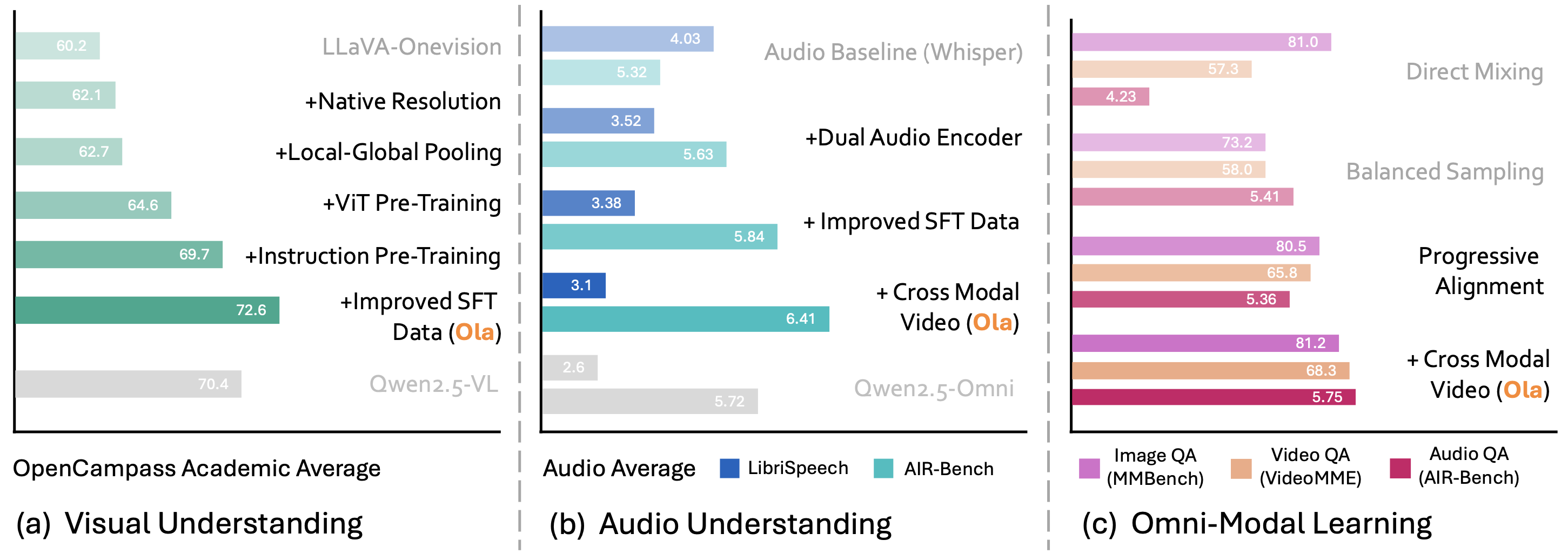
Ola is an Omni-modal language model that achieves competitive performance across image, video, and audio understanding compared to specialized counterparts. We conduct a comprehensive exploration of architectural design, data curation, and training strategies essential for building a robust omni-modal model.

Architecture
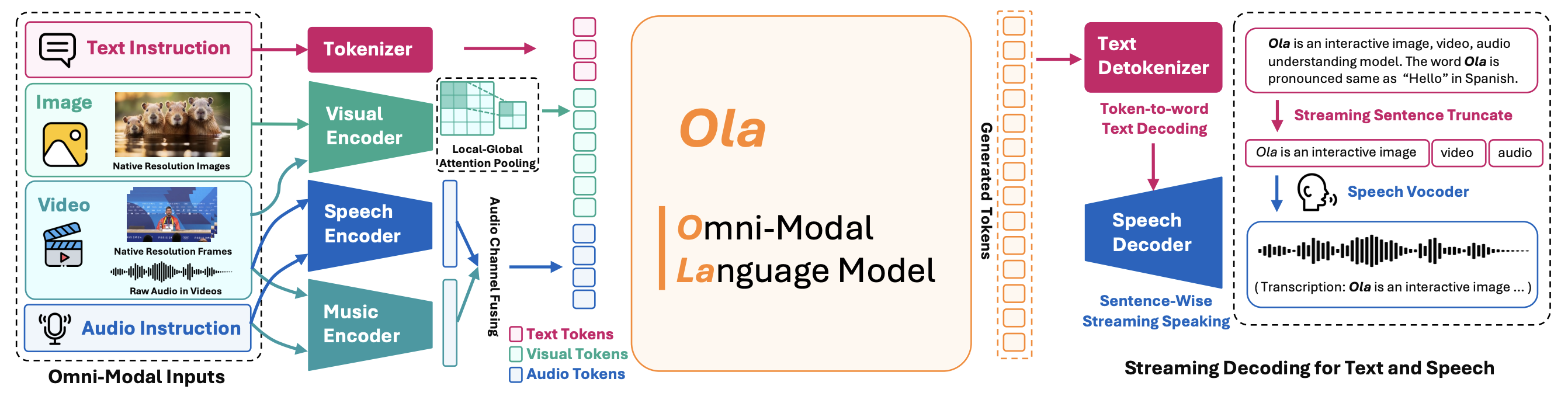
Ola supports omni-modal inputs including text, image, video, and audio, capable of processing the inputs simultaneously with competitive performance on understanding tasks for all these modalities. Meanwhile, Ola supports user-friendly real-time streaming decoding for texts and speeches thanks to the text detokenizer and the speech decoder.
Training Strategies
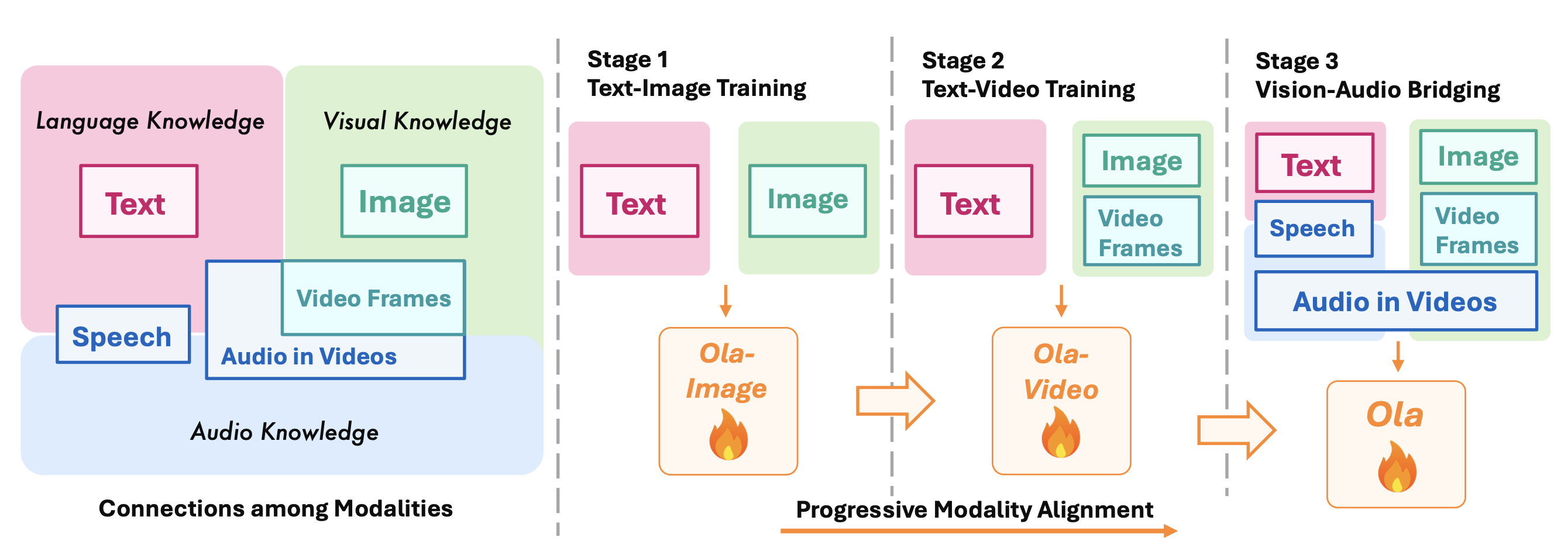
We visualize the relationships among modalities in the left part. Speech acts as the connection between language and audio knowledge, while video constructs the bridge with highly relevant visual and audio information. Therefore, we design the progressive alignment training strategy from primary to periphery. Furthermore, we design the cross-modality video-audio data to better capture the relationships among modalities.
Performance
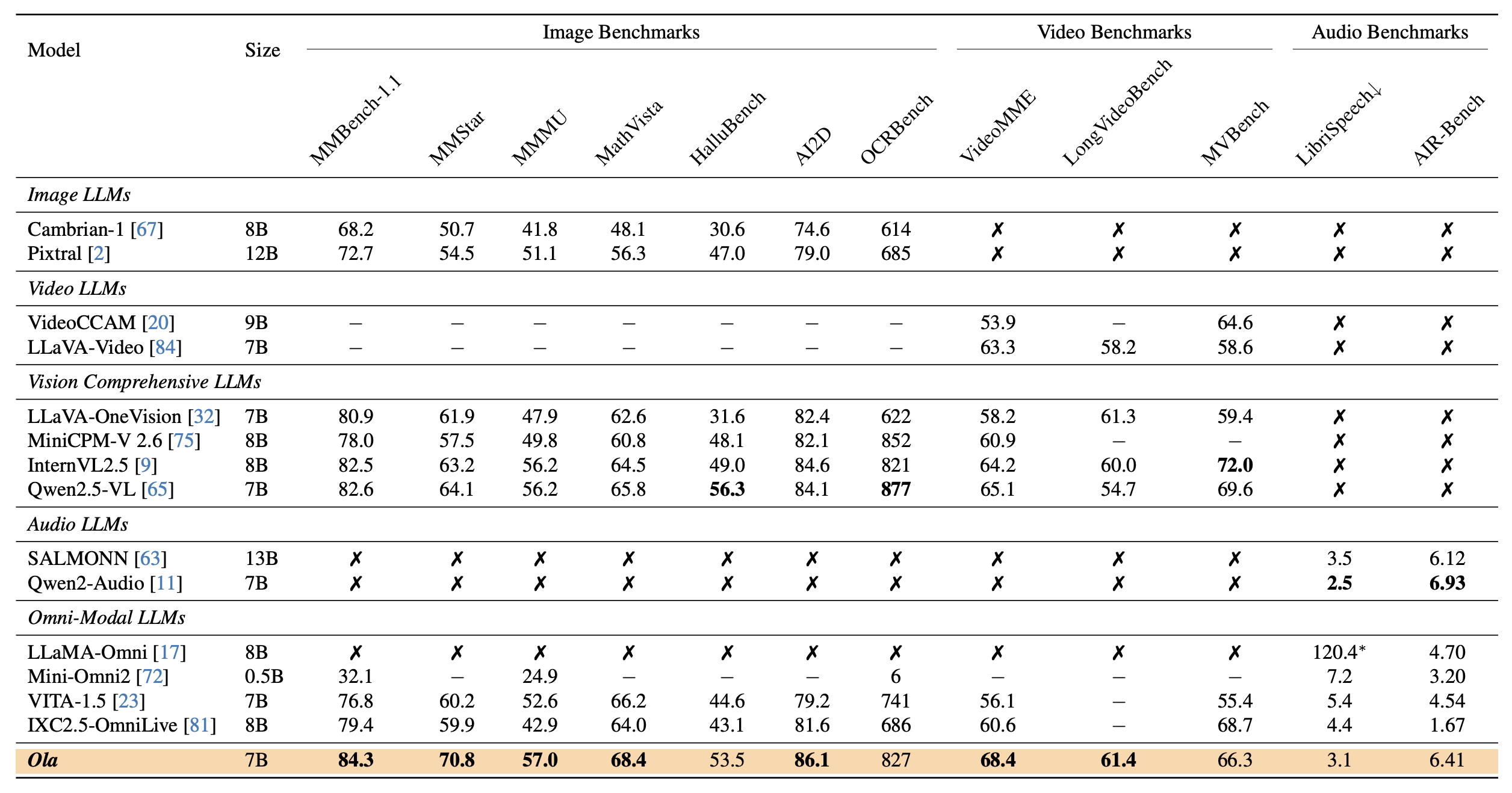
Ola achieves competitive performance across major multi-modal benchmarks when compared to state-of-the-art specialist-modal LLMs.
Installation
1. Clone this repository:
git clone https://github.com/Ola-Omni/Ola
cd Ola
2. Install the required package:
conda create -n ola python=3.10 -y
conda activate ola
pip install --upgrade pip
pip install -e .
3.Install additional packages for training cases
pip install -e ".[train]"
pip install flash-attn --no-build-isolation
Model Zoo
We provide our checkpoints at Huggingface
| Model | Link | Size | Modal |
|---|---|---|---|
| Ola-7b | Huggingface | 7B | Text, Image, Video, Audio |
| Ola-Image | Huggingface | 7B | Text, Image |
| Ola-Video | Huggingface | 7B | Text, Image, Video |
Quick Start
-
Download
Ola-7bfrom Huggingface or skip the step to using the online weights directly. -
Download audio encoder from Huggingface and put the weights
large-v3.ptandBEATs_iter3_plus_AS2M_finetuned_on_AS2M_cpt2.ptunder repo directorypath/to/Ola/ -
Run
inference/infer.py
- Text & Image Understanding
python3 inference/infer.py --image_path *.png,jpg --text user_instruction
- Text & Video Understanding
python3 inference/infer.py --video_path *.mp4 --text user_instruction
- Text & Audio Understanding
python3 inference/infer.py --audio_path *.wav,mp3 --text user_instruction
- Audio & Image Understanding
python3 inference/infer.py --audio_path *.png,jpg --audio_path *.wav,mp3
Evaluation
You can evaluate Ola model with VLMEvalKit and lmms-eval.
Training
Data Preparation
Please refer to DATA.md for instructions of customized finetuning or using the provided datasets.
Start Training
Please follow the script below to start training. Make sure you have created the correct datasets for fine-tuning.
- Finetuning Ola-7b Model:
bash ./scripts/finetune_ola.sh
- Finetuning Ola-Image Model (Ola Stage1 or Stage2)
bash ./scripts/finetune_ola_image.sh
- Finetuning Ola-Video Model (Ola Stage3):
bash ./scripts/finetune_ola_video.sh
Citation
If you find it useful for your research and applications, please cite our paper using this BibTeX:
@article{liu2025ola,
title={Ola: Pushing the Frontiers of Omni-Modal Language Model with Progressive Modality Alignment},
author={Liu, Zuyan and Dong, Yuhao and Wang, Jiahui and Liu, Ziwei and Hu, Winston and Lu, Jiwen and Rao, Yongming},
journal={arXiv preprint arXiv:2502.04328},
year={2025}
}
Acknowledgement
-
Our codebase is conducted on LLaVA
-
Thanks VLMEvalKit and lmms-eval team for the evaluation system!
Contributors


Similar repos



Languages
Python
98.3%
Shell
1.7%
Ola: Pushing the Frontiers of Omni-Modal Language Model
See the codeREADME
Ola: Pushing the Frontiers of Omni-Modal Language Model
Zuyan Liu*,1,2
Yuhao Dong*,2,3
Jiahui Wang1
Ziwei Liu3
Winston Hu2
Jiwen Lu1,✉
Yongming Rao2,1,✉
1Tsinghua University 2Tencent Hunyuan Research 3S-Lab, NTU
* Equal Contribution ✉ Corresponding Author
Project Page:
Weights in Huggingface:
arXiv Paper:
Demo by Gradio:
Training Data:
中文解读:
Contact: Leave an issue or contact liuzuyan19@gmail.com . We are on call to respond.
📢 News
-
🔥[28/2/2025] We release the intermediate model, Ola-Image and Ola-Video, try building your own omni-modal models!
-
🚀[19/2/2025] We release the huggingface demo of Ola, try the advanced omni-modal model on your own!
-
🔥[18/2/2025] The training data, training script for Ola-7b is released!
-
🎉[07/2/2025] The Ola is released! Check our project page, model weights, arXiv paper for the strong omni-modal understanding model!
-
🔥[06/2/2025] Ola-7b achieves Rank #1 on the OpenCompass Multi-modal Leaderboard among all the models under 15B parameters with average score of 72.6. Check the impressive results here!
🚀Coming Soon
- Evaluation code on omni-modal benchmarks
- Gradio Demo
- Training Data (Video, Audio, Cross-Modality)
🌟 Introduction
Roads to Ola
Ola is an Omni-modal language model that achieves competitive performance across image, video, and audio understanding compared to specialized counterparts. We conduct a comprehensive exploration of architectural design, data curation, and training strategies essential for building a robust omni-modal model.
Architecture
Ola supports omni-modal inputs including text, image, video, and audio, capable of processing the inputs simultaneously with competitive performance on understanding tasks for all these modalities. Meanwhile, Ola supports user-friendly real-time streaming decoding for texts and speeches thanks to the text detokenizer and the speech decoder.
Training Strategies
We visualize the relationships among modalities in the left part. Speech acts as the connection between language and audio knowledge, while video constructs the bridge with highly relevant visual and audio information. Therefore, we design the progressive alignment training strategy from primary to periphery. Furthermore, we design the cross-modality video-audio data to better capture the relationships among modalities.
Performance
Ola achieves competitive performance across major multi-modal benchmarks when compared to state-of-the-art specialist-modal LLMs.
Installation
1. Clone this repository:
git clone https://github.com/Ola-Omni/Ola
cd Ola
2. Install the required package:
conda create -n ola python=3.10 -y
conda activate ola
pip install --upgrade pip
pip install -e .
3.Install additional packages for training cases
pip install -e ".[train]"
pip install flash-attn --no-build-isolation
Model Zoo
We provide our checkpoints at Huggingface
| Model | Link | Size | Modal |
|---|---|---|---|
| Ola-7b | Huggingface | 7B | Text, Image, Video, Audio |
| Ola-Image | Huggingface | 7B | Text, Image |
| Ola-Video | Huggingface | 7B | Text, Image, Video |
Quick Start
-
Download
Ola-7bfrom Huggingface or skip the step to using the online weights directly. -
Download audio encoder from Huggingface and put the weights
large-v3.ptandBEATs_iter3_plus_AS2M_finetuned_on_AS2M_cpt2.ptunder repo directorypath/to/Ola/ -
Run
inference/infer.py
- Text & Image Understanding
python3 inference/infer.py --image_path *.png,jpg --text user_instruction
- Text & Video Understanding
python3 inference/infer.py --video_path *.mp4 --text user_instruction
- Text & Audio Understanding
python3 inference/infer.py --audio_path *.wav,mp3 --text user_instruction
- Audio & Image Understanding
python3 inference/infer.py --audio_path *.png,jpg --audio_path *.wav,mp3
Evaluation
You can evaluate Ola model with VLMEvalKit and lmms-eval.
Training
Data Preparation
Please refer to DATA.md for instructions of customized finetuning or using the provided datasets.
Start Training
Please follow the script below to start training. Make sure you have created the correct datasets for fine-tuning.
- Finetuning Ola-7b Model:
bash ./scripts/finetune_ola.sh
- Finetuning Ola-Image Model (Ola Stage1 or Stage2)
bash ./scripts/finetune_ola_image.sh
- Finetuning Ola-Video Model (Ola Stage3):
bash ./scripts/finetune_ola_video.sh
Citation
If you find it useful for your research and applications, please cite our paper using this BibTeX:
@article{liu2025ola,
title={Ola: Pushing the Frontiers of Omni-Modal Language Model with Progressive Modality Alignment},
author={Liu, Zuyan and Dong, Yuhao and Wang, Jiahui and Liu, Ziwei and Hu, Winston and Lu, Jiwen and Rao, Yongming},
journal={arXiv preprint arXiv:2502.04328},
year={2025}
}
Acknowledgement
-
Our codebase is conducted on LLaVA
-
Thanks VLMEvalKit and lmms-eval team for the evaluation system!
Similar repos
Contributors
Languages
Python
98.3%
Shell
1.7%