Self-hosted multimodal RAG for PDFs, talks and audio: searches page images as well as text, cites the page or timestamp, and gates every change on human-labelled test sets.
See the code



SpectraRAG is a self-hosted multimodal RAG system that answers questions from charts, scanned tables, slides and speech, across PDFs, talk videos and audio, and points to the page or timestamp each answer came from. Also in the repo:
▶ Live demo: https://spectrarag-demo.web.app
spectrarag serve needs no GPU and no other services./answer calls a model through
OpenRouter, and /context returns the prompt so you can send it to your own.POST /ingest, off by default.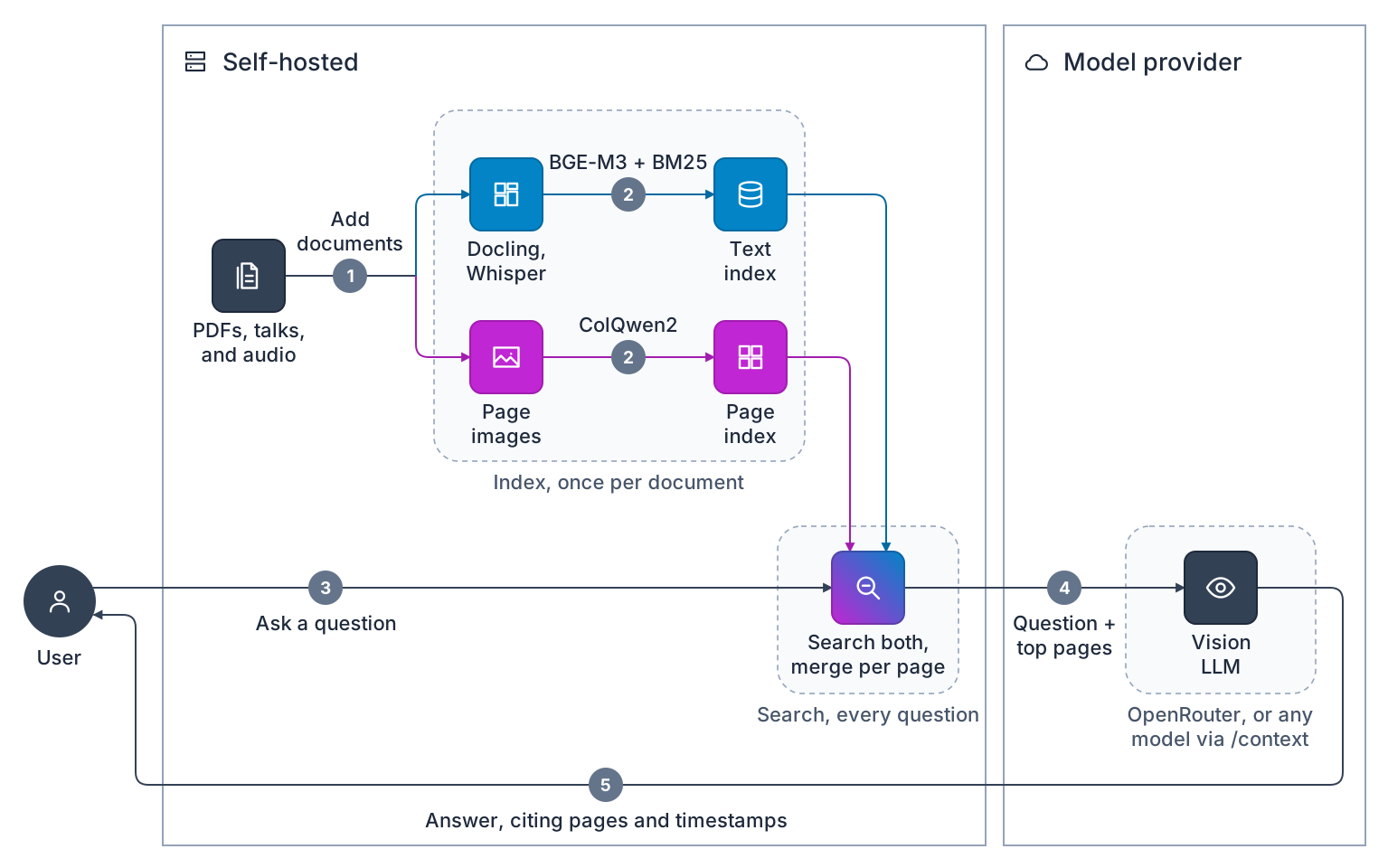
Finding the right page on MMDocIR, a
public benchmark of questions about long documents. The search corpus is the
218 documents of up to 60 pages in its evaluation set; the table covers the
1,029 questions on the 200 of them that MMLongBench-Doc does not also use
(selection). From one
recorded run
(data/eval/mmdocir-depth50-legs.json.gz):
share of correct pages in the top 5 and top 10 results.
| search | top 5 | top 10 |
|---|---|---|
| text only | 0.42 | 0.46 |
| text and page images | 0.70 | 0.79 |
| page images only | 0.75 | 0.80 |
Answers, on 150 of the 1,029 questions above
(data/golden/mmdocir-gen150.yaml): the
same mix of kinds as the full set, 69 text, 48 figure and 33 table questions
from 92 documents. Each ran the way the demo runs: text and page-image search
together, the top 5 pages go to gemma4:31b, which reads them and answers, and
gpt-oss:120b grades each answer against MMDocIR's reference answer. MMDocIR
asks each question about one document
("How many authors are listed in the paper?"), so the first row limits the
search to that document; the second searches all 218, like the table above.
Receipts: one document,
all documents.
| search | correct | declined to answer | wrong |
|---|---|---|---|
| within the question's document | 0.58 | 0.11 | 0.31 |
| across all 218 documents | 0.50 | 0.14 | 0.36 |
Method and full numbers: docs/results.md.
Recordings: each question is searched within its own recording, against a random order of that recording's segments.
| recordings | questions | right segment first | right segment in top 3 |
|---|---|---|---|
| talks with slides (MCIF) | 192 | 0.57 (random 0.10) | 0.82 (random 0.28) |
| meetings (QMSum on AMI) | 123 | 0.46 (random 0.17) | 0.75 (random 0.39) |
Requirements: Python 3.12 and uv.
git clone https://github.com/NorthernLightx/spectrarag
cd spectrarag
uv sync --extra dev
uv run spectrarag serve
This serves the demo set that ships in the repo: 20 arXiv papers and 3 recorded
talks, indexed for text search, with their page images. Page-image search needs
its own index, built on a GPU (see Page-image search).
The first run downloads the embedding and reranking models, about 3 GB. The
API is at http://localhost:8000, with interactive docs at /docs.
curl -s localhost:8000/query -H "Content-Type: application/json" \
    -d '{"text": "What does Figure 1 in HERMES++ illustrate?", "top_k": 5}'
For answers with citations, set RAG_OPENROUTER_API_KEY in .env and send the
same body to /answer.
| route | what it does |
|---|---|
POST /query | search only; filters.paper_id limits it to one document |
POST /answer | search, then an answer with citations, through OpenRouter |
POST /context | the prompt for one question, for a client that calls its own model |
POST /ingest | add a PDF while it runs (needs RAG_ENABLE_UPLOAD=true) |
GET /papers, GET /figures | the indexed documents, and their figures and tables |
GET /pages/... | page images, when RAG_PAGES_DIR is set |
GET /health | status, and a fingerprint of the search settings |
POST /query/dci | experimental: an LLM agent searches the text with grep instead of the indexes (OpenRouter key in X-OpenRouter-Key, or the server's) |
The live demo is a separate web app built on this API.
| you have | run | you get |
|---|---|---|
| one PDF, while the server runs | POST /ingest | text search |
| a folder of PDFs | spectrarag ingest (Docker Qdrant and Ollama) | text search |
| talk videos or audio | scripts.ingest_media | search over the transcript, with times |
| PDFs, or a talk's slides | scripts.build_visual_index (CUDA GPU) | page-image search |
It is searchable right away, by text.
RAG_ENABLE_UPLOAD=true uv run spectrarag serve
curl -F "[email protected]" localhost:8000/ingest
This path runs Qdrant and the embedding model in Docker:
cp .env.example .env
docker compose up -d qdrant ollama
docker exec rag-ollama ollama pull bge-m3
uv run spectrarag ingest --pdf-dir ./mydocs --collection my_corpus
Set RAG_CORPUS_COLLECTION=my_corpus in .env, then start the API with
uv run uvicorn src.api.main:app --port 8000.
Videos (mp4, mov, mkv, webm) and audio (mp3, wav, m4a, flac, ogg, opus, aac)
join the index spectrarag serve uses. Stop the server first; the local index
takes one process at a time.
uv sync --extra dev --extra media
uv run python -m scripts.ingest_media --media-dir ./recordings \
    --pages-dir data/pages --qdrant path:./qdrant_local --collection rag_corpus
uv run spectrarag serve
A recording's id is its file name without the extension. Each result from it
has start_s and end_s in its metadata.
Build the page index on a CUDA GPU (8 GB is enough); searching it runs on CPU. For the demo set, the second command adds the talks' slides:
uv run spectrarag fetch
uv run python -m scripts.build_visual_index
uv run python -m scripts.build_visual_index --pages-only \
    --paper-id wJAPXMIoIG --paper-id csJIsDTYMW --paper-id DyXpuURBMP
RAG_ENABLE_MULTIMODAL=true uv run spectrarag serve
For your own recordings, pass their ids to --paper-id. For a folder of PDFs in
the Docker setup:
uv run python -m scripts.build_visual_index --pdf-dir ./mydocs \
    --qdrant http://localhost:6333 \
    --corpus-collection my_corpus --collection my_corpus_visual
Then set RAG_ENABLE_MULTIMODAL=true and RAG_VISUAL_COLLECTION=my_corpus_visual.
If answers live mostly in figures and scans, try RAG_VISUAL_FUSION_WEIGHT=2.
Set these in .env or the environment.
| variable | what it does | default |
|---|---|---|
RAG_OPENROUTER_API_KEY | key for /answer | unset |
RAG_DEFAULT_CHAT_MODEL | model /answer calls | anthropic/claude-sonnet-4.6 |
RAG_PUBLIC_API_KEY | key every request must send, except /health and the docs | unset (no auth) |
RAG_QDRANT_URL | Qdrant server URL, or path:<dir> for a local store | http://localhost:6333; spectrarag serve uses path:./qdrant_local |
RAG_CORPUS_COLLECTION | text collection to serve | rag_corpus |
RAG_ENABLE_MULTIMODAL | turn on page-image search | false |
RAG_VISUAL_COLLECTION | page index collection | rag_corpus_visual |
RAG_PAGES_DIR | page images for /pages and the answer model | unset; spectrarag serve uses data/pages when present |
RAG_VISUAL_FUSION_WEIGHT | weight of page-image results when merging | 1 |
RAG_ENABLE_UPLOAD | allow POST /ingest | false |
RAG_PROFILE | settings profile | unset; spectrarag serve uses cpu |
POST /ingest has no rate limit. On a shared deploy, keep
RAG_ENABLE_UPLOAD off or set RAG_PUBLIC_API_KEY.spectrarag ingest needs Docker Qdrant and Ollama. The self-contained index
that spectrarag serve uses takes new PDFs only through POST /ingest, one
at a time.POST /ingest takes PDFs only.uv run python -m scripts.eval_run --profile cpu --pdf <files> --golden <golden.yaml>
uv run python -m scripts.check_regression --baseline <baseline.json> --candidate <run.json>
eval_run scores search, and optionally answers, on a set of questions with
known answers, and writes the results as JSON. check_regression fails if a
score drops more than 5% below a committed baseline.
On every push, CI runs the served setup on the demo papers, with and without page-image search, and fails if any question loses a correct page from its top 10. CI has no GPU, so page-image results are replayed from a recording.
The LLM judge sees only text, so it can mark down a right answer read from an image; for those, compare with the known answer.
Question-set format, metrics, and how to reproduce the numbers above:
docs/evals.md.
uv sync --extra dev
uv run ruff check . && uv run ruff format --check .
uv run mypy src tests scripts          # strict
uv run pytest -q -m "not slow and not integration"
CI also runs the slow and integration tests. To run the checks and a secret
scan before each push: git config core.hooksPath .githooks.
src/        API, retrievers, ingestion, eval, observability
scripts/    CLI entry points: ingest, index, eval, regression
data/       eval baselines, golden sets, the demo manifest
docs/       results, eval method, design notes
tests/      unit and integration suites
Contributing: CONTRIBUTING.md. Design notes:
docs/decisions/.
docs/comparison.md.MIT. See LICENSE.
Self-hosted multimodal RAG for PDFs, talks and audio: searches page images as well as text, cites the page or timestamp, and gates every change on human-labelled test sets.
See the code
SpectraRAG is a self-hosted multimodal RAG system that answers questions from charts, scanned tables, slides and speech, across PDFs, talk videos and audio, and points to the page or timestamp each answer came from. Also in the repo:
▶ Live demo: https://spectrarag-demo.web.app
spectrarag serve needs no GPU and no other services./answer calls a model through
OpenRouter, and /context returns the prompt so you can send it to your own.POST /ingest, off by default.
Finding the right page on MMDocIR, a
public benchmark of questions about long documents. The search corpus is the
218 documents of up to 60 pages in its evaluation set; the table covers the
1,029 questions on the 200 of them that MMLongBench-Doc does not also use
(selection). From one
recorded run
(data/eval/mmdocir-depth50-legs.json.gz):
share of correct pages in the top 5 and top 10 results.
| search | top 5 | top 10 |
|---|---|---|
| text only | 0.42 | 0.46 |
| text and page images | 0.70 | 0.79 |
| page images only | 0.75 | 0.80 |
Answers, on 150 of the 1,029 questions above
(data/golden/mmdocir-gen150.yaml): the
same mix of kinds as the full set, 69 text, 48 figure and 33 table questions
from 92 documents. Each ran the way the demo runs: text and page-image search
together, the top 5 pages go to gemma4:31b, which reads them and answers, and
gpt-oss:120b grades each answer against MMDocIR's reference answer. MMDocIR
asks each question about one document
("How many authors are listed in the paper?"), so the first row limits the
search to that document; the second searches all 218, like the table above.
Receipts: one document,
all documents.
| search | correct | declined to answer | wrong |
|---|---|---|---|
| within the question's document | 0.58 | 0.11 | 0.31 |
| across all 218 documents | 0.50 | 0.14 | 0.36 |
Method and full numbers: docs/results.md.
Recordings: each question is searched within its own recording, against a random order of that recording's segments.
| recordings | questions | right segment first | right segment in top 3 |
|---|---|---|---|
| talks with slides (MCIF) | 192 | 0.57 (random 0.10) | 0.82 (random 0.28) |
| meetings (QMSum on AMI) | 123 | 0.46 (random 0.17) | 0.75 (random 0.39) |
Requirements: Python 3.12 and uv.
git clone https://github.com/NorthernLightx/spectrarag
cd spectrarag
uv sync --extra dev
uv run spectrarag serve
This serves the demo set that ships in the repo: 20 arXiv papers and 3 recorded
talks, indexed for text search, with their page images. Page-image search needs
its own index, built on a GPU (see Page-image search).
The first run downloads the embedding and reranking models, about 3 GB. The
API is at http://localhost:8000, with interactive docs at /docs.
curl -s localhost:8000/query -H "Content-Type: application/json" \
    -d '{"text": "What does Figure 1 in HERMES++ illustrate?", "top_k": 5}'
For answers with citations, set RAG_OPENROUTER_API_KEY in .env and send the
same body to /answer.
| route | what it does |
|---|---|
POST /query | search only; filters.paper_id limits it to one document |
POST /answer | search, then an answer with citations, through OpenRouter |
POST /context | the prompt for one question, for a client that calls its own model |
POST /ingest | add a PDF while it runs (needs RAG_ENABLE_UPLOAD=true) |
GET /papers, GET /figures | the indexed documents, and their figures and tables |
GET /pages/... | page images, when RAG_PAGES_DIR is set |
GET /health | status, and a fingerprint of the search settings |
POST /query/dci | experimental: an LLM agent searches the text with grep instead of the indexes (OpenRouter key in X-OpenRouter-Key, or the server's) |
The live demo is a separate web app built on this API.
| you have | run | you get |
|---|---|---|
| one PDF, while the server runs | POST /ingest | text search |
| a folder of PDFs | spectrarag ingest (Docker Qdrant and Ollama) | text search |
| talk videos or audio | scripts.ingest_media | search over the transcript, with times |
| PDFs, or a talk's slides | scripts.build_visual_index (CUDA GPU) | page-image search |
It is searchable right away, by text.
RAG_ENABLE_UPLOAD=true uv run spectrarag serve
curl -F "[email protected]" localhost:8000/ingest
This path runs Qdrant and the embedding model in Docker:
cp .env.example .env
docker compose up -d qdrant ollama
docker exec rag-ollama ollama pull bge-m3
uv run spectrarag ingest --pdf-dir ./mydocs --collection my_corpus
Set RAG_CORPUS_COLLECTION=my_corpus in .env, then start the API with
uv run uvicorn src.api.main:app --port 8000.
Videos (mp4, mov, mkv, webm) and audio (mp3, wav, m4a, flac, ogg, opus, aac)
join the index spectrarag serve uses. Stop the server first; the local index
takes one process at a time.
uv sync --extra dev --extra media
uv run python -m scripts.ingest_media --media-dir ./recordings \
    --pages-dir data/pages --qdrant path:./qdrant_local --collection rag_corpus
uv run spectrarag serve
A recording's id is its file name without the extension. Each result from it
has start_s and end_s in its metadata.
Build the page index on a CUDA GPU (8 GB is enough); searching it runs on CPU. For the demo set, the second command adds the talks' slides:
uv run spectrarag fetch
uv run python -m scripts.build_visual_index
uv run python -m scripts.build_visual_index --pages-only \
    --paper-id wJAPXMIoIG --paper-id csJIsDTYMW --paper-id DyXpuURBMP
RAG_ENABLE_MULTIMODAL=true uv run spectrarag serve
For your own recordings, pass their ids to --paper-id. For a folder of PDFs in
the Docker setup:
uv run python -m scripts.build_visual_index --pdf-dir ./mydocs \
    --qdrant http://localhost:6333 \
    --corpus-collection my_corpus --collection my_corpus_visual
Then set RAG_ENABLE_MULTIMODAL=true and RAG_VISUAL_COLLECTION=my_corpus_visual.
If answers live mostly in figures and scans, try RAG_VISUAL_FUSION_WEIGHT=2.
Set these in .env or the environment.
| variable | what it does | default |
|---|---|---|
RAG_OPENROUTER_API_KEY | key for /answer | unset |
RAG_DEFAULT_CHAT_MODEL | model /answer calls | anthropic/claude-sonnet-4.6 |
RAG_PUBLIC_API_KEY | key every request must send, except /health and the docs | unset (no auth) |
RAG_QDRANT_URL | Qdrant server URL, or path:<dir> for a local store | http://localhost:6333; spectrarag serve uses path:./qdrant_local |
RAG_CORPUS_COLLECTION | text collection to serve | rag_corpus |
RAG_ENABLE_MULTIMODAL | turn on page-image search | false |
RAG_VISUAL_COLLECTION | page index collection | rag_corpus_visual |
RAG_PAGES_DIR | page images for /pages and the answer model | unset; spectrarag serve uses data/pages when present |
RAG_VISUAL_FUSION_WEIGHT | weight of page-image results when merging | 1 |
RAG_ENABLE_UPLOAD | allow POST /ingest | false |
RAG_PROFILE | settings profile | unset; spectrarag serve uses cpu |
POST /ingest has no rate limit. On a shared deploy, keep
RAG_ENABLE_UPLOAD off or set RAG_PUBLIC_API_KEY.spectrarag ingest needs Docker Qdrant and Ollama. The self-contained index
that spectrarag serve uses takes new PDFs only through POST /ingest, one
at a time.POST /ingest takes PDFs only.uv run python -m scripts.eval_run --profile cpu --pdf <files> --golden <golden.yaml>
uv run python -m scripts.check_regression --baseline <baseline.json> --candidate <run.json>
eval_run scores search, and optionally answers, on a set of questions with
known answers, and writes the results as JSON. check_regression fails if a
score drops more than 5% below a committed baseline.
On every push, CI runs the served setup on the demo papers, with and without page-image search, and fails if any question loses a correct page from its top 10. CI has no GPU, so page-image results are replayed from a recording.
The LLM judge sees only text, so it can mark down a right answer read from an image; for those, compare with the known answer.
Question-set format, metrics, and how to reproduce the numbers above:
docs/evals.md.
uv sync --extra dev
uv run ruff check . && uv run ruff format --check .
uv run mypy src tests scripts          # strict
uv run pytest -q -m "not slow and not integration"
CI also runs the slow and integration tests. To run the checks and a secret
scan before each push: git config core.hooksPath .githooks.
src/        API, retrievers, ingestion, eval, observability
scripts/    CLI entry points: ingest, index, eval, regression
data/       eval baselines, golden sets, the demo manifest
docs/       results, eval method, design notes
tests/      unit and integration suites
Contributing: CONTRIBUTING.md. Design notes:
docs/decisions/.
docs/comparison.md.MIT. See LICENSE.



