Stable Diffusion Model that speaks 40 languages! - BSc Thesis
Jupyter Notebook
7
33 commits
updated Dec 15, 2023
This repository presents a specialized variant of the Stable Diffusion model designed for multilingual text-to-image synthesis. In response to the observed underperformance of existing models on languages beyond English, this project introduces the Multilingual Stable Diffusion, providing a more inclusive solution for diverse linguistic contexts.
Stable Diffusion, while powerful, faces challenges when applied to languages other than English. CLIP and Stable Diffusion models often underperform when tested on non-English data. To address this limitation, we introduce a multilingual variant that leverages the strengths of Stable Diffusion while accommodating up to 40 languages. Our aim is to enhance the accessibility of text-to-image diffusion models, promoting cultural understanding and inclusivity.
The Multilingual Stable Diffusion is tailored to:
Generate Culturally Relevant Images : Our model is trained to produce images that align with the cultural nuances of various languages.
Support Multiple Languages : With a focus on inclusivity, this variant enables text-to-image generation in up to 40 languages, promoting a more diverse range of creative outputs.
Adapter Layer for Alignment : We introduce an adapter layer to bridge the gap between multilingual-CLIP and the original CLIP, ensuring effective communication between text embeddings and the decoder.
The training of Multilingual Stable Diffusion involves a two-stage process:
Integration of Multilingual-CLIP : We substitute the original CLIP text-encoder with the multilingual version and directly pass text embeddings from multilingual-CLIP to the decoder.
Adapter Layer Training : An adapter module is introduced and exclusively trained on English captions to align multilingual-CLIP's output with the original CLIP's embedding space. This ensures effective cross-linguistic text-to-image generation.
The model is trained on a diverse dataset, including English captions from the LAION-2B-en dataset. This dataset encompasses approximately 12,500 English captions, serving as a foundation for training the adapter module.
The effectiveness of Multilingual Stable Diffusion is demonstrated through qualitative analysis against baseline models, including the original Stable Diffusion and a variant without the adapter layer ("No Adapter"). The model excels in generating culturally relevant images, addressing the limitations observed in the original Stable Diffusion.
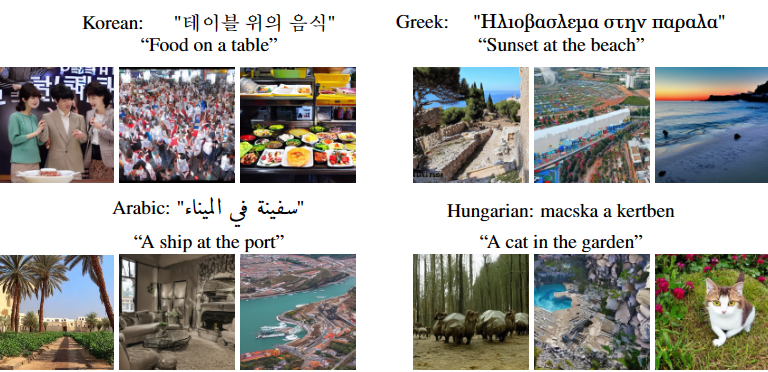 Figure 1: Samples of generations from multilingual prompts from Stable Diffusion, No Adapter
and Ours, left to right.
Figure 1: Samples of generations from multilingual prompts from Stable Diffusion, No Adapter
and Ours, left to right.
Evaluation results, with a focus on the Arabic text caption subset, showcase significant improvements in performance:
Table 1: Arabic Language Evaluation - FID and CLIP Scores Comparison
| Model | FID Score | CLIP Score |
|---|---|---|
| Original Stable Diffusion | 132.23 | 8.07 |
| Multilingual Stable Diffusion | 50.99 | 18.2 |
These results highlight a 61.47% FID score improvement and a 125% CLIP score improvement, affirming the efficacy of the multilingual approach.
This project introduces Multilingual Stable Diffusion as a step towards a more inclusive text-to-image synthesis experience. By leveraging multilingual-CLIP and training an adapter layer, we enhance Stable Diffusion's ability to handle non-English text, making strides toward bridging the gap between linguistic diversity and AI-generated visuals.
Stable Diffusion Model that speaks 40 languages! - BSc Thesis
Jupyter Notebook
7
33 commits
updated Dec 15, 2023
This repository presents a specialized variant of the Stable Diffusion model designed for multilingual text-to-image synthesis. In response to the observed underperformance of existing models on languages beyond English, this project introduces the Multilingual Stable Diffusion, providing a more inclusive solution for diverse linguistic contexts.
Stable Diffusion, while powerful, faces challenges when applied to languages other than English. CLIP and Stable Diffusion models often underperform when tested on non-English data. To address this limitation, we introduce a multilingual variant that leverages the strengths of Stable Diffusion while accommodating up to 40 languages. Our aim is to enhance the accessibility of text-to-image diffusion models, promoting cultural understanding and inclusivity.
The Multilingual Stable Diffusion is tailored to:
Generate Culturally Relevant Images : Our model is trained to produce images that align with the cultural nuances of various languages.
Support Multiple Languages : With a focus on inclusivity, this variant enables text-to-image generation in up to 40 languages, promoting a more diverse range of creative outputs.
Adapter Layer for Alignment : We introduce an adapter layer to bridge the gap between multilingual-CLIP and the original CLIP, ensuring effective communication between text embeddings and the decoder.
The training of Multilingual Stable Diffusion involves a two-stage process:
Integration of Multilingual-CLIP : We substitute the original CLIP text-encoder with the multilingual version and directly pass text embeddings from multilingual-CLIP to the decoder.
Adapter Layer Training : An adapter module is introduced and exclusively trained on English captions to align multilingual-CLIP's output with the original CLIP's embedding space. This ensures effective cross-linguistic text-to-image generation.
The model is trained on a diverse dataset, including English captions from the LAION-2B-en dataset. This dataset encompasses approximately 12,500 English captions, serving as a foundation for training the adapter module.
The effectiveness of Multilingual Stable Diffusion is demonstrated through qualitative analysis against baseline models, including the original Stable Diffusion and a variant without the adapter layer ("No Adapter"). The model excels in generating culturally relevant images, addressing the limitations observed in the original Stable Diffusion.
Figure 1: Samples of generations from multilingual prompts from Stable Diffusion, No Adapter
and Ours, left to right.
Evaluation results, with a focus on the Arabic text caption subset, showcase significant improvements in performance:
Table 1: Arabic Language Evaluation - FID and CLIP Scores Comparison
| Model | FID Score | CLIP Score |
|---|---|---|
| Original Stable Diffusion | 132.23 | 8.07 |
| Multilingual Stable Diffusion | 50.99 | 18.2 |
These results highlight a 61.47% FID score improvement and a 125% CLIP score improvement, affirming the efficacy of the multilingual approach.
This project introduces Multilingual Stable Diffusion as a step towards a more inclusive text-to-image synthesis experience. By leveraging multilingual-CLIP and training an adapter layer, we enhance Stable Diffusion's ability to handle non-English text, making strides toward bridging the gap between linguistic diversity and AI-generated visuals.