
Lokalise for one person. Translate your app's strings with a local model, keep the diff clean, check every placeholder and plural.
Rust
0
18 commits
updated Sep 17, 2026
README
polygo
Lokalise for one person. A 4 MB CLI binary that translates your app's strings with a local model, tracks what changed in a lockfile, and refuses to write a translation with a broken placeholder or a missing plural form.



For solo developers and small teams shipping an iOS, Android, Flutter, web or .NET app in a few languages. Lokalise starts at $149/month and keeps your strings on its servers. polygo runs in your repo and writes into the files you already have, so the diff is just the new strings.
curl -fsSL https://raw.githubusercontent.com/Na5co/polygo/main/install.sh | sh
Or brew install na5co/tap/polygo · cargo binstall polygo · cargo install polygo · Windows zip. Local models run through Ollama (brew install ollama); no Ollama? polygo use openai/gpt-4o-mini --api-key ... works the same way.
Thirty seconds
cd your-app
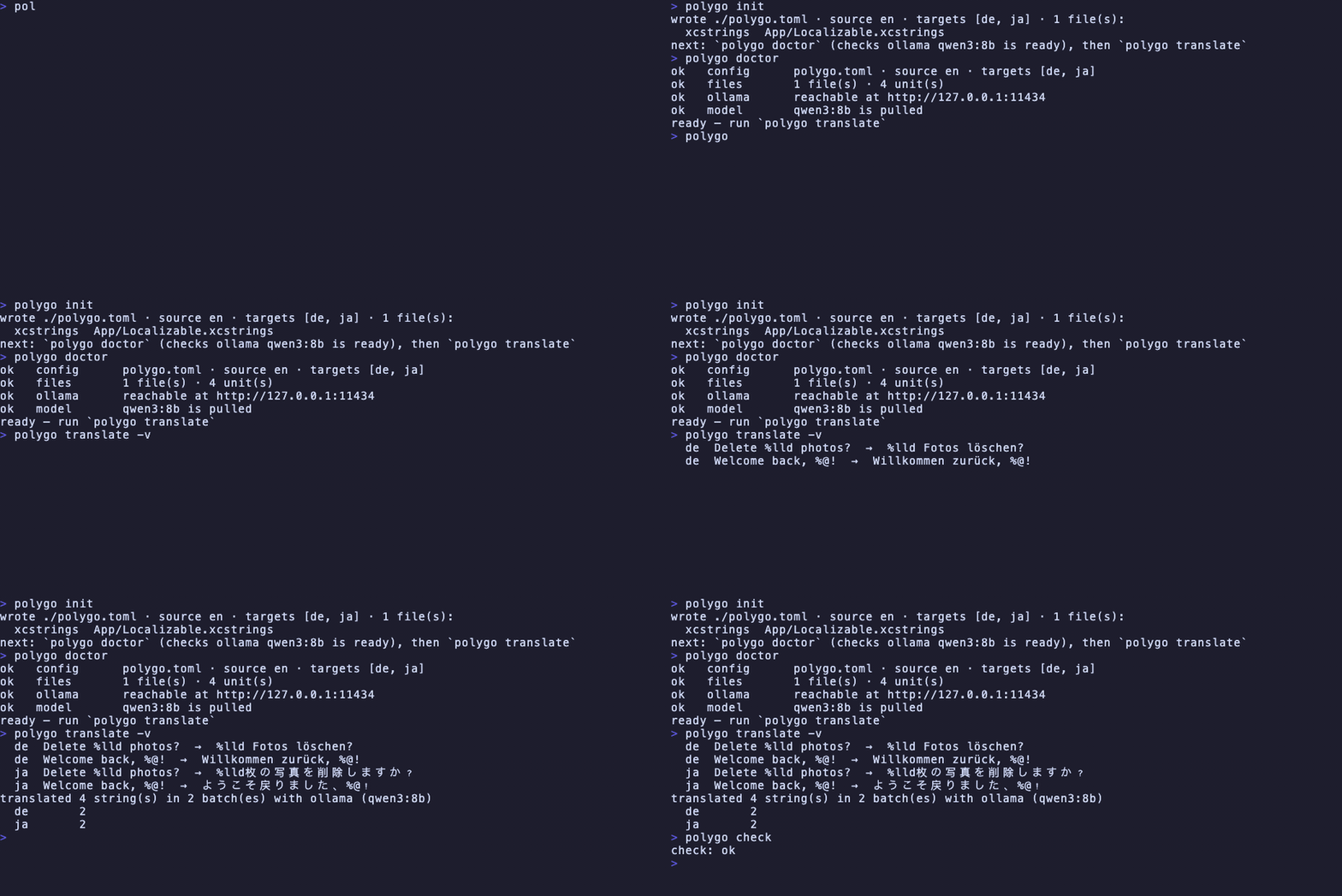
polygo init          # finds your string files, writes polygo.toml
polygo use gemma4    # picks a model and pulls it (or openai/..., anthropic/... with a key)
polygo doctor        # is everything in place? says what to fix if not
polygo translate     # translates new and changed strings into every target locale
polygo check         # placeholders, plurals, lengths; exit 1 on errors
git diff             # look it over, commit
init recognises .xcstrings catalogs, Android values-* folders, Flutter l10n.yaml and ARB files, i18next locales/, gettext .po trees and .NET .resx/.resw. polygo add fr ja adds languages later.
Web app with no string files yet
polygo extract --dry-run   # lists every piece of UI text it found, with file:line
polygo extract --rewrite   # writes locales/en.json, replaces the strings in the code with t("key"), generates src/i18n.ts
polygo init && polygo add de fr && polygo translate
extract reads the markup in JSX, HTML inside template literals, and .html/.vue/.svelte files: text between tags plus placeholder, title, alt and aria-label attributes. It skips <script>, <style>, <svg>, <code>, tests and node_modules. ${expr} and {expr} become {{0}} placeholders and are passed as arguments: <p>Signed in as ${email}.</p> becomes <p>${t("Signed in as {{0}}.", { 0: email })}</p>.
--rewrite edits .ts/.tsx/.js/.jsx files in place, adds the import, and generates a 20-line i18n.ts with t, setLocale and addCatalog (no library needed; keys are the English text, so English works with nothing loaded). Review it with git diff. Sentences split by inline markup (writes a <code>.form</code> file) are listed as fragments and left alone, because translating the pieces separately gives bad results. On a 160-file server-rendered app it rewrote 387 strings in 20 files with no new TypeScript errors.
Keep brand names and whole pages out of it with flags or polygo.toml:
[extract]
ignore = ["Leafslip", "API key"]          # strings containing these are skipped
ignore_paths = ["src/admin*", "legacy/**"]
iOS, Android, Flutter and gettext already have their own extractors, so extract is for the web.
What it catches
This is polygo check on the DuckDuckGo macOS browser's shipped string catalog, unmodified:
$ polygo check
error   Localizable.xcstrings  open.in  [fr]  placeholders: missing %1$@
error   Localizable.xcstrings  open.in  [it]  placeholders: missing %1$@
error   Localizable.xcstrings  permission.popup.title  [it]  placeholders: missing %#@…@
error   Localizable.xcstrings  tooltip.clearHistory  [it]  placeholders: missing %1$@
error   Localizable.xcstrings  preferences.about.more-at  [nl]  placeholders: missing %1$@
error   Localizable.xcstrings  fire.dialog.history.count  [pl]  placeholders: missing %#@…@
error   Localizable.xcstrings  pm.card.expires.format  [pl]  placeholders: missing %1$@
…
12 error(s), 380 warning(s)
Ouvrir dans % @ (a space inside the placeholder), a dropped %d, mangled %#@var@ variables. Across DuckDuckGo and Ice Cubes: 32 placeholder bugs and 44 missing Slavic plural forms, all in production, plus a Ukrainian string that reads "ключа DeepL API key". Details in tests/corpus/xcstrings/KNOWN_BUGS.md.
Formats
| Format | Used by | What init looks for |
|---|---|---|
.xcstrings | iOS / macOS (Xcode 15+) | one catalog with every locale; plural variations and %#@var@ substitutions translated per CLDR category |
strings.xml | Android | res/values/ plus res/values-<locale>/; <plurals> translated per quantity |
.json (i18next) | React / web | locales/<locale>.json or locales/<locale>/<ns>.json, nested keys |
.arb | Flutter | l10n.yaml pointing at lib/l10n/app_<locale>.arb; ICU plurals and @metadata |
.po | gettext (Django, Rails, Python, PHP) | locale/<locale>/LC_MESSAGES/*.po or flat <locale>.po; msgid_plural filled per Plural-Forms slot |
.resx / .resw | .NET / WinUI | Name.<locale>.resx or <locale>/Resources.resw |
Every writer round-trips byte for byte: parse then serialize gives back the original file. Tested on 35 real files from DuckDuckGo, Ice Cubes, Grafana, Django, NewPipe, Penpot and others, so a translation never hides a real change under a reformatting diff. Per-format notes are in docs/.
Why not paste the file into a chat window
| Knows what changed | polygo.lock stores a hash of every source string per locale. Change the English and only that string is translated again. Edit a translation by hand and it is marked edited and never overwritten. |
| Reads your code | Before translating "Open" it finds Button("Open") in LibraryView.swift and tells the model this is a menu item, not a verb. The most similar strings you already translated ride along so terms stay consistent. In a blind A/B judged by a second model this context won 9 to 5, rest tied. |
| Does plurals properly | %lld photos becomes four strings for Polish (one, few, many, other) and one for Japanese. Each form is requested with a concrete count so the model picks the right inflection, then written into the format's own plural structure. |
| Checks the output | Placeholders (%@, %1$s, {count}, {{name}}, %(name)s, {0}, ICU plural blocks) have to survive. CLDR plural categories have to be complete. Empty, identical, oversized and half-translated strings (ようこそ back!) are flagged. Anything the model gets wrong twice is quarantined as needs-review and not written to your files. |
| Gets a second opinion | polygo audit --locale bg asks a different model to score each translation 1 to 5 with a reason. Structural checks can't see a wrong word; this can. --fix re-translates the flagged ones and leaves human edits alone. |
| Remembers | Translations a human wrote or approved go into ~/.config/polygo/memory.toml. The next project that has "Cancel" gets it back without a model call. polygo memory shows what is stored. |
Also: CI, local review page, pseudo-localization, per-key directives
- CI.
polygo check --json --strictin a pipeline, or the GitHub Action that opens a PR with new translations on every push, coverage table included. - Review is local.
polygo reviewserves a page on127.0.0.1to approve or reject pending translations. Approvals are recorded as human. - Pseudo-localization.
polygo pseudowrites[Šáṽé çĥáñĝéš ~~~~]for every string asen-XA. Run the app in that locale to spot hardcoded text and truncation. - Per-key control from the code.
polygo:skipandpolygo:max=20in a developer comment are respected by translate and check.
Compared with
| Lokalise, Crowdin, Phrase | Hosted translation platforms: web editor, translator accounts, subscription pricing, your strings on their servers. polygo has no server and no accounts; the review step is git diff. |
| Weblate | Open-source web platform you host yourself (database, web UI, workers). polygo is one binary in the repo with nothing to run. |
| Editor extensions (i18n Ally and friends) | Show and edit keys inline while you code. polygo translates in batches, checks in CI and keeps a lockfile; the two sit side by side fine. |
| A DeepL or Google Translate script | One string at a time, no code context, no CLDR plural forms, no placeholder check. That gap is what check, audit and the context engine close. |
| Pasting the file into ChatGPT | See the section above. |
polygo is MIT-licensed and open source. There is no hosted tier, no account and no telemetry.
Which model
polygo models lists the options with sizes and notes. The workflow is the same whichever you pick.
| Size | Good for | |
|---|---|---|
qwen3:8b (default) | 5 GB | UI strings into major languages. In a live test: 8 of 8 Polish plural forms, 6 of 8 Russian, rough Bulgarian ("Достъп за достъп"). |
gemma4 | 9.6 GB | Smaller languages, Slavic plurals, anything customer-facing. |
openai/…, anthropic/… | API | Same as above, no local GPU needed. |
check catches structural mistakes, not a wrong word, so step up from the default for anything a customer will read.
polygo use gemma4                               # pulls through Ollama with a progress bar, writes polygo.toml
polygo use qwen3:14b --global                   # also the default for future `polygo init`
polygo use openai/gpt-4o-mini --api-key sk-...  # key stored in ~/.config/polygo/credentials.toml (0600)
polygo use anthropic/claude-sonnet-5            # or export ANTHROPIC_API_KEY
polygo use openai/llama-3.3-70b --base-url https://api.groq.com/openai/v1   # any OpenAI-compatible server
Privacy
- No telemetry, no analytics, no update checks. The only network request polygo makes is the translation call to the provider in your
polygo.toml. With the default Ollama provider that is127.0.0.1:11434. The one opt-in exception: setPHOENIX_COLLECTOR_ENDPOINTand prompts and replies are also exported as traces to that address, for your own Phoenix instance. check,status,reviewandinitnever touch the network.translate --dry-runlists what would be sent and sends nothing. The test suite makes no network calls.polygo reviewbinds to127.0.0.1only and rejects requests whoseHostheader is not localhost.- Nothing is written outside your repo (
polygo.toml,polygo.lock, your string files) except~/.config/polygo/when you ask for it with--globalor--api-key. - One static binary, about 4 MB, no runtime dependencies. Built on GitHub Actions; every release ships a
SHA256SUMS. - API keys come from
POLYGO_API_KEY,OPENAI_API_KEY/ANTHROPIC_API_KEY, or~/.config/polygo/credentials.toml(mode 0600; the environment wins). They are only sent to thebase_urlyou configured.
Verify it yourself on macOS
Block every connection except the local Ollama port and translate anyway:
cat > offline.sb <<'SB'
(version 1) (allow default) (deny network*) (allow network* (remote ip "localhost:11434"))
SB
sandbox-exec -f offline.sb polygo translate
# translated 2 string(s) in 1 batch(es) with ollama (qwen3:8b)
Configuration
polygo init and polygo use write this for you; here is everything it can hold.
source_locale = "en"
target_locales = ["de", "fr", "ja"]
batch_size = 20        # strings per model call
jobs = 1               # parallel model calls
context = true         # attach code usage and similar translations to prompts
memory = true          # use the cross-project translation memory
glossary = "glossary.toml"

[[files]]
format = "android"
path = "app/src/main/res/values/strings.xml"
locale_path = "app/src/main/res/values-{android_locale}/strings.xml"

[provider]
kind = "ollama"                          # or "openai", "anthropic"
model = "qwen3:8b"
timeout_secs = 300
# base_url = "https://api.openai.com/v1"  # any OpenAI-compatible server: llama.cpp, vLLM, LM Studio, OpenRouter
glossary.toml pins brand names and required translations:
do_not_translate = ["Polygo", "GitHub"]

[terms.de]
"Sign in" = "Anmelden"
Commands
polygo init | detect project type and locales, write polygo.toml |
polygo add <locale>... / polygo remove | edit target_locales |
polygo extract [--dry-run] [--rewrite] [--ignore WORD] [--ignore-path GLOB] [--json] | pull UI text out of web markup into an i18next catalog; --rewrite swaps in t("key") calls |
polygo models | local models with sizes and notes, marks pulled (+) and active (*), API options |
polygo use <model> [--base-url] [--api-key] [--global] [--no-pull] | pull an Ollama model or set an API provider, writes [provider] |
polygo doctor [--json] | config parses, files load, provider reachable, model pulled; each failure names its fix |
polygo translate [--locale de,fr] [--dry-run] [-v] [--retry-review] [--no-context] | translate new and changed strings; exit 3 if some were quarantined |
polygo check [--json] [--strict] [--fix] | placeholders, plurals, lengths, untranslated fragments; --fix re-translates the failures |
polygo audit [--locale] [--judge gemma4] [--threshold 3] [--fix] [--json] | a second model grades translations 1 to 5 with reasons; exit 1 when anything is flagged |
polygo pseudo [--locale en-XA] | write a pseudo-locale to catch hardcoded strings and truncation |
polygo memory [--forget] | cross-project translation memory |
polygo status [--json] [--markdown] | counts per locale; --markdown is a coverage table for a README or PR |
polygo review [--port 4133] [--open] | local page to approve or reject quarantined translations |
FAQ
Does it work offline? Yes. The default provider is Ollama on localhost; check, status, review and init never use the network at all. See Privacy for how to prove it with sandbox-exec.
Will it overwrite translations I edited by hand? No. The lockfile marks them edited; translate and audit --fix skip them. The one exception is check --fix, which re-translates a hand-edited string only when it has a structural error such as a missing placeholder.
Can I use OpenAI, Anthropic, Groq, OpenRouter or my own llama.cpp / vLLM / LM Studio server? Yes: polygo use openai/<model> --base-url <url> --api-key <key>, or polygo use anthropic/<model>. Any OpenAI-compatible endpoint works.
Does it send my strings anywhere? Only to the provider in your polygo.toml, and only the strings that need translating (translate --dry-run shows exactly which). With Ollama that is 127.0.0.1.
Is it free? MIT, no account, no tier. Ollama models cost nothing; API models cost whatever your provider charges.
The model is bad at my language. Switch to gemma4 or an API model (polygo use), run polygo audit to have a second model grade the output, and approve or reject the flagged ones in polygo review.
My app has no string files yet. Web: polygo extract builds locales/en.json from your markup. iOS, Android, Flutter and gettext: use the platform's own extractor, then polygo init.
Does it run in CI? polygo check --json --strict fails the build on broken placeholders; the GitHub Action translates on push and opens a PR.
Development
cargo test                  # offline, about 10 s
cargo test --features live  # also hits a local Ollama
scripts/killtest.sh tests/corpus/xcstrings/loop.xcstrings de   # blind A/B judged by a second model
scripts/demo.sh             # re-record docs/demo.gif (vhs + ffmpeg)
MIT
Contributors

18 commits
See what people are saying
Similar repos


Languages
Rust
93.3%
Python
4.9%
Lokalise for one person. Translate your app's strings with a local model, keep the diff clean, check every placeholder and plural.
Rust
0
18 commits
updated Sep 17, 2026
README
polygo
Lokalise for one person. A 4 MB CLI binary that translates your app's strings with a local model, tracks what changed in a lockfile, and refuses to write a translation with a broken placeholder or a missing plural form.
For solo developers and small teams shipping an iOS, Android, Flutter, web or .NET app in a few languages. Lokalise starts at $149/month and keeps your strings on its servers. polygo runs in your repo and writes into the files you already have, so the diff is just the new strings.
curl -fsSL https://raw.githubusercontent.com/Na5co/polygo/main/install.sh | sh
Or brew install na5co/tap/polygo · cargo binstall polygo · cargo install polygo · Windows zip. Local models run through Ollama (brew install ollama); no Ollama? polygo use openai/gpt-4o-mini --api-key ... works the same way.
Thirty seconds
cd your-app
polygo init          # finds your string files, writes polygo.toml
polygo use gemma4    # picks a model and pulls it (or openai/..., anthropic/... with a key)
polygo doctor        # is everything in place? says what to fix if not
polygo translate     # translates new and changed strings into every target locale
polygo check         # placeholders, plurals, lengths; exit 1 on errors
git diff             # look it over, commit
init recognises .xcstrings catalogs, Android values-* folders, Flutter l10n.yaml and ARB files, i18next locales/, gettext .po trees and .NET .resx/.resw. polygo add fr ja adds languages later.
Web app with no string files yet
polygo extract --dry-run   # lists every piece of UI text it found, with file:line
polygo extract --rewrite   # writes locales/en.json, replaces the strings in the code with t("key"), generates src/i18n.ts
polygo init && polygo add de fr && polygo translate
extract reads the markup in JSX, HTML inside template literals, and .html/.vue/.svelte files: text between tags plus placeholder, title, alt and aria-label attributes. It skips <script>, <style>, <svg>, <code>, tests and node_modules. ${expr} and {expr} become {{0}} placeholders and are passed as arguments: <p>Signed in as ${email}.</p> becomes <p>${t("Signed in as {{0}}.", { 0: email })}</p>.
--rewrite edits .ts/.tsx/.js/.jsx files in place, adds the import, and generates a 20-line i18n.ts with t, setLocale and addCatalog (no library needed; keys are the English text, so English works with nothing loaded). Review it with git diff. Sentences split by inline markup (writes a <code>.form</code> file) are listed as fragments and left alone, because translating the pieces separately gives bad results. On a 160-file server-rendered app it rewrote 387 strings in 20 files with no new TypeScript errors.
Keep brand names and whole pages out of it with flags or polygo.toml:
[extract]
ignore = ["Leafslip", "API key"]          # strings containing these are skipped
ignore_paths = ["src/admin*", "legacy/**"]
iOS, Android, Flutter and gettext already have their own extractors, so extract is for the web.
What it catches
This is polygo check on the DuckDuckGo macOS browser's shipped string catalog, unmodified:
$ polygo check
error   Localizable.xcstrings  open.in  [fr]  placeholders: missing %1$@
error   Localizable.xcstrings  open.in  [it]  placeholders: missing %1$@
error   Localizable.xcstrings  permission.popup.title  [it]  placeholders: missing %#@…@
error   Localizable.xcstrings  tooltip.clearHistory  [it]  placeholders: missing %1$@
error   Localizable.xcstrings  preferences.about.more-at  [nl]  placeholders: missing %1$@
error   Localizable.xcstrings  fire.dialog.history.count  [pl]  placeholders: missing %#@…@
error   Localizable.xcstrings  pm.card.expires.format  [pl]  placeholders: missing %1$@
…
12 error(s), 380 warning(s)
Ouvrir dans % @ (a space inside the placeholder), a dropped %d, mangled %#@var@ variables. Across DuckDuckGo and Ice Cubes: 32 placeholder bugs and 44 missing Slavic plural forms, all in production, plus a Ukrainian string that reads "ключа DeepL API key". Details in tests/corpus/xcstrings/KNOWN_BUGS.md.
Formats
| Format | Used by | What init looks for |
|---|---|---|
.xcstrings | iOS / macOS (Xcode 15+) | one catalog with every locale; plural variations and %#@var@ substitutions translated per CLDR category |
strings.xml | Android | res/values/ plus res/values-<locale>/; <plurals> translated per quantity |
.json (i18next) | React / web | locales/<locale>.json or locales/<locale>/<ns>.json, nested keys |
.arb | Flutter | l10n.yaml pointing at lib/l10n/app_<locale>.arb; ICU plurals and @metadata |
.po | gettext (Django, Rails, Python, PHP) | locale/<locale>/LC_MESSAGES/*.po or flat <locale>.po; msgid_plural filled per Plural-Forms slot |
.resx / .resw | .NET / WinUI | Name.<locale>.resx or <locale>/Resources.resw |
Every writer round-trips byte for byte: parse then serialize gives back the original file. Tested on 35 real files from DuckDuckGo, Ice Cubes, Grafana, Django, NewPipe, Penpot and others, so a translation never hides a real change under a reformatting diff. Per-format notes are in docs/.
Why not paste the file into a chat window
| Knows what changed | polygo.lock stores a hash of every source string per locale. Change the English and only that string is translated again. Edit a translation by hand and it is marked edited and never overwritten. |
| Reads your code | Before translating "Open" it finds Button("Open") in LibraryView.swift and tells the model this is a menu item, not a verb. The most similar strings you already translated ride along so terms stay consistent. In a blind A/B judged by a second model this context won 9 to 5, rest tied. |
| Does plurals properly | %lld photos becomes four strings for Polish (one, few, many, other) and one for Japanese. Each form is requested with a concrete count so the model picks the right inflection, then written into the format's own plural structure. |
| Checks the output | Placeholders (%@, %1$s, {count}, {{name}}, %(name)s, {0}, ICU plural blocks) have to survive. CLDR plural categories have to be complete. Empty, identical, oversized and half-translated strings (ようこそ back!) are flagged. Anything the model gets wrong twice is quarantined as needs-review and not written to your files. |
| Gets a second opinion | polygo audit --locale bg asks a different model to score each translation 1 to 5 with a reason. Structural checks can't see a wrong word; this can. --fix re-translates the flagged ones and leaves human edits alone. |
| Remembers | Translations a human wrote or approved go into ~/.config/polygo/memory.toml. The next project that has "Cancel" gets it back without a model call. polygo memory shows what is stored. |
Also: CI, local review page, pseudo-localization, per-key directives
- CI.
polygo check --json --strictin a pipeline, or the GitHub Action that opens a PR with new translations on every push, coverage table included. - Review is local.
polygo reviewserves a page on127.0.0.1to approve or reject pending translations. Approvals are recorded as human. - Pseudo-localization.
polygo pseudowrites[Šáṽé çĥáñĝéš ~~~~]for every string asen-XA. Run the app in that locale to spot hardcoded text and truncation. - Per-key control from the code.
polygo:skipandpolygo:max=20in a developer comment are respected by translate and check.
Compared with
| Lokalise, Crowdin, Phrase | Hosted translation platforms: web editor, translator accounts, subscription pricing, your strings on their servers. polygo has no server and no accounts; the review step is git diff. |
| Weblate | Open-source web platform you host yourself (database, web UI, workers). polygo is one binary in the repo with nothing to run. |
| Editor extensions (i18n Ally and friends) | Show and edit keys inline while you code. polygo translates in batches, checks in CI and keeps a lockfile; the two sit side by side fine. |
| A DeepL or Google Translate script | One string at a time, no code context, no CLDR plural forms, no placeholder check. That gap is what check, audit and the context engine close. |
| Pasting the file into ChatGPT | See the section above. |
polygo is MIT-licensed and open source. There is no hosted tier, no account and no telemetry.
Which model
polygo models lists the options with sizes and notes. The workflow is the same whichever you pick.
| Size | Good for | |
|---|---|---|
qwen3:8b (default) | 5 GB | UI strings into major languages. In a live test: 8 of 8 Polish plural forms, 6 of 8 Russian, rough Bulgarian ("Достъп за достъп"). |
gemma4 | 9.6 GB | Smaller languages, Slavic plurals, anything customer-facing. |
openai/…, anthropic/… | API | Same as above, no local GPU needed. |
check catches structural mistakes, not a wrong word, so step up from the default for anything a customer will read.
polygo use gemma4                               # pulls through Ollama with a progress bar, writes polygo.toml
polygo use qwen3:14b --global                   # also the default for future `polygo init`
polygo use openai/gpt-4o-mini --api-key sk-...  # key stored in ~/.config/polygo/credentials.toml (0600)
polygo use anthropic/claude-sonnet-5            # or export ANTHROPIC_API_KEY
polygo use openai/llama-3.3-70b --base-url https://api.groq.com/openai/v1   # any OpenAI-compatible server
Privacy
- No telemetry, no analytics, no update checks. The only network request polygo makes is the translation call to the provider in your
polygo.toml. With the default Ollama provider that is127.0.0.1:11434. The one opt-in exception: setPHOENIX_COLLECTOR_ENDPOINTand prompts and replies are also exported as traces to that address, for your own Phoenix instance. check,status,reviewandinitnever touch the network.translate --dry-runlists what would be sent and sends nothing. The test suite makes no network calls.polygo reviewbinds to127.0.0.1only and rejects requests whoseHostheader is not localhost.- Nothing is written outside your repo (
polygo.toml,polygo.lock, your string files) except~/.config/polygo/when you ask for it with--globalor--api-key. - One static binary, about 4 MB, no runtime dependencies. Built on GitHub Actions; every release ships a
SHA256SUMS. - API keys come from
POLYGO_API_KEY,OPENAI_API_KEY/ANTHROPIC_API_KEY, or~/.config/polygo/credentials.toml(mode 0600; the environment wins). They are only sent to thebase_urlyou configured.
Verify it yourself on macOS
Block every connection except the local Ollama port and translate anyway:
cat > offline.sb <<'SB'
(version 1) (allow default) (deny network*) (allow network* (remote ip "localhost:11434"))
SB
sandbox-exec -f offline.sb polygo translate
# translated 2 string(s) in 1 batch(es) with ollama (qwen3:8b)
Configuration
polygo init and polygo use write this for you; here is everything it can hold.
source_locale = "en"
target_locales = ["de", "fr", "ja"]
batch_size = 20        # strings per model call
jobs = 1               # parallel model calls
context = true         # attach code usage and similar translations to prompts
memory = true          # use the cross-project translation memory
glossary = "glossary.toml"

[[files]]
format = "android"
path = "app/src/main/res/values/strings.xml"
locale_path = "app/src/main/res/values-{android_locale}/strings.xml"

[provider]
kind = "ollama"                          # or "openai", "anthropic"
model = "qwen3:8b"
timeout_secs = 300
# base_url = "https://api.openai.com/v1"  # any OpenAI-compatible server: llama.cpp, vLLM, LM Studio, OpenRouter
glossary.toml pins brand names and required translations:
do_not_translate = ["Polygo", "GitHub"]

[terms.de]
"Sign in" = "Anmelden"
Commands
polygo init | detect project type and locales, write polygo.toml |
polygo add <locale>... / polygo remove | edit target_locales |
polygo extract [--dry-run] [--rewrite] [--ignore WORD] [--ignore-path GLOB] [--json] | pull UI text out of web markup into an i18next catalog; --rewrite swaps in t("key") calls |
polygo models | local models with sizes and notes, marks pulled (+) and active (*), API options |
polygo use <model> [--base-url] [--api-key] [--global] [--no-pull] | pull an Ollama model or set an API provider, writes [provider] |
polygo doctor [--json] | config parses, files load, provider reachable, model pulled; each failure names its fix |
polygo translate [--locale de,fr] [--dry-run] [-v] [--retry-review] [--no-context] | translate new and changed strings; exit 3 if some were quarantined |
polygo check [--json] [--strict] [--fix] | placeholders, plurals, lengths, untranslated fragments; --fix re-translates the failures |
polygo audit [--locale] [--judge gemma4] [--threshold 3] [--fix] [--json] | a second model grades translations 1 to 5 with reasons; exit 1 when anything is flagged |
polygo pseudo [--locale en-XA] | write a pseudo-locale to catch hardcoded strings and truncation |
polygo memory [--forget] | cross-project translation memory |
polygo status [--json] [--markdown] | counts per locale; --markdown is a coverage table for a README or PR |
polygo review [--port 4133] [--open] | local page to approve or reject quarantined translations |
FAQ
Does it work offline? Yes. The default provider is Ollama on localhost; check, status, review and init never use the network at all. See Privacy for how to prove it with sandbox-exec.
Will it overwrite translations I edited by hand? No. The lockfile marks them edited; translate and audit --fix skip them. The one exception is check --fix, which re-translates a hand-edited string only when it has a structural error such as a missing placeholder.
Can I use OpenAI, Anthropic, Groq, OpenRouter or my own llama.cpp / vLLM / LM Studio server? Yes: polygo use openai/<model> --base-url <url> --api-key <key>, or polygo use anthropic/<model>. Any OpenAI-compatible endpoint works.
Does it send my strings anywhere? Only to the provider in your polygo.toml, and only the strings that need translating (translate --dry-run shows exactly which). With Ollama that is 127.0.0.1.
Is it free? MIT, no account, no tier. Ollama models cost nothing; API models cost whatever your provider charges.
The model is bad at my language. Switch to gemma4 or an API model (polygo use), run polygo audit to have a second model grade the output, and approve or reject the flagged ones in polygo review.
My app has no string files yet. Web: polygo extract builds locales/en.json from your markup. iOS, Android, Flutter and gettext: use the platform's own extractor, then polygo init.
Does it run in CI? polygo check --json --strict fails the build on broken placeholders; the GitHub Action translates on push and opens a PR.
Development
cargo test                  # offline, about 10 s
cargo test --features live  # also hits a local Ollama
scripts/killtest.sh tests/corpus/xcstrings/loop.xcstrings de   # blind A/B judged by a second model
scripts/demo.sh             # re-record docs/demo.gif (vhs + ffmpeg)
MIT
See what people are saying
Similar repos
Contributors
18 commits
Languages
Rust
93.3%
Python
4.9%