






3D Latent Diffusion Models (LDM) for generating large CT and MRI images with corresponding segmentation masks. Supports variable volume size and voxel spacing with precise control of organ/tumor size.
Please cite all the following papers if you are using code or model from this repo.
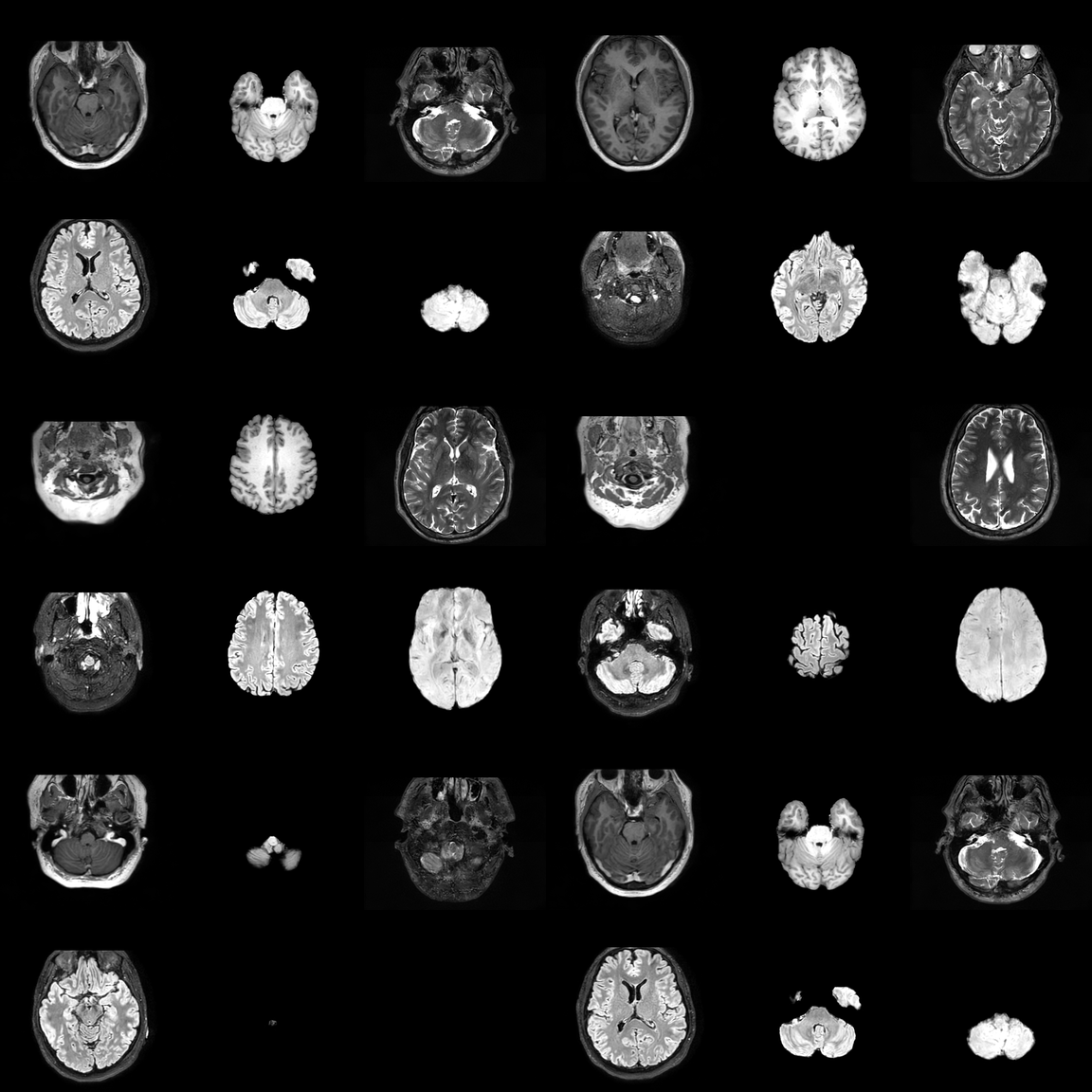 | 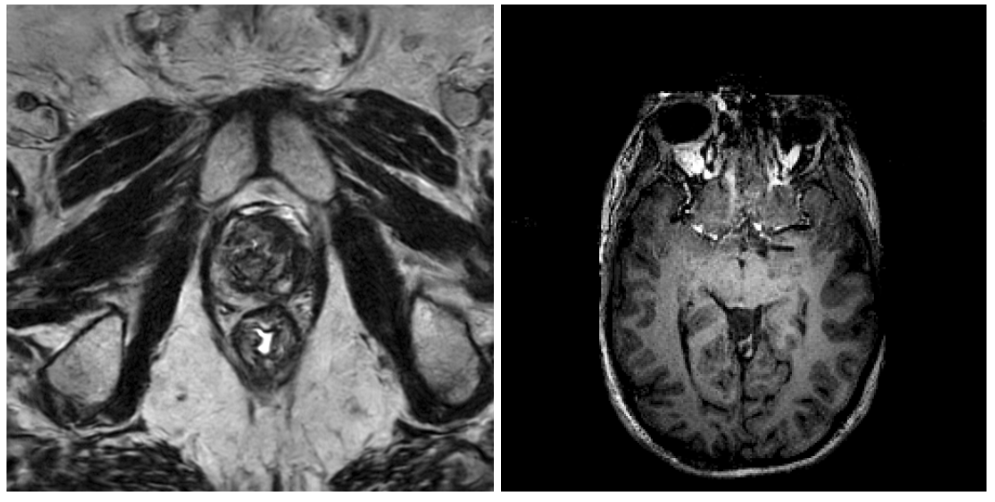 | 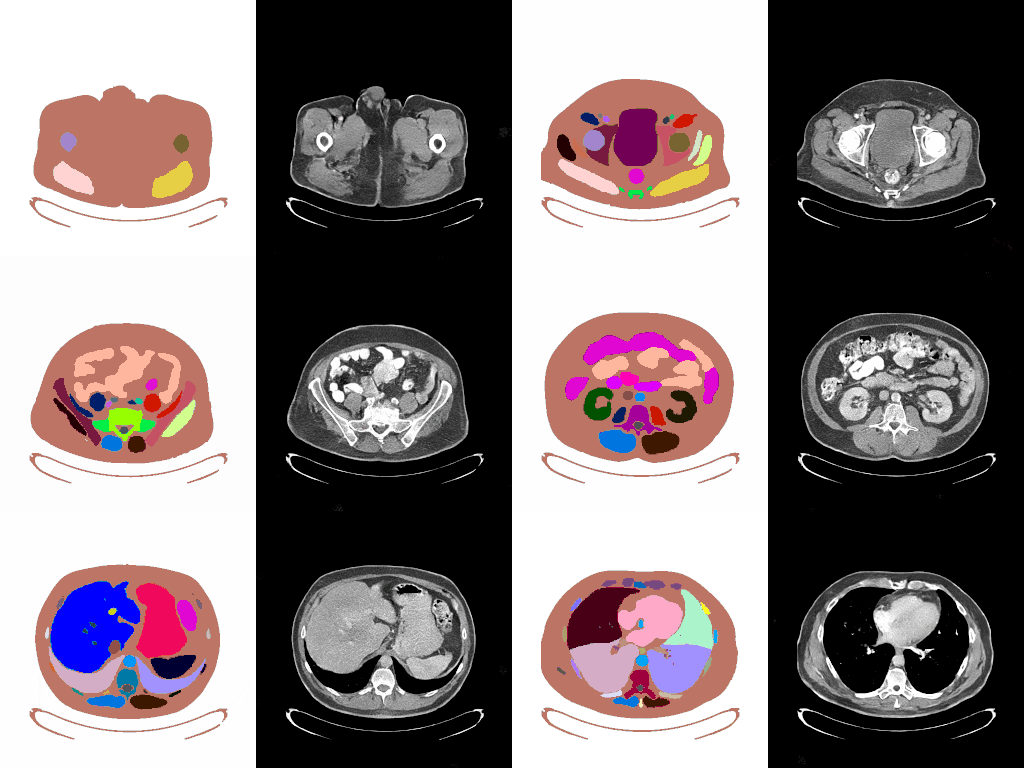 |
Generated MR Brain with rflow-mr-brain | Generated MR T2w prostate and T1w brain image with with rflow-mr | Generated CT image/mask pair with with rflow-ct |
NV-Generate-CTMR generates high-resolution synthetic 3D medical volumes using latent diffusion models built on the MAISI (Medical AI for Synthetic Imaging) framework. It produces CT images with paired segmentation masks and MRI volumes across multiple contrasts — enabling synthetic training data generation, data augmentation for rare pathologies, and privacy-preserving data sharing.
Key capabilities:
Live Demo (no GPU required)
rflow-mr-brain for fast high-resolution 3D MR brain image generation, which covers both whole brain and skull-stripped brain generation for T1w, T2w, FLAIR, SWI images. The training data of this version v0 is MR-RATE.rflow-mr for fast high-resolution 3D MR image generation. Upgraded previous MAISI
repo to this NV-Generate-CTMR repo.rflow-ct for fast high-resolution 3D CT image generation and paired CT
image/mask synthesis. rflow-ct is 33x faster than ddpm-ct and generates better quality images for the head region and small
output volumes.ddpm-ct supporting 3D latent diffusion (DDPM) for CT image generation and paired CT image/mask
synthesis.This repository provides five model variants for medical image generation: rflow-mr-brain, rflow-mr, rflow-ct, ddpm-ct, and rflow-mask.
rflow-mr-brain | rflow-mr | rflow-ct | ddpm-ct | rflow-mask | |
|---|---|---|---|---|---|
| Modality | MRI (Brain) | MRI | CT | CT | CT (mask only) |
| Model Weights | NV-Generate-MR-Brain | NV-Generate-MR | NV-Generate-CT | NV-Generate-CT | NV-Generate-CT |
| Architecture | MAISI-v2 (Rectified Flow) | MAISI-v2 (Rectified Flow) | MAISI-v2 (Rectified Flow) | MAISI-v1 (DDPM) | MAISI-v2 (Rectified Flow, AdaGN) |
| Paper | MAISI-v2 | MAISI-v2 | MAISI-v2 | MAISI-v1 | MAISI-v2 |
| Inference Steps | 30 | 30 | 30 | 1000 | 100 |
| Max Volume | 512x512x256 | 512x512x128 | 512x512x768 | 512x512x768 | 256x256x256 |
| Use Case | MR Brain multi-contrast synthesis | MR image-only generation | CT image/mask pair generation | CT image/mask pair generation | CT body mask with controllable anatomy, tumor, and demographics |
| License | NVIDIA Open Model | NVIDIA Non-Commercial | NVIDIA Open Model | NVIDIA Open Model | NVIDIA Open Model |
Summary: Use rflow-ct for CT image/mask pairs (whole-body). Use rflow-mask for CT body mask with controllable anatomy size, tumor, and demographics. Use rflow-mr-brain for brain MRI (multi-contrast). Use rflow-mr for other MRI anatomies (fine-tune on your own data).
rflow-mr-brain | rflow-mr | rflow-ct | ddpm-ct | rflow-mask | |
|---|---|---|---|---|---|
| Modality | MRI (brain) | MRI | CT | CT | CT (mask only) |
| Release Date | March 2026 | October 2025 | March 2025 | August 2024 | October 2026 |
| Model Weights | NV-Generate-MR-Brain | NV-Generate-MR | NV-Generate-CT | NV-Generate-CT | NV-Generate-CT |
| Quick Start | 2.2 MR Brain Image Generation | 2.6 MR Image Generation | 2.3 CT Paired Image/Mask, 2.5 CT Image | 2.3 CT Paired Image/Mask | 2.4 Body Mask Generation |
| Architecture | MAISI-v2 (Rectified Flow) | MAISI-v2 (Rectified Flow) | MAISI-v2 (Rectified Flow) | MAISI-v1 (DDPM) | MAISI-v2 (Rectified Flow, AdaGN) |
| Paper | MAISI-v2 | MAISI-v2 | MAISI-v2 | MAISI-v1 | MAISI-v2 |
| Network Detail | config_network_rflow.json | config_network_rflow.json | config_network_rflow.json | config_network_ddpm.json | DiffusionModelUNetMaisiAdaGN |
| Inference Steps | 30 | 30 | 30 (33× faster than ddpm-ct) | 1000 | 100 |
| Max Volume | 512×512×256 | 512×512×128 | 512×512×768 | 512×512×768 | 256×256×256 |
| Use Case | MR image-only generation for brain (T1w, T2w, FLAIR, SWI; whole brain and skull-stripped) | MR image-only generation with user specified contrast | CT image-only generation; CT image/mask pair generation | CT image-only generation; CT image/mask pair generation | CT body mask generation with controllable anatomy size, tumor, and demographics (19-d conditioning) |
| Model: Foundation VAE | same VAE with ddpm-ct | trained on CT and MR (with additional abdomen MRI) | same VAE with ddpm-ct | trained on CT and MR | dedicated mask VAE (4-ch latent → 125-class softmax) |
| Model: Foundation Diffusion Model | does not take body region as input, takes modality as input (brain-focused) | does not take body region as input, takes modality as input. We recommend finetuning with users' own MRI data. | does not take body region as input, has API for modality input (always set as 'ct' but expandable) | takes body region as input, no API for modality input | AdaGN cross-attention on 19-d vector (14 anatomy size slots + 5 demographics); CFG scale 2.0 |
| Model: ControlNet | Coming soon | N/A | generate image/mask pairs, with contrastive loss | generate image/mask pairs, no contrastive loss | N/A (mask-only output) |
💡 Using an AI coding agent (Claude Code, Cursor, Codex, etc.)? Each subsection below links to a per-workflow skill in
skills/. Ask the agent to read this README then use the corresponding skill file — it will run the matching workflow end-to-end, including model download, config edits, and the inference command.Example prompt — copy into your agent:
Read the README in this repo and use the matching skill to generate a T1 whole-brain MR image. Please first summarize what you plan to do, and let me know where the output will be saved.⚠️ Run inference manually?
dimandspacingare the single biggest factor in output quality — their productdim × spacingdefines the field of view (FOV). Each model variant has only ever seen FOVs in the training-data distribution for its target anatomy; asking it to synthesize at a numerically-valid but out-of-distribution FOV (e.g. a 128 mm-cube whole-body CT) produces unusable output. Start from the recommended(dim, spacing)per anatomy:
- CT (
rflow-ct,ddpm-ct): docs/inference.md#recommended-spacing-for-ct- MR (non-brain) (
rflow-mr): docs/inference.md#recommended-fov-for-mr-rflow-mr-model- MR Brain (
rflow-mr-brain): docs/inference.md#recommended-fov-for-mr-rflow-mr-brain-model
pip install -r requirements.txt
Skill: infer_image-only — feed this file to an AI coding agent to run the workflow below end-to-end.
Please refer to inference_diff_unet_tutorial.ipynb for the inference tutorial that generates CT or MR image without mask.
You can also run it in command line to generate MR image without mask. Please change "modality" in configs/config_maisi_diff_model_rflow-mr-brain.json according to configs/modality_mapping.json to control the output MR contrast. Currently we support both whole brain and skull-stripped brain generation for T1w, T2w, FLAIR, SWI images.
"mri":8, # MRI without specifying contrast or skull condition, can be any of them
"mri_t1":9, # T1w whole-brain MRI
"mri_t2":10, # T2w whole-brain MRI
"mri_flair":11, # FLAIR whole-brain MRI
"mri_swi":20, # SWI whole-brain MRI
"mri_t1_skull_stripped":29, # T1w skull-stripped brain MRI
"mri_t2_skull_stripped":30, # T2w skull-stripped brain MRI
"mri_flair_skull_stripped":31, # FLAIR skull-stripped brain MRI
"mri_swi_skull_stripped":32, # SWI skull-stripped brain MRI
export MONAI_DATA_DIRECTORY="./temp_work_dir"
network="rflow"
generate_version="rflow-mr-brain"
python -m scripts.diff_model_infer \
    -t ./configs/config_network_${network}.json \
    -e ./configs/environment_maisi_diff_model_${generate_version}.json \
    -c ./configs/config_maisi_diff_model_${generate_version}.json \
    --version ${generate_version}
Skill: infer_mask-image-paired — feed this file to an AI coding agent to run the workflow below end-to-end.
export MONAI_DATA_DIRECTORY="./temp_work_dir"
network="rflow"
generate_version="rflow-ct" # can change to "ddpm-ct"
python -m scripts.inference -t ./configs/config_network_${network}.json -i ./configs/config_infer.json -e ./configs/environment_${generate_version}.json --random-seed 0 --version ${generate_version}
See also: inference_tutorial.ipynb
Skill: infer_mask-only — feed this file to an AI coding agent to run the workflow below end-to-end.
Generate a 3D CT body mask using the v2 mask diffusion model (rflow-mask). The mask always contains all 132 MAISI labels. Control anatomy size, tumors, and patient demographics via controllable_anatomy_size and controllable_demographics (Path A), or retrieve a training mask matching body_region + anatomy_list (Path B).
# Set MONAI_DATA_DIRECTORY — weights and datasets (~10 GB) are downloaded here automatically on first run.
export MONAI_DATA_DIRECTORY="./temp_work_dir"

# Edit config_infer.json: set controllable_anatomy_size / controllable_demographics for Path A,
# or body_region / anatomy_list for Path B (leave controllable_* empty).
python -m scripts.inference \
    -t ./configs/config_network_rflow.json \
    -i ./configs/config_infer.json \
    -e ./configs/environment_rflow-ct.json \
    --random-seed 0 --version rflow-ct
The paired image is also generated (mask stage + image stage cannot be separated in the current CLI). The mask is saved as sample_<timestamp>_label.nii.gz.
Path A example — control bone-lesion size and patient demographics:
{
  "controllable_anatomy_size": [["bone lesion", 0.5]],
  "controllable_demographics": [["age", 55], ["sex", "M"], ["bmi", 24.5]],
  "output_size": [256, 256, 256],
  "spacing": [1.5, 1.5, 2.0]
}
⚠️
controllable_anatomy_sizeaccepts conditioning slot names ("liver","spleen","lung","bone lesion", …) — notanatomy_listorgan names."lung"is a valid conditioning name (slot 7) but is not valid inanatomy_list. SeeANATOMY_SIZE_IDXinscripts/sample_mask.pyfor all 14 valid names.
Skill: infer_image-only — feed this file to an AI coding agent to run the workflow below end-to-end.
export MONAI_DATA_DIRECTORY="./temp_work_dir"
network="rflow"
generate_version="rflow-ct" # can change to "ddpm-ct"
python -m scripts.diff_model_infer \
    -t ./configs/config_network_${network}.json \
    -e ./configs/environment_maisi_diff_model_${generate_version}.json \
    -c ./configs/config_maisi_diff_model_${generate_version}.json \
    --version ${generate_version}
Skill: infer_image-only — feed this file to an AI coding agent to run the workflow below end-to-end.
Change "modality" in configs/config_maisi_diff_model_rflow-mr.json according to configs/modality_mapping.json to control the output MR contrast. Supported contrasts: T1/T2 brain, FLAIR skull-stripped brain, T2 prostate, T1 breast, T1/T2 abdomen. But if you are going to synthesize brain images, we recommend using rflow-mr-brain model instead. Please see 2.2 MR Brain Image Generation. Different body region has different recommended FOV, please see detailed inference guide.
export MONAI_DATA_DIRECTORY="./temp_work_dir"
network="rflow"
generate_version="rflow-mr"
python -m scripts.diff_model_infer \
    -t ./configs/config_network_${network}.json \
    -e ./configs/environment_maisi_diff_model_${generate_version}.json \
    -c ./configs/config_maisi_diff_model_${generate_version}.json \
    --version ${generate_version}
Skill: infer_image-from-mask — feed this file to an AI coding agent to run the workflow below end-to-end (including mask preprocessing).
If you already have a 3D label mask in the MAISI 132-class vocabulary with the body envelope (label 200) added, you can feed it directly to the CT ControlNet to synthesize a paired CT image — no mask diffusion step needed:
network="rflow"
generate_version="rflow-ct" # can change to "ddpm-ct"
python -m scripts.download_model_data --version ${generate_version} --root_dir "./"
python -m scripts.infer_image_from_mask \
  -t ./configs/config_network_${network}.json \
  -i ./configs/config_infer.json \
  -e ./configs/environment_${generate_version}.json \
  --mask /path/to/your_mask.nii.gz
⚠️ The mask must be in the MAISI 132-class label vocabulary AND include the body envelope (label 200). In concrete terms, the MAISI 132-class vocabulary is the same as the
nv-segment-ctoutput label definition plus the body envelope (label 200). The authoritative reference isconfigs/label_dict.json. Two practical ways to produce a valid mask:
- From
nv-segment-ct(recommended — already in MAISI vocabulary): runnv-segment-cton the CT, then add the body envelope viascripts.utils.add_body_envelope(label 200 is never emitted bynv-segment-ct).- From another segmenter: remap the output labels to the MAISI 132-class IDs in
configs/label_dict.json, then add the body envelope.See the
infer_image-from-maskskill for the full preprocessing chain and the complete spec of "valid mask format".
For batch generation from many masks listed in a JSON, see scripts.infer_image_from_mask_batch.
⚠️ Independently developed by their respective authors; not endorsed, maintained, or audited by NVIDIA or the NV-Generate-CTMR maintainers — use at your own risk and review each project's license + clinical disclaimers. See
docs/applications.mdfor the full disclaimer.
rflow-ct: https://github.com/brudfors/maisi-mr-to-ct.If you've adapted NV-Generate-CTMR for other imaging tasks or applications and would like to share your work, please feel free to open an issue or contact the maintainers — we'd love to link to your repo.
| Guide | Description |
|---|---|
| Setup | Full installation guide, dependencies, model weight download |
| Inference | Detailed inference parameters, spacing tables |
| Training | VAE, Diffusion Model, and ControlNet training guides |
| Data Preparation | Dataset formats and preparation steps |
| Evaluation | FID evaluation tool and benchmark results |
| Troubleshooting | Common issues and solutions |
| Applications | Community adaptations (MR-to-CT synthesis, radiotherapy educational toolkit) |
| Inference Tutorial | Quick start CT paired generation (notebook) |
| Diffusion Inference | CT/MR image-only generation (notebook) |
| Training Tutorials | VAE, diffusion, and ControlNet training |
Training, inference, data preparation, and evaluation details are covered in the guides linked above.
On the unseen autoPET 2023 benchmark:
| Model | FID Score | Inference Steps | Speed vs ddpm-ct |
|---|---|---|---|
rflow-ct | 5.124 | 30 | 33x faster |
ddpm-ct | 6.083 | 1000 | baseline |
For inference parameters, see Documentation. For GPU memory and timing, see Performance.
| Component | License |
|---|---|
| Source code | Apache 2.0 |
| NV-Generate-CT weights | NVIDIA Open Model |
| NV-Generate-MR weights | NVIDIA Non-Commercial |
| NV-Generate-MR-Brain weights | NVIDIA Open Model |
This project will download and install additional third-party open source software projects. Review the license terms of these open source projects before use.
@article{zhao2026maisi,
  title={MAISI-v2: Accelerated 3D high-resolution medical image synthesis with rectified flow and region-specific contrastive loss},
  author={Zhao, Can and Guo, Pengfei and Yang, Dong and Tang, Yucheng and He, Yufan and Simon, Benjamin and Belue, Mason and Harmon, Stephanie and Turkbey, Baris and Xu, Daguang},
  journal={Proceedings of the 40th AAAI Conference on Artificial Intelligence (AAAI 2026)},
  year={2026}
}
@inproceedings{guo2025maisi,
  title={MAISI: Medical AI for synthetic imaging},
  author={Guo, Pengfei and Zhao, Can and Yang, Dong and Xu, Ziyue and Nath, Vishwesh and Tang, Yucheng and Simon, Benjamin and Belue, Mason and Harmon, Stephanie and Turkbey, Baris and others},
  booktitle={2025 IEEE/CVF Winter Conference on Applications of Computer Vision (WACV)},
  pages={4430--4441},
  year={2025},
  organization={IEEE}
}
This project was conducted by NVIDIA in collaboration with the University of Zurich, Istanbul Medipol University, and Forithmus.
We would like to thank the following people for their contributions to the development of the NV-Generate-MR-Brain models: Bjoern Menze, Ibrahim Ethem Hamamci, Sezgin Er, Suprosanna Shit, Utku Türkbey, etc.

168 followers · starred Mar 2026
3D Latent Diffusion Models (LDM) for generating large CT and MRI images with corresponding segmentation masks. Supports variable volume size and voxel spacing with precise control of organ/tumor size.
Please cite all the following papers if you are using code or model from this repo.
| | |
Generated MR Brain with rflow-mr-brain | Generated MR T2w prostate and T1w brain image with with rflow-mr | Generated CT image/mask pair with with rflow-ct |
NV-Generate-CTMR generates high-resolution synthetic 3D medical volumes using latent diffusion models built on the MAISI (Medical AI for Synthetic Imaging) framework. It produces CT images with paired segmentation masks and MRI volumes across multiple contrasts — enabling synthetic training data generation, data augmentation for rare pathologies, and privacy-preserving data sharing.
Key capabilities:
Live Demo (no GPU required)
rflow-mr-brain for fast high-resolution 3D MR brain image generation, which covers both whole brain and skull-stripped brain generation for T1w, T2w, FLAIR, SWI images. The training data of this version v0 is MR-RATE.rflow-mr for fast high-resolution 3D MR image generation. Upgraded previous MAISI
repo to this NV-Generate-CTMR repo.rflow-ct for fast high-resolution 3D CT image generation and paired CT
image/mask synthesis. rflow-ct is 33x faster than ddpm-ct and generates better quality images for the head region and small
output volumes.ddpm-ct supporting 3D latent diffusion (DDPM) for CT image generation and paired CT image/mask
synthesis.This repository provides five model variants for medical image generation: rflow-mr-brain, rflow-mr, rflow-ct, ddpm-ct, and rflow-mask.
rflow-mr-brain | rflow-mr | rflow-ct | ddpm-ct | rflow-mask | |
|---|---|---|---|---|---|
| Modality | MRI (Brain) | MRI | CT | CT | CT (mask only) |
| Model Weights | NV-Generate-MR-Brain | NV-Generate-MR | NV-Generate-CT | NV-Generate-CT | NV-Generate-CT |
| Architecture | MAISI-v2 (Rectified Flow) | MAISI-v2 (Rectified Flow) | MAISI-v2 (Rectified Flow) | MAISI-v1 (DDPM) | MAISI-v2 (Rectified Flow, AdaGN) |
| Paper | MAISI-v2 | MAISI-v2 | MAISI-v2 | MAISI-v1 | MAISI-v2 |
| Inference Steps | 30 | 30 | 30 | 1000 | 100 |
| Max Volume | 512x512x256 | 512x512x128 | 512x512x768 | 512x512x768 | 256x256x256 |
| Use Case | MR Brain multi-contrast synthesis | MR image-only generation | CT image/mask pair generation | CT image/mask pair generation | CT body mask with controllable anatomy, tumor, and demographics |
| License | NVIDIA Open Model | NVIDIA Non-Commercial | NVIDIA Open Model | NVIDIA Open Model | NVIDIA Open Model |
Summary: Use rflow-ct for CT image/mask pairs (whole-body). Use rflow-mask for CT body mask with controllable anatomy size, tumor, and demographics. Use rflow-mr-brain for brain MRI (multi-contrast). Use rflow-mr for other MRI anatomies (fine-tune on your own data).
rflow-mr-brain | rflow-mr | rflow-ct | ddpm-ct | rflow-mask | |
|---|---|---|---|---|---|
| Modality | MRI (brain) | MRI | CT | CT | CT (mask only) |
| Release Date | March 2026 | October 2025 | March 2025 | August 2024 | October 2026 |
| Model Weights | NV-Generate-MR-Brain | NV-Generate-MR | NV-Generate-CT | NV-Generate-CT | NV-Generate-CT |
| Quick Start | 2.2 MR Brain Image Generation | 2.6 MR Image Generation | 2.3 CT Paired Image/Mask, 2.5 CT Image | 2.3 CT Paired Image/Mask | 2.4 Body Mask Generation |
| Architecture | MAISI-v2 (Rectified Flow) | MAISI-v2 (Rectified Flow) | MAISI-v2 (Rectified Flow) | MAISI-v1 (DDPM) | MAISI-v2 (Rectified Flow, AdaGN) |
| Paper | MAISI-v2 | MAISI-v2 | MAISI-v2 | MAISI-v1 | MAISI-v2 |
| Network Detail | config_network_rflow.json | config_network_rflow.json | config_network_rflow.json | config_network_ddpm.json | DiffusionModelUNetMaisiAdaGN |
| Inference Steps | 30 | 30 | 30 (33× faster than ddpm-ct) | 1000 | 100 |
| Max Volume | 512×512×256 | 512×512×128 | 512×512×768 | 512×512×768 | 256×256×256 |
| Use Case | MR image-only generation for brain (T1w, T2w, FLAIR, SWI; whole brain and skull-stripped) | MR image-only generation with user specified contrast | CT image-only generation; CT image/mask pair generation | CT image-only generation; CT image/mask pair generation | CT body mask generation with controllable anatomy size, tumor, and demographics (19-d conditioning) |
| Model: Foundation VAE | same VAE with ddpm-ct | trained on CT and MR (with additional abdomen MRI) | same VAE with ddpm-ct | trained on CT and MR | dedicated mask VAE (4-ch latent → 125-class softmax) |
| Model: Foundation Diffusion Model | does not take body region as input, takes modality as input (brain-focused) | does not take body region as input, takes modality as input. We recommend finetuning with users' own MRI data. | does not take body region as input, has API for modality input (always set as 'ct' but expandable) | takes body region as input, no API for modality input | AdaGN cross-attention on 19-d vector (14 anatomy size slots + 5 demographics); CFG scale 2.0 |
| Model: ControlNet | Coming soon | N/A | generate image/mask pairs, with contrastive loss | generate image/mask pairs, no contrastive loss | N/A (mask-only output) |
💡 Using an AI coding agent (Claude Code, Cursor, Codex, etc.)? Each subsection below links to a per-workflow skill in
skills/. Ask the agent to read this README then use the corresponding skill file — it will run the matching workflow end-to-end, including model download, config edits, and the inference command.Example prompt — copy into your agent:
Read the README in this repo and use the matching skill to generate a T1 whole-brain MR image. Please first summarize what you plan to do, and let me know where the output will be saved.⚠️ Run inference manually?
dimandspacingare the single biggest factor in output quality — their productdim × spacingdefines the field of view (FOV). Each model variant has only ever seen FOVs in the training-data distribution for its target anatomy; asking it to synthesize at a numerically-valid but out-of-distribution FOV (e.g. a 128 mm-cube whole-body CT) produces unusable output. Start from the recommended(dim, spacing)per anatomy:
- CT (
rflow-ct,ddpm-ct): docs/inference.md#recommended-spacing-for-ct- MR (non-brain) (
rflow-mr): docs/inference.md#recommended-fov-for-mr-rflow-mr-model- MR Brain (
rflow-mr-brain): docs/inference.md#recommended-fov-for-mr-rflow-mr-brain-model
pip install -r requirements.txt
Skill: infer_image-only — feed this file to an AI coding agent to run the workflow below end-to-end.
Please refer to inference_diff_unet_tutorial.ipynb for the inference tutorial that generates CT or MR image without mask.
You can also run it in command line to generate MR image without mask. Please change "modality" in configs/config_maisi_diff_model_rflow-mr-brain.json according to configs/modality_mapping.json to control the output MR contrast. Currently we support both whole brain and skull-stripped brain generation for T1w, T2w, FLAIR, SWI images.
"mri":8, # MRI without specifying contrast or skull condition, can be any of them
"mri_t1":9, # T1w whole-brain MRI
"mri_t2":10, # T2w whole-brain MRI
"mri_flair":11, # FLAIR whole-brain MRI
"mri_swi":20, # SWI whole-brain MRI
"mri_t1_skull_stripped":29, # T1w skull-stripped brain MRI
"mri_t2_skull_stripped":30, # T2w skull-stripped brain MRI
"mri_flair_skull_stripped":31, # FLAIR skull-stripped brain MRI
"mri_swi_skull_stripped":32, # SWI skull-stripped brain MRI
export MONAI_DATA_DIRECTORY="./temp_work_dir"
network="rflow"
generate_version="rflow-mr-brain"
python -m scripts.diff_model_infer \
    -t ./configs/config_network_${network}.json \
    -e ./configs/environment_maisi_diff_model_${generate_version}.json \
    -c ./configs/config_maisi_diff_model_${generate_version}.json \
    --version ${generate_version}
Skill: infer_mask-image-paired — feed this file to an AI coding agent to run the workflow below end-to-end.
export MONAI_DATA_DIRECTORY="./temp_work_dir"
network="rflow"
generate_version="rflow-ct" # can change to "ddpm-ct"
python -m scripts.inference -t ./configs/config_network_${network}.json -i ./configs/config_infer.json -e ./configs/environment_${generate_version}.json --random-seed 0 --version ${generate_version}
See also: inference_tutorial.ipynb
Skill: infer_mask-only — feed this file to an AI coding agent to run the workflow below end-to-end.
Generate a 3D CT body mask using the v2 mask diffusion model (rflow-mask). The mask always contains all 132 MAISI labels. Control anatomy size, tumors, and patient demographics via controllable_anatomy_size and controllable_demographics (Path A), or retrieve a training mask matching body_region + anatomy_list (Path B).
# Set MONAI_DATA_DIRECTORY — weights and datasets (~10 GB) are downloaded here automatically on first run.
export MONAI_DATA_DIRECTORY="./temp_work_dir"

# Edit config_infer.json: set controllable_anatomy_size / controllable_demographics for Path A,
# or body_region / anatomy_list for Path B (leave controllable_* empty).
python -m scripts.inference \
    -t ./configs/config_network_rflow.json \
    -i ./configs/config_infer.json \
    -e ./configs/environment_rflow-ct.json \
    --random-seed 0 --version rflow-ct
The paired image is also generated (mask stage + image stage cannot be separated in the current CLI). The mask is saved as sample_<timestamp>_label.nii.gz.
Path A example — control bone-lesion size and patient demographics:
{
  "controllable_anatomy_size": [["bone lesion", 0.5]],
  "controllable_demographics": [["age", 55], ["sex", "M"], ["bmi", 24.5]],
  "output_size": [256, 256, 256],
  "spacing": [1.5, 1.5, 2.0]
}
⚠️
controllable_anatomy_sizeaccepts conditioning slot names ("liver","spleen","lung","bone lesion", …) — notanatomy_listorgan names."lung"is a valid conditioning name (slot 7) but is not valid inanatomy_list. SeeANATOMY_SIZE_IDXinscripts/sample_mask.pyfor all 14 valid names.
Skill: infer_image-only — feed this file to an AI coding agent to run the workflow below end-to-end.
export MONAI_DATA_DIRECTORY="./temp_work_dir"
network="rflow"
generate_version="rflow-ct" # can change to "ddpm-ct"
python -m scripts.diff_model_infer \
    -t ./configs/config_network_${network}.json \
    -e ./configs/environment_maisi_diff_model_${generate_version}.json \
    -c ./configs/config_maisi_diff_model_${generate_version}.json \
    --version ${generate_version}
Skill: infer_image-only — feed this file to an AI coding agent to run the workflow below end-to-end.
Change "modality" in configs/config_maisi_diff_model_rflow-mr.json according to configs/modality_mapping.json to control the output MR contrast. Supported contrasts: T1/T2 brain, FLAIR skull-stripped brain, T2 prostate, T1 breast, T1/T2 abdomen. But if you are going to synthesize brain images, we recommend using rflow-mr-brain model instead. Please see 2.2 MR Brain Image Generation. Different body region has different recommended FOV, please see detailed inference guide.
export MONAI_DATA_DIRECTORY="./temp_work_dir"
network="rflow"
generate_version="rflow-mr"
python -m scripts.diff_model_infer \
    -t ./configs/config_network_${network}.json \
    -e ./configs/environment_maisi_diff_model_${generate_version}.json \
    -c ./configs/config_maisi_diff_model_${generate_version}.json \
    --version ${generate_version}
Skill: infer_image-from-mask — feed this file to an AI coding agent to run the workflow below end-to-end (including mask preprocessing).
If you already have a 3D label mask in the MAISI 132-class vocabulary with the body envelope (label 200) added, you can feed it directly to the CT ControlNet to synthesize a paired CT image — no mask diffusion step needed:
network="rflow"
generate_version="rflow-ct" # can change to "ddpm-ct"
python -m scripts.download_model_data --version ${generate_version} --root_dir "./"
python -m scripts.infer_image_from_mask \
  -t ./configs/config_network_${network}.json \
  -i ./configs/config_infer.json \
  -e ./configs/environment_${generate_version}.json \
  --mask /path/to/your_mask.nii.gz
⚠️ The mask must be in the MAISI 132-class label vocabulary AND include the body envelope (label 200). In concrete terms, the MAISI 132-class vocabulary is the same as the
nv-segment-ctoutput label definition plus the body envelope (label 200). The authoritative reference isconfigs/label_dict.json. Two practical ways to produce a valid mask:
- From
nv-segment-ct(recommended — already in MAISI vocabulary): runnv-segment-cton the CT, then add the body envelope viascripts.utils.add_body_envelope(label 200 is never emitted bynv-segment-ct).- From another segmenter: remap the output labels to the MAISI 132-class IDs in
configs/label_dict.json, then add the body envelope.See the
infer_image-from-maskskill for the full preprocessing chain and the complete spec of "valid mask format".
For batch generation from many masks listed in a JSON, see scripts.infer_image_from_mask_batch.
⚠️ Independently developed by their respective authors; not endorsed, maintained, or audited by NVIDIA or the NV-Generate-CTMR maintainers — use at your own risk and review each project's license + clinical disclaimers. See
docs/applications.mdfor the full disclaimer.
rflow-ct: https://github.com/brudfors/maisi-mr-to-ct.If you've adapted NV-Generate-CTMR for other imaging tasks or applications and would like to share your work, please feel free to open an issue or contact the maintainers — we'd love to link to your repo.
| Guide | Description |
|---|---|
| Setup | Full installation guide, dependencies, model weight download |
| Inference | Detailed inference parameters, spacing tables |
| Training | VAE, Diffusion Model, and ControlNet training guides |
| Data Preparation | Dataset formats and preparation steps |
| Evaluation | FID evaluation tool and benchmark results |
| Troubleshooting | Common issues and solutions |
| Applications | Community adaptations (MR-to-CT synthesis, radiotherapy educational toolkit) |
| Inference Tutorial | Quick start CT paired generation (notebook) |
| Diffusion Inference | CT/MR image-only generation (notebook) |
| Training Tutorials | VAE, diffusion, and ControlNet training |
Training, inference, data preparation, and evaluation details are covered in the guides linked above.
On the unseen autoPET 2023 benchmark:
| Model | FID Score | Inference Steps | Speed vs ddpm-ct |
|---|---|---|---|
rflow-ct | 5.124 | 30 | 33x faster |
ddpm-ct | 6.083 | 1000 | baseline |
For inference parameters, see Documentation. For GPU memory and timing, see Performance.
| Component | License |
|---|---|
| Source code | Apache 2.0 |
| NV-Generate-CT weights | NVIDIA Open Model |
| NV-Generate-MR weights | NVIDIA Non-Commercial |
| NV-Generate-MR-Brain weights | NVIDIA Open Model |
This project will download and install additional third-party open source software projects. Review the license terms of these open source projects before use.
@article{zhao2026maisi,
  title={MAISI-v2: Accelerated 3D high-resolution medical image synthesis with rectified flow and region-specific contrastive loss},
  author={Zhao, Can and Guo, Pengfei and Yang, Dong and Tang, Yucheng and He, Yufan and Simon, Benjamin and Belue, Mason and Harmon, Stephanie and Turkbey, Baris and Xu, Daguang},
  journal={Proceedings of the 40th AAAI Conference on Artificial Intelligence (AAAI 2026)},
  year={2026}
}
@inproceedings{guo2025maisi,
  title={MAISI: Medical AI for synthetic imaging},
  author={Guo, Pengfei and Zhao, Can and Yang, Dong and Xu, Ziyue and Nath, Vishwesh and Tang, Yucheng and Simon, Benjamin and Belue, Mason and Harmon, Stephanie and Turkbey, Baris and others},
  booktitle={2025 IEEE/CVF Winter Conference on Applications of Computer Vision (WACV)},
  pages={4430--4441},
  year={2025},
  organization={IEEE}
}
This project was conducted by NVIDIA in collaboration with the University of Zurich, Istanbul Medipol University, and Forithmus.
We would like to thank the following people for their contributions to the development of the NV-Generate-MR-Brain models: Bjoern Menze, Ibrahim Ethem Hamamci, Sezgin Er, Suprosanna Shit, Utku Türkbey, etc.
168 followers · starred Mar 2026



