LLM-based Literary Translation evaluation metric with Professional Question Answering
Jupyter Notebook
4
16 commits
updated Nov 16, 2025

LitTransProQA/
├── datasets/                    # Dataset directory
│   ├── QA_weights.csv          # selected question weights
│   ├── benchmark_dataset_all_src_tgt.csv # LitEval + Iyyer: full sample ID
│   └── sampled_benchmark.csv   # Sampled ID for validation set
├── finetuning_method/         # Fine-tuning related code
│   ├── configs/               # Configuration files
│   ├── xcomet_regression.py   # Regression task finetuning
│   ├── xcomet_inference.py    # Inference implementation
│   └── xcomet_ranking.py      # Ranking task finetuning
├── prompting_method/          # Prompt-based approaches
│   ├── template/             # Prompt templates
│   ├── QA_translators/       # translator voting results
│   ├── prompt_openrouter.py  # API integration
│   ├── run_all_models.py     # Model execution script
│   └── build_dataset.py      # Prompt preparation
└── SOTA_metric/              # State-of-the-art metrics
    └── m_prometheous.py      # Prometheus metric implementation
Dataset: Due to copyright and licensing restrictions, we only release the IDs on GitHub. The complete test datasets, including source and target texts, can be downloaded via Google form (coming soon, awaiting permission and ethical checks) for research purposes only.
Installation:
pip install --upgrade pip  # ensures that pip is current
pip install unbabel-comet
Multiple Assessment Methods:
Instructions to run LitTransProQA: To reproduce results or use for scoring, one must first download the dataset containing the source and target information from the instructions above. Alternatively, you can replace this with your own data.
# Step1: Build prompts from datasets (.csv containing "src" [source] and "tgt" [target] columns); one can modify the template
python prompting_method/build_dataset.py

# Step2: Scoring using a single {model}
python prompting_method/prompt_openrouter.py \
              --file final_set/final_set_with_QA.csv \
              --model {model} \
              --content-column QA \
              --temperature 0.3 \
              --output-dir final_results/

# Or Step2: Scoring using multiple models, e.g., from model_list.txt
python prompting_method/run_all_models.py
Feel free to contribute by submitting a pull request.
# Fork the repository
# Create a new branch for your feature or fix
# Commit your changes with a clear message
# Push to your fork and submit a PR
Specify the license under which this code is shared.
This project is licensed under the CC License - see the LICENSE file for details.
If you use this work in your research, please cite it as:
@inproceedings{zhang-etal-2025-litransproqa,
    title = "{L}i{T}rans{P}ro{QA}: An {LLM}-based Literary Translation Evaluation Metric with Professional Question Answering",
    author = "Zhang, Ran  and
      Zhao, Wei  and
      Macken, Lieve  and
      Eger, Steffen",
    editor = "Christodoulopoulos, Christos  and
      Chakraborty, Tanmoy  and
      Rose, Carolyn  and
      Peng, Violet",
    booktitle = "Proceedings of the 2025 Conference on Empirical Methods in Natural Language Processing",
    month = nov,
    year = "2025",
    address = "Suzhou, China",
    publisher = "Association for Computational Linguistics",
    url = "https://aclanthology.org/2025.emnlp-main.1482/",
    doi = "10.18653/v1/2025.emnlp-main.1482",
    pages = "29087--29109",
    ISBN = "979-8-89176-332-6",
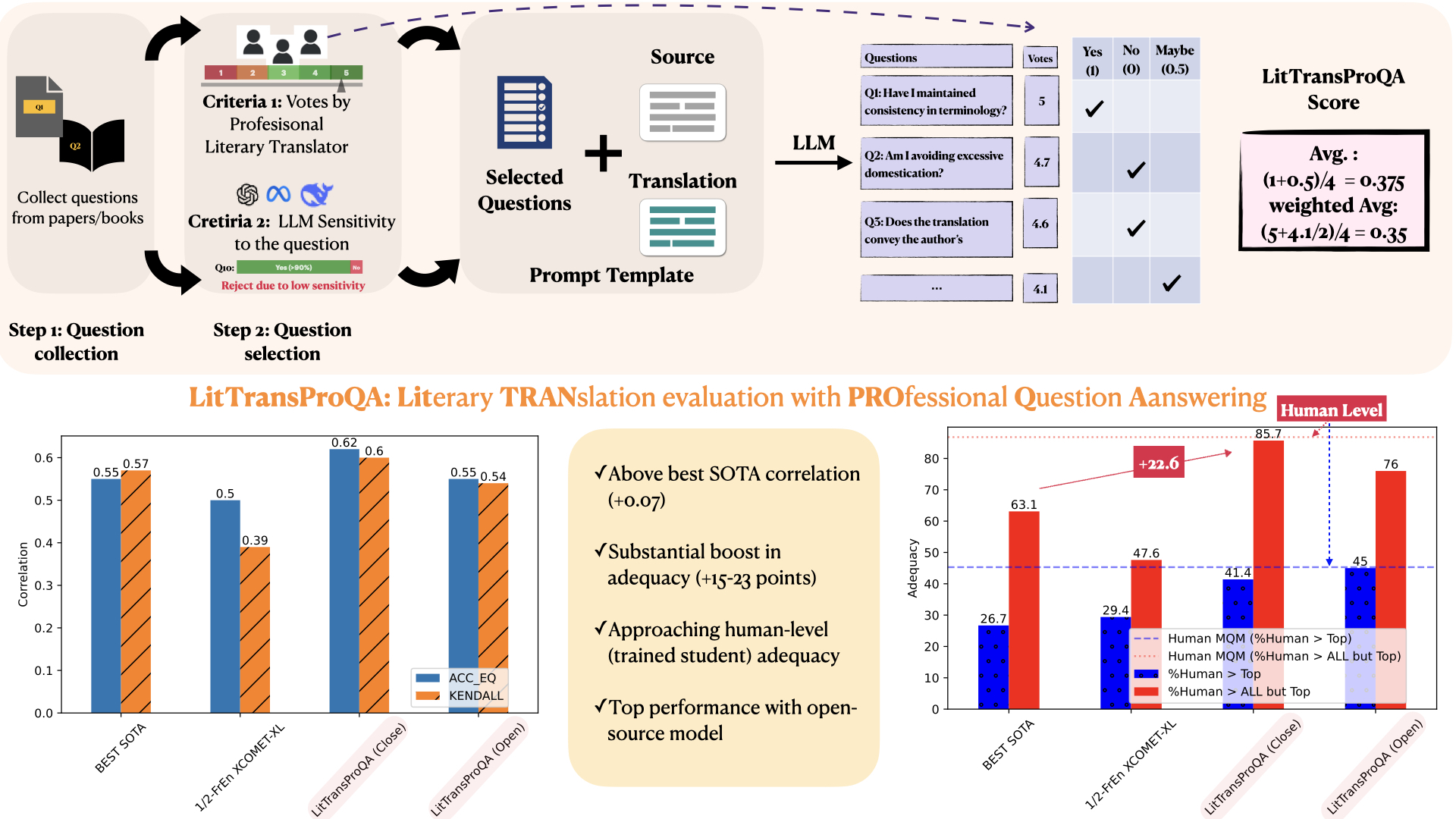
    abstract = "The impact of Large Language Models (LLMs) has extended into literary domains. However, existing evaluation metrics for literature prioritize mechanical accuracy over artistic expression and tend to overrate machine translation as being superior to human translation from experienced professionals. In the long run, this bias could result in an irreversible decline in translation quality and cultural authenticity. In response to the urgent need for a specialized literary evaluation metric, we introduce LITRANSPROQA, a novel, reference-free, LLM-based question-answering framework designed for literary translation evaluation. LITRANSPROQA integrates humans in the loop to incorporate insights from professional literary translators and researchers, focusing on critical elements in literary quality assessment such as literary devices, cultural understanding, and authorial voice. Our extensive evaluation shows that while literary-finetuned XCOMET-XL yields marginal gains, LITRANSPROQA substantially outperforms current metrics, achieving up to 0.07 gain in correlation and surpassing the best state-of-the-art metrics by over 15 points in adequacy assessments. Incorporating professional translator insights as weights further improves performance, highlighting the value of translator inputs. Notably, LITRANSPROQA reaches an adequacy performance comparable to trained linguistic student evaluators, though it still falls behind experienced professional translators. LITRANSPROQA shows broad applicability to open-source models like LLaMA3.3-70b and Qwen2.5-32b, indicating its potential as an accessible and training-free tool for evaluating literary translations that require local processing due to copyright or ethical considerations."
}
LLM-based Literary Translation evaluation metric with Professional Question Answering
Jupyter Notebook
4
16 commits
updated Nov 16, 2025
LitTransProQA/
├── datasets/                    # Dataset directory
│   ├── QA_weights.csv          # selected question weights
│   ├── benchmark_dataset_all_src_tgt.csv # LitEval + Iyyer: full sample ID
│   └── sampled_benchmark.csv   # Sampled ID for validation set
├── finetuning_method/         # Fine-tuning related code
│   ├── configs/               # Configuration files
│   ├── xcomet_regression.py   # Regression task finetuning
│   ├── xcomet_inference.py    # Inference implementation
│   └── xcomet_ranking.py      # Ranking task finetuning
├── prompting_method/          # Prompt-based approaches
│   ├── template/             # Prompt templates
│   ├── QA_translators/       # translator voting results
│   ├── prompt_openrouter.py  # API integration
│   ├── run_all_models.py     # Model execution script
│   └── build_dataset.py      # Prompt preparation
└── SOTA_metric/              # State-of-the-art metrics
    └── m_prometheous.py      # Prometheus metric implementation
Dataset: Due to copyright and licensing restrictions, we only release the IDs on GitHub. The complete test datasets, including source and target texts, can be downloaded via Google form (coming soon, awaiting permission and ethical checks) for research purposes only.
Installation:
pip install --upgrade pip  # ensures that pip is current
pip install unbabel-comet
Multiple Assessment Methods:
Instructions to run LitTransProQA: To reproduce results or use for scoring, one must first download the dataset containing the source and target information from the instructions above. Alternatively, you can replace this with your own data.
# Step1: Build prompts from datasets (.csv containing "src" [source] and "tgt" [target] columns); one can modify the template
python prompting_method/build_dataset.py

# Step2: Scoring using a single {model}
python prompting_method/prompt_openrouter.py \
              --file final_set/final_set_with_QA.csv \
              --model {model} \
              --content-column QA \
              --temperature 0.3 \
              --output-dir final_results/

# Or Step2: Scoring using multiple models, e.g., from model_list.txt
python prompting_method/run_all_models.py
Feel free to contribute by submitting a pull request.
# Fork the repository
# Create a new branch for your feature or fix
# Commit your changes with a clear message
# Push to your fork and submit a PR
Specify the license under which this code is shared.
This project is licensed under the CC License - see the LICENSE file for details.
If you use this work in your research, please cite it as:
@inproceedings{zhang-etal-2025-litransproqa,
    title = "{L}i{T}rans{P}ro{QA}: An {LLM}-based Literary Translation Evaluation Metric with Professional Question Answering",
    author = "Zhang, Ran  and
      Zhao, Wei  and
      Macken, Lieve  and
      Eger, Steffen",
    editor = "Christodoulopoulos, Christos  and
      Chakraborty, Tanmoy  and
      Rose, Carolyn  and
      Peng, Violet",
    booktitle = "Proceedings of the 2025 Conference on Empirical Methods in Natural Language Processing",
    month = nov,
    year = "2025",
    address = "Suzhou, China",
    publisher = "Association for Computational Linguistics",
    url = "https://aclanthology.org/2025.emnlp-main.1482/",
    doi = "10.18653/v1/2025.emnlp-main.1482",
    pages = "29087--29109",
    ISBN = "979-8-89176-332-6",
    abstract = "The impact of Large Language Models (LLMs) has extended into literary domains. However, existing evaluation metrics for literature prioritize mechanical accuracy over artistic expression and tend to overrate machine translation as being superior to human translation from experienced professionals. In the long run, this bias could result in an irreversible decline in translation quality and cultural authenticity. In response to the urgent need for a specialized literary evaluation metric, we introduce LITRANSPROQA, a novel, reference-free, LLM-based question-answering framework designed for literary translation evaluation. LITRANSPROQA integrates humans in the loop to incorporate insights from professional literary translators and researchers, focusing on critical elements in literary quality assessment such as literary devices, cultural understanding, and authorial voice. Our extensive evaluation shows that while literary-finetuned XCOMET-XL yields marginal gains, LITRANSPROQA substantially outperforms current metrics, achieving up to 0.07 gain in correlation and surpassing the best state-of-the-art metrics by over 15 points in adequacy assessments. Incorporating professional translator insights as weights further improves performance, highlighting the value of translator inputs. Notably, LITRANSPROQA reaches an adequacy performance comparable to trained linguistic student evaluators, though it still falls behind experienced professional translators. LITRANSPROQA shows broad applicability to open-source models like LLaMA3.3-70b and Qwen2.5-32b, indicating its potential as an accessible and training-free tool for evaluating literary translations that require local processing due to copyright or ethical considerations."
}