This is the official implementation of the paper PEGRL: Improving Machine Translation by Post-Editing Guided Reinforcement Learning.
Python
5
9 commits
updated Apr 17, 2026
A reinforcement learning framework for improving machine translation via post-editing guidance.
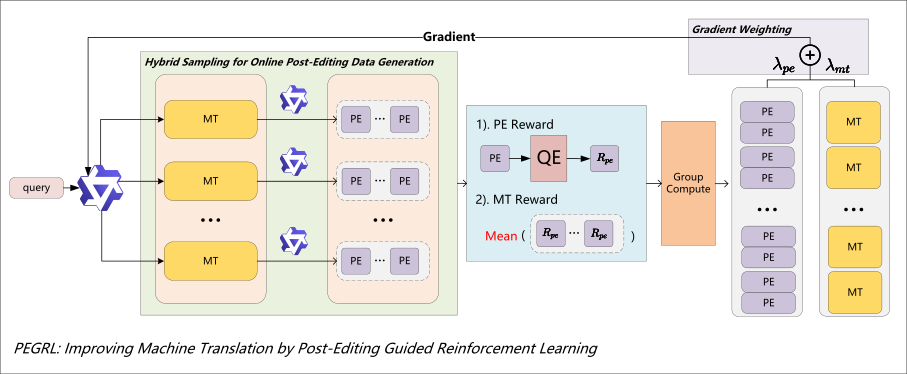


PEGRL is a two-stage reinforcement learning (RL) framework for machine translation that leverages post-editing as an auxiliary task to stabilize training and guide optimization. While RL has shown strong promise in LLM-based MT (e.g., GRPO), translation-oriented RL suffers from noisy Monte Carlo return estimates and large trajectory spaces, often favoring global over local optimization.
PEGRL addresses these challenges by:
Results: Experiments on English→Finnish, English→Turkish, and English↔Chinese show consistent improvements over standard RL baselines. Notably, English→Turkish COMET-KIWI performance approaches state-of-the-art LLM systems (DeepSeek-V3.2: 68.14 vs. 68.13).
Our software environment is based on Python 3.11. The main upper-level Python packages include verl, sacrebleu, and unbabel-comet. You can build the software environment using the following script:
First, install COMET:
git clone https://github.com/dgme-syz/COMET.git && cd COMET && git checkout feature/support-custom-strategy && pip install -e .
Then, prepare the dependencies required for the training framework:
USE_SGLANG=0 USE_MEGATRON=0 bash scripts/install_vllm_sglang_mcore.sh
pip install sacrebleu "sacrebleu[ja]" "sacrebleu[ko]"
We provide a Conda environment file for reference. We recommend using the installation script above for setup. The env.yaml file is intended for reference only.
For Ascend users, run the following:
git clone https://github.com/dgme-syz/COMET.git && cd COMET && git checkout feature/support-custom-strategy && pip install -e .
pip install vllm==0.11.0
pip install vllm-ascend==0.11.0rc1
pip install -r requirements-npu.txt
pip install -e .
pip install sacrebleu "sacrebleu[ja]" "sacrebleu[ko]"
The project uses both policy models and external reward models. For policy models, we recommend creating symbolic links under the models directory. External reward models include COMETKiwi and XCOMET (we recommend managing COMET models using $HF_HOME):
ln -sfn path/to/your/locate/model models/Qwen3-0.6B
ln -sfn path/to/your/locate/model models/Qwen3-4B
ln -sfn path/to/your/locate/model models/Qwen3-8B
Make sure you know the location specified by the HF_HOME environment variable:
hf download Unbabel/wmt23-cometkiwi-da-xl
hf download Unbabel/XCOMET-XL
If hf download is used without specifying the --local-dir parameter, you do not need to manually set the COMET model path. Otherwise, if you:
please refer to comet.yaml.
[!TIP] In multi-GPU settings, using many COMET models is not recommended. The current implementation loads one COMET model per GPU, which can consume a large amount of memory even before the models are invoked.
Simply place the folder from the link into the project root directory, i.e.:
project-root/
├── data/
│   ├── train/
│   ├── test/
│   └── ...
├── verl/
└── scripts/
All experiment scripts are organized by category under train_scripts. The main subdirectory contains the primary experiments, ablation contains the main ablation studies, and weight contains weight analysis experiments. All scripts should be executed from the project root directory. For example:
bash train_scripts/main/train_0_4B_en2fi_ours.sh
# Or ascend
bash train_scripts/main_ascend/train_0_4B_en2fi_ours.sh
For the experiment scripts, you may adjust two per-GPU batch parameters based on the available GPU memory:
ppo_micro_batch_size_per_gpu:
forward_micro_batch_size (in comet.yaml):
Other parameters, such as project/experiment naming and model checkpoint saving frequency, can be modified if necessary, but changes beyond these are not recommended.
If you have any questions or run into issues, please feel free to open an issue for discussion. You can also reach me at [email protected].
If you find this repository useful, please consider citing:
@misc{shen2026pegrlimprovingmachinetranslation,
  title={PEGRL: Improving Machine Translation by Post-Editing Guided Reinforcement Learning},
  author={Yunzhi Shen and Hao Zhou and Xin Huang and Xue Han and Junlan Feng and Shujian Huang},
  year={2026},
  eprint={2602.03352},
  archivePrefix={arXiv},
  primaryClass={cs.CL},
  url={https://arxiv.org/abs/2602.03352}
}
Our codebase is built upon the work of MT-R1-Zero and Verl. We extend our sincere thanks to their projects.
This is the official implementation of the paper PEGRL: Improving Machine Translation by Post-Editing Guided Reinforcement Learning.
Python
5
9 commits
updated Apr 17, 2026
A reinforcement learning framework for improving machine translation via post-editing guidance.
PEGRL is a two-stage reinforcement learning (RL) framework for machine translation that leverages post-editing as an auxiliary task to stabilize training and guide optimization. While RL has shown strong promise in LLM-based MT (e.g., GRPO), translation-oriented RL suffers from noisy Monte Carlo return estimates and large trajectory spaces, often favoring global over local optimization.
PEGRL addresses these challenges by:
Results: Experiments on English→Finnish, English→Turkish, and English↔Chinese show consistent improvements over standard RL baselines. Notably, English→Turkish COMET-KIWI performance approaches state-of-the-art LLM systems (DeepSeek-V3.2: 68.14 vs. 68.13).
Our software environment is based on Python 3.11. The main upper-level Python packages include verl, sacrebleu, and unbabel-comet. You can build the software environment using the following script:
First, install COMET:
git clone https://github.com/dgme-syz/COMET.git && cd COMET && git checkout feature/support-custom-strategy && pip install -e .
Then, prepare the dependencies required for the training framework:
USE_SGLANG=0 USE_MEGATRON=0 bash scripts/install_vllm_sglang_mcore.sh
pip install sacrebleu "sacrebleu[ja]" "sacrebleu[ko]"
We provide a Conda environment file for reference. We recommend using the installation script above for setup. The env.yaml file is intended for reference only.
For Ascend users, run the following:
git clone https://github.com/dgme-syz/COMET.git && cd COMET && git checkout feature/support-custom-strategy && pip install -e .
pip install vllm==0.11.0
pip install vllm-ascend==0.11.0rc1
pip install -r requirements-npu.txt
pip install -e .
pip install sacrebleu "sacrebleu[ja]" "sacrebleu[ko]"
The project uses both policy models and external reward models. For policy models, we recommend creating symbolic links under the models directory. External reward models include COMETKiwi and XCOMET (we recommend managing COMET models using $HF_HOME):
ln -sfn path/to/your/locate/model models/Qwen3-0.6B
ln -sfn path/to/your/locate/model models/Qwen3-4B
ln -sfn path/to/your/locate/model models/Qwen3-8B
Make sure you know the location specified by the HF_HOME environment variable:
hf download Unbabel/wmt23-cometkiwi-da-xl
hf download Unbabel/XCOMET-XL
If hf download is used without specifying the --local-dir parameter, you do not need to manually set the COMET model path. Otherwise, if you:
please refer to comet.yaml.
[!TIP] In multi-GPU settings, using many COMET models is not recommended. The current implementation loads one COMET model per GPU, which can consume a large amount of memory even before the models are invoked.
Simply place the folder from the link into the project root directory, i.e.:
project-root/
├── data/
│   ├── train/
│   ├── test/
│   └── ...
├── verl/
└── scripts/
All experiment scripts are organized by category under train_scripts. The main subdirectory contains the primary experiments, ablation contains the main ablation studies, and weight contains weight analysis experiments. All scripts should be executed from the project root directory. For example:
bash train_scripts/main/train_0_4B_en2fi_ours.sh
# Or ascend
bash train_scripts/main_ascend/train_0_4B_en2fi_ours.sh
For the experiment scripts, you may adjust two per-GPU batch parameters based on the available GPU memory:
ppo_micro_batch_size_per_gpu:
forward_micro_batch_size (in comet.yaml):
Other parameters, such as project/experiment naming and model checkpoint saving frequency, can be modified if necessary, but changes beyond these are not recommended.
If you have any questions or run into issues, please feel free to open an issue for discussion. You can also reach me at [email protected].
If you find this repository useful, please consider citing:
@misc{shen2026pegrlimprovingmachinetranslation,
  title={PEGRL: Improving Machine Translation by Post-Editing Guided Reinforcement Learning},
  author={Yunzhi Shen and Hao Zhou and Xin Huang and Xue Han and Junlan Feng and Shujian Huang},
  year={2026},
  eprint={2602.03352},
  archivePrefix={arXiv},
  primaryClass={cs.CL},
  url={https://arxiv.org/abs/2602.03352}
}
Our codebase is built upon the work of MT-R1-Zero and Verl. We extend our sincere thanks to their projects.





