
README
AVE-Compass
Can audio-visual editing models correctly follow cross-modal instructions?
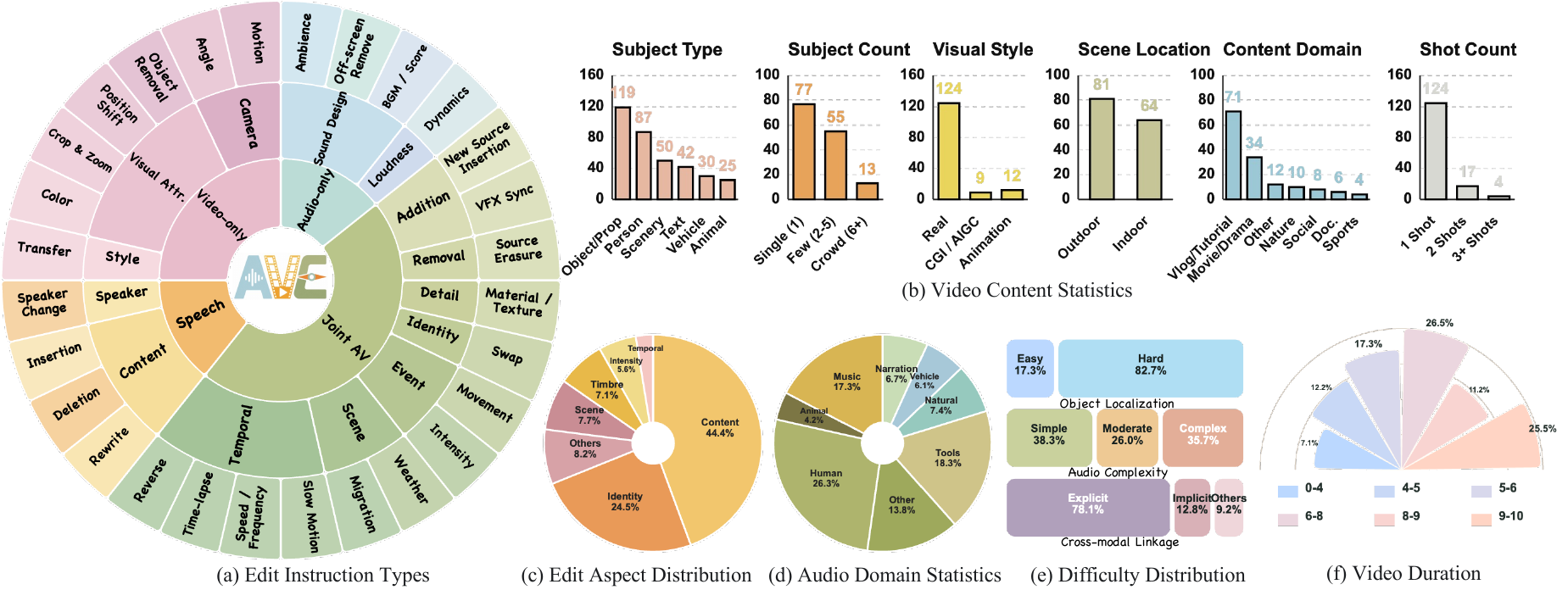
Dataset Statistics




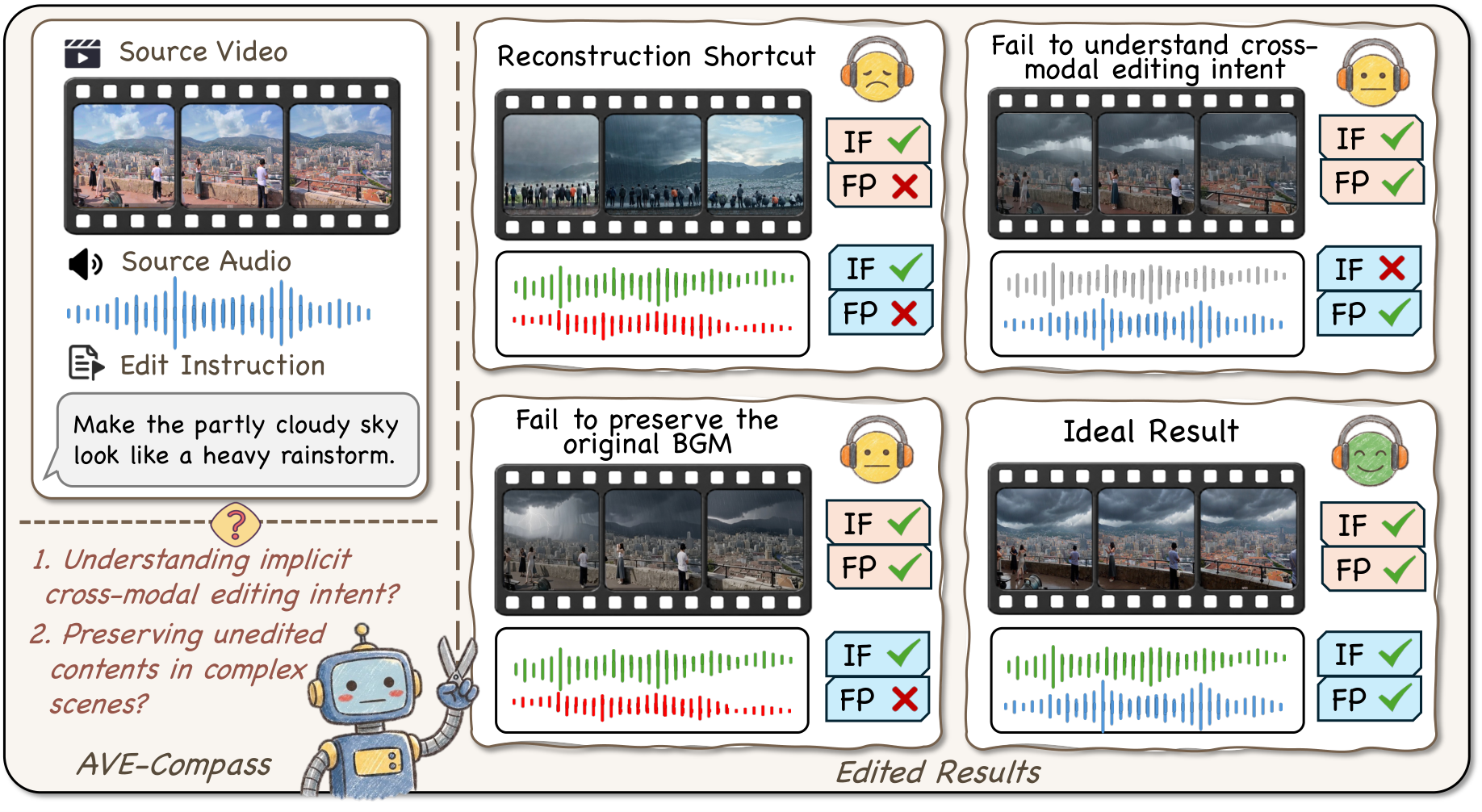
Work overview. AVE-Compass is a diagnostic benchmark for free-form audio-video editing, built from 145 curated source videos, 196 audio-visually coupled instructions, and 2,688 fine-grained checklist items. Its evaluation separates Instruction Following, Fidelity Preserving, Realism, and Editing Intent, combining MLLM-as-Judge evaluation with automated cross-modal, video, and audio metrics to expose incomplete edits, non-target drift, perceptual artifacts, and audio-visual misalignment.
Repository overview. This repository provides the AVE-Compass evaluation pipeline, configuration files, input templates, metric implementations, and AVE-Agent. The evaluator processes source videos, edit instructions, checklists, and model-generated edited videos with MLLM and objective metrics, while the AVE-Compass-v2 dataset provides the benchmark samples. AVE-Agent provides a planning and self-reflection baseline for complex editing instructions.
Evaluation Code · Key Findings · AVE-Agent
What We Evaluate
AVE-Compass contains 145 curated source videos, 196 human-verified editing instructions, 2,688 checklist items, and 28 editing operation types across joint, speech, video-only, and audio-only editing.
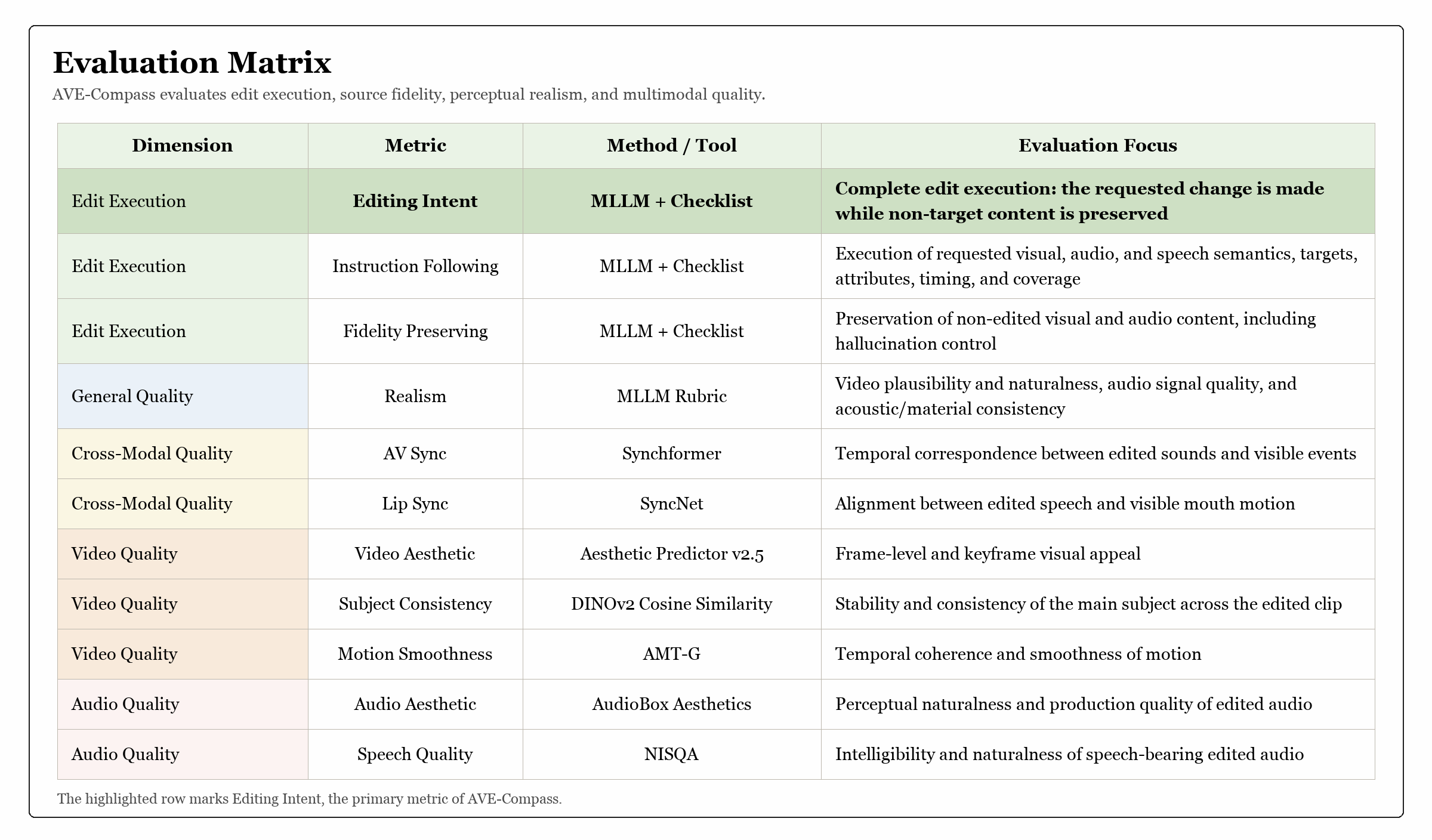
The benchmark reports four complementary dimensions:
| Dimension | Description |
|---|---|
| Instruction Following | Whether the requested edit is correctly executed |
| Fidelity Preserving | Whether non-target visual and audio content remains faithful to the source |
| Editing Intent | Whether the output both follows the instruction and preserves non-target content |
| Realism | Whether the edited audio-video result is natural and coherent |
The evaluation package also reports automated cross-modal, video, and audio metrics, together with source-preservation diagnostics for single-modality edits.
Leaderboard
Models are ranked by Overall Editing Intent, the primary metric of AVE-Compass. Scores are reported on a 0-100 scale, and higher is better.
| Rank | Model | Overall | Video | Audio |
|---|---|---|---|---|
| 1 | AVE-Agent (Wan) | 59.8 | 66.7 | 50.2 |
| 2 | Wan2.7 | 42.4 | 60.1 | 24.8 |
| 3 | HappyHorse | 41.3 | 56.7 | 18.8 |
| 4 | Gemini-Omni* | 38.0 | 56.1 | 10.0 |
| 5 | Seedance | 26.6 | 36.1 | 13.5 |
| 6 | LTX2 | 15.2 | 10.7 | 26.4 |
*Gemini-Omni misses 16 speech edits due to content moderation.
Evaluation Code
1. Configure Environment
Install the dependencies and model weights required by the selected metrics, and make sure ffmpeg and ffprobe are available on PATH. MLLM evaluation uses the official Gemini API:
export GEMINI_API_KEY=your_key
export DEFAULT_MODEL=your_model
modules: {objective: true, llm: true}
llm: {checklist: true, realism: true}
2. Prepare Inputs
Download the released source videos, instructions, and checklists into the three default directories:
hf download NJU-LINK/AVE-Compass --type dataset \
  --include "videos/*" \
  --include "edit_instructions/*" \
  --include "checklists/*" \
  --local-dir input
Place the videos produced by the model under evaluation in edited_videos/:
input/
|- videos/                         # downloaded
|- edit_instructions/              # downloaded
|- checklists/                     # downloaded
`- edited_videos/<sample_id>.mp4   # provided by the user
3. Run
bash run_eval.sh [input_root] [model_name] [output_path] [config_path] [device]
For example:
bash run_eval.sh \
  input \
  my_model \
  output \
  configs/path.yml \
  cuda
The five positional parameters default to input, model, output, configs/path.yml, and cuda, respectively. Use cpu as the last parameter for CPU-compatible metrics.
4. Outputs
output/
|- <model_name>_eval_<timestamp>_eval_results.json
|- <model_name>_eval_<timestamp>_eval_results.csv
`- <model_name>/
   `- <sample_id>/
      |- eval_result.json
      |- objective/
      `- llm/
The CSV contains one row per evaluated instruction; the JSON additionally retains per-question judgments, metric details, warnings, and aggregate summaries.
Key Findings
- Current editors often struggle to satisfy instruction execution and non-target preservation at the same time.
- A model that leaves the input unchanged can receive deceptively strong preservation scores, so edit response must be reported separately.
- Audio-side execution and temporal audio-visual alignment remain common failure modes.
- AVE-Agent improves Editing Intent and Instruction Following, with particularly strong gains in audio-side execution and audio-visual synchronization.
AVE-Agent
This repository also includes AVE-Agent, a modular audio-video editing agent that plans dependent subtasks, dispatches modality-specific tools, and refines failed edits through evaluator feedback. See the agent/ directory for setup, architecture, and usage.
Repository Layout
./
|- README.md
|- input/
|  |- videos/
|  |- edit_instructions/
|  |- checklists/
|  `- edited_videos/
|- run_eval.sh
|- configs/
|- metrics/
|- modules/
|- models/
|- tests/
|- agent/
`- docs/assets/
Reproducibility Notes
- Input samples are paired by their shared
<sample_id>, while the source video is resolved from the instruction JSON. - Missing or disabled objective metrics remain unset and are not converted into fabricated zero scores.
- MLLM evaluation uses the official Gemini API.
Run the evaluation checks with:
python -m pytest tests
The tests cover input pairing, metric routing, missing-value handling, checklist aggregation, and Realism score normalization.
Citation
@article{wen2026avecompass,
  title  = {AVE-Compass: Towards Holistic Evaluation for Audio-Video Editing Abilities},
  author = {Wen, Yuqing and Huang, Yukai and Xie, Qianqian and Wu, Jiangtao and Lin, Yibin and Gu, Yikai and Chen, Jialu and Zhang, Yuanxing and Liu, Jiaheng},
  year   = {2026},
  eprint = {2607.24821},
  archivePrefix = {arXiv},
  primaryClass = {cs.MM},
  url    = {https://arxiv.org/abs/2607.24821}
}
Similar repos





Languages
Python
99.9%
README
AVE-Compass
Can audio-visual editing models correctly follow cross-modal instructions?
Dataset Statistics
Work overview. AVE-Compass is a diagnostic benchmark for free-form audio-video editing, built from 145 curated source videos, 196 audio-visually coupled instructions, and 2,688 fine-grained checklist items. Its evaluation separates Instruction Following, Fidelity Preserving, Realism, and Editing Intent, combining MLLM-as-Judge evaluation with automated cross-modal, video, and audio metrics to expose incomplete edits, non-target drift, perceptual artifacts, and audio-visual misalignment.
Repository overview. This repository provides the AVE-Compass evaluation pipeline, configuration files, input templates, metric implementations, and AVE-Agent. The evaluator processes source videos, edit instructions, checklists, and model-generated edited videos with MLLM and objective metrics, while the AVE-Compass-v2 dataset provides the benchmark samples. AVE-Agent provides a planning and self-reflection baseline for complex editing instructions.
Evaluation Code · Key Findings · AVE-Agent
What We Evaluate
AVE-Compass contains 145 curated source videos, 196 human-verified editing instructions, 2,688 checklist items, and 28 editing operation types across joint, speech, video-only, and audio-only editing.
The benchmark reports four complementary dimensions:
| Dimension | Description |
|---|---|
| Instruction Following | Whether the requested edit is correctly executed |
| Fidelity Preserving | Whether non-target visual and audio content remains faithful to the source |
| Editing Intent | Whether the output both follows the instruction and preserves non-target content |
| Realism | Whether the edited audio-video result is natural and coherent |
The evaluation package also reports automated cross-modal, video, and audio metrics, together with source-preservation diagnostics for single-modality edits.
Leaderboard
Models are ranked by Overall Editing Intent, the primary metric of AVE-Compass. Scores are reported on a 0-100 scale, and higher is better.
| Rank | Model | Overall | Video | Audio |
|---|---|---|---|---|
| 1 | AVE-Agent (Wan) | 59.8 | 66.7 | 50.2 |
| 2 | Wan2.7 | 42.4 | 60.1 | 24.8 |
| 3 | HappyHorse | 41.3 | 56.7 | 18.8 |
| 4 | Gemini-Omni* | 38.0 | 56.1 | 10.0 |
| 5 | Seedance | 26.6 | 36.1 | 13.5 |
| 6 | LTX2 | 15.2 | 10.7 | 26.4 |
*Gemini-Omni misses 16 speech edits due to content moderation.
Evaluation Code
1. Configure Environment
Install the dependencies and model weights required by the selected metrics, and make sure ffmpeg and ffprobe are available on PATH. MLLM evaluation uses the official Gemini API:
export GEMINI_API_KEY=your_key
export DEFAULT_MODEL=your_model
modules: {objective: true, llm: true}
llm: {checklist: true, realism: true}
2. Prepare Inputs
Download the released source videos, instructions, and checklists into the three default directories:
hf download NJU-LINK/AVE-Compass --type dataset \
  --include "videos/*" \
  --include "edit_instructions/*" \
  --include "checklists/*" \
  --local-dir input
Place the videos produced by the model under evaluation in edited_videos/:
input/
|- videos/                         # downloaded
|- edit_instructions/              # downloaded
|- checklists/                     # downloaded
`- edited_videos/<sample_id>.mp4   # provided by the user
3. Run
bash run_eval.sh [input_root] [model_name] [output_path] [config_path] [device]
For example:
bash run_eval.sh \
  input \
  my_model \
  output \
  configs/path.yml \
  cuda
The five positional parameters default to input, model, output, configs/path.yml, and cuda, respectively. Use cpu as the last parameter for CPU-compatible metrics.
4. Outputs
output/
|- <model_name>_eval_<timestamp>_eval_results.json
|- <model_name>_eval_<timestamp>_eval_results.csv
`- <model_name>/
   `- <sample_id>/
      |- eval_result.json
      |- objective/
      `- llm/
The CSV contains one row per evaluated instruction; the JSON additionally retains per-question judgments, metric details, warnings, and aggregate summaries.
Key Findings
- Current editors often struggle to satisfy instruction execution and non-target preservation at the same time.
- A model that leaves the input unchanged can receive deceptively strong preservation scores, so edit response must be reported separately.
- Audio-side execution and temporal audio-visual alignment remain common failure modes.
- AVE-Agent improves Editing Intent and Instruction Following, with particularly strong gains in audio-side execution and audio-visual synchronization.
AVE-Agent
This repository also includes AVE-Agent, a modular audio-video editing agent that plans dependent subtasks, dispatches modality-specific tools, and refines failed edits through evaluator feedback. See the agent/ directory for setup, architecture, and usage.
Repository Layout
./
|- README.md
|- input/
|  |- videos/
|  |- edit_instructions/
|  |- checklists/
|  `- edited_videos/
|- run_eval.sh
|- configs/
|- metrics/
|- modules/
|- models/
|- tests/
|- agent/
`- docs/assets/
Reproducibility Notes
- Input samples are paired by their shared
<sample_id>, while the source video is resolved from the instruction JSON. - Missing or disabled objective metrics remain unset and are not converted into fabricated zero scores.
- MLLM evaluation uses the official Gemini API.
Run the evaluation checks with:
python -m pytest tests
The tests cover input pairing, metric routing, missing-value handling, checklist aggregation, and Realism score normalization.
Citation
@article{wen2026avecompass,
  title  = {AVE-Compass: Towards Holistic Evaluation for Audio-Video Editing Abilities},
  author = {Wen, Yuqing and Huang, Yukai and Xie, Qianqian and Wu, Jiangtao and Lin, Yibin and Gu, Yikai and Chen, Jialu and Zhang, Yuanxing and Liu, Jiaheng},
  year   = {2026},
  eprint = {2607.24821},
  archivePrefix = {arXiv},
  primaryClass = {cs.MM},
  url    = {https://arxiv.org/abs/2607.24821}
}
Similar repos
Languages
Python
99.9%