Python
15
26 commits
updated Sep 30, 2026





This is the official repository for the paper "Audio-to-Score Transcription using Pre-trained Features, Data Augmentation, and the New SheetSage-A2S Dataset", which has recently been accepted by ACMMM 2026.
In this repo, the following are released:
**kern notation.We introduce SheetSage-A2S, the first audio-to-score (A2S) dataset for popular music: 61 hours of real, commercially released audio paired with **kern lead-sheet encodings across 6,066 songs. Unlike existing A2S datasets, which rely on synthetic recordings of Western classical music, SheetSage-A2S is built from real audio and isolates the sung melody together with its chords.
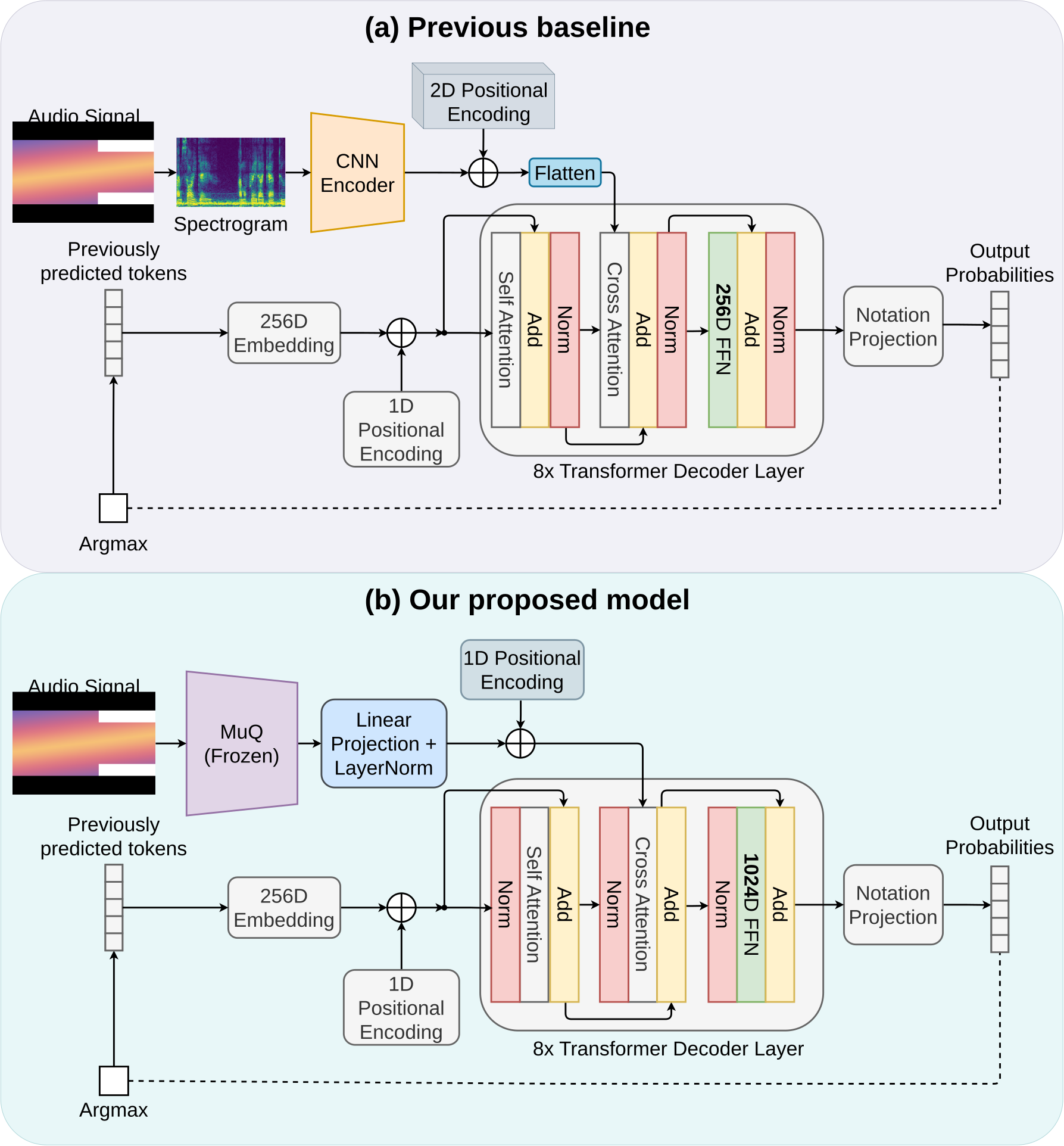
We also propose an A2S model that improves on prior work with three changes to an autoregressive transformer decoder: a larger ff dim + pre-norm decoder, using MuQ as an encoder in place of the CNN, and pitch/tempo data augmentation. The model reaches 4.98% symbol error rate on the classical Quartets collection and sets a 20.92% benchmark on SheetSage-A2S.
For more details, please refer to our paper.
Datasets and model checkpoints are hosted on the Hugging Face Hub: https://huggingface.co/collections/MMR-Lab/sheetsage-a2s. The model checkpoints are publicly available for inference. To train our model from scratch and/or conduct other customized experiments, you need to fill in a brief application form at Hugging Face Hub in order to access the datasets. NOTE: applications with no real names or a curt description of use may not be approved.
Note: if
huggingface.cois unreachable, set the mirror endpoint before downloading:export HF_ENDPOINT=https://hf-mirror.com
SheetSage-A2S is published in two forms. They contain the same songs and the same train/val/test splits. https://huggingface.co/datasets/MMR-Lab/Sheetsage-A2S contains the kern scores along with the YouTube links and timestamps. https://huggingface.co/datasets/MMR-Lab/Sheetsage-A2S-MuQ contains the dataset with MuQ preprocessed features as well as kern scores.
Every script that takes --ds_location accepts either a local path or a Hub dataset id.
python train.py --ds_location MMR-Lab/Sheetsage-A2S-MuQ --encoder preprocessed_muq ...
To download once up front instead.
hf download MMR-Lab/Sheetsage-A2S-MuQ \
    --repo-type dataset \
    --local-dir /path/to/data/Sheetsage-A2S-MuQ
Both checkpoints are hosted in the SheetSage-A2S model repository:
sheetsage_a2s.ckpt): our best-performing model that was trained and evaluated
on SheetSage-A2S.quartets_a2s.ckpt): our best-performing model that was trained and evaluated on the
Quartets dataset.--checkpoint_path accepts either a local checkpoint file or a Hugging Face checkpoint path
in the form org/repository/filename.ckpt. Hub checkpoints are downloaded automatically into
the local Hugging Face cache.
# Local checkpoint
python run_metrics.py --checkpoint_path /path/to/checkpoint.ckpt ...

# SheetSage-A2S checkpoint
python run_metrics.py \
  --checkpoint_path MMR-Lab/Sheetsage-A2S-model/sheetsage_a2s.ckpt \
  ...

# Quartets checkpoint
python run_metrics.py \
  --checkpoint_path MMR-Lab/Sheetsage-A2S-model/quartets_a2s.ckpt \
  ...
Option A — Docker (recommended).
docker build -t hookkern .
docker run -it --gpus all --ipc=host \
    -v /path/to/data:/data \
    hookkern bash
Option B — pip. Requires python>=3.11, a CUDA-capable GPU, and the system packages
ffmpeg, fluidsynth, and (for augmentation only) rubberband-cli.
pip install -r requirements.txt
Precompute MuQ features so training does not run the (frozen) MuQ encoder every step.
Required for the preprocessed_muq encoders. If you want to do this for the Sheetsage-A2S dataset please note that we release the already preprocessed MuQ features for this dataset.
python preprocess_muq.py --input-dataset /path/to/dataset --output-dir /path/to/output
Note: MuQ features are always extracted in 32-bit precision. Although training otherwise runs in 16-bit mixed precision, MuQ is executed with autocasting disabled both here and on-the-fly during training if you skip this step, since half precision produces NaN values in its output.
SheetSage-A2S (lead sheets) with the precomputed-MuQ encoder:
python train.py \
    --ds_location MMR-Lab/Sheetsage-A2S-MuQ \
    --encoder preprocessed_muq \
    --tokeniser word \
    --batch_size 8 \
    --learning_rate 5e-5 \
    --weight_decay 1e-3 \
    --ff_dim_multiplier 4 \
    --label_smoothing 0.1 \
    --patience 5
To use the raw-spectrogram CNN encoder instead, pass --encoder cnn
For the Quartets dataset, use --tokeniser original (this applies the cleaning from
the original quartets paper together with word-level tokenisation):
python train.py \
    --ds_location /path/to/preprocessed_muq_quartets \
    --encoder preprocessed_muq \
    --tokeniser original \
    --batch_size 8 \
    --learning_rate 5e-5 \
    --weight_decay 1e-3 \
    --ff_dim_multiplier 4 \
    --patience 5
Batch size must be one of
1, 2, 4, 8. For values below 8, gradient accumulation is applied automatically to keep an effective batch size of 8. Checkpoints are written toweights/<encoder>/and training is logged to Weights & Biases (wandb login, or setWANDB_MODE=offline).
Valid encoders: cnn, muq, preprocessed_muq.
Valid tokenisers: word, medium, original.
Compute metrics (Sym-ER, MV2H) on the test set. Both --checkpoint_path and --ds_location
accept a local path or a Hub id.
# Lead sheets (SheetSage-A2S)
python run_metrics.py \
    --checkpoint_path MMR-Lab/Sheetsage-A2S-model/sheetsage_a2s.ckpt \
    --ds_location MMR-Lab/Sheetsage-A2S-MuQ \
    --encoder preprocessed_muq \
    --tokeniser word \
    --dataset_type lead_sheet

# String quartets
python run_metrics.py \
    --checkpoint_path MMR-Lab/Sheetsage-A2S-model/quartets_a2s.ckpt \
    --ds_location /path/to/preprocessed_muq_quartets \
    --encoder preprocessed_muq \
    --tokeniser original \
    --dataset_type quartets
Run inference sample-by-sample, printing ground-truth and predicted tokens together with Verovio Humdrum Viewer links that render the output as sheet music.
python sample.py \
    --checkpoint_path MMR-Lab/Sheetsage-A2S-model/sheetsage_a2s.ckpt \
    --ds_location MMR-Lab/Sheetsage-A2S-MuQ \
    --tokeniser word \
    --number 5
--number limits how many samples are printed.
Pitch/tempo augmentation of the quartets dataset. Requires the Humdrum transpose tool and the
rubberband CLI on your PATH.
python augment_existing_hf_dataset.py --output-path /path/to/augmented
Model performance on the SheetSage-A2S and Quartets datasets using the word-level tokenisation scheme.
| Method | SheetSage-A2S | Quartets |
|---|---|---|
| Baseline | 66.85 | 15.3 |
| + 1024 Pre-Norm | 53.7 | 8.48 |
| + MuQ encoder | 25.39 | 7.16 |
| + Augmented data | 20.92 | 4.98 |
Per-spine SER (melody and chord spines) and MV2H on SheetSage-A2S. Lower is better for SER; higher is better for MV2H.
| Variant | Normal SER | Melody SER | Chord SER | MV2H |
|---|---|---|---|---|
| Baseline | 66.85 | 106.88 | 64.12 | 70.39 |
| + 1024 Pre-Norm | 53.7 | 90.56 | 51.8 | 72.62 |
| + MuQ | 25.39 | 46.21 | 26.76 | 79.38 |
| + Augmented | 20.92 | 38.62 | 22.28 | 85.05 |
The code in this repository is released under the MIT license as found in the LICENSE file.
@article{cummins2026audio,
  title={Audio-to-Score Transcription using Pre-trained Features, Data Augmentation, and the New SheetSage-A2S Dataset},
  author={Cummins, Eoin and Huang, Zhongyi and D'Hooge, Alexandre and Mo, Zhuoro and Ju, Yaolong},
  journal={arXiv preprint arXiv:2608.06165},
  year={2026}
}
Python
15
26 commits
updated Sep 30, 2026
This is the official repository for the paper "Audio-to-Score Transcription using Pre-trained Features, Data Augmentation, and the New SheetSage-A2S Dataset", which has recently been accepted by ACMMM 2026.
In this repo, the following are released:
**kern notation.We introduce SheetSage-A2S, the first audio-to-score (A2S) dataset for popular music: 61 hours of real, commercially released audio paired with **kern lead-sheet encodings across 6,066 songs. Unlike existing A2S datasets, which rely on synthetic recordings of Western classical music, SheetSage-A2S is built from real audio and isolates the sung melody together with its chords.
We also propose an A2S model that improves on prior work with three changes to an autoregressive transformer decoder: a larger ff dim + pre-norm decoder, using MuQ as an encoder in place of the CNN, and pitch/tempo data augmentation. The model reaches 4.98% symbol error rate on the classical Quartets collection and sets a 20.92% benchmark on SheetSage-A2S.
For more details, please refer to our paper.
Datasets and model checkpoints are hosted on the Hugging Face Hub: https://huggingface.co/collections/MMR-Lab/sheetsage-a2s. The model checkpoints are publicly available for inference. To train our model from scratch and/or conduct other customized experiments, you need to fill in a brief application form at Hugging Face Hub in order to access the datasets. NOTE: applications with no real names or a curt description of use may not be approved.
Note: if
huggingface.cois unreachable, set the mirror endpoint before downloading:export HF_ENDPOINT=https://hf-mirror.com
SheetSage-A2S is published in two forms. They contain the same songs and the same train/val/test splits. https://huggingface.co/datasets/MMR-Lab/Sheetsage-A2S contains the kern scores along with the YouTube links and timestamps. https://huggingface.co/datasets/MMR-Lab/Sheetsage-A2S-MuQ contains the dataset with MuQ preprocessed features as well as kern scores.
Every script that takes --ds_location accepts either a local path or a Hub dataset id.
python train.py --ds_location MMR-Lab/Sheetsage-A2S-MuQ --encoder preprocessed_muq ...
To download once up front instead.
hf download MMR-Lab/Sheetsage-A2S-MuQ \
    --repo-type dataset \
    --local-dir /path/to/data/Sheetsage-A2S-MuQ
Both checkpoints are hosted in the SheetSage-A2S model repository:
sheetsage_a2s.ckpt): our best-performing model that was trained and evaluated
on SheetSage-A2S.quartets_a2s.ckpt): our best-performing model that was trained and evaluated on the
Quartets dataset.--checkpoint_path accepts either a local checkpoint file or a Hugging Face checkpoint path
in the form org/repository/filename.ckpt. Hub checkpoints are downloaded automatically into
the local Hugging Face cache.
# Local checkpoint
python run_metrics.py --checkpoint_path /path/to/checkpoint.ckpt ...

# SheetSage-A2S checkpoint
python run_metrics.py \
  --checkpoint_path MMR-Lab/Sheetsage-A2S-model/sheetsage_a2s.ckpt \
  ...

# Quartets checkpoint
python run_metrics.py \
  --checkpoint_path MMR-Lab/Sheetsage-A2S-model/quartets_a2s.ckpt \
  ...
Option A — Docker (recommended).
docker build -t hookkern .
docker run -it --gpus all --ipc=host \
    -v /path/to/data:/data \
    hookkern bash
Option B — pip. Requires python>=3.11, a CUDA-capable GPU, and the system packages
ffmpeg, fluidsynth, and (for augmentation only) rubberband-cli.
pip install -r requirements.txt
Precompute MuQ features so training does not run the (frozen) MuQ encoder every step.
Required for the preprocessed_muq encoders. If you want to do this for the Sheetsage-A2S dataset please note that we release the already preprocessed MuQ features for this dataset.
python preprocess_muq.py --input-dataset /path/to/dataset --output-dir /path/to/output
Note: MuQ features are always extracted in 32-bit precision. Although training otherwise runs in 16-bit mixed precision, MuQ is executed with autocasting disabled both here and on-the-fly during training if you skip this step, since half precision produces NaN values in its output.
SheetSage-A2S (lead sheets) with the precomputed-MuQ encoder:
python train.py \
    --ds_location MMR-Lab/Sheetsage-A2S-MuQ \
    --encoder preprocessed_muq \
    --tokeniser word \
    --batch_size 8 \
    --learning_rate 5e-5 \
    --weight_decay 1e-3 \
    --ff_dim_multiplier 4 \
    --label_smoothing 0.1 \
    --patience 5
To use the raw-spectrogram CNN encoder instead, pass --encoder cnn
For the Quartets dataset, use --tokeniser original (this applies the cleaning from
the original quartets paper together with word-level tokenisation):
python train.py \
    --ds_location /path/to/preprocessed_muq_quartets \
    --encoder preprocessed_muq \
    --tokeniser original \
    --batch_size 8 \
    --learning_rate 5e-5 \
    --weight_decay 1e-3 \
    --ff_dim_multiplier 4 \
    --patience 5
Batch size must be one of
1, 2, 4, 8. For values below 8, gradient accumulation is applied automatically to keep an effective batch size of 8. Checkpoints are written toweights/<encoder>/and training is logged to Weights & Biases (wandb login, or setWANDB_MODE=offline).
Valid encoders: cnn, muq, preprocessed_muq.
Valid tokenisers: word, medium, original.
Compute metrics (Sym-ER, MV2H) on the test set. Both --checkpoint_path and --ds_location
accept a local path or a Hub id.
# Lead sheets (SheetSage-A2S)
python run_metrics.py \
    --checkpoint_path MMR-Lab/Sheetsage-A2S-model/sheetsage_a2s.ckpt \
    --ds_location MMR-Lab/Sheetsage-A2S-MuQ \
    --encoder preprocessed_muq \
    --tokeniser word \
    --dataset_type lead_sheet

# String quartets
python run_metrics.py \
    --checkpoint_path MMR-Lab/Sheetsage-A2S-model/quartets_a2s.ckpt \
    --ds_location /path/to/preprocessed_muq_quartets \
    --encoder preprocessed_muq \
    --tokeniser original \
    --dataset_type quartets
Run inference sample-by-sample, printing ground-truth and predicted tokens together with Verovio Humdrum Viewer links that render the output as sheet music.
python sample.py \
    --checkpoint_path MMR-Lab/Sheetsage-A2S-model/sheetsage_a2s.ckpt \
    --ds_location MMR-Lab/Sheetsage-A2S-MuQ \
    --tokeniser word \
    --number 5
--number limits how many samples are printed.
Pitch/tempo augmentation of the quartets dataset. Requires the Humdrum transpose tool and the
rubberband CLI on your PATH.
python augment_existing_hf_dataset.py --output-path /path/to/augmented
Model performance on the SheetSage-A2S and Quartets datasets using the word-level tokenisation scheme.
| Method | SheetSage-A2S | Quartets |
|---|---|---|
| Baseline | 66.85 | 15.3 |
| + 1024 Pre-Norm | 53.7 | 8.48 |
| + MuQ encoder | 25.39 | 7.16 |
| + Augmented data | 20.92 | 4.98 |
Per-spine SER (melody and chord spines) and MV2H on SheetSage-A2S. Lower is better for SER; higher is better for MV2H.
| Variant | Normal SER | Melody SER | Chord SER | MV2H |
|---|---|---|---|---|
| Baseline | 66.85 | 106.88 | 64.12 | 70.39 |
| + 1024 Pre-Norm | 53.7 | 90.56 | 51.8 | 72.62 |
| + MuQ | 25.39 | 46.21 | 26.76 | 79.38 |
| + Augmented | 20.92 | 38.62 | 22.28 | 85.05 |
The code in this repository is released under the MIT license as found in the LICENSE file.
@article{cummins2026audio,
  title={Audio-to-Score Transcription using Pre-trained Features, Data Augmentation, and the New SheetSage-A2S Dataset},
  author={Cummins, Eoin and Huang, Zhongyi and D'Hooge, Alexandre and Mo, Zhuoro and Ju, Yaolong},
  journal={arXiv preprint arXiv:2608.06165},
  year={2026}
}