
README
Crucible



A knowledge-grounded agent runtime. Agents that draw from a knowledge graph make better decisions.
Local-first. No cloud. No lock-in. Your conversations, notes, and wikilinks form a knowledge graph that agents draw from and contribute to — all as markdown files you own.
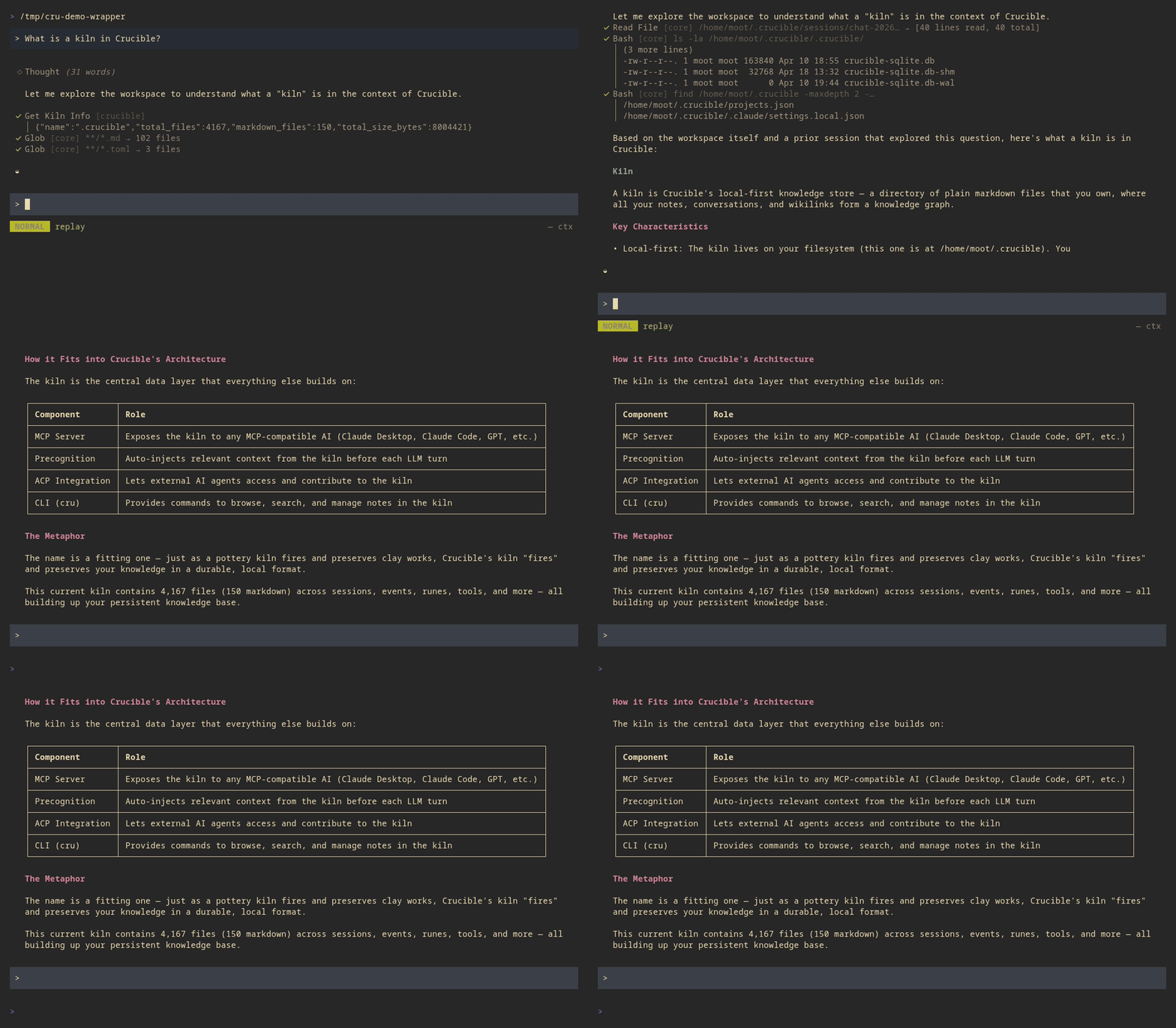
Early Development: APIs and storage formats may change. Contributions welcome!
What Makes Crucible Different
Memory and knowledge are too fundamental to be an afterthought. Most AI tools treat conversations as disposable — Crucible makes them the foundation.
- Knowledge-grounded agents. Precognition auto-injects relevant context from your knowledge graph before each LLM turn. Block-level embeddings power semantic search at paragraph granularity. The more you use it, the smarter your agents get.
- Sessions are searchable knowledge. Every chat saves as markdown under the daemon data root, searchable with
cru session searchand scoped by the kilns a session shares with yours. What a session learns goes into your kiln as notes; the transcript itself stays out of it, so a kiln stays shareable. - Neovim-like architecture. Luau plugins, TUI-first, headless daemon with RPC. Most behaviors beyond the knowledge core can be scripted.
- Bring any LLM. Ollama, OpenAI, Anthropic, Cohere, OpenRouter, GitHub Copilot, Vertex AI, or a custom HTTP endpoint. Embeddings run locally by default.
- Plaintext first. No proprietary formats. Files are the source of truth. The database is optional acceleration.
How It Compares
The difference is architectural, not a feature checklist.
| Crucible | Hosted chat assistant | Markdown editor + AI plugin | |
|---|---|---|---|
| Source of truth | Markdown on your disk | The vendor's servers | Markdown on your disk |
| Chat history | A note in the same graph — linkable, greppable, versionable | In your vendor account | Outside the note graph |
| Index | SQLite, rebuildable from the files | Not exposed | Varies by plugin |
| Retrieval granularity | Blocks (paragraph-level embeddings) | Not exposed | Varies by plugin |
| LLM choice | Any provider, or a local model | The vendor's | Varies by plugin |
| Extension surface | Luau against a headless daemon | None | The editor's plugin API |
Install
Pre-built binaries (Linux x86_64, macOS Apple Silicon):
curl -fsSL https://github.com/Mootikins/crucible/releases/latest/download/crucible-cli-installer.sh | sh
From source (needs a Rust toolchain and protoc; apt install protobuf-compiler or brew install protobuf):
cargo install --git https://github.com/Mootikins/crucible.git --locked crucible-cli
--locked is required, not optional: without it Cargo re-resolves and picks a
jaq-std that does not compile against the pinned jaq-json.
The CLI, TUI and daemon need no JavaScript toolchain. cru web does: the UI is
compiled into the binary from crates/crucible-web/web/dist, which is a
bun build artifact and is not in the repository. A cargo install therefore gives you everything except the web UI, and cru web serves a
page saying so. To get it, clone and run just install (or just web-build
before cargo build) — or use a pre-built binary above, which ships it.
Quick Start
# Start a chat session
cru chat

# Chat with Claude Code, enriched by your knowledge base
cru chat -a claude

# Or start the MCP server for Claude/GPT integration
cru mcp
First run prompts for a kiln path and detects available LLM providers. A background daemon auto-spawns via cru daemon serve to manage session state, file watching, and multi-session support. It communicates over a Unix socket and restarts automatically if stopped.
In a chat session:
- Type naturally, the agent responds with access to your knowledge base
- Precognition pulls relevant notes into context before each turn;
:set precognitiontoggles it :model,:set,:exportfor REPL commands —:helplists them allBackTabcycles modes: Normal → Plan → Auto (/planand/autojump straight there)F1opens the command palette
Features
Agent Chat
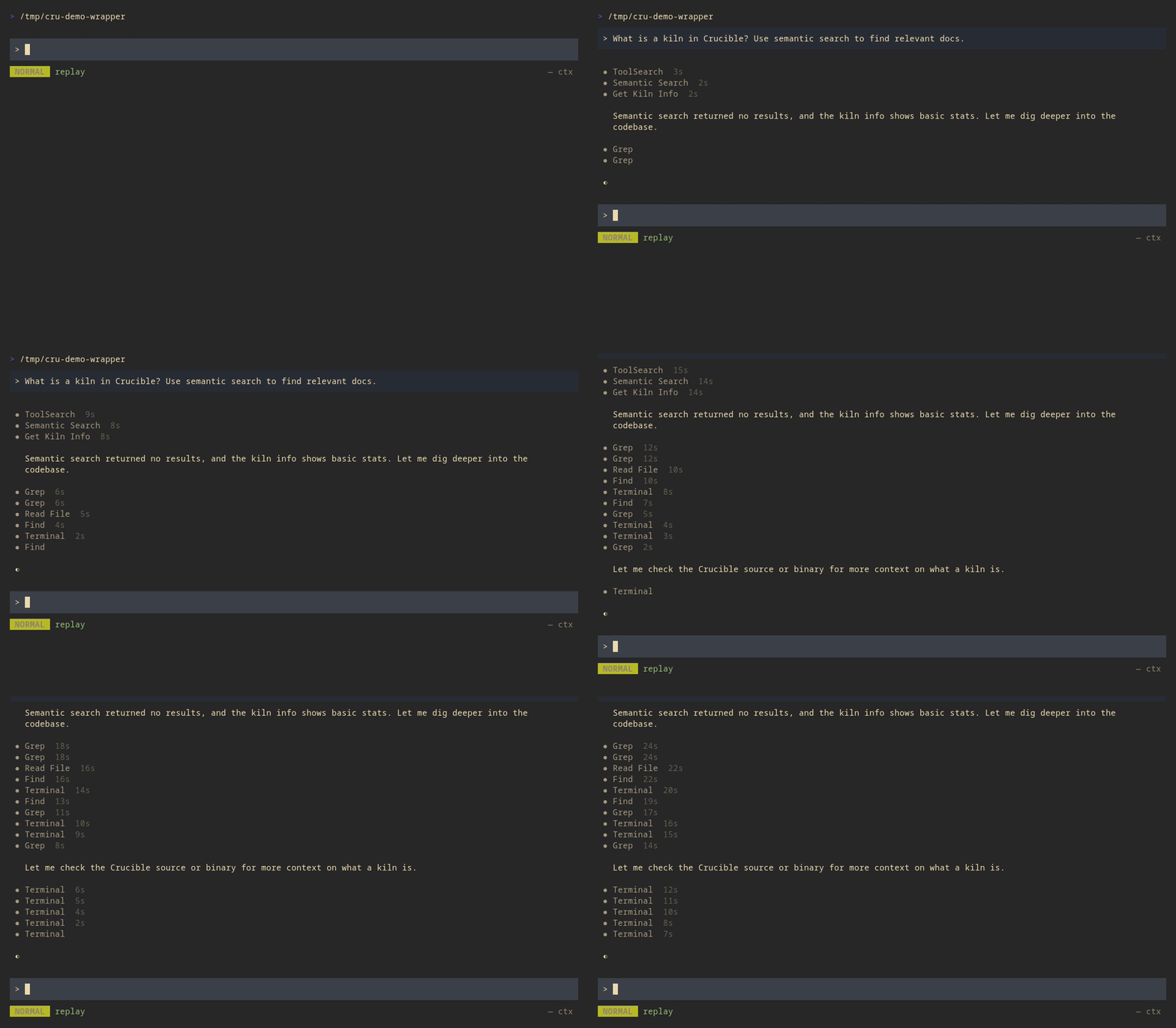
Interactive conversations with full session persistence. The TUI supports streaming markdown, tool calls, and multi-turn context. Sessions save under the daemon data root (~/.crucible/sessions/) and carry a flat set of attached kilns as their knowledge scope.
Knowledge Graph
Wikilinks ([[Note Name]]) define your graph. No extraction step, no special syntax beyond what you'd write naturally. Query by graph traversal, semantic similarity, tags, or full-text search.
MCP Server
Expose your knowledge base to any MCP-compatible AI (Claude Desktop, Claude Code, GPT, local models):
cru mcp
Notes: create_note, read_note, update_note, delete_note, list_notes, read_metadata.
Search: semantic_search, grep_notes, property_search. Plus get_kiln_info,
delegate_session, and job control.
Agent Integration (ACP)
Crucible can spawn and orchestrate external AI agents through the Agent Client Protocol. Your agent gets full access to Crucible's knowledge graph, semantic search, and tools.
# Use Claude Code with your knowledge base
cru chat -a claude

# Use OpenCode
cru chat -a opencode

# Use Gemini CLI
cru chat -a gemini
Built-in agents (auto-discovered if installed):
| Agent | Command | Install |
|---|---|---|
| opencode | opencode acp | npm install -g opencode-ai@latest |
| claude | npx @agentclientprotocol/claude-agent-acp | npm install -g @agentclientprotocol/claude-agent-acp |
| gemini | gemini | npm install -g @google/gemini-cli |
| codex | npx @agentclientprotocol/codex-acp | npm install -g @agentclientprotocol/codex-acp |
| cursor | cursor-agent acp | curl https://cursor.com/install -fsS | bash |
| hermes | hermes acp | curl -fsSL https://hermes-agent.nousresearch.com/install.sh | bash |
claude and codex are bridges — they need the corresponding vendor CLI installed as well.
opencode, gemini, cursor and hermes speak ACP from their own CLI. If none are
installed, cru chat -a <agent> prints the install command for each.
Agents can delegate tasks to each other. An ACP agent like Claude can hand off work to Cursor or OpenCode mid-conversation using the delegate_session tool, then incorporate the results. Delegation works both directions: internal agents can delegate to ACP agents, and ACP agents can delegate to other ACP agents.
Custom profiles go in ~/.config/crucible/init.lua:
cru.config.set({
  acp = {
    agents = {
      ["my-claude"] = {
        extends = "claude",
        env = { ANTHROPIC_BASE_URL = "http://localhost:4000" },
      },
    },
  },
})
Then: cru chat -a my-claude. See ACP configuration for every
field, including per-profile trust and delegation limits.
Lua Plugins
Drop a .lua file into ~/.config/crucible/plugins/. It returns a spec table; the
daemon registers whatever it declares.
-- ~/.config/crucible/plugins/summarize.lua
return {
  name = "summarize",
  tools = {
    summarize = {
      desc = "Summarize the notes matching a query",
      params = {
        { name = "query", type = "string", desc = "What to search for" },
        { name = "limit", type = "number", desc = "How many notes", optional = true },
      },
      fn = function(args)
        local hits = cru.kiln.search(args.query, { limit = args.limit or 5 })
        return { notes = hits }
      end,
    },
  },
}
Agents can now call summarize. Hooks live in the same file: crucible.on("pre_tool_call", handler) at the top level registers a handler that can observe a tool call, replace its result,
or block it outright.
See the plugin guide for the full API.
Documentation
- Documentation Site — searchable, organized reference
- docs/ is both the user guide and a working example kiln — interlinked notes with wikilinks and frontmatter, parsed and indexed by the integration tests
- AGENTS.md covers architecture and AI agent instructions
Command Reference
| Command | Alias | Description |
|---|---|---|
cru chat | c | Interactive AI chat with session persistence |
cru chat -a <agent> | Use an ACP agent (claude, opencode, gemini, etc.) | |
cru chat --resume <id> | Resume a previous session | |
cru mcp | Start MCP server for external AI agents | |
cru web | Start the browser chat UI | |
cru process | p | Parse, enrich, and store markdown files |
cru init | i | Initialize a new kiln |
cru session create | Create a new session (--agent <card>, or --acp <profile> for an external agent) | |
cru session list | List sessions (live by default, --all includes persisted) | |
cru session show <id> | Show session details (daemon first, file fallback) | |
cru session open <id> | Open a previous session in the TUI | |
cru session send <id> "msg" | Send a message and stream the response | |
cru session configure <id> | Set agent backend (provider, model, endpoint) | |
cru session pause <id> | Pause a running daemon session | |
cru session resume <id> | Resume a paused daemon session | |
cru session end <id> | End a daemon session | |
cru session export <id> | Export session to markdown | |
cru session search <q> | Search sessions by title | |
cru set <id> key=val | Tweak runtime settings (model, mode, etc.) | |
cru stats | Display kiln statistics | |
cru status | Storage status and metrics | |
cru models | List available LLM models | |
cru config init | Initialize config file | |
cru config show | Show effective configuration | |
cru agents list | List registered agent cards | |
cru skills list | List discovered agent skills | |
cru plugin list | List installed Luau plugins | |
cru plugin check | <dir> | Check a plugin parses, its declarations are readable, and (with luau-analyze) its types |
cru tasks list | Manage tasks from TASKS.md | |
cru daemon start | Start background daemon | |
cru daemon status | Check daemon status | |
cru daemon logs | Show recent output from the background daemon | |
cru storage verify | Verify content integrity | |
cru auth login | Store LLM provider API key | |
cru doctor | Diagnose setup problems, each with a concrete fix | |
cru search <query> | Semantic + text search across kiln notes | |
cru setup | Bootstrap the runtime directory (plugins, themes) |
Command groups abbreviate: cru session → cru s (or cru sess), cru config → cru cfg.
Run cru <command> --help for full options.
Roadmap
- TUI chat with session persistence and resume
- MCP server for external agents
- Luau plugin system
- Block-level semantic search with reranking
- Precognition (auto-RAG before each turn)
- Daemon with auto-spawn, file watching, multi-session support
- Web chat interface (
cru web) - ACP host mode (use Claude Code, Cursor, OpenCode through Crucible)
- ACP agent mode —
cru acpalready serves editors (Zed, JetBrains, Neovim, marimo); session modes, model switching, and host-side filesystem/terminal capabilities are not wired yet
License
Licensed under either of
- Apache License, Version 2.0 (LICENSE-APACHE or http://www.apache.org/licenses/LICENSE-2.0)
- MIT license (LICENSE-MIT or http://opensource.org/licenses/MIT)
at your option.
Unless you explicitly state otherwise, any contribution intentionally submitted for inclusion in this project by you, as defined in the Apache-2.0 license, shall be dual licensed as above, without any additional terms or conditions.
Contributors


Similar repos


Languages
Rust
72.2%
TypeScript
21.9%
Luau
3.9%
README
Crucible
A knowledge-grounded agent runtime. Agents that draw from a knowledge graph make better decisions.
Local-first. No cloud. No lock-in. Your conversations, notes, and wikilinks form a knowledge graph that agents draw from and contribute to — all as markdown files you own.
Early Development: APIs and storage formats may change. Contributions welcome!
What Makes Crucible Different
Memory and knowledge are too fundamental to be an afterthought. Most AI tools treat conversations as disposable — Crucible makes them the foundation.
- Knowledge-grounded agents. Precognition auto-injects relevant context from your knowledge graph before each LLM turn. Block-level embeddings power semantic search at paragraph granularity. The more you use it, the smarter your agents get.
- Sessions are searchable knowledge. Every chat saves as markdown under the daemon data root, searchable with
cru session searchand scoped by the kilns a session shares with yours. What a session learns goes into your kiln as notes; the transcript itself stays out of it, so a kiln stays shareable. - Neovim-like architecture. Luau plugins, TUI-first, headless daemon with RPC. Most behaviors beyond the knowledge core can be scripted.
- Bring any LLM. Ollama, OpenAI, Anthropic, Cohere, OpenRouter, GitHub Copilot, Vertex AI, or a custom HTTP endpoint. Embeddings run locally by default.
- Plaintext first. No proprietary formats. Files are the source of truth. The database is optional acceleration.
How It Compares
The difference is architectural, not a feature checklist.
| Crucible | Hosted chat assistant | Markdown editor + AI plugin | |
|---|---|---|---|
| Source of truth | Markdown on your disk | The vendor's servers | Markdown on your disk |
| Chat history | A note in the same graph — linkable, greppable, versionable | In your vendor account | Outside the note graph |
| Index | SQLite, rebuildable from the files | Not exposed | Varies by plugin |
| Retrieval granularity | Blocks (paragraph-level embeddings) | Not exposed | Varies by plugin |
| LLM choice | Any provider, or a local model | The vendor's | Varies by plugin |
| Extension surface | Luau against a headless daemon | None | The editor's plugin API |
Install
Pre-built binaries (Linux x86_64, macOS Apple Silicon):
curl -fsSL https://github.com/Mootikins/crucible/releases/latest/download/crucible-cli-installer.sh | sh
From source (needs a Rust toolchain and protoc; apt install protobuf-compiler or brew install protobuf):
cargo install --git https://github.com/Mootikins/crucible.git --locked crucible-cli
--locked is required, not optional: without it Cargo re-resolves and picks a
jaq-std that does not compile against the pinned jaq-json.
The CLI, TUI and daemon need no JavaScript toolchain. cru web does: the UI is
compiled into the binary from crates/crucible-web/web/dist, which is a
bun build artifact and is not in the repository. A cargo install therefore gives you everything except the web UI, and cru web serves a
page saying so. To get it, clone and run just install (or just web-build
before cargo build) — or use a pre-built binary above, which ships it.
Quick Start
# Start a chat session
cru chat

# Chat with Claude Code, enriched by your knowledge base
cru chat -a claude

# Or start the MCP server for Claude/GPT integration
cru mcp
First run prompts for a kiln path and detects available LLM providers. A background daemon auto-spawns via cru daemon serve to manage session state, file watching, and multi-session support. It communicates over a Unix socket and restarts automatically if stopped.
In a chat session:
- Type naturally, the agent responds with access to your knowledge base
- Precognition pulls relevant notes into context before each turn;
:set precognitiontoggles it :model,:set,:exportfor REPL commands —:helplists them allBackTabcycles modes: Normal → Plan → Auto (/planand/autojump straight there)F1opens the command palette
Features
Agent Chat
Interactive conversations with full session persistence. The TUI supports streaming markdown, tool calls, and multi-turn context. Sessions save under the daemon data root (~/.crucible/sessions/) and carry a flat set of attached kilns as their knowledge scope.
Knowledge Graph
Wikilinks ([[Note Name]]) define your graph. No extraction step, no special syntax beyond what you'd write naturally. Query by graph traversal, semantic similarity, tags, or full-text search.
MCP Server
Expose your knowledge base to any MCP-compatible AI (Claude Desktop, Claude Code, GPT, local models):
cru mcp
Notes: create_note, read_note, update_note, delete_note, list_notes, read_metadata.
Search: semantic_search, grep_notes, property_search. Plus get_kiln_info,
delegate_session, and job control.
Agent Integration (ACP)
Crucible can spawn and orchestrate external AI agents through the Agent Client Protocol. Your agent gets full access to Crucible's knowledge graph, semantic search, and tools.
# Use Claude Code with your knowledge base
cru chat -a claude

# Use OpenCode
cru chat -a opencode

# Use Gemini CLI
cru chat -a gemini
Built-in agents (auto-discovered if installed):
| Agent | Command | Install |
|---|---|---|
| opencode | opencode acp | npm install -g opencode-ai@latest |
| claude | npx @agentclientprotocol/claude-agent-acp | npm install -g @agentclientprotocol/claude-agent-acp |
| gemini | gemini | npm install -g @google/gemini-cli |
| codex | npx @agentclientprotocol/codex-acp | npm install -g @agentclientprotocol/codex-acp |
| cursor | cursor-agent acp | curl https://cursor.com/install -fsS | bash |
| hermes | hermes acp | curl -fsSL https://hermes-agent.nousresearch.com/install.sh | bash |
claude and codex are bridges — they need the corresponding vendor CLI installed as well.
opencode, gemini, cursor and hermes speak ACP from their own CLI. If none are
installed, cru chat -a <agent> prints the install command for each.
Agents can delegate tasks to each other. An ACP agent like Claude can hand off work to Cursor or OpenCode mid-conversation using the delegate_session tool, then incorporate the results. Delegation works both directions: internal agents can delegate to ACP agents, and ACP agents can delegate to other ACP agents.
Custom profiles go in ~/.config/crucible/init.lua:
cru.config.set({
  acp = {
    agents = {
      ["my-claude"] = {
        extends = "claude",
        env = { ANTHROPIC_BASE_URL = "http://localhost:4000" },
      },
    },
  },
})
Then: cru chat -a my-claude. See ACP configuration for every
field, including per-profile trust and delegation limits.
Lua Plugins
Drop a .lua file into ~/.config/crucible/plugins/. It returns a spec table; the
daemon registers whatever it declares.
-- ~/.config/crucible/plugins/summarize.lua
return {
  name = "summarize",
  tools = {
    summarize = {
      desc = "Summarize the notes matching a query",
      params = {
        { name = "query", type = "string", desc = "What to search for" },
        { name = "limit", type = "number", desc = "How many notes", optional = true },
      },
      fn = function(args)
        local hits = cru.kiln.search(args.query, { limit = args.limit or 5 })
        return { notes = hits }
      end,
    },
  },
}
Agents can now call summarize. Hooks live in the same file: crucible.on("pre_tool_call", handler) at the top level registers a handler that can observe a tool call, replace its result,
or block it outright.
See the plugin guide for the full API.
Documentation
- Documentation Site — searchable, organized reference
- docs/ is both the user guide and a working example kiln — interlinked notes with wikilinks and frontmatter, parsed and indexed by the integration tests
- AGENTS.md covers architecture and AI agent instructions
Command Reference
| Command | Alias | Description |
|---|---|---|
cru chat | c | Interactive AI chat with session persistence |
cru chat -a <agent> | Use an ACP agent (claude, opencode, gemini, etc.) | |
cru chat --resume <id> | Resume a previous session | |
cru mcp | Start MCP server for external AI agents | |
cru web | Start the browser chat UI | |
cru process | p | Parse, enrich, and store markdown files |
cru init | i | Initialize a new kiln |
cru session create | Create a new session (--agent <card>, or --acp <profile> for an external agent) | |
cru session list | List sessions (live by default, --all includes persisted) | |
cru session show <id> | Show session details (daemon first, file fallback) | |
cru session open <id> | Open a previous session in the TUI | |
cru session send <id> "msg" | Send a message and stream the response | |
cru session configure <id> | Set agent backend (provider, model, endpoint) | |
cru session pause <id> | Pause a running daemon session | |
cru session resume <id> | Resume a paused daemon session | |
cru session end <id> | End a daemon session | |
cru session export <id> | Export session to markdown | |
cru session search <q> | Search sessions by title | |
cru set <id> key=val | Tweak runtime settings (model, mode, etc.) | |
cru stats | Display kiln statistics | |
cru status | Storage status and metrics | |
cru models | List available LLM models | |
cru config init | Initialize config file | |
cru config show | Show effective configuration | |
cru agents list | List registered agent cards | |
cru skills list | List discovered agent skills | |
cru plugin list | List installed Luau plugins | |
cru plugin check | <dir> | Check a plugin parses, its declarations are readable, and (with luau-analyze) its types |
cru tasks list | Manage tasks from TASKS.md | |
cru daemon start | Start background daemon | |
cru daemon status | Check daemon status | |
cru daemon logs | Show recent output from the background daemon | |
cru storage verify | Verify content integrity | |
cru auth login | Store LLM provider API key | |
cru doctor | Diagnose setup problems, each with a concrete fix | |
cru search <query> | Semantic + text search across kiln notes | |
cru setup | Bootstrap the runtime directory (plugins, themes) |
Command groups abbreviate: cru session → cru s (or cru sess), cru config → cru cfg.
Run cru <command> --help for full options.
Roadmap
- TUI chat with session persistence and resume
- MCP server for external agents
- Luau plugin system
- Block-level semantic search with reranking
- Precognition (auto-RAG before each turn)
- Daemon with auto-spawn, file watching, multi-session support
- Web chat interface (
cru web) - ACP host mode (use Claude Code, Cursor, OpenCode through Crucible)
- ACP agent mode —
cru acpalready serves editors (Zed, JetBrains, Neovim, marimo); session modes, model switching, and host-side filesystem/terminal capabilities are not wired yet
License
Licensed under either of
- Apache License, Version 2.0 (LICENSE-APACHE or http://www.apache.org/licenses/LICENSE-2.0)
- MIT license (LICENSE-MIT or http://opensource.org/licenses/MIT)
at your option.
Unless you explicitly state otherwise, any contribution intentionally submitted for inclusion in this project by you, as defined in the Apache-2.0 license, shall be dual licensed as above, without any additional terms or conditions.
Similar repos
Contributors
Languages
Rust
72.2%
TypeScript
21.9%
Luau
3.9%