
README

MiniTriton is a teaching-grade but production-minded tile compiler. You
write kernels in a small Python-embedded tile DSL; they lower through
upstream MLIR dialects to PTX and run on NVIDIA GPUs. On top of that sits
an eager tensor library (eager execution and tile-level compilation, one
API). All application kernels — flash
attention, KDA (Kimi Delta
Attention), and friends — are
written in the DSL itself; the compiler
contains only tile-level vocabulary primitives and general passes — no
application-specific intrinsics (the one expressibility exception is a
generic linear-algebra primitive, tl.solve_tril; see Limitations). Known gaps are documented in
Limitations below. The tile programming model deliberately follows
Triton's — a familiar,
well-specified target to validate an agent-built compiler against;
upstream triton appears here only as a benchmark baseline.
Built by Kimi K3 (Moonshot AI). The whole stack — the DSL frontend, the MLIR compiler, CUDA kernels, autograd/nn, benchmarks, figures and documentation — was designed, implemented, measured and written by Moonshot AI's K3 model, with engineering direction and review by the maintainer.
Disclaimer: this is a demonstration of K3's capability on compiler design — not a Moonshot product, and not for production use.
Start here
- Use the tensor library:
examples/vecadd.py→examples/matmul.py→examples/train_gpt.py— same API as the package (minitriton.tensor/minitriton.nn/minitriton.autograd) - Write a GPU kernel: the tile DSL in
examples/vecadd.py(@tl.kernel); the kernel corpus to learn from lives inminitriton/device/cuda/kernels/— pure DSL, no compiler intrinsics - See the numbers: the figures below regenerate from
benchmarks/roofline/(performance, incl. baselines) andbenchmarks/training/(convergence & correctness evidence) - Hack the compiler:
minitriton/frontend/(DSL → AST) →minitriton/compiler/(builder → passes → lowering to PTX), withtests/as the executable specification
Headline results
| CUDA-core roofline (fp32) | Tensor-core roofline (tf32/bf16) | train_gpt convergence (default fp32 path) |
|---|---|---|
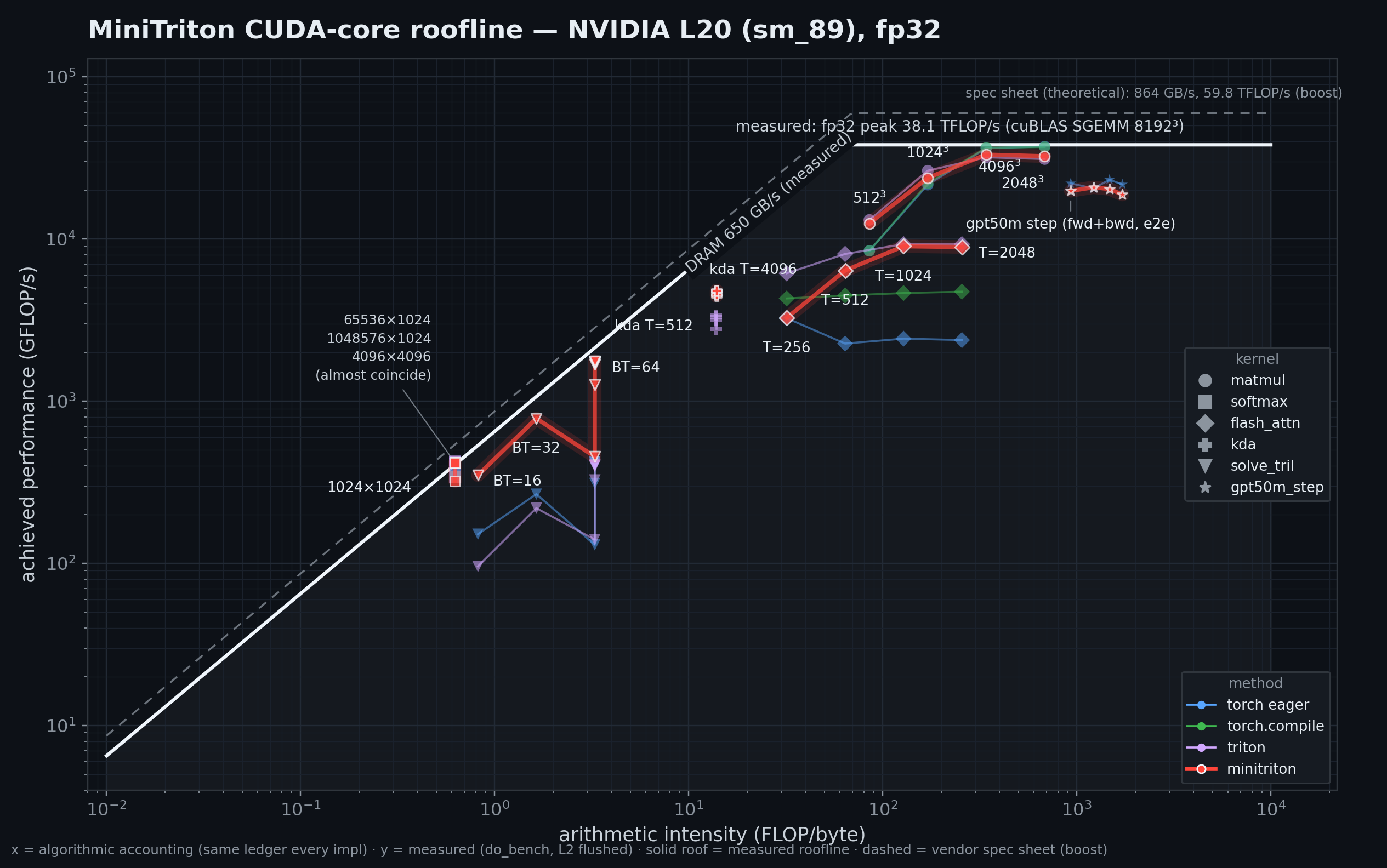 | 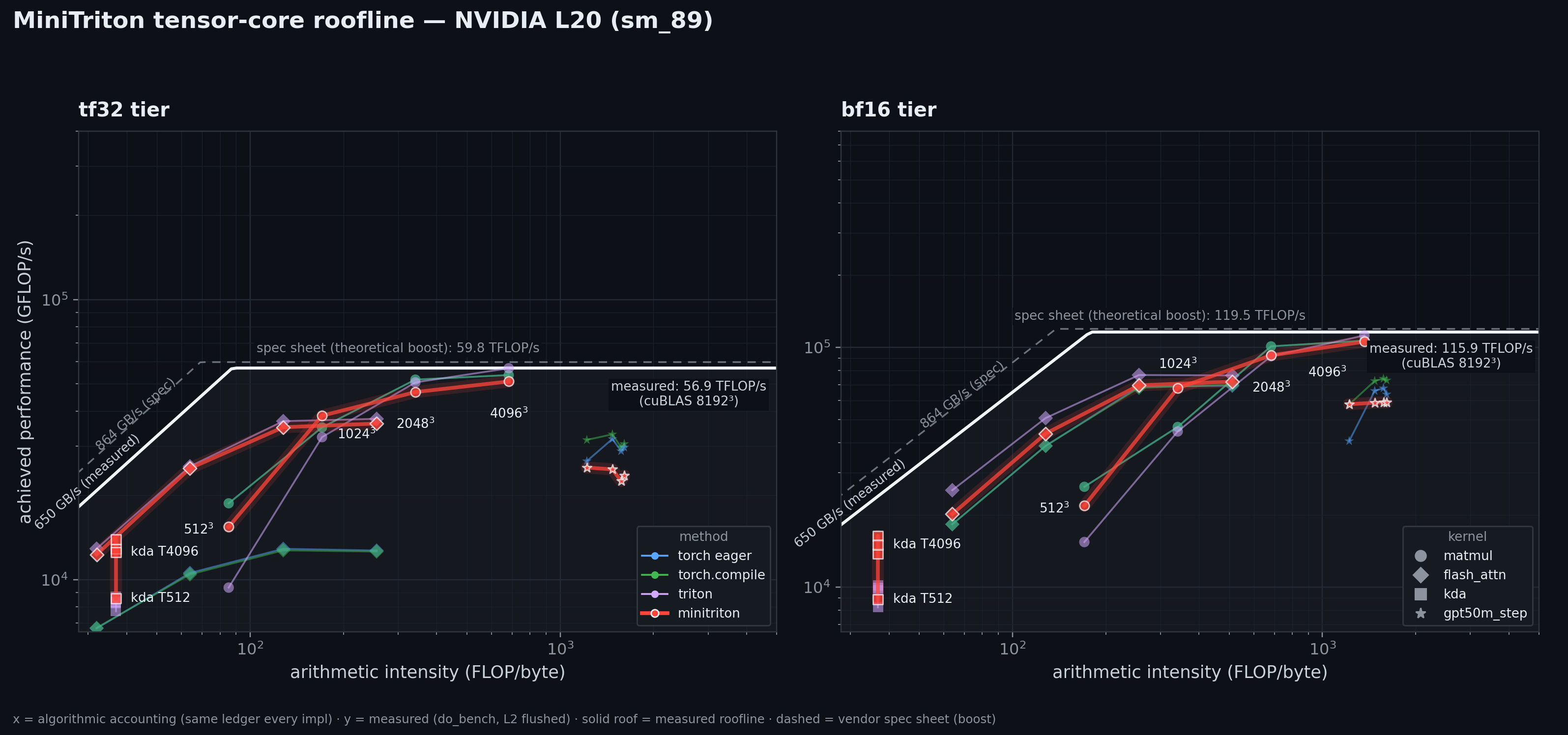 | 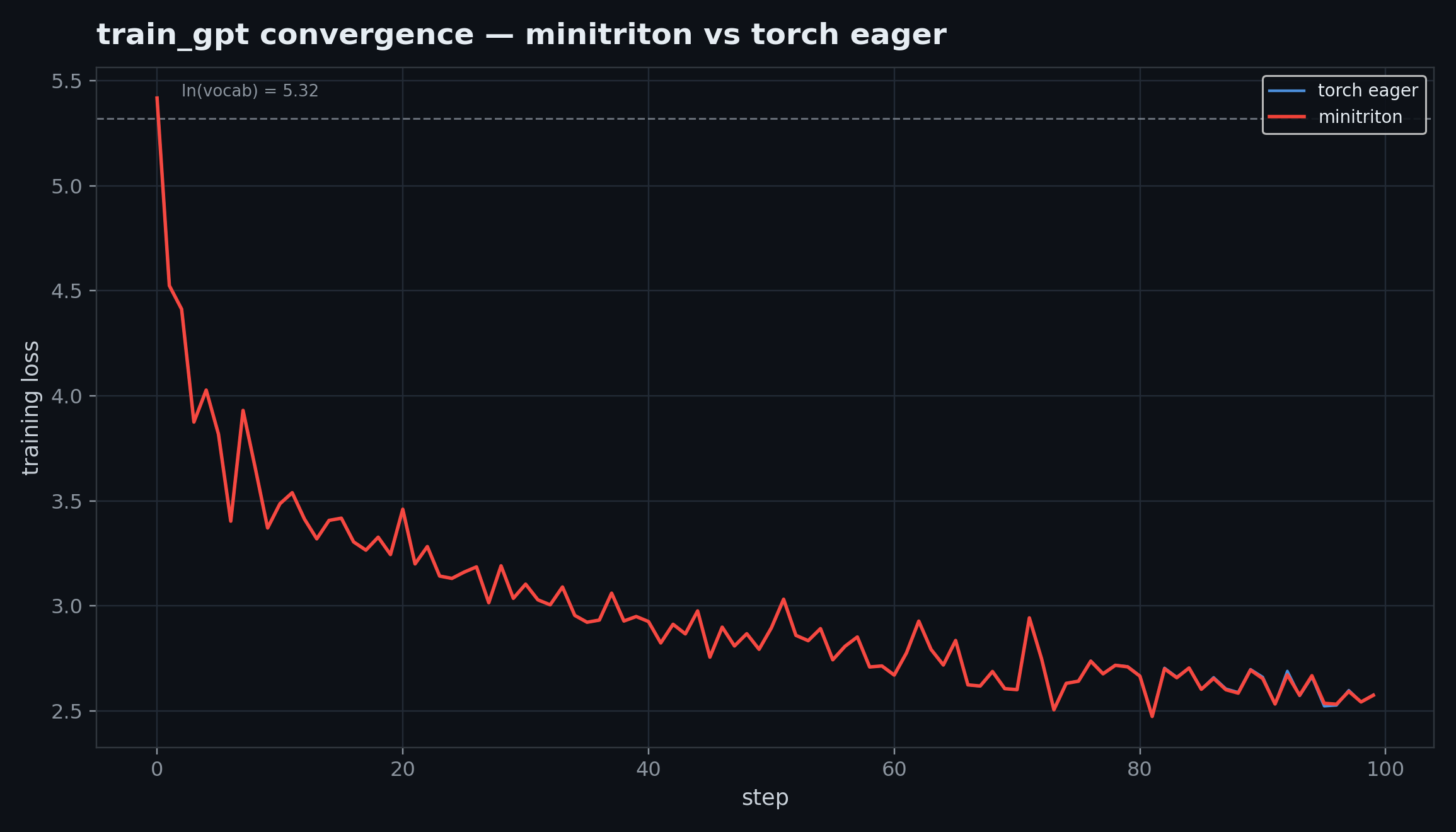 |
How to read a roofline: the x-axis is arithmetic intensity (FLOPs per DRAM byte), the y-axis is measured GFLOP/s. The solid line is the measured limit, the dashed line is the vendor spec sheet. Red is minitriton, blue is torch (eager or cuBLAS), green is torch.compile, purple is triton. Implementations that share a shape sit at the same point; the baseline series are drawn larger and lighter, so an overlap shows as a faint halo around the red marker. Points below the roofline's rivals are published too, on purpose. The star marker is the full gpt50m train step measured end to end (steady-state ms/step, identical accounting on every stack; gpt50m is the benchmark's ~50M config, L10/D640/H10 — 49.4M at T128 to 50.0M at T1024 via the positional table; the torch baseline uses explicit-eager attention below block 512 and SDPA at block 512+) — read the red stars against the torch ones directly (eager and compile; the fp32 panel shows eager only): that is the current, honest state of the library, wins and losses alike. The third figure trains the same small GPT in default fp32 on both stacks — the curves overlap. It is an L20 measurement snapshot captured at vocab=204 (the figure's own ln(vocab) annotation is self-consistent with that); the train corpus is the source tree itself, so the runtime vocab moves as the code changes — 103 at this writing, and the scripts always use the runtime value.
Quick start
Requirements: NVIDIA GPU (sm_89 verified; sm_80+ in principle), system
CUDA ≥ 12 (ptxas), Python ≥ 3.10. Toolchain via conda-forge:
conda create -p ./.conda-env -c conda-forge python=3.10 mlir=22.1.0 mlir-python-bindings=22.1.0 llvm-tools=22.1.0
./.conda-env/bin/pip install "cuda-python>=12,<13" numpy pytest pytest-xdist pytest-rerunfailures matplotlib   # torch/triton: benchmark baselines only; matplotlib: example loss plots
./.conda-env/bin/pip install torch==2.6.0   # benchmark baselines only (pulls triton==3.2.0)
PY=./.conda-env/bin/python

$PY examples/vecadd.py                  # DSL → MLIR → PTX → GPU end to end
$PY -m pytest tests/ -q                 # numpy/fp64 oracles only, no torch import
Or install as a git package (MLIR toolchain via the pip mlir-wheels index — note the wheel is ~1.3 GB and the index tracks 22.x snapshots; the conda-forge route above gives the exact 22.1.0 toolchain this repo was verified with):
pip install "mlir>=22" -f https://github.com/makslevental/mlir-wheels/releases/expanded_assets/latest
pip install "cuda-python>=12,<13" numpy
pip install .            # from the repository checkout
python -c "import minitriton; print(minitriton.__version__)"
The pip package contains only the library; the examples and benchmarks
below assume a source checkout with the conda-route $PY defined above.
Examples and usage guide
Everyday tasks, one command each (torch/triton are comparison baselines only, never runtime dependencies):
# 1. write a kernel: @tl.kernel DSL → MLIR → PTX (examples/vecadd.py, matmul.py)
$PY examples/vecadd.py

# 2. fuse eager code: @tl.compile + the fusion rule engine (R1-R4/R8 + R2'/R2V)
$PY -m pytest tests/test_fusion.py -q          # 20+ runnable fusion examples

# 3. train a model end to end (corpus = the repo's own source, zero external data)
CUDA_VISIBLE_DEVICES=0 $PY examples/train_gpt.py --steps 200   # ~85M char-GPT (12L/12H/768 default)

# 4. mixed precision: bf16 training path
#    (bf16 params + fp32 master weights + dynamic loss scaling, CUDA-graphed step)
$PY benchmarks/training/train_gpt_precision_bench.py --steps 60 --impls tl_bf16_graph

# 5. streams: overlap independent kernels on side streams (opt-in)
MT_STREAM_OVERLAP=1 $PY benchmarks/training/train_gpt_precision_bench.py --steps 60 --impls tl_bf16

# 6. benchmarks + CI gate (core suite vs torch eager and torch.compile)
CUDA_VISIBLE_DEVICES=0 $PY benchmarks/roofline/ce_report.py
CUDA_VISIBLE_DEVICES=0 $PY benchmarks/roofline/ci_report.py   # rc=0 means PASS

# 7. scheduling helpers: canonical pipeline skeletons and composed
#    row-op reference forms live in minitriton/sched/ (import and reuse)
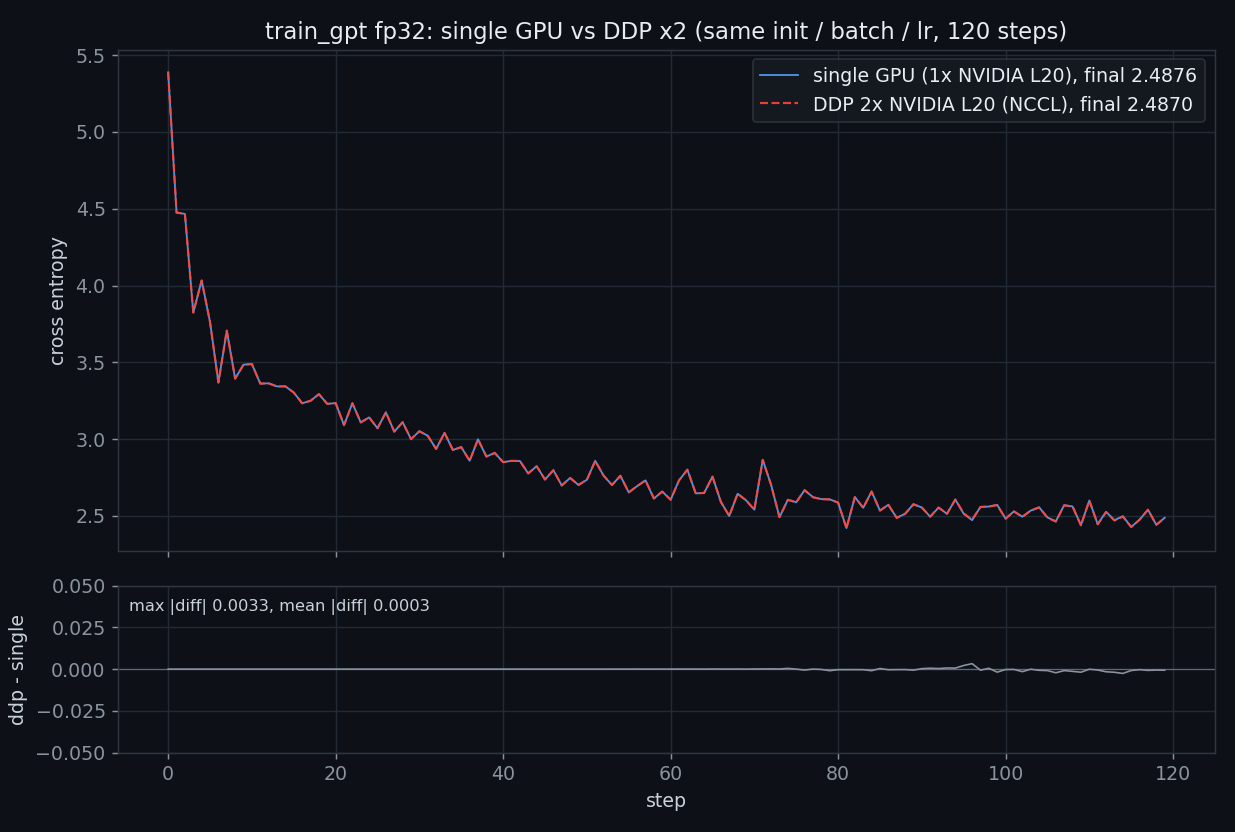
Distributed (NCCL data-parallel, gradients all-reduced once per step):
CUDA_VISIBLE_DEVICES=0,1 $PY examples/train_gpt.py --ddp --steps 120 --loss-csv /tmp/ddp.csv
Graphics / physics (minitriton.viz, window or headless PNG frames):
$PY examples/rigid_demo.py --steps 240 --frames /tmp/rigid_frames   # rigid-body particles
$PY examples/sph_demo.py   --steps 240 --frames /tmp/sph_frames     # SPH fluid
$PY examples/mpm_demo.py   --stats 50                               # MPM continuum (console stats)
SPH dam-break, 50k particles: field-sampled water (navy background,
cyan surface, white compressed foam), 480 steps @ 48 fps; regenerate
with examples/render_gallery.py (extra deps: pip install pillow
plus a system ffmpeg).
Static contact sheet ·
PDF for print.
Limitations
- Hardware: verified on NVIDIA L20 (sm_89) only; sm_80+ in principle but untested; no AMD/ROCm; the CPU backend is a numpy oracle for tests, not a usable runtime.
- Dtypes: fp32 and bf16 are first-class, tf32 is opt-in; fp16 works
for elementwise, cast and norm/CE paths (16-bit norms compute in f32
internally and cast back on store); fp16 matmul runs through f32
compute with a cast back (numerically correct — there is no fp16
tensor-core path); no fp8/quantized paths. The default path is not
bit-identical to torch (different reduction order,
ex2.approx). - Operator coverage: the op set is what the benchmarks and examples
exercise — not a torch replacement (no conv/pool/recurrent ops; most
ops assume contiguous inputs; new shape/stride keys trigger a fresh
compile + autotune pass).
@tl.compilefuses forward-only: gradients do not flow through a compiled graph (backward on its output raises — compute the loss/backward outside it, unlike torch.compile). The layer_norm/rms_norm/softmax row kernels (forward and backward) cap the reduced row width at C ≤ 8192 and raiseNotImplementedErrorabove it; cross_entropy covers wider rows through its split route. KDA is forward-only (no tape — backward is not implemented), and in-place indexed assignment (t[i] = v) raisesNotImplementedError. - Autograd: the tape is single-use —
backward()frees it and a second backward through the same graph raises (there is noretain_graph); with several losses, sum them first and backprop the sum ((l1 + l2).backward()). There is no version counter on in-place writes: mutating a non-requiring-grad tensor in place (x += d) after the graph saved it but beforebackward()yields silently wrong gradients, where torch raises (in-place writes on requiring-grad tensors are rejected). - Performance ceilings are documented, not hidden: some kernel
families sit below torch/cuBLAS (see the rooflines; the evidence
regenerates with the scripts in
benchmarks/roofline/). Cold-start compilation is serial per process (the test gate parallelizes at process level with pytest-xdist). - Distributed: NCCL data-parallel only, tested at 2 GPUs
single-node.
sparse/anddistributed/are the youngest packages. - Recorded non-fixes (evaluated and deliberately left as-is):
sparse.spmm_csr/segment_reduceindices are not range-checked (the embedding-family ops above are);gather/scatter_addinside@tl.compilefails with a bareAttributeError(no trace nodes);tl.pipelinedon an empty trip count still stages one tile;file://rendezvous files are not cleaned up on reuse;_depoverlap loops withiv > 0get no automatic sync; one_bar / one_shot mma schedules have a theoretical tail-barrier race window (never reproduced);viz.meshedge indices andsparse.coo_sort_by_key's i64→i32 truncation are unchecked (caller contract). - Ecosystem & maturity: torch-like API, not torch-compatible; no HuggingFace/ONNX bridges. Teaching-grade but measurement-honest — every claim has a re-runnable script; known gaps are listed in this section.
- Compiler vocabulary exceptions:
tl.solve_tril(a batched triangular solve, used by KDA's factor kernel) is implemented in the compiler rather than the DSL — a warp-role-specialized row solve that does not express well in the tile vocabulary. It is a generic linear-algebra primitive, not an application kernel; everything application-level (flash attention, KDA) is pure DSL. - Input validation is deliberately thin: embedding, cross-entropy,
gather and scatter_add indices ARE bounds-checked at the op entry
(
IndexError); each guarded call pays two device reduces plus host syncs (safety over speed, a teaching-grade trade-off). Inside@tl.compilethe check is skipped — a traced graph caches by shape and cannot replay data-dependent asserts. Beyond those, validation stays thin — tensor-tensorpowwith a negative base returns NaN (integer scalar exponents likex ** 3work). - Single tensors are limited to 2³¹ − 1 elements: kernel address
arithmetic is i32, so the elementwise/matmul/attention entry points
reject larger tensors loudly — including small strided views whose
reachable address range crosses the limit; the norm/misc/cross-entropy
row kernels row-chunk bigger inputs and keep working. A few entry points
(
l2norm_rows,adamw_step, gather/sparse) are not yet guarded, and a matmul/bmm whose output crosses the limit surfaces a misleadingautotune: no valid config— split the tensor instead. - No middle-layer optimizer: the DSL lowers to hand-scheduled MLIR
(pipelining, smem swizzles, ldmatrix/mma orchestration and 23 inline
PTX hotspots in
compiler/builder.pyandpasses.py), with only three small general W-IR passes on top. This is a teaching-grade hand-scheduled tile DSL, not an optimizing compiler — a new kernel family costs a few hundred lines of hand-written schedule code, not a new pass.
Repository layout
├── minitriton/          # the package
│   ├── frontend/        # @tl.kernel AST frontend (types/code_generator/semantics)
│   ├── compiler/        # builder (tile→MLIR) layout (layout algebra)
│   │                    #   wir/passes (general passes) lowering (→PTX→cubin)
│   ├── fusion.py        # graph-level fusion rule engine (registry + arbitration)
│   ├── compile.py       # @tl.compile (trace + executor)
│   ├── sched/           # scheduling choreography skeletons + row-op reference forms
│   ├── runtime/         # cuda_driver / buffer / cache / autotune / allocator / streams
│   ├── device/
│   │   ├── cuda/        # ops.py (routing shells) elementwise.py (generator + expr vocab)
│   │   │   └── kernels/ # the single kernel library (matmul/attention/norm/ce/misc/kda, pure DSL)
│   │   └── cpu/         # numpy oracle
│   ├── ops/             # eager op shared semantics (broadcast/promotion/dispatch)
│   ├── nn/  autograd/  distributed/  sparse/  precision.py (precision switches)
├── examples/            # vecadd → matmul → train_gpt (~85M char-GPT, self-contained corpus)
├── benchmarks/
│   ├── roofline/        # all performance measurement: kernel reports (matmul/
│   │                    #   attention/kda/ce/rowfam), dual rooflines + solve_tril,
│   │                    #   ci_report.py (CI performance gate)
│   └── training/        # convergence figures, precision bench, DDP, grad check
├── tests/               # pytest (numpy/fp64 oracles; no torch imports)
├── assets/              # logos + tracked figures/media
└── build/               # compile intermediates (gitignored, local debugging)
Engineering rules
- Every performance comparison ships with a figure + baseline
implementation (torch eager / torch.compile / triton, same
methodology; the CSV data behind each figure is regenerated by the
script, not committed); figures go through the
benchmarks/roofline/plot_style.pystyle family ((dark, light) × (png, svg, pdf); light PDFs for print/LaTeX) - Negative results and unmet targets are recorded in
Limitations, not hidden - DSL first: application kernels are written in the Python DSL and lowered through the generic pipeline; compiler intrinsics are limited to the tile-vocabulary set (general primitives like load/store/dot/mma/reduce), case-by-case justified expressibility exceptions, and explicit scheduling constructs; application-level kernels never enter the compiler
- Every kernel has a numpy/fp64 oracle test;
benchmarks/training/grad_check.py(vs torch autograd, atol 1e-4) must not regress
Significant stargazers

137 followers · starred Jul 2026

594 followers · starred Jul 2026

135 followers · starred Jul 2026
Similar repos


Languages
Python
100.0%
README
MiniTriton is a teaching-grade but production-minded tile compiler. You
write kernels in a small Python-embedded tile DSL; they lower through
upstream MLIR dialects to PTX and run on NVIDIA GPUs. On top of that sits
an eager tensor library (eager execution and tile-level compilation, one
API). All application kernels — flash
attention, KDA (Kimi Delta
Attention), and friends — are
written in the DSL itself; the compiler
contains only tile-level vocabulary primitives and general passes — no
application-specific intrinsics (the one expressibility exception is a
generic linear-algebra primitive, tl.solve_tril; see Limitations). Known gaps are documented in
Limitations below. The tile programming model deliberately follows
Triton's — a familiar,
well-specified target to validate an agent-built compiler against;
upstream triton appears here only as a benchmark baseline.
Built by Kimi K3 (Moonshot AI). The whole stack — the DSL frontend, the MLIR compiler, CUDA kernels, autograd/nn, benchmarks, figures and documentation — was designed, implemented, measured and written by Moonshot AI's K3 model, with engineering direction and review by the maintainer.
Disclaimer: this is a demonstration of K3's capability on compiler design — not a Moonshot product, and not for production use.
Start here
- Use the tensor library:
examples/vecadd.py→examples/matmul.py→examples/train_gpt.py— same API as the package (minitriton.tensor/minitriton.nn/minitriton.autograd) - Write a GPU kernel: the tile DSL in
examples/vecadd.py(@tl.kernel); the kernel corpus to learn from lives inminitriton/device/cuda/kernels/— pure DSL, no compiler intrinsics - See the numbers: the figures below regenerate from
benchmarks/roofline/(performance, incl. baselines) andbenchmarks/training/(convergence & correctness evidence) - Hack the compiler:
minitriton/frontend/(DSL → AST) →minitriton/compiler/(builder → passes → lowering to PTX), withtests/as the executable specification
Headline results
| CUDA-core roofline (fp32) | Tensor-core roofline (tf32/bf16) | train_gpt convergence (default fp32 path) |
|---|---|---|
| | |
How to read a roofline: the x-axis is arithmetic intensity (FLOPs per DRAM byte), the y-axis is measured GFLOP/s. The solid line is the measured limit, the dashed line is the vendor spec sheet. Red is minitriton, blue is torch (eager or cuBLAS), green is torch.compile, purple is triton. Implementations that share a shape sit at the same point; the baseline series are drawn larger and lighter, so an overlap shows as a faint halo around the red marker. Points below the roofline's rivals are published too, on purpose. The star marker is the full gpt50m train step measured end to end (steady-state ms/step, identical accounting on every stack; gpt50m is the benchmark's ~50M config, L10/D640/H10 — 49.4M at T128 to 50.0M at T1024 via the positional table; the torch baseline uses explicit-eager attention below block 512 and SDPA at block 512+) — read the red stars against the torch ones directly (eager and compile; the fp32 panel shows eager only): that is the current, honest state of the library, wins and losses alike. The third figure trains the same small GPT in default fp32 on both stacks — the curves overlap. It is an L20 measurement snapshot captured at vocab=204 (the figure's own ln(vocab) annotation is self-consistent with that); the train corpus is the source tree itself, so the runtime vocab moves as the code changes — 103 at this writing, and the scripts always use the runtime value.
Quick start
Requirements: NVIDIA GPU (sm_89 verified; sm_80+ in principle), system
CUDA ≥ 12 (ptxas), Python ≥ 3.10. Toolchain via conda-forge:
conda create -p ./.conda-env -c conda-forge python=3.10 mlir=22.1.0 mlir-python-bindings=22.1.0 llvm-tools=22.1.0
./.conda-env/bin/pip install "cuda-python>=12,<13" numpy pytest pytest-xdist pytest-rerunfailures matplotlib   # torch/triton: benchmark baselines only; matplotlib: example loss plots
./.conda-env/bin/pip install torch==2.6.0   # benchmark baselines only (pulls triton==3.2.0)
PY=./.conda-env/bin/python

$PY examples/vecadd.py                  # DSL → MLIR → PTX → GPU end to end
$PY -m pytest tests/ -q                 # numpy/fp64 oracles only, no torch import
Or install as a git package (MLIR toolchain via the pip mlir-wheels index — note the wheel is ~1.3 GB and the index tracks 22.x snapshots; the conda-forge route above gives the exact 22.1.0 toolchain this repo was verified with):
pip install "mlir>=22" -f https://github.com/makslevental/mlir-wheels/releases/expanded_assets/latest
pip install "cuda-python>=12,<13" numpy
pip install .            # from the repository checkout
python -c "import minitriton; print(minitriton.__version__)"
The pip package contains only the library; the examples and benchmarks
below assume a source checkout with the conda-route $PY defined above.
Examples and usage guide
Everyday tasks, one command each (torch/triton are comparison baselines only, never runtime dependencies):
# 1. write a kernel: @tl.kernel DSL → MLIR → PTX (examples/vecadd.py, matmul.py)
$PY examples/vecadd.py

# 2. fuse eager code: @tl.compile + the fusion rule engine (R1-R4/R8 + R2'/R2V)
$PY -m pytest tests/test_fusion.py -q          # 20+ runnable fusion examples

# 3. train a model end to end (corpus = the repo's own source, zero external data)
CUDA_VISIBLE_DEVICES=0 $PY examples/train_gpt.py --steps 200   # ~85M char-GPT (12L/12H/768 default)

# 4. mixed precision: bf16 training path
#    (bf16 params + fp32 master weights + dynamic loss scaling, CUDA-graphed step)
$PY benchmarks/training/train_gpt_precision_bench.py --steps 60 --impls tl_bf16_graph

# 5. streams: overlap independent kernels on side streams (opt-in)
MT_STREAM_OVERLAP=1 $PY benchmarks/training/train_gpt_precision_bench.py --steps 60 --impls tl_bf16

# 6. benchmarks + CI gate (core suite vs torch eager and torch.compile)
CUDA_VISIBLE_DEVICES=0 $PY benchmarks/roofline/ce_report.py
CUDA_VISIBLE_DEVICES=0 $PY benchmarks/roofline/ci_report.py   # rc=0 means PASS

# 7. scheduling helpers: canonical pipeline skeletons and composed
#    row-op reference forms live in minitriton/sched/ (import and reuse)
Distributed (NCCL data-parallel, gradients all-reduced once per step):
CUDA_VISIBLE_DEVICES=0,1 $PY examples/train_gpt.py --ddp --steps 120 --loss-csv /tmp/ddp.csv
Graphics / physics (minitriton.viz, window or headless PNG frames):
$PY examples/rigid_demo.py --steps 240 --frames /tmp/rigid_frames   # rigid-body particles
$PY examples/sph_demo.py   --steps 240 --frames /tmp/sph_frames     # SPH fluid
$PY examples/mpm_demo.py   --stats 50                               # MPM continuum (console stats)
SPH dam-break, 50k particles: field-sampled water (navy background,
cyan surface, white compressed foam), 480 steps @ 48 fps; regenerate
with examples/render_gallery.py (extra deps: pip install pillow
plus a system ffmpeg).
Static contact sheet ·
PDF for print.
Limitations
- Hardware: verified on NVIDIA L20 (sm_89) only; sm_80+ in principle but untested; no AMD/ROCm; the CPU backend is a numpy oracle for tests, not a usable runtime.
- Dtypes: fp32 and bf16 are first-class, tf32 is opt-in; fp16 works
for elementwise, cast and norm/CE paths (16-bit norms compute in f32
internally and cast back on store); fp16 matmul runs through f32
compute with a cast back (numerically correct — there is no fp16
tensor-core path); no fp8/quantized paths. The default path is not
bit-identical to torch (different reduction order,
ex2.approx). - Operator coverage: the op set is what the benchmarks and examples
exercise — not a torch replacement (no conv/pool/recurrent ops; most
ops assume contiguous inputs; new shape/stride keys trigger a fresh
compile + autotune pass).
@tl.compilefuses forward-only: gradients do not flow through a compiled graph (backward on its output raises — compute the loss/backward outside it, unlike torch.compile). The layer_norm/rms_norm/softmax row kernels (forward and backward) cap the reduced row width at C ≤ 8192 and raiseNotImplementedErrorabove it; cross_entropy covers wider rows through its split route. KDA is forward-only (no tape — backward is not implemented), and in-place indexed assignment (t[i] = v) raisesNotImplementedError. - Autograd: the tape is single-use —
backward()frees it and a second backward through the same graph raises (there is noretain_graph); with several losses, sum them first and backprop the sum ((l1 + l2).backward()). There is no version counter on in-place writes: mutating a non-requiring-grad tensor in place (x += d) after the graph saved it but beforebackward()yields silently wrong gradients, where torch raises (in-place writes on requiring-grad tensors are rejected). - Performance ceilings are documented, not hidden: some kernel
families sit below torch/cuBLAS (see the rooflines; the evidence
regenerates with the scripts in
benchmarks/roofline/). Cold-start compilation is serial per process (the test gate parallelizes at process level with pytest-xdist). - Distributed: NCCL data-parallel only, tested at 2 GPUs
single-node.
sparse/anddistributed/are the youngest packages. - Recorded non-fixes (evaluated and deliberately left as-is):
sparse.spmm_csr/segment_reduceindices are not range-checked (the embedding-family ops above are);gather/scatter_addinside@tl.compilefails with a bareAttributeError(no trace nodes);tl.pipelinedon an empty trip count still stages one tile;file://rendezvous files are not cleaned up on reuse;_depoverlap loops withiv > 0get no automatic sync; one_bar / one_shot mma schedules have a theoretical tail-barrier race window (never reproduced);viz.meshedge indices andsparse.coo_sort_by_key's i64→i32 truncation are unchecked (caller contract). - Ecosystem & maturity: torch-like API, not torch-compatible; no HuggingFace/ONNX bridges. Teaching-grade but measurement-honest — every claim has a re-runnable script; known gaps are listed in this section.
- Compiler vocabulary exceptions:
tl.solve_tril(a batched triangular solve, used by KDA's factor kernel) is implemented in the compiler rather than the DSL — a warp-role-specialized row solve that does not express well in the tile vocabulary. It is a generic linear-algebra primitive, not an application kernel; everything application-level (flash attention, KDA) is pure DSL. - Input validation is deliberately thin: embedding, cross-entropy,
gather and scatter_add indices ARE bounds-checked at the op entry
(
IndexError); each guarded call pays two device reduces plus host syncs (safety over speed, a teaching-grade trade-off). Inside@tl.compilethe check is skipped — a traced graph caches by shape and cannot replay data-dependent asserts. Beyond those, validation stays thin — tensor-tensorpowwith a negative base returns NaN (integer scalar exponents likex ** 3work). - Single tensors are limited to 2³¹ − 1 elements: kernel address
arithmetic is i32, so the elementwise/matmul/attention entry points
reject larger tensors loudly — including small strided views whose
reachable address range crosses the limit; the norm/misc/cross-entropy
row kernels row-chunk bigger inputs and keep working. A few entry points
(
l2norm_rows,adamw_step, gather/sparse) are not yet guarded, and a matmul/bmm whose output crosses the limit surfaces a misleadingautotune: no valid config— split the tensor instead. - No middle-layer optimizer: the DSL lowers to hand-scheduled MLIR
(pipelining, smem swizzles, ldmatrix/mma orchestration and 23 inline
PTX hotspots in
compiler/builder.pyandpasses.py), with only three small general W-IR passes on top. This is a teaching-grade hand-scheduled tile DSL, not an optimizing compiler — a new kernel family costs a few hundred lines of hand-written schedule code, not a new pass.
Repository layout
├── minitriton/          # the package
│   ├── frontend/        # @tl.kernel AST frontend (types/code_generator/semantics)
│   ├── compiler/        # builder (tile→MLIR) layout (layout algebra)
│   │                    #   wir/passes (general passes) lowering (→PTX→cubin)
│   ├── fusion.py        # graph-level fusion rule engine (registry + arbitration)
│   ├── compile.py       # @tl.compile (trace + executor)
│   ├── sched/           # scheduling choreography skeletons + row-op reference forms
│   ├── runtime/         # cuda_driver / buffer / cache / autotune / allocator / streams
│   ├── device/
│   │   ├── cuda/        # ops.py (routing shells) elementwise.py (generator + expr vocab)
│   │   │   └── kernels/ # the single kernel library (matmul/attention/norm/ce/misc/kda, pure DSL)
│   │   └── cpu/         # numpy oracle
│   ├── ops/             # eager op shared semantics (broadcast/promotion/dispatch)
│   ├── nn/  autograd/  distributed/  sparse/  precision.py (precision switches)
├── examples/            # vecadd → matmul → train_gpt (~85M char-GPT, self-contained corpus)
├── benchmarks/
│   ├── roofline/        # all performance measurement: kernel reports (matmul/
│   │                    #   attention/kda/ce/rowfam), dual rooflines + solve_tril,
│   │                    #   ci_report.py (CI performance gate)
│   └── training/        # convergence figures, precision bench, DDP, grad check
├── tests/               # pytest (numpy/fp64 oracles; no torch imports)
├── assets/              # logos + tracked figures/media
└── build/               # compile intermediates (gitignored, local debugging)
Engineering rules
- Every performance comparison ships with a figure + baseline
implementation (torch eager / torch.compile / triton, same
methodology; the CSV data behind each figure is regenerated by the
script, not committed); figures go through the
benchmarks/roofline/plot_style.pystyle family ((dark, light) × (png, svg, pdf); light PDFs for print/LaTeX) - Negative results and unmet targets are recorded in
Limitations, not hidden - DSL first: application kernels are written in the Python DSL and lowered through the generic pipeline; compiler intrinsics are limited to the tile-vocabulary set (general primitives like load/store/dot/mma/reduce), case-by-case justified expressibility exceptions, and explicit scheduling constructs; application-level kernels never enter the compiler
- Every kernel has a numpy/fp64 oracle test;
benchmarks/training/grad_check.py(vs torch autograd, atol 1e-4) must not regress
Similar repos
Significant stargazers
137 followers · starred Jul 2026
594 followers · starred Jul 2026
135 followers · starred Jul 2026
Languages
Python
100.0%