A Benchmark for clinical notes entity linking in the SNOMED CT clinical terminology
Python
13
5 commits
updated May 30, 2024
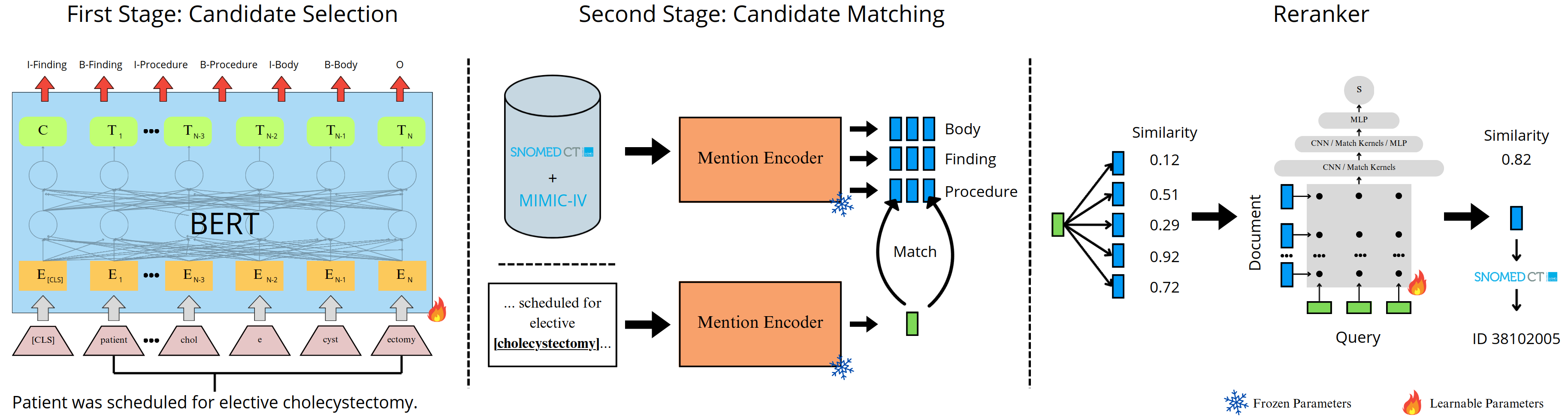
The method consists of two stages: Candidate Selection (I) and Candidate Matching (II).
For more information and details about the dataset see: https://arxiv.org/abs/2405.16115
Training an ensemble of BERT models, NER task in B-I-O format (7 classes, B-find, I-find, B-proc, I-proc, B-body, I-body, 0)
Using a pretrained embedder, predict ID based on cosine similarity.
For the whole SNOMED database extract concepts that are in [Body structure, Findings, Procedure] nodes (about 200k of unique IDs).
Get a database of embeddings:
# pseudocode
ID2EMB = {}
for id in all_ids:
  embeds = []
  for synonym in get_all_synonyms(id):
    embed = embedder(synonym)
    embeds.append(embed)
  true_embed = embeds.mean(0)
  ID2EMB[id] = true_embed
Match extracted mentions (from stage 1) with database:
# pseudocode
for mention in predicted_mentions:
   qvec = embed(mention)
   similarities = qvec @ ID2EMB.values()
   top1_idx = argsort(similarities)
   qID = ID2EMB.keys()[top1_idx]
├── configs
├── data
│   ├── competition_data
│   │   ├── mimic-iv_notes_training_set.csv
│   │   ├── SnomedCT_InternationalRF2_PRODUCTION_20230531T120000Z_Challenge_Edition
│   │   └── train_annotations.csv
│   ├── first_stage
│   │   ├── S0_0_score_0.1129
│   │   └── Sall_9_score_0.2807
│   ├── preprocess_data
│   └── second_stage
│       └── sapbert
│           ├── embeds
│           └── model
├── docker
├── output
│   ├── 03-20
│   │   ├── 22_00_40
│   │   │   ├── models
│   │   │   │   └── Sall_56_score_0.9491
│   │   │   ├── src
│   │   │   ├── tb
│   │   │   └── tokenizer
│   │   └── 22_22_46
│   │       ├── models
│   │       │   └── S0_11_score_0.4197
│   │       ├── src
│   │       ├── tb
│   │       └── tokenizer
├── src
└── submission
Prior to training, add the following raw data sources do data/competition_data:
data
└── competition_data
    ├── mimic-iv_notes_training_set.csv
    ├── SnomedCT_InternationalRF2_PRODUCTION_20230531T120000Z_Challenge_Edition
    └── train_annotations.csv
data/competition_data/mimic-iv_notes_training_set.csv): From the SNOMED CT Entity Linking Challenge dataset. See Data access instructions.data/competition_data/train_annotations.csv): From the SNOMED CT Entity Linking Challenge dataset. See Data access instructions.data/competition_data/SnomedCT_InternationalRF2_PRODUCTION_20230531T120000Z_Challenge_Edition): Download SnomedCT_InternationalRF2.zip from the challenge data download page. Unzip it to the data/competition_data directory.Fixing train annotations: To address certain annotation inaccuracies in train_annotations.csv, such as those caused by shifts due to <br> tags, we utilized the NER pipeline in labelstudio. Approximately 8-10 notes (out of 204) underwent corrections, involving adjustments to around 100-200 annotation IDs (out of over 50,000). These corrections specifically targeted errors resulting from shifted annotations. As a result of these adjustments, the overall score changed by approximately 0.002.
No-annotation-parts: Several parts of almost every note were excluded from annotations. We excluded them from the training process. Excluded parts-segments-headers: ['medications on admission:', '___ on admission:', 'discharge medications:']
To run a container using the image:
make docker
Or Anaconda:
conda create -n snomed-snobert python=3.10
conda activate snomed-snobert
pip install .  # installs requirements from pyproject.toml
We used NVIDIA A100-SXM4-40GB (4 cards), but the solution should be replicatable on single A10 24gb
Optional (small score improvement): MLM pretrained model + 24hrs on 4 x A100
Training time:
Inference time: ~1 minute
Preprocess the raw data into intermediate features:
python src/preprocess.py
To create data splits for validation run: python src/preprocess.py --val
This performs a variety of preprocessing steps including:
data/preprocess_data/{proc, find, body}_sctid_syn.jsondata/second_stage/{embedder}/embeds/{name}_{concept_type}.pthdata/preprocess_data/most_common_concept.pklWe use hydra config to configure training of the first stage, an NER task. Set the value of OUTPUTS in configs/snom.yaml to the desired output directory (where model weights will be saved).
To run training in Distributed Data Parallel (DDP) mode:
# DDP mode (multiple GPUs)
torchrun --nproc-per-node=4 src/main.py PARALLEL.DDP=true

# or in single GPU mode
torchrun --nproc-per-node=1 src/main.py PARALLEL.DDP=false
As an example:
torchrun --nproc-per-node=1 src/main.py split=0 class_weights=[0.142,0.142,0.142,0.142,0.142,0.142,0.142] epochs=100 chunked_repeat=2
trains in 80 minutes on a single A10 24GB GPU and results in IoU of 0.4277 and first stage score of 0.7410.
The final leaderboard submission was an ensemble of six models:
torchrun --nproc-per-node=1 src/main.py split=0 class_weights=[0.142,0.142,0.142,0.142,0.142,0.142,0.142] epochs=100
torchrun --nproc-per-node=1 src/main.py split=3 class_weights=[0.142,1,1,1,1,1,1] epochs=100
torchrun --nproc-per-node=1 src/main.py split=all class_weights=[1,1,1,1,1,1,1] epochs=110
torchrun --nproc-per-node=1 src/main.py split=all class_weights=[0.142,0.142,0.142,0.142,0.142,0.142,0.142] epochs=110
torchrun --nproc-per-node=1 src/main.py split=all class_weights=[0.142,0.571,0.571,0.571,0.571,0.571,0.571] epochs=120
torchrun --nproc-per-node=1 src/main.py split=all class_weights=[0.142,0.571,0.571,0.571,0.571,0.571,0.571] epochs=120
Training can be started from:
microsoft/BiomedNLP-BiomedBERT-large-uncased-abstractmicrosoft/BiomedNLP-BiomedBERT-base-uncased-abstract-fulltextmicrosoft/BiomedNLP-BiomedBERT-large-uncased-abstractThis should be set in configs/snom.yaml, field model.
| Model | GPU | First stage score | IoU | Epoch |
|---|---|---|---|---|
| MLM pretrained (420000 epochs) | 1 | 0.7429 | 0.4231 | 75 |
| BiomedNLP-BiomedBERT-large-uncased-abstract | 1 | 0.7487 | 0.4199 | 76 |
| MLM pretrained (420000 epochs) | 4 | 0.7514 | 0.4302 | 74 |
| BiomedNLP-BiomedBERT-large-uncased-abstract | 4 | 0.7499 | 0.4257 | 72 |
output
├── 03-20           # date
│   ├── 22_00_40    # time
│   │   ├── models  # last 3 checkpoints in HF format
│   │   │   ├── Sall_54_score_0.9418  # S - split; all - alldata mode; 54- epoch; 0.9418 - F1 macro score
│   │   │   ├── Sall_55_score_0.9462
│   │   │   └── Sall_56_score_0.9491
│   │   ├── src        # source code for debugging
│   │   ├── tb         # tensorboard logs
│   │   └── tokenizer
To run inference:
output/<date>/<time>/models, (e.g., output/03-20/22_00_40/Sall_54_score_0.9418), place them in data/first_stage folder.data/competition_data/test_notes.csvThen run the following:
python submission/main.py
To run in validation-scoring mode, run python submission/main.py --val.
main.py contains variables that point to assets required for inference:
FIRST_STAGE_CHECKPOINTS (default data/first_stage): list of paths to model weights for ensemblingSECOND_STAGE_CHECKPOINTS (default data/second_stage/sapbert): path to SapBERT weightsSTATIC_DICT_PATH (default data/preprocess_data/most_common_concept.pkl)TRAIN_NOTES_PATH (data/competition_data/cutmed_fixed_train_annotations.csv)TRAIN_ANNOTAIONS_PATH (data/competition_data/cutmed_fixed_train_annotations.csv)TEST_NOTES_PATH (data/competition_data/test_notes.csv)SUBMISSION_PATH (submission.csv)@misc{kulyabin2024snobert,
title={SNOBERT: A Benchmark for clinical notes entity linking in the SNOMED CT clinical terminology},
author={Mikhail Kulyabin and Gleb Sokolov and Aleksandr Galaida and Andreas Maier and Tomas Arias-Vergara},
year={2024},
eprint={2405.16115},
archivePrefix={arXiv},
primaryClass={cs.CL}
}
A Benchmark for clinical notes entity linking in the SNOMED CT clinical terminology
Python
13
5 commits
updated May 30, 2024
The method consists of two stages: Candidate Selection (I) and Candidate Matching (II).
For more information and details about the dataset see: https://arxiv.org/abs/2405.16115
Training an ensemble of BERT models, NER task in B-I-O format (7 classes, B-find, I-find, B-proc, I-proc, B-body, I-body, 0)
Using a pretrained embedder, predict ID based on cosine similarity.
For the whole SNOMED database extract concepts that are in [Body structure, Findings, Procedure] nodes (about 200k of unique IDs).
Get a database of embeddings:
# pseudocode
ID2EMB = {}
for id in all_ids:
  embeds = []
  for synonym in get_all_synonyms(id):
    embed = embedder(synonym)
    embeds.append(embed)
  true_embed = embeds.mean(0)
  ID2EMB[id] = true_embed
Match extracted mentions (from stage 1) with database:
# pseudocode
for mention in predicted_mentions:
   qvec = embed(mention)
   similarities = qvec @ ID2EMB.values()
   top1_idx = argsort(similarities)
   qID = ID2EMB.keys()[top1_idx]
├── configs
├── data
│   ├── competition_data
│   │   ├── mimic-iv_notes_training_set.csv
│   │   ├── SnomedCT_InternationalRF2_PRODUCTION_20230531T120000Z_Challenge_Edition
│   │   └── train_annotations.csv
│   ├── first_stage
│   │   ├── S0_0_score_0.1129
│   │   └── Sall_9_score_0.2807
│   ├── preprocess_data
│   └── second_stage
│       └── sapbert
│           ├── embeds
│           └── model
├── docker
├── output
│   ├── 03-20
│   │   ├── 22_00_40
│   │   │   ├── models
│   │   │   │   └── Sall_56_score_0.9491
│   │   │   ├── src
│   │   │   ├── tb
│   │   │   └── tokenizer
│   │   └── 22_22_46
│   │       ├── models
│   │       │   └── S0_11_score_0.4197
│   │       ├── src
│   │       ├── tb
│   │       └── tokenizer
├── src
└── submission
Prior to training, add the following raw data sources do data/competition_data:
data
└── competition_data
    ├── mimic-iv_notes_training_set.csv
    ├── SnomedCT_InternationalRF2_PRODUCTION_20230531T120000Z_Challenge_Edition
    └── train_annotations.csv
data/competition_data/mimic-iv_notes_training_set.csv): From the SNOMED CT Entity Linking Challenge dataset. See Data access instructions.data/competition_data/train_annotations.csv): From the SNOMED CT Entity Linking Challenge dataset. See Data access instructions.data/competition_data/SnomedCT_InternationalRF2_PRODUCTION_20230531T120000Z_Challenge_Edition): Download SnomedCT_InternationalRF2.zip from the challenge data download page. Unzip it to the data/competition_data directory.Fixing train annotations: To address certain annotation inaccuracies in train_annotations.csv, such as those caused by shifts due to <br> tags, we utilized the NER pipeline in labelstudio. Approximately 8-10 notes (out of 204) underwent corrections, involving adjustments to around 100-200 annotation IDs (out of over 50,000). These corrections specifically targeted errors resulting from shifted annotations. As a result of these adjustments, the overall score changed by approximately 0.002.
No-annotation-parts: Several parts of almost every note were excluded from annotations. We excluded them from the training process. Excluded parts-segments-headers: ['medications on admission:', '___ on admission:', 'discharge medications:']
To run a container using the image:
make docker
Or Anaconda:
conda create -n snomed-snobert python=3.10
conda activate snomed-snobert
pip install .  # installs requirements from pyproject.toml
We used NVIDIA A100-SXM4-40GB (4 cards), but the solution should be replicatable on single A10 24gb
Optional (small score improvement): MLM pretrained model + 24hrs on 4 x A100
Training time:
Inference time: ~1 minute
Preprocess the raw data into intermediate features:
python src/preprocess.py
To create data splits for validation run: python src/preprocess.py --val
This performs a variety of preprocessing steps including:
data/preprocess_data/{proc, find, body}_sctid_syn.jsondata/second_stage/{embedder}/embeds/{name}_{concept_type}.pthdata/preprocess_data/most_common_concept.pklWe use hydra config to configure training of the first stage, an NER task. Set the value of OUTPUTS in configs/snom.yaml to the desired output directory (where model weights will be saved).
To run training in Distributed Data Parallel (DDP) mode:
# DDP mode (multiple GPUs)
torchrun --nproc-per-node=4 src/main.py PARALLEL.DDP=true

# or in single GPU mode
torchrun --nproc-per-node=1 src/main.py PARALLEL.DDP=false
As an example:
torchrun --nproc-per-node=1 src/main.py split=0 class_weights=[0.142,0.142,0.142,0.142,0.142,0.142,0.142] epochs=100 chunked_repeat=2
trains in 80 minutes on a single A10 24GB GPU and results in IoU of 0.4277 and first stage score of 0.7410.
The final leaderboard submission was an ensemble of six models:
torchrun --nproc-per-node=1 src/main.py split=0 class_weights=[0.142,0.142,0.142,0.142,0.142,0.142,0.142] epochs=100
torchrun --nproc-per-node=1 src/main.py split=3 class_weights=[0.142,1,1,1,1,1,1] epochs=100
torchrun --nproc-per-node=1 src/main.py split=all class_weights=[1,1,1,1,1,1,1] epochs=110
torchrun --nproc-per-node=1 src/main.py split=all class_weights=[0.142,0.142,0.142,0.142,0.142,0.142,0.142] epochs=110
torchrun --nproc-per-node=1 src/main.py split=all class_weights=[0.142,0.571,0.571,0.571,0.571,0.571,0.571] epochs=120
torchrun --nproc-per-node=1 src/main.py split=all class_weights=[0.142,0.571,0.571,0.571,0.571,0.571,0.571] epochs=120
Training can be started from:
microsoft/BiomedNLP-BiomedBERT-large-uncased-abstractmicrosoft/BiomedNLP-BiomedBERT-base-uncased-abstract-fulltextmicrosoft/BiomedNLP-BiomedBERT-large-uncased-abstractThis should be set in configs/snom.yaml, field model.
| Model | GPU | First stage score | IoU | Epoch |
|---|---|---|---|---|
| MLM pretrained (420000 epochs) | 1 | 0.7429 | 0.4231 | 75 |
| BiomedNLP-BiomedBERT-large-uncased-abstract | 1 | 0.7487 | 0.4199 | 76 |
| MLM pretrained (420000 epochs) | 4 | 0.7514 | 0.4302 | 74 |
| BiomedNLP-BiomedBERT-large-uncased-abstract | 4 | 0.7499 | 0.4257 | 72 |
output
├── 03-20           # date
│   ├── 22_00_40    # time
│   │   ├── models  # last 3 checkpoints in HF format
│   │   │   ├── Sall_54_score_0.9418  # S - split; all - alldata mode; 54- epoch; 0.9418 - F1 macro score
│   │   │   ├── Sall_55_score_0.9462
│   │   │   └── Sall_56_score_0.9491
│   │   ├── src        # source code for debugging
│   │   ├── tb         # tensorboard logs
│   │   └── tokenizer
To run inference:
output/<date>/<time>/models, (e.g., output/03-20/22_00_40/Sall_54_score_0.9418), place them in data/first_stage folder.data/competition_data/test_notes.csvThen run the following:
python submission/main.py
To run in validation-scoring mode, run python submission/main.py --val.
main.py contains variables that point to assets required for inference:
FIRST_STAGE_CHECKPOINTS (default data/first_stage): list of paths to model weights for ensemblingSECOND_STAGE_CHECKPOINTS (default data/second_stage/sapbert): path to SapBERT weightsSTATIC_DICT_PATH (default data/preprocess_data/most_common_concept.pkl)TRAIN_NOTES_PATH (data/competition_data/cutmed_fixed_train_annotations.csv)TRAIN_ANNOTAIONS_PATH (data/competition_data/cutmed_fixed_train_annotations.csv)TEST_NOTES_PATH (data/competition_data/test_notes.csv)SUBMISSION_PATH (submission.csv)@misc{kulyabin2024snobert,
title={SNOBERT: A Benchmark for clinical notes entity linking in the SNOMED CT clinical terminology},
author={Mikhail Kulyabin and Gleb Sokolov and Aleksandr Galaida and Andreas Maier and Tomas Arias-Vergara},
year={2024},
eprint={2405.16115},
archivePrefix={arXiv},
primaryClass={cs.CL}
}



