Code for the paper "Modelling Latent Translations for Cross-Lingual Transfer"
Python
17
16 commits
updated Nov 22, 2021
Documentation | Cite | Paper
While often achieving SOTA results, “translation test” suffers from some limitations: 1) errors accumulate along the pipeline and cannot be corrected; 2) only the maximum-likelihood translation is generated, which is not necessarily the most relevant to the downstream task.
Instead, we integrate both translator and classifier into a single model, by treating the intermediate translations as a latent random variable. By initialising both components with pre-trained models, our method is suitable for few-shot learning.
By performing inference under this model, 1) we fine-tune the translator end-to-end or via Minimum Risk Training according to the downstream task loss; 2) we draw multiple translation samples to perform ensemble prediction in the downstream task.
For instance, the following example from Turkish XCOPA reveals how the maximum-likelihood translation leads to a wrong prediction. On the other hand, majority voting from multiple translation samples recover the correct prediction.
| NLL | Premise | Hypothesis 1 | Hypothesis 2 | Prediction |
|---|---|---|---|---|
| Adam partide çok içti. | Ertesi gün başı ağrıdı. | Ertesi gün burnu aktı. | ||
| 1.49 | He drank too much at the party. | She had a headache the next day. | The next day, he had a runny nose. | 1 |
| 2.07 | The guy drank too much at the party. | He had a headache the next day. | The next day, his nose leaked. | 0 |
| 2.26 | The guy drank a lot at the party. | He got a headache the next day. | The next day, his nose ran. | 0 |
pip install -r requirements.txtThe datasets for the experiments reported in the paper can be obtained with this command:
cd scripts
bash download_data.sh
The traslations into English of their test sets via Google MT can be found at the following links:
| Dataset | Task | Google Translate |
|---|---|---|
| XNLI | Natural Language Inference | link |
| XCOPA | Commonsense Reasoning | link |
| PAWS-X | Paraphrase Identification | link |
For cross-lingual transfer based on neural machine translation:
python train.py --task_name <xcopa|pawsx|xnli> --mode <trans-soft|trans-hard> --nmt_model_name <marian|google|mbart50> --do_train --do_eval --do_refine --num_samples 12 --per_gpu_train_batch_size 1 --gradient_accumulation_steps 24 --learning_rate 8e-6 --per_gpu_eval_batch_size 2
Note that the number of translation samples is specified by --num_samples. By setting --mode trans-soft the translator parameters are fine-tuned with Minimum Risk Training, whereas --mode trans-hard keeps them frozen.
For cross-lingual transfer based on multilingual encoders:
python train.py --task_name <xcopa|pawsx|xnli> --mode multi --cls_model_name <xlmr|mbart50> --do_train --do_eval --do_refine --per_gpu_train_batch_size 4 --gradient_accumulation_steps 6 --learning_rate 8e-6 --max_seq_length 384 --num_train_epochs 2 --save_steps 1000
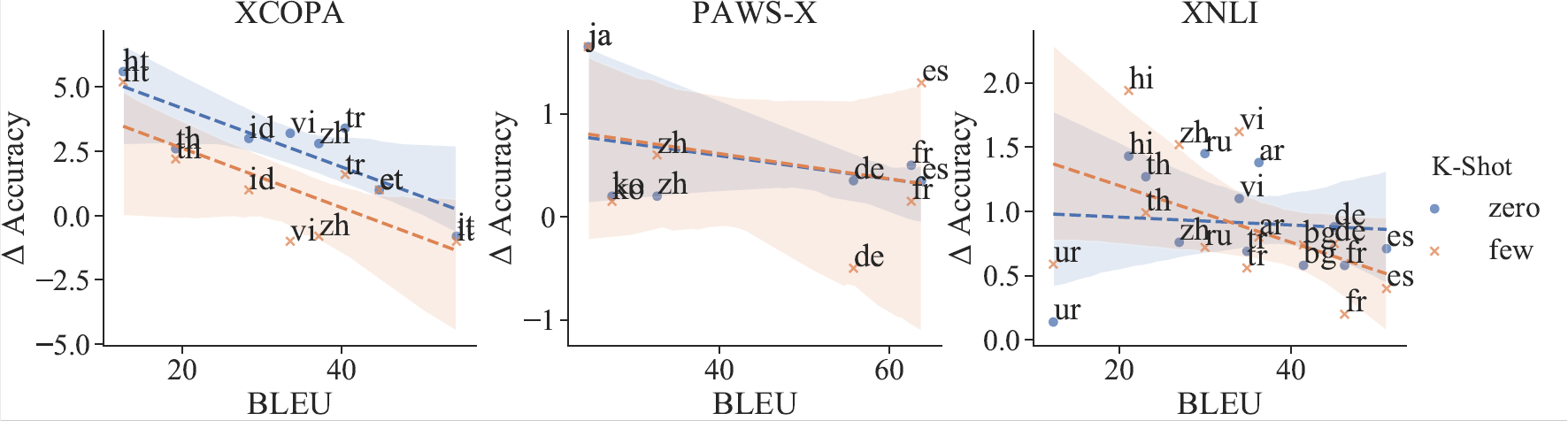
Our method yields larger gains for languages whose BLEU scores are lower. This plot shows the correlation between NMT BLEU score and gains compared to vanilla translate test.
@misc{ponti2021modelling,
      title={Modelling Latent Translations for Cross-Lingual Transfer},
      author={Edoardo Maria Ponti and Julia Kreutzer and Ivan Vulić and Siva Reddy},
      year={2021},
      eprint={2107.11353},
      archivePrefix={arXiv},
      primaryClass={cs.CL},
      url={https://arxiv.org/pdf/2107.11353.pdf},
}
Code for the paper "Modelling Latent Translations for Cross-Lingual Transfer"
Python
17
16 commits
updated Nov 22, 2021
Documentation | Cite | Paper
While often achieving SOTA results, “translation test” suffers from some limitations: 1) errors accumulate along the pipeline and cannot be corrected; 2) only the maximum-likelihood translation is generated, which is not necessarily the most relevant to the downstream task.
Instead, we integrate both translator and classifier into a single model, by treating the intermediate translations as a latent random variable. By initialising both components with pre-trained models, our method is suitable for few-shot learning.
By performing inference under this model, 1) we fine-tune the translator end-to-end or via Minimum Risk Training according to the downstream task loss; 2) we draw multiple translation samples to perform ensemble prediction in the downstream task.
For instance, the following example from Turkish XCOPA reveals how the maximum-likelihood translation leads to a wrong prediction. On the other hand, majority voting from multiple translation samples recover the correct prediction.
| NLL | Premise | Hypothesis 1 | Hypothesis 2 | Prediction |
|---|---|---|---|---|
| Adam partide çok içti. | Ertesi gün başı ağrıdı. | Ertesi gün burnu aktı. | ||
| 1.49 | He drank too much at the party. | She had a headache the next day. | The next day, he had a runny nose. | 1 |
| 2.07 | The guy drank too much at the party. | He had a headache the next day. | The next day, his nose leaked. | 0 |
| 2.26 | The guy drank a lot at the party. | He got a headache the next day. | The next day, his nose ran. | 0 |
pip install -r requirements.txtThe datasets for the experiments reported in the paper can be obtained with this command:
cd scripts
bash download_data.sh
The traslations into English of their test sets via Google MT can be found at the following links:
| Dataset | Task | Google Translate |
|---|---|---|
| XNLI | Natural Language Inference | link |
| XCOPA | Commonsense Reasoning | link |
| PAWS-X | Paraphrase Identification | link |
For cross-lingual transfer based on neural machine translation:
python train.py --task_name <xcopa|pawsx|xnli> --mode <trans-soft|trans-hard> --nmt_model_name <marian|google|mbart50> --do_train --do_eval --do_refine --num_samples 12 --per_gpu_train_batch_size 1 --gradient_accumulation_steps 24 --learning_rate 8e-6 --per_gpu_eval_batch_size 2
Note that the number of translation samples is specified by --num_samples. By setting --mode trans-soft the translator parameters are fine-tuned with Minimum Risk Training, whereas --mode trans-hard keeps them frozen.
For cross-lingual transfer based on multilingual encoders:
python train.py --task_name <xcopa|pawsx|xnli> --mode multi --cls_model_name <xlmr|mbart50> --do_train --do_eval --do_refine --per_gpu_train_batch_size 4 --gradient_accumulation_steps 6 --learning_rate 8e-6 --max_seq_length 384 --num_train_epochs 2 --save_steps 1000
Our method yields larger gains for languages whose BLEU scores are lower. This plot shows the correlation between NMT BLEU score and gains compared to vanilla translate test.
@misc{ponti2021modelling,
      title={Modelling Latent Translations for Cross-Lingual Transfer},
      author={Edoardo Maria Ponti and Julia Kreutzer and Ivan Vulić and Siva Reddy},
      year={2021},
      eprint={2107.11353},
      archivePrefix={arXiv},
      primaryClass={cs.CL},
      url={https://arxiv.org/pdf/2107.11353.pdf},
}



