
We release Evo-RL, the opensource real-world offline RL on So-101 and AgileX PiPER for easier reproduction.
Python
817
73 commits
updated Sep 15, 2026
README
Evo-RL








SJTU & Evo-Tech
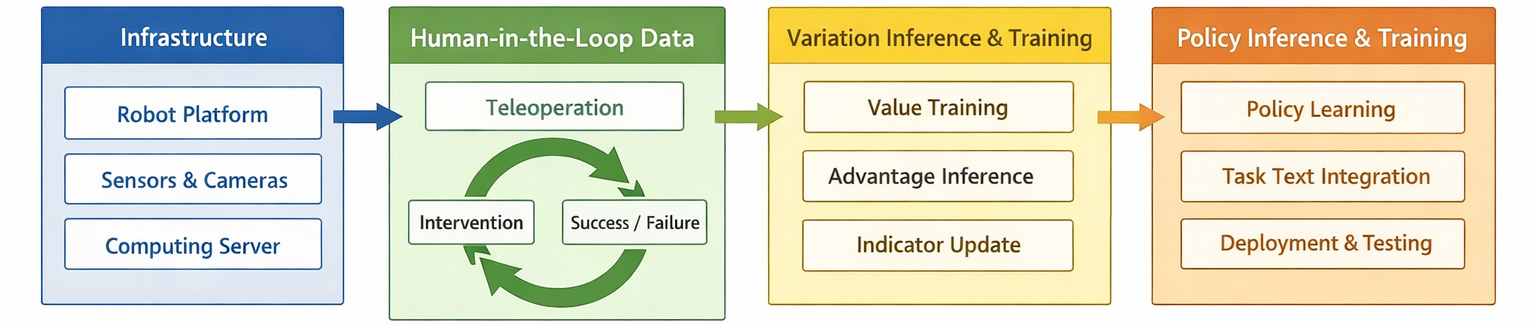
Architecture Overview
🎯 Evo-RL Focus
- Open real-world RL on two platforms: we build and release full real-world RL pipelines on SO101 and AgileX (PiPER/PiPER-X).
- Open code, models, and datasets for reproducibility: we continuously release runnable offline RL assets so more people can reproduce results and apply them to real-world tasks.
- Open algorithm and community co-evolution: we reproduce existing real-world RL methods, propose new methods, and keep publishing data/benchmarks to grow a collaborative open-source community.
🚀 News
- [2026-06-30] Added a detailed Hugging Face dataset card for the RW-RL Dataset, including visual examples, release statistics, file layout, modalities, and download instructions.
- [2026-03-07] Added AgileX (PiPER/PiPER-X) support for real-world RL.
- [2026-02-26] First SO101 real-world RL baseline and reproducible CLI workflow are released.
🧭 Table of Contents
Value Visual Results
Success Case

Failure Case

Policy Rollout Visual Results


Human-in-the-Loop Visual Results


⚡ Quick Start
LeRobot-aligned foundation: we use LeRobot as the base of this codebase because its inference and data-collection logic are highly aligned with real-world RL workflows.
1) Installation
git clone https://github.com/MINT-SJTU/Evo-RL.git
cd Evo-RL
conda create -y -n evo-rl python=3.10
conda activate evo-rl
pip install -e .
For setup details and platform-specific dependencies, follow the official LeRobot configuration guide.
2) Hardware Setup
SO Series (SO100/SO101)
For SO-series setup, please follow the official tutorial in detail and complete all installation and configuration steps there before continuing. The examples below use SO101 as the reference configuration.
Device path recommendation
Recommended path strategy:
- Robot serial: use
/dev/serial/by-id/(stable across reboots). - Cameras: prefer
/dev/v4l/by-id/; if IDs are not unique, use/dev/v4l/by-path/. - In examples below: robot ports use
by-id, camera paths useby-path.
You can inspect available stable paths with:
ls -l /dev/serial/by-id/
ls -l /dev/v4l/by-id/
ls -l /dev/v4l/by-path/
For single-arm users, no major changes are required. After setup, run the command below to verify your system is ready for the next stage:
lerobot-teleoperate \
  --robot.type=so101_follower \
  --robot.port=/dev/serial/by-id/<SO101_FOLLOWER_PORT> \
  --robot.id=my_so101_follower \
  --teleop.type=so101_leader \
  --teleop.port=/dev/serial/by-id/<SO101_LEADER_PORT> \
  --teleop.id=my_so101_leader
For dual-arm users, we recommend mirroring the mechanical parts corresponding to servos 4/5/6 on the left leader and left follower arms, which usually provides a more natural bimanual operation feel.
Before running the dual-arm command, make sure calibration files exist under ~/.cache/huggingface/lerobot/calibration/ like:
calibration/
├── robots
│   └── so_follower
│       ├── bi_so101_follower_left.json
│       └── bi_so101_follower_right.json
└── teleoperators
    └── so_leader
        ├── bi_so101_leader_left.json
        └── bi_so101_leader_right.json
This layout is slightly different from single-arm setup.
Then run this command to verify dual-arm setup:
lerobot-teleoperate \
  --robot.type=bi_so_follower \
  --robot.left_arm_config.port=/dev/serial/by-id/<LEFT_FOLLOWER_PORT> \
  --robot.right_arm_config.port=/dev/serial/by-id/<RIGHT_FOLLOWER_PORT> \
  --robot.id=bi_so101_follower \
  --teleop.type=bi_so_leader \
  --teleop.left_arm_config.port=/dev/serial/by-id/<LEFT_LEADER_PORT> \
  --teleop.right_arm_config.port=/dev/serial/by-id/<RIGHT_LEADER_PORT> \
  --teleop.id=bi_so101_leader
Camera configuration
Before data collection, validate camera mapping first.
Check whether each camera supports your target setting (for example, 640x480 @ 30):
v4l2-ctl -d /dev/v4l/by-path/<CAM_PATH> --list-formats-ext
Single-arm camera check (example):
lerobot-teleoperate \
  --robot.type=so101_follower \
  --robot.port=/dev/serial/by-id/<SO101_FOLLOWER_PORT> \
  --robot.id=my_so101_follower \
  --robot.cameras='{ front: {type: opencv, index_or_path: "/dev/v4l/by-path/<FRONT_CAM>", width: 640, height: 480, fps: 30}}' \
  --teleop.type=so101_leader \
  --teleop.port=/dev/serial/by-id/<SO101_LEADER_PORT> \
  --teleop.id=my_so101_leader \
  --display_data=true
Dual-arm camera check (example):
lerobot-teleoperate \
  --robot.type=bi_so_follower \
  --robot.left_arm_config.port=/dev/serial/by-id/<LEFT_FOLLOWER_PORT> \
  --robot.right_arm_config.port=/dev/serial/by-id/<RIGHT_FOLLOWER_PORT> \
  --robot.id=my_bi_so101_follower \
  --robot.left_arm_config.cameras='{ wrist: {type: opencv, index_or_path: "/dev/v4l/by-path/<LEFT_WRIST_CAM_PATH>", width: 640, height: 480, fps: 30}}' \
  --robot.right_arm_config.cameras='{ wrist: {type: opencv, index_or_path: "/dev/v4l/by-path/<RIGHT_WRIST_CAM_PATH>", width: 640, height: 480, fps: 30}, front: {type: opencv, index_or_path: "/dev/v4l/by-path/<FRONT_CAM_PATH>", width: 640, height: 480, fps: 30}}' \
  --teleop.type=bi_so_leader \
  --teleop.left_arm_config.port=/dev/serial/by-id/<LEFT_LEADER_PORT> \
  --teleop.right_arm_config.port=/dev/serial/by-id/<RIGHT_LEADER_PORT> \
  --teleop.id=my_bi_so101_leader \
  --display_data=true
For dual-arm camera mapping, it is fine to attach front under either the left-arm or right-arm camera config. If you use more camera views, place them under either the left or right arm camera config as well.
If needed, you can also use temporary device paths (for example /dev/ttyACM* and /dev/video*) during initial debugging.
AgileX (PiPER/PiPER-X)
PiPER commands use the USB-CAN adapter's stable ID_SERIAL_SHORT instead of a temporary Linux
canN name. List the connected adapters with:
for device in /sys/class/net/*; do
  [ "$(cat "$device/type" 2>/dev/null)" = "280" ] || continue
  serial=$(udevadm info --query=property --path="$device" | sed -n 's/^ID_SERIAL_SHORT=//p')
  echo "$(basename "$device"): $serial"
done
Then configure the adapters needed for the run:
lerobot-setup-can --mode=setup \
  --usb_can_serials=<USB_CAN_SERIAL_1>,<USB_CAN_SERIAL_2>,<USB_CAN_SERIAL_3>,<USB_CAN_SERIAL_4>
For single-arm users, run the command below to verify the system is ready:
lerobot-teleoperate \
  --robot.type=piperx_follower \
  --robot.port=<FOLLOWER_USB_CAN_SERIAL> \
  --robot.id=my_piperx_follower \
  --teleop.type=piperx_leader \
  --teleop.port=<LEADER_USB_CAN_SERIAL> \
  --teleop.id=my_piperx_leader
For bimanual users, run this command to verify dual-arm teleoperation:
lerobot-teleoperate \
  --robot.type=bi_piperx_follower \
  --robot.id=my_bi_piperx_follower \
  --robot.left_arm_config.port=<LEFT_FOLLOWER_USB_CAN_SERIAL> \
  --robot.right_arm_config.port=<RIGHT_FOLLOWER_USB_CAN_SERIAL> \
  --teleop.type=bi_piperx_leader \
  --teleop.id=my_bi_piperx_leader \
  --teleop.left_arm_config.port=<LEFT_LEADER_USB_CAN_SERIAL> \
  --teleop.right_arm_config.port=<RIGHT_LEADER_USB_CAN_SERIAL>
For PiPER (non-X), replace bi_piperx_follower/bi_piperx_leader with bi_piper_follower/bi_piper_leader.
3) Data Collection
Collect rollout data with lerobot-human-inloop-record.
SO Series (SO100/SO101)
Bimanual template:
lerobot-human-inloop-record \
  --robot.type=bi_so_follower \
  --robot.left_arm_config.port=/dev/serial/by-id/<LEFT_FOLLOWER_PORT> \
  --robot.right_arm_config.port=/dev/serial/by-id/<RIGHT_FOLLOWER_PORT> \
  --robot.id=my_bi_so101_follower \
  --robot.left_arm_config.cameras='{ wrist: {type: opencv, index_or_path: "/dev/v4l/by-path/<LEFT_WRIST_CAM_PATH>", width: 640, height: 480, fps: 30, fourcc: "MJPG"}}' \
  --robot.right_arm_config.cameras='{ wrist: {type: opencv, index_or_path: "/dev/v4l/by-path/<RIGHT_WRIST_CAM_PATH>", width: 640, height: 480, fps: 30, fourcc: "MJPG"}, front: {type: intelrealsense, serial_number_or_name: "<REALSENSE_SN>", width: 640, height: 480, fps: 30, warmup_s: 2}}' \
  --teleop.type=bi_so_leader \
  --teleop.left_arm_config.port=/dev/serial/by-id/<LEFT_LEADER_PORT> \
  --teleop.right_arm_config.port=/dev/serial/by-id/<RIGHT_LEADER_PORT> \
  --teleop.id=my_bi_so101_leader \
  --dataset.repo_id=<HF_USERNAME_OR_ORG>/<DATASET_NAME> \
  --dataset.single_task="<YOUR_TASK_DESCRIPTION>" \
  --dataset.num_episodes=<NUM_EPISODES> \
  --dataset.episode_time_s=<EPISODE_SECONDS> \
  --dataset.reset_time_s=<RESET_SECONDS> \
  --dataset.push_to_hub=true \
  --display_data=true
Recommendation: use fourcc: "MJPG" for OpenCV and warmup_s for RealSense. In this example front uses RealSense, but you can switch it to OpenCV with the same structure.
AgileX (PiPER/PiPER-X)
Bimanual template (left/right, PiPER-X example):
lerobot-human-inloop-record \
  --robot.type=bi_piperx_follower \
  --robot.id=my_bi_piperx_follower \
  --robot.left_arm_config.port=<LEFT_FOLLOWER_USB_CAN_SERIAL> \
  --robot.right_arm_config.port=<RIGHT_FOLLOWER_USB_CAN_SERIAL> \
  --teleop.type=bi_piperx_leader \
  --teleop.id=my_bi_piperx_leader \
  --teleop.left_arm_config.port=<LEFT_LEADER_USB_CAN_SERIAL> \
  --teleop.right_arm_config.port=<RIGHT_LEADER_USB_CAN_SERIAL> \
  --dataset.repo_id=<HF_USERNAME_OR_ORG>/<DATASET_NAME> \
  --dataset.single_task="<YOUR_TASK_DESCRIPTION>" \
  --dataset.num_episodes=<NUM_EPISODES> \
  --dataset.episode_time_s=<EPISODE_SECONDS> \
  --dataset.reset_time_s=<RESET_SECONDS> \
  --dataset.push_to_hub=true \
  --display_data=true
Hotkeys:
i: toggle intervention mode (policy <-> teleop takeover)s: mark success and end current episodef: mark failure and end current episodeRight Arrow: end the current loop earlyLeft Arrow: end early and re-record the current episodeEsc: stop the recording session
Quick quality check:
lerobot-dataset-report --dataset <HF_USERNAME_OR_ORG>/<DATASET_NAME>
This prints: dataset meta, totals, episode-length stats/histogram, success/intervention metrics, task list, and full feature schema.
4) Value Function Training
Train the value function on the current dataset. Current default: Pi*0.6 (--value.type=pistar06).
Single-GPU template:
lerobot-value-train \
  --dataset.repo_id=<HF_USERNAME_OR_ORG>/<DATASET_NAME> \
  --value.type=pistar06 \
  --value.dtype=bfloat16 \
  --value.push_to_hub=true \
  --value.repo_id=<HF_USERNAME_OR_ORG>/<VALUE_MODEL_REPO> \
  --batch_size=64 \
  --output_dir=outputs/value_train/<RUN_NAME> \
  --job_name=<RUN_NAME> \
  --wandb.enable=true
Multi-GPU template:
CUDA_VISIBLE_DEVICES=<GPU_ID_LIST> accelerate launch \
  --multi_gpu \
  --num_processes=<NUM_GPUS> \
  --mixed_precision=bf16 \
  $(which lerobot-value-train) \
  --batch_size=32/<NUM_GPUS> \
  <VALUE_TRAIN_ARGS>
To plug in a different value function, minimal path in this repo:
- Add
src/lerobot/values/<your_value>/configuration_<your_value>.pywith@PreTrainedConfig.register_subclass("<your_value>"). - Add
src/lerobot/values/<your_value>/modeling_<your_value>.pywith<YourValue>Policy(PreTrainedPolicy)(implement at leastforward,predict_value, andbuild_training_raw_batch_hookforlerobot-value-train). - Add
src/lerobot/values/<your_value>/processor_<your_value>.pywithmake_<your_value>_pre_post_processors(...). - Remove/replace the current
pistar06-only type checks insrc/lerobot/configs/value_train.pyandsrc/lerobot/scripts/lerobot_value_infer.py.
5) Value Inference
Infer value signals and write value/advantage/indicator back to the dataset:
value: estimated return-to-go of the current frame.advantage: relative improvement signal (higher means better-than-baseline trajectory quality).indicator: binarized training tag derived from advantage.
Single-GPU template:
lerobot-value-infer \
  --dataset.repo_id=<HF_USERNAME_OR_ORG>/<DATASET_NAME> \
  --inference.checkpoint_path=outputs/value_train/<RUN_NAME> \
  --runtime.device=cuda \
  --runtime.batch_size=64 \
  --acp.enable=true \
  --acp.n_step=50 \
  --acp.positive_ratio=0.3 \
  --acp.value_field=complementary_info.value_<TAG> \
  --acp.advantage_field=complementary_info.advantage_<TAG> \
  --acp.indicator_field=complementary_info.acp_indicator_<TAG> \
  --output_dir=outputs/value_infer/<RUN_NAME> \
  --job_name=<RUN_NAME>.infer
Multi-GPU template:
CUDA_VISIBLE_DEVICES=<GPU_ID_LIST> accelerate launch \
  --multi_gpu \
  --num_processes=<NUM_GPUS> \
  --mixed_precision=bf16 \
  $(which lerobot-value-infer) \
  <VALUE_INFER_ARGS>
Parameter notes:
--acp.n_step: n-step advantage horizon.
--acp.positive_ratio: positive label ratio after advantage binarization (e.g., 0.3 = top 30% per task).
Expected new columns:
complementary_info.value_<TAG>
complementary_info.advantage_<TAG>
complementary_info.acp_indicator_<TAG>
These columns are written back to the original dataset specified by --dataset.repo_id.
6) Policy Training
Train the policy with advantage-conditioned tags. Policy requirement: it must support text/task input, because Advantage-Conditioned tags are injected into task text.
Single-GPU template:
lerobot-train \
  --dataset.repo_id=<HF_USERNAME_OR_ORG>/<DATASET_NAME> \
  --policy.type=<POLICY_TYPE> \
  --policy.pretrained_path=<POLICY_PRETRAINED_PATH> \
  --policy.device=cuda \
  --policy.dtype=bfloat16 \
  --batch_size=32 \
  --steps=30000 \
  --acp.enable=true \
  --acp.indicator_field=complementary_info.acp_indicator_<TAG> \
  --acp.indicator_dropout_prob=0.3 \
  --output_dir=outputs/train/<RUN_NAME> \
  --job_name=<RUN_NAME> \
  --wandb.enable=true \
  --policy.push_to_hub=true \
  --policy.repo_id=<HF_USERNAME_OR_ORG>/<POLICY_REPO>
--acp.indicator_dropout_prob controls tag drop rate in task text; 0.3 helps learn both tagged and untagged conditions.
Important checks:
--acp.indicator_fieldmust exist in the dataset and be binary (0/1).
Multi-GPU template:
CUDA_VISIBLE_DEVICES=<GPU_ID_LIST> accelerate launch \
  --multi_gpu \
  --num_processes=<NUM_GPUS> \
  --mixed_precision=bf16 \
  $(which lerobot-train) \
  --batch_size=32/<NUM_GPUS> \
  <POLICY_TRAIN_ARGS>
7) Closed-loop Rollout and Next Round
Deploy the trained policy in human-in-loop mode and collect the next dataset round:
lerobot-human-inloop-record \
  --robot.type=bi_so_follower \
  --robot.left_arm_config.port=/dev/serial/by-id/<LEFT_FOLLOWER_PORT> \
  --robot.right_arm_config.port=/dev/serial/by-id/<RIGHT_FOLLOWER_PORT> \
  --robot.id=my_bi_so101_follower \
  --robot.left_arm_config.cameras='{ wrist: {type: opencv, index_or_path: "/dev/v4l/by-path/<LEFT_WRIST_CAM_PATH>", width: 640, height: 480, fps: 30, fourcc: "MJPG"}}' \
  --robot.right_arm_config.cameras='{ wrist: {type: opencv, index_or_path: "/dev/v4l/by-path/<RIGHT_WRIST_CAM_PATH>", width: 640, height: 480, fps: 30, fourcc: "MJPG"}, front: {type: intelrealsense, serial_number_or_name: "<REALSENSE_SN>", width: 640, height: 480, fps: 30, warmup_s: 2}}' \
  --teleop.type=bi_so_leader \
  --teleop.left_arm_config.port=/dev/serial/by-id/<LEFT_LEADER_PORT> \
  --teleop.right_arm_config.port=/dev/serial/by-id/<RIGHT_LEADER_PORT> \
  --teleop.id=my_bi_so101_leader \
  --dataset.repo_id=<HF_USERNAME_OR_ORG>/<DATASET_NAME_NEXT_ROUND> \
  --dataset.single_task="<YOUR_TASK_DESCRIPTION>" \
  --dataset.num_episodes=<NUM_EPISODES> \
  --dataset.episode_time_s=<EPISODE_SECONDS> \
  --dataset.reset_time_s=<RESET_SECONDS> \
  --dataset.push_to_hub=true \
  --display_data=true \
  --policy.path=<POLICY_CHECKPOINT_OR_HUB_ID> \
  --resume=true
Dataset continuation options:
- Append in place: keep
--resume=trueand continue recording into the same dataset. - Merge multiple rounds: use the official dataset editor to merge separate datasets.
lerobot-edit-dataset \
  --repo_id=<HF_USERNAME_OR_ORG>/<MERGED_DATASET_NAME> \
  --operation.type=merge \
  --operation.repo_ids="['<HF_USERNAME_OR_ORG>/<DATASET_ROUND_1>','<HF_USERNAME_OR_ORG>/<DATASET_ROUND_2>']"
Additional data attributes vs default lerobot-record behavior:
complementary_info.policy_action: policy output action at each step.complementary_info.is_intervention: whether current step is in intervention.complementary_info.state: intervention state-machine state.complementary_info.collector_policy_id: step-level action source ID (humanor policy ID).- Episode metadata
episode_success: success/failure label saved per episode.
Iterative training loop (abstract):
[Multi-task demonstration data pool]
        |
        v
[Offline RL pretraining for a vision-language-action policy]
        |
        v
[Task-specific initialization / fine-tuning from demonstrations]
        |
        v
|---- Iteration k = 1..K -------------------------------------|
| 1) Deploy current policy π_k and collect new rollout data   |
| 2) Merge into data pool: D <- D U new_data                  |
| 3) Train value function on D                                |
| 4) Infer advantage and binarize into indicator tags         |
| 5) Train advantage-conditioned policy to get π_{k+1}        |
|-------------------------------------------------------------|
        |
        v
[Stronger policy with improved success rate and throughput]
Model & Dataset
- Hugging Face model release: coming soon
- Hugging Face dataset: MINT-SJTU/RW-RL-Dataset
RW-RL Dataset is the companion real-world reinforcement learning dataset for Evo-RL. It is organized around iterative policy improvement on real robots, including teleoperation demonstrations, human-in-the-loop intervention data, policy rollout traces, episode-level success/failure labels, intervention states, and complementary signals used for value/reward modeling.
The dataset is designed to support offline RL, value learning, advantage-conditioned policy training, and closed-loop rollout analysis across real robot tasks. Please refer to the Hugging Face dataset card for release notes, schema details, splits, and version tags.
Community Channels
- WeChat official post: Coming Soon
- Documentation:
docs/README.md - GitHub Issues: Create an issue
- Email: business@evomind-tech.com
- Get into WeChat group by scanning QR code:
- Get into WeChat Group or get So101 Supplier, please contact the following WeChat, 加群(注明加真机强化学习群)/So101 设备提供商:

Affiliations


Citation
@misc{evorl2026,
  title        = {Evo-RL: Towards Iterative Policy Improvement in Real-World Offline RL},
  author       = {Evo-RL Contributors},
  year         = {2026},
  howpublished = {\url{https://github.com/MINT-SJTU/Evo-RL}}
}
License
Apache-2.0. See LICENSE.
Star History


Similar repos


Languages
Python
98.8%
We release Evo-RL, the opensource real-world offline RL on So-101 and AgileX PiPER for easier reproduction.
Python
817
73 commits
updated Sep 15, 2026
README
Evo-RL
SJTU & Evo-Tech
Architecture Overview
🎯 Evo-RL Focus
- Open real-world RL on two platforms: we build and release full real-world RL pipelines on SO101 and AgileX (PiPER/PiPER-X).
- Open code, models, and datasets for reproducibility: we continuously release runnable offline RL assets so more people can reproduce results and apply them to real-world tasks.
- Open algorithm and community co-evolution: we reproduce existing real-world RL methods, propose new methods, and keep publishing data/benchmarks to grow a collaborative open-source community.
🚀 News
- [2026-06-30] Added a detailed Hugging Face dataset card for the RW-RL Dataset, including visual examples, release statistics, file layout, modalities, and download instructions.
- [2026-03-07] Added AgileX (PiPER/PiPER-X) support for real-world RL.
- [2026-02-26] First SO101 real-world RL baseline and reproducible CLI workflow are released.
🧭 Table of Contents
Value Visual Results
Success Case
Failure Case
Policy Rollout Visual Results
Human-in-the-Loop Visual Results
⚡ Quick Start
LeRobot-aligned foundation: we use LeRobot as the base of this codebase because its inference and data-collection logic are highly aligned with real-world RL workflows.
1) Installation
git clone https://github.com/MINT-SJTU/Evo-RL.git
cd Evo-RL
conda create -y -n evo-rl python=3.10
conda activate evo-rl
pip install -e .
For setup details and platform-specific dependencies, follow the official LeRobot configuration guide.
2) Hardware Setup
SO Series (SO100/SO101)
For SO-series setup, please follow the official tutorial in detail and complete all installation and configuration steps there before continuing. The examples below use SO101 as the reference configuration.
Device path recommendation
Recommended path strategy:
- Robot serial: use
/dev/serial/by-id/(stable across reboots). - Cameras: prefer
/dev/v4l/by-id/; if IDs are not unique, use/dev/v4l/by-path/. - In examples below: robot ports use
by-id, camera paths useby-path.
You can inspect available stable paths with:
ls -l /dev/serial/by-id/
ls -l /dev/v4l/by-id/
ls -l /dev/v4l/by-path/
For single-arm users, no major changes are required. After setup, run the command below to verify your system is ready for the next stage:
lerobot-teleoperate \
  --robot.type=so101_follower \
  --robot.port=/dev/serial/by-id/<SO101_FOLLOWER_PORT> \
  --robot.id=my_so101_follower \
  --teleop.type=so101_leader \
  --teleop.port=/dev/serial/by-id/<SO101_LEADER_PORT> \
  --teleop.id=my_so101_leader
For dual-arm users, we recommend mirroring the mechanical parts corresponding to servos 4/5/6 on the left leader and left follower arms, which usually provides a more natural bimanual operation feel.
Before running the dual-arm command, make sure calibration files exist under ~/.cache/huggingface/lerobot/calibration/ like:
calibration/
├── robots
│   └── so_follower
│       ├── bi_so101_follower_left.json
│       └── bi_so101_follower_right.json
└── teleoperators
    └── so_leader
        ├── bi_so101_leader_left.json
        └── bi_so101_leader_right.json
This layout is slightly different from single-arm setup.
Then run this command to verify dual-arm setup:
lerobot-teleoperate \
  --robot.type=bi_so_follower \
  --robot.left_arm_config.port=/dev/serial/by-id/<LEFT_FOLLOWER_PORT> \
  --robot.right_arm_config.port=/dev/serial/by-id/<RIGHT_FOLLOWER_PORT> \
  --robot.id=bi_so101_follower \
  --teleop.type=bi_so_leader \
  --teleop.left_arm_config.port=/dev/serial/by-id/<LEFT_LEADER_PORT> \
  --teleop.right_arm_config.port=/dev/serial/by-id/<RIGHT_LEADER_PORT> \
  --teleop.id=bi_so101_leader
Camera configuration
Before data collection, validate camera mapping first.
Check whether each camera supports your target setting (for example, 640x480 @ 30):
v4l2-ctl -d /dev/v4l/by-path/<CAM_PATH> --list-formats-ext
Single-arm camera check (example):
lerobot-teleoperate \
  --robot.type=so101_follower \
  --robot.port=/dev/serial/by-id/<SO101_FOLLOWER_PORT> \
  --robot.id=my_so101_follower \
  --robot.cameras='{ front: {type: opencv, index_or_path: "/dev/v4l/by-path/<FRONT_CAM>", width: 640, height: 480, fps: 30}}' \
  --teleop.type=so101_leader \
  --teleop.port=/dev/serial/by-id/<SO101_LEADER_PORT> \
  --teleop.id=my_so101_leader \
  --display_data=true
Dual-arm camera check (example):
lerobot-teleoperate \
  --robot.type=bi_so_follower \
  --robot.left_arm_config.port=/dev/serial/by-id/<LEFT_FOLLOWER_PORT> \
  --robot.right_arm_config.port=/dev/serial/by-id/<RIGHT_FOLLOWER_PORT> \
  --robot.id=my_bi_so101_follower \
  --robot.left_arm_config.cameras='{ wrist: {type: opencv, index_or_path: "/dev/v4l/by-path/<LEFT_WRIST_CAM_PATH>", width: 640, height: 480, fps: 30}}' \
  --robot.right_arm_config.cameras='{ wrist: {type: opencv, index_or_path: "/dev/v4l/by-path/<RIGHT_WRIST_CAM_PATH>", width: 640, height: 480, fps: 30}, front: {type: opencv, index_or_path: "/dev/v4l/by-path/<FRONT_CAM_PATH>", width: 640, height: 480, fps: 30}}' \
  --teleop.type=bi_so_leader \
  --teleop.left_arm_config.port=/dev/serial/by-id/<LEFT_LEADER_PORT> \
  --teleop.right_arm_config.port=/dev/serial/by-id/<RIGHT_LEADER_PORT> \
  --teleop.id=my_bi_so101_leader \
  --display_data=true
For dual-arm camera mapping, it is fine to attach front under either the left-arm or right-arm camera config. If you use more camera views, place them under either the left or right arm camera config as well.
If needed, you can also use temporary device paths (for example /dev/ttyACM* and /dev/video*) during initial debugging.
AgileX (PiPER/PiPER-X)
PiPER commands use the USB-CAN adapter's stable ID_SERIAL_SHORT instead of a temporary Linux
canN name. List the connected adapters with:
for device in /sys/class/net/*; do
  [ "$(cat "$device/type" 2>/dev/null)" = "280" ] || continue
  serial=$(udevadm info --query=property --path="$device" | sed -n 's/^ID_SERIAL_SHORT=//p')
  echo "$(basename "$device"): $serial"
done
Then configure the adapters needed for the run:
lerobot-setup-can --mode=setup \
  --usb_can_serials=<USB_CAN_SERIAL_1>,<USB_CAN_SERIAL_2>,<USB_CAN_SERIAL_3>,<USB_CAN_SERIAL_4>
For single-arm users, run the command below to verify the system is ready:
lerobot-teleoperate \
  --robot.type=piperx_follower \
  --robot.port=<FOLLOWER_USB_CAN_SERIAL> \
  --robot.id=my_piperx_follower \
  --teleop.type=piperx_leader \
  --teleop.port=<LEADER_USB_CAN_SERIAL> \
  --teleop.id=my_piperx_leader
For bimanual users, run this command to verify dual-arm teleoperation:
lerobot-teleoperate \
  --robot.type=bi_piperx_follower \
  --robot.id=my_bi_piperx_follower \
  --robot.left_arm_config.port=<LEFT_FOLLOWER_USB_CAN_SERIAL> \
  --robot.right_arm_config.port=<RIGHT_FOLLOWER_USB_CAN_SERIAL> \
  --teleop.type=bi_piperx_leader \
  --teleop.id=my_bi_piperx_leader \
  --teleop.left_arm_config.port=<LEFT_LEADER_USB_CAN_SERIAL> \
  --teleop.right_arm_config.port=<RIGHT_LEADER_USB_CAN_SERIAL>
For PiPER (non-X), replace bi_piperx_follower/bi_piperx_leader with bi_piper_follower/bi_piper_leader.
3) Data Collection
Collect rollout data with lerobot-human-inloop-record.
SO Series (SO100/SO101)
Bimanual template:
lerobot-human-inloop-record \
  --robot.type=bi_so_follower \
  --robot.left_arm_config.port=/dev/serial/by-id/<LEFT_FOLLOWER_PORT> \
  --robot.right_arm_config.port=/dev/serial/by-id/<RIGHT_FOLLOWER_PORT> \
  --robot.id=my_bi_so101_follower \
  --robot.left_arm_config.cameras='{ wrist: {type: opencv, index_or_path: "/dev/v4l/by-path/<LEFT_WRIST_CAM_PATH>", width: 640, height: 480, fps: 30, fourcc: "MJPG"}}' \
  --robot.right_arm_config.cameras='{ wrist: {type: opencv, index_or_path: "/dev/v4l/by-path/<RIGHT_WRIST_CAM_PATH>", width: 640, height: 480, fps: 30, fourcc: "MJPG"}, front: {type: intelrealsense, serial_number_or_name: "<REALSENSE_SN>", width: 640, height: 480, fps: 30, warmup_s: 2}}' \
  --teleop.type=bi_so_leader \
  --teleop.left_arm_config.port=/dev/serial/by-id/<LEFT_LEADER_PORT> \
  --teleop.right_arm_config.port=/dev/serial/by-id/<RIGHT_LEADER_PORT> \
  --teleop.id=my_bi_so101_leader \
  --dataset.repo_id=<HF_USERNAME_OR_ORG>/<DATASET_NAME> \
  --dataset.single_task="<YOUR_TASK_DESCRIPTION>" \
  --dataset.num_episodes=<NUM_EPISODES> \
  --dataset.episode_time_s=<EPISODE_SECONDS> \
  --dataset.reset_time_s=<RESET_SECONDS> \
  --dataset.push_to_hub=true \
  --display_data=true
Recommendation: use fourcc: "MJPG" for OpenCV and warmup_s for RealSense. In this example front uses RealSense, but you can switch it to OpenCV with the same structure.
AgileX (PiPER/PiPER-X)
Bimanual template (left/right, PiPER-X example):
lerobot-human-inloop-record \
  --robot.type=bi_piperx_follower \
  --robot.id=my_bi_piperx_follower \
  --robot.left_arm_config.port=<LEFT_FOLLOWER_USB_CAN_SERIAL> \
  --robot.right_arm_config.port=<RIGHT_FOLLOWER_USB_CAN_SERIAL> \
  --teleop.type=bi_piperx_leader \
  --teleop.id=my_bi_piperx_leader \
  --teleop.left_arm_config.port=<LEFT_LEADER_USB_CAN_SERIAL> \
  --teleop.right_arm_config.port=<RIGHT_LEADER_USB_CAN_SERIAL> \
  --dataset.repo_id=<HF_USERNAME_OR_ORG>/<DATASET_NAME> \
  --dataset.single_task="<YOUR_TASK_DESCRIPTION>" \
  --dataset.num_episodes=<NUM_EPISODES> \
  --dataset.episode_time_s=<EPISODE_SECONDS> \
  --dataset.reset_time_s=<RESET_SECONDS> \
  --dataset.push_to_hub=true \
  --display_data=true
Hotkeys:
i: toggle intervention mode (policy <-> teleop takeover)s: mark success and end current episodef: mark failure and end current episodeRight Arrow: end the current loop earlyLeft Arrow: end early and re-record the current episodeEsc: stop the recording session
Quick quality check:
lerobot-dataset-report --dataset <HF_USERNAME_OR_ORG>/<DATASET_NAME>
This prints: dataset meta, totals, episode-length stats/histogram, success/intervention metrics, task list, and full feature schema.
4) Value Function Training
Train the value function on the current dataset. Current default: Pi*0.6 (--value.type=pistar06).
Single-GPU template:
lerobot-value-train \
  --dataset.repo_id=<HF_USERNAME_OR_ORG>/<DATASET_NAME> \
  --value.type=pistar06 \
  --value.dtype=bfloat16 \
  --value.push_to_hub=true \
  --value.repo_id=<HF_USERNAME_OR_ORG>/<VALUE_MODEL_REPO> \
  --batch_size=64 \
  --output_dir=outputs/value_train/<RUN_NAME> \
  --job_name=<RUN_NAME> \
  --wandb.enable=true
Multi-GPU template:
CUDA_VISIBLE_DEVICES=<GPU_ID_LIST> accelerate launch \
  --multi_gpu \
  --num_processes=<NUM_GPUS> \
  --mixed_precision=bf16 \
  $(which lerobot-value-train) \
  --batch_size=32/<NUM_GPUS> \
  <VALUE_TRAIN_ARGS>
To plug in a different value function, minimal path in this repo:
- Add
src/lerobot/values/<your_value>/configuration_<your_value>.pywith@PreTrainedConfig.register_subclass("<your_value>"). - Add
src/lerobot/values/<your_value>/modeling_<your_value>.pywith<YourValue>Policy(PreTrainedPolicy)(implement at leastforward,predict_value, andbuild_training_raw_batch_hookforlerobot-value-train). - Add
src/lerobot/values/<your_value>/processor_<your_value>.pywithmake_<your_value>_pre_post_processors(...). - Remove/replace the current
pistar06-only type checks insrc/lerobot/configs/value_train.pyandsrc/lerobot/scripts/lerobot_value_infer.py.
5) Value Inference
Infer value signals and write value/advantage/indicator back to the dataset:
value: estimated return-to-go of the current frame.advantage: relative improvement signal (higher means better-than-baseline trajectory quality).indicator: binarized training tag derived from advantage.
Single-GPU template:
lerobot-value-infer \
  --dataset.repo_id=<HF_USERNAME_OR_ORG>/<DATASET_NAME> \
  --inference.checkpoint_path=outputs/value_train/<RUN_NAME> \
  --runtime.device=cuda \
  --runtime.batch_size=64 \
  --acp.enable=true \
  --acp.n_step=50 \
  --acp.positive_ratio=0.3 \
  --acp.value_field=complementary_info.value_<TAG> \
  --acp.advantage_field=complementary_info.advantage_<TAG> \
  --acp.indicator_field=complementary_info.acp_indicator_<TAG> \
  --output_dir=outputs/value_infer/<RUN_NAME> \
  --job_name=<RUN_NAME>.infer
Multi-GPU template:
CUDA_VISIBLE_DEVICES=<GPU_ID_LIST> accelerate launch \
  --multi_gpu \
  --num_processes=<NUM_GPUS> \
  --mixed_precision=bf16 \
  $(which lerobot-value-infer) \
  <VALUE_INFER_ARGS>
Parameter notes:
--acp.n_step: n-step advantage horizon.
--acp.positive_ratio: positive label ratio after advantage binarization (e.g., 0.3 = top 30% per task).
Expected new columns:
complementary_info.value_<TAG>
complementary_info.advantage_<TAG>
complementary_info.acp_indicator_<TAG>
These columns are written back to the original dataset specified by --dataset.repo_id.
6) Policy Training
Train the policy with advantage-conditioned tags. Policy requirement: it must support text/task input, because Advantage-Conditioned tags are injected into task text.
Single-GPU template:
lerobot-train \
  --dataset.repo_id=<HF_USERNAME_OR_ORG>/<DATASET_NAME> \
  --policy.type=<POLICY_TYPE> \
  --policy.pretrained_path=<POLICY_PRETRAINED_PATH> \
  --policy.device=cuda \
  --policy.dtype=bfloat16 \
  --batch_size=32 \
  --steps=30000 \
  --acp.enable=true \
  --acp.indicator_field=complementary_info.acp_indicator_<TAG> \
  --acp.indicator_dropout_prob=0.3 \
  --output_dir=outputs/train/<RUN_NAME> \
  --job_name=<RUN_NAME> \
  --wandb.enable=true \
  --policy.push_to_hub=true \
  --policy.repo_id=<HF_USERNAME_OR_ORG>/<POLICY_REPO>
--acp.indicator_dropout_prob controls tag drop rate in task text; 0.3 helps learn both tagged and untagged conditions.
Important checks:
--acp.indicator_fieldmust exist in the dataset and be binary (0/1).
Multi-GPU template:
CUDA_VISIBLE_DEVICES=<GPU_ID_LIST> accelerate launch \
  --multi_gpu \
  --num_processes=<NUM_GPUS> \
  --mixed_precision=bf16 \
  $(which lerobot-train) \
  --batch_size=32/<NUM_GPUS> \
  <POLICY_TRAIN_ARGS>
7) Closed-loop Rollout and Next Round
Deploy the trained policy in human-in-loop mode and collect the next dataset round:
lerobot-human-inloop-record \
  --robot.type=bi_so_follower \
  --robot.left_arm_config.port=/dev/serial/by-id/<LEFT_FOLLOWER_PORT> \
  --robot.right_arm_config.port=/dev/serial/by-id/<RIGHT_FOLLOWER_PORT> \
  --robot.id=my_bi_so101_follower \
  --robot.left_arm_config.cameras='{ wrist: {type: opencv, index_or_path: "/dev/v4l/by-path/<LEFT_WRIST_CAM_PATH>", width: 640, height: 480, fps: 30, fourcc: "MJPG"}}' \
  --robot.right_arm_config.cameras='{ wrist: {type: opencv, index_or_path: "/dev/v4l/by-path/<RIGHT_WRIST_CAM_PATH>", width: 640, height: 480, fps: 30, fourcc: "MJPG"}, front: {type: intelrealsense, serial_number_or_name: "<REALSENSE_SN>", width: 640, height: 480, fps: 30, warmup_s: 2}}' \
  --teleop.type=bi_so_leader \
  --teleop.left_arm_config.port=/dev/serial/by-id/<LEFT_LEADER_PORT> \
  --teleop.right_arm_config.port=/dev/serial/by-id/<RIGHT_LEADER_PORT> \
  --teleop.id=my_bi_so101_leader \
  --dataset.repo_id=<HF_USERNAME_OR_ORG>/<DATASET_NAME_NEXT_ROUND> \
  --dataset.single_task="<YOUR_TASK_DESCRIPTION>" \
  --dataset.num_episodes=<NUM_EPISODES> \
  --dataset.episode_time_s=<EPISODE_SECONDS> \
  --dataset.reset_time_s=<RESET_SECONDS> \
  --dataset.push_to_hub=true \
  --display_data=true \
  --policy.path=<POLICY_CHECKPOINT_OR_HUB_ID> \
  --resume=true
Dataset continuation options:
- Append in place: keep
--resume=trueand continue recording into the same dataset. - Merge multiple rounds: use the official dataset editor to merge separate datasets.
lerobot-edit-dataset \
  --repo_id=<HF_USERNAME_OR_ORG>/<MERGED_DATASET_NAME> \
  --operation.type=merge \
  --operation.repo_ids="['<HF_USERNAME_OR_ORG>/<DATASET_ROUND_1>','<HF_USERNAME_OR_ORG>/<DATASET_ROUND_2>']"
Additional data attributes vs default lerobot-record behavior:
complementary_info.policy_action: policy output action at each step.complementary_info.is_intervention: whether current step is in intervention.complementary_info.state: intervention state-machine state.complementary_info.collector_policy_id: step-level action source ID (humanor policy ID).- Episode metadata
episode_success: success/failure label saved per episode.
Iterative training loop (abstract):
[Multi-task demonstration data pool]
        |
        v
[Offline RL pretraining for a vision-language-action policy]
        |
        v
[Task-specific initialization / fine-tuning from demonstrations]
        |
        v
|---- Iteration k = 1..K -------------------------------------|
| 1) Deploy current policy π_k and collect new rollout data   |
| 2) Merge into data pool: D <- D U new_data                  |
| 3) Train value function on D                                |
| 4) Infer advantage and binarize into indicator tags         |
| 5) Train advantage-conditioned policy to get π_{k+1}        |
|-------------------------------------------------------------|
        |
        v
[Stronger policy with improved success rate and throughput]
Model & Dataset
- Hugging Face model release: coming soon
- Hugging Face dataset: MINT-SJTU/RW-RL-Dataset
RW-RL Dataset is the companion real-world reinforcement learning dataset for Evo-RL. It is organized around iterative policy improvement on real robots, including teleoperation demonstrations, human-in-the-loop intervention data, policy rollout traces, episode-level success/failure labels, intervention states, and complementary signals used for value/reward modeling.
The dataset is designed to support offline RL, value learning, advantage-conditioned policy training, and closed-loop rollout analysis across real robot tasks. Please refer to the Hugging Face dataset card for release notes, schema details, splits, and version tags.
Community Channels
- WeChat official post: Coming Soon
- Documentation:
docs/README.md - GitHub Issues: Create an issue
- Email: business@evomind-tech.com
- Get into WeChat group by scanning QR code:
- Get into WeChat Group or get So101 Supplier, please contact the following WeChat, 加群(注明加真机强化学习群)/So101 设备提供商:
Affiliations
Citation
@misc{evorl2026,
  title        = {Evo-RL: Towards Iterative Policy Improvement in Real-World Offline RL},
  author       = {Evo-RL Contributors},
  year         = {2026},
  howpublished = {\url{https://github.com/MINT-SJTU/Evo-RL}}
}
License
Apache-2.0. See LICENSE.
Star History
Similar repos
Languages
Python
98.8%